


| CARVIEW |

Educational Classes
The candidacy classes are intended to provide a framework for the party’s year-long candidacy program. They are basic classes addressing many of the foundations of Marxism and of Workers World Party.
Additional classes and materials will be uploaded as they become available.
2025 Candidate Classes
Class: Communist Manifesto

- Who is the bourgeoisie and who is the proletariat?
- Why is their relationship exploitative and antagonistic?
- How did the bourgeoisie evolve? Five stages of society.
- All of history is the history of class struggle.
- Revolutionary internationalism, the working class has no country.
- The bourgeoisie produces its own gravediggers.
Downloads:
- Lesson Plan: Communist Manifesto
- Slideshow (PDF format): Communist Manifesto
SHOW MORE
Class: The Black Liberation Struggle

- Why was the Reconstruction period considered to be revolutionary for Black people? What were important features of this period?
- What conditions led to the overthrow of Reconstruction?
- What is an oppressed nation & an oppressor nation
- Defending the right to self-determination is part and parcel with building working class solidarity.
- What are some historic and current examples of this relationship?
- Socialism is key to the liberation of all workers, including the most oppressed
Downloads:
- Lesson Plan: Black Liberation Struggle
- Slideshow (PDF format): Black Liberation Struggle
SHOW MORE
Class: What is a cadre?
(Available on request for candidates.)
SHOW MORE
Class: Women, Gender Oppression and Marxism

- How has class society given rise to women’s oppression?
- How does racism, capitalism, settler-colonialism, and imperialism intersect with struggles of women and transgender people today?
- Why is socialism the answer?
Downloads:
- Lesson Plan: Women, Gender Oppression and Marxism
- Slideshow (PDF format): Women, Gender Oppression and Marxism
SHOW MORE
Class: Dialectical and Historical Materialism

The class will discuss:
- Engels’ fundamental principle of dialectics
- Three “laws of change”
- Differences between dialectical and metaphysical thinking
- What does Dialectics has to do with us as revolutionaries?
- Historical materialism
Dowloads:
- Lesson Plan: Dialectical and Historical Materialism
- Slideshow: The Science of Change
SHOW MORE
Class: Lenin’s State and Revolution

- What do Marxist-Leninists mean by the “State”?
- Where does the State come from?
- What class does the State serve?
- What is the “dictatorship of the proletariat”?
Downloads:
- Lesson Plan: State and Revolution
- Slideshow (PDF format): State and Revolution
SHOW MORE
Class: Marxist Economics

Marxist Economics
- Labor theory of value
- Money and labor power
- Surplus value and exploitation
- Profit
- Declining rate of profit and more!
Downloads:
- Lesson Plan: Marxist Economics
- Slideshow (PDF format): Marxist Economics
SHOW MORE
What is a Cadre?
Class: Workers World Party History
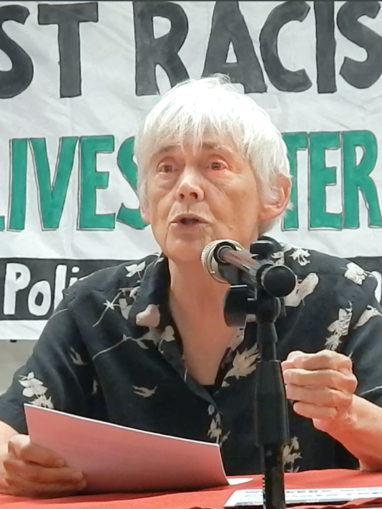
Deirdre Griswold
In this taped interview with Deirdre G, a founding member of Workers World Party and an editor of Workers World newspaper, describes the reasons and the principled process by which founding members split from the Socialist Workers Party in 1958 and founded Workers World Party in 1959. She describes with engaging anecdotes the political and cultural climate that early comrades developed in the Party, which continue to guide the Party today.
This class includes a lesson plan to encourage candidate discussion and questions about the history, politics and culture of the Party.
- Lesson Plan: History of Workers World Party
- Excerpt from Sam Marcy’s 1972 document, From Ideological Tendency to Political Party of the Working Class
SHOW MORE
Class: WW Newspaper & Communist Organizing
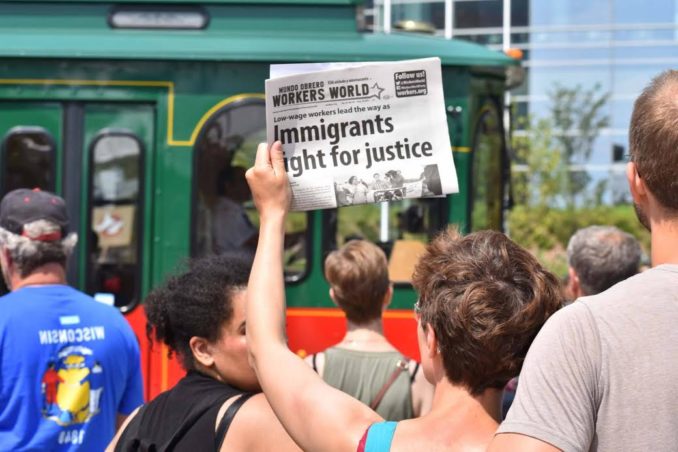 A power point slideshow, “Writing for Workers World/ Mundo Obrero Newspaper,” introduces a Marxist-Leninist perspective on how a newspaper can be a communist organizing tool and presents an orientation for both seasoned comrades and new candidates on writing and photographing for Workers World/ Mundo Obrero. This class contains a lesson plan of a workshop on contributing to WW/MO and on using the newspaper in both local organizing and national theoretical work in a democratically centralized process.
- Lesson Plan: Workers World Newspaper & Community Organizing
- PDF of Powerpoint: Writing for Workers World Newspaper
SHOW MORE
National Oppressions
Class: Tribal Sovereignty and the Right to Self‑Determination
“The history of the United States is a history of settler colonialism—the specific form of colonialism whereby an imperial power seizes Native territory, eliminates the original people by force, and resettles the land with a foreign, invading population.”
— Nick Estes, Our History is the Future
- Lesson Plan: Tribal Sovereignty and the Right to Self-Determination
- Powerpoint/PDF: Tribal Sovereignty and the Right to Self-Determination: Fundamentals of the Native American Struggle
SHOW MORE
Class: The National Question, Self Determination and the Black Struggle
 The U.S. represents an oppressor nation as defined by Vladimir Lenin and by the related principles that all oppressed nations have the right to self-determination and that the self-determination of nations includes the right to separate from oppressor nations. The Black struggle for bourgeois democratic rights is part of the overall struggle against the racist ruling class, although its forms vary. The class contains a lesson plan, a talk by Monica Moorehead on “The National Question, Self Determination and the Black Struggle,” and selections by Moorehead, Lenin and WWP co-founder Sam Marcy, to be read aloud and discussed.
- Lesson Plan: The National Question, Self Determination and the Black Struggle
- Discussion: Remarks by Monica Moorehead on “National Oppression, Self Determination and the Black Struggle”
- Sam Marcy: “The right of self-determination and the class struggle”
- V.I. Lenin’s thesis on national and colonial questions
- V.I. Lenin: excerpt from Chapter 7 of Imperialism, the highest stage of Capitalism
- Map: Africa in 1914
- What is a Nation? by Monica Moorehead
SHOW MORE
Special Oppressions
Class: LGBTQ2+/Sex, Gender and Sexuality Liberation
 Workers World Party’s principled position on oppressions based on gender and sexuality is that this struggle for liberation is inextricably intertwined with the struggles of workers and the working class, and with the class struggle against capitalism and imperialism and for socialism. This class focuses on LGBTQ2+ people and linkages of that struggle to oppression based on the M/F sex binary. This class contains a lesson plan along with short reports and group readings from several sources, including Leslie Feinberg, Minnie Bruce Pratt and the Combahee River Collective.
- Lesson Plan: LGBTQ2+/Sex, Gender and Sexuality Liberation
- Handout: WWP Excerpts on Gender Oppression
- UC-Davis LGBTQIA Resource Center Glossary
- Statement, Combahee River Collective, 1977
- Article: LGBTQ2+ Liberation and Working-Class Struggle, by Minnie Bruce Pratt, Nov. 16, 2016
- Pamphlet: “Transgender Liberation: A Movement Whose Time Has Come.” By Leslie Feinberg
- From Leslie Feinberg’s Lavender & Red series, #71 and #92
“Many histories converged to fight back at Stonewall, 1969”
“Gay Cuba: 1965 UMAP brigades: What they were, what they were not”
SHOW MORE
Imperialism
Class: Imperialism
 In Imperialism: The Highest Stage of Capitalism, Lenin defines imperialism as “the monopoly stage of capitalism” and describes the resulting five basic stages in the development of Imperialism. This class contains a lesson plan, a power point slideshow presenting the main points of Lenin’s argument, and a reading from WWP co-founder Vince Copeland on Expanding Empire.
- Lesson Plan: Imperialism
- Powerpoint (PDF format): Lenin’s Imperialism, the Highest Stage of Capitalism
- Imperialism, the Highest Stage of Capitalism by Vladimir Lenin
- Expanding Empire: The global war drive of big business and the forces that will stop it, by Vince Copeland
SHOW MORE
Class: Neocolonialism in Africa
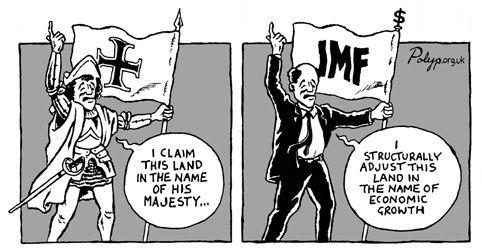 African revolutionary Kwame Nkrumah wrote that “the neo-colonialism of today represents imperialism in its final and perhaps its most dangerous stage.” Using points by revolutionaries, including Nkrumah and Walter Rodney, the power point slideshow for this class presents concepts of development vs. underdevelopment, the difference between colonialism and neo-colonialism and the effects of colonialism on African-American people within the U.S. In addition to the slideshow, this class contains a lesson plan to encourage discussion that links this issue to ongoing developments within the U.S. and internationally.
- Lesson Plan: Neocolonialism in Africa
- Powerpoint (PDF format): Neocolonialism in Africa
- Walter Rodney, How Europe Under Developed Africa (1972)
- Kwame Nkrumah, Class Struggle in Africa (1970)
- Kwame Nkrumah, Neo-Colonialism, the Last Stage of Imperialism (1965)
- Monica Moorehead, “Reparations and Black Liberation” and “Africa’s debt crisis calls for reparations” from Marxism, Reparations and the Black Freedom Struggle (2007)
SHOW MORE
Class: Fascism
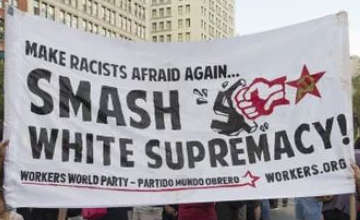 Fascism is an extreme right-wing form of capitalist rule. Fascist deologies still exist in different forms in most capitalist countries and in former colonies that are ruled by puppet regimes. In the U.S., fascism is closely linked to the ideology of white supremacy and shows itself in many institutions and cultural tendencies. Fascism is a last resort of the ruling class, which uses it to try to smash all working-class organizations. (workers.org/fascism/) This class includes a lesson plan and powerpoint slideshow on how communists have fought and are still fighting against fascism!
- Lesson Plan: Fascism
- Powerpoint (PDF format): Fascism: What It Is & How to Fight It
SHOW MORE
Class: Democratic Socialism vs. Revolutionary Socialism
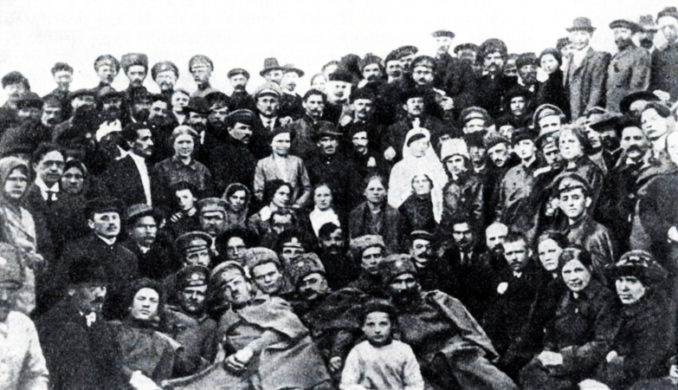
This class highlights the difference between democratic socialism focusing on parliamentary procedures and a revolutionary socialism that faces the need to deal with the power of the capitalist state; the control exerted by corporations and the ruling class on the state apparatus; bourgeois control over education, media, religion and culture; and working class divisions cultivated by the ruling class. The class lesson plan of readings from Workers World/ Mundo Obero newspaper clarifies the differences between democratic and revolutionary socialism.
- Lesson Plan: Democratic Socialism vs. Revolutionary Socialism
- Article: The ‘Socialist Manifesto’ and the rise of social democracy
- Article: The strength of women: Venezuelan commune members confront the blockade
- Article: Seeking truth about Venezuela’s food production
- Article: Venezuela today, part 2: People power resists U.S. threats
- Article: Venezuela today: consolidating people power to face U.S. threats
SHOW MORE
Class: China and Socialist Development
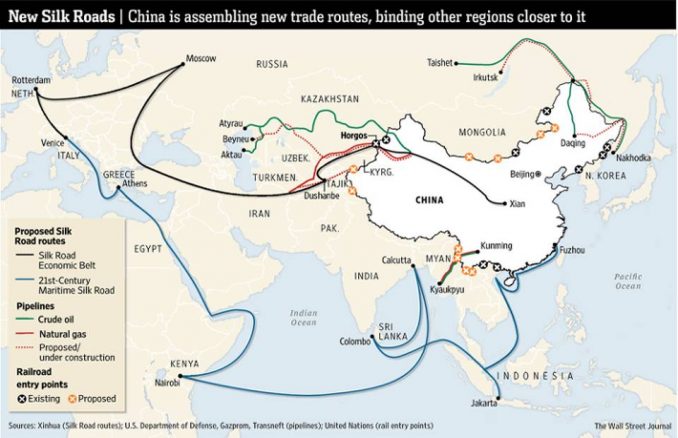
New Silk Roads: China is assembling new trade routes
This two-part class concentrates on China’s role as a new global superpower that still continues to build on its socialist revolutionary roots, and also focuses on the 2019 Hong Kong protests and how these are linked to imperialist and capitalist global competition with China. The lesson plan includes extensive readings suggestions.
- Lesson Plans: China and Socialist Development
SHOW MORE
Copyright © 2024 Workers.org

- Buffer
- Diggit
- More
- Flattr
- Google+
- Stumble
- tumblr
- VK
- Yummly
Share this