
Getty Images/iStockphoto
Evaluate 10 AI chatbots for business use cases
Businesses are bypassing out-of-the-box AI for custom chatbots tailored to their complex needs. Explore these 10 AI chatbot platforms for building business-ready assistants.

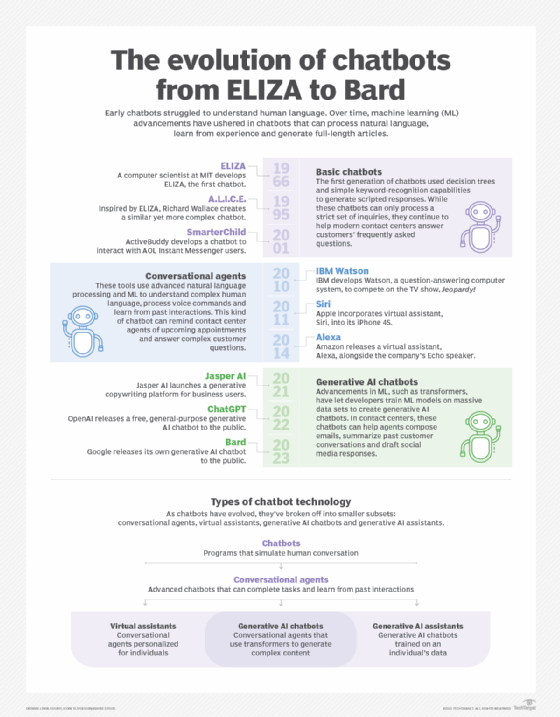
Business-facing chatbots have evolved over time, offering increasingly complex and personalized options for organizations to choose from.
This evolution defines the current market. Traditional chatbots handling rule-based interactions still operate in many organizations. Intent-based AI chatbots -- developed in the past five to seven years with natural language understanding (NLU) -- also run at scale. And a new class of fine-tuned chatbots, driven by large language models (LLMs), is currently reshaping expectations for accuracy and efficiency.
At the same time, chatbot adoption, particularly at a large scale, faces several challenges. Years of exposure to poorly designed chatbots have created customer skepticism that enterprises must overcome with demonstrably better experiences. Additionally, legacy systems that are difficult to integrate and hallucination concerns remain constraints on mainstream deployment.
With various chatbot options and adoption concerns to consider, it's crucial to choose the right AI chatbot platform for your business' AI development. Explore AI chatbot adoption trends, market landscape, 10 leading chatbot options and best practices to pick the right platform for your business.
AI chatbot business adoption trends
Enterprise adoption of conversational automation has shifted from isolated experiments to scaled, operational systems embedded across customer-facing and internal workflows. Today, organizations want to deploy multi-turn, transactional chatbots -- which often use the power of agentic AI -- to support customer service, HR, IT, marketing and sales operations.
These chatbots can absorb substantial interaction volume at marginal cost, enabling always-on service while accelerating payback periods. Adoption is robust in retail, e-commerce, telecom and financial services, with healthcare and the public sector expanding rapidly as they seek to offset workforce constraints and improve access to services.
Advances in foundation models and retrieval-augmented generation (RAG) have raised expectations for accuracy, contextual grounding and integration. Businesses now require chatbots that operate reliably within complex environments and legacy systems. Integration complexity and governance needs -- such as privacy, data residency and access controls -- have emerged as the critical determinants of scale. Businesses increasingly use hybrid and virtual private cloud (VPC) deployments to meet these requirements.
At the same time, organizations face practical constraints, including the limited availability of AI-skilled talent, legacy infrastructure that doesn't natively interoperate with modern AI systems and the need to restructure knowledge bases that are unfit for conversational access. These operational realities are shaping the pace and trajectory of enterprise adoption.
Enterprise AI chatbot market landscape
The landscape of business-facing chatbots encompasses a diverse range of vendors and models. Conversational AI platforms are incorporating generative and agentic capabilities, while foundation model providers are productizing chatbot-building functionality. As a result, the boundaries between categories have blurred.
There are three main product groups: horizontal, general-purpose conversational platforms; foundation model and infrastructure providers; and vertical, domain-specific vendors. These groups offer a practical approach for business decision-makers to evaluate options tailored to their specific needs.
Horizontal, general-purpose conversational platforms
These platforms provide a unified toolkit for deploying chatbots across multiple functions, including customer service, HR, IT, sales and operations. They offer low-code/no-code design tools, omnichannel delivery, extensive connectors and centralized governance. Modern platforms blend deterministic dialog flows with generative components.
Many now include multi-agent orchestration capabilities that enable multiple agents or task-specific chatbots to collaborate as part of an integrated experience. They also increasingly support multimodal interactions such as text, voice and image-based workflows.
Representative vendors listed alphabetically: Amazon Lex; Boost.ai; Cognigy; Google Conversational Agents (Dialogflow CX); IBM watsonx Assistant; Kore.ai; Microsoft Copilot Studio; and Yellow.ai.
Foundation model and infrastructure providers
These providers supply LLMs, APIs, orchestration tools and development infrastructure for businesses building highly customized chatbots. They support flexible deployment patterns -- including cloud, VPC and on-premises -- and provide the extensibility required for complex workflows, unique data governance needs and deep integration with proprietary systems.
These stacks include AI engineering capabilities, such as LLMOps and DataOps, as well as guardrails for safe model execution and multimodal support for text, voice, images and numeric inputs.
Representative vendors listed alphabetically: Amazon Bedrock; Anthropic Claude; Google Vertex AI; IBM watsonx LLMs; Meta Llama models; Microsoft Azure OpenAI; and OpenAI ChatGPT Enterprise.
Vertical, domain-specific chatbot vendors
These chatbots focus on specific industries or functional domains, such as banking, healthcare, e-commerce or IT support. They include pretrained intents, domain-tuned workflows and connectors to specialized systems such as EMRs, core banking platforms, ERP or IT service management (ITSM) tools.
Their narrow focus enables fast deployment and high accuracy in targeted scenarios. Many now emphasize advanced capabilities such as conversation intelligence, domain-specific performance metrics and human-in-the-loop workflows for regulated environments.
Representative vendors listed alphabetically: Aisera (recently acquired by Automation Anywhere); Hyro (healthcare); Kasisto (financial services); Paradox (recently acquired by Workday) (HR); PolyAI (customer service); Salesforce Einstein Bots; SAP Conversational AI; ServiceNow Virtual Agent; and Syllable (healthcare).
10 AI chatbot platforms for business use
The following AI chatbot providers and platforms highlight some of the leading options available to businesses. Each platform offers specific business-driven use cases, along with its own set of strengths, limitations, integration capabilities and enterprise readiness.
These tools are listed in alphabetical order.
1. Amazon (Lex + Bedrock)
Amazon offers two complementary capabilities: Lex, a platform for general-purpose, NLU-driven conversation automation across chat and voice, and Bedrock, which provides access to foundation models capable of supporting generative and retrieval-based workflows. Together, they form a flexible stack for customer service, commerce and operational chatbot automation.
- Business use cases. Applications include contact center automation, digital commerce assistance, order tracking, knowledge retrieval, IT service interactions and workflow-triggered customer support.
- Strengths. Strengths include deep AWS ecosystem integration, mature telephony and IVR support using Amazon Connect, global scalability and the ability to design highly reliable chatbots.
- Limitations. Limitations include less sophisticated conversation design tooling compared to specialized platforms, as well as a heavier reliance on engineering resources for complex orchestration.
- Integration. Options include native integration with AWS Connect, Lambda, DynamoDB, event-driven workflows and Bedrock models. Supports API-based extensions into enterprise systems. Bedrock supports custom model fine-tuning and enterprise RAG, enabling organizations to integrate proprietary data into chatbot interactions.
- Enterprise readiness. Strong fit for cloud-centric businesses that need predictable scalability and reliability.
2. Anthropic (Claude)
Anthropic provides Claude models optimized for reasoning, safety and grounded conversational performance. Anthropic's foundation models and infrastructure tools can help businesses build advanced chatbots and agentic components.
- Business use cases. Applications include complex inquiry handling, analytic reasoning, summarization, policy interpretation, compliance-sensitive support tasks and customer-facing advisory functions.
- Strengths. Strengths include strong reasoning and safety constraints, which make Claude suitable for sensitive or high-precision interactions.
- Limitations. Limitations include fewer native chatbot-building features compared to horizontal platforms and a reliance on partner ecosystems for orchestration.
- Integration. Options include API-based integration, availability through major cloud platforms and compatibility with agent frameworks. Supports structured prompt specialization and controlled customization for businesses.
- Enterprise readiness. Suitable for organizations that require reliable reasoning, stringent safety behavior and high-quality responses across complex workflows.
3. Aisera
Aisera, recently acquired by Automation Anywhere, offers a business chatbot assistant and agent platform that focuses on self-service automation across IT, HR and customer support. As a vertical, domain-specific platform, Aisera combines conversational AI with workflow and ticketing automation.
- Business use cases. Applications include ITSM ticket resolution, HR inquiry automation, customer self-service and multilingual enterprise support.
- Strengths. Strengths include high-resolution automation across internal processes, strong workflow orchestration and multilingual capabilities.
- Limitations. Limitations include narrower applicability outside IT and customer service due to domain-optimized models.
- Integration. Options include native integrations with service desks, ticketing systems, identity systems and enterprise workflow platforms. Includes multi-agent structures for domain and task-level automation, along with prompt orchestration tools.
- Enterprise readiness. Well-suited for businesses driving internal support automation at scale.
4. Boost.ai
Boost.ai offers a conversational automation platform for high-volume customer service tasks in regulated industries. The general-purpose platform features robust capabilities for secure and scalable deployments across chat and voice channels.
- Business use cases. Applications include customer service automation in banking, insurance, telecom and government, as well as agent assist and compliance-sensitive transactional workflows.
- Strengths. Strengths include a strong security posture, low-latency automation, reliable performance at scale and rapid deployment cycles.
- Limitations. Limitations include a smaller research footprint and a greater focus on specific industries, which might reduce versatility.
- Integration. Options include omnichannel connectors, agent desktop integrations, enterprise system APIs and voice channels. Enhancements include generative response augmentation, workflow optimization and model tuning for specific tasks.
- Enterprise readiness. Optimized for businesses with large-scale customer service operations and a high degree of compliance expectations.
5. Cognigy
Cognigy offers a general-purpose, business-focused conversational platform designed for multimodal customer engagement, combining rich development tooling with advanced automation capabilities.
- Business use cases. Applications include contact center automation, IT service desk support, conversational IVR, agent assist and multimodal customer journeys.
- Strengths. Strengths include robust voice capabilities, extensive coding and low-code options, strong process automation features and broad connector support.
- Limitations. Limitations include the need for businesses to have skilled teams to fully use advanced capabilities.
- Integration. Options include connectors to CRM, ERP, contact center platforms, telephony gateways and enterprise applications, with support for both hybrid and on-premises deployments. Supports generative workflows, domain-tuned models and advanced orchestration patterns.
- Enterprise readiness. Suitable for businesses seeking deep multimodal capabilities and flexible architecture.
6. Google (Conversational Agents [Dialogflow CX])
Google's general-purpose conversational platform features a flow-based design augmented by generative models and multimodal capabilities, making it suitable for global deployments across various channels.
Conversational Agents (Dialogflow CX) is part of Google Vertex AI, which provides foundation models and infrastructure to support various chatbot development needs.
- Business use cases. Applications include customer service automation, transactional journeys, voice assistants, process automation and cross-channel support.
- Strengths. Strengths include extensive language support, strong cloud-native integration and support for both deterministic and generative behaviors.
- Limitations. Limitations include a complex product portfolio and dependence on generative modules for many advanced capabilities.
- Integration. Options include prebuilt connectors for Salesforce, ServiceNow, BigQuery, collaboration tools, telephony systems and custom API integrations. Supports hybrid (deterministic and generative) flows, RAG and multimodal processing.
- Enterprise-readiness. Effective for larger businesses requiring scalable, multilingual automation.
7. IBM watsonx Assistant
IBM's watsonx Assistant is a general-purpose, enterprise-grade conversational platform with strong governance, compliance and deployment flexibility across cloud and on-premises environments.
- Business use cases. Applications include customer support automation, internal support for HR and IT, finance and banking workflows and healthcare service operations.
- Strengths. Strengths include rigorous governance controls, secure deployment models and strong compatibility with regulated industries.
- Limitations. Limitations include overlapping components within the larger Watsonx ecosystem, which might require careful architectural planning.
- Integration. Options include APIs, webhooks, on-premises connectors, enterprise application integration and hybrid-cloud support. Supports fine-tuning of IBM Granite models, retrieval workflows and specialized assistants for industry tasks.
- Enterprise readiness. Highly aligned for organizations requiring stringent compliance and a high degree of control over data.
8. Kore.ai
Kore.ai provides a general-purpose conversational and process automation platform with broad horizontal capabilities and specialized tools for industries such as banking and healthcare.
- Business use cases. Applications include customer service, IT and HR support, banking assistance, healthcare interactions, enterprise search and workflow automation.
- Strengths. Strengths include comprehensive features, advanced agent orchestration, multimodal capabilities and a strong library of vertical accelerators.
- Limitations. Limitations include a complex feature set that can require structured onboarding and governance.
- Integration. Options include CRM/ERP connectors, omnichannel connectors, voice integrations and hybrid and on-premises deployments. Supports intent tuning, task agent specialization, generative enhancements and orchestration tools.
- Enterprise readiness. A good fit for businesses seeking multi-department chatbot automation under a unified platform.
9. Microsoft (Azure OpenAI + Copilot Studio)
Microsoft offers two pathways: Azure OpenAI, a foundation model and infrastructure option for custom chatbot systems, and Copilot Studio, a general-purpose platform for embedded productivity agents across Office applications.
- Business use cases. Applications include customer service chatbots, internal advisors, workflow automation, knowledge retrieval and employee productivity assistants.
- Strengths. Strengths include tight integration with enterprise identity, security and collaboration ecosystems, alongside powerful model access.
- Limitations. Limitations include architectural complexity when combining platform components for multi-department deployments.
- Integration. Options include Azure Cognitive Services, Microsoft Graph, Teams, Office apps and Copilot Studio for custom agents. Supports fine-tuning, retrieval orchestration, agent frameworks and automation pipelines.
- Enterprise readiness. A good fit for businesses that are standardized on Microsoft infrastructure.
10. OpenAI (ChatGPT Enterprise)
As a foundation model and infrastructure provider, OpenAI's ChatGPT Enterprise offers GPT-based models and enterprise tools that serve as a foundation layer for building advanced chatbots.
- Business use cases. Applications include knowledge automation, support assistants, code generation, content synthesis and reasoning-based guidance tools.
- Strengths. Strengths include industry-leading reasoning and language capabilities.
- Limitations. Limitations include a lack of built-in enterprise connectors, requiring integration work or partner tooling.
- Integration. Options include API and SDK-based integration with third-party ecosystems and chatbot frameworks. Supports custom GPTs, fine-tuning, RAG and tool-based agentic workflows.
- Enterprise readiness. Strong option for custom development teams building bespoke conversational systems.
How to select an AI chatbot platform for your business
Selecting an AI chatbot platform can be daunting. Businesses can start their evaluations by defining their intended use case, identifying their data and governance requirements and assessing their enterprise readiness and integration needs.
1. Define intended use case
Selecting an AI chatbot begins with aligning the technology to the complexity and scale of the intended use cases. Simple informational or FAQ-driven interactions can be handled by horizontal platforms with minimal engineering effort. More demanding workflows -- with multi-step transactions, diagnostic reasoning, exception handling or integrations involving multiple enterprise systems -- require platforms capable of orchestrating deterministic workflows, retrieval-based grounding and agentic behaviors.
Business leaders should also anticipate that narrow pilot projects often expand across departments. Early architectural choices become long-term constraints. This makes it essential to choose platforms that can scale functionally and operationally.
2. Identify data and governance needs
Data and governance requirements influence deployment options. Workflows involving personal, financial or regulated data require strong controls around data residency, encryption, access controls, safe model behavior and auditability. Businesses must ensure that a platform can integrate securely with existing data estates and meet internal security policies.
Even organizations with lower-sensitivity workloads benefit from mature governance models, as customer-facing chatbots surface inconsistencies in data quality, content structures and process definitions. Platforms that provide robust guardrails, monitoring and human-in-the-loop workflows are better suited for long-term growth.
3. Assess enterprise readiness and vendor integration
Internal engineering maturity and integration readiness are also key factors in determining vendor fit.
- Foundation model stacks offer the most flexibility but require experienced engineering teams, operational discipline and ongoing ownership of prompts, pipelines, knowledge sources and model updates.
- Horizontal platforms reduce integration burdens through prebuilt connectors, ecosystem integrations and packaged accelerators, but might limit customization options.
- Vertical chatbot platforms offer the fastest time to value in domain-specific contexts, although their extensibility outside those domains can be limited.
Across all categories, organizations should also evaluate vendor stability, implementation quality, deployment support and the ability to partner effectively.
Kashyap Kompella, founder of RPA2AI Research, is an AI industry analyst and advisor to leading companies across the U.S., Europe and the Asia-Pacific region. Kashyap is the co-author of three books, Practical Artificial Intelligence, Artificial Intelligence for Lawyers and AI Governance and Regulation.