Can you use a string of black and white symbols to communicate colour? This is the premise behind the Color Game app, in which users create and solve puzzles matching colours to non-coloured symbols.
I’ve been enjoying coming up with ways to represent different colours for other players to decode, and also playing through puzzles created by others. Because humans are wonderfully clever and good at communicating, players often do better than chance at the puzzles.
Other than being entertaining, this app is also helping researchers better understand how language evolves. It was designed by Scientists at the Max Planck Institute for the Science of Human History, who will use the anonymous data gathered from the game to understand how the players create an ever-changing symbolic vocabulary.
From the app’s press release:
Difficult as this may sound, players are able to reach the correct result more often than would occur by chance. Players also get better at it, as once-neutral symbols acquire meanings that they lacked at the start of the game. Players are creating a language together, in the very act of using it.
The Color Game Website, including links to download the app for Android and iOS: www.colorgame.net
Lingthusiasm Episode 5: Colour words around the world and inside your brain
Red, orange, yellow, grue, and purple? Not so fast – while many languages don’t distinguish between green and blue, it’s unlikely that a language would lump these two together while also having distinct words for “orange” and “purple”.
But how do we know this? What kinds of ways do different languages carve up the colour spectrum? Why does English say “redhead” instead of “orangehead”? How do colour words interact with smells, reading, and the human brain? In episode 5 of the podcast that’s enthusiastic about linguistics, your hosts Lauren and Gretchen talk about what linguistic typology and psycholinguistics can tell us about colour words.
We also chat about Lauren’s archiving work, and the iGesto gesture conference, and Gretchen’s upcoming ICLDC conference adventures.
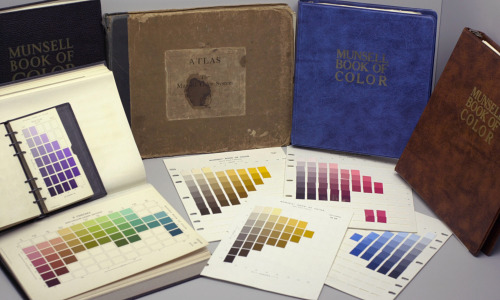
We talk about colour, and the words people
use for it across languages. I wanted to share a picture of of a Munsell
chip set, because I find them very soothing. `This one is from the Wikipedia page on Munsell chips, which gives some detail on how Albert H. Munsell came up with the system of colour grading in the early 20th century.
A recent paper looks at the relationship between vision and smell, and asks whether certain smells are associated with certain colours. The paper in Psychonomic Bulletin from Josje M. de Valk, Ewelina Wnuk, John L. A. Huisman & Asifa Majid was published late last year, and is a great piece of cross-linguistic research, involving speakers of Dutch, Thai and Maniq (spoken in Thailand). They also have a great summary of the paper on their website:
Do you think the smell of lemon is yellow and that of lime green? Or are
both of these smells the same color? Studies have shown that people
often agree as to what colors go with odors, but it is unclear how
exactly they come to create these associations. One possibility is they
could be using language–they label the odors they smell and select a
color matching with their label. To see whether this is true, we
investigated odor-color associations among speakers of three different
languages: Dutch, Thai and Maniq (a language spoken by a small
hunter-gatherer community in Thailand). These groups differ in the way
they describe odors: Dutch speakers usually describe the odor object
(e.g smells like banana), whereas Thai and Maniq speakers (also) use
abstract smell terms, i.e. words that describe a smell quality (e.g.
musty). We found that people chose different colors depending on the
labels they used to describe the odors: When people described the odor
with an object, they more often chose colors matching the odor object
(e.g. peanut butter odor – brown) than when they used smell terms (e.g.,
musty odor — ? color). They especially chose matching colors when they correctly identified the object. This suggests that people indeed use language to form odor-color associations.
The full paper is available to read as a PDF from their website. It has some great visualisations - Figure 1 shows all the different colours people chose for difference smells, it’s very pretty.
Reference: De Valk, J. M., Wnuk, E., Huisman, J. L., & Majid, A. (2016).
Odor–color associations differ with verbal descriptors for odors: A
comparison of three linguistically diverse groups. Psychonomic Bulletin & Review, 1-9.
Our group investigates meaning in language and cognition across diverse
semantic domains and disparate languages. Only humans have a
communication system that combines a finite number of meaningless
elements (sounds) to a potentially infinite set of meaningful concepts.
But where do these meanings come from? According to some scholars, word
meanings are largely the same across people, and are shaped in only a
limited way by experience. According to others, word meanings vary
substantially from culture to culture and every infant must learn a
different system. Recent research supports a more nuanced picture than
this dichotomy demands. Large-scale cross-cultural comparison reveals
little evidence for absolute universals in word meaning, consistent with
the cultural relativity view. However, there are striking statistical
regularities in how meaning is carved up into words, suggesting that
similar perceptual and cognitive constraints are in operation across
diverse languages. Our current research focus is on the language of
perception, particularly olfaction.
We had a Valentine’s themed reading group last Thursday, and the lovely Karri wrote us all personalised poetry.
It’s nerdy, and factually accurate; Yolmo historically doesn’t have a separate word for blue, instead they have a word that covers both blue and green (common enough cross-linguistically to be known as grue). Interestingly, since they now speak more Nepali (which does have a separate word for blue) speakers have started using one of their grue words to specifically mean blue.
[Although a couple of us in the reading group are linguists, it’s not a linguistics reading group - we read fiction to each other. I do have hobbies that aren’t linguistics… well, at least one!]
I thought I’d celebrate getting my thesis draft finished with a bit of hair painting. I’ve found the feedback amusing because some people call it blue and others call it green. I haven’t been keeping count, but I reckon for the first few days it was around 50/50 (it’s now faded and I am getting more of one than the other).
There are many languages in the world that do not have separate words for what we think of as blue and green. It’s such a common merger of category that it’s known cross-linguistically as grue. I can’t believe I’ve never mentioned grue on Superlinguo before (although we have talked about the opposite; where a language has different words for light and dark blue). I’m rather happy with my grue hair!