“Etymology isn’t destiny” on shirts, magnets, notebooks, and more!
Words change their meanings over time, and when we remind ourselves that etymology isn’t destiny, we can also remember we’re free to grow and change over the course of our lives too. We’ve talked about how the meanings of words are something that we’re constantly creating with each other in many Lingthusiasm episodes, so the idea that etymology isn’t destiny is a fun and liberating thing that you can now contemplate regularly by looking at these words in sparkly, witchy script by our linguist-artist Lucy Maddox in black, white, midnight blue, Lingthusiasm green, or (our personal favourite) rainbow gradient. Etymology isn’t Destiny is available on lots of items, including many different shapes and colours of shirts (for adults, kids, and babies!), stickers, laptop cases, mugs, tote bags, water bottles, zip pouches, notebooks, and excitingly, magnets!
Aesthetic IPA chart now on posters, shirts, and more!
The International Phonetic Alphabet chart is sometimes called the periodic table of linguistics – an important technical diagram that’s also visually interesting and which many linguists hang up on a wall, carry around inside a notebook, or simply know the exact keystrokes that’ll get them to a page to type or listen to it.
Like with the periodic table of the elements, the layout of the IPA chart is a key to what the symbols mean: from top to bottom, the chart goes roughly from sounds where the mouth is the most closed to the most open, and from left to right, it goes from sounds where the constriction is the front of the mouth to the back of the mouth. This means that many linguists only know well the parts of the IPA that they encounter regularly in languages they work with, and rely on their knowledge of the overall structure to retrieve other parts on occasion. Hence the need to have it handy to refer to.
But there’s also an important way in which the IPA chart and the periodic table differ: art. If you want a handy reference chart of the elements for your wall or your pocket, there are hundreds of possible designs, ranging from subtle, minimalist designs that look like cool nerdy art to intricate, maximalist designs with all the technical detail you might possibly want to refer to.
With the International Phonetic Alphabet, most people are still printing out (or occasionally stickering, or laminating) the same greyscale diagram from the International Phonetic Association. We, your Lingthusiasm cohosts, have a lot of affection for this classic design, which we’ve spent many hours poring over (especially the forbidden grey areas, ahem), but we also wondered, wouldn’t it be cool if there was a more subtle, minimal version that would look more like weird-yet-stylish nerd art and less like a diagram from an academic paper?
For these reasons, last year we commissioned an aesthetically redesigned version of the International Phonetic Alphabet from our linguist-artist Lucy Maddox and put it on a one-time order of microfibre lens cloths. We’ve since heard from several people who missed out on that order or wish they could have the design in another format, so we’ve now made that available in several versions: the original square design as a poster, a version with rectangular proportions as a poster (depending on the shape of that blank space on your wall which needs a cool IPA poster), and a transparent background version that plays well on a shirt! The notebooks and tote bags also look really good with the aesthetic IPA chart on them if you want a version to bring to classes or conferences. Also someone requested a mouse pad so we did that and then we put it on an apron because why not.
Lingthusiasm merch generally
If you’re looking for subtle-to-obvious ways to signal that you’re a linguist or linguistics fan in public, gift ideas for the linguistics enthusiast in your life (or handy links to forward to people who might be interested in getting you a gift sometime), we also have many previous items of Lingthusiasm merch! There are many subtly linguistics-patterened scarves, water bottles with linguistics-related jokes on them, NOT JUDGING YOUR GRAMMAR, JUST ANALYSING IT shirts, or just have a browse. All of the Lingthusiasm merch makes a great gift for the linguist or linguistics fan in your life, and as a patron you get to find out about new merch before anyone else! Check out the merch page at lingthusiasm.com/merch for the previous rounds of Lingthusiasm merch.
As ever, we love seeing photos of any Lingthusiasm merch or linguistics-themed crafts in your lives! Tag us in them @lingthusiasm on all of the social medias (or private message us photos of your babies in Lingthusiasm onesies if you’re not keen on posting baby photos publically, we still love to see them!)
I’m very excited for our new Etymology Isn’t Destiny merch!
✨Perfect for when you feel like the meaning of your name doesn’t vibe with who you are✨
(sorry to those Olivias who don’t like eating olives, and those atheist Theodores)
We have such a great catalogue of merch for every aesthetic and area of linguistic interest: https://lingthusiasm.com/merch
The International Phonetic Alphabet chart is sometimes called the periodic table of linguistics – an important technical diagram that’s also visually interesting and which many linguists hang up on a wall, carry around inside a notebook, or simply know the exact keystrokes that’ll get them to a page to type or listen to it.
Like with the periodic table of the elements, the layout of the IPA chart is a key to what the symbols mean: from top to bottom, the chart goes roughly from sounds where the mouth is the most closed to the most open, and from left to right, it goes from sounds where the constriction is the front of the mouth to the back of the mouth. This means that many linguists only know well the parts of the IPA that they encounter regularly in languages they work with, and rely on their knowledge of the overall structure to retrieve other parts on occasion. Hence the need to have it handy to refer to.
But there’s also an important way in which the IPA chart and the periodic table differ: art. If you want a handy reference chart of the elements for your wall or your pocket, there are hundreds of possible designs, ranging from subtle, minimalist designs that look like cool nerdy art to intricate, maximalist designs with all the technical detail you might possibly want to refer to.
With the International Phonetic Alphabet, most people are still printing out (or occasionally stickering, or laminating) the same greyscale diagram from the International Phonetic Association. We, your Lingthusiasm cohosts, have a lot of affection for this classic design, which we’ve spent many hours poring over (especially the forbidden grey areas, ahem), but we also wondered, wouldn’t it be cool if there was a more subtle, minimal version that would look more like weird-yet-stylish nerd art and less like a diagram from an academic paper?
After many months of back-and-forth on coming up with and refining the design, we’re very excited to share the near-final design with you!
[Image description: an abstract, minimalist* rendering of the International Phonetic Alphabet as a grid of white, sans-serif letters on a midnight blue background, with no row or column headings. Bright green is used as an accent colour, for solid green circles around the voiceless consonants; white circles with green font for the rounded vowels, and narrow green borders around the lateral sounds. There’s a small lingthusiasm logo in the bottom corner and a translucent “demo” watermark splashed in the background.]
*Yes, we know there’s a syntax theory called Minimalism as well, which this has no real relationship to because it’s a different subfield. Consider it a bonus easter egg!
(By the way, the design still has “demo” on it because, while we’ve checked it with several very helpful phonetics/phonology friends, there remains a possibility that there’s a typo somewhere which the linguistics internet at large will tell us about before we get it printed. Hey, did we mention – if you notice a typo here, now would be a GREAT time to tell us about it before we print a zillion copies.)
We’ve actually recorded a whole episode chatting with Lucy about the design process, which will be September’s bonus episode, but a few brief notes about our design inspirations until then:
First, we were inspired by the ad-hoc IPA diagrams that linguists draw quickly on blackboards and notebooks when they want to discuss a point, which just have the minimal amount of information, and which generally don’t have any labels for the rows or columns. So we ditched the labels. This is an IPA chart for people who already understand the general principles of reading an IPA chart, even if they don’t quite remember all the symbols – everything should be figure-out-able based on its position relative to common, well-known symbols. Same with the various circles for non-positional information: if you know that the difference between /p/ and /b/ is that /p/ is voiceless and /b/ is voiced, you can deduce that the solid green circle also indicates voicing for less familiar symbols. Or, if you’re inclined to puzzles, this is an IPA chart for people who enjoy the challenge of decoding what some cool-looking symbols mean based on some familiar ones with maybe an assist from Wikipedia or a clickable IPA chart.
But wait – this left us with a conundrum. The main consonant and vowel charts are totally decodable based on position. But there are also two other extra consonant charts which contain a grab-bag of other symbols arranged in no particularly decodable order. Simply removing the headings from these charts left them confusing. But after all, the IPA sounds are all produced with the same vocal apparatus…could we just fit them all into one diagram? It turns out that this (eventually, after much tweaking) looks really neat. And, we think, even makes these oft-disregarded consonants easier to remember.
Oh and by the way, since the 1900 version of the IPA chart had the consonants and vowels all on the same diagram, what if we included the vowels on there too? (We could not, alas, figure out a way of arranging the diacritics to make their meanings decodable from position only, so in the end we omitted them. If anyone does figure this out, please do let us know and we can talk about a revised version.)
With such a cool-looking IPA design, we also wanted to make it exist as a durable, tiny, lightweight object that you could carry with you everywhere and which might even be useful for secondary purposes. Which brings us to…lens cloths!
Lens cloths are a small, durable format for a reference image and you can use them to clean glasses, sunglasses, screens, camera lenses, and so on. Plus, they’re a kind of merch we’ve never been able to do before, because lens cloth printing companies want you to place orders in the hundreds or ideally thousands.
Thousands? Oh, that brings us to The Plan:
We’re going to place ONE (1) massive order for aesthetic IPA chart lens cloths on October 6, 2022. If you want one, be a patron at the Lingthusiast tier or higher on October 5th, 2022, timezone: anywhere in the world. If you’re already a patron at that tier, then you’re set! (That’s the tier where you also get bonus episodes and the Discord access, we’ve never run a special offer at this tier before but we think this time it’ll be worth it!)
If you want several IPA lens cloths, to give to friends or to make double extra sure you never leave home without one, you can also join the higher tiers (or stick around if you’re already there). Patrons as the Ling-phabet tier will get 4 lens cloths and patrons at the Phil-ling-thropist tier will receive 12, in addition to the other rewards at those tiers.
We’ve ordered sample lens cloths from several different companies and we’re really pleased with the quality of the company we’re planning on going with – the design will be entirely sublimated into the microfibre material so there’s nothing to scratch your lenses, and it has a satisfying thickness and image resolution. The lens cloth production company estimates about a 2 week turnaround on ordering, so we expect we’ll be mailing the lens cloths in late October or early November, which *should* be plenty of time for the major winter gifting holidays, assuming the supply chains cooperate.
We do also want to make this sleek aesthetic IPA chart design available on posters and possibly other objects (tell us what you’d be excited about in the comments below!) but that’s going to take a second phase of design work to also make the design look good as a rectangle in addition to a square and figure out some additional colour options to go with a variety of decors. To be honest, running the square design as a special offer is also a bit of a test-run/fundraiser for the rectangular stage of the design, since we’ve already put quite a lot of our own energy and paying-the-designer into it. If people aren’t as excited as we are about this idea, then maybe a rectangular version and/or more colours don’t need to exist. Which would be fine too! But, I mean, c'mon.
If you know other linguists or linguistics fans who might be excited to have a snazzy aesthetic IPA chart that they can carry around with them (plus, y'know, get access to the usual Patreon perks like bonus Lingthusiasm episodes and a Discord server that’s enthusiastic about linguistics), please help them find out about this before it’s too late! We are not planning to ever order a second batch of IPA lens cloths, so this is your one chance to get them.
Whew, that was a long post! Here’s the highlights:
[Image description: What if the International Phonetic Alphabet looked like weird nerd art? Get this design (arrow to previously-described abstract IPA demo) on a handy-to-carry lens cloth (image of those microfibre cloths you clean glasses with; these are not the actual cloths but just to give you an idea of the genre). (Tiny abstract drawing of Lauren & Gretchen silhouettes from the website.) We’re placing one bulk order for everyone who’s a Lingthusiast patron or higher as of October 5, 2022. Sign up at patreon.com/lingthusiasm]
Like here’s this absolutely jumbled version (by modern standards) from 1899 which is both upside-down and backwards and also has the headings in phonetically transcribed German but tbh the columns are kinda sleek, I like it:
Or here’s this 1900 version with French headings (no longer phonetically transcribed, alas) which has a much boxier aesthetic and still goes from back of the mouth to front (honestly just as logical, I wonder why it ever switched!) but it does the thing with the vowel trapezoid where it’s in with the consonants! You can also see how in this period they weren’t distinguishing between fricatives like /f/ and /x/ and approximants like /w/ and /j/ yet.
Absolutely adore this 1907 French version where the vowels are upside-down above the consonants!!!
Okay here’s the left-to-right order that we’re used to finally showing up in 1912 but can you imagine if we still called the alveolars “point and blade” I sorta love it!?
Here’s the “other symbols” grab-bag section starting up in 1926, so like phoneticians have been aware of clicks for almost a hundred years but I don’t see them on the main chart at any time in here:
I mean, to be clear, this redesign is an art project by us, definitely not a proposal that’s been cosigned by a committee of hundreds of phonologists. In particular, we needed it to be legible a 15cm/6in square, because that’s the size we can get little microfibre lens cloths made. There’s already a few tweaks I might want to make for the rectangle version, once we’re no longer quite as confined space-wise. And possibly there’s even still a typo somewhere, although I’ve now fixed the two that people helpfully pointed out yesterday. (Thank you!)
But I think one of the cool things that art can do is help us think about familiar things in new ways, and for me seeing an IPA chart that puts the clicks, ejectives, and implosives (which just so happen to not be very common in European languages) alongside all the other consonants is a thing that made me think “huh, maybe putting all the non-pulmonics in their own special area was kind of a eurocentric decision and we could instead decide to not do that.”
More broadly, I hope that this encourages more people to think about the symbols and layout of the International Phonetic Alphabet as a statement about how humans try to make sense of the natural world, and one which can have many possibilities as our understanding of the world continues to evolve. Someone already mentioned that it would be really neat to see the IPA and the extended IPA on the same chart together and I agree that would be super cool too! Maybe, to go back to the periodic table, there could be dozens of visualizations of the same-at-core IPA depending on what your aesthetic sense and theoretical goals are.
We’ve been working on this design for over a year, and it’s exciting to get to share it with you!
We’re running a special offer for Lingthusiasm patrons:
We’re going to place ONE (1) massive order for aesthetic IPA chart lens cloths on October 6, 2022. If you want one, be a patron at the Lingthusiast tier or higher on October 5th, 2022,
timezone: anywhere in the world. If you’re already a patron at that
tier, then you’re set! (That’s the tier where you also get bonus episodes and the Discord access, we’ve never run a special offer at this tier before but we think this time it’ll be worth it!)
We’re hoping the special offer will help us fund a design update to add this design to more merch, which will be available later.
Lingthusiasm Episode 44: Schwa, the most versatile English vowel
The words about, broken, council, potato, and support have something in common – they all contain the same sound, even though they each spell it with a different letter. This sound is known as schwa, it’s written as an upside-down lowercase e, and it has the unique distinction of being the only vowel with a cool name like that! (The other vowels are called, unglamorously, things like “high front unrounded vowel”).
In this episode of Lingthusiasm, your hosts Gretchen McCulloch and Lauren Gawne get enthusiastic about why the schwa is cool enough to get its own name! We also talk about why the word schwa doesn’t itself have a schwa in it, the origin of the word schwa in Hebrew and German, the relationship between schwa and “silent e”, and how schwa contributes to an English-sounding accent in other languages. Schwa is also a big reason why English spelling is so difficult, because other vowels often become schwa when they’re not in a stressed syllable (giving rise to lots of jokes like “I wanna be a schwa, it’s never stressed).
–
This month’s bonus episode is about numbers! We talk about fossilized number systems (which explain words like “eleven” and “twelve” in Germanic languages), counting gestures and different base systems in various languages (from base 6 to base 27), and indefinite hyperbolic numerals (words like “bazillion” and “umpteen”). Support Lingthusiasm on Patreon to get access to the numbers episode, as well as 38 other bonus episodes, and to chat with fellow lingthusiasts in the Lingthusiasm patron Discord.
We can all aspire to be a little less stressed, like our favourite English vowel. We’ve created new Schwa (Never Stressed) merch. Available in a floral garland, stylised geometric black on white and stylised geometric white on black. Pins, cards, mugs, and mobile phone cases. Art by Lucy Maddox www.lucymaddox.com. Lingthusiasm merch makes a great gift for yourself or other lingthusiasts! Also check out IPA scarves, IPA socks, and more at lingthusiasm.redbubble.com
Lingthusiasm merch makes a great gift for yourself or other lingthusiasts! Check out IPA scarves, IPA socks, and more at lingthusiasm.redbubble.com
Have
a great idea for a linguistics communication project, but need a bit of
money to get it off the ground? Looking to support emerging lingcomm
projects? The LingComm Grant is four $500 grants for communicating
linguistics to broader audiences in 2020. Applications close 1st of June
2020. Find out more and apply here.
You can help keep Lingthusiasm advertising-free by supporting our Patreon. Being a patron gives you access to bonus content and lets you help decide on Lingthusiasm topics.
Lingthusiasm is created by Gretchen McCulloch and Lauren Gawne. Our senior producer is Claire Gawne, our editorial producer is Sarah Dopierala, and our music is ‘Ancient City’ by The Triangles.
Lingthusiasm Episode 26: Why do C and G come in hard and soft versions? Palatalization
A letter stands for a sound. Or at least, it’s supposed to. Most of the time. Unless it’s C or G, which each stand for two different sounds in a whole bunch of languages. C can be soft, as in circus or acacia, or hard, as in the other C in circus or acacia. G can be hard, as in gif, or soft, as in gif.
Why can C and G be hard or soft? And why don’t other letters come in hard and soft versions?
In this episode of the podcast that’s enthusiastic about linguistics, your hosts Lauren Gawne and Gretchen McCulloch get enthusiastic about the group of sounds that are pronounced with the back part of the roof of your mouth, aka the palate. When one sound in a word is produced at the palate, it tends to pull neighbouring sounds towards the palate as well, and this palatal attraction explains so many weird mismatches of sound and spelling. Why can C and G be hard and soft? Why do T and D sometimes get different pronunciations as well, as in nation and didja? Why are Irish and Scottish Gaelic names spelled that way? Why is it so hard to spell the clipped forms of “usual” and “casual”? How are cheese and cacio e pepe and queso and Käse all related?
This month’s bonus episode was about how to have fun at (or just survive) academic conferences. Whether you’re new to academic conferences, or have never been to one and want to know how they’re different from other large gatherings like conventions, this episode has all the info! Support Lingthusiasm on Patreon to gain access to this and 20 previous bonus episodes.
This is also our anniversary episode! Whether you’ve been with us for the whole two years or you’ve joined us more recently, we’re glad you’re here. Thank you to everyone who has helped bring the show to more language fans in honour of our anniversary. There’s still a bit of time to get your name on the special thank you post and help more people get a fun language thing in their ears by recommending Lingthusiasm on social media before the end of the month.
You can help keep Lingthusiasm advertising-free by supporting our Patreon. Being a patron gives you access to bonus content and lets you help decide on Lingthusiasm topics.
Lingthusiasm
is created by Gretchen McCulloch and Lauren Gawne. Our audio producer
is Claire Gawne, our editorial producers are Emily Gref and A.E.
Prévost, and our music is
‘Ancient City’ by The Triangles.
Gretchen and I had a lot of fun swapping examples of Palatalisation in
different languages! We also got really excited about cheese being a key
theme. So much goodness in this episode!
Lingthusiasm Episode 23: When Nothing Means Something
When we think about language, we generally think about things that are visible or audible: letters, sounds, signs, words, symbols, sentences. We don’t often think about the lack of anything. But little bits of silence or invisibility are found surprisingly often throughout our linguistic system, from the micro level of an individual sound or bit of meaning to the macro level of sentences and conversations.
In this episode of the podcast that’s enthusiastic about linguistics, your hosts Lauren Gawne and Gretchen McCulloch get enthusiastic about four different kinds of linguistic nothings: silence in between turns, silence in between sounds, invisible units of meaning, and invisible words. (Officially known as turntaking, glottal stops, zero morphemes, and traces.)
We also announced some details about our upcoming liveshow! Our last liveshow was in Montreal where Gretchen lives, so it’s only fair that our next official show is in Lauren’s hometown of Melbourne! It’ll be sometime in November. Stay tuned for the exact date and venue - you can sign up for Lingthusiasm email updates if you want to be sent it directly bit.ly/LingthusiasmEmailList
You can help keep Lingthusiasm advertising-free by supporting our Patreon. Being a patron gives you access to bonus content and lets you help decide on Lingthusiasm topics.
Lingthusiasm
is created by Gretchen McCulloch and Lauren Gawne. Our audio producer
is Claire Gawne, our editorial producers are Emily Gref and A.E.
Prévost, our production assistants are Celine Yoon & Fabianne
Anderberg, and our music is
‘Ancient City’ by The Triangles.
I’ve been looking forward to doing this episode for so long! The way we
make meaning out of nothingness across all levels of language has always
fascinated me.
Say, “aaaaaahhhh…..” Now try going smoothly from one vowel to another, without pausing: “aaaaaaaeeeeeeeiiiiiii”. Feel how your tongue moves in relation to the back of the roof of your mouth as you move from one vowel to the next. When you say “ahhhh” like at the dentist, your tongue is low and far back and your mouth is all the way open. If you say “cheeeeese” like in a photo, your tongue is higher up and further forward, and your mouth is more closed: it’s a lot harder for the dentist to see your molars.
In this episode, your hosts Lauren Gawne and Gretchen McCulloch explain how the position of our tongue when we make vowels can be described in the shape of a trapezoid: it can go up and down, forward towards the teeth and backwards towards the throat, and there’s a bit more space for movement higher up towards the roof of your mouth.
Vowels don’t just exist in a trapezoid, they move around inside it: sometimes they squish up against their neighbours, sometimes they expand into less-occupied corners of the trapezoid for more elbow room. These vowel gymnastics explain so many things: why is the first letter in the alphabet named “ay” in English, but “ah” in most other languages that use the Roman alphabet? Why is “e” in “coffee” pronounced one way and “cafe” another, when they’re clearly related? Why is English spelling so difficult? What’s the difference between a California accent and a Kiwi accent? It’s all about VOWEL SHIFTS.
You can help keep Lingthusiasm advertising-free by supporting our Patreon. Being a patron gives you access to bonus content and lets you help decide on Lingthusiasm topics.
Lingthusiasm
is created by Gretchen McCulloch and Lauren Gawne. Our audio producer
is Claire Gawne, our editorial producer is Emily Gref, our production assistant is Celine Yoon, and our music is
‘Ancient City’ by The Triangles
We had a lot of fun making very silly sounds this episode.
One thing we didn’t get to talk about were Cardinal Vowels.
You can make vowel sounds anywhere in the vowel trapezoid (cf. this
episode). Phoneticians needed an agreed-upon way to talk about vowels.
They decided that some vowels would be canonical reference points that
others could be measured against. The most commonly used system was
devised by Daniel Jones in the early 20th Century. This was one of the
main starting points of the International Phonetic Alphabet, which
filled in the rest of the space with common sounds.
The International Phonetic Association has a long-running series of articles where the sound system of a language is presented. These “Illustrations of the IPA” have now been produced for many languages across the world. Marija Tabain (my colleague at La Trobe) has produced a clickable map, an illustration of the Illustrations of the IPA if you will. From the website:
The map below shows (approximate) locations of languages for which
there is an Illustration in the Journal of the International Phonetic
Association. Green markers denote Illustrations that also appear in the
Handbook of the International Phonetic Association.
Click on the pin on the map to identify the language and follow the
link to the publication and recordings, where available. Languages
marked with * have multiple pins.
Suzy Styles of NTU’s BLIP Lab has put together this chart showing the most common speech sounds across languages. It’s set out like the IPA chart, but incorporates features such as unvoiced nasals that are represented with diacritics and not typically included in the main chart. You can see that only a few sounds occur in 80% or more of the world’s languages, and there are many sounds that only occur in a small handful (some of you may think of Zipf’s law when you see this distribution, as only a few sounds are in many languages, and many sounds are only in a few languages).
It’s useful if you’re building a conlang and you want to know how naturalistic it sounds. It’s also handy if you’re learning a language and want to know just how ‘weird’ those ‘weird’ sounds you’re learning are. For example, the trilled ‘r’ of Italian and Spanish [r] is actually much more common than the English ‘r’ sound [ɹ], and the sound at the start of thing in English [θ] is also pretty unusual.
Prevalence rates of
speech-sounds across 1672 languages. Data from PHOIBLE Online. Colour scale
indicates range from the listed percentage to the next higher percent.
This
figure first appeared in Styles SJ (2016) ‘Sensory worlds: Multisensory
outcomes of sensory tuning to phoneme structure’ Presentation at the
5th Southern African Microlinguistics Workshop, Bloemfontein, South
Africa, November 2016.
Lingthusiasm Episode 6: All the sounds in all the languages - The International Phonetic Alphabet
[This month soundcloud is having issues with tumblr embedding, so for the moment if you want to listen to the audio please go here to listen on soundcloud directly.
I’ll link to the shownotes page when things are working again. I
thought I’d use it as a chance to remind you can you also listen on
YouTube!]
Episode 6 of Lingthusiasm is all about the IPA! IP-YAY! Shownotes:
English writing is hugely inconsistent: is “ough” pronounced as in
cough, though, through, thought, rough, plough, or thorough? And once
you start adding in other languages with different conventions and
writing systems, things get even more complicated. How’s a person
supposed to know whether to pronounce “j” as in Jane, Juan, Johan, Jeanne, or Jing?
In
the 1800s, linguists decided to create a single alphabet that could
represent any sound spoken in any human language. After several
revisions and competing standards, we now have the modern International
Phonetic Alphabet with 107 letters, 52 diacritics, and a surprisingly
passionate fanbase including linguists, musicians, and people who like
cool symbols.
In episode 6 of Lingthusiasm, your hosts Lauren and Gretchen talk about
the history of the IPA, how it works, and some of the fun linguistics
games and stories that have arisen around the IPA.
Christmas baking this year included gingerbread schwas. I made up the cutter after a Twitter conversation about linguistics baking. The cutter and the resulting cookies turned out pretty well.
When I studied phonetics in undergrad I spent hours making IPA flash cards to learn all of those symbols and their associated values. These days a smart phone makes learning the IPA a lot easier! I thought I’d see what’s out there if you wanted to learn the IPA. I’ve only reviewed free apps, or free versions of apps that also have a premium option.
TLDT: Quizlet is good for old-school flashcards, Android is uninspired and if you have an iPhone get IPA Phonetics.
If you’re after an old-fashioned flash-card substitute I find Quizlet does the job quite well. They already have quite a few IPA set you can choose from (here’s a good one), or make your own. Unfortunately none of the sets come with the sounds, but the fonts all worked ok on my Android mobile, so that’s good.
In terms of specific apps, if you’re on an Android it’s slim pickings. There’s Pronunroid, if you’re willing to be limited to sounds found in English. It has a mini-game as well where you have to pick the correct symbol for a sound that’s highlighted in 3 written English words. IPA Phonetic Keyboard LITE is a free version of an app. There is an IPA table layout for consonants and vowels, once typed out they will play back - you can type a string of characters (and save it for later if you wish, I’m not sure why). You can add diacritics for things like tone and length but they don’t appear to have any effect on the vowel quality. You navigate between voiced/voiceless with an on-screen set of navigation buttons. The free version restriction is that you cannot select voiced consonants. It’s clunky enough that you’re probably better of just trying to navigate a full website instead.
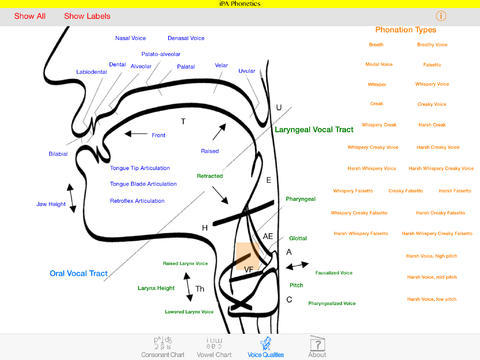
With those uninspired options behind me, I borrowed a friend’s iPhone (thanks Kent!) and tried the IPA Phonetics app, available from Apple’s app store. It is pretty much the perfect app. There are three main screens, a full consonant chart, a full vowel chart and a midsagittal view with different modalities and places of articulation all up to IPA 2005 spec. Every symbol you click on in vowels and consonants has audio and a video of someone making the sound - for hard-to-see articulations there are even laryngoscope views and ultrasound. Click on the modality terms (like creaky or falsetto) and someone will read those terms in that voice. There’s also a listen-to-the-sound and choose the right symbol mini-game. It’s, slick, comprehensive and a very useful tool. It would be great if they made an Android version, although I won’t hold my breath.
Do you know any good IPA or phonetics apps that I missed?
Anonymous asked:
Hi! I am doing Linguistics at uni currently, and I'm having trouble with acoustic phonetics. Do you have advice on how to determine what kind of laryngeal contrast a language has?
Hello, it’s likley that your classes have ended since you wrote this, but I’ll share my tips and tricks in case you continue with your studies, or for others who may have similar problems.
Laryngeals offer a bit of a challenge to budding phoneticians (and experienced ones too!). Also known as glotals, they are made far back in the vocal tract. This mean that you can’t really see any of the articulatory moving. With
sounds made using the palate or alveolar you can generally get up close
and look at where the tongue is placed.
There are two different things that you might be confused by - you might be confusing them with sounds made in other parts of the vocal tract (e.g. you might confuse them with pharyngeals made a bit further up the tract) or you might be confusing different features of the different laryngeal sounds.
You can use an audio illustrated IPA to help you practice hearing the differences (here is one from internationalphoneticalphabet.org, and another from UVic in Canada). You can hear that the pharyngeals have more involve frication against articulators, so it sounds less ‘clean’ (I’m sure there are more technical ways to talk about these things, but creating your own vocabulary can be helpful too).
If you are working with speakers of the language, as with every other distinction try and find minimally different pairs. This will indicate there is a distinction there, and help you train your ear to it.
Remember you can use tricks that are useful for other distinctions too - try replicate a sound while holding a finger to your larynx. If you get a buzzing then you are voicing the sound. Feel whether you’re using pharyngeal articulation or not using a similar technique.