







Bramble Berry is lucky to be situated in the Pacific Northwest. The “PNW,” as we affectionately call it, is home to gorgeous forests, thrilling hikes, and, yes, many damp fern-covered fern-covered rocks. (And by “damp,” we mean, “Yes, it always rains. I’m so sorry.”) This soap is an ode to my place and the trails I hike.
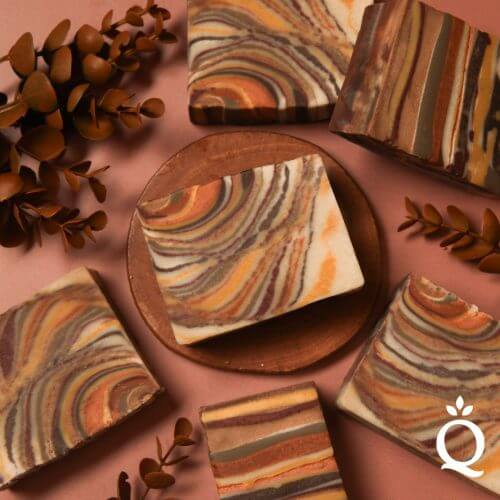
Wood Grain Soap Technique Final Bars
This project is an Advanced DIY, so if you’ve never made soap before, get a solid ten (or twenty) batches under your soapmaking belt before attempting this one. It requires a solid understanding of trace and the ability to work quickly – but if you’re looking for your next soapmaking challenge, this is it.
Let’s get started!
First, suit up for safety (and if you don’t know what this means, this video is for you … enjoy the OG Soap Queen, including the haircut).
I used the Bramble Berry Swirl Quick Mix (Not sure what the Quick Mix is? Explainer post + video here but in a nutshell, Quick Mixes are a product I developed to help short-cut the soapmaking process for soapers – they’re designed so you don’t need to measure anything but one Mix that we’ve carefully measured and calculated in our Bellingham, WA production warehouse.) If you want to go rogue and use your favorite xix of oils, know that you need a solid 10 minutes for this technique (it’s a lot of tiny little pours).
Recipe:
54 ounces Bramble Berry Swirl Quick Mix
7.61 ounces Lye (Sodium Hydroxide)
17 ounces Distilled Water
Optional but recommended: 3 teaspoons Sodium Lactate
Colorants; Pick 4-6 colorants that say “wood grain” to you; mix and match it up. I used oranges, yellows, and browns and mixed and matched them. Make sure to have titanium dioxide also mixed up for a contrast color.
Fragrance: I used Sensuous Sandalwood because it doesn’t affect trace or color, and, smells woody.
Pre:
Pre Mix your colorants – 1 teaspoon of colorant into 1 Tablespoon of lightweight oil like Avocado or Sweet Almond Oil.
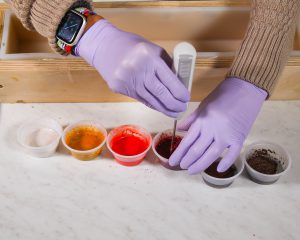
Pre-mix colorants to help prevent clumping
Lay out your containers for the individually-colored soaps that make up the wood grain. In this case, I used six different Bramble Berry Easy Pour containers to ensure I had enough.
Prop the soap mold on its side at roughly a 45-60-degree angle. I used the Bramble Berry Sliding Bottom Mold with the silicone liner. I used two hand towels to prop up so I could take one away at a time during the pouring process.
Instructions:
1) Measure your water (17 oz) and lye (7.61 oz) in two separate, chemical-resistant containers.
2) Carefully and slowly add the lye to the water (never the other way around). Ensure you are in a well-ventilated area with no kids or pets. Stir with your non-aluminum stirring utensil until the lye is dissolved. Set aside.
3) Heat your oils (or, in this case, your Quick Mix) to approximately 120 to 130 degrees.
4) Check your lye water for temperatures; if it’s around 120-130, it’s ready to add to your oils. Add the lye water slowly to your warm oils, slowly mixing in with a stick blender until you reach the very lightest trace (Not sure what ‘trace’ is or what the ‘very lightest’ of trace is? Some tips here or a full video of it here).
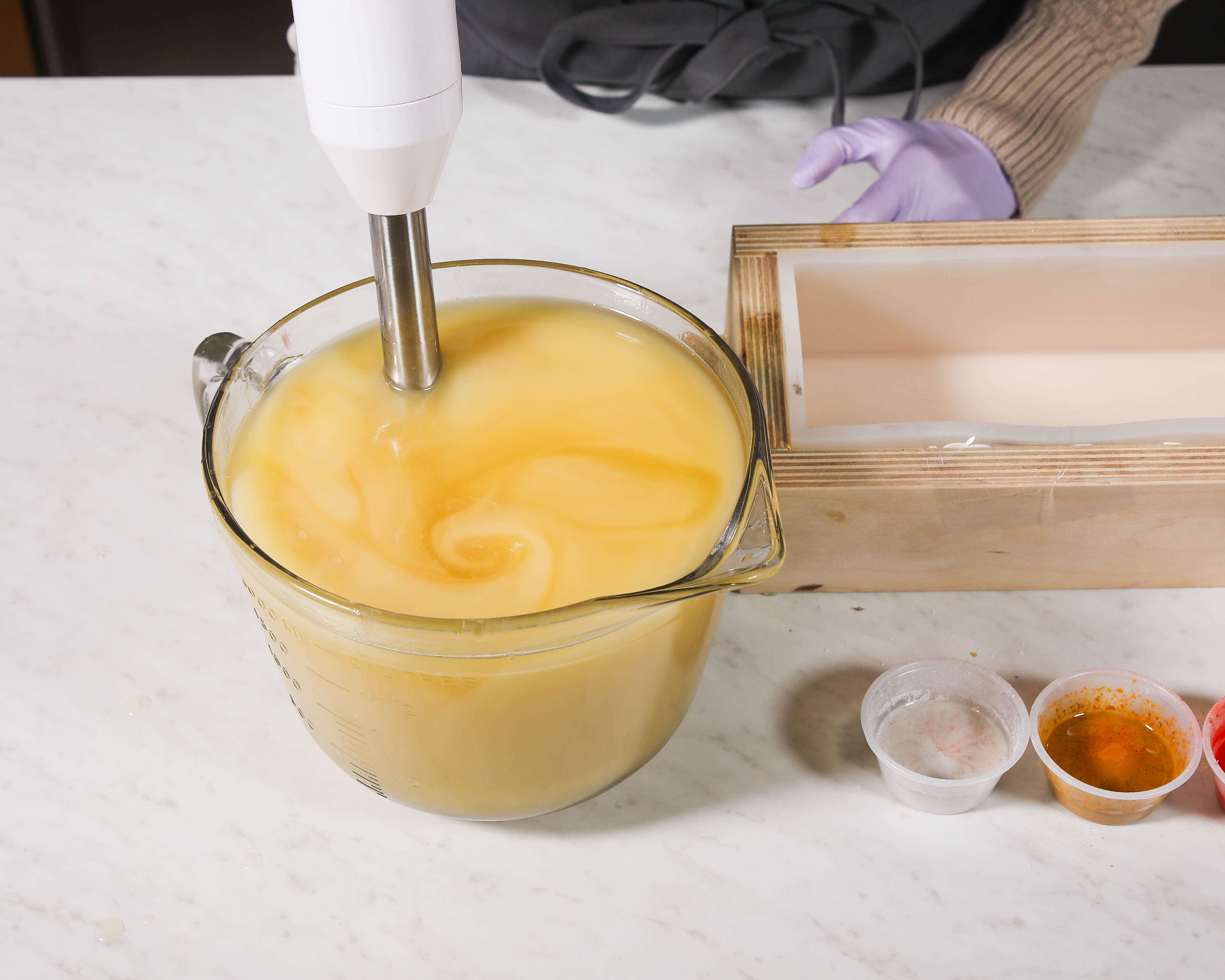
Stick blend to light trace
5) Separate the batter into 5 or 6 containers (or 7 or 8—however many colors you decided for your design) at the thinnest trace. Reserve the largest for your titanium dioxide-colored soap. It will provide the perfect contrast color for the wood grain colors.
6) Hand whisk in the colorants and fragrances until you reach the desired tone and hue. If any colors are not fully mixed in, stick blend in a short burst to incorporate the full color smoothly. Add the fragrances to the individual containers.
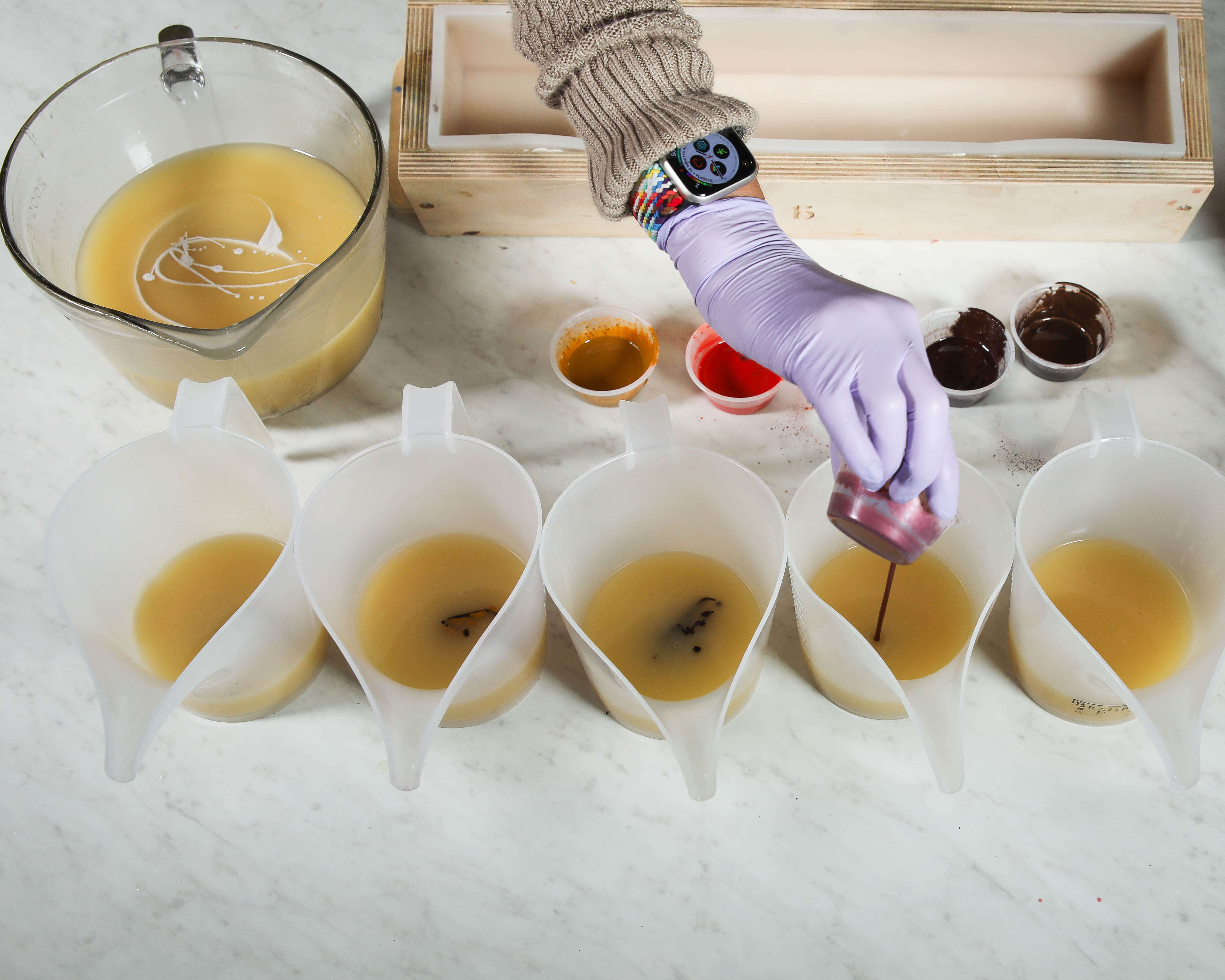
Add color before fragrance
7) Arrange each layer, color by color, in the order you plan to create your woodgrain design. Carefully pour the first layer down the side of the mold, followed by each successive color in the design. Alternate each color with a thin layer of white to ensure that the woodgrain design shows up. Keep pouring down the side of the mold; it’s awkward but that’s how the ‘wood grain’ design forms.
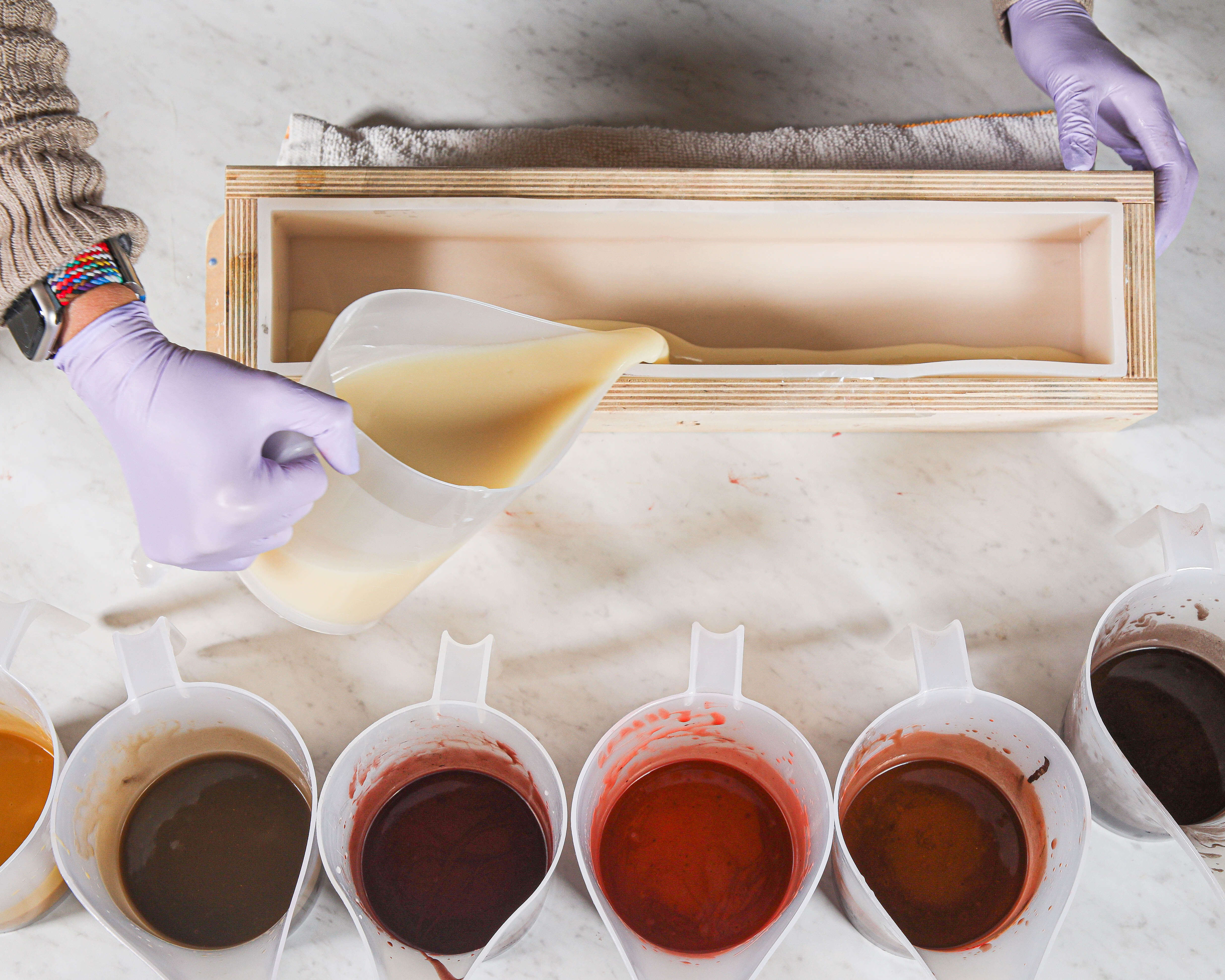
Soap is colored, fragrance and ready to pour
8) Keep alternating colors until the mold needs to be rotated down to 30 or 15 degrees. Continue pouring alternating colors until the mold is filled to the side again, and then put the mold on a flat surface. Pour the rest of the colors until the remaining soap is gone.
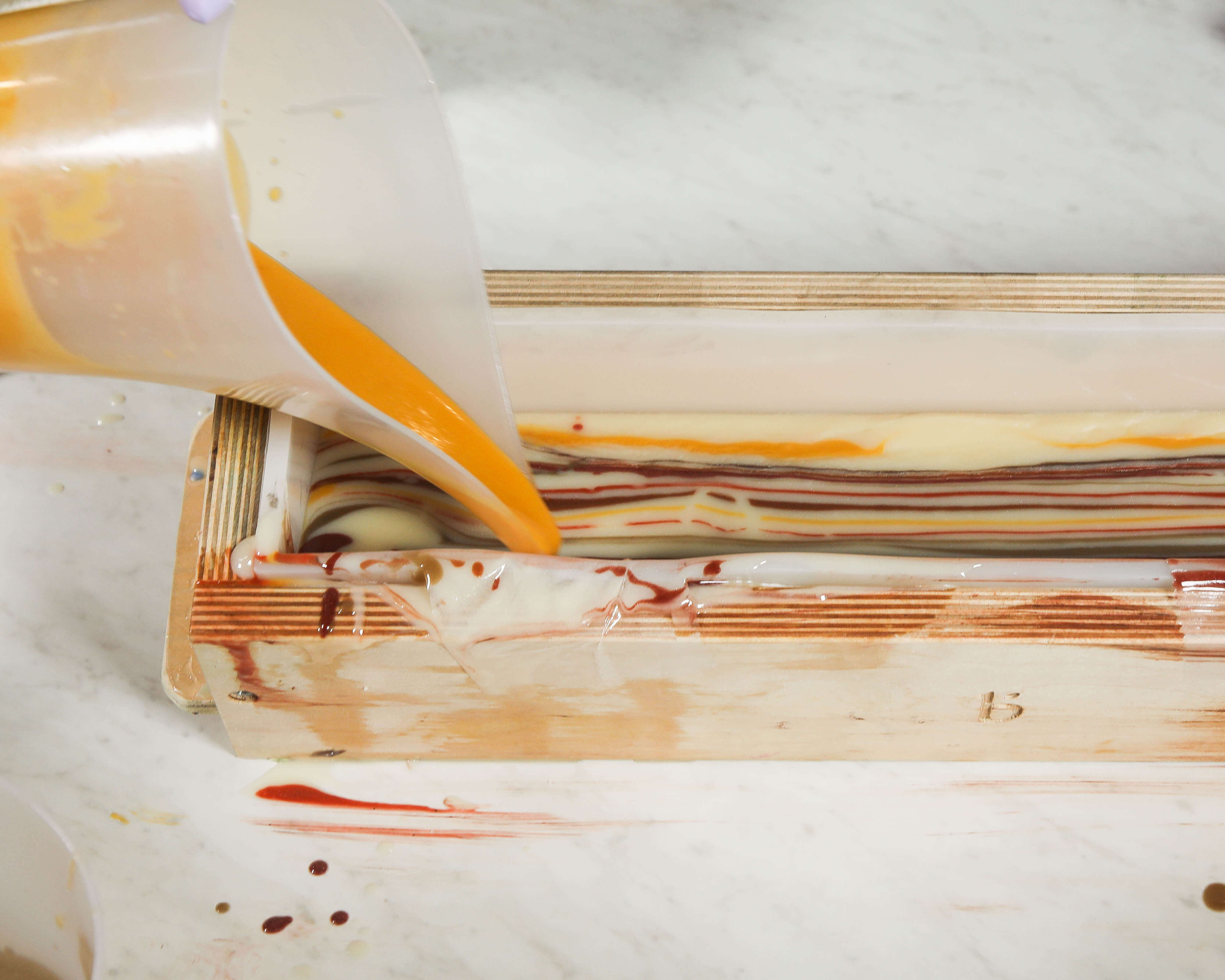
Multiple soap pours down the side of the mold
9) Spray the top of the mold with 99% rubbing alcohol to help prevent soda ash.
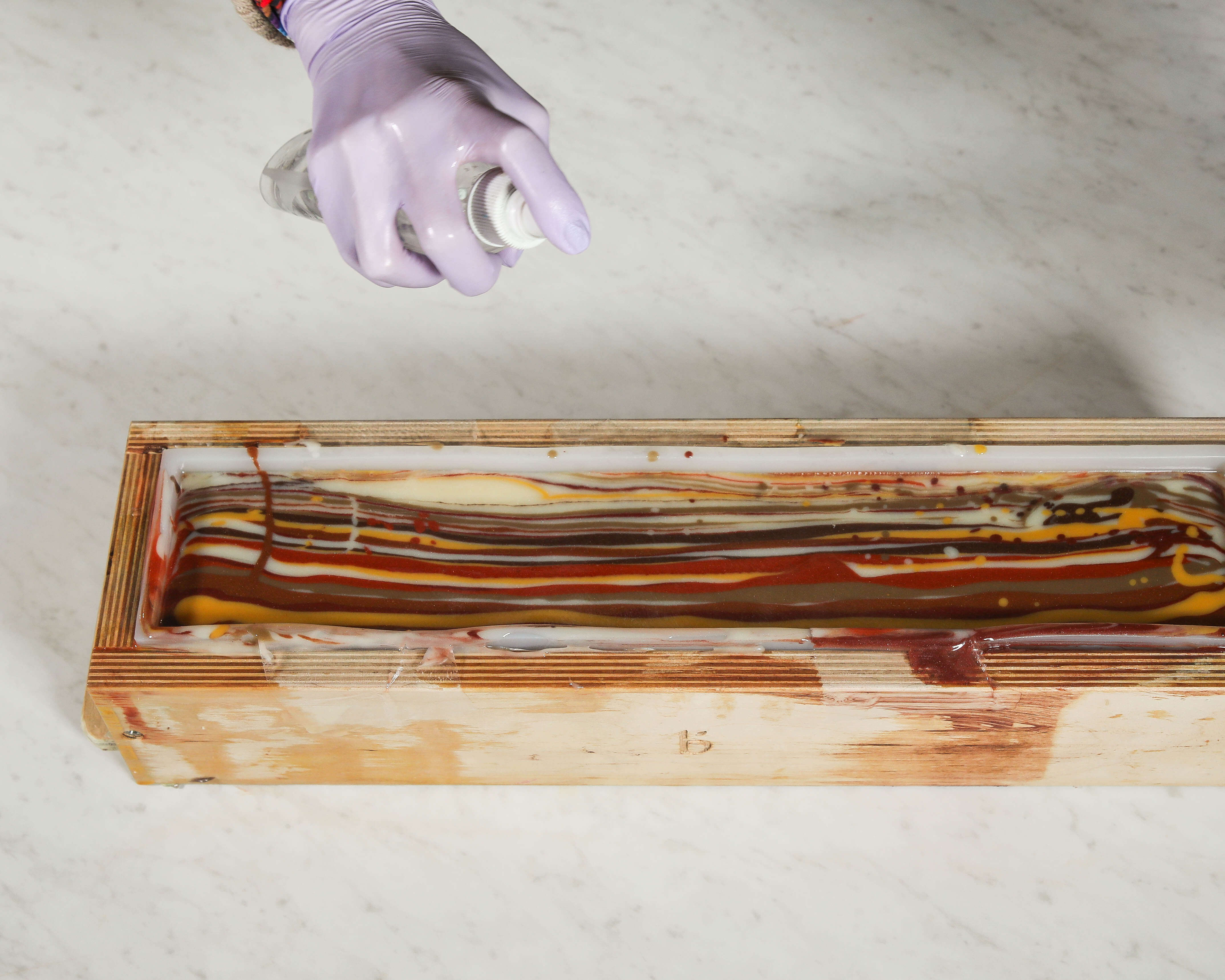
Spraying with 99% rubbing alcohol
10) Insulate your soap or put on a heat blanket to ensure the soap goes through the full gel phase (not sure what gel phase is? Full explanation here)
11) Let soap harden and dry until it is ready to cut. Cut into bars. Once cut, put in a fully ventilated area for 4-6 weeks until soap is fully cured, dried, and ready to use.
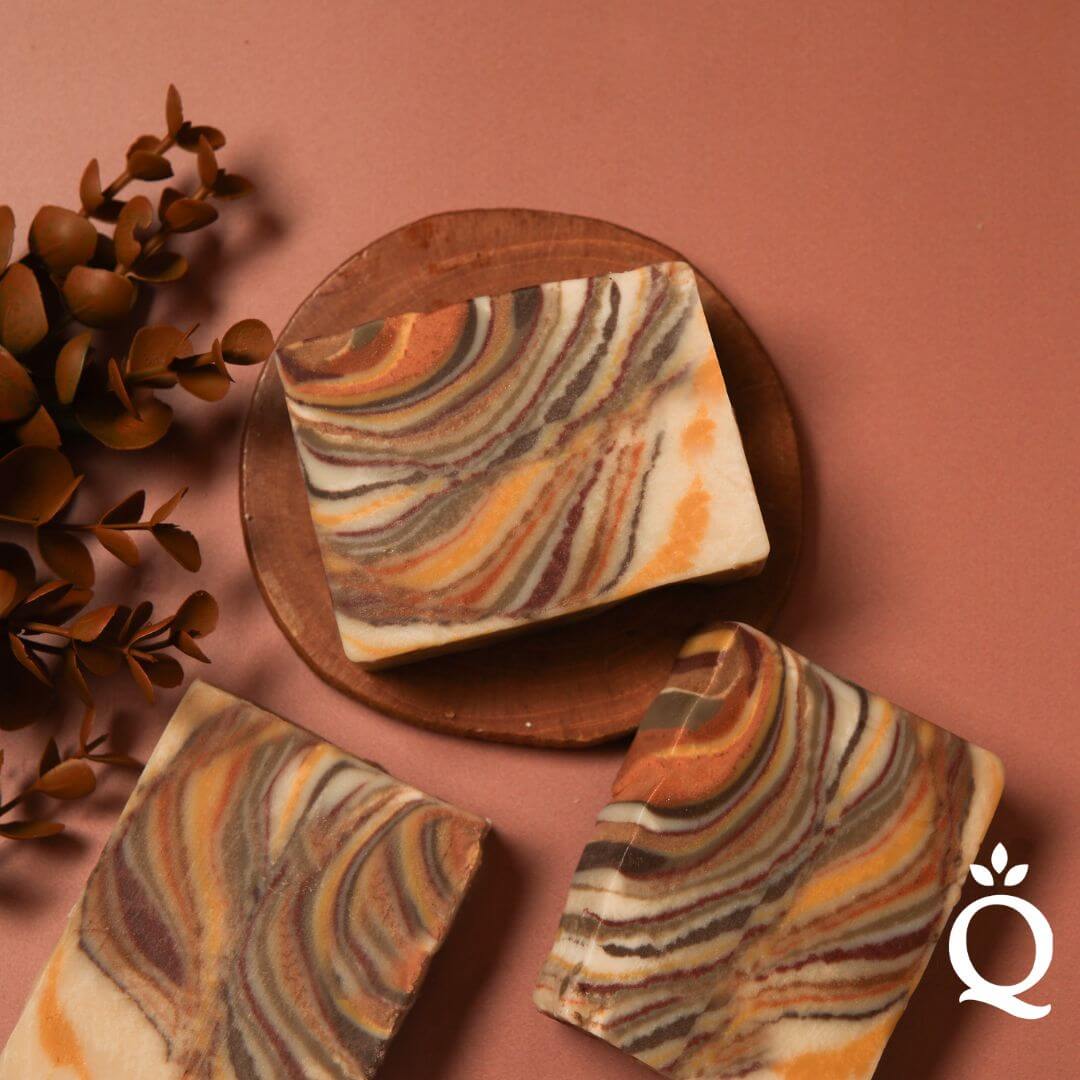
Wood Grain Soap
If you make this soap, I’d love to see it. Post your version of this and hashtag it #brambleon. I can’t wait to see what you create!
I pored over our sales reports for the last few months today. I realized that our essential oil line has been sadly underutilized in sales lately. I’m unsure if it’s because we started out as a fragrance oil company ten years ago and are mostly thought of as primarily a fragrance oil company. Or if … Continue Reading
Palm Oil is one of my favorite oils in soapmaking. It contributes to a harder bar and also helps Coconut Oil do its job and lather up big bubbles. Unfortunately, there are some negative repercussions from using Palm Oil to the environment. How can something natural be harmful to the environment? Demand for palm oil … Continue Reading
General Guidelines for working with essential oils – keep away from fire or naked flame – store in a cool place – keep out of sunlight – plastic bottles are a no as they allow the essential oil to evaporate and take on the plastic smell; additionally, plastic bottles generally collapse as they start to … Continue Reading
Thank you to Two Tadpoles, Teresa, One Bubble, Amber’s Ambry, and Soapaholics Anonymous for the blog shout outs this week. Heidi, your heat transfer method soap pictured above looks amazing. The texture really adds interest to the bar. Teresa, the soap (pictured on right) that your boys made is adorable! I love that you are … Continue Reading
This is a candle I made with 100% Stearic Acid. Why Stearic Acid? Because I saw some candles at a high end gift shop that were made with “Palm Wax.” They were very expensive candles and I thought, “Gosh, Stearic Acid is derived from Palm Oil. I wonder if I could just use Stearic Acid … Continue Reading
I have been addicted to hot oil hair treatments since I was about 12 years old. I used to warm the oil up, put it on my hair, and then rinse it out with apple cider vinegar/baking soda. I’m not sure that the last part of my hair treatment was all that healthy but I … Continue Reading
Since I started making soaps, I always wanted to take pictures of my projects. Even before I sold them online I wanted to keep an album of what I made. When I started to sell them on Etsy I realized that good photography was essential to being successful. Unfortunately I had no experience with product … Continue Reading
Have you tried Grapefruit Lily before? It’s a lighter, romantic fragrance with a clean finish. Though this fragrance is heavy on the Lily notes, the touch of Grapefruit makes it an intriguing scent. It’s also a fun scent to blend. I’ve included a few blends below that really make this fragrance a great one to … Continue Reading
Bramble Berry is lucky to be situated in the Pacific Northwest. The “PNW,” as we affectionately call it, is home to gorgeous forests, thrilling hikes, and, yes, many damp fern-covered fern-covered rocks. (And by “damp,” we mean, “Yes, it always rains. I’m so sorry.”) This soap is an ode to my place and the trails … Continue Reading
Yay! We’ve got a new video on how to make perfect charcoal lines, embed soap and, make a scraper tool. Craft a Heartfelt Gesture with Our DIY Love Letter Soap In the spirit of creativity and heartfelt gestures, embark on a DIY journey that combines the art of soap making with the timeless appeal of … Continue Reading
When diving into the world of soapmaking at 16, I began with the messiness of cold process soap, rendering fat, and navigating the challenges of a craft with scarce resources and zero instructions. The initial five batches were failures, leading me to explore the world of melt and pour soap, which, at the time, wasn’t … Continue Reading
Embrace Moisturized, Protected Skin with DIY Cleansing Facial Balm! Unmask your natural beauty with this easy-to-make, cost-effective Cleansing Balm! Designed to seamlessly melt away makeup, this balm stands out as a practical alternative to commercial formulas. For those new to the world of solid cleansing balms, consider this your gateway to a realm of skincare … Continue Reading
Ahhhh, I have been loving the DIY skin and haircare ingredients Bramble Berry has been bringing in. They’ve definitely gotten me trying new things well outside of the soapmaking realm. Yay! One of the most popular projects we launched was a solid cleansing balm which of course, got me thinking about how oils wash skin and … Continue Reading
Page [tcb_pagination_current_page] of [tcb_pagination_total_pages]
The Latest from Soap Queen TV
Inspired by Gems & Crystals
All About Essential Oils
The Power of Charcoal
Create Your Own Clay Face Mask
DIY Bath Bombs
Cold Process Soap Tips & Tricks
Learn the Basics of Cold Process Soapmaking
Learn the Basics of Melt & Pour Soapmaking
Want to Start Your Own Soap Business?
Soap Business Success Stories
Soap Queen TV Favorites
Ingredient Spotlight
Disclosure
Unless stated otherwise, all images are original material and are copyrighted. If you'd like to use an image, please be a friend and credit the photo and link back to Soap Queen. Feel free to share, tweet and pin to your hearts content.