How to Train Your Dragon meets Mad Max in this story of an orphan in a fractured Southwest who just wants to ride a dinosaur under the lights.
Come one, come all to the dinosaur rodeo!
Tif Tamim wants nothing more than to be a dinosaur buckaroo. An orphan in search of a place to rest his head and a job to weigh down his pockets, Tif has bounced from circus to circus, yearning for a chance to ride a prehistoric beauty under the sparkling lights of a big-top.
To become a buckaroo, Tif needs to learn the tools of the trade, yet few dino maestros want to take a scrawny nobody from nowhere under their wing. But when Tif frees a dino from an abusive owner and braves the roving gangs of the formerly-American west to bring the dino to safety, he catches someone’s eye. And boy, how those eyes dazzle Tif from the back of a bucking carnosaur.
My Review:
The opening scene of this book is absolutely, even cinematically, iconic. To the point where the reader can almost see it as the opening of a new Mad Max movie – except for one rather large detail.
It’s the scene of a young man pedaling a dusty but serviceable bicycle on a cracked and ruined highway in a blasted post-apocalyptic landscape. With a DINOSAUR walking beside him.
That’s right, a dinosaur. What’s that doing here? There? Whichever. Dinosaurs and humans never coexisted. At least not yet.
The story begins a bit in its middle, but in a way that absolutely does work. Because it starts with the boy and the dinosaur that he has definitely acquired by accident. Not that he didn’t always WANT a dinosaur, just that he never expected to be walking down the road with one.
He was hoping to RIDE dinos in the dino rodeos. (A phrase that needs serious unpacking – and gets it – in this story.)
So, first, the story backtracks to how Tif Tamim found himself on the road with an old, rather beat up, dinosaur, heading towards the nearest dino rodeo or circus so that he can deliver the poor dino back to its home in the Triassic era by way of the B2T2 time machine.
Even more to unpack there – and unpacking all of it forms the backbone of the rest of the story.
And it’s a doozy.
Escape Rating B: I picked this one up purely for the title. Seriously, there’s just so much to unpack in those four words, and whatever it was, I NEEDED to know.
What I got is one of those ‘story blender’ books – and it has to be a ‘story’ blender instead of a ‘book’ blender because not all the stories that got thrown into this blender are – or ever were – in books.
So start with the Mad Max movies, because the scenario is very much a Mad Max style blasted landscape, post-apocalyptic, dystopian setting. With perhaps a touch of Junkyard Cats for the distinctly American brand of the way that the country split into regions and races and religions and factions. (I’m not so sure about that reference to How to Train Your Dragon. You’d have to mentally squint a LOT to make that work IMHO and your reading (and viewing) mileage may definitely vary.)
Then add in a combination of The Kaiju Preservation Society or Julian May’s Saga of Pliocene Exile. Both are stories where portals open up between contemporary Earth and either times or places or both where either humanity hasn’t effed up the planet – YET – or where the ultimate in charismatic megafauna are the dominant species. Or both.
The question that pops up almost instantly is the one about ‘for every action there’s an equal or opposite reaction.’ Or the Jurassic Park version of ‘just because we could doesn’t mean we should.’
It’s possible that the time grabbing machine that’s picking up dinosaurs and depositing them on this near-future Earth is at least part of the cause of the current post-apocalyptic dystopian mess of the place.
But however much the time traveling dinos may be the cause of this mess, the story is about the effect. Not necessarily the effect on either the planet or on humanity – although both certainly play into it.
The story is about the effect on individual humans, which is how we wind this back to the boy doing his damndest to take the dinosaur to where it can get all the way home. Because the story is about him doing the same thing. Only in his case, it’s both forward and back to his found family, the brother he was forced to leave behind and the circus that adopts him into their hearts – along with his dinosaur.
And allows him one, bright, shining moment to be who he’s always wanted to be. A rhinestone buckaroo riding a dino.
While there’s a romance that doesn’t quite work (at least not for this reader) buried in the story of the boy and the dino and the circus, the thing as a whole worked pretty damn well, and absolutely did manage to live up to its fantastic title.
A proclamation by President Obama on 13 January 2017:
Those who dismiss the magnitude of the progress that has been made dishonor the courage of all who marched and struggled to bring about this change — and those who suggest that the great task of extending our Nation’s promise to every individual is somehow complete neglect the sacrifices that made it possible. Dr. King taught us that “The ultimate measure of a man is not where he stands in moments of convenience and comfort, but where he stands at times of challenge and controversy.” Although we do not face the same challenges that spurred the Civil Rights Movement, the fierce urgency of now — and the need for persistence, determination, and constant vigilance — is still required for us to meet the complex demands and defeat the injustices of our time. With the same iron will and hope in our hearts, it is our duty to secure economic opportunity, access to education, and equal treatment under the law for all. The arc of the moral universe may bend toward justice, but it only bends because of the strength and sacrifice of those who reject complacency and drive us forward.
…
NOW, THEREFORE, I, BARACK OBAMA, President of the United States of America, by virtue of the authority vested in me by the Constitution and the laws of the United States, do hereby proclaim January 16, 2017, as the Martin Luther King, Jr., Federal Holiday. I encourage all Americans to observe this day with appropriate civic, community, and service projects in honor of Dr. King and to visit www.MLKDay.gov to find Martin Luther King, Jr., Day of Service projects across our country.
As of the drafting of this post, Trump has not deigned to release a proclamation for MLK Day 2026. I, for one, will not be waiting for it: he said enough last year by dropping MLK Day and Juneteenth as free-admittance days for national parks in favor of his own birthday.
If the moral arc of the universe bends towards justice only through the effort of people, it can certainly bend the other way. We are now living in dangerous times for our Republic, with the outcome uncertain.
King himself certainly had no illusions that the Civil Rights Movement, despite its clear victories, was something forever settled with the signing of the Civil Rights Act in 1964; he was killed while seeking justice for Memphis’ sanitation workers. Had he lived on until a peaceful death at a natural age, there cannot be any doubt that he would have been occupied the entire time remaining to him with that fight for justice.
Today the administration has seen fit to not do so much as dust off a web page listing some volunteer opportunities to mark this day. But we don’t need the prompting. King did not ask permission of the White House to strive for justice; despite everything, he understood that “the goal of America is freedom”. How better to mark his birthday—and all the days thereafter—than to follow his example? If we are to be a free people, we must exercise that freedom and resist those who would fence it in through bonds of hate.
As you read this, I’m on the last day of a four-day marathon Zoom meeting and my brain is probably toast. This is a once a year thing, as whatever ALA committee I’m on for the year has its final deliberations meeting. It’s generally a lot of fun, it’s always fun to talk about good books, but four solid days of Zoom is just, well, A LOT.
I’m sure that each of the cats will keep me company in one way or another for a bit each day. Several of us have pets and they generally serve as both comfort and comic relief – and we’ll all need both of those things before it’s over. One year, Hecate had OPINIONS and started waving her bunghole in front of the camera. Being obedient humans, we immediately changed whatever subject had ‘Her Highness’ so incensed.
Today’s cat picture is of Miss Luna, who hasn’t been featured for a while, participating in one of Galen’s work meetings. She also looks very much like she’s posing for her close-up. And she’s gorgeous at it, which of course SHE KNOWS. She absolutely KNOWS.
I definitely picked up You Had me at Bigfoot, while the books I’m most looking forward to getting into are Brimstone Hollow, Junkyard Riders and The Last Contract of Isako. I’m also really glad that Junkyard Riders is publishing in ebook and audio simultaneously, which has not been the case until now. I love the audio, I enjoy the narrator’s voice, but there have been times when I’ve been desperate for a text just so I can spell all the names properly in the review. I’m happy to have one this time around.
The books I’m most curious about are Homemaker and Trailbreaker. I loved Ruthie Knox’ earlier work but I haven’t seen her name on a book in quite a while. It looks like I’ve missed a few, so these new books are a great chance to get caught up!
What about you? What new or new to you books are calling your name from YOUR stack?
Winter started yesterday here in the ATL and it looks like it will be over in the middle of next week. I’m joking, but not by all that much. The winters here seem to get warmer and shorter every year. Very much on the other hand, the summers are longer and hotter than Hades.
Still, climate is what you expect and weather is what you get. But it doesn’t feel like we’re getting quite the climate we used to – at least not around here.
Part of the attraction of moving to Atlanta was that we got all four seasons, but winter wasn’t all that much. And that’s the way we’d prefer it. What about you? How much winter is too much? How much is not enough? What’s just right for you?
For more frosty winter prizes, be sure to visit the other stops on this hop!
MamatheFox, Mom Does Reviews, and all participating blogs are not held responsible for sponsors who fail to fulfill their prize obligations.
A transportive work of historical fiction chronicling the life, loves, and larger-than-life successes of Rafael Guastavino, an influential yet largely forgotten Spanish architect of New York’s Gilded Era
Iconoclast. Genius. Womanizer. Architect Rafael Guastavino’s signature vaulted tile ceilings revolutionized Gilded Age New York City. The Oyster Bar in Grand Central, the Prospect Park Boathouse, and the iconic Old City Hall subway stop, number among his masterpieces. But while his works continue to imbue the city with the glamor of a bygone era, the man himself has been largely forgotten. Until now.
Told through the eyes of Guastavino’s son and business partner, Javier Moro’s magnetic prose brings to life the remarkable rags-to-riches journey of this influential immigrant family. Guastavino was a stubborn man, enamored of his own sense of destiny, but he was also a deeply compassionate father, as committed to his family as he was to his work, and equally defined by his successes in the latter realm as by his failures in the former.
Set against historical events including the Chicago World's Fair and the sinking of the Titanic, The Architect of New York is a moving and entertaining father-son story filled with finely developed and deeply researched real-life characters (including figures like Stanford White) that captures the glamor and drama of a bygone era while offering a perrenial glimpse into the human heart.
My Review:
They called him “the architect of New York” in his New York Times obituary dated February 2, 1908. And he was. Or rather, THEY were. The title in the obituary, at the time it was written, referred to the elder Guastavino, Rafael Guastavino Moreno, but even then it could have referred to either Rafael Guastavino, the father or the son he named for himself and trained to be his protegee, his right-hand man, and his shadow.
As told in this fictionalized biography/autobiography, not even the two Rafaels Guastavino could tell where the one ended and the other began. And by the end of this story, it’s clear that, as much as he might have wanted to stand apart from his father as a young man, once his beloved father was gone he wished he’d never been forced to discover where that line was drawn.
Rafael Guastavino (1842-1908)
The story reads as if it was intended to be a biography of the older Guastavino. But that biography is written as if from the perspective of the younger, and he tells his own story just as much – if not at points a bit more – than he does his father’s. After all, he knows his own story better AND remembers what he thought and felt as the events he witnessed actually happened.
His father was often a closed book, partly because this story begins when the younger Guastavino, called Rafaelito to distinguish him from the larger-than-life persona of his father, was merely nine years old. A boy, recently immigrated to the United States, with his parents and his older sisters, in the midst of his family tearing itself apart due to stresses that he was, at the time, too young to understand.
But also, and more prominently as Rafaelito’s story continues and he grows in maturity and understanding, because the bits of his father’s life in their native Spain that his father reluctantly reveals over the years contains a great deal of truly messy embarrassments and outright scandals, and the father doesn’t want to tarnish the worship in his son’s eyes.
As much as Guastavino senior had been at the (first) height of his career as an architect and builder when he fled Spain for America on borrowed – and possibly swindled – money, as a human being he was a bit of a louse. More than a bit when it came to his relationships with women.
Part of Rafaelito’s growing up included the discovery that his mother was not his father’s wife, that older his sisters were his half-sisters AND that he had older half-brothers (sons of his father’s first and at the time legal wife) that he’d never met, that the woman in New York City who loved him like a mother couldn’t legally marry his father, and that dear old dad cheated on her, too, repeatedly.
Senior also sent the family – however untraditionally it was constituted – into desperate financial straits over and over again because he could not manage money to save either his soul or whatever building company he was operating at the time.
He always meant well, but he didn’t always do well – at least not personally. Professionally, Guastavino senior was a bit of a dreamer – but he was often right and always visionary. His ability to execute those visions, when he was forced to rely on others outside himself, was hampered by his inability to see the way the world really worked.
But his buildings assuredly did – beautifully so – and in many cases, still do.
The elder Guastavino’s story is a compelling one. It’s a riches to rags to riches to rags to riches story told from the perspective of a person who knew him intimately, shared his life, his work, his profession and his company – and loved him much too much to have anything like an unbiased opinion on anything to do with the man he saw as larger than life until long after the end of it.
That their identities became so intertwined that the many, many buildings they created or helped to create, including parts of Vanderbilt’s famous Biltmore Estate, the Boston Public Library, the Spanish Pavilion at the 1893 Chicago World’s Fair, and several glorious and iconic New York City Subway Stations are now often credited to the company they shared rather than either of them individually.
So, in the process of telling his father’s story, a labor of love for a man now old enough to look back and see a bit more of his father’s truth, Rafael Guastavino, Jr. also does a heartfelt and heart wrenching job of telling his own.
Guastavino Vault in the Boston Public Library Entrance TODAY
Escape/Reality Rating A: To quote Mark Twain, one of the elder Guastavino’s contemporaries, “Truth is stranger than fiction, but it is because Fiction is obliged to stick to possibilities; Truth isn’t.” The story that Rafaelito tells in The Architect of New York is so wild that it seems over the top at many points – and yet it’s all based on the known facts of the man’s life and the work that he – and his son – left behind all over New York City, most of the Eastern Seaboard and all the way across the country.
Which is why this is both an Escape and a Reality rating. As a reader/listener (mostly listener), I certainly escaped into this story. As someone fascinated with history, that the bones of this story are both true and not well known made for a delightful voyage of discovery. The Guastavino designs remain gorgeous examples of New York City’s Gilded Age and Art Deco periods, with their sweeping vaulted ceilings and glorious ceramic tilework.
At the same time, because this is a fictionalized version of a real life it’s difficult to separate what happened from how it’s being told. I both don’t want to critique the man’s actual life – but I also do because his personal life was, to put it in 21st century terms, a hot mess. One of his own making, at that. While he didn’t actually marry all of the women involved, he did also kind of bypass bigamy on the way to trigamy – just not in a legal sense which would have gotten him in even more hot water than he was already in up to his neck.
By telling the story through Rafaelito it allows the author to put a bit of gauze over the lens of objectivity, and also puts the focus more on the work they did together. It turns the story of a truly wild life into a story about the relationship between fathers and sons, the relationship between the immigrant generation and the more formally educated second generation, and, in a business sense, the relationship between the hard driven founding generation and the softer, more privileged generation that comes after them. Those stories, those relationships, are universal and are beautifully explored here.
Rafaelito’s later-in-life reflections on just how much he STILL misses his father, on how much he regrets their frequent arguments, how heartbreakingly often he wishes he could go back in time and tell his father how much he loved him just once more, will bring tears to the eyes of anyone with a heart – especially those who lost their own fathers before they had a chance to realize everything they would miss.
The Architect of New York is a beautiful, absorbing LOT of a story. The audio, read by Robert Fass, was also very well done. Something in the narrator’s voice allowed me to sink right into the story, and that was just right as the story is more than dramatic enough to the point that too much vocal embellishment would take away from it.
Rafael Guastavino, Jr. (1872-1950)
In the end, I was surprised by how much I enjoyed this book, both for its story and for its peek into the Gilded Age and turn of 20th century America, as well as for its tale of love and independence and fathers and sons. If you enjoy stories of fascinating characters with big dreams, even bigger accomplishments, and feet of clay up to the knees, it’s a compelling journey from beginning to end.
One final note; Throughout my absorption in this book, as I listened to the narrator there was a song running through my head. The song, which has reached earworm status and I can’t get it out, is “Leader of the Band” by Dan Fogelberg. Because, the story in that song, the story of Fogelberg’s love for his own father and appreciation of his legacy, may refer to a different shared profession but is very much the same story. A story about a son whose life “has been a poor attempt to imitate the man” and feels as though he’s “just a living legacy” to the father he loved and worshiped.
"A humorous yet poignant queer romance in a fantasy-period setting. Just the thing for grown-up fans of Alice Oseman’s Heartstopper, Kevin Panetta’s Bloom, or Jarrett Melendez’s Chef’s Kiss who are intrigued by the occult." —Library Journal, starred review
A half-demon socialite-turned-exorcist and his disgruntled bodyguard have no trouble facing down the hordes of darkness—but facing their feelings for each other? Well now, that’s a whole different story . . .
Helianthes is a Cambion—a child born touched by demons. Horned, clawed, and tailed, Helianthes—Hell for short—is a devil-may-care exorcist whose devil-may-care attitude has succeeded in alienating those closest to him—all save for his long-suffering bodyguard, Elias, who sees him as less a strange, mythical being and more just a . . . nuisance.
Together, the two venture into the streets of this psuedo-remix of Victorian London to exorcise demons (and maybe cause a little mischief on the way). But as Hell becomes increasingly drawn to his enigmatic bodyguard—and as Elias becomes increasingly aware of his feelings for his trouble of a charge—the two find themselves faced with a growing, chaotic dark that might threaten everything they’ve been working toward . . .
A world of half-demons and the boys who love them await in this epic queer romance by writer/artist Mari Costa!
My Review:
I originally picked this up because I fell in love with the author’s cozy fantasy novel, Shoestring Theory, about a cat and his wizard. I fully admit that I was there for Shoestring a whole lot more than I was for Cyril, Shoestring’s poor, incompetent human. I doubt anyone is surprised by this one little bit.
I don’t read a lot of graphic novels, but I loved Shoestring a lot, and this was recommended to me as part of a panel I was asked to moderate for Library Journal (LibraryCon Live) and it looked like fun. I had a ball with all of the books for the panel, but read them really fast and wasn’t planning on reviewing them all.
This one stuck with me. Or Shoestring was prodding me to come back to it. Perhaps a bit of both. Because it’s a bit of a devil’s food cake kind of book, literally and figuratively, and I’m always a sucker for sinfully dark chocolate.
Something like that, anyway.
The story you start out with it not the story you end with, while the ending makes you realize that the story you started with wasn’t the real story in the first place.
Cryptic enough?
Because we start with half-demon Helianthes Beausoleil being absolutely railed by his future brother-in-law. Well, his erstwhile future brother-in-law, as their romp is interrupted by the arrival of Hell’s sister and needless to say the engagement is OFF.
At first it seems like Hell is just a chaos agent, causing destruction wherever he goes, living down to the opinion that everyone has of him. After all, he’s a cambion, a half-demon, supposedly filled with all of a demon’s sins and all of a human’s weaknesses. Breaking his sister’s engagement with a sex scandal is EXACTLY the sort of thing that everyone expects of him.
This is where the story goes in a direction that the opening does not lead the reader to expect. Because Hell’s parents throw him out of the house, but send a bodyguard with him. Forcing him to make his way in the world while still trying to keep him safe.
And it’s the making of him. That’s the story. The story of half demon Hell going into business as a demon hunter, taking on the jobs that only he can, getting those very dangerous jobs done and making himself an entirely different kind of reputation along the way.
Not that it does anything to erase his reputation as a self-indulgent wild child, because that scandal is just too damn delicious for anyone to let go of.
But underneath that story is the real Hell. (Pun possibly intended, but sorta/kinda not). Because Hell is alone and lonely and a bit desperate for love and companionship and the only one he can trust for either of those things is his dog Cerberus. (The panel of Hell hugging Cerberus because no one else could ever love him is utterly heartbreaking.)
Meanwhile, standing right beside him – and occasionally in front defending him – is his bodyguard Elias. A man who tells Hell he’s being an absolute ‘bellend’ when he’s being an absolute brat, doesn’t take any shit, has no clue about fighting demons but sticks by Hell through thick and thin.
And it’s their story, the story of a lonely young man getting by on his wits and bravado, and a man just barely older using his size to cover up his soft heart, trying to be brave for each other while not revealing – or seeing – that they are so far gone for each other that nothing and no one can get between them.
Not even Hell’s obsessive, possessive ex who thinks that turning Elias into an actual monster will win back a Hell that he only thought he once had – but never really knew. At all.
Escape Rating A-: I was charmed by the grumpy/sunshine relationship between Helianthus and Elias. That Hell is the literal sunshine in their relationship while Elias is the grump is deliciously ironic. And I was captivated by the slow build of the reluctant romance between the two.
The story exists on two levels almost all the time, but not in the same way. The story on the top is the action/chaos/hellraising/hellbeating story, where Hell seems to be the optimistic fool rushing in where angels fear to tread. But then he would because he’s half demon.
At the same time, as Elias observes, whatever Hell looks like or dresses like or sounds like or acts like, he’s out there working, for real, as a vigilante, exorcising demons and saving ordinary humans. He may play at being a thorough reprobate, but he’s clearly one of the ‘good guys’ if you look beneath the provocation and flamboyance.
Hidden in the artwork, however, is the true story of their growing relationship. No matter what either of them says – and Hell says a lot while Elias doesn’t say very much at all – every scene shows them looking towards each other for reassurance, for acceptance, and for a love that neither is brave enough to admit.
One of the terrific things about this format is that their eyes are telling a quiet romantic story while the lion’s share of each panel is showing a whole lot of action and danger even as the dialog delivers some truly epic banter to devastating effect.
In the end, this is a charming, steamy, romance AND a beautiful story about being loved and accepted for who you really are and not settling for anything less. I’m very happy I picked it up to reread – more thoroughly this time, and I’m looking forward to the author’s next, especially if I get to catch up with Elias and Hell and especially Cerberus – so that he can steal the show again!
When you lose your way in life, the Elsewhere Express just might find you. Step aboard the train that can take you to your life’s purpose, in this cozy and inspiring fantasy from the nationally bestselling author of Water Moon. This whimsical, deluxe first edition hardcover includes designed sprayed edges, a full-color illustrated book case with character art, and interactive endpapers with a scene you can color in—while supplies last!
You can’t buy a ticket for the Elsewhere Express. Appearing only to those whose lives are adrift, it’s a magical train carrying very rare and special cargo: a sense of purpose, peace, and belonging.
Raya is one of those lost souls. She had dreamed of being a songwriter, but when her brother died, she gave up on her dream and started living his instead.
One day on the subway, as her thoughts wander, she’s swept off to the Elsewhere Express. There she meets Q, a charming, handsome artist who, like her, has lost his place in the world.
Together they find a train full of wonders, from a boarding car that’s also a meadow to a dining car where passengers can picnic on lily pads to a bar where jellyfish and whales swim through pink clouds.
But they also discover that the train harbors secrets—and danger: A mysterious stranger has stowed away and brought with him a dark, malignant magic that threatens to destroy the train.
But in investigating the stowaway's identity, Raya also finds herself drawing closer to the ultimate question: What is her life's true purpose—and might Q be connected to it?
My Review:
The Elsewhere Express is a train. Well, it takes the form of a train. Whether or not it’s actually or exactly a train is up for a bit of a debate. It’s mostly a metaphor. Well, sorta/kinda. And does that EVER need some explanation.
Which is not what the two most recent passengers on the Elsewhere Express get. Also not exactly but sorta/kinda.
There’s a LOT of that going around this particular train.
The Elsewhere Express is where people find themselves when they want to or need to be, well, elsewhere. When they’re wishing themselves someplace else. When their burdens are too heavy to carry. When life is too much and they want to escape.
And all of those thoughts and griefs and daydreams, right and wrong and good and bad, make up the Express. Literally. Every single car, every single device, every single bit of food and drink, everything, everywhere all around the passengers is built on thoughts and dreams – and maybe just a few nightmares.
So the Express is a place to get away from all of that, where a passenger can leave all their troubles behind. But the problem with people is that, no matter where you go, there you are. You bring yourself and all your worries and griefs with you wherever you are, no matter how much you want to get away from them.
But the Express has a solution for that, too. A potion that each passenger is expected to take that makes them forget all the excess emotional baggage they brought with them on the train.
Which is both a relief and a gigantic problem, as its our memories that make us who we are – even if who we are is depressed and grief-stricken and weighed down by worries and expectations.
That’s where, and when, Raya and Q board the Express. Raya, musician turned medical student, can’t get over her grief or her guilt over the death of the brother she was born to save. Q, an artist, can’t get past the loss of his sight – and his dreams – or the suicide death of his father.
Q would love to forget all of his griefs and just live for today on the Express, because his today on the Express has magically restored his sight. Raya doesn’t believe she deserves to stay and forget, because the emotional baggage she’s unwilling to drop is her guilt.
But Q and Raya are unique on the Express in that they are the only passengers who have not taken the forgetting potion – at least not yet. And the Express desperately needs people who have not forgotten what it is to feel pain and most importantly, break the rules.
Otherwise the Express is going to die, because no one, not even the staff entrusted with her care, has enough fire in their belly to risk everything in the hope of saving someone – and especially each other.
Escape Rating A-: I picked this up because I enjoyed the author’s previous book, Water Moon. Howsomever, having read that I was expecting this to also hit some of the same notes, meaning that I expected magical realism filled with sad fluff that goes to bigger questions but leaves the reader to work out the answers in their own heads.
And I certainly did get all of that. Along with a combination of the movie Somewhere in Time (or the book of the same title by Richard Matheson), Alice in Wonderland and even The Wizard of Oz. Meaning that the characters have been dropped through the ‘looking-glass’, that there is more than one someone hiding behind the curtain, and that they fall in love in spite of not being in sync in time and space.
That story, and this book, are underlaid by the desire to forget the things that bother us, and include a fantasy/SFnal means of doing so. The stories that follow, both Ross’ short story and this novel, deal with the collateral damage of actually doing it. In (or on) the Elsewhere Express the long-term consequences are only dealt with by implication, along with the question of just because a person is comfortable and busy, does that mean they are actually happy.
It’s a question that doesn’t get answered in the story, but then it can’t. It’s left to the reader to wonder. A LOT in the case of this particular reader.
What this story turns out to be is a quest and a chase, about caring enough to make a selfless sacrifice for the one you love, and about doing a duty to make that sacrifice feel worthwhile. I was expecting this to have a bittersweet ending – because that’s where everything was heading.
That it squeaked out a happy ending in spite of all the expectations that were set was a bit of a surprise and an absolute delight.
From New York Times bestselling and Hugo Award-winning author T. Kingfisher comes Nine Goblins, a tale of low fantasy and high mischief.
No one knows exactly how the Goblin War began, but folks will tell you that goblins are stinking, slinking, filthy, sheep-stealing, henhouse-raiding, obnoxious, rude, and violent. Goblins would actually agree with all this, and might throw in “cowardly” and “lazy” too for good measure.
But goblins don't go around killing people for fun, no matter what the propaganda posters say. And when a confrontation with an evil wizard lands a troop of nine goblins deep behind enemy lines, goblin sergeant Nessilka must figure out how to keep her hapless band together and get them home in one piece.
Unfortunately, between them and safety lies a forest full of elves, trolls, monsters, and that most terrifying of creatures…a human being.
My Review:
Before you begin reading Nine Goblins – and you SHOULD read Nine Goblins – expunge everything you think you know about goblins from your head. Because these goblins are not like that at all. And considering the way that goblins (and orcs and other supposedly born evil creatures) are used in fantasy as substitutes for whatever foreign element of the population is the enemy of the day, they probably never were.
I digress, but it fits right in because Sergeant Nessilka of the Goblin Army does that too. Think about how things really are and how they’re really going to go and what’s really going to happen to her squad – even though the Goblin Army brass always leads with big hopes and high expectations that are unlikely to be realized by anyone at all, let alone the band of misfit grunts that she has the dubious privilege of herding around more or less in the direction of a battlefield.
Then again, the Goblin Wars, the wars between the humans who took over all the land that used to be goblin territory, and the goblins who gave way until they reached the far ocean and discovered that there was no place left to go except backwards, aren’t exactly what the high muckety-mucks say they were about, either.
Especially the ones on the human side. The goblins are pretty clear about where they stood, and that they’d run out of land to stand on. And if you hear the echoes of ‘manifest destiny’ in the human position on all this, you’re not imagining things. Or we’re imagining the same things.
This particular story in the midst of those terrible Goblin Wars isn’t about blood and battles. It’s absolutely not a story about the battle between good and evil, neither of which are present on the battlefield or anywhere else – which is kind of the point.
Sergeant Nessilka and the nine members of her squad who find themselves in the middle of this mess are pretty much lost and doing the best they can to get home. Because magic isn’t half so codified or functional as a whole lot of fantasy stories might lead one to believe, and they got caught up in a wizard’s spell that went very, very wrong. For select definitions of wrong – which is where magic usually goes in this world.
The wizard was just a kid who wanted to go home, and had the magical ability to make that happen. The story begins when he scoops up those nine goblins and takes them along for his ride, leaving him unconscious and a bit short of his goal, while putting the goblins 50 miles INSIDE enemy lines with no easy way to get back home and no desire – or possibly even capacity – to cut a bloody swath across human territory.
Which is how they sneak their way into the home of an elven veterinarian who prefers animals to people and goblins to humans or even elves most of the time. He’s happy to help them get home, but there’s another wizard in their way. One who is cutting a bloody swath through the countryside – and doesn’t care at all if she includes a few goblins – and at least one elf – in her bloodbath as long as she gets her way.
Escape Rating A: Nine Goblins is cozy fantasy from before cozy fantasy became cool. It’s probably a grandmother or a godmother (or both) for the whole cozy fantasy thing in one way or another, and I think that Sergeant Nessilka would be absolutely fine with that. If she had time to think about it for a minute – which she generally doesn’t.
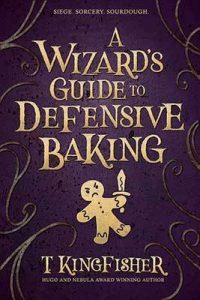
I picked this up because Kingfisher. Really, truly, that’s the reason. I fell in love with her work when I read A Wizard’s Guide to Defensive Baking and have been working my way both backwards and forwards ever since. In fact, I was listening to her latest, Hemlock & Silver, as I was reading Nine Goblins, which is one of her early works for adults. The comparison and contrast between this earlier work and her latest has been fascinating!
But she’s become so popular in the last few years – and rightfully so – that Tor Books/Tordotcom is bringing out a lot of her earlier work in spiffy, new and more widely available editions (like this year’s re-release of Swordheart with the glorious new cover) than was originally the case considering that Kingfisher originally self-published Nine Goblins on SMASHWORDS in 2013.
I’m going to squee more than a bit because I had a fantastic time with this book. It reminds me a lot of both Mary Gentle’s Grunts and Jacqueline Carey’s books Banewreaker and Godslayer and Jonathan French’s The Grey Bastards, as they are all fantasy stories told from the perspective of ‘the other side’, the folks who are supposed to be ‘evil’ but are instead just people with a different agenda. If the winners write history – and they do – then these are stories told from what usually turns out to be the ‘losing’ side.
Sergeant Nessilka and her squad just want to go home. They’d also like to stop the war, but Nessilka, at least, knows that’s impossible at this point. Both sides are much too invested in revenge to come to a negotiating table, and both sides have spent lives and years in demonizing the enemy to the point that there is no trust on either side to make such negotiation possible.
But this is a cozy fantasy, which means it’s not about making war. It’s not even about waging peace – although it turns out to be. Instead, it’s about small groups on both sides who, instead of taking the knee-jerk way out when they find themselves face to face, unite against a common enemy and discover that the enemy of my enemy may not exactly be my friend but absolutely IS a person who isn’t all that different from themselves in spite of just how different they look from each other.
The story is told with wry and self-deprecating humor – as Kingfisher’s stories often are – from the first-person perspective of Sergeant Nessilka. A character who very much reads and feels like the author’s own avatar, just as Mona is in Wizard’s Guide, Halla in Swordheart, and Anya in Hemlock & Silver.
Nessilka is a ‘feel the fear and do it anyway’ kind of character, and the reader empathizes with her from the beginning because she’s honest and true inside herself and honestly and truly knows that her squad is FUBAR’d but she’s still doing her damndest to get them home in the same number of pieces that they started in.
The story rollicks along, partly because of Nessilka’s marvelous internal dialog, but also because there’s just so much going on, they’re jumping from the frying pan into the fire every step, and they’re all trying so hard to succeed but the deck is so stacked against them and they keep trying anyway in spite of their collective ineptitude at almost but not quite everything. They screw up over and over, all the time, and still keep going.
And even in the messed up situation they’re in, they do it without turning to whatever the dark side would be for a squad of goblins teamed up with a grumpy elven veterinarian trying to convince a human commander that ‘no, they did not commit the murders that surround them on every side.’
For a really, really good reading time, sign up with Sergeant Nessilka. You’ll be glad you did, because the comment on the cover of Nine Goblins is absolutely right, this IS “A Tale of Low Fantasy and High Mischief.” Nessilka and her squad are just the kind of ‘friends in low places’ that everyone needs for a reading pick-me-up and a grand escape from our reality into theirs.
Last week, it seemed like there was all the time in the world. This week, not so much. Not nearly so much. Possibly not even enough. And how was your first week back to the full-on daily grind?
It’s not that I’m not actually enjoying the return to routine – just that’s there’s so much of it!
Even Tuna is tired by it all. So exhausted, in fact, that he’s practically disassembled himself in his search for a good position to nap in. The picture also does an excellent job of showing that there is rather a lot of Tuna to love. Which we absolutely do!



 Boy, with Accidental Dinosaur by Ian McDonald




 Current Giveaways:
 Blog Recap:
 Coming This Week:


 The Architect of New York by


 The Demon of Beausoleil by
  This one stuck with me. Or Shoestring was prodding me to come back to it. Perhaps a bit of both. Because it’s a bit of a devil’s food cake kind of book, literally and figuratively, and I’m always a sucker for sinfully dark chocolate.
 The Elsewhere Express by
  Escape Rating A-: I picked this up because I enjoyed the author’s previous book,
  Nine Goblins: A Tale of Low Fantasy and High Mischief by
  I digress, but it fits right in because Sergeant Nessilka of the Goblin Army does that too. Think about how things really are and how they’re really going to go and what’s really going to happen to her squad – even though the Goblin Army brass always leads with big hopes and high expectations that are unlikely to be realized by anyone at all, let alone the band of misfit grunts that she has the dubious privilege of herding around more or less in the direction of a battlefield.
 Escape Rating A: Nine Goblins is cozy fantasy from before cozy fantasy became cool. It’s probably a grandmother or a godmother (or both) for the whole cozy fantasy thing in one way or another, and I think that Sergeant Nessilka would be absolutely fine with that. If she had time to think about it for a minute – which she generally doesn’t.
 The story is told with wry and self-deprecating humor – as Kingfisher’s stories often are – from the first-person perspective of Sergeant Nessilka. A character who very much reads and feels like the author’s own avatar, just as Mona is in
 Current Giveaways:
 Blog Recap:
 Coming This Week: