


| CARVIEW |
Select Language
HTTP/2 200
server: nginx
date: Sat, 27 Dec 2025 07:02:25 GMT
content-type: text/html; charset=UTF-8
x-hacker: If you're reading this, you should visit https://join.a8c.com/viphacker and apply to join the fun, mention this header.
x-powered-by: WordPress VIP
host-header: a9130478a60e5f9135f765b23f26593b
link: ; rel="alternate"; title="JSON"; type="application/json"
link: Pew Research Center | Numbers, Facts and Trends Shaping Your World
![An image of four teenagers looking at their cellphones]()
![]()
![Rows of wooden seats seen on a famous English cathedral, used by congregations of the cathedral. Visitors can be seen in the background.]()
![Line chart showing U.S. religiousness has been fairly stable since 2020]()
![]()


![]()
![]()
![Map showing how religious each state is]()
![]()
![An Amazon Web Services data center is shown near a neighborhood in Stone Ridge, Virginia, in 2024. Northern Virginia is the top data center market in the U.S. (Nathan Howard/Getty Images)]()
![]()
![The director of the Center of Secure Artificial Intelligence for Healthcare at UTHealth Houston reviews computer slides in his office on June 5, 2024. (Kirk Sides/Houston Chronicle via Getty Images)]()
![]()
![]()
![]()
![Mother and daughter praying on their knees in their bedroom]()
![Line chart showing that between 2024 and 2025, there was a sharp rise in the share of Americans who say religion is gaining influence]()
![A newspaper reader in Washington Square Park on a September Sunday in New York City. (Gary Hershorn/Getty Images)]()
![]()
![]()
![]()

![]()
![]()
![(JLGutierrez via Getty Images)]()
![]()
![]()
Numbers, Facts and Trends Shaping Your World
short read
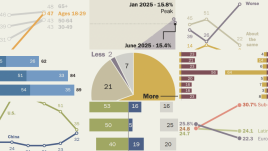
Striking findings from 2025
report

Why Do Some Americans Leave Their Religion While Others Stay?
Many U.S. adults (35%) have moved on from the religion of their youth. Yet most Americans have not, including a majority – 56% – who still identify with their childhood religion.
report

Religion Holds Steady in America
data essay

Young Adults and the Future of News
Sign up for our weekly newsletter
Fresh data delivered Saturday mornings
Latest Publications
-
short reads
Younger Americans are less likely than others to support an active role for the U.S. in world affairs
Overall, 53% of Americans say it is extremely or very important for the U.S. to take an active role in world affairs.
-
short reads
U.S. stands out globally in how it draws legislative districts
Among 107 democracies, we found that only one other country uses the same redistricting approach as the U.S.
-
short reads
Trump has already issued more executive orders in his second term than in his first
Before Trump, the last time a president surpassed 100 executive orders in the first year of a term was 1945, when Harry Truman took over the presidency after FDR’s death.
-
report
Why Do Some Americans Leave Their Religion While Others Stay?
A majority of adults still identify with their childhood religion, but 35% don’t. Read about when and why Americans may switch faiths or stay.
-
short reads
Growing shares say the Trump administration is doing ‘too much’ to deport immigrants in the U.S. illegally
Overall, 50% of adults disapprove of the Trump administration’s approach to immigration, including 36% who strongly disapprove.


Most Popular
Sign up for The Briefing
Weekly updates on the world of news & information
Politics & Policy
short read

Most Americans say government has a responsibility to ensure health care coverage
Most Americans (66%) say the federal government has a responsibility to make sure all Americans have health care coverage.


Features
fact sheet

Public Trust in Government: 1958-2025
short read
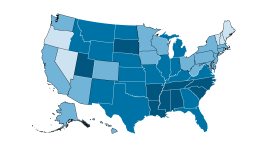
How religious is your state?


Artificial Intelligence
short read

Republicans, Democrats now equally concerned about AI in daily life, but views on regulation differ
Overall, 44% of U.S. adults say they trust the U.S. a lot or some to regulate the use of AI effectively, while 47% have little to no trust in the U.S. to do this.
short read

What we know about energy use at U.S. data centers amid the AI boom
Data centers accounted for 4% of total U.S. electricity use in 2024. Their energy demand is expected to more than double by 2030.
report

How People Around the World View AI
Most adults across 25 countries are aware of AI, and people are generally more concerned than excited about its effects on daily life.
short read

About 1 in 5 U.S. workers now use AI in their job, up since last year
Workers younger than 50 and workers with a bachelor’s degree or more education are among the most likely to use AI in their job.
report

How Americans View AI and Its Impact on People and Society
Americans are worried about using AI more in daily life, seeing harm to human creativity and relationships. But they’re open to AI use in weather forecasting, medicine and other data-heavy tasks.
Religion
short read

Many religions are heavily concentrated in a few countries
Half of the world’s population lives in just seven countries. But some of the world’s religious groups are even more concentrated than that.
short read

If the U.S. had 100 people: Charting Americans’ religious affiliations
If the U.S. had 100 people, 62 would be Christians, including 40 Protestants, 19 Catholics, two Latter-day Saints and two who identify with other Christian groups.
short read

Key facts about Black Americans and religion
Most Black Americans are Christian, though the share who identify as such has fallen since 2007.
report

Growing Share of U.S. Adults Say Religion Is Gaining Influence in American Life
Americans’ views of religion’s role in society have grown more positive in recent years. But many feel their religious beliefs conflict with the mainstream.
News Habits & Media
short read

Americans are following the news less closely than they used to
In 2016, 51% of U.S. adults said they followed the news all or most of the time, but that share fell to 36% in 2025.
short read

More Americans prefer to watch the news than read or listen to it
A majority of Americans who prefer to watch the news (62%) say they prefer to get it from TV, rather than another platform.
fact sheet

News Influencers Fact Sheet
About one-in-five U.S. adults say they regularly get news from news influencers on social media, and this is especially common among younger adults.
short read
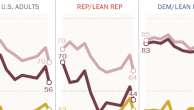
How Americans’ trust in information from news organizations and social media sites has changed over time
Overall, 56% of U.S. adults now say they have a lot of or some trust in the information they get from national news organizations – down 11 percentage points since March 2025.
Our Methods
U.S. Surveys
Pew Research Center has deep roots in U.S. public opinion research. Launched as a project focused primarily on U.S. policy and politics in the early 1990s, the Center has grown over time to study a wide range of topics vital to explaining America to itself and to the world.
International Surveys
Pew Research Center regularly conducts public opinion surveys in countries outside the United States as part of its ongoing exploration of attitudes, values and behaviors around the globe.
Data Science
Pew Research Center’s Data Labs uses computational methods to complement and expand on the Center’s existing research agenda.
Demographic Research
Pew Research Center tracks social, demographic and economic trends, both domestically and internationally.

Our Experts
“A record 23 million Asian Americans trace their roots to more than 20 countries … and the U.S. Asian population is projected to reach 46 million by 2060.”
Neil G. Ruiz,
Head of New Research Initiatives
Methods 101 Videos
video

Video: Why have polls underestimated Donald Trump?
We’re in an era where the people most likely to respond to a poll are also the most likely to vote Democratic for president. Pew Research Center’s head methodologist Courtney Kennedy explains how pollsters are tackling this challenge to make samples as representative as possible.


Signature Reports
report

Decline of Christianity in the U.S. Has Slowed, May Have Leveled Off
report
America’s News Influencers
report
Race and LGBTQ Issues in K-12 Schools
report
Representative Democracy Remains a Popular Ideal, but People Around the World Are Critical of How It’s Working
report
Americans’ Dismal Views of the Nation’s Politics
report
Measuring Religion in China
Editor’s Pick
short read

8 facts about divorce in the United States
short read
Navigate with a compass? Fix a car engine? What Americans say they can (and can’t) do
short read
Americans increasingly see legal sports betting as a bad thing for society and sports
short read
Americans view Trump, Vance and congressional leaders in both parties more negatively than positively
data essay
Same-Sex Parents Raising Kids
report
How the Global Religious Landscape Changed From 2010 to 2020
Immigration & Migration
short read

Key facts about U.S. Latinos
report
U.S. Unauthorized Immigrant Population Reached a Record 14 Million in 2023
short read
What the data says about immigrants in the U.S.
report
Americans Have Mixed to Negative Views of Trump Administration Immigration Actions
short read
Trump’s executive order on birthright citizenship draws more disapproval than approval
International Affairs
report

People Around the World Want Political Change, but Many Doubt It Can Happen
report
German Views of the U.S.-Germany Relationship Turn Sharply Negative
short read
In many countries, views of the national economy are closely related to partisanship
short read
Opinions of the EU remain mostly favorable across 25 countries
short read