


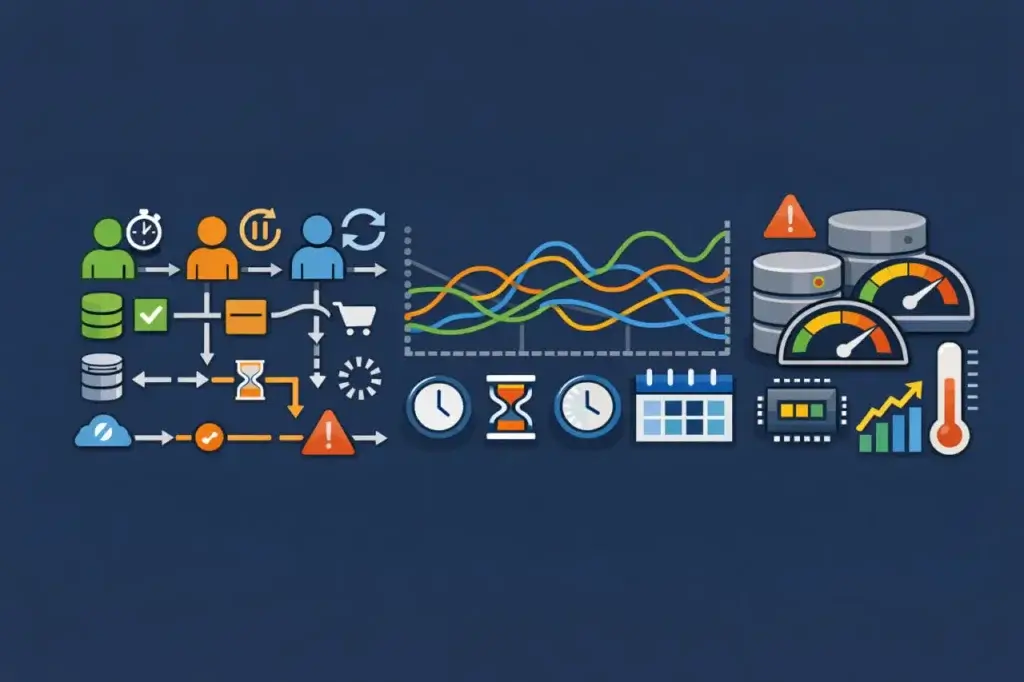
Load testing has a perception problem. It is still widely treated as an exercise in volume: how many users, how many requests, how much throughput. Those numbers are easy to configure, easy to report, and easy to compare across runs. They are also incomplete.
Production systems do not experience “users” as static counts. They experience activity over time. Requests arrive unevenly. Sessions overlap. Users pause, retry, abandon flows, and return later. Some sessions are brief and lightweight. Others are long-lived and stateful. These dynamics shape how infrastructure behaves far more than peak concurrency alone.
This is where load test modeling matters. Not as a buzzword, but as the discipline of describing how traffic actually behaves. Sessions, pacing, and user behavior are the mechanisms that turn a synthetic test into a credible simulation. Without them, even well-executed load tests can produce results that look reassuring and still fail to predict real-world failures.
Load Test Modeling Is Not User Count Configuration
At its core, load test modeling is the act of defining how load enters, accumulates, and persists in a system over time. It is not a configuration exercise, and it is not synonymous with choosing a target number of virtual users. A load model describes the shape of pressure a system experiences, including how that pressure evolves, overlaps, and compounds as activity continues.
In real environments, load is not applied evenly or instantaneously. It arrives in waves, lingers through active sessions, pauses during idle periods, and reappears through retries and returns. These dynamics determine whether resources are briefly exercised or continuously stressed, whether internal state stabilizes or drifts, and whether failures surface quickly or remain latent. Load modeling exists to capture those dynamics deliberately rather than leaving them to chance.
A load model answers questions such as:
- How do users arrive over time?
- How long do they remain active?
- What actions do they perform, and in what sequence?
- How much idle time exists between actions?
- When and why do they leave?
Two tests can generate the same request volume and produce very different system behavior depending on how those questions are answered. A thousand short-lived sessions arriving gradually is not equivalent to two hundred long-running sessions that remain connected, authenticated, and stateful for extended periods. The difference shows up in memory usage, connection pools, cache effectiveness, and background task pressure.
When teams focus exclusively on concurrency, they reduce load to a snapshot. Modeling restores the dimension of time, which is where most real failures live.
Sessions as the Unit of Reality
A session represents intent unfolding over time. It is the closest abstraction to how users actually interact with applications.
Sessions matter because state accumulates. Authentication tokens are issued and refreshed. Caches warm and decay. Server-side session stores grow. Database connections are held open longer than expected. Even in stateless architectures, session-like behavior emerges through repeated access patterns and shared resources.
In many systems, failures correlate more strongly with session duration than with peak request rate. Memory leaks, slow garbage collection, thread exhaustion, and connection starvation all tend to surface after sustained session activity, not during brief spikes.
Session-aware load testing exposes this behavior. It forces the system to manage continuity rather than bursts. It reveals whether resources are released promptly, whether background cleanup keeps pace, and whether performance degrades gradually instead of collapsing suddenly.
Ignoring sessions produces tests that look aggressive but are operationally shallow. Modeling sessions introduces persistence, and persistence is where systems are tested honestly.
Pacing: Time Is the Hidden Variable
Pacing defines how actions are distributed across time within a session. It includes think time, delays between steps, and the rate at which new sessions begin.
Poor pacing is one of the most common sources of misleading load test results. Fast loops that execute transactions back-to-back compress hours of real activity into minutes. This creates artificial contention patterns that rarely exist in production, while masking time-dependent failures that require sustained pressure to emerge.
Equally problematic is overly synchronized pacing. When all virtual users act at the same moment, the system experiences unrealistic request alignment. Production traffic is noisy. Requests overlap imperfectly. Some users hesitate, some retry immediately, others abandon flows altogether.
Pacing also distinguishes open and closed workload models. In a closed model, users wait for responses before proceeding. In an open model, arrivals continue regardless of system health. Each has legitimate use cases, but they produce different stress profiles. Modeling the wrong one can lead to confident conclusions that fail under real traffic conditions.
Accurate pacing does not slow tests down. It stretches them out. That stretch is what allows systems to reveal gradual degradation, not just acute failure.
User Behavior Shapes System Outcomes
User behavior is not random noise layered on top of load. It is the structure of the load itself.
Different behavior patterns stress systems in fundamentally different ways. Read-heavy browsing loads caches and CDN edges. Write-heavy transactional flows apply pressure to databases and queues. Idle sessions consume memory and connection slots. Retry behavior amplifies failures rather than smoothing them out.
Even subtle behavioral shifts can change outcomes. A small increase in retry aggressiveness under latency can double backend load. Slightly longer session durations can push caches past effective capacity. Increased abandonment can leave partial state that never completes cleanup paths.
Behavior modeling forces teams to confront these realities. It moves load testing away from idealized flows and toward the messy patterns observed in real usage. This does not require simulating every edge case. It requires identifying dominant behaviors and allowing them to interact naturally over time.
Systems do not fail because users behave perfectly. They fail because users behave realistically.
Sustained Load Versus Peak Load
Peak load tests are useful. They find ceilings. They show where systems stop responding altogether. But many production incidents occur well below those ceilings.
Sustained load exposes a different class of problems. Memory growth that is slow but unbounded. Caches that decay as working sets shift. Queues that drain more slowly than they fill. Autoscaling behavior that reacts correctly at first and poorly over time.
These issues do not announce themselves during short, aggressive tests. They emerge after hours of realistic session overlap and paced activity. By the time they surface in production, they are often misattributed to “traffic anomalies” rather than architectural behavior.
Load test modeling makes sustained testing practical and meaningful. It aligns test duration with the timelines on which systems actually fail.
Designing a Load Model That Matches Production
Effective load models are built from observation, not assumptions.
Production analytics, access logs, and APM data reveal arrival rates, session lengths, and common paths. They show where users pause, where they retry, and where they abandon flows. These signals should inform modeling decisions directly.
A practical approach starts by identifying a small number of representative session types. Each session type defines a flow, a duration range, and pacing characteristics. Arrival rates determine how those sessions overlap. Idle time and abandonment are included deliberately, not as afterthoughts.
Models should be validated against reality. If session duration or throughput diverges significantly from observed data, the model should be adjusted. The goal is not precision down to the second. The goal is fidelity at the system level.
Load modeling is iterative. As applications evolve, behavior changes. Tests must evolve with them. Static models produce static confidence, which is rarely deserved.
Applying Load Test Modeling with LoadView
Load modeling requires tools that respect state, timing, and behavior as first-class concerns. Real browser-based testing enables this by preserving session continuity and enforcing realistic execution paths, including client-side rendering, JavaScript execution, and network contention. These constraints matter because they naturally shape pacing and interaction timing, rather than relying on artificial delays to approximate user behavior.
Scripted user flows in LoadView allow sessions to persist across multi-step interactions while maintaining explicit control over think time, idle periods, and retry behavior. Scenario-based testing makes it possible to run multiple session types concurrently within a single test, allowing long-lived and short-lived behaviors to overlap in proportions that reflect production traffic. Sustained and stepped load configurations then reveal how systems respond not only at peak demand, but as pressure accumulates and persists over time.
The value is not in generating more load. It is in generating the right load.
Conclusion: Load Testing Is a Modeling Discipline
Load testing succeeds or fails before the first request is sent. It succeeds or fails in the model.
Sessions, pacing, and user behavior determine how load manifests inside systems. They shape memory usage, connection lifetimes, cache effectiveness, and failure modes. Ignoring them produces tests that look impressive and predict little.
Mature performance testing treats load modeling as a first-class discipline. It values realism over aggression and time over snapshots. Teams that invest in modeling do not just find failures earlier. They understand them better.
In the end, systems do not respond to user counts. They respond to behavior unfolding over time. Load tests should do the same.