


December 2025, Issue 547 Peter Marshall on Holbein * Joanna Kavenna on Camus * Sophie Oliver on Margaret Atwood * Dorian Lynskey on George Orwell * Daisy Dunn on Clodia of Rome * David Andress on Jean-Paul Marat * John Foot on the Spanish Civil War * Jerry White on high-rise buildings * Edward Shawcross on Mexico * Daniel A Bell on the Chinese examination system * Anna Reid on Russian women * Charles Darwent on Barnett Newman * Robert Crawford on T S Eliot * Ian Sansom on William Golding * Mark Lawson on John Updike * Charles Shaar Murray on musicians * Patrick Porter on NATO * Thomas Morris on Renaissance diagrams * Diane Purkiss on palmistry * Nigel Andrew on penguins * John Mullan on pedants * Molly Pepper Steemson on Anthony Bourdain * Mark Ford on Helen Vendler * Emma Smith on book tokens and much, much more…
| CARVIEW |
The Current Issue
Peter Marshall
Holbein: Renaissance Master
By Elizabeth Goldring
It’s an irony to savour: the man who invented the Tudors was a German. If Henry VIII, his wives and courtiers exercise a stronger hold on the public imagination than their Plantagenet precursors or Stuart successors, it is because we can all picture them so clearly. That, in turn, is due to an extraordinary sequence of portraits and drawings produced between the late 1520s and early 1540s by Hans Holbein of Augsburg (c 1497–1543), many of which have become instantly recognisable. This familiarity, as Elizabeth Goldring notes at the outset of her superb and ground-breaking biography, means it is harder to appreciate just how novel Holbein’s portraits appeared... read more
More Articles from this Issue
Sophie Oliver
Book of Lives: A Memoir of Sorts
By Margaret Atwood
Margaret Atwood has ‘always found snivelling in public embarrassing’. Light on introspection, even lighter on confession, Book of Lives is thus only a memoir ‘of sorts’: a 600-page chronicle of her life and times, in which one of our most celebrated novelists, just turned eighty-six, is determined not to take herself too seriously. Rolling your sleeves up and getting on with... read more
Robert Crawford
The Letters of T S Eliot, Volume 10: 1942–1944
By Valerie Eliot & John Haffenden (edd)
Describing himself in his mid-fifties as ‘a wambling old codger’, T S Eliot was hardly cut out to be a night-time fire watcher on London’s wartime rooftops. Yet for several nights each week, as first bombs and then V-weapons dropped from the sky, that is what he did. In the most recent volume of his capacious Letters – over a thousand pages covering... read more
Dorian Lynskey
Orwell: 2+2=5
By Raoul Peck (dir)
George Orwell: Life and Legacy
By Robert Colls
Nobody under the age of seventy-five has heard George Orwell’s voice. The only extant video footage is in a silent movie of the Eton Wall Game. None of his many wartime recordings for the BBC Eastern Service has survived. By all accounts his voice, damaged by a bullet to the throat during the... read more
Joanna Kavenna
The Complete Notebooks
By Albert Camus (Translated from French by Ryan Bloom)
How can we live in a meaningless world? Is there any hope of happiness, when our existence is fundamentally absurd and we must succumb to ‘revolting death’? Should we even bother with life, or just abandon the quest? These are the questions to which Albert Camus returns over and over again in his fiction, essays and plays. Camus was born in 1913 and brought up in working-class Algiers. His father was killed in 1914 at the Battle of the... read more
David Andress
Jean-Paul Marat: Prophet of Terror
By Keith Michael Baker
Jean-Paul Marat lives in cultural memory as a beautiful corpse, immortalised by Jacques-Louis David, who has him clutching a note pleading for the aid of ‘The People’s Friend’ (the note was in fact a treacherous assassin’s lure). It is a curiously passive depiction of martyrdom for a man who built his political career on frenetic and splenetic activity in writing and in person. David’s sanitised view, useful as it was to a beleaguered national Jacobin establishment... read more
Edward Shawcross
Mexico: A History
By Paul Gillingham
In Mexico City on 27 September 1842, a man was delivering an unusual eulogy. Fixing his eyes on what he called ‘the mutilated remains of an illustrious leader of independence’, the speaker was so moved that he felt he must ‘shed ardent tears over the remains of the hero’ before him. The occasion, however, was not quite as sad as he made out. For the hero, Antonio López de Santa Anna, a general and many times president of Mexico, was listening to the speech. What was being buried, for the... read more
Most Read
morePeter Jones
Peter Jones Welcomes Five Books on the Olympics
Peter Marshall
Holbein: Renaissance Master
By Elizabeth Goldring
Joanna Kavenna
The Complete Notebooks
By Albert Camus (Translated from French by Ryan Bloom)
Sebastian Shakespeare
Nothing That Meets the Eye: The Uncollected Stories of Patricia Highsmith
By Patricia Highsmith
John Foot
Travels Through the Spanish Civil War
By Nick Lloyd
El Generalísimo: Franco – Power, Violence and the Quest for Greatness
By Giles Tremlett
From the Archives
moreFrom the March 2020 issue
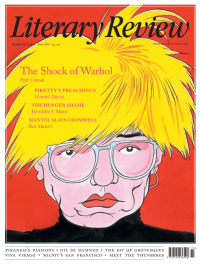
Peter Conrad
Warhol: A Life as Art
By Blake Gopnik
From the August 1995 issue
Syrie Johnson
Small Holdings
By Nicola Barker

From the June 1999 issue
Christopher Hitchens
Some Times in America
By Alexander Chancellor
Back Issues
more
November 2025

October 2025
Sign Up to our newsletter
Receive free articles, highlights from the archive, news, details of prizes, and much more.@Lit_Review
Follow Literary Review on Twitter
Twitter Feed
The latest volume of T S Eliot’s letters, covering 1942–44, reveals a constant stream of correspondence. By contrast, his poetic output was negligible.
Robert Crawford ponders if Eliot the poet was beginning to be left behind.
Robert Crawford - Advice to Poets
Robert Crawford: Advice to Poets - The Letters of T S Eliot, Volume 10: 1942–1944 by Valerie Eliot & John Haffenden (edd)
literaryreview.co.uk
What a treat to see CLODIA @Lit_Review this holiday!
"[Boin] has succeeded in embedding Clodia in a much less hostile environment than the one in which she found herself in Ciceronian Rome. She emerges as intelligent, lively, decisive and strong-willed.”
Daisy Dunn - O, Lesbia!
Daisy Dunn: O, Lesbia! - Clodia of Rome: Champion of the Republic by Douglas Boin
literaryreview.co.uk
‘A fascinating mixture of travelogue, micro-history and personal reflection.’
Read the review of @Civil_War_Spain’s Travels Through the Spanish Civil War in @Lit_Review👇
John Foot - Grave Matters
John Foot: Grave Matters - Travels Through the Spanish Civil War by Nick Lloyd; El Generalísimo: Franco – Power...
literaryreview.co.uk