


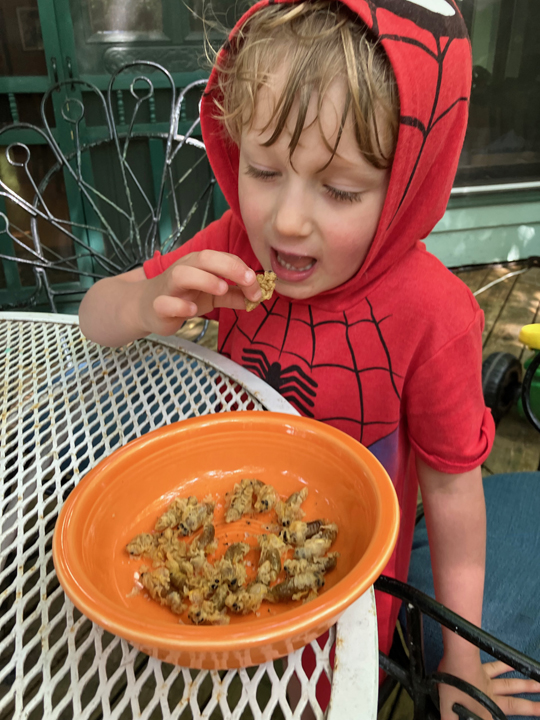
I had a not great experience eating an annual cicada years back. My friends and I were doing a shrimp boil on a balmy late summer eve, when a big green dog day harvest fly landed on a nearby table. “Shrimp of the woods” I declared (before I knew about the scrumptious mushroom of the same name.) It seemed like a no-brainer to toss the cicada into the boil. Chomping through its tough exoskeleton and the attending shrapnel of its legs and wings, I was treated to a burst of bitter bile-like ooze. No amount of Zatarain’s could mask that acrid flavor.
I’m a pretty dedicated bug eater, I love me some chapulines, have prepared my own, even. I’ve eaten crickets, ants, bamboo caterpillars at Sticky Rice, jarred Korean silkworm pupae (gross.) So faced with this spring’s magicicada emergence, I knew I’d have to buck up and give them another go.
Over on LTHForum, which was the media hub around the eating of cicadas the last time around in 2007, I read about harvesting tenerals, the freshly molted nymph stage, before the chitin of the adult cicada hardens. Soft shelled cicadas, if you will.
After two weeks on the hunt, I was kinda ready to throw in the towel – I had only spotted a few of the ghostly white emergents in my neighbor’s yard early in the morning. And while cicadas in all forms are not the most appetizing-looking critters, there was something about the under-developed wings and grub-like ivory look of the soft shells that made me a bit queasy.
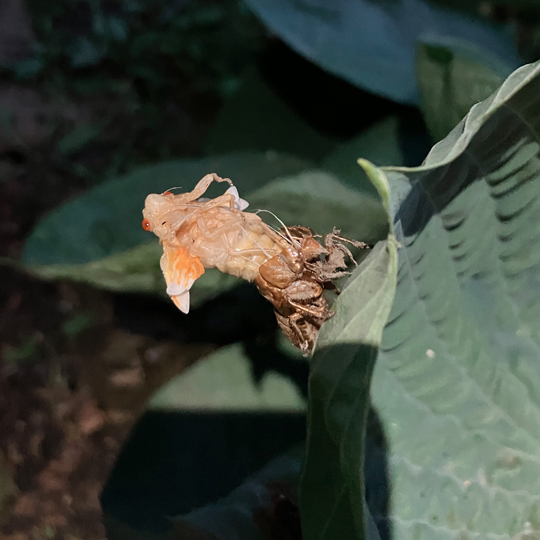
Then on a Friday night, I was enjoying a beer in the yard at dusk and spotted a major emergence of larvae crawling up every vertical surface in sight within a several yard radius around an old oak. By nightfall they were molting and I was able to collect a few dozen tenerals. Maybe it was the double IPA, but I quickly got over my trepidation and plucked them from their shells. Though docile while molting, the suckers got pretty squirmy in a deli container. They even made a faint squeaking sound. My wife and mother-in-law were none the wiser glued to Bridgerton in the other room.
First step was a quick blanch, following most recipes I had consulted. This worked well for me, since I intended to serve them two days later at Heron’s 4th birthday party and I imagined freshly molted cicada might have a short shelf life. To my surprise, the par-boiled cicadas had a pleasant, savory aroma.
On cook day, I had tinkering to do. I knew that I wanted to prepare and serve them as straightforwardly as possible. My first instinct was to deep fry them as is, a la chapulines, and season simply. I tried one this way and it sputtered quite a bit in the oil, its wings animated in deep-fried zombie flight. I gave it a few minutes, browning around the edges. It was too moist and the skin too delicate to properly crisp. The flavor was mild and downright edible though!
So I lightly tossed them in a bit of flour seasoned with s&p and fried in batches for about 3-4 minutes each until the breading had a tint of gold.
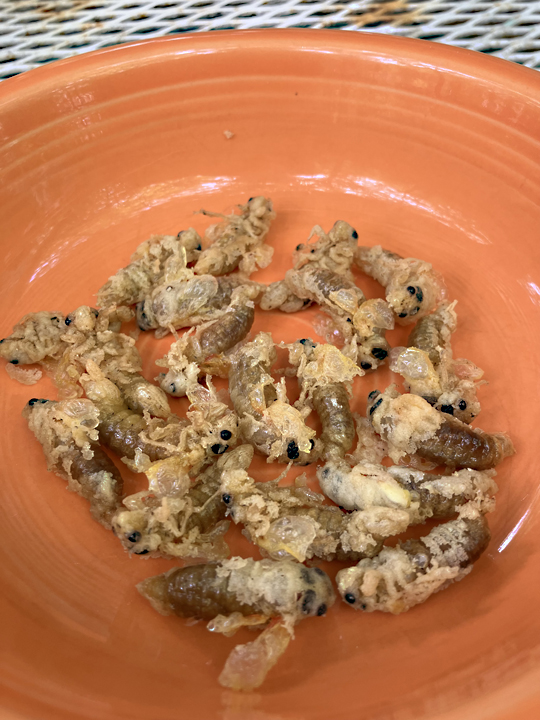
I hadn’t warned my guests that I was serving them, so a shocking addition to the birthday snack spread they made. 2/3 of the grown ups sampled them (my side of the family haha) and everyone was pleasantly surprised how mellow they were. My mom compared them to calamari, which the lightly breaded prep certainly suggested. A comparison to soft shelled crab is apt, but mainly in the texture of the taught chewiness of the skin. Compared to soft shelled crab, the textures were more uniform and the flavor was much more low key, with mild umami and a grassy finish I would liken to olive oil (they were fried in fresh canola, so I believe the flavor was from the bugs themselves.)
Probably the most joyful aspect of the entomophagy was how Heron snarfed them down with relish! And this is a kid who mostly only eats bread, rice, and fruit. Avery was a bit more cautious, nervously nibbling one with a grimace.
It seems like the emergence from the ground is giving way to high decibel fornicating in the trees. But given the opportunity I might just fry up another batch of soft-shelled cicadas. Or wait until 2041…











Birds 2025
This is a bird blog now!
Well, I placed number 5 on the list for top 5 birders for 2025 in DuPage County on eBird. I tied with Mike Madsen, who has been birding since before I was born and is ranked number two in our county of all time. I have had the honor of birding several times with Mike, who has demonstrated to me many virtues of good birding, important ones like patience and close listening. I did not set out to be competitive about this otherwise benevolent hobby, especially not with a GOAT like Mike. But I am proud of this achievement, I worked really hard at it and the journey brought me a lot of joy.
So how did I get here? Birding has come to me in sort of four rough stages. I’ve been into animals, nature, the outdoors, my entire life – I grew up in the woods. The pond in back of my childhood home in Palos Park was abundant with charismatic birds like Belted kingfishers and Wood ducks. We’ll call that stage one. Stage two was set in the wooded dunes of West Michigan, where I spent the summers of my 20s and 30s living and working. The Tallmadge Woods at Ox-Bow introduced me to Pileated woodpeckers, Barred owls, and Baltimore orioles. Inspired by a few birdy friends I met there, I started a “life list” of all the birds I had seen.
A more serious phase of birding arrived as we were cooped up at home for the first year and a half of this decade. The wooded acre we call home in west DuPage County was an idyllic place to while away those days with our two small kids, a natural playground replete with a menagerie of wildlife to divert my attention away from the horrors on my screens, and a distracting reverie during long mornings of entertaining our four year old and infant.
Very much credit is due here to the Merlin app developed by the Cornell Department of Ornithology, which uses AI technology (the only AI I am on board with, thank you!) to analyse real time recordings of bird vocalizations. I’d open the app, hit record, and be gobsmacked by the dozens of birds I had neglected to notice in my yard. I upgraded my binoculars and dusted off the life list. I was now a backyard birder and tallied up dozens of new birds like warblers, vireos, thrushes, and flycatchers in our woodland habitat, especially during spring and fall migrations.
We’re very lucky to live a half a mile away from a sweet forest preserve, Elsen’s Hill, where I frequently jog. In migration months, I would encounter scores of birders there. I misinterpreted their focused attention as aloofness and developed a somewhat negative bias about birders. I always thought they were annoyed that I was disturbing their birds as I jogged by. Then I met Pete, who I now know as a legendary birder in DuPage County. He suggested that I slow down and take a look up into the trees. Whenever I’d run into Pete I’d ask him what he’d seen that day, which opened me up to the frontiers beyond my own backyard.
Stage four arrived as I signed off social media in the fall of 2024. You probably don’t need me to lecture you about the apps’ ill effects on our mental health, erosion of our collective truth, and capitalization of our own attention spans. I found a need to re-focus my attention on the living breathing world, find my dopamine hits in the wonder of nature.
This coincided with a moment when I felt like my yard list had hit somewhat of a ceiling. It finally dawned on me to search online for bird sightings in my area, which brought me to eBird, Cornell’s flagship site and app. Pre-dating Merlin, eBird is a seemingly simple bird listing tool, though reveals a treasure trove for data nerds, with so many features to slice and dice your lists by times and places. It’s a pretty amazing experiment in collective citizen science – mobilizing hobby birders to track the populations of birds everywhere, every day, as our changing climate takes a toll on worldwide bird populations.
I drove down the street to Elsen’s and I never looked back. The first bird I saw that day was a Golden-winged warbler, a lifer (meaning my first sighting of a bird in my life.) And it turned out to be an infrequent, threatened species that other birders I met that day were all seeking. I quickly realized that the birding community was, in fact, incredibly welcoming. I made a few friends that day. Pete was there and everybody knew Pete. I have struggled at times to find community in mid-life, especially since we moved to the suburbs. Now I was meeting all kinds of folks from all walks of life who spoke the same secret language I did. The connections I’ve made with other birders have been incredibly valuable to me in this age of digital isolation, proof that there is plenty of human connection left in the world. I mean, in what other circumstances would I befriend a retired homicide detective?
It’s not all kumbaya in the world of birding though, and technology, once again, finds its ways to divide us. One highlight of my bird year was watching the excellent documentary Listers. At its core the film is about the birding community’s relentless quest to tally up lists. The film doesn’t shy away from exposing some of the more compulsive and competitive behaviors driven by a results-oriented approach to birding. Back to that top list of birders I mentioned in the intro – eBird has gamified birding – it notoriously ranks top birders by locale, in order of numbers of birds seen and lists made, a scoreboard that provokes competition (that I admit I can get wrapped up in.) So for all the benefits I found in logging off social media, eBird (and Discord) have replaced Instagram for my attention seeking impulse. I’m not just checking to see what birds are out there, I’m also checking in to see where I stand in the community.
I was a natural fit to become a lister. I mean here I am, writing a damn 5000 word list. There’s just something that helps me regulate all the stuff in my brain to list things out. Listers lands on a point that I have been reflective of in my own birding – getting caught up in making lists and chasing birds just for credentials can take away from the actual experience of learning from and enjoying nature. I certainly have two modes of birding – there’s the organic, relaxed style where I simply go for a walk at a place I like and keep a list of birds. This paradoxically is when I make higher quality, more thorough lists – I’m at my most dialed in and conscious of my surroundings. The other mode is what’s referred to as chasing (or twitching) and is the style of birding that the apps can motivate – bird x was seen at this time and place, better hop in the car and drive however long it takes to go get the tick on the list. Chasing can be pretty stressful – chances are high that you drove all that way and then won’t see the bird. Like everything in nature, the birds are out of our control. One great reason to bird is to actually let go of the control our brains seem wired to constantly seek. There’s a piece of advice that a seasoned birder shared with me that I keep coming back to – it’s better to find than to chase. There’s no doubt that I will still go after birds I need for my list – I love seeing new birds so much, not just for the list, but for the beauty and inspiration I find in them. But I’m at my best birding when I don’t have a goal in mind and am simply out there to intentionally and humbly commune with nature.
Alright we should get to the birds! Here is where I say that I love all the birds. Birders often muse about how we take the beauty of our local birds for granted. Take the cardinal, which in the Midwest are easy to overlook – they are everywhere! But my mother-in-law is enchanted whenever she sees one, since they are not native to her home in Utah. I spent so much of the year chasing lifers that I am sometimes guilty of not appreciating the beauty in the birds in my own backyard. Winter hit hard and early this year. I was hiking a favorite nearby woods, not hellbent on searching for any particular bird. With migration wound down, the variety of birds has settled into the usual set of winter residents. I caught the brilliant royal blue of a flock of Eastern bluebirds against the white of the snow and was reminded that beauty is often waiting for us if we are ready to see it.
The format of the list here is just a structure to recount meaningful experiences I had pursuing and viewing birds in 2025 – the narratives, the places, the people.
Photo by Bob Laramie
Common Loon
My bird of the year happens to also be the American Birding Association’s 2025 bird of the year. I’m pretty sure I had seen these far out in Lake Michigan before (or were those mergansers? cormorants?) Common loons, though plentiful north of here, are an infrequent visitor to deeper lakes in my county. So I jumped at the chance to view one at a favorite site, Deep Quarry Lake at the West Branch preserve, early in the spring. Problem was, our four year old was home sick. He seemed chipper enough to drag along for a birding outing, especially since it was a nice day and knowing we could sneak a look from the pier close to the parking lot. We immediately ran into my friend, Bob, on his belly, super-telephoto lens fixed on the water. The loon was right there – just a stone’s throw from the pier and swimming towards us.
Now, you can probably picture a loon, right? Black and white, black head, black collar on a white neck. From a further vantage, those are the distinguishing features most of us see. But a loon up close in direct sunlight is one of the trippiest animals I have ever laid my eyes on. The black (appearing) plumage of a breeding male Common loon is brilliantly iridescent in the right light. There’s a whole science on the coloration of bird feathers and how light refraction casts the colors we perceive rather than pigmentation. Anyway, this bird was positively radiating. Truly, a sober hallucination, I felt like I had taken a bump of the spice from Dune. Contributing to the effect was the intricate grid-pattern of its back feathers, a vibrating moire pattern.
Not that my kiddo was experiencing any of that, but this was true joy for him too – a big, gregarious bird he could see up close. Often when I drag the kids out with me to bird, papa’s attention is on the binocs, but this was truly a moment I could share my love of birds with my little guy.
Least Bittern
I was more than a little grumpy to be dragged away for the last ten days of peak migration at the end of May for a family wedding in Ontario. I knew I’d probably see plenty of migrants up there, but the handful of warblers and flycatchers I still needed for my list would be on their way south by then. The family knows by now that to regulate my nerves, I just need to bird – especially after five days and hundreds of miles in the car. I claimed a morning for some me-and-the-birds time – there was a birding hotspot about 15 miles south from the AirBnB, MacGregor Point Provincial Park on Lake Huron.
I had not anticipated arriving to a birding festival. The parking lots were full, though on the trail, it was fairly quiet, human-wise. Not so quiet, bird-wise, with dozens of warblers – noisy overbirds skulking in the dense brush and more conspicuous buddies like American redstarts and chestnut-sided warblers chirping away. Eventually I ran into festival-goers, first a trio of very-cool birders from Toronto, who welcomed me into their posse. I learned the prize bird of the day would be a Least bittern, reported up trail on a marsh. I had never seen this bird, though a fleeting view of its secretive, bigger cousin, the American bittern, had sparked an interest to get deeper into birds back when I was a student at Ox-Bow in the late 90s. The Least bittern is the smallest heron in North America with more dynamic markings than its chunkier cousin. I would have loved to see one, but knowing how inconspicuous these birds could be, I did not keep my hopes up.
We arrived at a viewing platform overlooking the marsh packed with tour groups. I chilled in the back, giving space to the multi-generational crowd of birders who were intent to see this bird. I scanned the wetland with my nocs and caught something darting out of sight in the reeds. I mumbled about it and word caught on amongst the group. All eyes fixed to the zone I pointed out. After about fifteen minutes the communal attention span started to give out and the group moved on. I decided to linger, ever the optimist and ready to get back to solo birding. Not a minute later, I saw rippling in the water just below the deck. And there it was, the Least bittern spearing at a frog, precariously clinging to two blades of cattail with each over-sized claw. I watched it poke away at the water for a good five minutes, relishing in the quiet space I was able to share with this shy and seldom-seen bird.
Photo by Randall Everts, the best bird photographer I know
Black-necked Stilt & American Avocet
Around mid-June, I hit a ceiling ticking off common and less common lifers in Dupage county. I had been invited to a Discord server for Illinois birding in the spring and had kept an eye on it, though now as I was getting bored on my home turf, my scrolling finger became habituated to clicking the app. Here the most online and competitive birders post real time updates about uncommon and rare birds, while maintaining a pretty convivial and supportive community (hard to sometimes not feel gatekept by the enforcement of moderators though.) I was now in the “chasing” stage of my birding hobby. It’s not like I hadn’t ventured at least a little far from home before – there was the 45 minute drive to see a snowy owl (more on that soon) and I often drive 20 miles to the edges of my county. But over the summer, this became my dominant mode, miles on my Sienna be damned.
So this entry is a two-fer, the circumstances for both birds are pretty similar – read about on Discord, drove 30-60 minutes to go see, witnessed with crowds of other birders. The two species, American avocet and Black-necked stilt have overlap as well – though distant cousins, both are shorebirds and infrequent migrants to Illinois. And I gotta say, both birds are absolutely gorgeous, like maybe the best looking birds I saw all year. Shorebirds migrate back south earlier than most birds, mid-summer from their spring Arctic breeding grounds. They are notoriously tricky to identify and are often on distant muddy edges of wetlands that require a spotting scope to discern the minutiae of their markings. But both the avocet and stilt are unmistakable and I was able to get looks of them both from very satisfying distances. The Black-necked stilts were on a mudflat in Lockport with tons of other shorbs, though their delicate pink legs and long-necked black-and-white appearance were instantly recognizable. It was a family with two adorable chicks, lil puffballs atop those spindly legs. A sad aside – the babes were gone a few days later and the parents soon after that, likely due to predator activity.
A week or so later I checked Discord at a stop light on my way to work in the city to reports of American avocets not far off my commute in Naperville. These two beauties were less than a hundred feet viewing from a bridge overlooking Whalon Lake – the most elegant of birds with gracefully curved blush-hued necks, blue legs!, and uncannily upturned bill.
Binoc photo by me on Mount Hoy, Warrenville, IL in November
Snow Bunting
There are certain birds that migrate to the Midwest for winter (now why would anyone do that?!). Some of these are familiar feeder visitors like Dark-eyed juncos. But there’s a handful of birds that migrate down from the Arctic tundra that prefer windswept habitat like beaches and farm fields, where they forage on the ground for scraps. I saw my first Snow bunting in March at a favorite birding site in rural Kane County, Muirhead Springs, a successful grassland and marsh habitat restoration project on an old farmland (adjacent to Frank Lloyd Wright’s only farmhouse!) I have a deep respect for the resilience of these birds. They definitely keep cold weather birding interesting, not common enough to see without at least a little searching and above all, just damn cute birds – I mean the Snow bunting’s nickname is toasted marshmallow!
Scope photo by me
Snowy Owl
Despite bragging about quitting social media, I still keep an eye on Facebook for bird groups. Come mid-November, my feed was awash in shots of porcelain-white owls with piercing yellow eyes against the backdrop of Lake Michigan. Heck, these two Snowy owls were all over the local news, with footage of hundreds of telephoto lens-sporting birders and “civilians” alike. Literally everyone I know asked me if I saw these birds – yep, I was there on day two, tipped off by Discord. A quick shout out to Montrose Point, Chicago’s most prominent birding hotspot – what can I say, the place lives up to the hype, a beautiful slice of urban green space with a range of habitat from prairie to duneland jutting out into the lake, a perfect respite for migrating birds. I snagged five lifers there this year, yes, including the positively adorable piping plovers.
But my lifer snowy came earlier in 2025, an early lesson in the pitfalls of chasing rare birds. About 45 minutes south of us at a prairie preserve in Will County, next to Stateville Prison of all places, a snowy had set up camp. It was a week loomed over by the polar vortex, but I would not let the frigidity stop me from pursuing one of my most sought after birds. My beloved Grandma Kay collected owl art, which always entranced me as a kid – a portrait of snowy owls presided over the couch where I slept at her house.
I arrived at the preserve to find its entrance police-taped off, the county was appropriately restricting access to this rare visitor. Snowy owls usually drift this far south due to scarcity of food in their Canadian homeland, so are potentially in a depleted state, plus owls are generally sensitive to disruption. I had seen pictures of the owl in an adjacent park that wasn’t blocked off, so I poked around there. With prison patrol helicopters circling in negative temps and all that police tape, the scene was giving me foreboding vibes, so I gave up after 15 minutes of unsuccessful scanning. Determined, I returned later in the week after reading about decent views of the bird from across the street from the preserve – sure enough, I was able to discern a large white blob smudged across the top of a blue dumpster. Not a satisfying look, but enough for a tick on my life list.
Montrose in November gave me the gratifying views I deserved after my previous arduous journey. I now came equipped with a spotting scope, which gave me detailed views of those golden eyes and intricate black crescent markings on the snowy fields of its feathers. There was a lot of handwringing in the community about the popularity of these birds. I fall on the side of the argument that any enthusiastic engagement with wildlife by the American public is a net win for nature. Plus the owls could have fled the pier for more private accommodations at any time. I, for one, am grateful they chose to grace us with their majesty.
Swallow-tailed Kite
At the peak of summer chasing season, I tested my fate by driving the furthest yet, two hours down to the Bloomington area, to witness a much-coveted Swallow-tailed kite. Hauling down I-57 I knew I was deeper into this journey than I could have had imagined just six months prior. It was a pleasant enough drive, I’ve always appreciated alone time on the road. I pulled up on a gravel country road to another car parked in front of a stately farm house. A local photographer was there, a sweet school teacher, who had returned to see the kite every day that week. Soon, the kind (and notably young and dashing) owner of the house came out to greet us. He clearly had developed a kinship with this bird, which had apparently taken up residence above his fields for a good month. I asked if he was a birder and he quipped not until this kite showed up. He assured my patience would be rewarded and the kite would circle over his fields foraging for dragonflies. About ten minutes later, a literal angel graced us from the heavens. Birds don’t get more striking than this, the size of a large hawk, white-bodied with black tipped wings and tail, its sleek build elegantly punctuated by a long forked tail. My religion is birds.
Short-eared Owl
Some say this is the easiest-to-see owl. And it’s understandable why, considering its crepuscular behavior – shorties are active during dawn and dusk light rather than the primarily nocturnal behavior of most owls. Around here, the habitat you’ll find shorties is (increasingly) less common – vast open grasslands, rather than the forests surrounding my home turf preferred by Great-horned, Barred, and Eastern screech owls. There are a couple of reliable spots where these owls spend the winter months in my county including nearby Fermilab, one of my most birded spots and perhaps the best birding site in the county with its impressive range of habitats.
I had a real hard time spotting a Short-eared owl though, it took five drives out to Fermilab in the late afternoon beginning last January before I finally saw one. Birding at that hour is just complicated for my schedule, which is bound to the afterschool routines of my boys. To do so requires bundling up and packing up the dudes in the minivan, not without some protestation. In November, I caught a fleeting glimpse of the owl, the clip of a wing weaving in and out of the grass on the darkened horizon. I ran into one of the Fermilab bird monitors and he verified that he saw one around the same spot. Unfortunately, not a satisfying enough view for my life list. I made the mistake of leaving the kids in the van with their seats facing where they couldn’t see me (left the heat on, of course.) I guess I was gone for 10 minutes, birding time has its own pace. The boys were hysterical when I got back in the car and for the first time I had to ask myself if my birding obsession was getting in the way of my life responsibilities, yikes. Fortunately, the boys seemed to have some skin in the game and were enthusiastic about going back out for another try the next week, as long as I stayed near the car and out for no more than 5 minutes. Swooping up over the dimming horizon, I finally witnessed the graceful, some say moth-like fluttering, dipping and weaving flight of the shortie.
Hooded Warbler
We’re blessed by an abundance of migrating warblers in our backyard in the spring and fall, my current yard count is 21 species. What we don’t have is warblers who stick around for the summer and breed. So most of the lifer warblers I saw last year, outside of the backyard, were breeding species. Warblers can be pretty tough to spot, they’re tiny, they move fast, they often hang out high up in the trees where they duck in and out of sight behind leaves. Especially in spring, they are often heard more than they are seen.
There is a controversial trick called playback that I have really flip-flopped on throughout the year – the use of digital recordings of bird songs and calls, conveniently at one’s fingertips on Merlin, to lure birds into sight. It might seem innocent enough, but disturbing birds, especially during breeding and nesting season, can disrupt them from behaviors critical to their survival.
There is an argument that any birding, just by the nature of humans poking around these animal’s habitation, is disruptive. On the other hand, there’s a saying that there is no such thing as a right or wrong way to bird – appreciation of birds is a positive thing when much of mankind tramples over and extracts their wants from nature. Heck, I’ve met duck hunters, who literally kill birds, but ultimately have affection for their targets and deeply care about their conservation. So in the bigger picture of things, is luring a bird into sight with a recording the worst thing in the world? Most birders I know use it, some flagrantly and others secretively. The best birder I know, as we were staking out a stubbornly camouflaged Clay-colored sparrow, quipped to me that he would not tell anyone if I decided to play its song on my phone after he left. Another sage birder gave me permission to use it for a lifer view, once per bird.
So, while I don’t think playback is the biggest threat to the well being of birds in this precarious world, I have learned the ethics of how to do it discreetly. I was staking out a Hooded warbler, when yet another wise birder mentored me about avoiding playback entirely on breeding grounds. Patience is a key virtue of good birding, if you’re still and as unobtrusive as possible, you can be rewarded by intimate experiences with birds. I learned this lesson with Wes that day, in fact we never saw the warbler after about 45 minutes of silent looking, we heard it and could sense where it was moving around, but no views. Later that week, on my birthday, I gave it another try. They’re noisy birds in the spring, so I could pinpoint exactly where it was. And after only about five minutes, this sneaky, striking bird with a burglar’s balaclava on its bright yellow face popped up out of the brush.
Nelson’s Sparrow
Identifying sparrows was a big level up for me last fall. To the untrained eye, the majority of sparrows, at first glance, look like the most generic of gray and brown birds. And they can be pretty uncooperative to look at, skittish dwellers of dense brush. There are two species of sparrows that land in the Midwest in late fall that are kind of holy grails for local birders, birds that buck the stereotype of “little brown jobs” – the Nelson’s and LeConte’s sparrows. These two related species are quite colorful for sparrows, with orange washes to their faces and crisp, intricate markings on their heads and chests – both gorgeous.
A favorite spot I’ve mentioned, Muirhead Springs in Kane County, is the most reliable spot for both species in the fall and I saw my lifers of each there. This entry gets tipped in favor of the Nelson’s, since I saw it three times and got much more satisfying looks. The LeConte’s is notably more timid and I never saw it sit still. Neither of these birds show up in DuPage County very often and I happened to find a Nelson’s about two miles up the street from home at a favorite (and under-rated) forest preserve, Timber Ridge West. I was poking around the marsh there, hoping to flush Wilson’s snipe when I was graced by the Nelson’s tangerine glow, point blank, in the cattails.
It had been a week of birding milestones. A few days before I had flushed the remarkably secretive and camouflaged American bittern while walking around the marsh at Springbrook Prairie (which, as mentioned before, was my spark bird which I hadn’t seen since 1999 in Michigan.) This is a coveted bird to see and I posted about my sighting to some fanfare on Discord – a few experienced birders were able to find the bird after my report. Prior to this moment, I had been feeling inadequate in my birding, since I relied, for the most part, on other birders’ reports to find birds I needed for my lists.
And then I found the Nelson’s – which only had a handful of reports in DuPage County in 2025. I posted on Discord and while I was still out in the field, two birders I know came to have a look. Neither of them were able to find the bird and one of them even questioned my identification skills. This would have pissed me off, but I had new-found confidence. I am proud of my identification skills, I have invested a lot of research time to make accurate conclusions in the field. I trust my judgment – I’m very cautious about reporting birds I’m not certain about. And in this moment, I knew that I had the ability to not just chase the coolest birds, but to find them.