

|

|
| CARVIEW |


 We were fishermen:



I have an odd relationship with nature and landscape writing. Naming, as any poet will tell you—I remember Carol Ann Duffy saying something to this effect—is a powerful thing. Through their parts or as wholes, names set off small semantic explosions in the mind of the reader as well as serving to anchor poetic abstraction in places, things, and people. Clive James’s Japanese Maple, Alice Oswald’s Severn, Heaney’s Mossbawn, miscellaneous Wordsworth: each by its naming puts out little tendrils which hold the world close. That, I think, is what I find attractive about writing on place, nature, landscape, and wildlife: its naming and exploration of things named.
Yet, this interest can feel like bad faith. It is because I am so poor at naming plants, birds, trees, and landscape—chalk hills? Clay? Limestone?—that I find this writing so fascinating, so enchanting. Of course, the history and human relationships bound up in landscape and wildlife are deeply interesting, and I love good writing about them; but, nonetheless, it is the power of naming, built on a way of perceiving I lack that lies at the heart of my worry.
Such writing has for me something of the allure of fantasy or science fiction: the exploration and evocation of another world, where most of the world-building has been taken care of by history and the environment, though interpretation and projection by the writer certainly has its part to play. Writers who can draw on language and knowledge I’ve never known or which seems to vanish as soon as I hear it. (Expressed in a rather flippant poem—but the anxiety is more substantial.) Roger Deakin wanders about discussing blackthorn, coppicing, insects, beetles, and really rather a large variety of birds; Robert Macfarlane springs up and down hills, across moors and tidal pathways, with a dictionary in tow: that’s how it feels anyway. Helen Macdonald and J. A. Baker name the birds and understand the goshawk and peregrine. I struggle to remember the difference between blue tits and great tits, ash and bay, which hills are where and what they are made of. (I’m beginning to grasp the South Downs.)
All of this bothers me because each of these writers hints at a way of perceiving that feels lost. If you can name things you can understand the relations between them—and vice versa—and that understanding can penetrate your perception of the environment and its history. This capacity enchants me as a mystery does: like a magic trick, I can’t see how it’s done, although I can think it impressive or beautiful: the bad faith worry stems from the sense that—as with the magic trick—learning how its done might lead to disenchantment. I don’t think that would happen; in fact, I expect it would be quite the reverse. Acquaintance would enrich rather than diminish, because naming and understanding aren’t sleights.
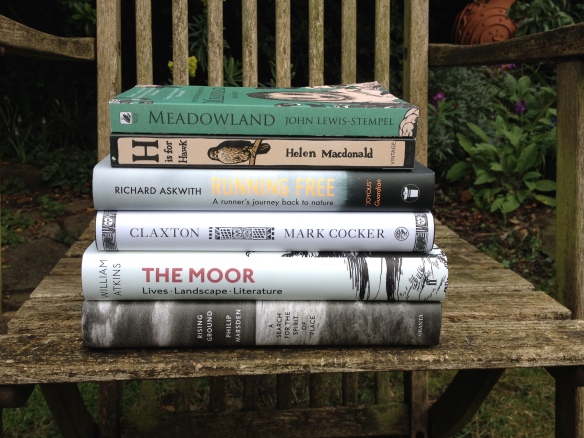
In order to deepen my acquaintance I’m going to be reading the Thwaites Wainwright Prize shortlist over the next few weeks. I’ve read the wonderful H is for Hawk already—and you really must—and the rest of the shortlist is a cross-section of the kind of writing I’ve been considering: place, people, wildlife, and their histories and crossings. I’m starting with Meadowland: The Private Life of an English Field by John Lewis-Stempel in my attempt to move beyond all that undifferentiated green.
- Running Free: A Runner’s Journey Back to Nature, Richard Askwith (Vintage/Yellow Jersey).
- The Moor: Lives Landscape Literature, William Atkins (Faber & Faber).
- Claxton: Field Notes from a Small Planet, Mark Cocker (Vintage).
- Meadowland: The Private Life of an English Field, John Lewis-Stempel (Transworld).
- H is for Hawk, Helen Macdonald (Vintage).
- Rising Ground: A Search for the Spirit of Place, Philip Marsden (Granta).

“You would have searched a long time for the sort of winding lane or tranquil meadow for which England later became celebrated.”
The first sentence is as good a place to start as any for a reflection on Kazuo Ishiguro’s first novel in ten years; and this is more of a reflection than a review, for The Buried Giant is a resistant, circular, and potentially frustrating work. The book begins with “You”: we are a part of this from the very beginning and are reminded throughout. We are immediately placed in a conceptual landscape and atmosphere, an idea of England as a patchwork of tranquil meadows valorized the world over: other Eden, demi-paradise.
But it is an idea we should question precisely for its celebrity. The winding path to John of Gaunt’s bitter lamentation for sleeping England is long and part of the story itself. Something else came before and lies beneath the fields. We took a long time to get here, if we ever did. That simultaneously comforting, questioning, and warning opening sentence signals both the continuity of modern Britain with his concerns and creates a space for Ishiguro’s Dark Age novel of myth, legend, love and memory to occupy.
“It’s queer the way the world’s forgetting people and things from only yesterday and the day before that. Like a sickness come over us all.”
The Romans are gone. Who knows how long, but their ruined villas dot the country. This is a landscape of magic, ogres, demons, and sprites. Britons and Saxons live separately, but mostly in peace, spread across the “desolate uncultivated land: here and there, rough-hewn paths over craggy hills or bleak moorland.” Time is unmarked. Two old married Britons, Axl and Beatrice, live on the margins of a warren of dwellings dug into a hillside. They are increasingly troubled by the way those around them—especially the young—forget people and events. “It simply did not occur to these villagers to think about the past—even the recent one.” Their candle has been taken from them—too old—yet it is Axl and Beatrice who seem to recall the most, to resist the darkness of “a mist as dense as that which hung over the marshes”.
Axl and Beatrice set out on a journey long put off for reasons neither really recalls, to visit a son neither can picture, who lives in a village neither knows how to reach. It seems they forgot their son for a long time, forgot they ever had a child, although they sometimes wondered, sometimes saw images when half asleep of a small hand held or some conflict leading to their son’s departure. Throughout the novel Ishiguro shifts the reasons Axl and Beatrice think they are searching for their son: he anxiously awaits them, they will live with him and be cared for, they are simply visiting and will return to their village. What remains is the belief in the necessity of their journey and their bond: a belief which has more to do with feeling than memory or knowledge. In that sense Ishiguro is dealing in themes of memory and trauma which run back to A Pale View of Hills.
“He’s our son,” Beatrice said. “So I can feel things about him, even if I don’t remember clearly. And I know he longs for us to leave this place and be living with him under his protection.”
This troubling fluidity of desire, intention, mood, will, and memory permeates The Buried Giant. It is reflected in the landscape through which Axl and Beatrice move: a landscape without reference points, where fiends attack from behind, and strange tableaux emerge from the rains and forests. This strange rootlessness of a country which is nonetheless England recalls the floating village of Jim Crace’s Harvest; and the troubling half-recognised narrative space of Quarantine. The Buried Giant is in many ways a fusion of Ishiguro’s literary concerns: the loss of memory and control, and a troubling ethical environment which we cannot entirely reject, because it is grounded in love and care.
“An old burial ground. And so it may be. I dare say, sir, our whole country is this way. A fine green valley. A pleasant copse in the springtime. Dig its soil, and not far beneath the daisies and buttercups come the dead. And I don’t talk, sir, only of those who received Christian burial. Beneath our soil lie the remains of old slaughter.”
At the heart of this novel are the conflicting necessities, the paradoxical duties of remembrance and forgetting; and in that twin necessity is an allegory both of history and of love. Axl and Beatrice’s journey and their simultaneous fear of remembering and forgetting the life they have shared forces us to think about the differences between national memory and the memories of love. Reconciliation requires both acknowledgement of past wrongs and a kind of forgetfulness which can so easily become a belief in the necessity of suppression in the cause of national pride, recovery, and stability. (“Is it shame makes their memories so weak or simply fear?”) These are motives easily recognised in modern Russia and China, but which is equally insidious in the whiggish tendencies of a Britain in the midst of a celebration of Magna Carta.
“…I wonder if what we feel in our hearts today isn’t like these raindrops still falling on us from the soaked leaves above, even though the sky itself long stopped raining. I’m wondering if without our memories, there’s nothing for it but for our love to fade and die.”
It is tempting to link Ishiguro’s Beatrice with Dante’s, but Axl is old and his crossroads are unlike those of The Divine Comedy. We remain in the dark wood throughout The Buried Giant. Beatrice is Axl’s constant companion: a picture of love—another winding lane, another concept with darkness lurking beneath it—more honest than Dante’s courtly infatuation.
“Are you still there, Axl?”
Yet, Ishiguro retains something of Dante’s journey—something shared with journeys from The Odyssey to The Pilgrim’s Progress—as Axl and Beatrice meet figures who represent conflicting approaches to memory, duty, shame, peace and revenge. Unlike those legendary journeys, however, there is little moral clarity or satisfaction to be found. The fantastic is deployed, at least in part, to undermine the allegory of the journey and mythic ideas of nationhood. Indeed, it is one of the advantages of fantasy that creatures, landscapes, and characters can become representative of aspects of humanity in a manner realism militates against. The legendary characters or creatures that populate the novel are often weak and tired: implicated in the false logic of genocide and the suppression of memory in the service of peace. In that respect, the influence of Michael Moorcock can be detected in The Buried Giant.
“We must hope God yet finds a way to preserve the bonds between our peoples, yet custom and suspicion have always divided us. Who knows what will come when quick-tongued men make ancient grievance rhyme with fresh desire for land and conquest?”
It may well be that the shifting and veiled narrative of The Buried Giant frustrates many. Yet, rather like Keith Ridgway’s otherwise very different approach in Hawthorn and Child, the resistance to narrative cohesion is part of the point. Memory, shame, duty, and vengeance are part of the story not just of England, but the world: part of us; and the winding path of love runs not to Dante’s paradise and a beatific vision, but to moments of joy, contentment, ease, conflict, resentment, union and separation. It is in that respect—and despite its Dark Age demeanour—a very timely novel. It will take some time to tell, but I think The Buried Giant is a serious achievement: one that will split people. Which seems rather fitting.
“The giant, once well buried, now stirs.”
The Buried Giant is published by Faber on the 3rd of March 2015.
My thanks to Faber for this review copy.
]]> The distant mountains rise higher and darker, surrounding us: shadowed blue-green masses capped with white snow.
On the surface Emma Chapman’s debut novel is a cool, controlled, and compact account of the apparent psychosis of Marta Bjornstad in a nameless Scandinavian town as her husband and son look on in increasing despair. Yet beneath this is a deeply intelligent consideration of the destabilising effects on identity and the experience of time caused by the absence of a framework of memory. Marta’s narration relates a scraped out experience related by Chapman’s chillingly direct and economical language which always points beyond itself and the starved atmosphere of her character’s mind. An unstocked mind in which things reverberate: sounds, images, memories, desires. These oscillations colour everything. Shapes rise and fall in the wan twilight of a Scandinavian Autumn, the rays of the Sun playing on the surface and, although attenuated, penetrating the depths. From those depths rise visions or memories of a blonde girl in dirty pyjamas, a forgotten grace of movement, a prison. Each one confuses or casts doubt on the life Marta has led, cleaning, cooking, and caring for her husband Hector and son Kylan. The accepted narrative of their meeting and marriage is that Hector saved Marta from drowning and nursed her back to health after her parents died. And yet, as she once again stops taking her medication, the sunlit uplands of an apparently blissful marriage begin to fracture.
Now it’s as if I can see shadows for the first time.
Marta’s experience of time is episodic because she lacks the kind of structure required to secure its continuity. Hence, her narration and experience is insistently present tense, which is why knowing the time is so important to her: it’s the only structure she has. The only structure, that is, apart from the book given to her on her wedding day by Hector’s overbearing mother – How to be a Good Wife – which contains such commands as ‘Never hurry or nag him along. His time is precious, and must be treated as such’; ‘Always wait for him before you begin eating: he should always come first’; and ‘Never question his authority, for he always does what is best for the family, and has your interests at heart.’ This guide and framework simultaneously secures Marta in a stale home and erodes any sense of agency and selfhood she might have possessed or developed. The question the reader must ask is whether it is in reaction to this diminished selfhood that Marta’s developing assertiveness arises.
The passivity of Marta’s narration is broken by insistent voices which, whether excerpts from a domestic guidebook, fragments of memory, unattributed threats and entreaties, or external attempts to constrain through dismissal and psychiatric diagnosis, serve to reinforce and then undermine her fragile structure as the of tone each develops throughout the novel. ‘If you do what I say, there’s no reason for anyone to get hurt.’
And there it is again, that strange echoing fear, slipping through the cracks that have formed in the memory. It’s easy to look at a photograph, and to tell yourself things happened in a certain way, that you were happy. Easy to talk about until it seems that it really happened that way. But as I looked out through that gauzy veil, the petals of my bouquet quivering in my hands, as I made those steps towards Hector standing at the altar without my father’s arm to support me, I remember being frightened, not excited.
This passage might stand for the whole novel in apparent simplicity and uneasy allusion: that gauzy veil a symbol of Marta’s desaturated experience, a filter on her perception, her understanding and memory. Her marriage has framed and constrained her entire being, completely externalising her identity such that it is dangerously dependent on feminine roles: wife, mother, housekeeper, cook. Are her insidious doubts a reaction to this constrained and hollow existence? Marta tries to lift her veil, which immediately speaks to Shelley’s sonnet and to the collapsing marriage of Maugham’s novel.
Lift not the painted veil which those who live
Call Life: though unreal shapes be pictured there,
And it but mimic all we would believe
With colours idly spread,—behind, lurk Fear
And Hope, twin Destinies; who ever weave
Their shadows, o’er the chasm, sightless and drear.
…
What lurks behind the veil, the story of her marriage, and that phantom girl, whose image seems to efface Marta’s each time she washes or gazes into the mirror? Reflecting surfaces herald the loss of one self and the glimpsing of another. Mirrors lack depth and yet mimic it. Waters can be deep and yet hide their extent. Marta’s certainties drain away with the bath water. Where is her father? Why was she so afraid on her wedding day? Perhaps most compelling: Is this veil her medication, forced upon her by Hector? Or is she actually ill? Or both? Of course, that very suspicion of Hector’s story should alert the reader to doubt Marta’s voice as keenly as she does her husband’s. Fear and hope begin to bleed into one another as her behaviour becomes increasingly erratic.
What if I wasn’t myself before?
Chapman probes how we treat individuals diagnosed with mental illness. There is an implicit challenge here to the view that a mental disorder should entail a corrosive departure from oneself; a challenge to the narrative of unreliability and the distrust of memories of potentially significant trauma. In many ways I prefer this book to Sebastian Faulk’s Engleby which shifts the ground very sharply beneath the reader’s feet toward the end. In its apparent simplicity How to be a Good Wife contains multitudes. It is not devastating and its development was far from a surprise, but I don’t think that is the point of this book at all. Chapman has done something far more interesting than just write a competent thriller: the landscape of the novel and Marta’s mind is submerged, but an emergence from those depths, an ascent to the mountain peaks that shelter the fjord, is not straightforwardly liberating, as the ambiguous relationship with water throughout attests. Her compact and allusive resistance to reduction and the complex archaeology of memory and despair make Emma Chapman’s debut novel very impressive indeed.
For some time, I have watched a magpie, working at the frozen earth.
How to be a Good Wife is published in paperback on 24th April by Picador.
My thanks to Picador for this review copy.
]]>
On Monday 10th March George Saunders won the inaugural Folio Prize for Tenth of December. Announcing the winner, Chair of the Judges Lavinia Greenlaw, said:
“George Saunders’s stories are both artful and profound. Darkly playful, they take us to the edge of some of the most difficult questions of our time and force us to consider what lies behind and beyond them. His subject is the human self under ordinary and extraordinary pressure. His worlds are heightened versions of our own, full of inexorable confrontations from which we are not easily released. Unflinching, delightful, adventurous, compassionate, he is a true original whose work is absolutely of the moment. We have no doubt that these stories will prove only more essential in years to come.”
I reviewed Tenth of December on release in early 2013. I liked it:
A fundamentally optimistic satirist is hard to find. A satirist who is fundamentally optimistic and actually funny is even more elusive. Yet in Tenth of December George Saunders presents a plural and intensely humane collection of stories which probe the dynamics of motivation, self-consciousness, violence, and the abuse of language in supple prose which unfailingly captures the diverse voices of characters in sore need of an entirely feasible redemption. And it’s funny.
The opening and closing stories explore the different ways that language aids us in gaining traction on the world. In ‘Victory Lap’ a young girl’s emotional and linguistic naivety is shattered by a foiled assault, her rescuer repressed by the internalised edicts of his parents, his only release the strings of swear-words he composes. Here is the first hint of Saunders’ concern with the structures of thought which constrain action. That theme continues in the title story, where a boy for whom the world overflows with voices and a dying man for whom that world has narrowed to a cancerous point cross paths in the snow. In the process, how each meets the world changes, as the voices and concerns of one recede, and those of the other, in a manner quite distinct, begin to reassert themselves.
‘His aplomb threw them loops.’ I really like this sentence. It bubbles and flows and is simply happy. Anyway.
‘Escape from Spiderhead’ is in many ways the heart of the collection. It considers the commercial manipulation of thought and feeling in a grim caricature set in a penal laboratory where powerful drugs with eerily familiar names like ‘VerbaLuce’, ‘Vivistif’, and ‘Darkenfloxx’ are mainlined by human guinea pigs for whom the sheen of agency resides in their apparent freedom to ‘acknowledge’. The endurance of conscience throughout this harsh story of chemical manipulation is testament to Saunders’ belief that goodness is our natural state. False reductions of crime or of love are damaging, for what you can reduce a thing to is far from being that which you destroyed in the analysis.
In ‘Sticks’ Saunders encompasses an entire life and the contingency of its expression in two pages ostensibly about a metal pole and its various accessories. The different brands of irresponsibility and their problematic reduction to a deficit of love or kindness are addressed in ‘Puppy’, which opens with one of my favourite paragraphs from the collection: at once rhythmic, amusing, and insightful.
Twice already Marie had pointed out the brilliance of the autumnal sun on the perfect field of corn, because the brilliance of the autumnal sun on the perfect field of corn put her in mind of a haunted house—not a haunted house she had ever actually seen but the mythical one that sometimes appeared in her mind (with adjacent graveyard and a cat on a fence) whenever she saw the brilliance of the autumnal sun on the perfect etc., etc.—and she wanted to make sure that, if the kids had a corresponding mythical haunted house that appeared in their minds whenever they saw the brilliance of the etc., etc., it would come up now, so that they could all experience it together, like friends, like college friends on a road trip, sans pot, ha ha ha!
That insecurity inflected need for shared experience in the face of well-intentioned failure develops in ‘Al Roosten’ wherein the eponymous sufferer of an inferiority complex shifts and twists under the world’s gaze and finds himself exhausted by reflection. ‘My Chivalric Fiasco’ echoes ‘Spiderhead’ and contains moments of pure brilliance as a medieval theme park employee’s day goes completely wrong under the influence of ‘KnightLyfe®’: an aid to improvisation which moulds not just its consumer’s vocabulary but their moral compass as well.
Did I want all home? I did. I wanted all, even the babies, to see and participate and be sorry for what had happened to me.
The most haunting and topical story is ‘Home’ in which ‘the power of recent dark experience’ emerges in the slowly discomfiting revelation of an Iraq veteran’s loss of self and the struggle to reintegrate on his post-court-martial return. His filter between thought and action has dissolved and brings him closer to the baby he isn’t allowed to hold than to those around him, each of whom thanks him for his service in such a way that it becomes a meaningless beat in an awkward conversation for a man who has lost almost all sense of home. The kernel which yearns to return is what makes this story heartbreaking.
Throughout Tenth of December Saunders resists the reduction of human behaviour to the things which condition our lives: drugs, military service, background, and language. Each constrains, but not irredeemably; and that possibility of redemption underpins a belief in a kind of prelapsarian goodness. Yet Saunders’ optimism isn’t metaphysical. It is here and now that we can do that tiny bit better. A plea for a common but plural humanity in the face of a thousand natural shocks, Tenth of December is a consummate collection which I thoroughly recommend.
Tenth of December is published by Bloomsbury.
My thanks to Bloomsbury for this review copy.
]]>City Boy
I wanted to be a nature poet,
But I don’t know enough about trees;
Nor flowers, nor meadows, or whose are those leaves
Lying there ready for a bonfire, no
Proper memorial.
John Clare I am not.
But does this blossom need a name, a lease
Of life from me? It seems quite happy
In obscurity, no label asked – quite free.
]]>