


| CARVIEW |
- Mastodon (that’s Twitter-like micro-posts): Meshed Cloud
- PixelFed (that’s Instgram-style photo sharing): MinkPix
- Plume (that’s for blogging): Minkiverse
If you’ve any Fediverse account, those all support the ActivityPub standard and you can follow and respond to any from any.
For a full list, try my new hub page at webm.ink
]]>In which Facebook reassures us once again they can definitely identify pornography, no problem, trust us to filter it out mate.
Is the Beeb OK? https://t.co/XHak9FZbxp pic.twitter.com/IEbSIOUMGs
— Olivia Solon (@oliviasolon) October 9, 2020
- Why some onions were too sexy for Facebook (BBC)
- Seed Company (Facebook)
(10 October 2020)
]]>Machines understand exactly what your child should know:
The Filter can tell when you are using dirty language and will protect sensitive Americans from your crudeness:
Also for the "mandatory filtering is the answer" file.https://t.co/Xht1y5281m
— Simon Phipps (@webmink) May 27, 2020
NASA is of course stealing the coverage of the space launch from NBC.
NBC Universal (likely robotic) copyright lawyer running around videos/livestreams claiming Doug and Bob's crew walkout on NASA TV is copyrighted to them.
— Chris Bergin – NSF (@NASASpaceflight) May 28, 2020@NBCUniversal
I'm going to say that's an error. Problem is you have to remove it as dispute can take forever. pic.twitter.com/2AtUOYrQRx
Facebook’s bots don’t agree with Facebook’s adjudication:
Oh, the fucking irony..
— Aby – now at https://aus.social/@aby (@AbyDarling) June 12, 2020
I'm trying to share a story about Facebook apologising for tagging this picture as nudity, and it's literally tagged the article as nudity…https://t.co/aXRyQctlyM
@joshgnosis from @GuardianAus pic.twitter.com/SvfzvO8jOa
Facial recognition will definitely help us find the right guy
— Chicken3gg(@Chicken3gg) June 20, 2020

The original State Of The Rat Technology:
https://twitter.com/AmandaLafrenais/status/1010742488703885312?
Now removed, the original post that triggered this page was from the owner of a mole rat complaining that her photos of her rat were being incorrectly tagged as pornography and consequently her account kept getting blocked.
Political content is so easy to spot:
Facebook's political ad verification rules blocked ads about
-beans
-hair waxing
-shrubbery
because they contained the word "Bush."
and ads about
– baseball
– theater
– free food at church for kids
because they were from towns called "Clinton"https://t.co/xreiSt03p3 pic.twitter.com/l7pEY86g5E— Sarah Frier (@sarahfrier) July 2, 2018
That reference database is spot on defining ownership:
https://twitter.com/neil_neilzone/status/1014948307939024896?s=19
History and classics are not always PC:
Facebook Algorithm Flags, Removes Declaration of Independence Text as Hate Speech https://t.co/IKBjawWPbf
— Tim Cushing (@TimCushing) July 3, 2018
While the putative targets of much of this bad legislation are US new-wave corporations — especially Google and Facebook — the actual victims are repeatedly the Europeans who are our best hope of countering this US corporate power; citizen-innovators. Far from gutting Google’s guns and foiling Facebook’s finagling, the new rules — notably GDPR and now the new copyright rules — give them and their peers unintended power over European innovators.
A root cause of many of the problems with British and European legislation regarding the Internet is a failure to recognise that, in the meshed society it creates, the citizen can play roles previously reserved for the corporation. I can create published works, I can directly fund new ventures, I can build global-scale applications and so on.
Believing these and other capabilities to only be within the scope of corporations, legislation frequently fails to observe the impact of regulations on individuals. Penalties are disproportionate, recourse is onerous or absent, restrictions are asymetric. Consequently, only well-resourced corporations can hope to fully comply — an exclusionary gift to the large and established players and a further smack in the face of European innovators.
To make significant progress with any “Digital Charter” of the kind the UK government purports to love, we first need to recognise that the Internet has created a meshed society of opportunity for all and not just a new market for the winners of the previous age to re-sell their old goods and methods. Until the legislators consult open source developers, self-published writers and musicians and other small-but-scaleable innovators, new rules targetting the Internet will only result in reinforced oligarchies.
]]>When a technologist embodies their or their employer’s view of what’s fair into a technology, any potential for the exercise of discretion is turned from a scale to a step and humanity is quantised. That quantisation of discretion always serves the interest of the person forcing the issue.
Calls for better robots that make better judgement calls are misguided and pointless. A robot that can successfully make life-or-death decisions is a piece of bad science fiction. Any technology that attempts to perform human judgement quantises discretion and inherently dehumanises culture. That technology should never have a weapon.
___________
Background reading
[Microsoft]: https://www.extremetech.com/extreme/194338-here-come-the-autonomous-robot-security-guards-what-could-possibly-go-wrong
[Halting]: https://medium.com/the-physics-arxiv-blog/halting-problem-proves-that-a-lethal-robot-cannot-correctly-decide-whether-to-kill-a-human-7c014623c13f
[3-Laws]: https://en.wikipedia.org/wiki/Three_Laws_of_Robotics
[Goedel]: https://en.wikipedia.org/wiki/G%C3%B6del%27s_incompleteness_theorems
[Motherboard]: https://motherboard.vice.com/read/how-the-pentagons-skynet-would-automate-war
[DoD]: https://www.defense.gov/news/newsarticle.aspx?id=123651
[DoD-Paper]: https://ctnsp.dodlive.mil/files/2014/09/DTP1061.pdf
[Moratorium]: https://phys.org/news/2013-05-moratorium-killer-robots.html
[Onion]: https://www.theonion.com/articles/new-law-enforcement-robot-can-wield-excessive-forc,36220/
saw the freedom to break rules and drive fast.
Missed that they’re arrest lights – police and cardiac;
find fear; lose liberty; run away with life.
I don’t want to ride the blue lights any more.
Blue is for skies and ribbons, for eyes and summer dresses.
The blue lights drain colour from our faces;
presage loss; predict shorter life; pin sadness in each flash.
I don’t want to ride the blue lights any more
and I don’t want you to either.
April 9, 2017
]]>
The Gig Economy
We’re moving more and more into what’s called the “gig economy”, where instead of a single, full-time, lifetime-long job, people engage in multiple activities. It’s certainly what I have been doing for the last few years; consulting on open source, serving on the boards of a variety of civil society organisations, arranging and conducting study tours, writing for several publications, writing on my own sites, speaking at events and more. Few of those have been paid work.
Along with the new economy, new approaches to “employment” have been evolving as well. Software developers are frequently familiar with the use of an umbrella or container company that handles their various consulting placements for them, collecting fees and paying taxes. Co-operatives like Snowdrift and bug bounty schemes like Hacker One are emerging. Open source communities are creating work tenders, as for example The Document Foundation has done.
Outside tech, Airbnb is allowing individuals to join the hospitality industry and a wide range of other (often more exploitative) “sharing economy” arrangements exist as well. We’ll see more and more of these new approaches to paying for work and collecting payment arising as people realise that the meshed economy — where every person is potentially connected to every other — opens up new ways to make a living from creativity without the burdens of the stiff command heirarchies of the passing industrial society.
Patronage
The mechanism I’m trying next is the reincarnation of patronage. Artists, musicians, writers and others living by creativity were once sustained by commisioning of works and gifts of money, accommodation and other in-kind essentials by rich patrons. Freed from the need to seek payment work-by-work, creativity flourished.
A web site called Patreon is bringing that same concept into the meshed society, and doing so pretty effectively for many people. Fans of a particular creator can pledge to pay a fixed amount either each month, or each time a new deliverable is created. The pledge can be as small (or large!) as necessary, with the goal that patronage is shared among a wide group of supporters rather than all carried by someone rich. It’s the way Amanda Palmer and my favourite Morgan James are earning a living, for example.
So I’ve created a Patreon page, which some lovely people have already used to support me. I want to be able to write, speak and volunteer freely in open source and digital rights communities without needing to constantly seek new contracts or approval from editors. If you follow my work here, on Meshed Insights, at OSI, on FLOSS Weekly, at Open Rights Group, at The Document Foundation or elsewhere, I would be really grateful to have you as a patron at any level at all. If you want to try Patreon yourself, use this link which may give you extra credit.
My first goal is to be free from having to only write about things that the editors of commercial publications think are controversial enough to drive advertising clicks. Can you help?
]]>At the end, he outlines a game plan for responsing to Trump which I think is superb. But I think it applies to more than just US politics; it’s a way to respond to post-truth politics anywhere. Here is a quick edit of the final section of Lakoff’s essay that generalises it for use anywhere:
First, don’t think of an elephant. Remember not to repeat false conservative claims and then rebut them with the facts. Instead, go positive. Give a positive truthful framing to undermine claims to the contrary. Use the facts to support positively-framed truth. Use repetition.
Second, start with values, not policies and facts and numbers. Say what you believe, but haven’t been saying. For example, progressive thought is built on empathy, on citizens caring about other citizens and working through our government to provide public resources for all, both businesses and individuals. … And stop defending “the government.” Talk about the public, the people, public servants, and good government. And take back freedom. Public resources provide for freedom in private enterprise and private life.
The conservatives are committed to privatizing just about everything and to eliminating funding for most public resources. The contribution of public resources to our freedoms cannot be overstated. Start saying it.
Third, keep out of nasty exchanges and attacks. Keep out of shouting matches. One can speak powerfully without shouting. Calmness and empathy in the face of fury are powerful.
Values come first, facts and policies follow in the service of values. They matter, but they always support values.
Give up identity politics. No more women’s issues, black issues, Latino issues. Their issues are all real, and need public discussion. But they all fall under freedom issues, human issues. And address poor whites!
]]>
The Java source code of OpenJDK usefully follows a layout convention. Up front of each file is a copyright and license statement. After that come a sequence of definitions of the various standard functions that complete the Java programming language. Together, a set of related definitions comprise a class library.
Each of those definitions comprise three parts. There is a function declaration, which defines the name of the function and the order and data types of the parameters used by the function. After that is a comment block with a summary of the specification for the function, tagged to allow it to be automatically harvested by a tool called JavaDoc. Finally there is the body of the function itself, the code which actually does the work of the function.
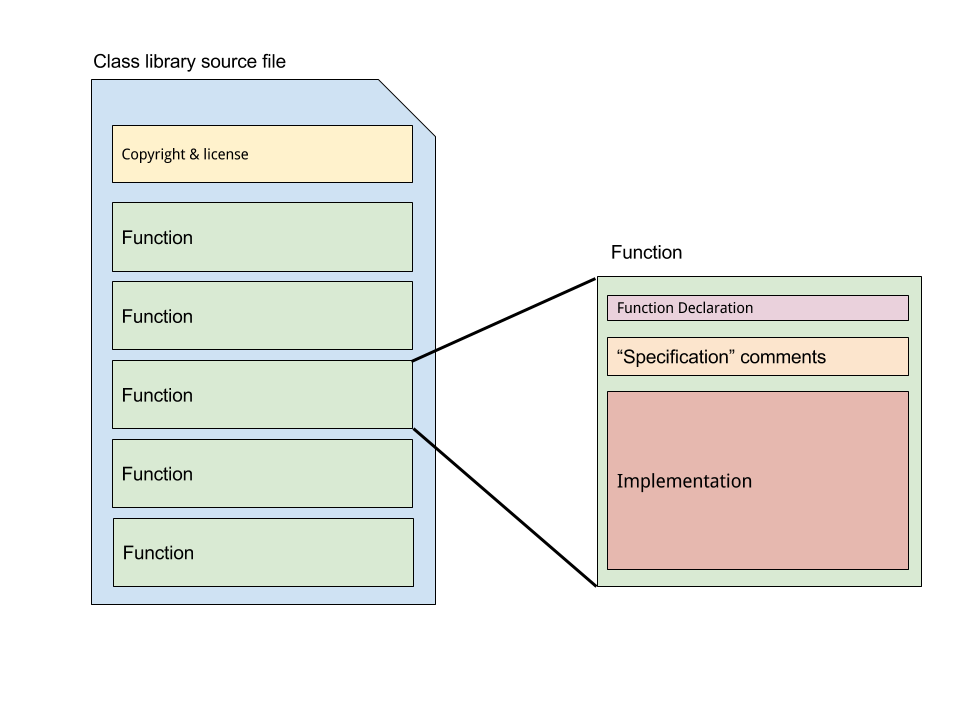
When a programmer uses the function in a program elsewhere, she lists just the function declaration and parameter list along with an indication of where to find the implementation of the function. Then when she calls the function, she uses the function name.
So what is the API? Although the term is also used in the software industry to mean the more general use of APIs as well (especially for REST applications), the clue is in the word “Interface”. An API is not the code that actually makes the function happen, nor is it the specification for the function. Those only appear in the class library source code.
The API is the part that appears both in the library source code and in the program where the function is used. It’s the interface to the library code used by an application. The API is the common ground; the handle by which the program holds the library; the glue holding linked code together.
Neither is a single Java function in that class file an API. The API is the set of exposed function declarations that provides an interface for the application programmer to the full class library. Other definitions I’ve seen – and were made in the courtroom – left open the possibility that an “API” was in some way the software itself. But it’s not – it’s just the interface between the application programmers code and the code in the library.

I’m sorry if that all sounds obvious. I discovered that there are plenty of people who don’t find it obvious at all that an API is an interface to some shared code for use by an application programmer and not the software which the programmer is trying to connect with. Hence the name.
]]>