As some of our regular readers undoubtedly know, I am involved in a few weekly live tweets on twitter. I host #FridayNightFlix every Friday, I co-host #ScarySocial on Saturday, and I am one of the five hosts of #MondayActionMovie! Every week, we get together. We watch a movie. We tweet our way through it.
Tonight, for #ScarySocial, I will be hosting 1984’s The Initiation!
If you want to join us on Saturday night, just hop onto twitter, start the film at 9 pm et, and use the #ScarySocial hashtag! The film is available on Prime and Tubi! I’ll be there co-hosting and I imagine some other members of the TSL Crew will be there as well. It’s a friendly group and welcoming of newcomers so don’t be shy!
Happy Birthday in Heaven to one of my all time favorite actors, Rutger Hauer. I was so happy when his career hit a resurgence in 2005 with roles in SIN CITY and BATMAN BEGINS. Today, I’m celebrating my wife’s birthday, and I’m also celebrating Rutger’s birthday by sharing this scene from the amazing SIN CITY.
Enjoy my friends, and Happy Birthday Rutger! You have brought me so much joy over the years!
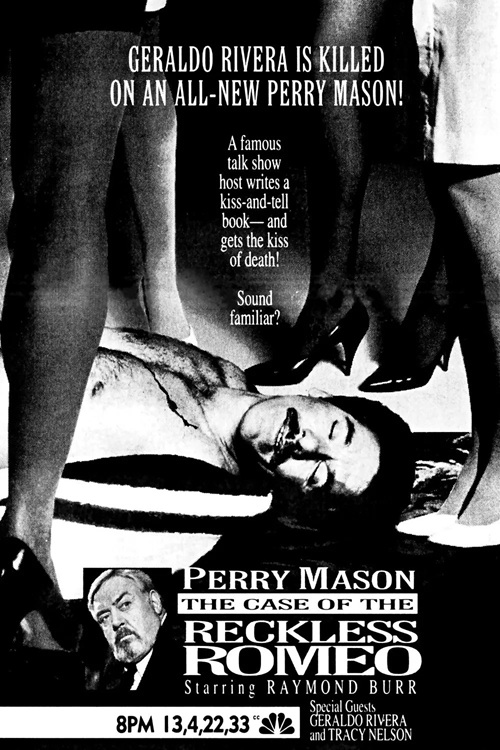
Sleazy talk show host Ted Mayne (Geraldo Rivera) writes a tell-all book about all of the famous women with whom he has had affairs. One of the women, Roxanne Shields (Amy Steel), is filmed threatening to kill him with a knife. When Ted is later found stabbed to death, Roxanne is arrested. Luckily, Perry Mason (Raymond Burr) is willing to take the case and reveal the true killer of the reckless Romeo.
This was one of the last of the Perry Mason movies. (Burr only did four more after this before he died.) The plot is okay, even if this is the third movie to feature Ken (William R. Moses) getting in trouble with the mob while investigating the the murder. It didn’t take me long to guess who the murderer was but the scene where Perry got his courtroom confession was still really well-done. Not surprisingly, the main pleasure of this film was seeing Geraldo Rivera as the victim. Geraldo may have been a terrible actor but he was still totally believable as a sleazy talk show host who went out of his way to embarrass every woman that he had ever had sex with. Geraldo is in the film long enough for you to get sick of him and then he goes away and isn’t seen again. That’s the way it should always be with Geraldo Rivera.
Perry does a few more courtroom tricks than usual in this movie. As the hapless district attorney, Kenneth Kimmins is no David Ogden Stiers. He’s not even Scott Baio. It’s really enjoyable to watch him get continually outsmarted by Perry. Raymond Burr was obviously not doing well physically when he made this movie but it’s still fun to watch him trick witness after witness into identifying the wrong woman.
Ranger Bill Williams (Bill Cody) is working undercover. First, he meets up with and goes to prison with rustler Dragon Morris (Ben Corbett). After Bill finds out that Dragon’s boss is Chuck Adams (George Chesebro), Bill gets out of prison, tracks down Chuck, and then has a fake posse pursue him in order to prove his bona fides as an outlaw. Chuck invites Bill to be a member of his gang. However, Dragon has figured out that Bill’s a lawman and, when he escapes from prison, he tries blow Bill’s cover.
I know I make a lot of excuses for Poverty Row westerns. I can’t do it with this one. The Border Menace is really bad. Produced by Aywon Film, one of the least success of the Poverty Row studios, nothing about The Border Menace works, not even the stock footage of the posse. This is one slow movie, even with barely enough plot to fill out its 50-minute run time. The acting is bad all around, except for veteran western baddie George Cheseboro and Bill Cody, who at least is likable as the hero. Bill has a comedic sidekick but it’s not Fuzzy St. John or Gabby Hayes. Instead, it’s Jimmy Aubrey as Polecat Pete. Polecat Pete yells and sings. I don’t think I’ve ever rooted for the comic relief to get caught in that crossfire before.
Bill Cody starred in a handful of B-westerns in the 30s. He was a former stuntman and looked convincing on a horse. He really wasn’t a bad actor but the main reason he found success was because he shared his name with “Wild Bill” Cody. The two Codys were not related.
“There are things within a soul that can never be unleashed… They would consume us. We would cease to be, and another would exist in our place, without control, without limits.” — Vanessa Ives
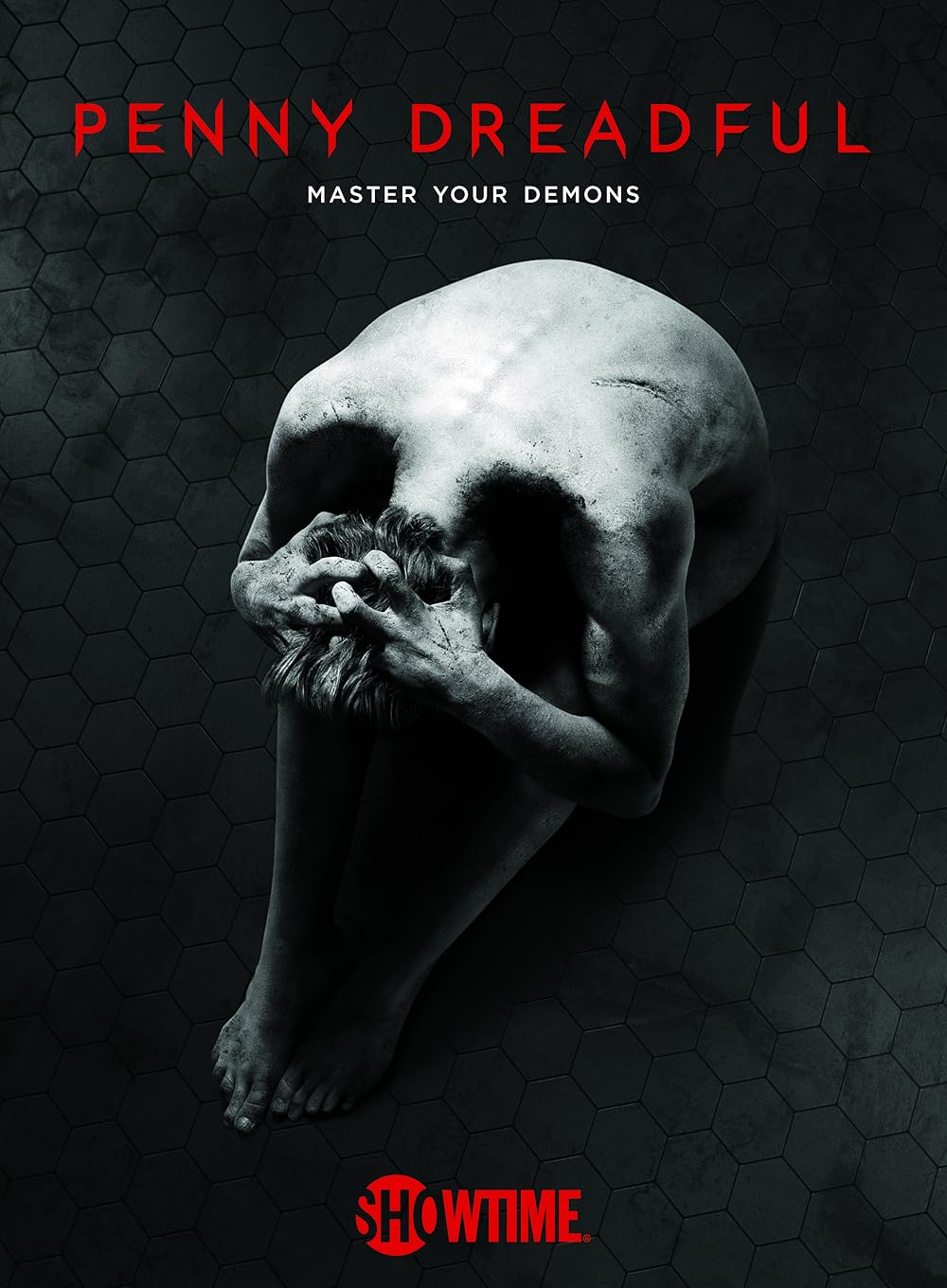
Penny Dreadful remains one of the more distinctive horror dramas of the 2010s, its three-season run on Showtime from 2014 to 2016 offering a rare blend of lush literary homage, character-driven tragedy, and outright Grand Guignol spectacle. Expanding the lens season by season clarifies how the series evolves from a moody, experimental monster mash into a full-blown gothic epic, while also highlighting the structural flaws and uneven pacing that prevent it from being universally accessible, even as standout performances from its ensemble elevate every frame. What emerges is a show that grows richer the more time it spends with its characters—particularly through highlight turns like Eva Green’s ferocious Vanessa Ives, Rory Kinnear’s soul-wrenching Creature, and the magnetic supporting work from Timothy Dalton, Josh Hartnett, and Billie Piper—rewarding patient viewers even as its narrative sometimes strains under the weight of its own ambition.
Season one of Penny Dreadful functions as an origin point and a proof of concept, introducing viewers to a haunted ensemble bound together by secrets, sin, and supernatural forces, with performances that immediately set a bar for emotional and physical intensity. The central plot—Sir Malcolm Murray and Vanessa Ives recruiting American gunslinger Ethan Chandler and tortured scientist Victor Frankenstein to rescue Malcolm’s daughter Mina from a vampiric master—serves less as a conventional quest and more as a framework to explore broken people clinging to purpose, anchored by Timothy Dalton’s commanding Sir Malcolm, whose gravelly authority and haunted eyes convey a lifetime of imperial regrets and paternal failure. Eva Green’s Vanessa is the undeniable highlight here, her ferocious intensity in episodes like Séance and Possession—where glossolalia, contortions, and violent ecstasy erupt—turning demonic outbreaks into raw expressions of guilt, repression, and spiritual crisis, earning her a Golden Globe nomination for a debut season that demands Oscar-level physicality and vulnerability. Josh Hartnett’s Ethan Chandler provides a grounded counterpoint, his brooding sharpshooter evolving from reluctant hero to tormented beast with subtle shifts in posture and gaze that foreshadow his lycanthropic reveal.
The first season also lays the groundwork for the show’s thematic fascination with duality and monstrosity, especially through Harry Treadaway’s brittle Victor Frankenstein—whose twitching desperation humanizes god-like hubris—and Rory Kinnear’s breakout as the Creature, a shambling horror who quickly reveals literate eloquence and bitter pathos, his scarred visage and rumbling baritone making every plea for connection a gut-punch that redefines “monster” from the outset. Season one’s pacing can feel deliberately slow, even theatrical, as it lingers on candlelit rooms, whispered confessions, and philosophical exchanges, and some viewers may find this emphasis on mood over plot progression alienating. Yet that same deliberation allows the show to build a cohesive emotional atmosphere in which every prayer, séance, and bloodletting feels weighted with meaning, amplified by Dalton’s authoritative gravitas and Green’s transcendent torment. Critics generally responded favorably to this opening run, praising these performances and the atmosphere while noting that its heavy tone and self-seriousness would not be to every viewer’s taste.
Season two represents Penny Dreadful at its most confident and cohesive, expanding the mythology while tightening the emotional focus around Vanessa’s confrontation with a coven of witches led by Evelyn Poole, with Helen McCrory’s serpentine Madame Kali emerging as a highlight villain whose purring malice and intimate manipulations steal scenes. By reframing the central antagonist from a shadowy vampire figure to this fully articulated witch—who weaponizes intimacy, religious iconography, and psychological terror—the show raises the stakes, and Green’s Vanessa responds with even greater ferocity, her possession battles now laced with backstory from Patti LuPone’s earthy, heartbreaking Cut-Wife, whose single-episode arc showcases LuPone’s unparalleled ability to blend folk wisdom with maternal ferocity. This season’s central conflict positions Vanessa as the battleground for Lucifer’s desire, giving the main cast a unity of purpose that the first sometimes lacked.
Character work in season two deepens significantly, with Josh Hartnett elevating Ethan into a moral savage whose lupine rampages in No Beast So Fierce blend raw physicality and soul-searching remorse, while Billie Piper’s evolution from fragile Brona Croft to the defiant Lily Frankenstein becomes a revelation—her steely monologues on patriarchal violence delivered with fiery conviction that rivals Green’s intensity. Rory Kinnear’s Creature reaches new pathos pleading for a mate, his rejection scene opposite Treadaway’s increasingly unhinged Victor one of the series’ most devastating showcases of mutual ruin. Reeve Carney’s Dorian Gray adds hedonistic shimmer, though his arc pales next to these powerhouses. Moments like the group’s desperate defense of Sir Malcolm’s home or Ethan’s transformations achieve a rare balance of gore, suspense, and lyrical resolution, with Dalton’s weary patriarch holding the emotional center. Critics frequently cite season two as the show’s peak, with 100% Rotten Tomatoes scores reflecting near-universal praise for these heightened performances and tighter narrative.
Season three is where the series’ strengths and weaknesses collide most dramatically, as it scatters the core ensemble geographically and mythologically while hurtling toward an abrupt conclusion, yet the actors rise to the challenge with career-best work. Eva Green’s Vanessa deepens into despairing isolation, her therapy sessions with Patti LuPone’s returning Dr. Seward (a chilling pivot from folk healer to clinical cutter) and tender courtship by Christian Camargo’s suave Dracula yielding some of her most nuanced work—balancing fragility, resolve, and erotic pull in a finale self-sacrifice that cements her as TV’s ultimate gothic heroine. Josh Hartnett’s Ethan, now grappling with Apache mystic Kaetenay (Wes Studi’s dignified gravitas a welcome addition), delivers visceral Western showdowns that showcase his action-hero chops alongside soulful reckoning. Timothy Dalton’s Sir Malcolm, questing in Zanzibar, brings imperial weariness to poignant closure, his highlight a raw confrontation with past sins.
Standouts continue with Billie Piper’s Lily rallying a feminist uprising, her ideological fire clashing gloriously with Dorian’s jaded ennui in scenes of revolutionary fervor and betrayal that highlight Carney’s subtle decay. Harry Treadaway’s Victor, partnering with Shazad Latif’s oily Jekyll, spirals into ethical abyss with manic precision, while Rory Kinnear’s Creature—rediscovering his identity as John Clare—delivers the series’ most quietly devastating arc, his family reunion a masterclass in restrained grief that rivals Green’s flashier exorcisms for emotional wallop. These performances salvage the fragmented plotting, infusing global detours with humanity even as resolutions feel rushed.
Evaluated across all three seasons, Penny Dreadful delivers a rich, if imperfect, journey elevated by its highlight performances: Green’s transcendent Vanessa as the tormented soul; Kinnear’s Creature as the rejected heart; Dalton’s authoritative patriarch; Hartnett’s brooding beast; Piper’s fiery avenger; and LuPone’s dual folk icons—forming an ensemble that turns gothic pulp into profound tragedy. Season one constructs a dense foundation; season two refines it into peak artistry; season three reaches for epic finality with power even in haste. The end result succeeds more as character-driven gothic poetry than tidy thriller, its actors ensuring unforgettable resonance for horror fans craving depth. In a landscape of sanitized scares, these performances make Penny Dreadful a dark, enduring achievement.
As some of our regular readers undoubtedly know, I am involved in a few weekly watch parties. On Twitter, I host #FridayNightFlix every Friday and I co-host #ScarySocial on Saturday. On Mastodon, I am one of the five hosts of #MondayActionMovie! Every week, we get together. We watch a movie. We tweet our way through it.
Tonight, at 10 pm et, I will be hosting #FridayNightFlix! The movie? 1990’s Lionheart!
If you want to join us this Friday, just hop onto twitter, find Lionheart on Prime, start the movie at 10 pm et, and use the #FridayNightFlix hashtag! I’ll be there happily tweeting. It’s a friendly group and welcoming of newcomers so don’t be shy.



 Through the Shattered Lens