

|

|
| CARVIEW |
The video that I selected is about what diets are and how they work in our bodies directly. This video is in relation to our interactive learning resource project, which is about essential nutrients. After learning essential nutrients in our bodies, learners can use this video as an introduction to learn more about how to design their daily plan and how to make dietary choices clearly.
1. In what way are they likely to respond to the video on their own, e.g. make notes, do an activity, think about the topic (learner-generated)?
Learners are likely to make notes when they watch this video in order to respond to the video on their own. This video has been divided into several aspects with clear subtitles, so taking notes will be much more useful and helpful for learners to understand and review the content. The learning content in this video is directly related to learners’ lives and daily diets, so they can also share their reflections or have a further researching on this topic through learning activities.
2. What activity could you suggest that they do, after they have watched the video (designed)? What type of knowledge or skill would that activity help develop? What medium or technology would students use to do the activity?
I will suggest learners to write their own reflections in relation to nutrients and diets they have learned after they have watched this video. If it is requited, I will also create an online discussion forum by using social media tool and encourage learners to discuss questions, share their reflections, and respond to other people’s experience on this online forum. Also, I will encourage them to work in a small group and design a balanced daily diet plan on the forum as well. In my opinion, this kind of learning activity can help learners to improve their communication skills and cooperative skills.
3. How would students get feedback on the activity that you set? What medium or technology would they and/or you use for getting and giving feedback on their activity?
From our reading material, Bates (2019) also reflects the importance of feedbacks in learning process. As he describes, some medium like an online discussion forum can be an effective platform for instructors to provide feedbacks (Bates, 2019). In order to give learners’ feedback on their activity, an online discussion forum will be created and used as well. In the discussion forums, learners can not only share ideas and reply to other people’s posts, but also can get feedbacks and suggestions from me as well.
4. How could the video have been designed to generate more or better activity from viewers or students?
The creator of this video can add more interactive activities in the video in order to help viewers or learners to generate more and better activities or ideas from it. For example, asking a relevant question in the end of the video in order to encourage learners to do more research on this topic. Also, adding more short questions during the video to help viewers to thinking and assessing in their learning process. The interactive activities can make the video become much more attractive as well.
Source
Bates, A. W (2019). Teaching in a Digital Age: Second Edition. Retrieved from: https://pressbooks.bccampus.ca/teachinginadigitalagev2/chapter/pedagogical-roles-for-text-audio-and-video/
]]>
Photo by Element5 Digital on Unsplash
Blog Prompt: How will your interactive learning resource specifically ensure that the needs of all learners can be met?
In this week, we focus mainly on discussing universal design. According to the web article, “Making Sense of Universal Design for Learning”, the author states that universal design for learning (UDL) is a useful educational method that benefits all learners by reducing barriers to learning and addressing learning needs of different learners. In my opinion, there are many benefits of using universal design in learning, such as giving learners many different ways to acquire and demonstrate knowledge, making the instructional practices more flexible and equable, increasing learner engagement and helping instructors to better support every learner.
In our group’s interactive learning resource, we also tend to use universal design to ensure that the needs of all learners can be met. We plan to use a blog on WordPress as our project’s teaching platform. The topic of our project will be divided into three main sub-topics (i.e. three blog posts). Each post will include a brief introduction of learning outcomes, learning materials with a variety of multimedia (i.e. texts, videos, audio, images, and links), and learning assessment. In my opinion, the design of our interactive learning resource can help learners to meet their learning needs and preferences specifically in several ways.
Specific learning goals are given to our learners. The brief and clear learning outcomes for each sub-topic will be shown in the beginning in order to help our learners to have a clearer viewing about what they will learn from our post directly. Our learners will know exactly what to expect from our lesson and will feel more motivated to pay attention to complete their learning goals.
Flexible learning places and times. Our project is learner-centered, which means learners can decide on their own pace, time, and place of learning directly by themselves. One of the biggest challenges for our learners are that they need to have access to use the Internet in order to read our blog posts. However, the learning places and times are very flexible, so they can participate in our project at any time, anywhere they want when they are available in using the Internet.
Learning materials with a variety of multimedia. As I mentioned above, the learning materials in our project will be used by different kinds of multimedia, including texts, audios, videos, and images. Therefore, it will always be convenient, useful, and effective for different groups of people. For learners who prefer to read, they can learn from the texts and additional reading materials in our lesson, but for learners who prefer to listen, they can watch the videos we shared and and get benefits from them directly.
Overall, I think all the ways can make me ensure that needs of all our learners can be met specifically from our interactive learning resource.
References
Making Sense of Universal Design for Learning. Retrieved from: https://education.alberta.ca/media/464638/video-discussion-guide-4-making-sense-of-universal-design.pdf
Jordan N. (2019). Universal Design for Learning. Retrieved from: https://www.prodigygame.com/blog/universal-design-for-learning/
]]>The image below demonstrates the Experiential Learning Cycle by Kolb, which also shows the main characteristics of this approach (Experiential Education, 2020):
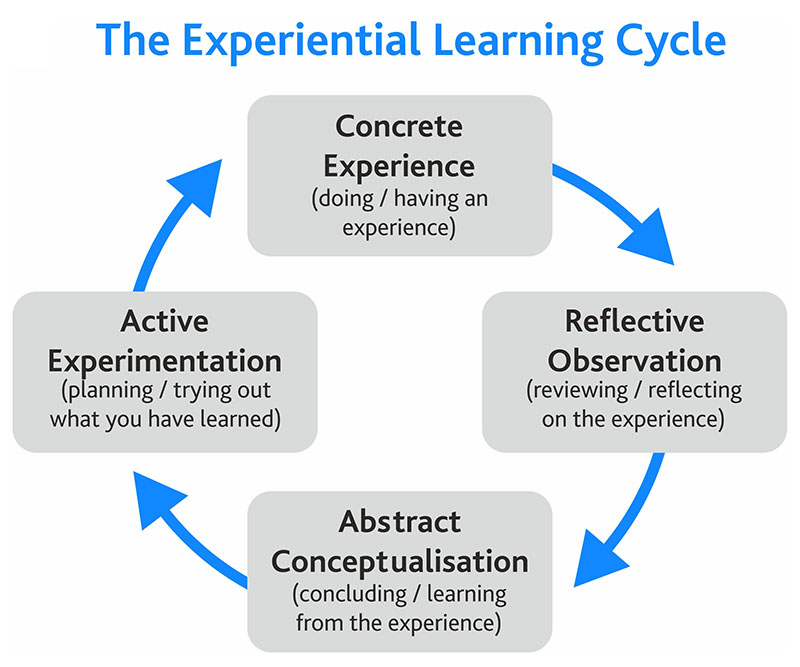
The Experiential Learning Cycle. Image by “What are Kolb’s Learning Styles and What Do They Mean?”
- Concrete Experience: the learner encounters a new experience or reinterprets an existing experience.
- Reflective Observation: the learner reflects on the new experience and finds the inconsistencies between his/her understanding and experience.
- Abstract Conceptualization: the learner develops new ideas based on experience and reflection.
- Active Experimentation: the learner acts on his/her new ideas by engaging in new experiences.
Based on the Experiential Learning Cycle, I think this approach can apply to our blueprint.
Concrete Experience: the topic of our blueprint is about the basic information of nutrients in our bodies. In the beginning, students will be asked to record their own daily diet and divide their diets into several groups, based on different nutrients. It is the process for them to reinterprets their existing experience.
Reflective Observation: after learning from the content we presented, learners need to reflect on their daily diets and explore the inconsistencies between their daily diets and their understanding.
Abstract Conceptualization: learners will develop new ideas about how to improve their daily diets based on their reflection. In this part, they will also share their ideas and experiences with their peers on online discussion forums and discuss their opinions with them.
Active Experimentation: learners will design and create new daily diet plans based on what they have learned from our project and what essential nutrients they needed.
In my opinion, experiential learning will play an important and necessary role in our Blueprint. Also, this approach can help our learners to be more engaged in learning process, develop new ideas, and have more learning experience and cognitive ability.
References
Image: What are Kolb’s Learning Styles and What Do They Mean? Retrieved from: https://www.skillshub.com/what-are-kolbs-learning-styles/
Experiential Learning Cycle Model (2020). Experiential Education. Retrieved from: https://carleton.ca/experientialeducation/what-is-experiential-education/experiential-learning-cycle-model/
]]>One of the learning experiences I want to share is about learning IELTs and taking the IELTs test. As an international student, I have to take and pass the IELTS Academic test in order to apply to the university successfully. At that time, a minimum overall score of 6.5 (total score is 9.0) is a mandatory requirement with a minimum score of 6.0 in each component of the academic IELTs test. There are four main parts on IELTs test, including speaking, listening, writing, and reading. However, one of the learning challenges for me in IELTs test was the section of writing. When I first time taking this academic test, I found that I was very poor in using academic vocabulary and I always made mistakes in grammar. I realized that I should improve my writing skills seriously in order to increase my overall score. It was challenging for me because improving the skills of writing in English was not easy for international students. Chinese writing skills like the use of grammar is totally different from others. To overcome this learning challenge, I begun to participate in online courses about developing writing strategies and skills on IELTS Academic test and used a social media tool, called “Duolingo” to practice the use of English vocabulary and grammar.

Photo by JESHOOTS.COM on Unsplash
From this week’s reading, I realized that I had used many learning strategies to improve my writing skills for that academic test. For example, the use of the social media tool, “Duolingo”, in improving English vocabulary is based on the learning theory, “Cognitivism”. This learning strategy focuses more on the mental process, such as thinking, knowing, memory, and problem-thinking. This tool helped me to learn new academic vocabulary in English and review the knowledge I had learned before through relevant educational games. Moreover, during the learning process, I spent a lot of time on practicing the use of grammars in English writing and I took lots of short quizzes in online courses to assess myself and improve my grammar. In the online course I took, the instructor also gave us direct instruction about the writing strategies. I think this learning process is based on the learning strategy of “Behaviorism”.
Based on my own learning experience, I think the learning strategies will be useful and important in English language teaching and learning.
Reference:
Ertmer, P. A., & Newby, T. J. (2013). Behaviorism, cognitivism, constructivism: Comparing critical features from an instructional design perspective. Performance Improvement Quarterly, 26(2), 43-71. Retrieved from: https://edtechbooks.org/lidtfoundations/behaviorism_cognitivism_constructivism
]]>Hello everyone, my name is Tingyan (Linda) Zhang. I come from Guangdong, where is a coastal province in South China. I love traveling with my friends and family. I think traveling can not only relax myself, but also open up my eyes and learn more about cultures, traditions, and history of different places. This is my fourth year studying in Uvic with the major of Economics. Hopefully, I will graduate after this summer semester. After I graduate, I plan to apply for graduate degree programs in my major as well.
My friends recommended me to take this course as one of my electives. I am very looking forward to taking this course and learning more about the basic information of learning design and its application to interactive learning environments.

- Do you want to be online vs. offline?
- Do you want to use your name (or part thereof) vs. a pseudonym (e.g., West Coast Teacher)?
- Do you want to have your blog public vs. private? (Note, you can set individual blog posts private or password protected or have an entire blog set to private)
- Have you considered whether you are posting within or outside of Canada? This blog on opened.ca is hosted within Canada. That said, any public blog posts can have its content aggregated/curated onto social networks outside of Canada.
First tasks you might explore with your new blog:
- Go into its admin panel found by adding /wp-admin at the end of your blog’s URL
- Add new category or tags to organize your blog posts – found under “Posts” (but do not remove the pre-existing “edci335” category).
- See if your blog posts are appearing on the course website (you must have the the edci335 category assigned to a post first and have provided your instructor with your blog URL)
- Add pages, if you like.
- Include hyperlinks in your posts (select text and click on the link icon in the post toolbar)
- Embed images or set featured images and embed video in blog posts and pages (can be your own media or that found on the internet, but consider free or creative commons licensed works). To embed a YouTube video, simply paste the URL on its own line.
- Under Dashboard/Appearance,
- Select your preferred website theme and customize to your preferences (New title, new header image, etc.)
- Customize menus & navigation
- Use widgets to customize blog content and features
- Delete this starter post (or switch it to draft status if you want to keep it for reference)
Do consider creating categories for each course that you take should you wish to document your learning (or from professional learning activities outside of formal courses). Keep note, however, that you may wish to rename the label of the course category in menus (e.g., as we did where it shows “Learning Design” as the label for the “edci335” category menu. This will enable readers not familiar with university course numbers to understand what to expect in the contents.
Lastly, as always, be aware of the FIPPA as it relates to privacy and share only those names/images that you have consent to use or are otherwise public figures. When in doubt, ask us.
Please also review the resources from our course website for getting started with blogging:
- WordPress resources
- Using RSS feeds to read blog posts from your networks (e.g., Feedly)
- Privacy resources
- Copyright resources
- Finding images you can use
- in the blog feed on the front of your website
- in the Learning Design menu on your website. This is because we have applied the “edci335” category to this post and the menu item “Learning Design” has been created from the category “edci335.” For every post you make for this course, please assign the “edci335” category to it. You are welcome to use this blog for your personal hobbies or for other courses, in which case, you could create additional menu items and categories for them.
- if you give permission, your posts categorized “edci335” will be aggregated onto the Blog Feed on the EDCI 335 Course Website.
Feel free to delete this post once you understand this. If you have any questions, please reach out to your instructor.
]]>