


| CARVIEW |
– William Gibson on NPR, August 1993
As a card-carrying Gen X human and longtime online educator, I’ve been seeing & hearing the quote above pretty much my entire career. I used to think it was about…well…the internet.
I’ve changed my mind. As I try to redesign my courses for online delivery and advise fellow educators being asked to prepare for online and HyFlex and everything else in the midst of the mad YMMV* of this whole ‘Year of the Pandemic’ misadventure, it occurs to me Gibson may have been a time-travelling Nostradamus, sent back in time from higher ed 2020. Because never have I seen ‘the future’ move so fast. And never have I seen such uneven fault lines laid visible in the process.
(Side meander: I read this Encyclopedia Brown book as a kid where the Boy Detective figures out that a war relic is a fake because its engraving is marked “The First Battle of X.” I distinctly remember Boy Detective smugly pointing out that nobody knew there was gonna be a Second Battle at the time of the first. ie, this ONLY goes down as ‘the Year of the Pandemic’ if we can be one and done by the time we see 2020 out. I have deep doubts about us, people, but…rolling with it.)
***
In the spirit of full disclosure, since you may not have realized you were being lured here by a title best described as ‘flippant and ill-considered,’ let me note that the idea of three easy steps to online re-design is a sardonic fiction. Redesign is a complex process and an ever-evolving one, full stop.
This post is effectively a really long “I don’t know who needs to hear this, but.” Key takeaways? It doesn’t get easy. And that doesn’t mean you’re doing it wrong.

Redesigning for online is a confronting process. It forces you to pare down both your course content AND your course communications to the bits that matter most, then demands that you consider how these things work together.
This is NOT a bad thing. This year of pandemic and protests makes visible the huge variabilities and inequities baked into so many of the systems we participate in. Removing the four walls of the classroom doesn’t magically create inequities in education…they’re present even when everyone sits together in the same space for the same amount of time. Brains and bodies vary: so do the experiences and expectations and assumptions teachers and learners bring with them about each others’ brains and bodies. We all live different realities.
Bitter truth: for the first month of the pandemic I had a full fight/flight recoil from any reflective process. What I lost in the capacity to think in full sentences, though, I gained in the ability to commandeer a fridge and pantry. I am not the cook in our family, but overnight, I became like someone who survived the Great Depression: hark! A stalk of celery and a tin of tomatoes! I can make a gourmet dinner AND make sure there are leftovers that get promptly eaten the following day. We used the hell outta our resources, for months.
This is what some of us do in uncertainty: focus down to immediate needs and capacity. The amygdala rules.
My partner, on the other hand, worked ten hour days, wrote half an Online Teaching textbook, and created an entire site of video resources and interviews about digital pedagogies and Online Learning in a Hurry. Jackal. ;) Even from the same house, we had totally different responses to the stress of the adaptation.
Come September, we won’t know what these last months have been in our students’ lives. We won’t know what their present is.
But we do need to know that going online forces a more drastic contention with the variable social and societal and financial and responsibility contexts in which our brains and bodies are embedded: online forces us to intentionally identify ALL the elements of our course communications and consider how those different contexts might shape how learners receive and perceive the constructs of our classes.
To circle back to Gibson, the internet has always distributed both the future and the present highly unevenly.
***
On the redesign front, I need to be clear: I have it as good as anybody could. Online is my field. I started on my online learning journey back in 1998. I have a tenure-track faculty position that pays me well for the time I put into redesign, and my university – like many in Canada but far fewer in other jurisdictions – has made a clear commitment to a fully online fall.
(Caveat: I know a lot of educators are navigating what appears to be a “let’s go back to campus, it’s fine!” death cult response from institutions whose bottom lines depend on residences or football or whatnot. It’s a public health and ethics horror show masquerading as an ugly version of The Trolley Problem and I don’t even know what to say about it. I also don’t know what to say about the idea that broadcasting lectures and in-class activities should be considered ‘online teaching,’ except…I’m a nope. So when I say ‘redesign is hard,’ I’m grateful for the problems I have. But maybe it’s important for someone like to me to say, it’s still hard. Trust me.)
Redesign is hard because it’s not actually a three-easy-step process, or a step-by-step process at all. It’s about power and pedagogy more than tools and content. Redesign forces us to think about the internet and how to use it for meaningful communications.
Handy-dandy truth: the infrastructure of the internet is actually designed FOR two-way participatory communications…students can post ideas (in written, video, or visual form) for other students or even public audiences – where relevant – to engage with, and there are ways to scaffold productive peer and public engagement with student work.
But. To make the most of that potential, you have to be game to do a few things you may or may not be doing in a more conventional classroom environment.
You have to build students’ capacity and confidence as knowledge creators, not just consumers.
You have to be willing to let students see each others’ work, even where that may challenge your power or authority, or your trust in their academic integrity.
You have to develop meta-guidelines about assignment expectations, focusing on core ideas and on what counts in different types of formats…especially outside the realm of formal academic writing.
(I also recommend you be gracious and non-punitive about honing and adapting your guidelines when you realize you’ve missed the mark. Better, engage students IN that adaptation. Build your own learning curve with new forms of communication into the teaching process).
If you want students to build some sense of community and social learning, you also need to teach them how to give meaningful formative feedback to each other. I use this four-sentence RISE model for my own feedback straight outta the gate in any online or blended course, then ask students to take it on as their own. It saves us all from awkward and pointless feedback. Ahem.
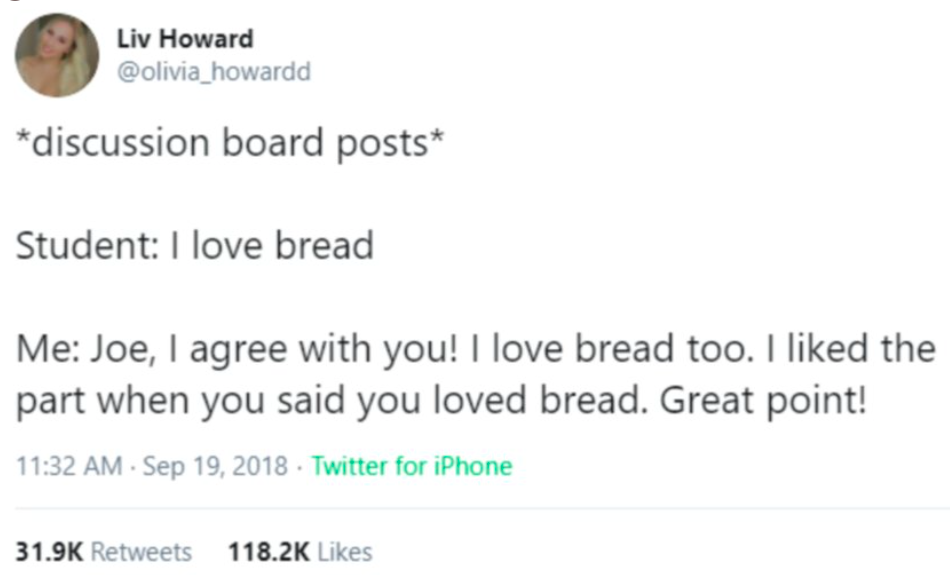
Ultimately, to build engaged, participatory online classes, you have to design projects and peer communication opportunities that make their work about more than right or wrong answers.
And, maybe…try to see your own work in a frame that’s wider than right and wrong, too. You won’t get every part of your course design and teaching right, no matter how hard you try. You can’t. Online teaching doesn’t work that way, any more than f2f does. If you’re new to online, you may worry students will disrespect you for not knowing what you don’t know, but…acknowledging that you’re on a learning journey, too, and open to growth is more likely to build respect than damage it.
Or at least I hope so. Since I emerged from my initial pandemic paralysis, I’ve spent a lot of the last few months talking about online teaching, with K-12 educators and folks from around Ontario and the world. But this video from last week is from by FAR the most intimidating session I held: PD for my own faculty colleagues.
I’m not suggesting you should watch this. I can tell you easily 23 things that went wrong. The recording isn’t great, because it’s Zoom and on Zoom, if you record from the same computer you screenshare the slides on, the recording ends up with the faces covering half the slides (here are the slides on their own, FWIW). Worse, if you’ve only used Zoom for webinars and one-way communication, and then try to leap into teaching / modelling participatory engagement without trying out the many-to-many features of Zoom with a live test audience, you’ll find yourself fumbling a lot. The live whiteboard contributions don’t automatically disappear when you move to another slide, because…you’re screensharing, not collaborating on the slides. Basically, it’s a decent PD session that also features raw video footage of me hanging in the wind and learning out loud, in front of my colleagues, while speaking blind to an audience I can’t see and whose esteem I care about. Sub-optimal, if you’re my pride.
But here’s the thing: my pride is not the point. Yes, I designed and redesigned this for hours. And still I missed a bunch and ended up questioning every life choice I’d made that brought me to that moment, because it was my first time using this particular tool this particular way. Full stop.
Maybe, in the end, that’s the best model I can offer to anyone venturing into the intimidation of online redesign and teaching: carry on. Keep learning. Reflect out loud.
*YMMV = ‘your mileage may vary’
***
Post-script:
I worry about how fast ‘the future’ is moving.
Audrey Watters points out that we need to decolonize the edtech imaginary our institutions are buying into at breakneck speed. Participatory pedagogies that use the communications capacity of the internet are messy, and complex, and confronting…simple ‘push this button and get data’ solutions are easier. They’re being pushed to decision-makers, hard. But if we want ANY future to be more evenly distributed, all of us with an investment in education need to push back.
As Audrey says in the powerful keynote script above, Don’t give me an app. Address structural racism. Don’t fund startups. Fund public education.
That’s the kind of online teaching I want to design for.
It’s a Tool Parade. At least on the surface. I’m marshalling the #UWinToolParade with three – soon to be four – brilliant and creative B.Ed students at the University of Windsor, thanks to (yay!) grants from our Office of Open Learning and Centre for Teaching & Learning.
And yep, we’re talking about tools. And tech platforms.
Apparently my “fun” face & my “deranged” face aren’t as distinct as they, um, could be)
***
I have opened just about every tech course and tech talk and tech workshop that I’ve given for YEARS with the caveat that I don’t talk about tech platforms, really. Or stand-alone tools. I talk about thinking tools for dealing with the digital. I talk about pedagogy. Or andragogy. Or heutagogy. But not about tools as shiny-things-by-themselves, decoupled from sociocultural and sociotechnical analysis.
I still stand by that. I think platforms are, socioculturally, a major problem. They mine data. They undermine democracy. Youtube just announced yesterday that homophobic slurs don’t violate its platform policies (edit: OOH LOOK that changed fast. But basically, hate and surveillance and anti-social behaviours are profitable. At least until they aren’t. Full stop.
Still. Critiques of platforms don’t keep edtech from being sold to school boards, mandated by governments, or used by students, often with unintended effects. AND I still think the participatory infrastructure of the web has huge educational value and potential, when web platforms ARE used to build participatory literacies and connections.
So. If you want a better web, you gotta help build a better web, right?
Part of that for me is the idea of the #prosocialweb. Part of building a #prosocialweb, IMO, is building capacity for educators and learners to engage with it, thoughtfully and productively.
And part of that is building critical literacies around edtech platforms and tools. Among educators…in K-12 AND in higher ed.
Especially in that notorious Bermuda triangle where conversations between Faculties and Education and pre-service teachers and School Boards/schools/practicing teachers seem to go to die.
Yes, K-12 and higher ed are different organizational realities, for sure. But when it comes to digital integration, we are ALL on the same learning curve. And we all have the same human tendencies to revert to what we know and time constraints on changing what we know.
***
So. We’re building the #UWinToolParade – coming soon to Twitter and Instagram feeds near you – to help do some of the heavy lifting of change, for faculty, for teachers, and for absolutely anybody else who might be interested.
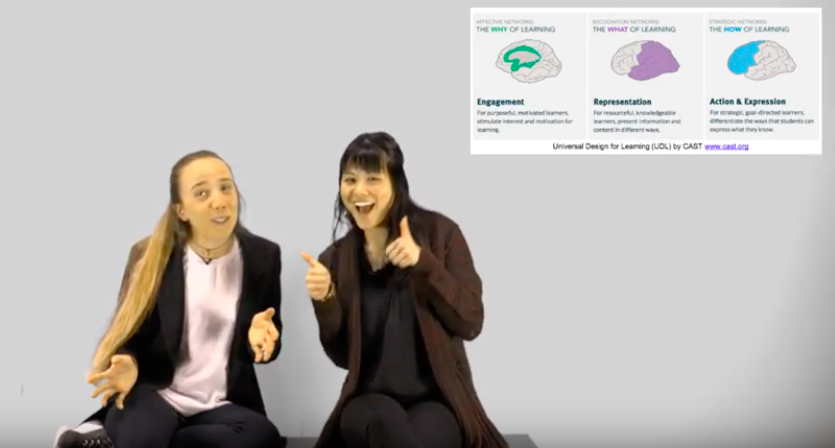
(UDL greenscreen outtake: Stephanie & Alyssa rock the filming learning curve)
Our project will produce a Tool Parade of at least ten smart, short Youtube videos by pre-service teacher candidates, hosted on a Faculty of Ed page for Open Educational Resources (OER).
(Note: huge shout-out to my Dean for being game to support this)
The Tool Parade’s 3-4 minute videos will focus on:
1. what a tool or platform actually does (the educational perspective rather than the vendor perspective
2. critical assessment of costs/risks/Terms of Service/data surveillance
3. how the tool could be used for differentiated learning or participatory pedagogy
The videos are just a start, though. Ultimately, they’ll be accompanied on our Faculty of Ed Open Page by pedagogical resources – ideas for classroom use, further readings – and hopefully by podcasts and other kinds of tool overviews, in different modalities, once my Service Learning students get engaged in the project next fall. All resources will be CC-BY-SA licensed. :)
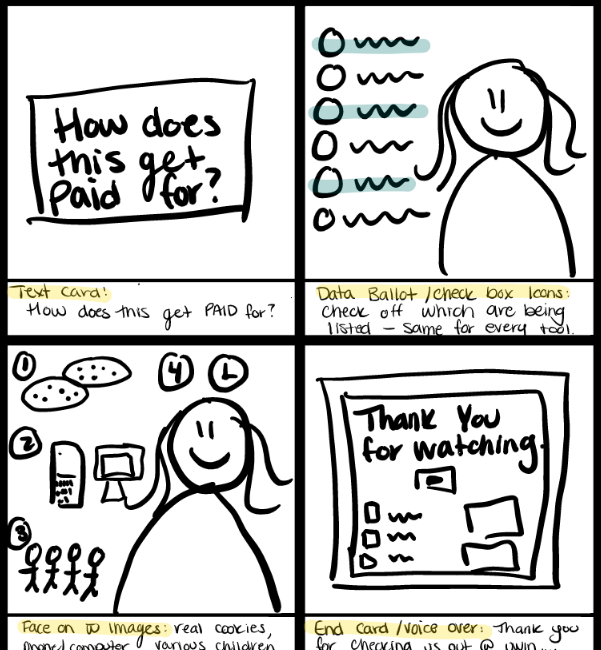
There will definitely be comics, or at least release of the awesome storyboards behind the videos’ creation.
But the real purpose of the project – the part where it’s just a Tool Parade on the surface – is professional learning and open pedagogy.
We’re reaching out to local school boards and schools to lead brief, fun PD sessions for teachers AND parents, about selected tools and participatory learning and differentiation. We’re aiming to try a couple of pilots for 2019-2020 – SO IF YOU’RE LOCAL & INTERESTED, GET IN TOUCH @bonstewart – AND we’ll be leading a faculty development side to the project, inviting and supporting my faculty colleagues to contribute videos or podcasts to the Tool Parade and showcasing these on campus.
The goal is to seed a conversation about tools that’s actually learning-focused, and that models open practice and participatory professional learning for educators at all levels: pre-service, K-12, and higher ed. It’s a big goal for a small project. But worth a shot. :)
***
We’re also hoping some #open colleagues find the resources – or the model – useful and interesting.
If you have suggestions for tools and platforms we might want to add to our roster of Tools To Talk About, let us know in comments or on Twitter using the #UWinToolParade hashtag. So far, we’re working on videos analyzing Flipgrid, Twitter, and Google Expedition, and a Canva v. Piktochart scrimmage between two of the project team has led to plans for a jaunty onscreen debate. We’ve also had suggestions for Prodigy, Grammarly, Phet, and Quizlet v. Kahoot. MORE WELCOME!
Disclaimer: I spent the early part of April living the Very Best of the Web. I’d doubted, frankly, that “best of the web” was a phrase I’d be likely to use again, but…life is funny.
A whirlwind journey landed me in Virginia, Nova Scotia, and Ireland over the first half of the month. In each space and with every collection of people, I framed the web in dire terms.
“We need to talk about the web,” I’d say, and I’d launch into a rat-a-tat battery of images depicting digital spaces in our present: the weaponization of attention. Monetization. Quantification. Algorithmic-decision-making. Surveillance. The enclosure of commons by totalizing technical systems. Basically, THIS:
I’m fun at parties.
But the conversations in the hallways and the restaurants and pubs and hotel spaces – and, yep, online – after each of those talks actually reminded me what the web can DO.
Because I would not have been in any of those rooms if it weren’t for the web.
The participatory web, originally – the old-skool Web 2.0 where readers were also writers and contributors and people were tied together by blog comments – but also social media. Twitter. Even Facebook. Together, these various platforms have networked me into some of the most important conversations and relationships of my life.
And at each stop on my trip in April, ties that had started online brought forth hopeful, meaningful exchanges, and real intellectual and emotional connection to other human beings in spite of geographic distance between our day-to-day lives. Moments of shared purpose and learning and capacity-building. Even in 2019.
This is the the Very Best of what the web makes possible. It was a mini-version what Jim Luke called, in his #OER19 reflection, “technology in the service of people.”
I was basically living the paradox that I was flying around trying to talk about: THE SYSTEMS WE ARE EMBEDDED IN ARE TOXIC. BUT THEY ARE ALSO AN IMPORTANT INFRASTRUCTURE ENABLING US TO WORK TOGETHER AND KNOW EACH OTHER.
We *do* need to talk about the web. But not just so we can all opt out and go home. Those of us who are already there, and for whom the web is more than just Google and a garbage fire, need to talk about it differently.
We need to make the participatory web visible again, in our small human corners of it…even amidst the sea of bots and surveillance and polarization.
NOT because we can drown all that out. So that we are not drowned by it. So we can help others struggling against the current. So we can build rafts, together…until we figure out how many rafts it takes to make a dam, perhaps.
***
Obviously, the toxicity doesn’t stop with digital systems.
It was Earth Day yesterday. I need to stop flying around. I need to work towards the fundamental, drastic changes that will mean my kids have the possibility of a long-term future on this planet. I gotta go deeper than the “one-car family with a hybrid car” schtick and actually change.
I’m reading pieces like Monbiot’s Only Rebellion Will Prevent an Economic Collapse. I signed up for notifications re Extinction Rebellion protests in my area. I note my area does not have an Extinction Rebellion Coordinator.
That kind of work is hard: change work, drastic non-status-quo work. I didn’t even know what a Community Organizer *was* until Obama came to prominence and people started throwing the term around in a loaded way.
When the next US President got elected, though, and terms like “fake news” started to be tossed around like grenades, there was a hot second where I thought maybe *I* could coordinate something. My professional background is part media literacy and part adult ed, and late one night I rambled my way to the idea that maybe we could model off the 20th century Antigonish Movement – an extraordinary Eastern Canadian legacy that brought people together to learn, and to fight The Company Store.
I thought an Antigonish 2.0 for community, citizenship, and information literacy might be a way to address some of the yawning literacy gaps of our own time.
A LOT of people signed up.
I found an amazing ally based in Antigonish, and we started writing grants and spreading the word in places like Educause and via DavidsonNow’s #engageMOOC.
And then we hit a wall. And realized that – whoopsie! – a lot of models of coordination and community organization require a structural position of power within whatever community you’re trying to organize. The #Antigonish2 model needed universities as its centre layer, in addition to networks and communities.
As precarious staff at our respective universities, my ally & I could hustle up a network and publish and write grants on our own time and plan community events and even generate *some* institutional support, but ultimately we did not fit funders’ models for Principal Investigators and we did not fit our institutions’ ideas of the package Strategic Change should come in.
You cannot leverage an institution when you have no real foothold IN the institution.
***
So. Ultimately I uprooted my family from the Maritimes, and #Antigonish2 lay low for the better part of a year. Until I got an invitation – thanks to the networked and institutional roots my ally had laid down – to go TO Antigonish and deliver a keynote for THATCampX in April.
That keynote is here. Its ending is probably more radical than its opening…but it posits that datafication and AI are the new Company Store. And it suggests that resisting the technocratic systems encroaching on our institutions and our lives means – in part, for those of us already online – bringing back the participatory web.
It’s not a one-size-fits-all solution. It is, however, a call to action…and a way of returning the #Antigonish2 name to its rightful home while building next steps for the network who were keen and generous enough to sign on. It’s rooted in what Dave & I have been calling “the #prosocialweb:” an invitation to think and write and build together.
The idea of the #prosocialweb assumes that our small social worlds matter.
Few decision-makers have lived the Best of The Web. What if those of us who have were able to make it visible? To counter the Company Store mythology of capital data solutions that’s gone viral among our leadership strata?
If our contemporary information ecosystem has taught us anything, it should be that that humans are VERY vulnerable to social contagion. All the systems we’ve accepted are neither natural nor inevitable.
And the system I am positioned to make a difference in – at the coordinating level – is networks…so the web and this idea of the #prosocialweb is where I’ll take the subversive hope that underpinned #Antigonish2, for now. To try to counter misinformation, yes. But also to try to push for change, and for a more pro-social and humane digital space through three key ideas: complexity, cooperation, and contribution. To try to foreground the “ethic of care” that Kate Bowles called for at #OER19, quoting Giroux:
“Hope is not a pipe dream, it is the most important resource we have. It is the heartbeat of our politics.”
If no one believes there are alternatives to this inexorable march towards The Company Store of datafication and automation and extinction that we seem to be on…there won’t be.
But the people I’ve met through the participatory web keep me believing in alternatives. And believing I am not alone.
– Myles Horton, We Make the Road by Walking: Conversations on Education and Social Change
So. Turns out picking up four humans and a cat and a hedgehog to drop them all somewhere new is…intense and amygdala-sparking and more Sisyphean than I realized. WHO KNEW?!? LOLweep. But it is December and Term One is done and it was good. And I have known myself long enough to know that only if I write will I ever start writing again so. So.
***
I gave a talk and then a workshop at Northwestern last week: Experiential Approaches to Digital Teaching & Learning.
The sessions was an opportunity to tie together the threads of the experiential work I did at UPEI in my final year there with the digital work I’ve been doing over the last couple of decades, in institutional roles and in the open.
Spoiler alert: turns out, from a participatory perspective on education – ie. pretty much where I’m coming from – experiential & digital approaches have a LOT in common. Not only that, experiential approaches have helped me do things in digital spaces that emphasize the participatory capacity of the web and hands-on engagement. They help me walk my own talk, and they help me help learners find ways into digital practice that aren’t about telling them what to do, but getting them doing – and hopefully understanding things from a different perspective after the doing. With structure and reflection as bookends to the process, in classic experiential style.
A caveat: as I noted in my workshop last week, experiential learning can feel a bit like a buzzword these days…one of those business-speak catch-all terms deployed primarily to align programming with funding priorities. There is definitely a market within current senior leadership sectors for incantations combining the words “AI,” “millennials,” “disrupt,” and “experiential learning” – repeat them while wearing a well-cut blazer and watch a shiny budget line emerge from the hot mess of cultural anxiety that is the contemporary social contract! Well, sometimes.
But fashion is not the fault of experiential learning…think of it as an eighty-year old concept having a moment. And a handy one for many of us trying to find ways to do digital teaching and learning that focus on practices and critical reflection, rather than tools.
***
Still. What *are* experiential approaches? Messy question. Important question. My bet is if you ask three different people what experiential learning or experiential education mean to them, you’ll get three different answers, because the term connotes a pretty wide swath of different things for different disciplines and in different institutional and geographic cultures.
Yes, most involve some form of doing, and some form of structured reflection upon doing. Experiential approaches can include labs, service learning placements, Co-op programs, formalized experiential teaching methods like case studies, and a slew of more informal experiential teaching methods that in some way incorporate Kolb or Dewey‘s reflexive (sometimes called interactive) cycles.
But like the parable of the blind men and the elephant, wherein each of the individuals extrapolates from his own context – tail, ear, trunk – to a larger absolute that fails to capture the complex reality in front of him, experiential learning is a pastiche of methods and practices that may not all look or feel like each other. Unlike the parable, I’m not even sure experiential learning *is* one single elephant. Or maybe that’s just not where my interest lies.
My interest lies in participatory learning. In ways to connect people to other people as part of their learning experience, and to have them contribute to each other’s learning through conversations and artifacts and reflective processes that continually work and re-work the ideas on the table.
In the slide deck, toward the end I share a few clips and screencaps from some of the experiential – read: mostly hands-on, immersive, application-focused, reflexive and participatory – approaches I’ve tried in different kinds of teaching over the last few years. I saved some of the most hands-on for the workshop rather than the talk, but everything from Twitter chats to sketchnoting & sharing reading responses to badging professional development all counts, IMO, under the broad experiential umbrella. So does working for public audiences of various sizes and privacy settings: work that’s just for me is unlikely to make much difference in a learner’s own professional practice or understanding of the world, IMO.
But the real core of what experiential offers the digital, I think, is not in any specific method or concept but in the fact that experiential learning is, ultimately, about navigating change. From where I sit, it’s a view of learning that recognizes change and complexity at its heart**.
Our digital culture forces change on us regularly, not just in technical learning curves but in the overwhelming, sensationalized narratives we have to sift through and make sense of daily just to be functional citizens of the worlds/nations/micro-cultures we inhabit. I teach teachers. I don’t need them to learn any one specific digital skill or platform, but a cocktail of of confidence and criticality in their exploration to digital space and digital culture…a cocktail I know no better way to build but through experience and reflection. Experiential approaches help us integrate new and complexity-oriented practices into existing understandings. Worth a shot.
**YMMV (your mileage may vary) – just today, with this post half-written, I got into a Twitter exchange with a colleague that was based on my slides but framed experiential learning on the spectrum of mastery learning rather than experimental learning, which is TOTALLY not how I’ve traditionally seen it…but makes some sense given our very different disciplinary backgrounds. Because I see experiential as a big tent term, I’m not sure either of us is wrong…but I have some more thinking to do.
The post Experience Required: Walking the Talk in Digital Teaching & Learning first appeared on the theoryblog.]]>It’s a to-do list I can’t actually access daily as it’s not on my work computer. It’s less a bullet journal than an every-few-weeks-or-months enforced offline focusing tool. In it, I organize the overall long-term arc of the things I’m doing – the seasonal tire change appointments that need making, the talks and travels and invoices, the childcare communications and dentist appointments, the house insurance and taxes and blog post ideas all jumbled in together, the research and review deadlines I need to keep track of. Each bit has a section, mostly disconnected notes, copy-pastes of links. Thought outtakes. Things I might need someday.
The Writing and Reviews sections – the academic stuff, the creative stuff – trailed off a year ago to a full stop.
There are no accompanying quit lit notes, even in the privacy of the Word doc. I didn’t quit. But I went dark because I didn’t know where I belonged or where I was going, and I had nowhere to direct the words.
***
A year ago, the staff job I’d had at UPEI since before the end of my Ph.D ended. I lost my job. It was no surprise – one of the two programs I was managing needed to be closed, and I recommended as much – but it was quick. And weirdly final.
I was lucky enough to turn one of my side hustles into a short term contract with the government, and I taught sessionally, as ever. I applied for two tenure-track jobs at my institution…and one or two elsewhere. I got one of the elsewhere interviews, but one of their long-term sessionals got the job – which is good and right. I did not get a local interview. I taught a #DigPed lab and I did talks through the summer and I pitched workshops and managed to lead a volunteer committee that put on a province-wide #LearnDay for PEI and I tried very hard to act chill, like a professional in a perfectly normal transition. Or hiatus. Or something.
But I could not write. Not a word of it. I was 45 years old and unemployed, without a pension, seven years after having put myself in debt to start a Ph.D in order to be more employable here in the narrow professional horizons of this small town. (Don’t laugh. I didn’t know better.) I felt like I’d spent seven years gaslighting myself.
I understood I was a fool. I figured I better not out myself as a fraud, too: the one thing still going for me was the privilege of a network-based reputation that got me invitations (and plane trips on which I could break out my Word doc).
If I said out loud that I was basically, finally, fully uncoupled from the academy, would I be tanking that too?
Reputation is hard to eat, but people sometimes do pay well when they fly you far away to talk. So I shut up. My precarity is generational. We had to buy my mother an apartment last summer, due to a combo of crap circumstances – lifelong renter, landlord moving in, housing crisis in the city – and bad timing. I had enough money squirrelled away from speaking gigs for a down payment on a clean little place for her. I was proud of that. I shut up.
In the fall, I went back to the university to a staff job I like. I thought I’d write but I didn’t.
And then the other academic job I’d applied to? They called.
***
Starting July 1, I will be Assistant Professor of Online Pedagogy and Workplace Learning at the University of Windsor. In Ontario. Right across from Detroit. Totally NOT PEI. Totally cool, though.
Dave signed a contract for work there this past week, as interim Manager of an, erm, Medical Education program. We sold our house. We got our financing on a new house last night. It’s an unfortunate minty-Kermit green but…everything we need. It all still feels vaguely surreal to me, but…everything keeps working out.
People in Windsor seem wonderfully friendly. I am excited to do the job. I get a research fund: I haven’t even had access to a travel fund for years. I GET A PENSION. I GET A PENSION. That deserves to be said twice.
But two weeks ago I was on a plane and I opened that old Word doc and I looked at the blank section where all the ideas used to be. Where I hustled for years trying to turn myself into an academic. Or at least a scholar. And I thought, okay, so now I know where I’m going…I need to start this again. And instead of ideas and itemized plans, all that came out was this big anxious ambivalent jumble that looked like (tl;dr):
I got a tenure-track job (yay!) in a system in which labour is increasingly precarious and even predatory (boo)
I am acutely aware of the privilege and good fortune this turn of events represents
I better do something with that INSIDE the academy to make things different
I’m not sure I know HOW
Actually I will probably do it all completely wrong because nearly thirty years around higher ed has taught me – harshly – that what my mother believed an education meant and would do for me is NOT how academia really operates and this system still replicates and reinforces the precarity of many of us – scholars of colour, LGBTQ scholars, first-generation scholars and scholars without wealth to fall back on, scholars with disabilities (especially invisible disabilities?) – and I have an unfailing gift for going about challenging that shit ALL WRONG because tacit rules
I can learn tho
I am getting kinda good at fake it til you make it
I am increasingly uncertain this is how academic stories even *should* end but I am still grateful
Starting over is scary and the last time we made a major move we got our very first house on the same day I went into labour early and Finn died in my arms eleven hours after birth and omg omg omg I can’t breathe and here I am crying on a frigging plane and do not ANYBODY tell me everything always works out okay thank you full stop
You survive and you go forward, if you’re lucky
I got unbelievably lucky this time
So there we are. Here I am, a raw open wound of outrageous fortune and overwhelm and gratitude. Uncertain of what it means to speak from this place of privilege. But tired of being tongue-tied by my own year-long identity crisis.
***
Today I added something to the “Writing” section of that Word doc for the first time in a year.
Write a damn blog post, it says. Spit it out. Start again. Hit ‘post.’
Here it is. Forward.
The post The Long Dark Tea-Time of the Soul first appeared on the theoryblog.]]>***
So. #engageMOOC is officially underway, officially lively, and very much still officially open to people joining in, even if just to listen for a part of the conversation or dip a toe in the waters.
Or write a whole opus or three. Whatever works.
There’s a lot going on so far. We had a first live hangout (that lead Designer Sundi Richard saved from confusion and delay) and that a whole crew of participants waited through 20 minutes of dead air to start. Huge thanks, patient people.
We migrated #engageMOOC over to Future Trends Forum with Bryan Alexander today, for a rollicking conversation that included an admission that I do not like to count, in research. ;0

But the best parts of the course are emerging where the conversations are beginning to take hold.
In our discussion forums, there are conversations about whether John Perry Barlow was wrong, and questions about online engagement and community and anonymity, and musings about social consequences of bad online behaviour and what we should do when the shouting starts.
These conversations are what the course is FOR. People have been responding to each other, connecting, being generous.
But. The container of EdX in which #engageMOOC mostly lives is a constrained space for a lively open conversation. All platforms have limitations. A platform designed primarily to deliver content rather to foster discussion has significant limitations for a course that aims to convene a conversation.
Enter Twitter.
TWITTER for conversation, you say?
I READ THE NEWS, you say. TWITTER IS WHERE PEOPLE LOSE THEIR JOBS & GET DRAGGED IN SHAME FOR FLOSSING INCORRECTLY.
Okay well not entirely. But Twitter, for all its *very* real issues – the pile-ons, the tactical decontextualization of people’s statements, the sea lions and the “well actually” folks – is designed for open, public conversation AND is still viewable even for participants who don’t have accounts.
The #engageMOOC hashtag is chock full of comments, requests, connections, distributed blog posts expanding on ideas…it’s happening.
We’re going for more.
One of the things we want to do in this course – even within its tiny pop up time frame and the limitations of our course space and our Google hangout provocations – is open up the questions and ideas people have brought to the table.
So tomorrow and the Friday after – the 16th and 23rd of February, starting at noon EST – we’ll have a Twitter chat, using the #engageMOOC hashtag. It’ll start at noon, and we’ll ask a question – based on participants’ intro questions for the course – every ten minutes or so for an hour. Participants can reply…or start whole new conversations and questions of their own, all on the hashtag.
If you want to just read the chat, click the hashtag. If you want to contribute, simply post or reply…and use the hashtag. If you can’t show up in the hour but have ideas to share to the conversation, the hashtag is *always* open.
Twitter chats are usually fast and furious. Do NOT feel you have to take it all in. You can’t. I can’t. Nobody will. It’s okay.
This in itself – this letting go and just focusing on the parts of the stream that you’re engaged with for the moment and letting the rest float on past – is a key web literacy, and (I think) key to getting any actual enjoyment from the web in an era of constant information abundance. THERE IS NO TEST AT THE END. Be wherever you are.
Join us, if you can. #engageMOOC. Try to remember the hashtag, if you’re tweeting. Answer the hell outta whatever question or branch or rabbit hole in the conversation interests you. Try to talk to some new people on the hashtag. Twitter, for all its faults, still has broad networks of engaged thinkers and learners and professionals of all stripes interested in sharing ideas…and a lot of them are in our course! The chats may be an easy way to build recognition and fledgling relationships – via follows – that you can take with you when our two weeks are over.
Thread your ideas (ie reply to yourself) if it takes more than one tweet to say what you want. That way people can read the whole train of thought.
And maybe try – if you think someone’s wrong – to offer an alternate perspective in a non-polarizing way. We’re aiming to practice what we preach, here: stumbling together towards a less polarized information ecosystem.
See you Friday at noon EST. Bring questions. :)
The post #engageMOOC – The Twitter Chats first appeared on the theoryblog.]]>Hear ye, hear ye…
Our pop up MOOC – Engagement in a Time of Polarization (#engageMOOC) – starts…MONDAY.
It’s only two weeks long, so sign up right here STAT and feel free to dip in & out however much works for you. There will be four topics over the two week run, some video interviews with people waaay cooler than us, one core provocation or reading for each topic, and one live hangout per topic. Plus some background readings for the keen amongst us…and some Twitter chats.
Here’s the schedule. Mark your calendars. Sign up: it all goes live Monday.

We’ve been thrilled with the uptake so far and encourage anybody half-thinking about it to just…join in! You can participate via the discussion boards, OR in the open – every topic will have a challenge we post publicly. You can engage through blog or video responses and post using the hashtag #engageMOOC. Contributions to the hashtag will be gathered and shared back to participants: we’re hoping for some distributed discussion, and welcome participants to open up new channels, too, as you wish.
The Monday Feb 12th intro hangout is a provocation in and of itself…we’ll be debating “Does engagement even matter today…and why?” Sign up or watch the hashtag to view live & throw in questions. See you there. :)
The post #engageMOOC – The Schedule first appeared on the theoryblog.]]>***
“The serious threat to our democracy is not the existence of foreign totalitarian states. It is the existence within our own personal attitudes and within our own institutions of conditions which have given a victory to external authority, discipline, uniformity and dependence upon The Leader in foreign countries. The battlefield is also accordingly here – within ourselves and our institutions.”
– John Dewey, 1939
Thursday, the FCC voted to end #NetNeutrality.
Okay, I’m in Canada. But most of the platforms and providers I use – for my teaching, my professional presence, my research, my entertainment, and all the blurry spaces in between – are not. They’re primarily US platforms.
So the repeal and what it means for education concerns me – even up here in the Maritimes – as a scholar, a higher ed professional, and a member of society.
(Sure, the open internet is a TERRIBLE platform for speech and justice. Point. But as Tressie McMillan-Cottom states very clearly, “the end of net neutrality also means the regulation-by-capital of online spaces where minority groups shut out of traditional media, politics, and economies have thrived.” So things are only set to get more stratified from here on out. That’s a problem.)
It’s not a problem any of us has a tidy solution for. But. Maybe it’s time to announce that some of us are convening an open conversation to try to grapple with some of what’s at stake: politics and polarization and participatory models for engagement and change.
From February 12-26, 2018, Dr. Natalie Delia Deckard and myself will facilitate a two week “pop-up MOOC” on EdX, with Davidson Now.
We want to invite you to join us.
Engagement in a Time of Polarization will be a discussion as much as a course, with provocations and live hangouts with leaders of this cultural conversation of the moment. Mike Caulfield, Chris Gilliard, Kris Shaffer, and (hopefully) Zeynep Tufekci will all join us, supported by Davidson’s Sundi Richard and staff, faculty, students and alumni. And all of you.
It’s the next step for #Antigonish2, as a concept and a network. We’ll explore some of the history and legacy of adult ed participatory engagement, then dive into what this means today, across education, government, and media.
All welcome. Please share.
The post Engagement in a Time of Polarization: An #Antigonish2-style Open Course first appeared on the theoryblog.]]>***
November. Rolling on an Amtrak train across North Carolina, on my way to Triangle SCI. Our team – one of six chosen for the Institute, woot! – will spend four days in Chapel Hill working on scholarly storytelling and digital storytelling. I’m here because of #Antigonish2 and its emphasis on participatory engagement models…I’m excited to see where the conversation leads.
But the journey is a story already, really.
This is the first Amtrak train I’ve ever been on. I heard Tom T Hall songs on a jukebox in Charlotte last night that I hadn’t heard in years. This is a part of the world I only know from books and songs. Just being here feels like some kind of peak Americana.
We just whistled past a little brick house by the side of the tracks with a big hand-painted sign in front of it that reads “THANK YOU JESUS.”
It leaves me wondering about the versions of North Carolina I am prepped to recognize and absorb, and all I’m missing. Whose stories I’m missing because they were not the stories I grew up on as my own/not my own, north of the border but somehow part of a shared dominant cultural narrative. I think about Chimimanda Ngozi Adichie’s “The Danger of a Single Story.”

I joke on FB that I flew from Charlottetown to Charlotte – both named after the same 18th century British Consort – and the airport promised me Billy Graham but I ended up with Burt Reynolds & I’d call it a win. All true. Still odd to visually revisit the white patriarchs of my 70s-80s childhood.
Anyway, I am here. Trying to tell it is never the same as the experience.
I am thinking about about storytelling as experience.
Academic and scholarly forms of storytelling – or knowledge dissemination, if you prefer the formal term – don’t tend to privilege the experiential. They tend to be abstracted, content-focused. Yet I keep seeing a FB link about how we can’t change people’s minds just with facts and content…I can’t find this FB link thanks to spotty train wifi, of course, and maybe it’s fake news (edit: it’s here, thanks Bob Gray!)….but with a grain of salt or two, I think we might want to begin to consider – from the big picture of academe – what we lose when we tell our stories the way we do. For the often-intentionally limited audiences we frame ’em for.
On the plane yesterday I read a blog post by Keith Hamon in which he explores the #MeToo hashtag as hyper-object and experiential…that there is no unity or single artifact to emerge from the hashtag, but rather the noise is the point. I also read an article in which major alt-right Twitter personas were just outed as Russian trolls. So much of what has shaped public narrative in the last 16-18 mos is still something we don’t fully have literacies to process, because tactical uses of Twitter make possible the unleashing of any narrative into an experiential environment that can convert biases and prejudices and positionality into perceived reality, into things people can’t unsee or unknow.
The combination of the two pieces got me thinking that being literate in a hashtag world involves recognizing that media are now experiential, full stop.
We are part of the circulation of this entity we cannot grasp as a whole. We need a new focus on literacies to make sense of it all…that was always the point of #Antigonish2…but the idea that they may be experiential literacies is one I’ve been bumbling towards. I hope to dig into more deeply this week.
And I want to find ways to put those diggings out there, where others can join.
When academic stories – academic knowledge – are mostly tied down in restricted and expensive journals and specialist language and reliant on journalists and audiences busy with nuclear threats and Nazis in the streets and catastrophic natural disasters and shootings, what gets lost?
This is what I’m thinking about, rolling across North Carolina with Amtrak spotty wifi.
The post Songs of…Experience? first appeared on the theoryblog.]]>But hey, I have news. I GOT A JOB.
As of tomorrow, I’ll be Program Lead & Designer for UPEI’s new Work-Integrated & Experiential Learning initiative. It’s a change leadership position, at the intersection of the digital and professional learning portfolios I’ve been working on building the last few years. So that’s cool. And it’s PEI-based, working for and with someone I’ve known and liked ridiculously much for YEARS.
(Though we head to Massachusetts for training Saturday, at the uncivilized hour of 6:30am. We’ll see how much we like each other after ten hours in a car.)
I haven’t had a formal institutional position since my last long-term contract ended in the spring. I’ve had four or five different contract jobs in the interim – some short-term, some longer, some research-focused, some teaching or strategy-focused – but no institutional ties beyond the summer course I taught. That felt weird. Precarity is weird.
Precarity is hard to talk about. And there’s not much time to talk in, if you’re lucky, because you’re busy hustling and delivering and invoicing. And waiting. (I knew about that part. I’ve been speaking/consulting for a good few years now. I hail those blessed institutions who pay people fast).
But I always had at least a part-time institutional position or a post-doc or grad student status, something that sorta legitimated me in higher ed. Low-tier ties, but still. Ties. Then I didn’t.
And so suddenly I found myself hustling twice as hard but it was the precarity that kept me quiet. I did work I loved with government and the public service for the first time this summer. But I didn’t know how to talk about it. I got involved in a couple of formal leadership training initiatives for the first time. I led workshops on social media and digital literacy and professional learning, in addition to teaching and speaking and facilitating #DigPed Vancouver. I even designed and led a province-wide participatory event called #LearnDay, as a volunteer gig.
But I didn’t blog about it. Because I didn’t know how to talk about it here.
Not just because precarity is weird but because higher ed continues to feel more like a zero sum game every day. Not all narratives or career paths are legible to those whose labour is more protected than mine has been. And when the end of your story or trajectory is not clear, it is easy for others with more power to write you off, thus limiting your capacity to continue to BE viable outside an institutional identity.
But I am beaming tonight because literally just about EVERY wild little side hustle I’ve ever taken on will inform and enhance my capacity to do this job I start tomorrow. Because it’s that kind of job. Messy. Broad. Uncertain. Exciting.
I’ll still be precarious after tomorrow. My contract is only a year. I still don’t know whether there’s scope for research capacity in the role. But I’m grateful to have the opportunity.
I am also embarrassed by my own giant sigh of relief at sliding back under the falsely protective wing of institutional identity. But there it is. Phewf.
And that’s the news, as is fit to print. It’s a start to finding a place to speak and write from again, I hope.
***
(It’s also an opportunity to ask if any of you have ties to Work-Integrated or Workplace Learning programs or Experiential Learning programs that I should be checking out, as my role will be to work with my team and with campus and the broader PEI workforce to develop a model. SEND ME ALL YOUR GOOD THINGS. THANKYOU.)