HTTP/2 301
server: nginx/1.27.4
date: Fri, 30 Jan 2026 05:00:59 GMT
content-type: application/rss+xml; charset=UTF-8
location: https://techtrovert.opened.ca/feed/
last-modified: Tue, 28 Jul 2020 21:10:06 GMT
etag: "5b826f4d4a94a3ccca39cb9fae56a400"
x-redirect-by: WordPress
fastcgi-cache: MISS
strict-transport-security: max-age=31536000; includeSubdomains;
HTTP/2 200
server: nginx/1.27.4
date: Fri, 30 Jan 2026 05:00:59 GMT
content-type: application/rss+xml; charset=UTF-8
vary: Accept-Encoding
last-modified: Tue, 28 Jul 2020 21:10:06 GMT
etag: W/"5b826f4d4a94a3ccca39cb9fae56a400"
link: ; rel="https://api.w.org/"
fastcgi-cache: BYPASS
strict-transport-security: max-age=31536000; includeSubdomains;
content-encoding: gzip
Techtrovert
https://techtrovert.opened.ca
stumbling through computer scienceTue, 28 Jul 2020 21:10:06 +0000en-CA
hourly
1 The Greenhouse and The Gardener
https://techtrovert.opened.ca/2020/07/27/the-greenhouse-and-the-gardener/
https://techtrovert.opened.ca/2020/07/27/the-greenhouse-and-the-gardener/#respondTue, 28 Jul 2020 02:35:40 +0000https://techtrovert.opened.ca/?p=346My original metaphor saw curriculum as a list of ingredients on a grocery store shopping list. The list tells you what items you need to buy, but with specific details omitted or left up to the shopper. All the shopper is given on the list are the items to be purchased; other information including where to shop, what brand to buy, or the quantity needed is excluded. Their background cooking knowledge, access to other ingredients to combine with these basic staples, and interest of the people they are serving the food to will impact how they use the ingredients on the list. Curriculum is a shopping list, where only the ingredients are provided – it is up to the shopper to turn these ingredients into a meal.
Curriculum is a greenhouse: sunshine, water, soil, tools, and pots are available to the gardener – what they plant is up to them. The seeds are each different plants with their own unique growing traits, nutrient needs, and thrive in different places in the greenhouse. Some need lots of water, long hours of sunlight, and demand daily attention from the gardener. Other plants like to be left alone, requiring only intermittent watering and can grow wherever they are placed in the greenhouse. Some may need lots of attention from the gardener when they are seedlings, but once they are given the right amount of water and planted in a large enough pot, they can take off and grow into strong leafy plants. Depending on the needs of the plant, different gardeners may be able to use the water, sun, pots, and tools in the greenhouse to grow the plant larger and produce more fruits or vegetables. Over the years, gardeners will learn from each other and work in different greenhouses throughout their career. Each gardener has something to give using the basic tools, but together, as a gardening community, each plant gets the support it needs to grow to its fullest potential. Curriculum is a greenhouse; the tools are there, but it is up to the gardener to know what tools are best for each seedling to grow.
My original metaphor focused on the ingredients used in the cooking, and less on the experience of the person who was doing the shopping and cooking. The shift in metaphor from groceries to greenhouse was a result of reading Tyler’s model of curriculum development which stressed experience and using the appropriate resources to suit the learner. The experience of the gardener and how the materials and tools would be used is imperative to support the growth of the plant. A deeper look at how the gardening tools are being used and if the correct tools are being provided to the gardener is a focus of Tyler’s article. Evaluating the growth of the plant over time based on what materials and tools are being used is essential for long lasting success. Each plant may grow differently and demonstrate success in their own way Fruiting, growing vines, vegetables, or achieving a great height are ways in which show plants are using the tools provided to them to achieve individual success. Tyler’s article highlights the importance of matching the most informed gardener to best suit the plant’s needs and using the tools appropriately.
Gardening is a science, and following set of growing methods can lead to successful yields. Gardeners can follow instructions developed by other growers which share what tools, exposure, nutrients, and attention leads to the best growing results for each plant. Bobbitt equates curriculum to the scientific method in that it is successful if the abilities and experiences of the individual are taken into consideration, and that these experiences are directed and utilized when delivering content and curricular outcomes. The same can be said about gardening; if the gardener learns from past growers that certain plants like certain shade levels, don’t enjoy being over-pruned, and grow best next to certain plants, they can adapt how they use their tools and set up their greenhouse to provide the maximum yield from their plants. Ignoring the individual needs and using the same tools and giving the same level of attention to each plant will not allow each plant to grow to their own potential. Gardening is a science and requires communication, adaptation and responding to each plants own growing requirements.
To build on Bobbitt’s theory that each plant has its own individual preferences and following a method will lead to the best yield, Dewey’s theory of group response has also influenced the gardening metaphor. Each plant has their own needs individually, and will respond and grow best when the tools and growing factors are used to their own desired requirements, but plants also grow in harmony with each other. Dewey factors in the social demands of learning and emphasizes that a child’s needs and responses to learning is impacted by their desire to be successful as a member of society. It is important to design a curriculum which focuses on the needs of the individual but also understand that in order for a student to be successful, they must also function and meet the demands and expectations of society and the group. This can be explored within the greenhouse, as many plants require the same level of nutrients and sunlight, and in order for all the plants to be successful, they must accommodate and share the growing space and attention of the gardener. If one plant is placed in a high sunlight area, receives all the of the best soil, and demands a lot of attention of the gardener, the other plants will be limited in their growing potential and the garden overall will suffer. To be successful as a greenhouse, the overall success of the plants as a group must be considered.
Classrooms function much like a greenhouse; teachers are equipped with a curriculum and resources which must meet the needs of each student in the classroom. It is up to the teacher to decide which student receive which tools, how much, and how frequently. Some students demand lots of attention, others may need more projects, school supplies, or assessment resources to be successful. It is important as an educator to shift and adapt your use of these resources, including your supplies and attention, to make sure that each student is able to grow in their learning, but that your class as a whole grows and is successful as a school and develops into function and thriving members of society.
References
Dewey, J. (1926). My pedagogic creed. Journal of Education (Boston, Mass.), 104(21), 542-542. doi:10.1177/002205742610402107
Flinders, D. J., & Thornton, S. J. (2004). The curriculum studies reader (2nd ed.). New York, NY: RoutledgeFalmer.
Wraga, W. G. (2017). Understanding the tyler rationale: Basic principles of curriculum and instruction in historical context. Espacio, Tiempo y Educación, 4(2), 227-252.
]]>https://techtrovert.opened.ca/2020/07/27/the-greenhouse-and-the-gardener/feed/0Assignment 3 A & B: Computational Thinking
https://techtrovert.opened.ca/2020/07/27/computational-thinking/
https://techtrovert.opened.ca/2020/07/27/computational-thinking/#respondTue, 28 Jul 2020 00:07:22 +0000https://techtrovert.opened.ca/?p=3373A: Connection to Universal Design Learning
This computational thinking and coding resource provides multiple means of engagement that offers each learner an opportunity to express their learning in a manner which is representative of them.
Digital Literacy
Digital literacy is the ability to use information and technology to find, create, and communicate information using creative and technical skills (Heitin, 2016). Each of these lessons emphasize and support teachers through computational thinking and provide context and terminology to support the activities. Students are scaffolded along the way, using World Walls of terms for guidance, building up brainstorming conversations, leaving space for error and struggle. Relevant uses of digital literacy are highlighted with references to Hidden Figures and early human calculators, as well as critical discussions about the struggles and places where coding and programming might be seen in the real world. The basis for computer literacy is balanced between direct instruction of terms, conversation and links to game-based, engaging learning to have a lasting impact on students.
Inquiry-Based Learning
Utilizing inquiry-based learning and self-discovery in each of these lessons supports UDL, as it leads to personal connection and interest. Supporting students as they stumble and make errors when building their code or algorithm builds a deeper connection to their end result, as they have had more investment and interest in the process rather than just being guided to the end result. Students develop grit and connection to their learning if they are allowed to make errors and feel frustrated (Duran, & Dökme, 2016). Threats and areas for distractions are limited because the lesson plans are designed to anticipate for areas of struggle, and there are supporting documents, videos and tips to guide students through these tough spots.
Measurable Outcomes
Each lesson is focused, concise, and has a measurable outcome at the end of each lesson. Each student is empowered to present their algorithms or Hour of Code based on a topic that interests them, but the outcome and expectation for the end result is the same for each student. With an overall outcome in mind, the teacher can adapt the process based on students interests and needs to ensure that each student understands the outcomes and learning goals from each lesson in a way that is authentic to their own learning. An example is if a student wants to go above and beyond and create a complicated algorithm for making a complete sandwich, and another student is capable of making a simple peanut butter and jelly sandwich algorithm using strips of paper, both students have demonstrated an understanding and utilization of the concept of what an algorithm is. Both satisfy the learning outcomes of the lessons, but are structured in a way which represent the learner.
What?
Reducing Barriers
Computer science is a course which can be intimidating to teach if you do not feel you have years of experience in the field. This resource aims to reduce the barriers to access for teachers wanting to introduce computational thinking to their class, regardless of experience. Each resource provides clarifying videos, glossaries, and guiding questions to provide teachers with background information on the topic covered in the lesson. An example of this is the Khan Academy video explaining the various programming languages used in computing. Including multimedia resources creates an engaging and user friendly resource for both teachers and learners.
Concise and Effective
There was the temptation to input an extensive list of programs which teachers can use to demonstrate computational thinking and game-forward learning, but the emphasis of this resource was to create two well thought out, well-supported lesson plans which could be expanded to suit learners needs. Critical features and big ideas in the curriculum were the focus, with critical and creative thinking and problem-based learning being at the forefront of each lesson. Teachers can link this type of thinking to other subjects, and satisfy other big ideas in the curriculum. Providing extension suggestions, such as watching Hidden Figures or exploring careers in computer programming maximize the transferability of this resource and makes it applicable to many subject areas.
How?
Accessibility
This resource provides room for individual responses and personal exploration of coding and gaming as an introduction to computational thinking. Students are given room to work on their own algorithms, explore their own Hour of Code program of their choice, and discuss ways in which they feel programming and coding applies to their own lives. Where this resource falls short is in terms of accessibility to those learners who may not be able to interact with video, online text, or guided instruction on SNAP! or LightBot. This resource relies heavily on self-paced learning or using the support of teaching assistants or guardians at home. It would be beneficial to explore ways in which to engage students who have accessibility barriers or who do not enjoy working at a their own pace.
Assessment
As a follow-up, there could be a supplementary resource which gives students who do not enjoy inquiry or project based learning a chance to show their understanding through a worksheet or short quiz. While this type of learning is not in focus of the current curriculum, it is important to meet students where they are at in order for them to succeed. Assessment is also not included in these resources, as these lessons are designed for exploration and increasing interest in computational thinking. Assessment focused teachers may find this difficult and may not utilize this resource without knowing how to assess their students learning without concise learning outcomes and assessment strategies included. The assessment included in this resource involves formative techniques including guiding questions, checking in, monitoring student progress and observing their end products, but summative assessment is not included.
3B: Literature Review
Computer science empowers students with 21st century skills which are relevant to the current and future workforce (Fluck, 2016 & Webb, 2017). The term computer science differs from computer literacy because it refers to the ability to create and adapt new technologies; Literacies focuses more on using and mastering existing technologies (Webb, 2017, pp. 446). Teaching computer skills strengthens local communities, promotes innovation and provides future opportunities for youth (Fluck, 2016, pp. 44). A majority of the innovation in society comes from the use of computer science including biotechnology, geoscience, and global security. “We need to develop aware citizens – not necessarily creators but more than consumers” (Webb, 2017, pp. 448). Incorporating computer science and technology forward thinking prepares and engages students to innovate and create the new technologies which drive global economies and growth.
Computer science is a critical component of the new BC curriculum because the ability to innovate with technology is important for students’ future success. It empowers them with the abilities to adapt to a rapidly tech-forward job market and demands from global society. Webb’s (2017) article offered suggestions for engaging students, school districts, and teachers in the computer science curriculum. Bringing computational thinking into elementary grades makes the transition to more complex digital thinking easier and allows for more opportunities for inquiry-based learning in the later years (Webb, 2017, pp. 451). Computer science teams and competitions for innovative thinking can increase engagement and help students interact with computational thinking in a fun and exciting way. Fluck (2016) stresses the importance of making computer science courses accessible for all learners and teachers. Actively encourage and recruit a diverse range of students to take computer science courses and employ inclusive pedagogies to meet the needs and interests of these students (Fluck, 2016, pp. 41-43). Develop learning content that is visual and interactive, and weave in real-world examples of people creating technologies that will change and make the world a more positive and innovative place. Technology is everywhere, and students are using computers every day. Empower them to be creators and innovators of technology by engaging them in the computer science curriculum throughout their educational journey.
References
Duran, M., & Dökme, İ. (2016). The effect of the inquiry-based learning approach on Student’s critical thinking skills. Eurasia Journal of Mathematics, Science and Technology Education, 12(12) doi:10.12973/eurasia.2016.02311a
Heitin, L. (2016). Digital Literacy: An Evolving Definition. The Changing Face of Literacy, 36(12), 5-6. Retrieved from https://www.edweek.org/ew/articles/2016/11/09/what-is-digital-literacy.html#:~:text=The%20American%20Library%20Association’s%20digital,both%20cognitive%20and%20technical%20skills.%22
Fluck, A., Webb, M., Cox, M., Angeli, C., Malyn-Smith, J., Voogt, J., & Zagami, J. (2016). Arguing for computer science in the school curriculum. Journal of Educational Technology & Society, 19(3), 38-46. Retrieved from https://search.proquest.com.ezproxy.library.uvic.ca/docview/1814441053?accountid=14846
]]>https://techtrovert.opened.ca/2020/07/27/computational-thinking/feed/0Lesson 2: The Language of Computer Science
https://techtrovert.opened.ca/2020/07/27/lesson-2-the-language-of-computer-science/
https://techtrovert.opened.ca/2020/07/27/lesson-2-the-language-of-computer-science/#commentsMon, 27 Jul 2020 22:34:18 +0000https://techtrovert.opened.ca/?p=328Learning Objectives
Students will be able to:
Complete small coding tasks
Hour of Code
Explain why computer programs are written in specialized languages
Materials and Preparation
Computers with Internet Access
Synchronous online meeting tool such as Zoom or Bluejeans if teaching online and completing the lesson with the class
Asynchronous such as Google Classroom if teaching online but recording the instructions for students to complete on their own
Work through at least one of the coding activities on your own before the lesson:
Terms introduced you may want to add to a classroom Word Wall either online or in person.
Word
Definition
Algorithm
A complete, well-defined sequence of steps for completing a task or solving a problem.
Computer
An electronic machine that can solve different problems, process data, store & retrieve data and perform calculations.
Computer Science
The study of the principles and use of computers.
Computer Program
A sequence of instructions or steps, written in a language that can be understood by a computer, that will be used by the computer to complete a task or solve a problem.
Debug
A process of locating and removing computer program bugs, fixing errors or abnormalities.
Programming Language
A vocabulary and set of grammatical rules for instructing a computer or computing device to perform specific tasks.
Lesson Plan Pacing for a 55 Minute Lesson
Duration
Description
5 minutes
Welcome, attendance, bell work, announcements
5 minutes
Introductory discussion
35 minutes
Coding activities
10 minutes
Debrief and wrap-up
Guiding Notes
Introduction
Introduce the concept of a computer program: a sequence of instructions or steps, written in a language that can be understood by a computer, that will be used by the computer to complete a task or solve a problem
Ask the group what aspect of programming might be the most challenging and what skills are the most useful
Sample guiding questions:
What are the steps required to write a computer program:
This is essentially developing an algorithm for writing a program!
What knowledge might make writing a program easier?
What might you need to do when writing a computer program that you have never or rarely done before?
What parts of programming are most intimidating or scary?
What are you good at that might help you be a good programmer?
Activity
Students should work through one of the Hour of Code activities of your choice. If you are familiar with all three activities, then it can be the choice of the student
Allow students to struggle with the activities if needed, stressing the importance of patience and persistence in programming.
Debrief
Guide students in a discussion about the activities including strengths, surprises and struggles
What was most challenging?
Explain that programming is a language and required editing and problem solving for a correct “sentence” or program to run and make sense
What was different about solving these computer program problems than other problems in school, other subjects, or in your every day life?
Why can instructions not be given in simple English? Why must we be limited to certain operations for building solutions?
If some students are interested, this can be an opportunity for a conversation about the difference between high-level programming languages and machine languages (assembly code). This video explains the difference between the two.
Accommodations and Differentiation
Let students struggle! Avoid the urge to show students the answer right away, and encourage them to try many approaches and develop partial solutions. This develops creativity in their expression of answers, as well as grit and determination when problem solving.
Do not let students skip out on certain steps, disengage or copy from a partner. The focus here is for individual expression of learning and demonstration of understanding. You can decide which students can work together, but only if collaboration and teamwork is part of your assessment.
Picking a program that is right for your students
LightBot Hour of Code is more challenging, but not substantially so, and is more game-like, which often leads to greater engagement. LightBot is recommended if students seem capable of handling the challenge.
SNAP Hour of Code is simpler, and has easier goals which take a shorter amount of time to accomplish. This task can be completed with the assistance of a guardian at home or with a teaching support in the classroom for students with specific learning accommodations.
It is unlikely that students will finish both activities in one class period. On the rare occasion some do, encourage them to explore SNAP! on their own or to try the full version of LightBot 2.0
Identify real-world examples where algorithms are used
Materials and Preparation
Computers if teaching online / hybrid
Internet access if teaching online / hybrid
Synchronous online meeting tool such as Zoom or Bluejeans if teaching online and completing the lesson with the class
Asynchronous such as Google Classroom if teaching online but recording the instructions for students to complete on their own
Large poster paper and markers for students to write out their ingredients
option to submit ingredients list via word doc, online whiteboard, google docs, etc.
Materials for the sandwich activity either at home or in the classroom
sandwich ingredients such as peanut butter & jelly
utensils such as a knife and spoon
plates
napkins
Word Wall
Terms introduced you may want to add to a classroom Word Wall either online or in person.
Word
Definition
Algorithm
A complete, well-defined sequence of steps for completing a task or solving a problem.
Computer
An electronic machine that can solve different problems, process data, store & retrieve data and perform calculations.
Computer Science
The study of the principles and use of computers.
Computer Program
A sequence of instructions or steps, written in a language that can be understood by a computer, that will be used by the computer to complete a task or solve a problem.
Debug
A process of locating and removing computer program bugs, fixing errors or abnormalities.
Programming Language
A vocabulary and set of grammatical rules for instructing a computer or computing device to perform specific tasks.
Lesson Plan Pacing for a 55 Minute Lesson
Duration
Description
5 minutes
Welcome, attendance, bell work, announcements
10 minutes
Introductory discussion; present activity
10 minutes
Students write first algorithms
5 minutes
Sample algorithm execution
10 minutes
Students debug/rewrite algorithms
5 minutes
Second sample algorithm execution
10 minutes
Debrief and wrap-up
Guiding Notes
Introduction
Invite students to discuss what is a computer, what do they do, and what they think computer science is
Create a group document either online or in person defining the following terms (use the word wall as a guide)
algorithm, computer science, computer, program, programming language
Display these definitions in your classroom, either in person on a poster or online on a slide, for example, during the lesson
For some context and interest to grab students attention, you can talk about the fact that the first computers were actually humans, where they were people who made calculations with the aid of a calculating machine
In pairs or small groups, students will attempt to develop an algorithm or an ordered list of instructions to teach a robot to brush their teeth, or to prepare a peanut butter and jelly sandwich (check for food allergies before performing this exercise). Specify to students that their algorithm must be complete and detailed enough for a “computer” (the teacher) to unambiguously follow the steps and achieve the desired result.
“Algorithms” or the steps should be written on paper or in the shared google doc or whiteboard to be shared and reviewed.
Sharing Algorithms
After groups have finished, choose a group and have them read their instructions. Act as a computer and follow each step as literally as possible. If there is ambiguity, or if a step is not possible to complete, point out the error.
When an instruction is ambiguous or impossible, interpret the algorithm in the most atypical (and hilarious) way possible. This will reinforce to students that many seemingly clear instructions can be taken many ways.
For the PB&J activity, common errors will include:
Failing to open a container before using what is inside
Response: Try (and fail) to access the inside in a humorous fashion (e.g. try to reach through the bag or jar, acting confused as to why you cannot reach the ingredient inside)
Failing to specify in which orientation or position to use something (e.g. “grab the knife” but not by the handle, “put down the bread” but not on the plate)
Response: use or place the ingredient in an obviously (and humorously) incorrect way (e.g. grab the knife (carefully) by the sharp end, put the slice of bread on the table next to plate, spread peanut butter around the crust instead of on the face)
Using instructions that are too broad (e.g. “pick up the bread” to mean a single slice, “put the peanut butter on the bread” to mean spreading a small amount)
Response: Ask for more detail, or interpret the instruction literally
Combining multiple steps into one instruction (e.g. “spread peanut butter on the bread” without specifically opening the jar, putting peanut butter on the knife, using the knife to spread, etc.)
Response: Ask for more detail
Most algorithms will fail. If there is time, repeat the process with one or two other groups.
Spend a brief moment explaining that programming is the language of computers, and that, like writing in english, some errors are expected before the final product is produced. Fixing grammatical errors in computer programming is called “debugging”.
Have the students fix or “debug” their algorithms and attempt to fix all errors and vagueness.
Track changes or other visual editing techniques on Word or Google Docs will show the teacher the thinking process.
On paper, using a different colour pen to make changes will show their edits
Executing or Testing the Algorithm
Once students are done debugging, execute, or try the algorithm again
Hopefully, at least one group will have a functioning algorithm. If not, make changes on the fly and request a fix before proceeding. The goal is to create a sandwich before the end of class
Many algorithms will still have similar problems to the first iteration. Others will have too much detail (see below) or other, subtler problems (such as skipping trivial steps like putting the two slices of bread together). Try to take note of issues while circulating so you can address them quickly.
Debrief
Ask students why there were problems in the first round, and how those problems were fixed. Encourage students to collaborate and add to a collective online document or poster. The use of computer science terminology (debugging, execution, algorithm, etc.) is encouraged
Have students discuss what lessons can be learned from this activity and how they can be applied to programming and computer science
Accommodations and Differentiation
Check for food allergies before letting students build their own sandwiches either at home or in the classroom
Instead of peanut butter, you can use cream cheese & jelly, toast with butter and jam, or a deli sandwich with mayo or mustard. Students do not have to make a physical sandwich, as the focus is on the order of instructions (the algorithm)
This is an option for students to make their “sandwich” out of clay, a cartoon drawing, or slips of paper with the words written. Be creative!
If students are struggling with the level of specificity, accommodate and allow for basic assumptions to be made to ease the process to enable all students to come away with an understanding of what an algorithm is
In the “debugging” round, some students may go overboard with the level of detail in an attempt to resolve all possible ambiguities. Remind these students that there are some basic instructions that can be easily understood by most people, and there is no need to go into further detail in those cases.
If you feel students can handle the discussion, you can draw a parallel to machine code and abstraction
]]>https://techtrovert.opened.ca/2020/07/27/lesson-1-introduction-to-algorithms/feed/2Creative Computational Thinking
https://techtrovert.opened.ca/2020/07/27/creative-computational-thinking/
https://techtrovert.opened.ca/2020/07/27/creative-computational-thinking/#commentsMon, 27 Jul 2020 20:11:48 +0000https://techtrovert.opened.ca/?p=290The following resources are example lesson plans which allow students to demonstrate computational thinking using projects which are unique to them. These examples represent ways educators can satisfy and meet the following learning outcome:
Learning Outcome
Student Independence:
Instructors and students will be able to use the appropriate platform of expression to demonstrate their ideas and conclusions to satisfy competencies, curriculum and assignment outcomes
The educators will demonstrate various strategies to use when experiencing struggles in understanding
The educator will prepare routines and materials for student reflection, focusing on work habits, understanding, and confidence
Creative Computational Thinking Lesson Plans
The following lesson plans are part of the broader Introduction to Computer Science curriculum which I have implemented into my grade 8 classroom over the last two years. Introduction to Computer Science is an engaging course that explores a variety of basic computational thinking and programming concepts through a project-based learning environment. The curriculum is flexible and approachable, with lesson plans adapted from the UC Berkeley CS 10. The philosophy behind the lesson plans is that this introductory course is approachable and made for a wide range of high school students from diverse backgrounds.
The lesson plans advocate for hands-on, immersive learning; students learn through discovery, experimentation and application rather than lecture based learning. These lessons will suit an online, hybrid, or face-to-face teaching model in schools. Lessons are structure with a brief introduction of the concepts or terms, with a guided activity to allow students to practice with and experience the concepts covered in the lesson objective.
Accessibility to the lessons plans was a main focus during the design; these lessons do not depend on an specific technologies or resources in the classroom or home other than computers with reliable internet access. The lessons are also designed without homework assignments, as the focus is to have all the learning completed with the support of the educator. If learning is completed entirely remotely, it is assumed the student will be equipped with a computer and reliable internet. If the learning model is hybrid or entirely face-to-face, then these lessons are designed to be completed within the “classroom” with educational support. Lab work and projects can be explored at home, given the motivation of the student to pursue the learning further.
The purpose of this lesson is to introduce students to the concept of algorithms and relate this concept to every day routines such as getting dressed, making a sandwich, or cooking. Students are given the freedom to construct an example of an everyday algorithm which suits the learning outcome while representing their individual interests and ways of thinking and understanding.
This lesson can be executed without the use of SNAP! (a block-based coding program explained below), and can be completed either online entirely, delivered using a hybrid teaching model, or completely offline in the classroom.
At the end of the lesson, students will be able to:
The purpose of this lesson is to explore the different types of programming languages used in computer science using a class-based discussion and a student led activity. Students will understand that computers use a sequence of instructions or steps, written in a language that can be understood by a computer, that will be used by the computer to complete a task or solve a problem. Students will then work through an Hour of Code activity that explores computer programming and its applications.
At the end of the lesson, students will be able to:
Complete small coding tasks
Hour of Code
Explain why computer programs are written in specialized languages
Basic block-based computer coding can be explored using SNAP!, an approachable, rudimentary visual block-based programming tool with a flexible tool set. SNAP! is free and is ideal for introducing students to coding for the first time.
SNAP! Support
The following resources are available to support use of Snap! in these lesson plans:
Snap! can be downloaded to run locally on a student’s computer, however the projects will not be able to be save to the cloud and will need to be exported and then imported to the cloud when Snap! becomes available.
Run Snap! from browser
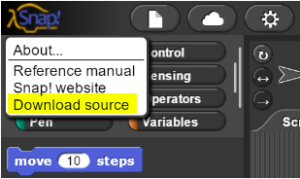
Click on the Snap! logo in the upper-left of the app.
Choose “Download source” from the menu
SNAP! Download
Save snap.zip locally on your computer.
Extract snap.zip.
Open snap.html in a web browser.
Interested in working with Microsoft TEALS to bring computer science to your classroom?
Technology Education and Literacy in Schools (TEALS) is a Microsoft Philanthropies program that connects classroom teachers with tech-industry volunteers to create sustainable CS programs. Volunteers support teachers as they learn to teach CS independently over time.
]]>https://techtrovert.opened.ca/2020/07/27/creative-computational-thinking/feed/1Computer Science and Cross-Curricular Engagement
https://techtrovert.opened.ca/2020/07/23/computer-science-and-cross-curricular-engagement/
https://techtrovert.opened.ca/2020/07/23/computer-science-and-cross-curricular-engagement/#commentsThu, 23 Jul 2020 22:27:25 +0000https://techtrovert.opened.ca/?p=283The inspiration for investigating the benefits of implementing the computer science curriculum in schools came from my experience of running an introduction to computer science course with my grade 8 class over the last two years. Microsoft TEALS offers a remote learning course called Introduction to Computer Science; this course brings in instructors actively working the field of computer science and programming to assist teachers in introducing students to computer science and the world of computational thinking. The positive impact of practicing computational thinking and the cross-curricular advantages I observed in my students during this course inspired me to further investigate the research and support for implementing the computer science curriculum in schools.
When advocating for implementing computer science at my school, the pushback I received was regarding the cost of bringing in the technology required to run the course. For my Microsoft TEALS remote learning course, each student needed a laptop with a webcam, and a pair of headphones. The total cost of the equipment was over five thousand dollars, factoring in that we already had computers for most of the students. I justified the cost by presenting the power and impact that my computer science course would have on our students. The future societal demands that computer science and computational thinking can support are examined in both Fluck’s (2016) article, Arguing for computer science in the school curriculum, and Webb’s (2017) article, Computer science in K-12 school curricula of the 2lst century: Why, what and when?.
Computer science empowers students with 21st century skills which are relevant to the current and future workforce (Fluck, 2016 & Webb, 2017). The term computer science differs from computer literacy because it refers to the ability to create and adapt new technologies; Literacies focuses more on using and mastering existing technologies (Webb, 2017, pp. 446). Teaching computer skills strengthens local communities, promotes innovation and provides future opportunities for youth (Fluck, 2016, pp. 44). A majority of the innovation in society comes from the use of computer science including biotechnology, geoscience, and global security. “We need to develop aware citizens – not necessarily creators but more than consumers” (Webb, 2017, pp. 448). Incorporating computer science and technology forward thinking prepares and engages students to innovate and create the new technologies which drive global economies and growth. Computer science is a critical component of the new BC curriculum because the ability to innovate with technology is important for students’ future success. It empowers them with the abilities to adapt to a rapidly tech-forward job market and demands from global society.
Beyond the benefits of engaging students in a field which will lead to flexible, immersive careers in tech, the field of computer science and its benefits in the classroom are broad. This science teaches students design, logical reasoning, and problem solving; these are skills which are directly transferable to the real world and other subjects well beyond the computer science classroom (Webb, 2017, pp. 446). Computer science courses can tap into students’ interest in technology, helping them become technology innovators. Other teachers can build on these skills, allowing students to design technical solutions to problems in science, math, social studies, the arts, and humanities (Webb, 2017, pp. 446). This can make courses more relevant to youth and promotes cross-curricular engagement, potentially improving their overall academic achievement and success in school as a whole.
Webb’s (2017) article offered suggestions for engaging students, school districts, and teachers in the computer science curriculum. The first suggestion was to implement computer science classes as early as possible. Bringing computational thinking into elementary grades makes the transition to more complex digital thinking easier and allows for more opportunities for inquiry-based learning in the later years (Webb, 2017, pp. 451). Computational thinking, which is a digitized way of saying problem solving, is the basis of computer science education. As this problem-based learning is becoming a requirement for many 21st century jobs, schools should look to embed computational thinking into other subjects and curricula (Fluck, 2016, pp. 43-44).
Computer science teams and competitions for innovative thinking can increase engagement and help students interact with computational thinking in a fun and exciting way. Fluck (2016) stresses the importance of making computer science courses accessible for all learners and teachers. Actively encourage and recruit a diverse range of students to take computer science courses and employ inclusive pedagogies to meet the needs and interests of these students (Fluck, 2016, pp. 41-43).
Both Fluck (2016) and Webb (2017) make note of creating and implementing a computer science curriculum that is, above all, fun and engaging. Teachers can do this by introducing technology in a way that connects with students, taking them on field trips to local tech industries, and bringing in real world examples of technological innovations to spark interest and inspiration (Fluck, 2016, pp. 42). Develop learning content that is visual and interactive, and weave in real-world examples of people creating technologies that will change and make the world a more positive and innovative place.
Technology is everywhere, and students are using computers every day. Empower them to be creators and innovators of technology by engaging them in the computer science curriculum throughout their educational journey.
References
Fluck, A., Webb, M., Cox, M., Angeli, C., Malyn-Smith, J., Voogt, J., & Zagami, J. (2016). Arguing for computer science in the school curriculum. Journal of Educational Technology & Society, 19(3), 38-46. Retrieved from https://search.proquest.com.ezproxy.library.uvic.ca/docview/1814441053?accountid=14846
]]>https://techtrovert.opened.ca/2020/07/23/computer-science-and-cross-curricular-engagement/feed/2Critical Self Expression
https://techtrovert.opened.ca/2020/07/21/critical-reflection-on-self-expression/
https://techtrovert.opened.ca/2020/07/21/critical-reflection-on-self-expression/#respondTue, 21 Jul 2020 17:00:25 +0000https://techtrovert.opened.ca/?p=255This post provides a rationale for the three resources I curated to assist students with self expression when submitting assignments and demonstrating their understanding of content within the remote teaching model.
The 2019/2020 school year was drastically changed with the COVID-19 pandemic. The Ministry of Education in British Columbia directed school districts to employ an online method of emergency teaching, with a hybrid model coming into place for some schools in June. The plan for online and hybrid teaching brought about various challenges for educators, students, and educational planners. One aspect of the online and hybrid model is examining student independence and accessing platforms to demonstrate learning.
This blog post will highlight and examine tools which promote independent learning and expression from students during this time of online and remote teaching.
The resources listed in the above blog support independent learning and expression. My rationale post will look at the integrity and reliability of these resources.
VoiceThread meets the needs of personalized demonstration of learning and unique expression of understanding of a topic. This program offers a variety of platforms to creating presentations and projects for students to explain their research, demonstrate their understanding of a topic or use original ideas and drawings to show the progression of a historical event or retell the major components in a story or novel. For older students, this VoiceThread is an ideal platform for developing digital portfolios and curating artifacts of learning when considering applications into post-secondary education programs.
Photo by Mark Fletcher-Brown on Unsplash
As students progress and add more artifacts and creations to VoiceThread, their collection grows over time. This long-term collection allows for teachers to support student growth in digital literacy and also content knowledge to support assessment and demonstrate learning while students are learning remotely. Collaboration is a key feature, with students being able to co-create resources as well as comment and critique the works of their peers. They can collaborate and each add their own choice of media, such as video, drawing, images or audio to create a polished, diverse product demonstrating each contributing members voice and understanding.
Photo by Jakob Owens on Unsplash
In regards to privacy and protection of information, students can choose to make their projects public or private by adding their projects to a public gallery to be viewed by all, or sending a unique URL to the teacher over email. This does require students to be prepped on online safety, protection of personal information and plagiarism guidelines when using online content and assigning the appropriate contributions when referring to other peoples’ ideas and content.
Photo by Brooke Lark on Unsplash
When sharing a URL privately, it means that students will need to have an email and understanding of email to be able to submit projects only the teacher can view. The embed function allows for users to share projects on school websites or their own. While this is great for responsible curators, teachers will have to be mindful of who they give access to for their class website and make sure to monitor what content is being shared and created. Parent participation is needed for this resource, as it might be challenging for students to work with some of the new content and figure out how to share, send and comment on the work of their peers. Collaboration and flexibility in terms of expression and accessibility makes this VoiceThread a strong resource for remote teaching and individual student expression of knowledge.
Toontastic 3D is a user-friendly resource geared at younger audiences who want to display creativity in story telling, using a more structured and self-guided approach to animation. This app is approachable because the steps to story-telling are integrated into the program and guide users, even very young, through the creation process at every point along the way.
Students are given the creative liberty to create and direct stories in a manner which is personal and easy to use. From the start, the interface may be a bit challenging as students get used to moving their characters around and interacting with the set, but the overall approach to designing the set and characters, narrating the story using audio and other customization features are easy to use. If a student did have mobility issues, this would not an accessible app and does demonstrate limitations for this program. It is meant for students who are able to read written instructions, apply those instructions to their own project and have the mobility skills to use their hands to move the characters and the voice to record and narrate the story. If a student did have audio or mobility limitations, they could work with a parent or older sibling to use this platform, but it does take away from the individual creativity.
Photo by Benjamin Catapane on Unsplash
The program is offered as a free app on Android, iOS and Chrome, which does imply that data is used from user interaction for targeting advertisers and marketers for product placement and ads when using the app. The information required for creating an account is limited, with no personal information needed, which reduces the concern about privacy somewhat. Teachers assigning this as a learning tool are assuming the student has access to a device at home which support this app and parental support in case they struggle with the instructions and applying the tips to their own project. Assessment and submitting their project is challenging, as the teacher can only access this project if the student texts or shows the teacher in person. This app would be a constructive supplemental learning tool, but not necessarily effective for formal assessment. Language could also be a barrier, as students need to record their own audio for the narration of the story. This is an app geared at elementary school aged students, but it allows for creative demonstration of story ideas in a unique and engaging way.
Audio Response / Podcast
Anchor Podcast App
www.anchor.fm
Two major components of the core competencies from K-12 are speaking and listening. Demonstrating learning through a podcast recording offers demonstration of those two skills. There are opportunities for cross-curricular learning, such as recording a podcast episode about a scientific topic to satisfy language arts and science content; language arts will be intertwined if a podcast is used in any other subject because students need to write, narrate and record their podcast episode about the topic. It engages students and teachers to expand their digital skills, modify their communication techniques for different audiences (incorporating humour into your episode to engage a wider audience, for example) and learning skills to tell stories or demonstrate ideas in an engaging way.
Photo by Jason Rosewell on Unsplash
Podcasting for demonstration of knowledge is accessible to students as they do not need access to fancy recording equipment or expensive programs; this app reduces the need for technical knowledge as the app walks the user through the recording, audio editing and publishing components to complete an episode. The ability to stop recording on one device and pick it up later for editing or continued recording increases accessibility as students can work on this at home if school is not in session or partially in session. Collaboration in person or within the app allows students to connect and co-create episodes even if they are not able to be together in person. Barriers to this app would be the assumption that students have a safe, quiet place to record their podcast, the device to record it on outside of school, and the support from their parents if they run into issues.
Photo by Hadis Malekie on Unsplash
As the app is free, there are limitations and concerns about privacy. Within the app, the editing functions are limited and students can do some basic trimming and editing, but they are unable to re-record parts once the episode has been strung together. The episode is recorded in a single file which makes editing or trimming middle portions impossible. If students have issues in the middle of the episode, there could be frustration and conflict when editing, leading to a disappointing end result.
Photo by Nick Fewings on Unsplash
In terms of digital literacy and safety, the app has some flaws. The first is that any podcast is public and can be accessed by anyone using the app. Personal information, depending on what is required of the user when they are creating the account, is displayed publicly. While this public access to podcasts can be an issue, with the right background preparation and insight of the teacher, students can be informed on how to keep their identities anonymous, respect other podcasters personal information when recording and episode, and maintain somewhat private on a public domain. The trade-off for a free app with in app purchases is that the data is collected and used for third-party marketing and advertising.
While I can’t see a school district embracing this app entirely, it does offer an easy option for students to explore the world of podcasting, digital media, and self-expression.
]]>https://techtrovert.opened.ca/2020/07/21/critical-reflection-on-self-expression/feed/0Ingredients… but no recipe
https://techtrovert.opened.ca/2020/07/10/ingredients-but-no-recipe/
https://techtrovert.opened.ca/2020/07/10/ingredients-but-no-recipe/#respondSat, 11 Jul 2020 03:03:24 +0000https://techtrovert.opened.ca/?p=248Curriculum is a list of ingredients on a grocery store shopping list. The list tells you what items you need to buy, but with specific details omitted or left up to the shopper. All the shopper is given are the items, but no other information such as where to shop, what brand of item to buy, or how many is provided. The finer details of the items purchased are left up to the shopper. Two shoppers are given the same list of items and their shopping trips could go something like this:
Shopping List: eggs, milk, noodles, flour, cheese
Shopper A:
Shopper A is an inexperienced cook and lives in a small, rural town near Hazelton, BC. They do all of their shopping at the small corner store. They purchase eggs shipped in from the larger factory farm, local dairy milk from the farmer just out of town, flour which has been shipped and therefore quite expensive for a generic brand, and the only cheese available to them is sharp cheddar in a large block. Their shopping is limited because they do not live in an area where they have lots of choice on the types of ingredients they buy, and the cost of some items is quite expensive so they cannot buy the flour, for example, in large quantity. Shopper one is limited by their location which determines where they shop, what type of ingredients they buy and what quantity based on price and availability.
Shopper B:
Shopper B lives on a small organic farm on the Saanich Peninsula and does their shopping at local farm stands and al the organic market in Sidney. Shopper B has been cooking for over twenty five years. They have a family friend who provides them with farm fresh eggs, and a variety of white and brown eggs of their choosing. At the local market, farmer’s bring in a wide selection of oat-fed cow’s milk, heavy cream, or milk substitutes. Shopper 2 notices that they have the option to buy whatever milk product they want, as the list is not specific. They choose to pick up some heavy cream, 1% milk and some almond milk. Flour is in the bulk section, so they are able to buy lots without it going over their budget. Cheese is in abundance with choices including cheese curds, goats cheese or sharp cheddar from a local farm. They pick out a sharp cheddar and a fresh mozzarella to have some variety in their dish. Shopper two is presented with an abundance of choice as to what items they can buy which match those on the list they were given. Shopper two has access to variety and local products at a low, affordable price.
The two shoppers were given the exact same shopping list, but the type, quantity, quality and variety of ingredients they purchased differed based on their decision making, location, background and experience. The choice is now up to them as to what meals they will make with these ingredients and what other ingredients they include is also up to them. The quality, variety, and quantity of ingredients will impact what meals they can make and serve. Their background cooking knowledge, access to other ingredients to combine with these basic staples, and interest of the people they are serving the food to will impact how they use the ingredients on the list.
Curriculum is a shopping list, where only the ingredients are provided, the rest is up to the shopper.
]]>https://techtrovert.opened.ca/2020/07/10/ingredients-but-no-recipe/feed/0Collective Success
https://techtrovert.opened.ca/2020/04/27/collective-success/
https://techtrovert.opened.ca/2020/04/27/collective-success/#commentsMon, 27 Apr 2020 17:38:08 +0000https://techtrovert.opened.ca/?p=243I feel like teachers and schools are working harder than ever to keep our students on track.
After spending countless hours redesigning our courses, setting up Google Classrooms, and getting devices out to numerous students… only a few of our kids are taking advantage of these resources or online spaces.
This is frustrating and worrying for the success of our kids and also a reflection on my level of professionalism as a teacher. It is challenging not to feel guilt about being paid while others around the globe have lost their jobs and are now relying on government relief funds.
Despite this worry, I always try to come back to the thought that we ARE doing our best and not to take it personally if students don’t participate, or spend time pressuring students or parents to get their kids online.
We have no idea what’s happening right now in students’ minds, hearts, and homes that’s causing them to put academics on the back burner.
Resist the natural human tendency to make assumptions and judgements: These kids don’t care. The families don’t value education. I’m not doing my job. Why am I getting paid to do this?
Instead, get curious. What else might be going on that’s preventing Google Classroom from being their foremost priority? How else could we drag content out of what they are already doing at home? How can we support without it looking like we are nagging on the students to get online?
I’m finding that it is nearly impossible to focus on ANYTHING or complete a task that is longer than 10 minutes. There are many days I’d rather watch TikTok videos or countless episodes of Netflix shows than get work done; I do the bare minimum because my concentration is shot.
And this is with the maturity level, self-discipline, and time management skills of an adult who’s living in a safe and peaceful home! I can’t imagine spending hours a day on schoolwork right now as a kid, especially if that work was not required for your final grade.
If your students would rather play and Facetime with friends than do school work right now, keep in mind that a) that’s normal behavior for kids, and b) these can be coping mechanisms for stress.
Kids and adults alike are engaging in numbing behaviors and distractions to help them deal with the stress of being confined to their homes. You personally may be coping well, but not everyone is, and making them feel shame about being unproductive in a pandemic isn’t likely to help.
So, don’t blame yourself OR your students if they’re not completing the work.
This is a time when it’s more important than ever to work from a human-centered lens, where we put our collective socio-emotional wellbeing first.
Even if your district is expecting you to teach like everything’s normal, you can infuse grace and empathy in your interactions with kids. You can start class with check-ins, be kind in your late work follow ups, and so on.
Focus on what you CAN control rather than escalating consequences for the stuff you can’t. Your job is to simply continue offering support.
Measure your success by how well you’re doing YOUR part, rather than by how many kids participate.
What you’re doing right now means something, even when students aren’t doing the assignments.
You see, the way we are showing up in our daily work right now is carving out the path to where we’re going next. It is shaping the way our students and families view school. It’s establishing what is truly important in how we educate kids, and what’s most essential about the role of a teacher.
This is a time when the rigid structures that define how we do school have been stripped away. What lies underneath is our shared humanity and connection. This is the time to embrace that, in all of its messiness.
]]>https://techtrovert.opened.ca/2020/04/27/collective-success/feed/1Coding – the hottest topic in teaching since sliced bread
https://techtrovert.opened.ca/2020/04/26/coding-the-hottest-topic-in-teaching-since-sliced-bread/
https://techtrovert.opened.ca/2020/04/26/coding-the-hottest-topic-in-teaching-since-sliced-bread/#commentsSun, 26 Apr 2020 18:52:30 +0000https://techtrovert.opened.ca/?p=234… at least I think that’s how the expression goes.
The idea of teaching coding in school has become a global phenomenon – every teacher wants to have some sort of coding program in their classroom. Whether this is through remote learning, completing a coding program themselves and teaching their kids, or going to tech workshops as field trips with their classes. This global interest is based on the belief that it is important, both educationally and socially, for students to learn how to code or program from an early age.
Teaching kids to code or program early does not only create a pool of skilled programmers to meet the needs of the future job market, it does much more. Learning to code enables children to use digital technology to develop their creativity and problem solving skills. It empowers children in our technology-based society to fill the role of a creator of societal content and marketable skills rather than simply a consumer of global products and ideas.
What do I mean by coding and programming, exactly?
When I am talking about teaching kids to program or code, I mean that they are learning the skills to tell a machine, a computer, a software program or Web page what to do. This is a feat accomplished behind the scenes… or screens… by mobile phones, computers and social media we use every day.
Telling a software program or Web page what you want it to do requires coders to use algorithmic thinking. Algorithmic thinking breaks down the steps of a complicated task and works backwards from the final product to the initial stage. This type of thinking is a large component of the curriculum when teaching students about coding.
An example of algorithmic thinking could be a simple task such as how to make a peanut butter sandwich.
The final product?
A peanut butter sandwich.
But what steps were made to create this sandwich?
Let’s break it down into steps starting from the very basics. Please note there are additional steps which could be listed, such as open the cupboard, get out a plate, lay the plate on the table, etc. but for the sake of this example we will only be focused on the algorithm or steps needed to make just the sandwich itself.
Lay the jam sliced bread jam side down on top of the peanut butter slice.
Cut the bread diagonally from the top right corner to the bottom left corner all the way through.
Enjoy your peanut butter and jelly sandwich!
This “Exact Instructions” Challenge video by Josh Darnit demonstrates algorithmic thinking when making a peanut butter and jelly sandwich by following the steps exactly… which leads to a hilarious outcome.
Teaching students about algorithmic thinking using common tasks we compete every day, such as this simple sandwich making, closes the gap between computational thinking and common sense. It shows that there isn’t that big of a difference between using algorithms in the computer to complete a task and that of every day actions. Every outcome and product can be broken down into simple steps.
Through coding and offline coding lessons (those which don’t use computers or programs to demonstrate a coding concept… see the sandwich example above), students develop algorithmic thinking skills. This enables them to better understand, interpret, and assess the impact of such thinking on our lives. Some may even take these thinking skills and take part in developing and guiding the use of algorithms in the world of the future.
Coding and computational thinking empowers children to use technology more effectively and guides them into choosing the right programs or devices to help them achieve their outcome. Integrating coding into their everyday learning enables students to better understand all aspects of the digital world and become better prepared for the future developments in tech and digitization.
10 key benefits of learning to code at school:
Increased academic motivation
Acquisition of mathematical, problem solving and computer skills
Development of autonomy
Teamwork and collaboration
Critical and creative thinking
Improved self-esteem
Increased sense of competence
Ability to find information
Increased resilience in the face of challenges
Enhanced reasoning, organization, and planning skills
In case you weren’t totally convinced about the benefits of coding, check out this Ted Talk by Mitch Resnick of MIT Media Lab, who explains that coding isn’t just for computer whizzes, it’s for everyone.
]]>https://techtrovert.opened.ca/2020/04/26/coding-the-hottest-topic-in-teaching-since-sliced-bread/feed/2Digital Literacy Framework Guiding Questions
https://techtrovert.opened.ca/2020/03/14/digital-literacy-framework-guiding-questions/
https://techtrovert.opened.ca/2020/03/14/digital-literacy-framework-guiding-questions/#commentsSat, 14 Mar 2020 21:34:35 +0000https://techtrovert.opened.ca/?p=231What is the Story?
The background behind the digital literacy framework is to guide and assist students who will continue to be surrounded by digital learning tools and media. It enables teachers and educators to develop strategies to for awareness, creativity and efficacy for students while interacting with and creating online tools. The framework acknowledges there are concerns with the wide spread availability of digital tools including the internet and media, and it incorporates safety, personal awareness and critical thinking of the tools and sites explored in digital media.
What theory, literature, frameworks and models have guided the framework?
Critical thinking, creative thinking, personal and social efficacy, communication, self-awareness, social awareness, self-expression, and research strategies.
What is missing?
This framework provides structure and theory behind how to implement the frameworks listed above for students to use and interact with digital learning tools. The learning outcomes and grade ranges help scaffold learning outcomes to become increasingly complex as grades progress. One aspect that is missing is acknowledging that not all students or teachers will use this framework or curriculum from kindergarten and some may start at higher grades. Including the grade range these concepts should be taught at could undercut the importance of these seemingly elementary level ideas. Removing the grade ranges will improve the accessibility and reduce barriers for learners and educators wanting to bring this framework into their classroom regardless of what grade they are teaching.
What other frameworks, theories, and models could improve the framework?
Including links and examples for projects or lesson plans to accompany these learning outcomes will increase the userability (?) of this resource. Currently it covers the outcomes with content suggestions rather than concrete examples teachers can use in their classroom. In today’s busy times, teachers want a resource they can read, understand and then bring into their classroom with minimal effort and barriers. Concrete examples and lesson plans will likely be added as educators have time to brainstorm and create resources supporting these learning outcomes.
Choose a curriculum area you want to explore further
The curriculum area I want to explore further is the communication and collaboration – technology mediated communication and collaboration.
Brainstorm a project you want to redesign or design
I would design a task where students are in a collaborative online learning platform and their instructor is teaching remotely from a location not physically in the school. Each student will have their own computer and meet in the online digital classroom. They will be learning the concept of computer science and be learning how to build their own pac-man game. They will listen to the remote instructor in the digital classroom, watch the example videos and be guided through the first steps on SNAP! to design their game. The online instructor will show them the beginning steps to building the Pac-Man game, but the creativity, character designs, and colours in their game will be up to the students. Students can work together on the game or have another student play their game after building it in SNAP! Collaboration will occur with students listening to the remote instructor, working in groups to build the game, have a friend play their game, and sharing their projects with the class after completion. A showcase of their games will occur after with students from other classes logging in to play each students game.
How does the framework integrate into your project?
This project includes collaboration, creative thinking, problem solving, communication, time management, workspace organization, and presentation skills both online and offline.
]]>https://techtrovert.opened.ca/2020/03/14/digital-literacy-framework-guiding-questions/feed/1Active Learning and Engagement
https://techtrovert.opened.ca/2020/02/21/active-learning-and-engagement/
https://techtrovert.opened.ca/2020/02/21/active-learning-and-engagement/#respondSat, 22 Feb 2020 01:33:07 +0000https://techtrovert.opened.ca/?p=80Where Did This Idea Come From?
The idea to investigate and explore active learning strategies came after a breakout room discussion during our meeting about effective learning design back in December. Our conversation started with some concerns about online learning not being engaging because students were not face-to-face with each other, they could mute their microphones, and effectively just be a passive observer during the lessons. Our breakout group realized, however, that this disengagement also happens just as often in face-to-face learning where students are present in the classroom. In person, though, it looks more like the student sitting at the back of the room, with their head down, and not participating in group discussions. This got us thinking about how we could adapt our lessons, both online and in person, to promote more active learning and increase participation.
What Is Active Learning and Why is It Important?
As a teacher, one of the biggest challenges is not the lesson planning itself, but rather getting the students to participate actively and engage with the material. Teacher-centred lessons are the easiest way to disengage your students because they take the spot-light off of them and you become the only source of voice or information. Using active learning strategies, you switch the emphasis from you onto the students. These techniques empower, engage, and stimulate a classroom by putting the focus and source of knowledge onto the students.
Active Learning Strategies
1. Change Up Your Classroom Setting
One of the easiest ways to bring new life into your lessons and students is to change the environment in which they learn. A new environment will break up the monotony of the school schedule, allow students to actively decide where they want to sit or stand, and a different surrounding will inspire new ideas and ways of thinking.
Here are three places you could hold your class other than your classroom:
Outside. Fresh air and a non-conventional classroom challenges students to move differently and embrace the fresh air and sunshine which will energize them. There is nothing more thrilling to a high school student than the words “we’re going outside!” They will be able to let their guard down and become engaged with the content in a way they won’t even realize is a lesson.
Gym. Allowing students to walk, stand or use quiet gym equipment such as foam blocks or balls while they are discussing ideas or brainstorming in groups
Common Area. Bringing your students to a more public area of the school may evoke leadership or mentorship with the younger students in the school and interact with other staff members or teachers who may not usually get to observe the learning happening in the class.
2. The Devil’s Advocate
The devil’s advocate approach challenges students to engage in the content or topic being explored and look at it from the opposite point of view being presented in the lesson. Students will have conversations in small groups, with one or more person being assigned the task of looking at the subject from the opposite point of view and presenting their thoughts.
For this to be effective, your topic must be suitable for debate and discussion and should have a well-supported argument for both sides. A great example in the media right now could be oil spill mediation and recovery plans looking at the different methods of transporting oil and how to best deal with possible environmental complications that could arise in each situation.
Using the devil’s advocate approach is flexible for any grade level or group size. You could simply divide the class into two sections, or create smaller groups for older students. Follow up lessons could include a presentation of your groups ideas or a visual representation of the other persons’ point of view on the topic. Another benefit of this strategy is increasing student engagement between each other and switching from a teacher centred to student centred approach to learning. Your students become experts on a topic from both perspectives and deliver it at a level that is appealing and at an age appropriate level.
Below are some examples of starter topics and opposing claims which could help guide your class into a devil’s advocate exercise.
This approach can help cultivate active learning in the classroom by encouraging students to:
Think more critically, challenging participants to expand their understanding of the perspectives surrounding an issue and to view it through a different lens
Become more engaged, fostering involvement by drawing out opinions to explore the complexity of an issue being studied
Produce deeper understanding of topics or issues, using rigorous analysis to collectively clarify, probe, and pose alternatives to problems being discussed
3. Game-based Learning Platforms
In today’s classroom, a large percentage of students actively engage in video games outside (and during!) class – so why not incorporate games into your lessons?
Game-based learning platforms add depth and differentiation while allowing students to be engaged with the lesson content. Avatars, music, challenges, and escaping to different worlds all while solving a quadratic equation! Students can lose themselves in the world of video games while developing an interest in the content in a whole new way.
Video games give material relevant application and evaluation. Students solve challenging problems while using technology they are interested in on a platform they are familiar with.
An effective platform that using video games to engage learners is Prodigy, which is free to play. This platform helps students tackle problems in math using words, charts, pictures, numbers and games.
Below are some guiding questions to ask yourself when practicing some of these active learning strategies:
Will this be engaging and exciting for my students?
What assessment can I take from this exercise?
Is the student placed at the centre of this learning strategy?
Will this encourage my students to discuss a topic with one another?
Am I giving students the opportunity to reflect on the learning process?
Is this activity getting my students to think deeply and critically about a topic or lesson or is it simply a comprehension exercise?
New Teacher, New Role
Some teachers may be hesitant to let go of the reigns and step down from their stage in front of the room. They may question that students could learn anything from their peers and be skeptical of the effectiveness of video games for helping students in math.
Engaging in an active learning model, the teacher becomes more of a facilitator for the learning experience and helps students’ along their journey to discovery of topics they are interested in. Taking a step back and observing your students during an active learning experience allows teachers to see their content from a different point of view. They will be able to engage more with their students, content and take the lesson further by sharing the role of teacher among the students and video games. The teacher is no longer the sole bearer of knowledge and collaboration can take place.
Holly Class enjoyed an outdoor arithmetic relay this morning! They competed in teams answering a range of tricky maths calculations. Fantastic cooperation and concentration, Holly Class! #activelearning@HullActiveSch@YHCLT1pic.twitter.com/TQ0A2LaZSc
With active learning, outcomes are better and the knowledge is retained so that a worker can access, adapt, and apply repeatedly and build upon it. #ActiveLearninghttps://t.co/3GY3xcKBwu
Planning a subject leader day/conference for the next academic year? Alongside our charitable partner @YouthSportTrust, we can deliver active learning workshops and keynotes across the UK free of charge! Drop Sophie an email on sophie@motd.org.uk to find out more! #Activelearningpic.twitter.com/tesyDMtk7T
https://techtrovert.opened.ca/2020/02/21/active-learning-and-engagement/feed/0Pros & Khans
https://techtrovert.opened.ca/2020/02/21/pros-khans/
https://techtrovert.opened.ca/2020/02/21/pros-khans/#respondSat, 22 Feb 2020 00:33:37 +0000https://techtrovert.opened.ca/?p=222
https://www.khanacademy.org
A Teaching Khan-undrum
The school that I currently teach as is a First Nations cultural school with a student population of just under 100 students. On the best of days, we have around 80 students in attendance, with many students frequently away for cultural reasons including ceremonies, hunting trips, or travel. The backbone of our school belief is that our students are the future of the Saanich Nation. Our school values a collaborative partnership of students, parents, elders, and leaders working together with educators in the community to ensure our youth develop into confident, caring, capable, and compassionate human beings.
As a teacher at the school, I recognize that it is not enough for students to leave school simply with the ability to communicate effectively or to understand intimately the principles of mathematical and scientific theory; they should also leave with the sensitivity, the skills, the desire, and the good judgment to put their knowledge to use confronting the issues, problems, and concerns of humankind and the world in which they live.
The class composition changes every year based on student demographics; historically, we have only offered grades 8-10 at the high school, with the students having to leave to graduate at a nearby high school. This year is the first year we have opened our doors, restructured our classrooms, and are offering classes for grades 6-11. My course-load this semester includes math 9-11, health 8, and a math intervention block for all students. One of the blocks that I teach is a math 10/11 split class, with students in all levels of academics and abilities. In addition to the students having a range of academic abilities, many of them are away often for cultural reasons or to help at home with their siblings and relatives. Our school recognizes that our students, in addition to a heavy course load at school, have full time jobs as caregivers in their home and cultural community. It is because of these reasons that many of our students miss multiple days of school and therefore miss lots of in class instruction which is sometimes out of their control. Attendance is key in the upper level math courses in particular, because of the pace at which content is delivered, and there is a focus on preparing students for the upcoming numeracy exam in April. These two factors left me in a hard spot: I have students who are frequently away from school, are academically low, and need to pass this numeracy exam with the help of direct instruction. I couldn’t see a way for my students to pass solely depending on face-to-face instruction in the classroom from me as the only teacher. After reading Crosslin’s article regarding mixing online and direct instruction in a wholistic manner using effective practices, I gained valuable insight into how I was going to be able to effectively run this course and get my students on track for graduation.
Combining Khan and Classroom to Create… a Klassroom
My solution for addressing a split grade class with a wide range students at different academic levels and varying attendance frequencies was to introduce an online instruction component to some of the more content heavy components of the math 10/11 curriculum. Finding an online course that was able to effectively demonstrate key concepts like algebra, variables, and multi-step substitution would free up time from me writing my own notes on the whiteboard, and allow me to supplement those lessons with my own examples and extra support to students that need it. This course needed to be adaptable to my high achieving students but also flexible to deliver content at a more basic level for students who are struggling or learn in a different or assisted manner.
The first speed bump of realizing I needed to find an online course with content to cover the heavier components of the curriculum was the easier part. The second component was that I needed the course to be either free, or relatively inexpensive per student. Our school is federally funded, and funding is dependent on registration status of each student and whether or not they identify as a First Nations individual. Our school supports a one hundred percent First Nations population, which means we have full federal funding from the government in terms of educational support. The only issue is that because I was proposing an online course late in the year, most of this funding had already been allocated to other needs in the school. So, I needed a program that was not only effective and worthwhile, but also free or cheap. With this in mind, along with the quality of content, I continued my search for the perfect online course.
My last hurdle was that this program needed to be accessible to my students at home in case they miss classes and want to catch up on their own time. As if finding a quality course for free that is adaptable to all learners wasn’t difficult enough, this course also has to be smartphone or tablet friendly, because we don’t have students with access to laptops or computers at home. This course needed to be something they could potentially do on their smartphone or tablet at home or off campus. I should mention that our school does acknowledge and factor in cultural and community work students complete which may take them out of school, but I wanted students who were keen to complete their work when they did miss classes to be able to do so with limited barriers.
With my obstacles laid out in front of me, I set to work trying to find a quality math 10/11 course that was adaptable to learners, free, and compatible with a smartphone or tablet.
After an extensive search and fighting multiple urges to just enrol every student in an expensive SIDES program, I checked out the Khan Academy website, and knew I had found the co-instructor I had been looking for.
What Khan This Academy Do for You?
Khan Academy is a non-profit MOOC provider. The platform being non-profit means that there is no such thing as pricing – everything that you’ll find on the site is available completely free of charge. MOOC abbreviates as Massive Open Online Courses – this means that Khan Academy provides its user with free, widely available and subject-specific courses that they can learn from.
https://www.khanacademy.org
The entirety of the content on the site is presented in the format of YouTube videos – which means students could access the videos from their smartphones or tablets… check!
If The Khan-ditions Are Right, You’ll Be Hooked
The homepage of Khan Academy is very straightforward, with an option to log in as a learner, student or teacher. The layout is simple, and it is easy to select from the multitude of courses they offer, create your own classroom, profile, and have students join your class with a simple code of letters and numbers. Having a stress-free, simple layout helped my students log in with ease and avoided frustration or opening another webpage of distraction before I could get around to them to help them log in. The log in page, even though it’s simple in design, isn’t generic. It offers a unique course topic layout that allows you to get a pretty good idea of what you can find on the platform itself. Having a landing page that is easy for students to log in, and get started right away reduces the temptation to go to another web page and creates the right conditions for them to get engaged in the online content right off the bat.
“You Khan Learn Everything. For Free. For Everyone. Forever”
https://www.khanacademy.org
Once you decide to choose a course, you can either do so by typing a desired keyword into the search bar or choosing a topic from the drop-down menu on the top of the main page. One thing that I immediately noticed is that even though Khan Academy offers a wide selection of topics to choose from, the main emphasis lies in math and subjects directly related to it. I simply had to choose the course I wanted to set up as the teacher, and from there an exhaustive list of lessons, videos, articles, questions and assessment options were presented to me. I could choose the students I wanted to assign the lessons to, when the due date was, and if the questions would be the same for all students. In a matter of minutes, I had set up my math 10/11 course with the lessons and assessment I wanted, and after my students had created their own log in and added my course code, they were working away at their own pace. With Khan Academy delivering the content to each student, I was free to roam around, monitor their progress and help with any issues or questions they had about the videos or questions. In one morning, I had gone from being a single teacher in the room, to co-teaching with another instructor in a manner which allowed each student to learn at their own level and pace.
https://www.khanacademy.org
Khan-tinuing Positive Reinforcement
In addition to quality content, the Khan Academy courses also offer some engaging features. When it comes to paid, subscription-based e-learning platforms, cool and interesting features are usually used to attract potential new customers while maintaining the already-existing ones. Since Khan Academy is free to use, however, all of the features that it offers are just a nice addition to an already great package.
If you choose to use Khan Academy, you will have access to personalized dashboards, instructional videos, various exercises and so on. A highlight on the course page is that the platform has an integrated “level” system – students gain XP (experience points) for learning and taking certain courses, thus increasing your overall level with time. This is a great visual motivator, and it adds some interactiveness to the overall process of learning.
https://www.khanacademy.org
The company also offers some interactive features for teachers and parents. After creating an account, as a teacher, I was able to access a huge data pool of information (all standardized and up-to-par), practice exercises, video tutorials and so on. Furthermore, Khan Academy offers tools to track student progress – something essential to all teachers. For parents that are also interested, they could also track their students’ progress.
https://www.khanacademy.org
Free Khan-tent for All
Creating an account and learning on Khan Academy is 100% free. The company aims to provide and make education available to anyone and everyone around the world – free of charge. This does make me question where and how the information my students and myself provided would be used. When logging in and creating an account, all that was asked of my students and myself was to choose their role, create a username, and a password. There was an option to link and log in using a Google account, but I opted for my students to go with the first option to reduce the amount of personal information they were giving. I would be curious to delve deeper into where Khan Academy’s information is stored and what issues are related to the ownership of this data.
In Khan-Clusion
Khan Academy is effective in delivering cross-curricular content, with multiple subjects being presented under the same topic. Also, there was a wide variety and blend of multi-modal lesson delivery methods which were delivered more seamlessly than in a face-to-face classroom. There is a flow between students watching a video, working on an assignment with diagrams and animations for support, and demonstrating their learning through a quiz or reflection.
Distance education is a convenient option when smaller schools have to combine grades based on the number of students. It would have been difficult to combine a wide range of content at multiple levels in order to effectively reach all of my students in my split math class. With online courses like Khan Academy, I was able to assign work to individual students who were at or below grade level. This online course also allowed students to work at the grade level they were at without being embarrassed or teased for being at a lower grade. It is less obvious when everyone is on the same program rather than working on completely different worksheets. I will continue to use Khan Academy in sections of my math classes, as it is an effective method of online instruction.
]]>
https://techtrovert.opened.ca/2020/02/21/pros-khans/feed/0Collaboration, Computer Science, and Community
https://techtrovert.opened.ca/2019/10/15/collaboration-computer-science-and-community/
https://techtrovert.opened.ca/2019/10/15/collaboration-computer-science-and-community/#respondWed, 16 Oct 2019 05:08:26 +0000https://techtrovert.opened.ca/?p=218Multimedia and Multiplace Based Learning
Language and culture are integrated into every subject and discipline in my school community. Students are learning the language of SENĆOŦEN, which is spoken in their surrounding communities and at home. Most are fluent, some are enrolled in the immersion program, and many only speak this language at home. The process of learning SENĆOŦEN does not happen from simply writing the words on paper; it is critical to hear, feel, and see the words in context. For example, when learning about plants and plant names, we go out onto the land and find the plant in its natural habitat. The SENĆOŦEN name for Tod Inlet is SṈITȻEȽ – which means the land of the blue grouse. To learn the name for Tod Inlet, and for its meaning to be significant, visiting the land and observing the species which interact and exist at the site creates a deeper connection and understanding to the name. If students were to only learn the name for Tod Inlet on paper in the classroom, it would merely be a name on a list that they would have to memorize later. SENĆOŦEN and the process of learning languages is a perfect example of multimedia/modal learning to effectively understand content. You cannot integrate a language into your everyday life without hearing it, writing it, and experiencing the roots of the words themselves. The Basic Principals of Multimedia Learning was significant to me and I have been able to observe this teaching practice through a First Nations lens, which also integrates the First Peoples Principals of Learning.
Games and Their Purpose
Game-based learning is integrated heavily into our remote Introduction to Computer Science course. Students are designing projects using Avatars and recreating retro games such as Snake and Pong. Designing, experimenting, creativity, and a sense of play are principals in which this course focuses around. Lots of time is given to students to explore our coding programs, play the games, and create projects which represent their interpretation of the project outline. An example is students are encouraged to play games like Roblox, Lightbot, or Minecraft on lab days to be inspired by how those games run and are designed for their own projects. SNAP! is the workspace from which students create, which in itself is a digital Makerspace. Without an objective or guidance from the instructors when students are in SNAP!, this platform wouldn’t be effective. A frontloading of information and scaffolding is necessary to show students how to create code to move their characters, build game platforms, and perform actions. This was a large topic examined in the Game-based learning article: a Makerspace is a platform for learning but it won’t provide the learning itself. What Makerspaces, such as SNAP!, allow for is scaffolded instructions to equip students with the skills to produce projects inspired by their individual creativity.
Leadership and Connection
First Peoples Principles of Learning. https://www.fnesc.ca/wp/wp-content/uploads/2015/09/PUB-LFP-POSTER-Principles-of-Learning-First-Peoples-poster-11×17.pdf
Our proposed project will emphasize the disconnect and hesitation new teachers in terms of integrating First Nations content into their practice, whether they themselves are First Nations or not. Teaching can be an isolating field, with many resources only being pulled from the internet or ancient books found amongst bookshelves at the back of the library. Since I started at the First Nations Leardership school, it became apparent how important collaboration and the sharing of knowledge is to really understand how to incorporate these Ways of Knowing and Principals of Learning into your lessons and pedagogy.
The Role of Leadership for Information Technology aligned with these Principles in a refreshing way, as it outlined how to integrate traditional, spoken knowledge and information sharing, with digital platforms and resources. A main idea behind these Leadership principles was adaptation and collaboration. In order for the information that is being shared to be useful, it must be presented in a way which is appropriate for the audience and situation where the learning is occurring. This is a shift in approach, where teachers must now consider is the resource they are using appropriate for who and where they are teaching. A collaboration between the knowledge keepers in the community or school district to look at the resource would clarify and improve the way our resources are being used. An example of this blending of traditional knowledge and digital media that is used frequently in my practice, and will be a feature in our project, is the SENĆOŦEN first voices website. Elders and speakers from the community have contributed their words to construct a comprehensive and interactive website containing words, stories, and media to teach the understandings of groups using that language. This website could be viewed from the five guiding principals for integrating technology in schools. The main principles that it follows are one of positivity, constructiveness, and simultaneity. It is a resource which acknowledges that the preservation of language requires perseverance and resiliency; the contributors are motivated by the possibilities and future where the next generation still can speak and use their language; and the elders and knowledge keepers are active in the schools and communities, answering questions about their culture and language to keep the fire and language alive for generations.
The model which is the most useful for incorporating technology into my classroom is the TPACK model because of how the lessons are developed and planned. First, instructor decides the learning outcomes of the lesson; this is the content. The second is which activities will be used in the lesson; this is the teaching pedagogy. The third is deciding which technology, from pens and paper to smartphones and videos, will be most effective in the activity for delivering the content. This model aligns with how I currently plan my lessons, so to be able to support my teaching methods with a model is very reassuring as a new educator. As a secondary trained teacher with a degree in science, it was a requirement when being hired as a teacher that I have a strong background in science and math. When teaching in a high school setting, your background knowledge in what you are teaching is critical in order to convey higher level thinking and complex topics to older students. The TPACK model prioritizes content and background knowledge, which is what has been my priority as an educator in my pedagogical development. Using pedagogy and technology to support content delivery is the basis for the TPACK model, which is how I structure my lessons and units in my science and math classes.
Background Knowledge
When examining the TPACK model, background knowledge and a high level of understanding of the content is required to simplify and present the material to students. I can relate to this through my teachings of computer science and biology to secondary students. During the summer, I completed the Introduction to Computer Science course with Microsoft, where I learned the basics of coding, programming, and simple game development using coding software. After completing the introductory course, I attended some workshops in Java script and Python coding in order to become proficient at those programs as well. Before starting the summer training, I had no previous experience using computer coding software, and I knew that I would not be able to effectively teach my students without having some background in this topic myself. Taking the Java and Python training courses allowed me to become more advanced in the course than I will be presenting to my students. It also provided an extensive knowledge base for me to draw on while working with my students. Reflecting on the TPACK model, I would have struggled to present more complex lessons in a simplified way in the introductory course had I not done the more advanced training. The TPACK model acknowledges that in order to simplify a concept for students, the instructor must have a higher level of understanding of the content. I believe this higher level of understanding also instills confidence in the instructor and encourages teachers to take on new courses that they may not have taught before. With this Java and Python training, I was also able to assess which coding software we would be using to best support the students learning. Without this further training and increased expertise in my field, I would not have been able to effectively decide which programs or technology would be best.
Supporting Inquiry Based Learning
In the new curriculum, each subject has a large inquiry based component, where students have the opportunity to explore a topic of interest to them within the subject. With inquiry based research, topics can expand far beyond the prescribed curriculum, and advanced questions can be explored. Without a teacher who has a well-developed background knowledge of the topic, the students research areas and questions could be limited. If the teacher leading the inquiry research has an extensive background knowledge of the topic, students can explore complex questions and broader subjects because of the teachers’ expertise in the field. The pedagogical insight for leading an inquiry based unit is highlighted, and the use of technology will be properly utilized because the teacher is aware of how to lead an inquiry unit based on a topic they are familiar with. Inquiry projects are best supported using the TPACK model, because it acknowledges the necessity of having a well balanced educator in the topics of teaching pedagogy, background content, and technology.
Technological Support
The TPACK model uses technology to support the content. In order to use the technology most effectively, it is critical to have a sound understanding on what you are teaching. This model favours the well-rounded individual and backs up lifelong learning. Teachers with a sound background in biology are able to go to a professional development conference to learn about a way to present the learning using a new technology and then present the lesson with that new technology in their classroom. They are not experts in the field of biology or technology, but their interest and experience in both fields allows them to blend the two worlds together to present the information to their students. This method reflects my method of teaching because I am actively looking for ways to present my information better. I have a sound understanding in both my subject areas of science and math, and technology – but I am not an expert in any of those topics. My skills as an educator and pedagogical background in teaching young adults, mixed with this technical knowledge background enables me to assess which technology to use for each lesson based on the content and learning outcomes for the student.
The Who and The What
The students and the learning environment are large components in the TPACK method, along with the technology and content. Who you are teaching to is as important as what you are teaching. While the content you are delivering to your students may be the same, the technology and teaching styles will vary based on which students you have in your class and how they are best able to learn. An example of this is while one math class may learn best through notes from a slideshow and guided practice, another class may learn best through videos and small group activities. The learning outcomes may be identical, but the technology and pedagogy behind the delivery is different depending on which group of students are being taught and their differing learning environments.
Step-by-Step
The SAMR model appeared to be much more regimented in terms of the steps used to implement the model in your teaching. While the TPACK model functions as more as a Venn diagram, integrated model, SAMR was more of a step by step guideline for using technology in place of traditional teaching, when appropriate. Substituting technology for pen a paper, enhancing your lesson by using technology such as internet links rather than textbooks, modifying your lesson to use technology when it is more appropriate, and assessing whether or not technology would make your lesson more valuable to your students. The augmentation portion of the SAMR model aligned most with my teaching beliefs where it is important to enhance your lesson with technology where appropriate, rather than doing it to tick a box or use the technology simply because it is there. The technology needs to have a purpose, whether it be replacing another resource of inferior technology, or supporting handwritten notes to deliver content, including graphic organizers such as Prezi. Currently, using my NewRow online classroom platform to deliver and moderate my computer science course, is an example of augmenting my unit to include technology. Instead of a traditional face-to-face model of teaching physically in the classroom, I have used NewRow to allow for computer science professionals in Vancouver to deliver the course content in a much more effective way to my students. Augmenting my unit and replacing face-to-face with online instruction enhanced the quality of my lesson, and follows the SAMR model process. While both models are effective and view technology as a supplemental, not essential part of education, the wholistic integration including pedagogy, knowledge background, and technology with the TPACK model resonates the most with my teaching philosophy.
]]>https://techtrovert.opened.ca/2019/09/24/background-check/feed/01994: The World Wide Web Was Born
https://techtrovert.opened.ca/2019/09/17/1994-the-world-wide-web-was-born/
https://techtrovert.opened.ca/2019/09/17/1994-the-world-wide-web-was-born/#respondWed, 18 Sep 2019 01:23:12 +0000https://techtrovert.opened.ca/?p=202
Book vs e Book reader published November 16, 2012 by Frederick Deligne politicalcartoons.com
Before reading the articles on the Clark-Kozma media debate, I expected Clark to completely swear of technology, and for Kozma to embrace using technology entirely. I predicted that Clark would support no technology in the classroom whatsoever, and only use paper, pencils, and direct instruction in education and learning. Kozma, on the other hand, I thought would opt for entirely online, self-directed courses, using Smartboards, videos, and mediums like digital games to connect students learning without direct in-person instruction. A debate is usually black and white, with one side opting for no technology at all, and the other supporting it entirely for all learning. What I discovered, after reading and watching supporting videos regarding the Clark-Kozma media debate, is that it wasn’t really a debate at all, but rather an elaboration and continuation of the examination of the usefulness of technology in education.
Clark presented the point that technology and media do not need to be present in order for learning to occur, and that only certain medias are more effective for certain learners, learning goals, and tasks (Clark, 1994). I agree with Clark’s point that the media and technology aren’t necessary for the learning to occur; teachers and educators must be present in some form or some point of the learning to direct the students to the correct learning outcomes. There needs to be critical assessment from the teacher to ask “is this media supporting what the learning outcomes of the student are?” The media is the vessel or portal from which the content and lesson comes from, but the media or technology platform is not the source of content or material. In order for the media to be used effectively, there has to be a source of knowledge or information that is integrated into the technology. Let’s look at a Smartboard, for example: the Smartboard alone is not what the students are using to learn; they are learning the content that the teacher or educator has loaded onto that technology which is then presented through the Smartboard media in an integrated way that is captivating and experiential. Without the effort from the teacher to load the videos, whiteboard notes, slideshow animations and content, the Smartboard alone would not be the source of learning, it would just be a blank digital screen. The merging of content and media is effective because it delivers content in a dynamic, multimedia way which is engaging to learners.
The reason I feel that this Clark-Kozma media debate is less of a debate and more of an elaboration is because Kozma seems to take Clark’s points of replaceability, and the inability to learn from media alone, and find a space that media can be effectively used, despite its shortcomings. He acknowledges that media alone won’t deliver a lesson, but he does support the idea that media can be used to deliver a dynamic, engaging platform to deliver otherwise dull or difficult content. His argument that using media is a complementary process connecting the learner, content, and technology to allow for the information to be processes in a multitude of ways, including visually, audibly, and kinaesthetically, is one that I agree with. His perspective on technology comes across as an agreement to Clark’s perceptions of the shortcomings of technology and seems to offer a solution for where technology and media can be useful in education. That being said, if I had to pick a side in this loosely defined debate, it would be with Kozma because of his practical merging of technology, media, and learning.
It has been 25 years since the Clark article was written, and a lot has changed in terms of media and technology both inside and outside of the classroom. Smartphones were an inconceivable notion of the future, and just having one computer in the entire school was deemed as high tech. Students were taught using blackboards, paper, pens, and textbooks. Teachers taught at the front of the room in a face to face manner, and once they left the classroom the only way to connect was over the telephone or waiting until class the next day. I can relate to Clark’s views on technology because given the time when this article was written, there was skepticism on the new wave technology and how it would change the world we once new. Terms like “new-age”, “revolutionary”, “the computer of the future” were being tacked on to computers, calculators, and technology programs which gave the sense that it was hokey and a gimmick. I can imagine that teachers were not receptive and unsure about spending all of the school funds just to have a computer in their classroom which may become obsolete within the year. Technology was so new in schools and educators were not largely familiar with the programs or how to use the new multimedia devices, which meant they were not being properly integrated into the classrooms and learning. Computers were seen as a fun supplement to the learning and something to use for exploration and free-time after the real learning had occurred. In 1994, the World Wide Web was invented, so it is no wonder Clark did not see a connection between technology and learning… because it was such a new idea!
Flash forward 25 years later, with over 45 billion web pages existing and everyone owning their own smartphone with endless internet access in their own hands, technology has changed quite dramatically since the release of Clark’s article. It takes a few generations for new ideas to become integrated into large social groups, and the same goes for integrating and finding useful ways for technology to become part of education.
The new BC curriculum has suggestions for technology in every subject, and courses around media design, computer science and digital literacy have been created as a response to the changing job market, and presence of technology, electronics, and media in today’s society. What was once a flashy new invention is now an everyday, completely integrated existence. While Kozma’s article was also published in 1994, his views on the integration and supportive opportunities for technology and learning apply to our education system and student needs in our schools today. I am supporting my students through an introduction to computer science course, where they are learning the basics of coding, algorithms and computer literacy. The entire course is run through an online classroom, where instructors based in Vancouver are leading the course from their offices remotely. The instructors are experts in computer science, and have developed a curriculum to support the students learning of basic computer science. From Kozma’s perspective, the online classroom is not the source of the learning, but rather the support and platform through which the learning process occurs. The use of videos, digital whiteboards, coding games, and programs like SNAP! are used to transfer the instructors knowledge of computer science and coding to the students. Without the media, this learning could not occur, or would be much less effective, because the communication of ideas and theories revolving around computer science could not be as accurately demonstrated or taught.
There are implications for the misuse of technology in the classroom. The first is with students taking advantage of the media in ways which are not productive to the learning process, such as texting on their phones or playing games on the computer when they are supposed to be using their phones or computers for research or watching a movie. Technology and media redirect the control of the teacher, and it may be harder to manage a class when the technology is being used. It is difficult to manage a course when the instructors are online and not in person, or when students are asked to watch a movie about space travel, rather than learn about it from the teacher on the board at the front of the room. Direct, face-to-face instruction, with limited supplies is the easiest teaching situation to manage in terms of staying on task and classroom management, but that isn’t what learning and education should be about. Students need to have opportunities to explore new technology, outlets for learning, and be given a chance to learn though a multitude of ways. There is a time and place for media just as much as there is a time and place for teaching a lesson at the front of the room with students using pencils and paper. In this day and age, technology has come a long way and it is important to harness its potential to support the learning of our students.
Education is such a broad subject, with many different aspects involved in learning and students. There will always be new technology, fads, and initiatives developed which claim to be the next best thing in education. These new ideas and initiatives being introduced all the time include technology, programs, methods, and curriculum. Each new idea will spark debate amongst educators, because we work in a passionate field where everyone aims to provide the best learning experience for their students. With new fads and studies coming out, debates will form over which ones work the best for students. There will be topics or tools that I will disagree with, or see as impractical, but in order to deal with conflicting opinions, it is important to keep in mind that educators will always have their students best interests in mind and that we are all working towards the same goal of creating educated citizens of the future.
]]>
https://techtrovert.opened.ca/2019/09/17/1994-the-world-wide-web-was-born/feed/0Technology: Approach With Caution
https://techtrovert.opened.ca/2019/09/10/technology-approach-with-caution/
https://techtrovert.opened.ca/2019/09/10/technology-approach-with-caution/#respondWed, 11 Sep 2019 01:00:34 +0000https://techtrovert.opened.ca/?p=181Three Tech Trends That Tick the Right Box
1. SmartBoards – An Oldie, but a Goodie
Most SmartBoards in schools can either be found in the janitorial closet, the basement, or covered in posters and sticky notes at the front of the classroom. These SmartBoards, or electronic interactive overheads and whiteboards, were installed or delivered to many classes across Canada, but many ended up in storage or were out of use soon after delivery. Why? Because most teachers didn’t know how to use this technology and simply gave up trying to integrate them into their classroom routine. Why would they have a use for SmartBoards when they already have a whiteboard and an overhead or projector in their classroom? The answer: Interactive learning and seamless integration.
In my grade 6 classroom, the times I lose the attention of my class the most is during task changeovers, or when I have to switch over from technology from the projector back to the whiteboard. As I am fiddling with my HDMI cord to show a video, or becoming entangled in the projector screen cord to display the worksheet on the document camera, my students start chatting, get out of their seat, and I lost their attention entirely.
SmartBoards, with their integrated technology, reduce tech change over time from document cameras, overheads, projectors and whiteboards. Students don’t have the option to become restless or distracted, because you are no longer fiddling with cords or projector screens. Teachers can play videos right on the screen, draw with digital markers over their projected notes, or display images from the internet or draw them for the class. Interacting with your class and showing concepts in written, audio, visual, or video form is the best way to teach a lesson. SmartBoards combine all of those elements into one technology.
An additional invention that would be interesting would be a tablet where the students could interact with the SmartBoard from their desk. This would be similar to individual whiteboards, where students could show their answers or participate in activities on the board.
2. Virtual Reality (VR) – From Alien Invasions to Ancient Forest Exploration
When I took my class to the UVic Digital Scholarship Commons, we had an opportunity to check out their virtual reality room, and explore the Commons through augmented reality. Students could pick from riding a roller coaster, to shooting intergalactic space aliens in the VR room. Most of them ended their turn with a huge smile on their face… and maybe a little nauseated. Virtual reality gives classes an opportunity to explore worlds out of reach on a regular school day. From exploring an archaeological site in Ancient Greece, to a flight simulator across the Atlantic, the opportunities are endless. Virtual reality in my classroom would be great for students to explore the original territories of their relatives, take a walk with an elder through ancient forests, and visit other First Nations groups around the globe. Virtual reality allows students to explore activities and destinations beyond the scope of the physical classroom.
3. Augmented Reality (AR) – When Worlds Collide
While most technology aims to bring students outside of the classroom, whether it be delving into content on the computer screen, or exploration using virtual reality glasses, augmented reality attempts to blend the classroom and technology realms. My class uses an app called HP Reveal, where students can animate or create digital clues and videos using actual objects in the classroom. For example, a map of Canada can have QR codes which students scan with the app on their smartphones to learn more about historical events which happened in each province. Videos may play, images may appear, or audio recordings will play as the app is scanned over the QR codes printed on the map. This blending of classroom and technology is very applicable with the push for cross-curricular activities and engaging students in the classroom.
Another perk about AR and VR?
The varied price point for devices and technology. Top of the line virtual reality glasses and a laptop with a high processing speed are out of reach for most classroom budgets, and more expensive equipment means fewer devices per student. If top of the line VR glasses are not in the cards for your class, cardboard attachments for any smartphone device can be made, which work just as well! There are lots of VR apps out there, some free of charge, and can be used with these cardboard attachments.
The TopHat article outlining the 5 tech trends to watch in 2019, Generation Z is mentioned as being the next demographic of students. This generation comes after millennials, and have been born into the technological generation. They have never known a world without the internet, smartphones, or technology surrounding their everyday lives. The article mentions how these students will want technology and digital access in all of their lessons, and will want to be connected digitally in school and into their professional careers. They prefer watching videos over text and want digital interactions over face-to-face communication. What I have noticed in my classroom is actually the opposite; students crave face-to-face interactions, written work, and offline tasks because they are so surrounded by technology in their everyday lives. They didn’t choose to be born into a technology-centred world, it is the previous generations that have forced them to be living in the digital age.
With such an abundance of technology around, students in my class are drawn to the good old-fashioned games like checkers and cards – something they wouldn’t normally access at home. When given the choice for a free play activity, a majority of my students will opt for face-to-face games like cards over a game on the computer. I had a student who complained that there was not enough face-to-face communication among his peers and that they only communicated on their apps and phones (he then immediately went back on his phone.. but old habits die hard). There is a desire to connect with folks face-to-face and that is being lost in this generation. It is important to have a balance between hands on, technology free activities, and digital devices so that students remain connected to both worlds.
2. Personalized Devices – Quantity Over Quality
While having a class where every student has their own device would be great, this isn’t a reality for most schools. Commonly, the only schools able to afford a tablet or computer for each student are those which are privately or parentally funded. In today’s education age, technology seems to be the draw for picking which school your child will go to. If you can afford to attend a school which offers devices for every student, that would appear to be the superior school. Schools which aren’t able to offer technological incentives are often seen as less desirable. This creates a stigma between children who can’t help but notice the privileges other students at other schools have, including high tech devices. The quality of education depends on what the students are actually doing with the technology, not the simple fact that each student is offered a laptop upon arrival at school. There is a time and place for devices such as laptops and smartphones, but they aren’t crucial for receiving a quality education.
TedTalk: How to Fix a Broken Education System… Without Any More Money
Seema Bansal addresses the current problems and issues in our education system, and how technology is not always the solution…
3. Wearable Technology – a loss of people skills
Wearable technology can include a wide range of technology, from assistive speech devices to smartwatches for each student. The first issue that is raised is the cost of providing each student in your class with a wearable piece of technology like a smartwatch. Schools which are privately funded would likely be the only schools able to afford this personalized technology. Most schools are struggling just to have enough desks and chairs for kids, let alone enough smartwatches for their students.
Another issue with wearable technology, is that teachers are using them to interact with their students during class. These watches are used to remind students to stay on task, or allow shy students to answer questions without having to speak out. It is important that teachers maintain that personal interaction between themselves and their students, which has a positive impact on classroom management. If those students acting out only receive a small buzz and a text message to their wrist, this method of keeping them on task will rapidly become ineffective. Students behave best when there is mutual respect and valuable interaction between teacher and students. Using these watches to allow shy students to answer questions will not serve them in the long run. In life, it is necessary to speak in front of a group, and the classroom should be the safest space to practice and become comfortable with speaking in front of your peers. Teacher and peer support in low-risk situations should support and develop student confidence with answering questions in class and public speaking. These wearable devices, if used incorrectly, could act as a negative crutch for some students and hinder teacher to student relationships.
The Everest Effect: Doing Something Simply Because It’s There
The “Everest Effect” refers to the act of doing something just because you can. People climb Mount Everest, just because it’s there. The same goes for bringing new technology into your classroom. Should you bring in tablets to your classroom, just because you can? I find that with the rush of technology in our education system today, teachers are bringing in all of these new technology programs and devices just because they are offered to them, without assessing the actual educational value of these devices. Does having a laptop or tablet for each student really increase the education they are receiving? Do smartwatches really improve the behaviour of each student in the class, or are we just using these devices simply because they are there? It is critical for teachers to not assume that improved technology leads to improved instruction or learning.
Top Three Education Trends
1. Alternative seating in classrooms including stools, beanbag chairs, no furniture at all, and eliminating rows of desks
2. Twitter for teacher professional development year round
3. Global Connection Apps such as Tik Tok, SnapChat, and NewRow virtual classrooms
Holland & Holland – Acknowledging The Individual
In Holland & Holland’s article, Implications of Shifting Technology In Education, the authors address how to find a balance between the use of technology and other teaching methods. A main issue that resonated with me was the gap in technological knowledge which exists among teachers. With all of these new apps, robotics, tablets, and coding programs being released by tech companies almost daily, it is impossible for teachers to remain up to date on these new programs in order to teach their students. The importance for teachers to fully explore what technology they are using in their lessons is critical to deliver and implement these programs effectively. An example in my own classroom is my Intro to Computer Science course I am teaching this year. I spent some time in the summer completing the Intro to Computer Science curriculum and made sure that I was able to complete all of the assignments I will be delivering to my students. Holland and Holland address the gaps in student knowledge with technology, but gaps also exist in teacher knowledge as well. Before bringing any technology into your classroom, it is important that teachers are well versed and able to fully support their students learning.
It was refreshing to read this article because it effectively weaved technology, apps, and computer programs into learning styles and lesson delivery techniques. The authors explored online programs such as code.org and Hour of Code, but also addressed how to use these programs in a variety of student exploratory methods including inquiry, problem based learning, and global learning. Rather than showcasing the technology or program as the focus of the lesson, it became a part of a larger learning exploration. An example of this was using problem based learning with the support of online programs to solve their larger group problem. In my classroom, I am looking forward to using the Hour of Code from code.org as part of a global connection during our inquiry lesson. This way, the technology is not the centre of the learning process, but rather a part of the bigger learning picture.
]]>https://techtrovert.opened.ca/2019/09/10/technology-approach-with-caution/feed/0Fostering Less Fear and Greater Confidence
https://techtrovert.opened.ca/2019/07/28/fostering-less-fear-and-greater-confidence/
https://techtrovert.opened.ca/2019/07/28/fostering-less-fear-and-greater-confidence/#respondSun, 28 Jul 2019 18:14:53 +0000https://techtrovert.opened.ca/?p=151
Past, Present, and Future pathways of First Nations Ways of Knowing Concept Map. (CC: Hayley Atkins, 2019)
“The pedagogical challenge of Canadian education is not just reducing the distance between Eurocentric thinking and Aboriginal ways of knowing, but engaging decolonized minds and hearts.” – Battiste, M. (2002)
Teaching in the 21st Century gives educators the opportunity to extend their teaching beyond their classroom and include the global community. Classrooms should be equipped with technology to connect with professionals, educators, and knowledge keepers who may not be physically in the room. For my classroom next year, I have requested a video conferencing system and microphones for each of my students. This equipment will support computer science volunteers to instruct my students through an introduction to computer science course remotely. There will also be an option for students to complete the course with me, if they choose not to connect via the online platform. Connecting students to professionals in the growing technology industry while they are still in school will make it easier to apply for jobs, decide on a post-secondary path, and understand what opportunities exist in the field of technology. Computer skills, coding, and robotics are part of the prescribed new BC curriculum, and these topics will be explored during this computer science course. Aside from the hard skills required from the Ministry of Education, my intention of this new computer science course is to enrich the soft skills and real-life connections which are needed outside of school in the professional community. Networking, communication skills, and the ability to interact and learn from others, be it in person or online, are the soft skills which will help my students be successful after graduation and outside of school.
The students at our school do not have access to reliable internet outside of school hours. Internet and digital connectivity are an assumed right for individuals living in Canada, and our professional and education institutions have been designed around the assumption that everyone has access to internet all of the time. It is popular for schools use Google classrooms to conduct their courses, so that students can log onto their course outside of school hours to complete their projects or homework. These digital classrooms were designed as a response to the growing demand to have technology in school and reduce the issue of lost paper assignments. Where this technology falls short is for those individuals who do not have access to internet outside of school. Internet is not a right, it is a privilege; teachers need to be aware that many of their students do not have a computer at home where they can access these online platforms. A student may not have internet access due to their geographical location, economic status, cultural background, or level of family support for their learning. We cannot assume, despite which school our students attend, that they will be able to connect to internet at home. As a teacher, it is my responsibility to provide students with an opportunity to connect to the digital learning and networking community while they are in my classroom. Networking, and digital literacy are critical skills which will lead to future success for our students. Many of the jobs our students will have after graduation do not yet exist; it is our responsibility to prepare our students with technological skills to be successful in a rapidly changing global environment (Monroe, 2013).
Since the beginning of this graduate program, my perceptions of acceptable research methods and education structures have been transformed and broadened. I am learning strategies to combine my structured, Western science educated background with my current teaching position in a school which fosters culture, traditional knowledge systems, and an emotional and spiritual connection to learning. My research project will revolve around the need for co-constructing curriculum for language and culture revitalization, drawing from community contexts to create curriculum, and teach in a way which represents all knowledge systems in BC. These knowledge systems include, but are not limited to First Nations Ways of Knowing and Western Science. I recognize that there are other forms of knowledge from other cultures and perspectives which I have yet to explore or incorporate consciously into my teaching.
Quantitative research has been my preferred method of research throughout my education. This method provides succinct, seemingly unbiased, data in a numerical form, which can be analyzed with statistics to produce a black and white solution to the question. There is a push among Western researchers to conduct quantitative research because it is perceived to be the most valid. Qualitative data encompasses interviews, story, personal connectedness, lived experience and emotions to analyze and provide insight into problems or areas of research. The data collected is not black and white, and every piece of information must be taken in the right context to understand the full meaning behind the data. While reading O’Cathain’s article on mixed methods assessment, I noticed that in order to produce meaningful qualitative research which will make a significant impact on the research community, it is common to have this qualitative data backed up by numerical findings (O’Cathain, 2010). An example of this could be a report on the most desirable neighbourhoods to live in. Researchers will conduct interviews and perspectives from the community members to produce a qualitative representation of which areas are the most desirable; this information, however, will not be as strong without accompanying numerical data such as the frequency of break-ins or proximity to hospitals to support this ranking. As a science and math teacher, I am trained to look at research from a numerical, unbiased stand-point and recognize that I am partial to data which is represented in a numerical way rather than emotion or interviews to support a claim.
A topic that is brought up frequently in educational assessment, is grading and assigning a number or letter to each student’s assignments. The common struggle for teachers is that they spend a large amount of time providing insightful comments and supportive feedback on a students work, but the only focus is the percent or letter grade attached. Students breeze over the comments and go straight to their mark. Trevor Mackenzie has adopted the guided inquiry process in his classroom, which looks at the process of student learning rather than letter grades. His issue with students only caring about what mark they get in the end resonated with me; I struggle with assigning a single letter grade to an assignment when my main focus is on the learning process of the student. How do we change our teaching practice to support the learning process rather than end result?
The new BC curriculum supports qualitative assessment, such as comments or feedback, rather than only a percent. The changing perspective is that education should be about supporting the students learning and guiding them through the learning process, and not the end product or report. The big ideas and core competencies of critical thinking, networking, community engagement and creating life long learners are now the priority for our students (https://curriculum.gov.bc.ca/).
As a researcher interested in assessment strategies, it is important to look at the paths our students take after high school graduation. Universities, and other post-secondary institutions base their admissions on a student’s GPA. If students need certain grades to get into their post-secondary institution programs, then it is no wonder that all of their focus is on their numerical mark. Their future depends on the grade tacked onto the end of their work. If we want to make a change to how assessment is perceived, then there needs to be a change at the K-20 level, not just K-12. Trevor Mackenzie’s assessment includes a student digital portfolio, which he discusses with each student throughout the course. How would our assessment at the secondary level change if universities or other post-secondary institutions based their admissions on the wholistic profile of a student’s learning journey, rather than just GPA alone?
Post-secondary admission requirements may be beyond my scope of influence in education, but what I can focus on is changing educators’ perspectives on incorporating First Nations Ways of Knowing, non-quantitative knowledge system, into their teaching practice.
To understand why teachers are hesitant to include First Nations content into their teaching, I have organized my thoughts into a concept map to explore the different branches or rhizomes of each topic involved in this larger research question.
Approaching research from a qualitative perspective was a difficult transition from the numerical and statistical analysis I have been used to throughout my education career. While reading about Van Manen’s phenomenological and Chambers’ métissage research approach, I was surprised at how fitting these different lenses will be to my research project (Van Manen, 2014), (Chambers, 2008). The First Nations Ways of Knowing is rooted in the 5Rs: reciprocity, respect, relevance, relationship, and responsibility (Restoule, 2018). When incorporating First Nations content into your teaching, it is important that it is done is an authentic way which is respectful and relevant to yourself and your students. Phenomenological research is based on wonder and lived-experience, which aligns with First Nations Principals of Learning. My research methods will be primarily interviews, stories, experiences, and rooted in emotion. It will be important to take into consideration the individual experiences of the people I talk to, and acknowledge the validity in the emotions that are felt. Chambers’ explanation of métissage as a research method demonstrates that research can be collected in a variety of ways including drawings, stories, emotions, and written accounts, which need to be taken into consideration as a whole in order to come to an accurate conclusion. My concept map includes the different rhizomes, or pathways, which are included in this topic. The link is included above and also the image of the map is at the beginning of this post. Broadening my view of what valid research is, incorporating emotion into my analysis, and acknowledging that people have unique lived experiences will be critical when delving into my research project and teaching as a whole.
The big question I have at this point in time is “How will my self-reflection and unconscious biases affect who I talk to, what I hear, and what I take away as important or relevant?”
References
Battiste, M. (2002). Indigenous knowledge and pedagogy in First Nations education: A literature review with recommendations. Prepared for the National Working Group on Education and the Minister of Indian Affairs Indian and Northern Affairs Canada (INAC): Ottawa, ON: National Working Group on Education and the Minister of Indian Affairs Indian and Northern Affairs Canada (INAC). Retrieved from https://www.usask.ca/education/people/battistem/ikp_e.pdf
BC’s New Curriculum. (n.d.). Retrieved July 25, 2019, from the Government of British Columbia’s website: https://curriculum.gov.bc.ca/
Chambers, C., Hasebe-Ludt, E., Donald, D., Hurren, W., Leggo, C. & Oberg, A. (2008). 12 métissage: a research praxis. In J. G. Knowles & A. L. Cole Handbook of the arts in qualitative research: Perspectives, methodologies, examples, and issues (pp. 142-154). Thousand Oaks, CA: SAGE Publications, Inc. doi: 10.4135/9781452226545.n12
First Nations Principals of Learning. (n.d). Retrieved July 25, 2019, from the First Nations Education Steering Committee (FNESC) website: https://www.fnesc.ca/wp/wp-content/uploads/2015/09/PUB-LFP-POSTER-Principles-of-Learning-First-Peoples-poster-11×17.pdf
Fournier, S. and Crey, E. (1996). Wolves in Sheep’s Clothing: The Child Welfare System. Stolen from our embrace, (PP 81-114). Vancouver, BC: Douglas & McIntyre. Retrieved from https://www.oacas.org/pubs/oacas/journal/2009Winter/antiopp.html
Monroe, E.A, Lunney-Borden, L.Murray Orr, A., Toney, D, & Meader, J. (2013). Decolonizing aboriginal education in the 21st century. McGill Journal of Education, 48(2), 317-337. Retrieved from https://mje.mcgill.ca/article/viewFile/8985/6878
O’Cathain, A. (2010). Assessing the quality of mixed methods research: toward a comprehensive framework. In Tashakkori, A., & Teddlie, C. SAGE handbook of mixed methods in social & behavioral research (pp. 531-556). Thousand Oaks, CA: SAGE Publications, Inc. doi: 10.4135/9781506335193
Tessaro, D., Restoule, J.-P., Gaviria, P., Flessa, J., Lindeman, C., & Scully-Stewart, C. (2018). The Five R’s for Indigenizing Online Learning: A Case Study of the First Nations Schools’ Principals Course (Vol. 40), 125-143. Retrieved from https://www.researchgate.net/publication/328289320_The_Five_R’s_for_Indigenizing_Online_Learning_A_Case_Study_of_the_First_Nations_Schools’_Principals_Course
Van Manen, M. (2014). Phenomenology of practice: Meaning-giving methods in phenomenological research and writing (pp. 26-71). Walnut Creek, California: Left Coast Press. Retrieved from https://drive.google.com/file/d/1WVhDVIsKsHNXwH8iZ9zYXtma-RzpDbyO/view
A note on terminology: Throughout this paper, we use “Indigenous Peoples in Canada” and “Indigenous” to describe the First Nations, Inuit and Metis peoples in Canada.
“Our children are our future. We have a tremendous responsibility to ensure that future. The need for radical change, a complete overhaul of the education system for our people is the basis of the required change. To do this, we must look within ourselves, our communities, our nations for ‘the answers are within us.”(Kirkness, 1999, pp. 14-30)
Overview
The chosen article describes a case study of a one-year pilot program, engaging in online learning platforms, offered to principals with the goal of becoming an accredited course from the Ontario College of Teachers. The program, titled “The First Nations Schools’ Principals Course” (FNSPC), was offered specifically to principals of on-reserve First Nation schools across Canada. Participants included principals of on-reserve schools across Canada, and these schools were limited to those identifying as First Nations. Qualitative methods were used, specifically document analysis, surveys and interviews. Surveys were the preferred method, and involved gathering data about participant perception through online platforms. The authors first explored challenges and complexities of integrating indigenous knowledge systems into online, educational environments. They posit that due to indigenous knowledge being rooted in community, context, and the place-based nature of these experiences, traditional online environments tend to not foster these connections. The authors then offered solutions in the form of embedding the “5Rs” of indigenous knowledge — respect, relevance, relationship, responsibility, and reciprocity— as the backbone of the course pedagogy in order to address this conflict between online and First Nations learning environments.
The 5Rs “can serve as useful tools for educators going forward across a range of contexts: from those working in First Nations schools, to those designing online courses, or simply for those who are interested in Indigenizing learning environments.” (Restoule, 2018, pp. 125-143)
Defining the 5 Rs
Respect: Respect refers to the need to recognize and respect Indigenous cultural norms and values
Reciprocity: Reciprocity should frame course design and relationships between instructor and pupil. Student voices should be actively listened to, and their needs and goals should be accommodated.
Relevance: Learning that is relevant to Indigenous culture should be based typically in community and oral communication
Responsibility: Both the teacher and learner have a responsibility to recognize and uphold “First Nations values, practices, and ways of knowing”(Kirkness & Barnhardt, 2001, pp. 14-30). Further, personal responsibilities and relationships, such as to family members, work, or community, are acknowledged for their role in the functioning of society and the shaping of daily experiences.
Relationships: Are meant to be reciprocal on behalf of teacher and pupil, and education should foster growth of personal relationships to community. In a school setting, relationships between the students themselves also need to be fostered.
Online education offers enhanced accessibility and removal of geographical distances. Embedding the 5Rs not only mitigated challenges, but strengthened learning. Researchers found that the aspect of “relationships” was most successfully integrated into the online learning program. Principals commented that they had “made new connections and networks” (Restoule, 2018, pp. 14-30). Because the pilot program was deemed a success, further programs have been offered, with full enrolment and a growing waitlist. Furthermore, the application of the Five R’s will become an essential component for all First Nations schools’ principals courses going forward and is now becoming part of the accreditation requirements.
Connections
Joanna: For me, this article highlights the importance of embedding Indigenous Knowledge into my daily teaching practice. On a personal level, I have experienced online learning as a detached system accompanied by a downloadable PDF version of a course outline and accompanied readings. Assignments were emailed directly to the instructor. The layout and design was boring, I was unmotivated, and frustrated to be paying so much money for a course. I felt isolated from my peers and was unable to form meaningful connections to the instructor or my classmates. My current experience with an online learning course is the opposite: We have built a networked community by communicating in person, over video conferencing, and through audio capabilities. We have also used Whats App, Twitter and Slack to build our PLN and connect further with each other; sharing resources, relevant findings, and some very funny jokes. When I reflect on these two different experiences, I notice that EDCI 568 actively practices embedding the 5Rs into the course design. I wonder how I can successfully incorporate the 5Rs into my daily teaching practice, in order to indigenize my learning environment.
Hayley: As a teacher at a First Nations school, this article has emphasized the divide that occurs between Western education and Indigenous Knowledge systems. My undergraduate degrees are in marine Biology and Secondary Education, so I have always related learning to research reports, lectures, and analyzing data in a statistical, unbiased way. Mastering and completing an online course meant you completed assignments, followed the structured research paper outlines, and memorized the information in order to get the right answer on the tests and quizzes. In a traditional online course, there is no option to take your learning outside of the prescribed curriculum, and very few options to personalize your own learning or assignments. The most common level of personalization of the online courses I have taken included an introductory assignment, that was not usually for marks, to write a short bio about yourselves to share with other students in the course. After a year in my current school, it is clear indigenous learning is rooted in personal story, community interest, and requires conversation between people who share the roles of teacher and learner. A one-sided approach to learning, where there is a set teacher and set student role, cannot be extended to indigenous learners. I see the 5R’s as interwoven in my teaching due to the students I have in my classroom, the community in which my school is located, and the breadth of knowledge that exists from the members of my school and the surrounding community.
Research Topic
Essential Question
What are the obstacles perceived by educators when it comes to incorporating Indigenous (First Nation, Inuit, Metis) content into their practice?
Topic
The broad subject matter addressed in the project will address settler-educator set-backs involving embedding Indigenous content into their practice. This will include pre-service, established, and new teachers responsible for delivering curriculum in the classroom environment whether online, blended, or in-person. Also included in this research will be administration, schools, the ministry of education, school districts, professors in the faculty of education, and other individuals or educating bodies responsible for or influencing educational institutions and curriculum.
Problem
The problem is that there has been a call to action from the Government to include Indigenous education into the new BC curriculum. The issue that isn’t being addressed is that research suggests that teachers do not feel comfortable, authentic, or ready to incorporate this content into their practices. This could be due to their own feelings of being a settler in Canada, a lack of authentic resources, and hesitation of doing it “wrong” or offending these nations and communities. Rather than curating their own resources from their point of view, it is common to rely heavily on current Indigenous educators to be accountable for all of the knowledge and resources.
We need to do the work and gather our resources ourselves, rather than depending on Indigenous community members. In order to fully engage, we need to bring our own background knowledge into the conversation to be able to talk about deeper topics. We cannot depend on the Indigenous community to be the only keepers of knowledge; burn-out, sensitivity, and tokenism could occur if we do not do some of the research ourselves. In conversation with Shauneen Pete, she expressed her exhaustion and frustration with teachers who were not taking the time to first learn the truths of our shared history. She urges settlers to first do our own research on the topic, then come back and engage in a critical discourse. She stresses the importance for settler-educators to form their own personal learning networks in order to talk about their fears and to make spaces that provide safe environments to express this vulnerability.
Purpose
Change requires knowing the why and the how. We would like to understand how to encourage educators to incorporate Indigenous content while acknowledging their own biases and backgrounds. To us, it seems like reciprocity is the how, and relationship is the why – each person should bring their own sources to the conversation, rather than it being a one way sharing of knowledge. Each individual has the ability to be both the teacher and the learner. Along with creating a resource bank for educators, we hope to engage in critical discourse with other settler-educators, as well as begin self-study in order to reflect upon our own biases and understand obstacles preventing settler-educators from fully engaging in this curriculum.
Resources
First People’s content is included in almost every subject in the new BC curriculum. However, many teachers are hesitant to embed this content with authentic resources. Online or outdated resources can also be a source of conflict, and can lead to feelings of self-doubt.
The resources we have compiled reflect the First Peoples Principles of Learning as well as the Calls to Action of the Truth and Reconciliation Commission, including the plea to “integrate Indigenous Knowledge and teaching methods into classrooms” and “build student capacity for intercultural understanding, empathy and mutual respect.” First Nations Education Steering Committee (FNESC)
First Nations Education Steering Committee (FNESC). (n.d.). Retrieved July 22, 2019, from First Nations Education Steering Committee FNESC website: https://www.fnesc.ca/
Kirkness, V. J. (1999). Aboriginal Education in Canada: A Retrospective and a Prospective. Journal of American Indian Education, 39(1), 14-30. Retrieved from https://web.archive.org/web/20100616044745/https://jaie.asu.edu/v39/V39I1A2.pdf
Kirkness, V. J., & Barnhardt, R. (2001). First Nations and Higher Education: The Four R’s – Respect, Relevance, Reciprocity, Responsibility. Knowledge Across Cultures: A Contribution to Dialogue Among Civilizations. R. Hayoe and J. Pan. Hong Kong, Comparative Education Research Centre, The University of Hong Kong, 30(3), 1-15. Retrieved from https://www.afn.ca/uploads/files/education2/the4rs.pdf
Tessaro, D., Restoule, J.-P., Gaviria, P., Flessa, J., Lindeman, C., & Scully-Stewart, C. (2018). The Five R’s for Indigenizing Online Learning: A Case Study of the First Nations Schools’ Principals Course (Vol. 40), 125-143. Retrieved from https://www.researchgate.net/publication/328289320_The_Five_R’s_for_Indigenizing_Online_Learning_A_Case_Study_of_the_First_Nations_Schools’_Principals_Course
]]>https://techtrovert.opened.ca/2019/07/25/the-unsettled-settler/feed/0Suspended Belief
https://techtrovert.opened.ca/2019/07/22/suspended-belief/
https://techtrovert.opened.ca/2019/07/22/suspended-belief/#commentsTue, 23 Jul 2019 06:30:19 +0000https://techtrovert.opened.ca/?p=138The article by Van Manen examines the effects of phenomenological perspective on the interpretation and structure of our research questions and topics. Phenomenology aims to isolate the exact moment of an event or phenomenon, and interpret the meaning and significance regardless of its existence in the natural world or influence from other events in the past, present, or future (Van Manen, 2014, pp. 26-71).
Phenomenological research occurs at the beginning of the research question, before data or inquiry has begun. It is the curiosity of wanting to explore the research topic and all the avenues which it could take before the research commences. The phenomenological question involves being in the moment, and examining it through a pre-predictive and pre-reflective lens. It focuses on the experience as we are living in it, not before and not after (Van Manen, 2014, pp. 26-71).
Bracketing and phenomenological reduction suspends judgement about the physical world to focus on the analysis of the experience itself (Brann, 1970, pp. 153-155). The experience, it the exact isolated moment, must be explored and interpreted as a singular event, not part or influenced by a larger system. Bracketing does not question whether the experience is real or possible; it simply takes the phenomenon for what it is. Natural sciences are responsible for considering the probability of this event happening or not (Van Manen, 2014, pp. 26-71), (Brann, 1970, pp. 153-155).
Phenomenological research is rooted in experience, regardless of natural occurrence or existence. An example of this is the experience of walking through a forest (Van Manen, 2014, pp. 26-71). The forest walk is bracketed as the experience and the researcher/phenomenologist suspends all investigation regarding if the forest walk actually occurred. The experience, or phenomena, that has occurred, is studied and interpreted, not the objectivity or existence of the object or subject itself. Phenomenological researchers are not concerned if the experience happened or if the object is real; they simply look at the meaning and significance of the event from the user’s perspective (Molina, 2017, pp 77-94).
In phenomenological research, empirical subjectivity, which are observations based on logic and existence, is disregarded. Transcendental subjectivity, focusing on the spiritual, experiential, and subjective experiences of each individual, is valued instead (Brann, 1970, pp. 153-155). An example is two people drinking a cup of hot coffee. They both know what a cup of hot coffee tastes like, but their lived experience will be different in the exact moment they sip. This is because their interpretation of that sip will be influenced by different lived experiences and reaction to the coffee. Empirical evidence will show the experience of drinking this cup of coffee will be the same because of objective observations: two people drinking the exact same cup of coffee will lead to identical results. From a transcendental perspective, these two people will have different experiences based on their backgrounds, mental processing, and emotional past which will lead to a completely different experience during the bracketed moment they are drinking the cup of coffee. Phenomenology is concerned with those isolated moments of experience, regardless of quantitative observations, or objective experience. It isolates the exact moment of the event regardless of context of the past, present, or future (Molina, 2017, pp. 77-94), (Van Manen, 2014, pp. 26-71).
Phenomenology develops theories around the event before it has occurred or been placed into context. While phenomenology is based on examining the experience or phenomenon from an individual’s perspective, regardless of the plausibility of the event in the natural world, grounded research looks at events from the opposite angle. Grounded theory arose from sociologists wanting to explore sociological research from a different angle, and give researchers a method of moving from data points to theories, rather than theories to data. Interpreting data after the event has occurred, and taking context into consideration, allows for new theories to develop and our understanding of events to broaden (Wiesche, 2017, pp. 685-701). Context, pretext, and background knowledge are included when analyzing events from a grounded theory approach, which leads to each theory or interpretation being specific to the context in which they developed and were studied (Buckley, 2019, pp. 965-989). The theories are ‘grounded’ in the data to give a more contextual interpretation of the event. The interpretation takes in the holistic view of the situation and event, rather than isolating and bracketing like in phenomenology. Grounded theory holds the natural world and the objectivity of the situation in high regard, and the plausibility of the findings actually being able to occur is considered (Wiesche, 2017, pp. 685-701). Grounded theory develops conclusions, findings, and ideas using the context of the research, which enables new ideas, perspectives, and contextualized theories to emerge (Bryant, 2002).
In the article by Thornberg, a field study involving school bullying and sense of belonging was examined with a grounded theory approach. 144 students and seven teachers from seven school classes in three Swedish public primary schools participated in a grounded research study to gather data on why bullying occurs and how it affects the students’ group dynamic. Ethnographic research was conducted, where the researcher spent four to six months with each class. Observations of interactions between peers, and between the pupils and teachers, and informal conversations and interviews of the pupils and teachers were the qualitative data that was collected. Field notes and audio transcripts were used to assess short term and long term bullying occurrences. This information was then transcribed into numerical data to record the number of bullying cases and the length of occurrence. This quantitative data was used in conjunction with the qualitative interviews to assess the cause and frequency of bullying. The author then correlated the frequency of bullying to how each student felt about their place, friendships, and sense of belonging at school. When analyzing the data, it was clear there was a strong correlation between the increased frequency and duration of bullying and a decreased sense of belonging in the school community. The author stressed how the theoretical understanding of bullying and a student’s sense of belonging cannot be confined to an individual event or factor. There are multiple factors in the socio-economic framework of school which impact how students are treated on a day-to-day basis. Grounded research and theory is necessary to take into account the multitude of issues relating to bullying. This includes racism, classism, heteronormativity, and a range of other oppressions students have (Thornberg, 2018, pp. 144-158).
If bullying and a student’s feeling of belonging at school were examined from a phenomenological approach, the results would be much different and likely difficult to understand without environmental context. Phenomenological research examines the event or phenomenon exactly as it occurs to that individual, without any outside context or explanation. If a student was yelled at by another student, and they experienced that yelling with a sense of violence, hurt, and betrayal, then that moment would be interpreted as a form of bullying on that individual if it was looked at from a phenomenological lens. Phenomenology is rooted in the act of suspending judgement regarding the true nature of reality; it is a neutralization of belief (Van Manen, 2014, pp. 26-71). This suspension of context becomes difficult, as it is nearly impossible, as humans, to ignore this belief of due to our unconscious subjectivity in every thought or experience we have (Brann, 1970, pp. 153-155). The individual experienced this yelling, felt a negative emotion of bullying, and therefore it will be recorded as an event of bullying. Whether or not this yelling happened in the natural world on the playground from a person intending to hurt the feelings of this person is irrelevant. All that is being focussed on is what the individual experienced and perceived. Where issues would arise is if we wanted to examine what was said, why it was hurtful, who the other student was, and if accusations of bullying are being laid upon another person, did this event actually happen? From a phenomenological perspective, these pieces of information do not matter; context and natural occurrence are not included in analysis. It only matters that this individual perceived they were being yelled at, interpreted this as negative, and therefore this was a case of bullying. We would then derive our theory of the causes of bullying to be from individuals feeling they are yelled at, record the types of emotions they felt, and would include these feelings as effects of bullying on peers in school. Bullying cannot be interpreted as individual events and actions without background context. Human emotions and interactions are complex and require context, motivation, and flexibility based on how each person reacts to each interaction. If we only looked at the immediate phenomenon of the bullying act, we would miss out on recognizing common issues in society such as gender norms, racism, homophobia, and judgement. Without the larger picture, including past, present and future context, we will be unable to identify causes, solutions and preventions for bullying at school and on a global scale (Thornberg, 2018, pp. 144-158).
References
Brann, H. W., & Institute for Scientific Co-operation (1970). Kant’s theory of subjectivity. A systematic analysis of the relation of transcendental and empirical subjectivity in his theoretical philosophy. Philosophy and History, 3(2), 153-155. doi:10.5840/philhist19703264
Bryant, A. (2002). Grounding systems research: Re-establishing grounded theory. Paper presented at the 3446-3455. doi:10.1109/HICSS.2002.994383
Buckley, J. B. (2019). A grounded theory of education for sustainability in the postsecondary classroom. The Review of Higher Education, 42(3), 965-989. doi:10.1353/rhe.2019.0026
Molina, E. (2017). Kant’s Conception of the Subject. CR: The New Centennial Review,17(2), 77-94. doi:10.14321/crnewcentrevi.17.2.0077
Thornberg, R., Utbildningsvetenskap, Pedagogik och didaktik, Linköpings universitet, & Institutionen för beteendevetenskap och lärande. (2018). School bullying and fitting into the peer landscape: A grounded theory field study. British Journal of Sociology of Education, 39(1), 144-158. doi:10.1080/01425692.2017.1330680
Van Manen, M. (2014). Phenomenology of practice: Meaning-giving methods in phenomenological research and writing (pp. 26-71). Walnut Creek, California: Left Coast Press. Retrieved from https://drive.google.com/file/d/1WVhDVIsKsHNXwH8iZ9zYXtma-RzpDbyO/view
Wiesche, M., Jurisch, M. C., Yetton, P. W., Krcmar, H., City of Munich, Deaken University, & Technische Universität München. (2017). Grounded theory methodology in information systems research. MIS Quarterly, 41(3), 685-701. doi:10.25300/MISQ/2017/41.3.02
]]>https://techtrovert.opened.ca/2019/07/22/suspended-belief/feed/1It’s Only A Matter of Time…
https://techtrovert.opened.ca/2019/07/21/its-only-a-matter-of-time/
https://techtrovert.opened.ca/2019/07/21/its-only-a-matter-of-time/#respondMon, 22 Jul 2019 05:56:42 +0000https://techtrovert.opened.ca/?p=100Kitchen Stories is about a research project studying men in the kitchen, which becomes interwoven with layers beyond research involving relationships, wider communities, human interactions, cultural backgrounds, and teaching. This movie examines the complexity of human interactions, and demonstrates how conversations are necessary between the researcher and researched in order to fully comprehend what is being studied.
The Reader/Viewer
This movie is based around the centre of many homes: the kitchen. Family kitchens are an important room for human interaction, bringing together people for conversation, eating, stories, and homework. Of all the rooms in the house, the kitchen is arguably the central room for bringing people together. As the reader/watcher, having the main story happen in the kitchen, it was easy to bring my feelings and experiences of this room into my views of the story. I knew immediately that there would be emotional and personal issues involved in the story because that is what the kitchen meant to me growing up. It was the place where I discussed my hopes and dreams of a career with my parents, had hard conversations in my teenage years, and spent lots of time with my brother loading and unloading the dishwasher. As a reader/viewer, it is impossible to remove context, emotion, and conversation out of any research conducted on human behaviour. As I watched Folke crawl up into that high umpire chair in the corner of the kitchen, and sit silently, I knew that the issue of conversation, context, and qualitative research would be a main theme of the movie.
The Researcher
The observer, or researcher, Folke, in the film tries to maintain a sense of neutrality throughout the film. Unbiased, unemotional, and non-judgemental attitudes are critical when conducting quantitative research. You are merely there to collect data based on what you see, and the numbers will reveal the result, not your opinion. The umpire chair reflected this neutrality, as well as refraining from having conversations with Isak regarding his activities in the house. Folke was determined to follow the scientific method of observation, and only collect data based on what he observed from an outside point of view. Folke is directed to collect data based on Isak’s movements in the kitchen and is not required to consider Isak’s context, history, or circumstances. Folke has been trained in the scientific way and was collecting data as a neutral observer, free from personal bias, opinion, or conversation. He is also directed to restrict his observations only to the kitchen and record only the activities that happen in that room. As the story goes on, Folke finds it increasingly difficult to refrain from satisfying his curiosity of Isak’s actions, and struggles to maintain a neutral, unbiased, observer point of view. A turning point from quantitative, unbiased data collection from Folke occurs when he asks Isak why he never answers the phone when it rings. From observation, numerical data collection and quantitative observation, the answer remains a mystery; but from a simple qualitative conversation, he learns the truth behind Isak’s friendship and reason for letting the phone continue to ring – it was too expensive to answer. The researcher, Folke, is trained as an observer to maintain a stance of neutrality and objectivity. The researcher is to remain unbiased and separate from the researched. This is the main idea behind scientific research; observe as closely as you can while remaining separate from your subjects.
The Researched
Kitchen Stories revolves around the idea that research can be conducted in a sterile and “hands-off” fashion… or so we think. Folke begins the story as the researcher, but quickly becomes the researched when Isak’s curiosity of the man in the umpire chair becomes too much. Each person makes sense of our own world and the experiences of others from the foundation of our own experience. It is impossible to be neutral observers. Scientific research implies that the subjects being researched are not going to be impacted by the act of being observed. This is not the case in the film, as Isak quickly switches his role of observed to observer when he begins to spy on Folke through a hole in the floor. Neutrality and one-sided observations prove to be impossible, as the two men begin to increasingly interact with each other, from sharing food to full on conversations about Isak’s past and reasons for not answering the ringing telephone. As the reader/viewer, I felt emotional about the developing relationship between the men.
The Research
The story of Folke and Isak represents the challenges of conducting purely quantitative data, and also supports the validity and need for qualitative research and data to fully understand the context and depth of the subject being studied. How could data collected on the interactions, behaviours, and activities of humans be purely numerical, when humans themselves are complex creatures with history and personal stories? The movie represented the process of involvement that evolves during qualitative data collection, and the necessity for interaction and conversation between the researcher and researched in order to fully understand the meaning of the topic being studied. Folke accepts that he cannot keep his research to the kitchen alone, and realizes that he needs to ask about Isak’s point-of-view, history, and background in order to fully understand his subject and research question. Isak realizes that he is unable to ignore Folke in his large umpire chair and becomes curious about interacting and studying Folke himself. Through their kitchen dialogue, the two men gain deeper understanding of each other’s experiences and lives. As the story of these two men evolves, the viewer becomes aware of the rich layering that is part and parcel of qualitative research.
]]>https://techtrovert.opened.ca/2019/07/21/its-only-a-matter-of-time/feed/0All Talk, All Action
https://techtrovert.opened.ca/2019/07/21/all-talk-all-action/
https://techtrovert.opened.ca/2019/07/21/all-talk-all-action/#commentsMon, 22 Jul 2019 04:57:27 +0000https://techtrovert.opened.ca/?p=102This blog post stemmed from a conversation with Jeff Hopkins, the founder of the Pacific School of Innovation and Inquiry (PSII).
“Educational Quote: “Albert Einstein says…”” by Ken Whytock is licensed under CC BY-NC 2.0
Below are my thoughts on the student transition from public school to PSII.
PSII’s core values encompass a very learner centred learning area such as Open Inquiry, Emergent Curriculum, Learning Happens Everywhere, Learning vs. Learning About, and Co-Construction of learning.
Questions for Jeff and the students at PSII
During our chat, a few thoughts came up that I would like to ask Jeff, students at PSII, or other teachers at the school.
What made you decide to come to PSII? (this would be for the student)
What are common paths your students take after graduation? Are there any unique paths students have taken as a result of going to PSII?
What challenges do students face switching from the public school system to PSII? Challenges if they switch back to public?
What level of parental support is expected for students? How to do you respond to little or no parental interest in their child’s learning?
Is there a limit to tapping into free mentor support and how do you check for reliability of mentor? Does it compromise the value of education and teachers?
Do you have or have you had any First Nations teachers? Students? How do you incorporate or encourage the incorporation of First Nations values / ways of knowing into students’ projects?
Could a remote access student or teacher attend or teach at PSII?
How to bring inquiry and collaboration into my classroom
PSII values collaboration, cross-curricular, and cross-grade projects and learning; this is why the school limits the number of students each year. A smaller class size allows for more personalized learning and for students to work together in a meaningful way inside and outside of school. Throughout our conversation with Jeff, he stressed that this model isn’t very effective in public schools because of a larger student body.
This got me thinking – if we can’t change the number of students in our schools, could we change our classroom layout to increase student interaction and small group conversation?
Reimagining Classrooms: Teachers as Learners and Students as Leaders | Kayla Delzer | TEDxFargo
Why do some classrooms look the same now as they did 70 years ago? In this passionate talk, second grade teacher Kayla Delzer speaks about her mission to revitalize learning and the classroom environment.
Classroom layout
Your classroom design and layout should have a positive impact on student learning, performance, and collaboration while helping to reduce anxiety of being in a group setting. An ideal classroom should offer private spaces for individual work, and group spaces for conversation and collaboration.
“The purpose of a design is to facilitate and enhance the enactment, continuance, and completion of activities appropriate to the setting the design exemplifies…”
“Classroom layouts should work towards enhancing the enactment, continuation, and completion of activities to reach specific educational goals.”
Throughout the years, classroom layouts have changed very little, whereas the office space has been completely redesigned in the past quarter-century. Many offices offer private meeting rooms, hang-out areas with ping pong tables or snacks, and large collaborative space with video conferencing facilities. We have made adaptations for the changing business world, but what changes have we made in our classrooms?
Clusters work best for group work, where students share tasks and cooperate.
Source: www.betterlesson.com
In a Socratic Seminar, students help one another understand the ideas, issues, and values reflected in a text through a group discussion format.
A Dynamic Classroom for All Types of Learning
The ideal classroom gives space for all types of learning. There should be group space to collaborate, private areas for individual work, large workspaces for projects and hands-on learning, and an array of seating, lighting, and spaces for students to work. It is important for each teacher to think about who they are teaching, what they are teaching, and how to arrange their classroom to meets their teaching needs.
This may may sound like a large list of requirements, but below I have designed a classroom layout which fits all of these needs.
There are group tables for collaboration, an area with computers, and lots of seating for individual work. Rugs, beanbag chairs, tables, chairs, desks, the floor, or in a cubby in the bookshelf are all work spaces the students can choose. A large kidney shaped table is ideal for hands-on activities as well as tables which can be rearranged for larger workspaces. A projector and TV allow for video conferencing between students and other people in the global community, as well as enough computers for each student. Lots of natural light and direct access to the outdoors helps students feel connected to their natural environment as well.
The Ideal Classroom Layout (CC: Hayley Atkins, 2019)
It is useful to think about how we would design our ideal classrooms, and how to best arrange each classroom to meet the needs of students and teachers.
‘The teacher’s educational philosophy will be reflected in the layout of the classroom. The teacher should be able to justify the arrangement of desks and chairs on the basis of certain educational goals. There is no ideal classroom layout for all activities.’ (Sommer, 1977)
Questions to ponder…
When was the last time you looked at your classroom layout from a student perspective?
Do you regularly check if everyone can see and hear properly?
Does the learning activity dictate the seating arrangement in your classroom? Do you change your layout according to different activities or at different times of the year?
Can you justify your choice of classroom seating arrangement on the basis of educational goals?
Here are the main factors you should consider in your classroom in terms of layout:
Seating
Place(s) of instruction
Technology
Storage
Decor/Displays
Flexibility
Size
In reality, teachers face issues of:
Budget
Custodial Agreement
Sharing room(s) with other teachers
Safety
Individual student needs
Resources related to classroom layout and active learning
Holly Class enjoyed an outdoor arithmetic relay this morning! They competed in teams answering a range of tricky maths calculations. Fantastic cooperation and concentration, Holly Class! #activelearning@HullActiveSch@YHCLT1pic.twitter.com/TQ0A2LaZSc
With active learning, outcomes are better and the knowledge is retained so that a worker can access, adapt, and apply repeatedly and build upon it. #ActiveLearninghttps://t.co/3GY3xcKBwu
Planning a subject leader day/conference for the next academic year? Alongside our charitable partner @YouthSportTrust, we can deliver active learning workshops and keynotes across the UK free of charge! Drop Sophie an email on sophie@motd.org.uk to find out more! #Activelearningpic.twitter.com/tesyDMtk7T
]]>https://techtrovert.opened.ca/2019/07/21/all-talk-all-action/feed/5Lost in Translation
https://techtrovert.opened.ca/2019/07/14/lost-in-translation/
https://techtrovert.opened.ca/2019/07/14/lost-in-translation/#commentsSun, 14 Jul 2019 21:29:05 +0000https://techtrovert.opened.ca/?p=64A large part of my teaching pedagogy involves incorporating First Nations views into my lesson plans, activities, and learning outcomes.
When I was in my PDPP education program, we had an Indigenous Education course that included history, curriculum, and current practices of First Nations ways of knowing. Overall, it is a wholistic view that knowledge should come from people, places, and things and can be from a historical, current, natural, supernatural, spiritual, or scientific background. An example of this is using myths and origin stories to explain natural phenomena such as earthquakes and mountain formations. This knowledge and knowledge keeping is embedded with the notion that information and history is best remembered in a story form, with meaning, emotion, and context.
Western science and knowledge is routed in facts, hypothesis, tests, and data which can be collected in experiments, recorded in textbooks, and studied by anyone who has access to these papers and texts. This data is studied out of written textbooks and papers, which can be compared to the First Nations knowledge which is largely verbal and passed down through sharing circles, ceremony, and conversations between people and communities.
There has been a large push from First Nations researchers to have the validity of their science and ways of knowing acknowledged by the Western World, in order for progress to be made in understanding the world today. It is common for Western Science to dominate our field, with quantitative research, structured experiments, and widely distributed papers; it is no wonder that Western Science is seen as the more valid, and right, way of knowing.
As the Reader
While reading the paper Understanding and Describing Quantitative Data, I focused my reader lens on how this type of research could be transferred to First Nations knowledge and science. Is quantitative information on First Nations knowledge restricted because of the method that information is shared? Respect, conversation, oral sharing, and reciprocity are values carried through when sharing knowledge in First Nations communities. Sharing ideas in exchange for hearing someone else’s is common, and is how culture is maintained in First Nations groups. It is difficult to collect quantitative data when their knowledge is spoken, passed on through song, told through stories, not written in books, or recorded on a numerical scale. As the reader, when most scientific papers focus on quantitative data, and believe it to be the best way of recording findings and information, I can’t help but think about all of the other information that will be lost or unexplored when the qualitative lens or First Nations oral tradition is excluded. How can these interviews, stories, and songs be converted into quantitative information without the value of the ideas and thoughts being compromised? It is similar to taking a photograph on film, copying it to your computer, transferring it onto a hard drive, and then posting it to Facebook or Instagram. While it is relatively the same photograph, the quality of the photo has been lost. If we continue to favour converting our findings to quantitative data, then First Nations knowledge and its quality will be diminished over time. It is important, as the reader, to recognize the prevalent bias in our Western society that Western Science, and research methodologies, are seen as “better” and more credible than other ways of knowing.
The Researcher
Cathy Lewin, the author of this paper, has research and education that includes education technology, digital pedagogy, and innovation. Most of their (I am using the term “their” not in the plural sense, but more as a gender neutral term) articles are centred around including more technology in schools, innovations in education with tech, and explore education from a European perspective. Her thorough, straightforward, universal outline for conducting quantitative research plays very well into the structure of Western Science. As a researcher with a deep sense and recognition of Western Science, I believe they are in strong favour of quantitative methodology being the most sound approach for research, compared to qualitative or First Nations ways of knowing. With her research being based in the UK, out of the Manchester Metropolitan University, it would be easy to access information supporting quantitative research, and Western Science, because First Nations culture and communities are not common in their region.
The Research
The research provides a clear framework for conducting, analyzing, and reporting on an area of study and collecting data that is quantitative, easily documented, and clearly measured. When conducting a study where you would like to analyze your results correctly, it would be tempting to use this quantitative method because it provides a clear guideline and methods to analyze the validity of your findings. The quality of your data and research can be numerically measured through statistics including P-values, lines of best fit, and probability. If the data that is being collected is numerical, and quantifiable, then this method is desirable. If your research involves emotion, differing opinions, conversations, and unwritten historical data, then there can be errors which occur when this information is translated into numbers and quantities.
The Researched
The research and quantitative methods model was used in a UK study to gather information on topics such as shoe size and cigarette consumption. This data is easy to gather, measure, and record using numbers. These numbers can be then inserted into statistical programming to display commonalities, trends, and other information about the UK population. The paper did not go into detail on how to collect non-numerical and qualitative information such as opinions, interviews, or emotional connectedness. The examples used to describe the quantitative process were unemotional, required only one type of numerical information, and was easily translated and statistically analyzed. This method and scaffolding is very useful for individuals collected quantitative information.
What Next?
In BC, First Nations knowledge and ways of knowing are gaining respect and validity in the lens of science and research. I can see that there is a change in perspective, and that Western Science is soon going to meld with other ways of knowing. I am curious to explore effective ways of translating interviews, stories, songs, and other qualitative information into quantitative data without losing the quality and perspective that information has.
]]>https://techtrovert.opened.ca/2019/07/14/lost-in-translation/feed/1Cellphones: Here to Stay.
https://techtrovert.opened.ca/2019/07/14/cellphones-here-to-stay/
https://techtrovert.opened.ca/2019/07/14/cellphones-here-to-stay/#commentsSun, 14 Jul 2019 19:30:00 +0000https://techtrovert.opened.ca/?p=66This blog post stems from our discussion of Digital Literacy in the 21st Century with Jessie Miller of Mediated Reality.
In September 2018, Central Middle School banned the use of cellphones on school property. Students were asked to leave their devices at home, and if they brought their cellphones to school the devices would be confiscated. During my teaching program, we visited Central Middle School, and I was delighted to see how progressive and tech-forward this school was; I couldn’t wait to apply for a practicum there with the hopes of working there once I graduated. To me, this was a forward thinking, tech-embracing, 3D printing, laptop-using middle school who was ahead of the curve for progressive education. Which is why, when this announcement was made about the cellphone ban, I was shocked. What could be so bad about cellphones that they aren’t even allowed on school property?
The principal of Central expressed that the staff felt there was very little – if not any – educational benefit of students having cell phones in their hands at school.
This ban led to me to think about the pros and cons of cellphone use in the classroom. This can’t be a black and white issue. Surely, we can find a way to embrace these devices and incorporate their uses into our lessons and teaching practice?
While many parents allow children free rein of the internet at home, it’s a common debate in education circles on how—and if—digital devices should be allowed at school. Supporters of technology in the classroom say that using laptops, tablets, and cellphones in the classroom can keep students engaged. Technology is what they know. Most students today don’t even remember a time without the internet. But critics say it’s yet another distraction in the classroom. From social media to texting, allowing digital devices could hinder a student’s performance in the classroom.
Check out this TedTalk about the negative effects that screen time, at any age, can have on our overall happiness:
Communication is Key
In my classroom, I struggle to keep students off of their cellphones. I use techniques like giving them “the look”, standing next to them while they are texting, or blatantly calling them out in class for using their phones. Usually, they respond with an eye roll, a sassy remark, but then put it back into their pocket or facedown on their desk. My classroom policy for cellphones is that the students are allowed to have their phones facedown on their desk, with their music on shuffle. If they need to look at their phones, it is only to change music quickly. They know that if they are waiting for a text or call from their parent/guardian, their best bet to avoid having their phone taken away is to let me know why they need their phone that day. Open communication is key for me – if there is something going on in your life that you need your phone for, let me know and I am happy to let you keep an eye out for those messages.
No cellphone jails in my classroom! (Hayley Atkins, 2019)
Jails, Boxes, Shoe Racks…
I have seen other classrooms and schools create cellphone jails, boxes of shame, cellphone cubbies, or even just a tub where phones are to be dumped before class starts. You can check some of them out in the link below:
I would not want to be responsible for all of these expensive devices, use class time to collect all of the phones, or have to communicate with parents/guardians who may disagree with this “cellphone jail”. For me, building relationships, trust, and communication with the students around my expectations for cellphones is how I manage cellphone use in my class.
Twitter: @ddmeyer
Cell-utions?
Cellphones are here to stay, and the more schools try to fight it, the more difficult it will be to get students off of their screens and back into the classroom. There is a place in school for cellphones, but if digital devices are permitted, there should be guidelines and rules in place.
Digital literacy and digital citizenship should become part of the new BC curriculum. Right now, the only place I see where it can fit is into Computer Science, Career Education, and ADST? I would be curious to start an EdChat on Twitter regarding where these issues could fit…
There are lots of resources for teaching the concepts of digital literacy / citizenship. The International Society for Technology in Education (ISTE) has comprehensive standards for students to be successful in the digital world. A resource I would recommend trying in your class is a digital citizenship game developed by ISTE and Google called Interland. This games shows kids how to manage their digital footprint and avoid hackers, phishers, oversharers, and bullies online!
If the students are going to become digitally aware and literate, it is important that the administration and staff become tech-literate as well. In order to incorporate digital literacy/citizenship in the classroom, teachers need proper support in training, professional development, and curriculum implementation. I believe most teachers want their students to be safer online, but are quite busy with the other demands in their classroom to really follow through with developing their own lessons around this topic. For busy teachers, like myself, a great place to start for curriculum and Pro-D resources is Common Sense Media. To effectively use the resources on this website, it is important that teachers take the time to collaborate, plan, and create a meaningful lesson about digital devices in their classroom – this would be a great Pro-D day topic!
Digital devices are great learning tools to embrace our ever changing, increasingly online world. In the classroom, devices are utilized best when there are specific goals for their use, focusing on student online safety, digital citizenship, and critical thinking.
I would like to explore the comparison between cellphone use in gym / sports and in the typical classroom. Would changing your classroom layout and activities reduce screen time and temptation? Is there a place for Movement Based Learning in the math classroom? Also a great #BCEdChat topic..
]]>https://techtrovert.opened.ca/2019/07/14/cellphones-here-to-stay/feed/15 Useful Blogs, #s, and @s
https://techtrovert.opened.ca/2019/07/11/5-useful-blogs-s-and-s/
https://techtrovert.opened.ca/2019/07/11/5-useful-blogs-s-and-s/#commentsThu, 11 Jul 2019 15:22:55 +0000https://techtrovert.opened.ca/?p=62Twitter – It’s a big expansive place, with lots of resources, but who has the time to sort through it all?
Here are a few useful #s, @s, and blogs to help you get started.
5 #s:
#blendedlearning
#mathchat
#scichat
#whatitaughttoday
#asechat
What’s missing? I am still on the hunt for a First Nations Education Chat…
]]>https://techtrovert.opened.ca/2019/07/11/5-useful-blogs-s-and-s/feed/1The New Value of Education
https://techtrovert.opened.ca/2019/07/05/the-new-value-of-education/
https://techtrovert.opened.ca/2019/07/05/the-new-value-of-education/#commentsSat, 06 Jul 2019 02:00:43 +0000https://techtrovert.opened.ca/?p=45Admittance: At What Cost?
When it comes to student access, High Tech High took a stand and opened their doors to those students who are classified as being the lowest on the education and economic scale. A school that looks like a top of the line, “Google-esq” establishment, is actually a free public school. The school’s selected students are those who come from rough backgrounds and low-income areas. This helps to reduce the barrier of attending progressive “tech” schools which would normally only be attended by wealthy students from upper class neighbourhoods and backgrounds.
Google Office… or High Tech High Classroom? “” by Marcin Wichary is licensed under CC BY 2.0
As the reader/viewer of this video, I raise a few issues of selecting students only based on their parents’ income:
Why should it be based on the salary of parents, when these children who may benefit from attending High Tech high are now not able to attend because they come from a higher income family? Reducing a barrier for those of lower income actually creates a barrier for others.
It is common for those higher income families to want their child to be successful in school, no matter what cost. Some wealthy parents are willing to pay for whatever tutoring, laptops, or learning aids their child may need so that they can achieve As and be accepted into their alma matter. While their grades may reflect success, many of these students may not have learned very much because of this sheltered system. What they show in book smarts, they lack in street smarts and perseverance. I wonder who would deliver more grit? A student who has only known how to use the support of others, or the student who has never been able to afford a tutor? It would be interesting to compare the success of each type of student at High Tech High.
As a teacher, we need to think critically and holistically about who our students are and what their backgrounds are. We can’t assume that the students who come from wealthy families are going to be inherently successful. While in the same thought, we can’t assume that the students who come from less-wealthy families will come with grit and determination. I understand that economic status is a common and efficient way to categorize people, but I would be curious if there is another way to assess which students would truly benefit from attending High Tech High.
As the researcher/creator of High Tech High, the main issues this school aims to address are those of social inequality and social differentiation. Social inequality is the unequal distribution of resources within a society. Social differentiation is the idea that people can be categorized based on characteristics including race, income, education and geography. Social differentiation is a key for fuelling social inequality; who you are and where you are from can have a large impact on the privileges that you have. High Tech High is focussing on limiting the social inequality that income and wealth can have on the accessibility to fair and open education, and ultimately lifelong success.
Teachers at High Tech High are hired based on subject need and specialization; their contracts expire each year and they are paid less than the average American teacher. As a reader/watcher of this video, I applaud these teachers and have respect for their passion as educators. They are willing to sacrifice their job stability and have a lower wage because they are committed to the work that High Tech High is aiming to accomplish. The teachers see themselves as part of the greater good, rather than how they are being treated individually. As a reader/watcher, I can admit to myself that I would not be comfortable with this uncertainty – but does this mean that I am not as dedicated a teacher? The research does acknowledge this feeling of uncertainty these teachers feel, but its main objective of creating a project-based-learning and needs based school justifies this feeling of professional insecurity.
Behind the Scenes
High Tech High uses a completely self-directed, unstructured approach to learning, which enables full student autonomy. There are no standardized tests, and projects are used to “grade” and assess student learning.
From the researchers point of view, this is a progressive new model focusing on the shortcomings of the traditional way of learning and testing. The researcher highlights how standardized tests can be inaccurate, cater towards one style of learner, and do not reflect a learner’s overall profile. This researcher’s view would correlate strongly with the reading “Teaching for Meaningful Learning,” where Dr. Barron and Darling-Hammond argue that the focus of learning and education should be about knowledge growth for the individual and collective group. From a reader/watcher’s point of view, High Tech High’s unstructured learning approach emphasizes engagement and collaboration to develop collective knowledge. What I noticed is that the content and background knowledge on robotics, woodworking, or other skills needed for these projects, was not included in this film or part of the “researched” content. This challenged my belief and comfort level of a teacher that students need to have the core skills and content to be able to take this project based learning into their own hands and apply these skills to larger ideas and into a broader context. An example of this from High Tech High, is how did the students know how to physically build the large cog wheel, if the teacher did not explicitly show them how to in a traditional way? Was there direct instruction happening between the students and teacher behind the scenes? I wonder if the researcher decided to not focus on the traditional note-taking or direct instruction that may happen at points throughout the day, and instead emphasize the project based learning that happens after those instructions.
Social Butterfly vs. Wallflower
Walking through the hallways of High Tech High, it is easy to get carried away looking at the artwork, robots, and other visually intriguing projects that fill the halls. It was fascinating to watch the students painstakingly piece together the intricate cog, or set up the best lighting system to showcase their play, but is this just an illusion of the success of project based learning? It is no wonder that project based learning gets showcased in social media more, because it is a more interesting process of learning to the audience/reader. People are more interested in watching a class build a robot battle arena then watch them master complex algebraic equations – but which group is learning more? Is the flashier learning more valuable than the intrinsic problem solving?
A “Boring” Perspective of Learning “Home Work” by Sam & Sophie Images is licensed under CC BY-NC-SA 2.0
Flashy, “Social Media” worthy learning! “P1030079” by __andrew is licensed under CC BY-NC 2.0
In my own classroom, I am hesitant to post on Facebook the “boring” photos of students completing math worksheets, or solving word problems, because I fear I will be labelled the “boring” math teacher. I know that these worksheets are building foundational skills of fractions, long division and algebraic equations so that we can then work on projects dealing with slope and velocity of racecar tracks. Why am I only showcasing the flashy work at the end rather than celebrating the internal process that happens before those projects can even develop?
These thoughts about flashy vs. unflashy lessons and work lead me to want to explore the perception of Project Based Learning from the teachers point of view when it comes to the amount of lesson planning and effort it takes to teach in this way… Can Project Based Learning Lead to Lazy Teaching? Another blog post to come!