


| CARVIEW |


Open Source Monitoring: Icinga vs Nagios
 Recently a customer asked a comparison between Nagios Core to Icinga Core, and we got granted the opportunity to make these findings available to the general public through SOS Open Source.
Some background information on Nagios and Icinga. Nagios – whose name is a recursive acronym (“Nagios Ain’t Gonna Insist On Sainthood”) ironically refers to the original name NetSaint changed to avoid trademark troubles – is among the most popular open source network management tools and application. Nagios has been designed and developed by Ethan Galstad over the last 11 years. Recently Ethan started to empower other developers, a transition that is slowly happening. Icinga is a Nagios fork born over one year ago, which aim was and is to make it a community-led project, probably not devoid of business logic. Nagios and Icinga Sustainability.
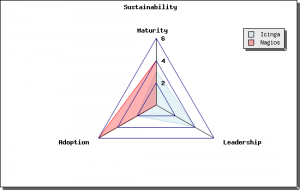 Sustainability considers projects’ Maturity (Nagios has a very long story, Icinga is pretty much young), Stability (both are stable and maintained), Popularity (Nagios is very popular, Icinga is starting to gain attention), Books availability (many Nagios books are available, while there is no book about Icinga), Community dimension (Nagios team gathers over 10 committers, but only 3 of them made commits during the last year; Icinga has over 10 committers) and Community leadership (Icinga is a community-led project, while Nagios is moving from a Benevolent dictator leadership to a more community oriented approach).
Nagios and Icinga Level of Industrialization.
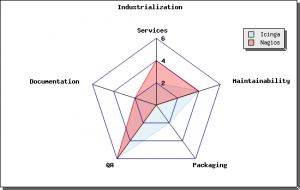 Industrialization considers many factors, including: Training support (Nagios training services are widely available, while Icinga training is offered only by credativ), Commercial support (Nagios is professionally supported also by other companies, while Icinga is backed only by the most active company in the community), Documentation (Nagios documentation is available in many languages, Icinga both in German and English), Packaging (Icinga is available also as a virtual appliance). Both projects offer prompt and effective responses. Amount of comments (Icinga is more commented than Nagios), and Modularity (Nagios is the only one providing tools to create extensions, along with a platform to share all Nagios projects).
Nagios and Icinga Strategy.
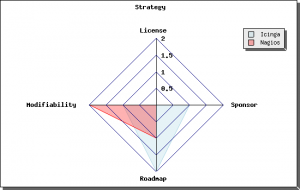 Strategy covers License (both projects are GPLv2), the Roadmap (Icinga has a detailed roadmap and its roadmap has been respected, Nagios Core roadmap is not as much detailed but plug-in roadmap is more detailed), Code modifiability (Nagios made available tools to propose modifications, Icinga doesn’t provide similar tools or procedures) and the project’s sponsor (Nagios Enterprise sponsors Nagios development, while Icinga is sponsored by its community). The recent history of Nagios/Icinga is important and probably not known to many. In the 18 months since the Icinga project “forked” the code of the Nagios project has evolved and developed a distinct style and approach to writing code and building community. For example, making available a one-stop shop for bug-tracking, and other useful and participatory tools. In the meantime Icinga code base has grown faster, but its community still needs tools aimed at empowering Icinga’s architecture of participation. In a word, both projects are making changes in an attempt to build stronger communities and encourage development of their codebase.
Companies or organizations looking at selecting one project or the other should consider which project best meets their needs. Typically users looking for a viable open source program focusing only on their own usage benefits, prefer programs ready for prime time, easy to try, install and configure. Available plug-ins, extensions and other add-ons are important parameters to take into account too.
System integrators or IT players used to open source plumbing should consider which project meets their style (commensalistic or symbiotic) and contribution type (code, documentation, plug-ins, etc).
VARs and Solution Providers look at Partner programs, certifications and certified compatibility, and other business tools. Whatever might be your motivations to choose one way or the other, the presence o f two closely competing open source monitoring projects may spur innovation in an area (server monitoring) not known for rapid development.
Want to talk to us?
Fill our contact form if you want to schedule a skype chat or a call to learn more about SOS Open Source services.News
- "Software De Código Aberto: Melhores Diretórios E Listas Para Encontrar E Avaliar Programas Open Source" MasterNewMedia.br, May 2011
- "Open Source Software Tools And Directories: Where To Find Them, How To Evaluate Them" MasterNewMedia, March 2011
- "The role of Open Source and Free software in today’s world, excellences, issues and frontiers to cross: an expert talk with Roberto Galoppini" Meedabyte, February 2011
- "IT: Updated law presses public administrations to share software" OSOR News, February 2011
- "SOS Open Source" TodoBI, January 2011
- "The choice engine is an Italian job" ZDNet, October 2010
- "Open Source Project Filtering" Content Here, July 2010
- "Managing Open Source Risk and Keeping It Legal" OSTATIC, May 2010
- "Picking the right open source projects" Infoworld, April 2010
- "This Roman knows how to spot the best open source" ZDNet, April 2010
- "Funambol Scores High In Galoppini SOS Open Source Software Evaluation" Funambol Press Release, April 2010
Twitter
Sorry, no Tweets were found.
About the author
Roberto has over 25 years experience in the IT field, and has spent the last 12 years working in the intersection of open source software and business development. Roberto has taken an active interest in different open source projects and organizations, he has served on advisory boards, and helped large IT vendors, open source vendors and customers to design and deploy their open source strategies. After serving as Senior Director of Business Development at SourceForge for over 4 years, in 2016 he started a new company called Business Follows., whose mission is to is to help developers, companies and organizations to make Open Source development a key part of their business strategies. He is the editor of commercial open source blog.Privacy
Please read the Privacy page.

This work is licensed under a Creative Commons Attribution-NonCommercial-NoDerivs 3.0 Unported License.
By continuing to use the site, you agree to the use of cookies. more information
We use cookies to personalize content and analyze our traffic. We also provide information on how you use our site to our web analytics, advertising and social media analytics partners, who may combine it with other information you have provided or collected based on your use of their services.
If you continue to use this website without changing your cookie settings or you click "Accept" below then you are consenting to this.
Please refer to our Privacy Policy page for further details.