


| CARVIEW |
Select Language
HTTP/2 200
date: Thu, 29 Jan 2026 06:02:58 GMT
content-type: text/html
content-length: 4408
last-modified: Fri, 16 Jan 2026 15:03:40 GMT
etag: "363a-64882a590eb03-gzip"
accept-ranges: bytes
vary: Accept-Encoding
content-encoding: gzip
x-backend-server: 10.0.0.42:80
Set Theory and Foundations of Mathematics
Other languages : FR − ES − IT − RU − TR − LT
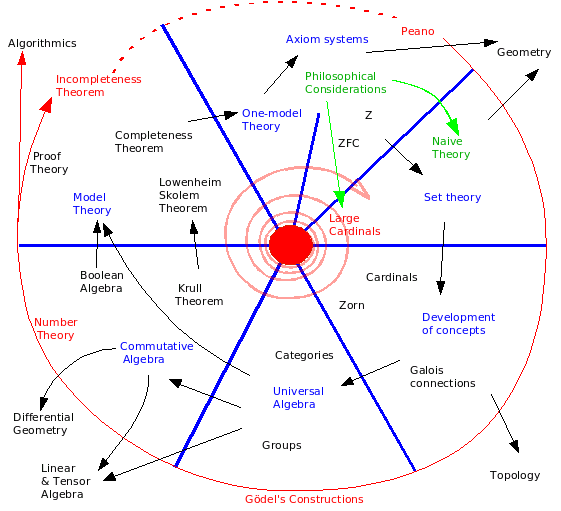
1. First foundations of mathematics (details) - all in 1 file (36 paper pages) - pdf version in 22 pages (15+7 - updated on Jan 16, 2026 by automatic conversion from html).
2. Set theory - all in one file (40 paper pages), pdf (37 pages not updated).
A notation change was done away from standards (see why) : from their definition in 2.6, the notation for direct images of sets by a graph R changed from R∗ to R⋆, and that for preimages changed from R* to R⋆.
3. Algebra 1 (all in one file)
4. Arithmetic and first-order foundations (all in one file : 30 paper pages)
5. Second-order foundations
6. Foundations of Geometry (draft)
7. Algebra 2 (draft)
Galois connections (11 pdf pages). Rigorously it only uses parts 1 (without complements) and 2. Its position has been moved from 3 for pedagogical reasons (higher difficulty level while the later texts are more directly interesting). The beginning was moved to 2.11.
Monotone Galois connections (adjunctions)
Upper and lower bounds, infimum and supremum
Complete lattices
Fixed point theorem
Transport of closure
Preorder generated by a relation
Finite sets
Generated equivalence relations, and more
Well-founded relations
Index of special words, phrases and notations, with references
Set Theory and Foundations of Mathematics
About (purpose and author) - Foundations of physics - Other topics and linksOther languages : FR − ES − IT − RU − TR − LT
1. First foundations of mathematics (details) - all in 1 file (36 paper pages) - pdf version in 22 pages (15+7 - updated on Jan 16, 2026 by automatic conversion from html).
1.1. Introduction
to the foundations of mathematics
1.2. Variables, sets, functions and operations
1.3. Form of theories: notions, objects, meta-objects
1.4. Structures of mathematical systems
1.5. Expressions and definable structures
1.6. Logical connectives
1.7. Classes in set theory
1.8. Binders in set theory
1.9. Axioms and proofs
1.10. Quantifiers
1.11. Second-order universal quantifiers
More philosophy:
1.A. Time in model theory
1.B. Truth undefinability
1.C. Introduction to incompleteness
1.D. Set theory as a unified framework
1.2. Variables, sets, functions and operations
1.3. Form of theories: notions, objects, meta-objects
1.4. Structures of mathematical systems
1.5. Expressions and definable structures
1.6. Logical connectives
1.7. Classes in set theory
1.8. Binders in set theory
1.9. Axioms and proofs
1.10. Quantifiers
1.11. Second-order universal quantifiers
More philosophy:
1.A. Time in model theory
1.B. Truth undefinability
1.C. Introduction to incompleteness
1.D. Set theory as a unified framework
2. Set theory - all in one file (40 paper pages), pdf (37 pages not updated).
A notation change was done away from standards (see why) : from their definition in 2.6, the notation for direct images of sets by a graph R changed from R∗ to R⋆, and that for preimages changed from R* to R⋆.
2.1. First axioms
of set theory
2.2. Set generation principle
2.3. Currying and tuples
2.4. Uniqueness quantifiers
2.5. Families, Boolean operators on sets
2.6. Graphs
2.7. Products and powerset
2.8. Injections, bijections
2.9. Properties of binary relations
2.10. Axiom of choice
Philosophical aspects :
2.A. Time in set theory
2.B. Interpretation of classes
2.C. Concepts of truth in mathematics
2.2. Set generation principle
2.3. Currying and tuples
2.4. Uniqueness quantifiers
2.5. Families, Boolean operators on sets
2.6. Graphs
2.7. Products and powerset
2.8. Injections, bijections
2.9. Properties of binary relations
2.10. Axiom of choice
Philosophical aspects :
2.A. Time in set theory
2.B. Interpretation of classes
2.C. Concepts of truth in mathematics
3. Algebra 1 (all in one file)
3.1. Galois
connections
3.2. Relational systems and concrete categories
3.3. Algebras
3.4. Special morphisms
3.5. Monoids and categories
3.6. Actions of monoids and categories
3.7. Invertibility and groups
3.8. Properties in categories
3.9. Initial and final objects
3.10. Products of systems (updated)
3.11. Basis
3.12. Composition of relations
3.2. Relational systems and concrete categories
3.3. Algebras
3.4. Special morphisms
3.5. Monoids and categories
3.6. Actions of monoids and categories
3.7. Invertibility and groups
3.8. Properties in categories
3.9. Initial and final objects
3.10. Products of systems (updated)
3.11. Basis
3.12. Composition of relations
4. Arithmetic and first-order foundations (all in one file : 30 paper pages)
4.1.
Algebraic terms
4.2. Quotient systems
4.3. Term algebras
4.4. Integers and recursion
4.5. Presburger Arithmetic
4.6. Finiteness
4.7. Countability and Completeness
4.8. More recursion tools (draft)
4.9. Non-standard models of Arithmetic
4.10. Developing theories : definitions
4.11. Constructions
4.A. The Berry paradox
4.2. Quotient systems
4.3. Term algebras
4.4. Integers and recursion
4.5. Presburger Arithmetic
4.6. Finiteness
4.7. Countability and Completeness
4.8. More recursion tools (draft)
4.9. Non-standard models of Arithmetic
4.10. Developing theories : definitions
4.11. Constructions
4.A. The Berry paradox
5. Second-order foundations
5.1. Second-order structures and invariants
5.2. Second-order logic
5.3. Well-foundedness
5.4. Ordinals and cardinals (draft)
5.5. Undecidability of the axiom of choice
5.6. Second-order arithmetic
5.7. The Incompleteness Theorem (draft)
More philosophical notes (uses Part 1
with philosophical
aspects + recursion) : 5.2. Second-order logic
5.3. Well-foundedness
5.4. Ordinals and cardinals (draft)
5.5. Undecidability of the axiom of choice
5.6. Second-order arithmetic
5.7. The Incompleteness Theorem (draft)
Gödelian arguments against mechanism : what was wrong and how to do instead
Philosophical proof of consistency of the Zermelo-Fraenkel axiomatic system
Philosophical proof of consistency of the Zermelo-Fraenkel axiomatic system
6. Foundations of Geometry (draft)
6.1. Introduction to the foundations of geometry
6.2. Affine spaces
6.3. Duality
6.4. Vector spaces and barycenters
Beyond affine geometry
Euclidean geometry
6.2. Affine spaces
6.3. Duality
6.4. Vector spaces and barycenters
Beyond affine geometry
Euclidean geometry
7. Algebra 2 (draft)
Varieties
Polymorphisms and invariants
Relational clones
Abstract clones
Rings
(To be continued - see below drafts)
Polymorphisms and invariants
Relational clones
Abstract clones
Rings
(To be continued - see below drafts)
Galois connections (11 pdf pages). Rigorously it only uses parts 1 (without complements) and 2. Its position has been moved from 3 for pedagogical reasons (higher difficulty level while the later texts are more directly interesting). The beginning was moved to 2.11.
Monotone Galois connections (adjunctions)
Upper and lower bounds, infimum and supremum
Complete lattices
Fixed point theorem
Transport of closure
Preorder generated by a relation
Finite sets
Generated equivalence relations, and more
Well-founded relations
Index of special words, phrases and notations, with references
Drafts of more texts, to be reworked later
Dimensional analysis : Quantities and real numbers
- incomplete draft text of a video lecture I wish to make
on 1-dimensional geometry
Introduction to inversive geometry
Affine geometry
Introduction to topology
Axiomatic expressions of Euclidean and Non-Euclidean geometries
Cardinals
An alternative to Zorn's Lemma
Introduction to inversive geometry
Affine geometry
Introduction to topology
Axiomatic expressions of Euclidean and Non-Euclidean geometries
Cardinals
An alternative to Zorn's Lemma
Diverse texts ready but not classified
Pythagorean
triples (triples of integers (a,b,c) forming the sides of a
right triangle, such as (3,4,5))
Resolution of cubic equations
Outer automorphisms of S6
Resolution of cubic equations
Outer automorphisms of S6
Contributions to Wikipedia
I wrote large parts of the Wikipedia article on Foundations
of mathematics (Sep. 2012 - before that,
other authors focused on the more professional and technical
article Mathematical
logic instead; the Foundations of mathematics article is
more introductory, historical and philosophical) and improved
the one on the completeness
theorem.
Something crazy
I wrote the following in reply to this post of r/math but got banned from there by admins just for this reason. What do you think ?- I feel usual references on universal algebra as very heavy and difficult to read, a "cost" which may explain why the topic gets usually ignored by other works on algebra. I undertook to write a much shorter, optimized presentation of its few main concepts in my work in settheory.net among other fundamental topics of mathematics. The main pages on universal algebra there are from 3.2 to 4.3, assuming to have read all from the start (more pages are in plan for later sections that are partly written...)