

|

|
| CARVIEW |
Sundry Sunday is our weekly feature of fun gaming culture finds and videos, from across the years and even decades.
HyperVoiceActing is a Youtube channel that frequently posts humorous vignettes, often involving video game characters, and hey that’s what Sundry Sunday mostly presents, so here’s one of theirs!
Dr. Wily and Dr WrLight have had a long rivalry, but usually their battles are by proxy, Wily through Robot Masters, Light through RockMega Man. One has to wonder if their time in grad school prepared them for this.
This video presents a scenario in which Light has had enough, and calls out Dr. Wily for what is refrered to in robotics circles as an ass-whoopin. The interesting things about that is, first, Dr. Wily seems worried that Dr. Light might actually get squished by his latest skull machine. This should properly be seen as a sop to the shippers, but I’m not annoyed, it’d probably happen anyway. Wily obviously cares deeply about what Dr. Light thinks, otherwise he wouldn’t rail* against him so much.
Second, Wily actually takes Dr. Light up on his challenge to settle their rivalry with fisticuffs. As for the outcome, well…. (2 minutes)
* Note: Completely platonic meaning for “rail”
]]>Here is their post, and here is the video (1 hour 33 minutes). It’s a link to the Computer History Museum’s symposium on the occasion of the 25th anniversary of the Commodore 64, and has Steve Wozniak (creator of the Apple II), William Lowe (“father” of the IBM PC), Adam Chowaniec (Vice President of World Product Development at Commdore) and Jack Tramiel (founder of Commodore and key to the success of the Commodore 64).
Since this talk was given, three of the four have passed away, leaving only Steve Wozniak, probably by virtue of his youth when he invented the Apple. Please enjoy!
]]>Here is this year’s post, but you don’t have to follow it because I’ve included the links in this post too.
They’re all videos this year. These first links are to videos by Skawo:
In Minish Cap, there are certain names you can’t put on your save file due to a checksum bug. (11 minutes) The same bug can result in a valid save file being declared corrupted:
I think I mentioned this one before, but again, in Ocarina of Time, if you go back the way you came during the event in Kakariko Village, the world will become a glitchy mess (7 minutes):
In early versions of Ocarina, holding down R while talking to King Zora when he gives you the Blue Tunic causes him to give you a different item instead (14 minutes):
Also in Ocarina of Time, in some areas there’s a mysterious square in the upper-left corner of the screen (6 minutes):
When fighting pairs of Stalfos enemies, the game starts to lag heavily when you defeat one of the two, before the other one is beaten (9 minutes):
Capsyst Animations made three fake commercials for early Zelda games, in the style of the evocative illustrations from the manual. There’s the original Zelda, Zelda II and Link to the Past (all 1 minute long):
And, finally, here are two strange commercials for the Zelda 1 on NES, the Zelda Rap, and whatever this is supposed to be (both ½ minutes):
]]>
The Amiga has hardware sprites, but they’re fairly limited. Most programmers prefer to use its powerful blitter hardware to simulate sprites, drawing them to screen memory much more rapidly than non-blitter hardware can. For more information, I refer you to the video.
That’s it for today, but there be something more substantial tomorrow….
]]>The weekly indie game showcases highlight the many games we check out on the channel (Game Wisdom). Please reach out if you would like to submit a game for a future one. All games shown are either press keys, demos, or games from my own collection.
00:00 Intro
00:14 Death Tower
1:46 Up to Par
2:51 Ale Abbey
4:19 Tartaros
5:49 Awaken Astral Blade
7:19 Nightmare The Lunatic
1. Sega’s One-Sided History, from The History of How We Play, about the tensions between Sega’s Japanese and American management.
2. From Mugen Gaming, working on a translation of Japanese TTRPG Sword World, with a crowdfunding campaign to begin in 2026. Included here because Sword World is soaked in video game influences. It really is a case of back-and-forth around the world: Wizardry and Ultima inspired Dragon Quest, Dragon Quest inspired other JRPGs, and then those JRPGs influenced Sword World. And to go with it, a nearly-complete fan translation of a Super Famicom Sword World game.
3. Martin Piper takes a look at the 3D wireframe driving game Stunt Car Racer for the Commodore 64. (45 minutes) From 1989, it did a number of things that you wouldn’t have thought possible on an unmodified C64, and he pieces through its programming.
4. At Retroevolve, Mandy Odoerfer describes the charm of bootleg Pokemon games, games like 2003 Pocket Monster Carbuncle and Pokemon Vietnamese Crystal.

5. The Splatterhouse Homepage, an oldschool webshrine, is still updating, and has a new page on the recent dumping of an unreleased sequel to Splatterhouse Wanpaku Graffiti, called Splatterworld, although I notice that one of its downloads is actually dated to 1993. Hmm, curious!
6. Userlandia exhaustively explored everything at VCFMW this year! (1 hour) I agree: there was a right ton of stuff there to explore!
Sundry Sunday is our weekly feature of fun gaming culture finds and videos, from across the years and even decades.
I was going to use Pannenkoek’s Christmas video this week, but then realized that I used that one last week. Serves me right for doubling up!
Instead have a listen to this collection of video game songs with a Christmas vibe. There’s no length notice because it’s a 24-hour-a-day livestream. Here!
I maintain that I am not a Nintendo Adult. But they have had a long history of making inventive and interesting games. I thought they’d been failing a bit at that lately, but then comes Kirby Air Riders, as weird and distinctive game as they’ve ever published. (By the way, did you know that they’ve put up Christmas decorations on the Kirby Air Riders menu screen and paddock area?)

The holidays tend to be a time of distraction for me, so let’s just gawk at some animated Nintendo commercials from across the years. (26 minutes)
Many of these games had weird differences from Nintendo’s originals. The best known of them is probably Super Mario Bros. Special, a very weird version with paged scrolling, which is to say, no scrolling at all, but just flipping forward one screen at a time. Super Mario Bros. Special isn’t on the subject page of this post, which is old enough that it’s only available on the Wayback Machine, but it is on the website World Of Stewart, and wonder of wonders that page is available on the living internet! Playthroughs of the whole game, in its clunky miscolored XOR-sprite glory, can also be seen on Youtube, here, for instance. (51 minutes)
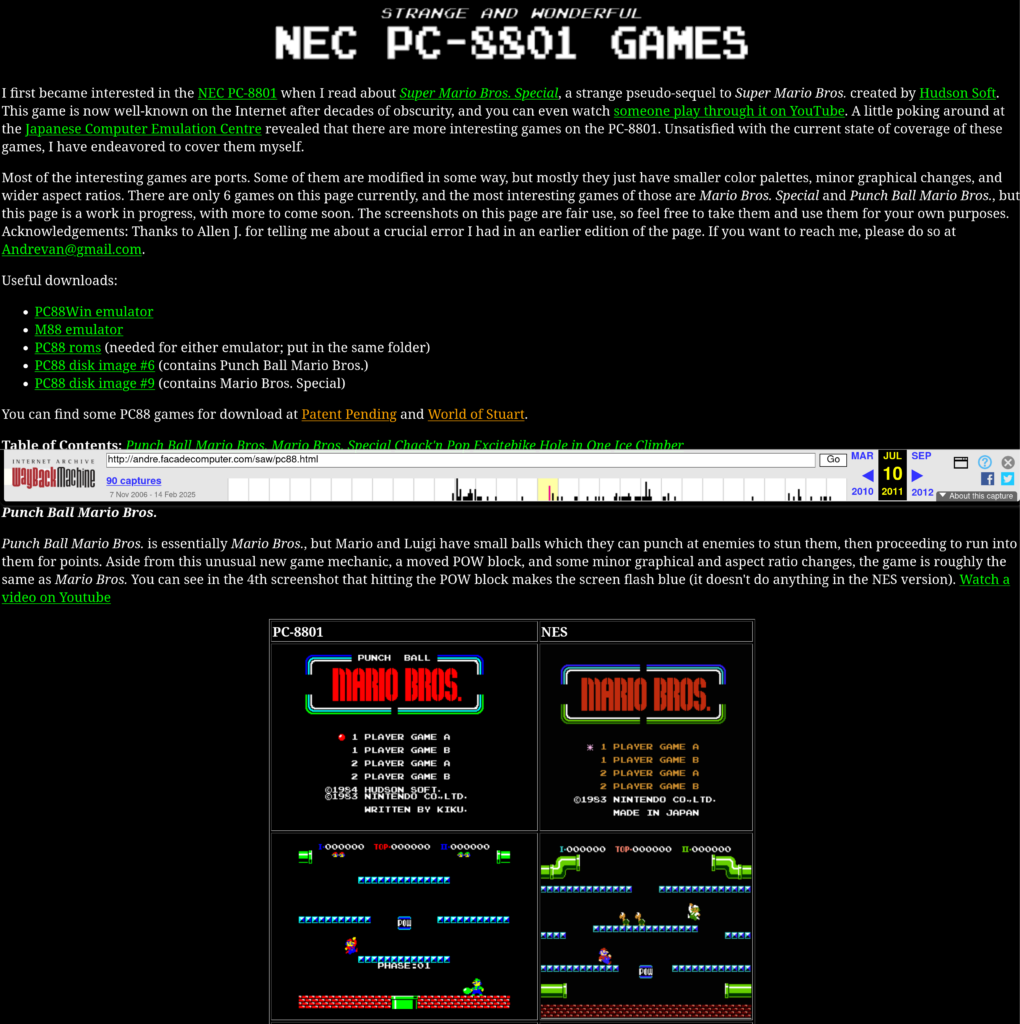
There was also Punch Ball Mario Bros., which took the basic premise of Mario Bros. and just, well threw it away, just tossed it right in the trash, and replaced it with punching a ball around to attack enemies. Gameplay of that is also on Youtube. (5½ minutes)
Another version of Mario Bros., Mario Bros. Special (which isn’t Super Mario Bros. Special but something else) It’s harder to find Youtube video of that because Google assumes you must be looking for the Super version, but it can be found. (8½ minutes) If you recognize the title screen music from that then you are really a supergeek! (I did recognize it, so yes, that includes me.) And the game, wow… it really doesn’t look fun to play.
Some other games listed include Excitebike (11 minute video), Ice Climber (7½ minute video), the (only slightly Nintendo and with janky music) HAL Hole-In-One Golf (15 minute video), and (the very non-Nintendo) Chack’n Pop (4 minute video). Hole-In-One is a predecessor of Nintendo’s Golf, if you’re looking for that Nintendo connection.
One thing all of these games, except maybe Hole-In-One, have in common is they look like they’re excruciating to play now! They either have way too fast or slow controls, or ear-tearing scratchy music, or both. But they are interesting as curiosities, so here they are. Curious!
Strange and Wonderful NEC PC-8801 Games (Wayback Machine)
]]>As it turns out, the PS2 was actually all that great a Linux machine, and it was soon outclassed by PCs. That hasn’t stopped there from being a Playstation Linux community, with a website that sadly announces that it most soon close down in a post dating to 2009. It feels a bit like one of those “Closing Liquidation” signs that sometimes stores that have no plans of shutting down put up, in the hopes of attracting some extra customers. Oh well, I’m sure it’ll perish eventually, such is the way of all things. I just hope they can hold out a few extra decades.
Here is the video (20 minutes), although note that it contains a sponsored segment. This link skips past it. Michael MJD also tried it out a couple of years ago (27 minutes), if you’d like to see their reactions.
Some observations:
- Buying a complete unopened PS2 Linux box nowadays can cost you well over $1,000.
- It was released in 2002; Linux itself was first created in 1991.
- It’s based on the Japanese distribution Kondara, which itself was based off of Red Hat, and it shows due to it using RPM for its package format.
- It runs WindowMaker for its GUI, which is based off of NeXTSTEP, the predecessor of the GUI used in current-day macOS.
- In 2025 this is very much a Stupid Computer Trick, or perhaps a Stupid Console Trick, but ActionRetro has so much fun running OSes on various unexpected hardware that it’s difficult to fault him for it.
In the meantime, here’s another ridiculous glitch, explained by Skawo. (7 minutes) Skawo’s style is to use onscreen text to do the talking, which I can appreciate since I usually have subtitles on anyway.
In brief, due to the way the game handles weather, if you enter Kakariko Village during a certain story event, then leave it immediately, it starts raining heavily, then doesn’t have the chance to stop. The game handles lighting separately for each time of day and each kind of weather. Kakariko has a table for the specific kind of weather for that event, HEAVY_RAIN, but most places don’t, so the game refers to a table of garbage data to provide lighting for places. That causes Hyrule Field to take on a bright purple hue, among other places. Have a look!
]]>This is a review of Symphonia played with a games pass key.
]]>1. Fan patches English into Wizardry VI for Saturn.
2. The unreleased web browser for the Gamecube. (8 minutes)
3. Read Only Memo on a recompilation of Dinosaur Planet, Rare’s N64 game that got reconfigured into Star Fox Adventures on Gamecube, their last game made for Nintendo before Microsoft bought them. (They did make some portable games after that, like It’s Mr Pants for Gameboy Advance and a port of Diddy Kong Racing for the DS.)
4. Max Fog on Interactive Fiction blog The Rosebush writing on the history of Infocom and the Z-Machine.
5. A Sonic the Hedgehog romhacking tutorial. (15½ minutes)
6. Pictochat Online.
]]>
Sundry Sunday is our weekly feature of fun gaming culture finds and videos, from across the years and even decades.
Two new items. The short one first, a brief holiday video from pannenkoek, the Mario 64 expert. It isn’t about beating the game without pressing the A button, nor is it a deep dive into the game’s internals in such a way that you could use it in a computer science course. It’s just Christmas as it’s celebrated on Cold Cold Mountain, with festive decorations and multicolored penguins. It’s only a minute and a half:
You want something longer? The Amazing Digital Circus just released episode 7, and it’s much darker than past episodes. What’s that, you think it’s been plenty dark already? Well, now it’s even more so, despite the fact it’s titled Beach Episode and features the return of the Sun. (33 minutes)
Not long ago the creators mentioned that Amazing Digital Circus was never envisioned as a long-term series, that just keeps running on and on, and I think I remember them saying the plan was for about nine or ten episodes? Not many of those left. I wonder if afterwards Gooseworx will get back to continuing her personal series, like the adventures of Elaine or Darly Boxman, or maybe something else like Little Runmo?
]]>Nambo created a video that showcases every Super Monkey Ball glitch, for the first two games at least. The video title calls them techniques, but I think glitches more accurately describes what’s being explicated here.
The video is amazingly complete and is 42 minutes long. It takes some kind of ridiculous ultrageek to watch the whole thing. Yes, I did that, why do you ask? Are you going to do it too? If you don’t it’s no skin off of your nose, maybe just watch enough of it to get some idea of how deep the Super Monkey Hole goes?
Pac-Man has a reputation as a game of patterns, and seems designed in such a way as to enable patterns to work. The only randomness is in the behavior of the ghosts when they’re vulnerable, and even then, if the player has performed the same moves at the same times up to that point in the level, even their vulnerable behavior will be consistent. Its GCC-developed follow-up, Ms. Pac-Man, has the red and pink ghosts move randomly at the start of each board specifically to foil patterns.
But you don’t have to play Pac-Man as a pattern game. It is possible to play it “freestyle,” like a naive player would, reacting to the ghosts’ movements. You’re unlikely to make it to Pac-Man’s famous kill screen at board 256 that way, but you can still make it pretty far.
Key to doing that is keeping the ghosts as close to each other as you can. The ghosts are much more dangerous when they’re scattered around you, because they can block off all of your escape routes. Four ghosts piled up on the same spot not only can’t block off other corridors, but their AIs tend to continue to keep them together, at least when they’re far away from Pac-Man. Red and Orange behave identically when they’re at a distance, and Pink’s behavior appear to be more like Red’s the further away from Pac-Man it us. Blue has the most chance of diverging, but often moves the same way anyway.
Not only does keeping the ghosts clustered make survival easier, but it makes it much easier to eat all of them with a single Energizer. The ghosts only turn blue up to around the 4/6th Key board, but up to that point it’s basically impossible to get the maximum score from every Energizer if one hasn’t managed to herd the ghosts into a single, easy-to-gobble blob.
That’s where Jamey’s tutorial comes through. It presents a series of situations and techniques for getting the ghosts near each other and moving as one unit, whether it’s for avoiding them or getting the maximum points from an Energizer. It’s a bit much for casual play, but it can be very interesting to see how a true expert goes about doing it. Here, then, is the tutorial (27 minutes):
I still don’t know how Jeremy Parish can finish all of his video game history subseries before the year 2084, when the Robotrons revolt and destroy human-kind, but he’s making good time. He’s at last started on his examination of the Nintendo 64 era, with N64 Works #000. (22 minutes)
He admits that the N64 era was one where he originally didn’t have the Nintendo console for that generation, opting instead for the Playstation. I was in college at the time and had both, but got the N64 first, and got far more use out of it overall. Maybe I had weird tastes? Jeremy does admit that Super Mario 64 looked really impressive on all those demo kiosks.
Back then, Mario 64 looked like an impossible feat. Nowadays, through the efforts of people like pannenkoek, Kaze Emanuar and others, we know that Super Mario 64 was a creation combining long cycles of iteration, a bunch of outright hackery, and a whole lot of work. I hope someday that the full story of Mario 64’s creation can be told. Maybe Jeremy’s eventual examination of the game will help to pull back the curtain?
]]>I could go on about its very light RPG elements (there’s no experience system at all), its comedic story, its characters and music, and I will someday. But until then, please be content with what the Basement Brothers had to say about the original PC-88 version of Popful Mail, which is the version for the weakest machine, but still fun. (39 minutes)
Falcom had developed a reputation for making hardcore, unique and system-heavy RPGs like Dragon Slayer and Xanadu, so Popful Mail was a departure. It was designed to be an early multimedia game, with animations and even voice acting in some versions. This version, however, was distributed on floppy disk, and for a underpowered system, so it couldn’t rely on audio-visual splendor. It still did pretty well for itself, as the Brothers demonstrate.
It’s always saddened me that Popful Mail was a one-off. It’s a property that seems ripe for sequels and animation, but to my knowledge it never happened. Maybe Falcom will ease their stream of Ys sequels someday and look at updating more of the other games in their history, and maybe then they’ll return to Mail and her cartoony comrades. Here’s hoping.
]]>The weekly indie game showcases highlight the many games we check out on the channel. Please reach out if you would like to submit a game for a future one. All games shown are either press keys, demos, or games from my own collection.
00:00 Intro
00:14 What the Car
1:31 Mandragoria
3:23 Kelp Keeper
4:49 SomnaBuster
6:09 Mini Mini Golf Golf
7:30 Bloomtown
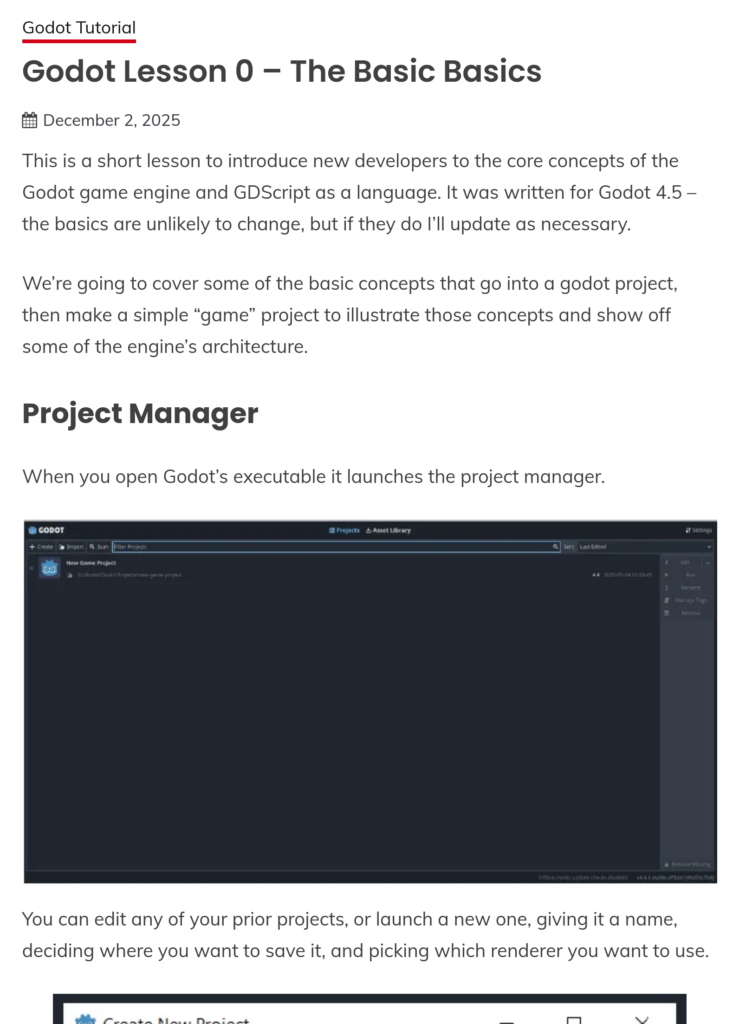
1. Godot Lesson 1: The Basic Basics, a non-video tutorial for getting yourself started with the best Unity alternative.
2. NESbag, a system for wrapping NES homebrew for immediate play by others without having to set up an emulator yourself, announces two-player support.
3. A “demake” of Zelda’s Adventure for CDi to make it a much more playable, Link’s Awakening-style game for Gameboy Color.

4. Along those lines, from Gumpy Function, maker of Grimace’s Birthday (previously), two Simpsons fangames for Gameboy, Lee Carvallo’s Putting Challenge 2, and the My Dinner with Andre game that Martin was seen playing on an arcade cabinet.
5. He uses AI-generated images to provide visual interest, which is usually a strike against a link for me, but I know he means well so I’ll give him a pass this time. Youtuber Lupe Darksnout presents a series on getting video to play on a Commodore 64. (playlist link, 48 videos averaging about 17 minutes each, about 10½ hours in all)
6. Abyssoft on Youtube, Multiple World Record Speedruns Brought Into Question. (18 minutes) There is a sponsored segment that’s about a minute long, here’s a link queued up to after it.
]]>Sundry Sunday is our weekly feature of fun gaming culture finds and videos, from across the years and even decades.
To recap. Ten years ago, Disney hired the Brothers Chaps, creators of seminal Flash series Homestar Runner, to make for them a series of Flash shorts for Youtube and (I think?) broadcast as bumpers, called Two More Eggs.
At that time Matt and Mike Chapman already had a working relationship with Disney working on their shows Gravity Falls and Wander Over Yonder, and it was an opportunity to return to their roots making little shorts in Flash. The Two More Shorts are generally brilliant, and one subseries of them that fortuitously strays just inside the borders of our mandated focus is Eggpo, about two Goomba-like minion characters within a video game. We’ve covered five of the seven episodes so far; check out the Eggpo tag for all of them.
In Eggpo #6: Speedrun (2¼ minutes), our underling friends get invested in the success of a speedrunner blazing through their game.
Blippo+ is more of a unique means of telling a story than a game. I’m brought to mind of Portal, not Valve’s 2007 weird kinetic puzzle-action game, but Activison’s 1986 even weirder storytelling experience, about exploring a planet-wide information system to discover what happened to its missing inhabitants. In both Blippo+ and (older) Portal, all the “gameplay” is in a system of presenting information to the viewer/reader.
There is a story that progresses through a series of updates. On the Playdate it was timelocked, so it was like it was passing in real time. In the new Steam and Switch versions, the story unfolds more at your own pace; after you’ve seen most of one set you can “download” the next “packette” of shows, but also go to previous packettes whenever you feel like it.
I said shows, because Blippo+ presents itself as the television of a distant planet. I have avoided calling it an alien planet, because it’s really a lot like Earth, and while there’s definitely some unexpected elements (a scientist talks to long-dead inhabitants who are brains in jars) most of it you wouldn’t have been surprised to have seen on Earth TV in the early 90s. There’s a self-centered teen show, an exercise program, an entertainment news show that feels like it’s from the MTV of old, a show with a character much like Max Headroom, and many other callbacks to cable television of three decades past. There’s even a scrambled porn channel, although there’s really no porn behind it, other than “Tantric Computing,” which is but video clips of a lady’s hand lovingly fondling old-style computer mice and monitors.
There’s a show about two space-faring cowboys. A claymation kids show. The “Fighting Trillions” series of action movies, of which we only ever see trailers, narrated by a virtual soundlike of the late, great Gary Owens. (All of the shows have really great voice acting!) A D&D-themed trivia gameshow. The weird Julia Child-like cooking show Snacks Come Alive. And more. One of the shows is just different kinds of static. Another is info cards for local programming. The “Tips” channel is, wonderfully, just a sequence of error messages.
It’s all rounded off with a Preview Guide-style program listing channel, and a Ceefax-like information presentation service that’s somehow one of the most affecting parts of the whole package.
Each show, of about 20 in all, is only two minutes long. It’s easy to load it up and watch the entire contents of one or two of the channels, either intently or as background to other things.
It really needs to be experienced to get the idea across. This collection of first week clips on Youtube (11 minutes) that should demonstrate to you what it’s like.
Blippo+ (Playdate $10, Steam $15, Switch $15 currently on sale for $12)
]]>First video (beginning to the end of the second dungeon + extras):
Second video (Jabu-Jabu’s Belly through to the end of the Forest Temple):
Third video (the Fire Temple, the Water Temple and the fetch quest to get Biggoron’s Sword):
Fourth video (The Shadow and Spirit Temples and the end):
Is that not enough? Rival channel U Can Beat Video Games has been churning through all of Final Fantasy VI (a.k.a. III, it’s complicated), having done five videos so far with one left to go, with videos ranging in length between 3⅓ to 4 hours: Part One – Part Two – Part Three – Part Four – Part Five.
]]>I didn’t know that Nintendo’s first foray into consoles was making a custom controller for the Odyssey (not the Odyssey 2, the Odyssey), and distributed it in Japan. But I do know that Nintendo’s history extends far back before video games, to making Hanafuda and traditional playing cards, and still makes them to this day, along with Mah Jong, Shogi and Go equipment.
]]>How well-known would you consider Conway’s Life to be? By one measure it’s incredibly obscure, in that if you ask a random person on the street if they know about it they’ll probably at best think you’re talking about Hasbro’s Game of Life, a simple board game where players pilot colored pegs riding in a tiny plastic car down a winding road from birth to retirement, a buffet of unexamined assumptions with a long history which itself may be worthy of exploration here itself some day.
But by another yardstick, few games are more well-known than Conway’s Life. It was created 55 years ago, in 1970, by British mathematician John Horton Conway, meaning it’s Older than Pong. It’s not technically just a computer game, but its explorations have grown so huge that practically everyone who cares simulates it on a computer.
When I say it’s a creation of pure mathematics, please don’t be scared off, because it’s really simple to understand. It was a popular subject of Martin Gardner’s Mathematical Recreations columns in Scientific American.
Imagine an infinite grid, a pocket universe that’s like an Excel spreadsheet that goes on forever. Each cell can contain a counter, which is considered “alive,” or nothing, which is considered “dead,” or just empty. From there, you use a simple process to simulate this universe.
You don’t have to worry about physics or gravity or free will. Instead, every counter on the grid with less than two neighbors dies (is removed) due to loneliness; every counter with more than three dies due to overcrowding; and on every empty space with exactly three neighbors is birthed a new counter. By “neighbors,” I mean on one of the eight spaces around it. By “birthed,” I note that reproduction in the world of Life is genderless and trinary.
So that’s how to do it. But why would you? It’s because despite its simplicity, Life patterns grow by unexpected and interesting processes. It’s a case of emergent complexity; like how DNA molecules ultimately produce living creatures in our world, simple origins create hugely complex results. That similarity of complexity to our universe is why it’s called a “game of life.”
A better introduction can be found at this page at Cornell University. It’s a type of cellular automation, a wider field with many game design implications. You could consider classical roguelikes to be a type of cellular automation, although not nearly as simple, or as elegant. Within the world of Conway’s Life there are Gliders, Oscillators, Wicks, Puffers, Guns, Methuselahs, Spaceships and more. While there aren’t physics as we consider them, there is a “speed of light.”
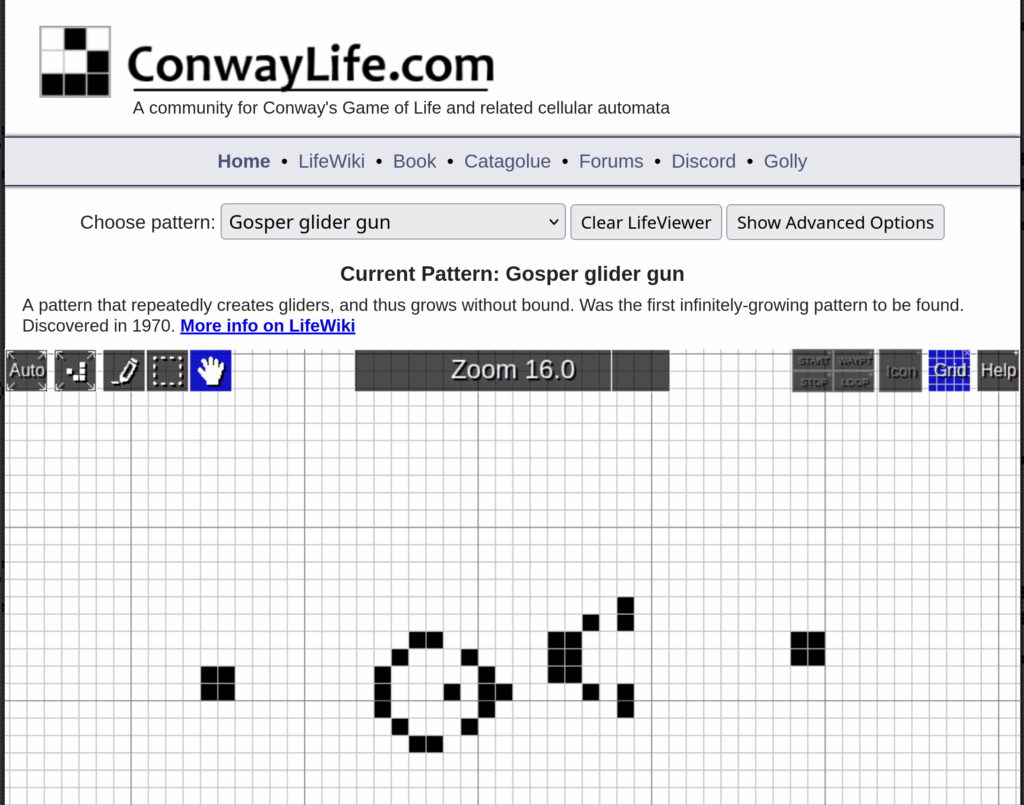
The website ConwayLife.com, created probably some time in 2009, is one of those many websites out there that invisibly hosts active communities that big media sites routinely ignore, the kind of thing that Set Side B carries both a banner and a deep affection for. There was a time where sites like this were a major focus of the World Wide Web, and it still is, even if the wider world fails to notice it. ConwayLife.com hosts a simulator on its homepage, a wiki of concepts, an active forum, a well-populated list of links, and even a Discord.
Please, those of you who read this, try to move your interest in the direction of exploring this strange but fascinating phenomena. Maybe it’ll bounce off of you, but maybe it won’t.
]]>This is video review of the game Öoo played with a press key.
]]>Sundry Sunday is our weekly feature of fun gaming culture finds and videos, from across the years and even decades.
Bubsy has been undergoing a bit of a revival lately, with a well-received collection out from Limited Run/Atari and an upcoming 3D platformer that’s the talk of the flat-toned polygonal town.
Soon after release hopes were high for Bubsy. Games like Sonic the Hedgehog and… well… Sonic the Hedgehog 2 had the world convinced that edgy animal mascot platformers were golden, and characters like Aero the Acrobat and Awesome Possum invested our consoles like wisecracking vermin. Bubsy was just one of them.
Bubsy got a pilot for an animated show. It follows. (27 minutes)
Another failed pilot from the time was one for Battletoads (22 minutes). Earthworm Jim’s pilot was actually successful, and its cartoon lasted for two seasons, and it wasn’t all that bad. Bubsy’s cartoon… well, see for yourself.
Before Tiger’s line of cheap handheld mechanical electonic games in the 80s and 90s, there were cheap handheld mechanical wide-up games in the 70s and 80s! These are basically forgotten by most people today, but kids of that age might vaguely remember them, made by companies like Tomy.
There used to be more websites dedicated to uncovering and preserving them. One that remains to this day is the Handheld Museum, which has an extensive listing of Tomy’s titles.
Another place you might be able to learn about them, with demonstrations, is Robin’s video on them. (29 minutes)
Robin shows off a variety of them, including a variety of electric (as opposed to electronic) games. Some weren’t even battery powered, instead having to be wound up via a dial on the back, but all but the last of the games in this video run on batteries. One had to be repaired on camera. The first game is the earliest, a solitaire version of poker, dating to 1971; for context, Pong, the first commercially successful video game, was made in 1972.
It just goes to show that personal gaming was something that existed even before video games. It was something in the air at the time, and even if Pong hadn’t happened (or the earlier Computer Space, or the Odyssey, or even prior games made at universities and laboratories), it seems evident that it would have happened shortly anyway. It was an idea that was bound to happen eventually, and probably sooner rather than later.
]]>