| CARVIEW |

Reimagining CS Pathways
Every student prepared for a world powered by computing
Today’s high school students will face pervasive questions that require foundational knowledge of computer science (CS) for them to answer.

I don’t know if my personal data is safe if I use this sleep app – Could I create my own app?

An ad just recommended
that I try that bakery – Is something tracking my location?

Tracking data for my soccer team takes a lot of time – Should I automate the process?

Should I vote for the candidate who promises to regulate AI?
Vision for the Future of K-12 CS Education

- All students are engaged and supported in learning CS, including its impacts on individuals, societies, cultures, democracies, and policies.
- Policies, pedagogies, and practices support all students learning CS.
- Standards align with the current and future needs for learning CS.

The Need to Reimagine CS Education
Surge in Interest
Graduation Requirements
Greater Diversity
Advances in Computing
Reimagining CS Pathways is a community-wide project that explores how CS learning opportunities can be reenvisioned for high school students. CSTA and IACE co-led the project, in partnership with ACM, Code.org, College Board, CSforALL, and ECEP Alliance.
We convened representatives from K-12, higher education, and industry across the U.S. to develop community definitions that answer two key questions:

What CS content is essential for all high school graduates to know?

What pathways should exist to continue learning beyond the foundational high school content?

Outcomes
This project resulted in:
- Recommendations on the foundational content that should be included in courses or experiences satisfying a high school graduation requirement;
- Examples of high school CS pathways that extend beyond the foundational content;
- Guidance for implementation of these pathways and how to integrate CS content into other subject areas; and
- A framework that enables a systematic and deliberate process for examining and re-creating similar pathways in the future.
These results will directly inform a planned revision to the CSTA K-12 Computer Science Standards and future updates to Advanced Placement CS courses, which will guide what students learn in the classroom.
Foundational Content
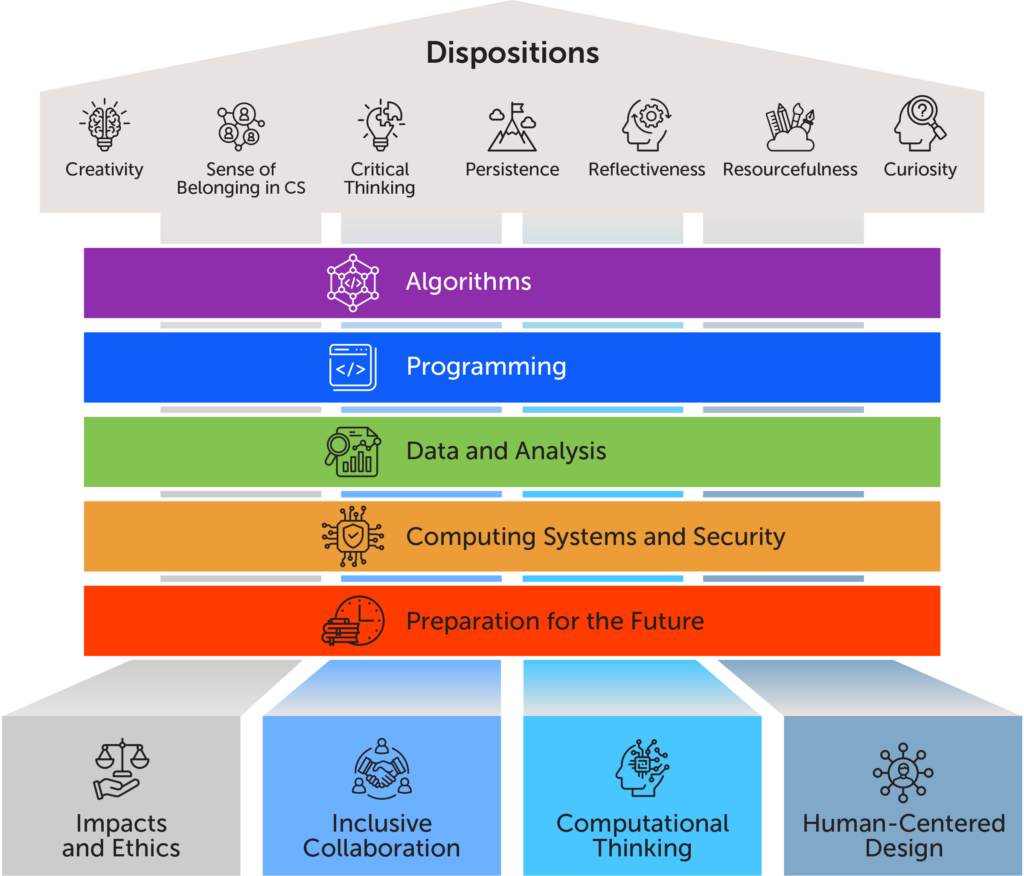
The foundation defines essential computer science learning outcomes for all high school students. Topics emerged through analysis of convening data and review of relevant research. Foundational content is organized into Topic Areas, Pillars, and Dispositions.
Learning Beyond the Foundation
There are many possible pathways stemming from this foundational content, ranging from cybersecurity and artificial intelligence to X + CS (where another subject, such as journalism or biology, is integrated with the study of computing). We defined content progressions for seven specialty areas, plus example course pathways that align to these progressions.
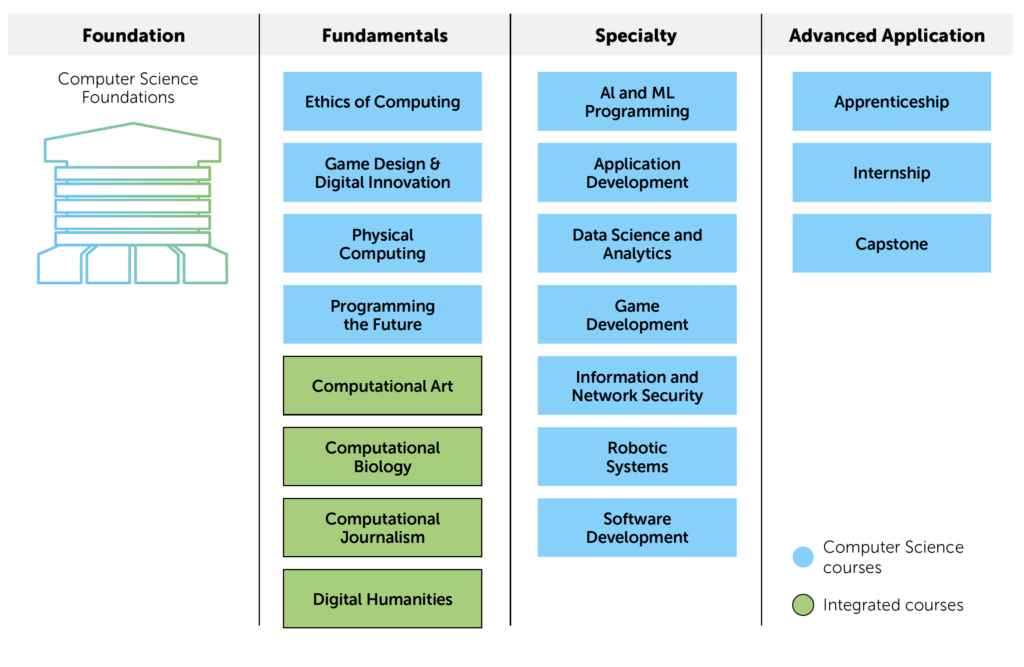
Guidance for Implementation
Implementation will vary significantly depending on community priorities and school contexts. Schools could teach the foundational content and resulting pathways in several, potentially complementary, ways, including offering discrete courses and integrating CS into other subject areas. We suggest schools develop multi-year plans to enable thoughtful implementation.

Integrating CS into Other Subject Areas
While there are some substantial challenges to integrating CS into other subject areas, there are also distinct advantages, including creating authentic learning opportunities and broadening the reach of CS instruction. We offer observations and examples about when and how CS content might meaningfully integrate into a variety of other subject areas.
Centering Equity
Access the Full Report

This project is supported by the National Science Foundation (NSF) under Grant No. 2311746. Any opinions, findings, and conclusions or recommendations expressed in this material are those of the author(s) and do not necessarily reflect the views of the NSF.