

|

|
| CARVIEW |
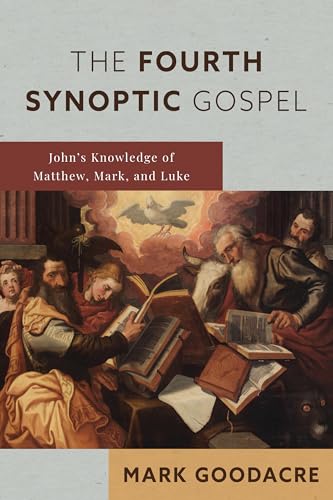
2026.01.01 | Mark Goodacre. The Fourth Synoptic Gospel: John’s Knowledge of Matthew, Mark, and Luke. Eerdmans, 2025. 191 pp. $29.99.
Goodacre advances a straightforward thesis: John’s Gospel was written with an awareness of the Synoptic Gospels. More specifically, Goodacre argues that the author of this Gospel “knew, used, presupposed, and transformed the Synoptics” (p. ix). For Goodacre, “the significant literary parallels between the Synoptic Gospels and John” represent good enough evidence to conclude that John was familiar with the final form of these texts. In other words, “the author of the Fourth Gospel did not use Synoptic-like traditions but the Synoptic Gospels themselves” (p. 17).
For most of Christian history, this would not have been a controversial claim. Early patristic testimony consistently viewed John’s Gospel as a culminating textual and theological witness. With the rise of the modern era, the intellectual and interpretive groundwork was laid that led to a decisive shift in the most commonly accepted view. Among other factors, the fascination with fluid oral traditions, the location of original audience in isolated communities, and the critical reconstruction of hypothetical sources used in the production of the Jesus tradition all contributed to the notion of a Johannine witness that was independent of the Synoptic Gospels. In recent years, of course, several of these methodological blocks at the bottom of the Jenga tower of formerly fixed consensus have been nudged out of place. The resulting tumble has opened up space in the scholarly guilds for new methodological configurations and fresh formulations of older paradigms.
In this scenario, Goodacre’s scholarship has helped establish a strong base upon which to build comparative and exegetical work on the New Testament Gospels. In The Case Against Q (2002), he argued that the “double tradition” material shared by Matthew and Luke is best explained by Luke’s direct use of Matthew (the Farrer Hypothesis), rather than a lost sayings source (“Q”). In Thomas and the Gospels (2012), he extended this logic to the Gospel of Thomas, arguing that its parallels to the Synoptics are the result of literary dependence rather than an independent, primitive oral stream. The present volume participates in this project by seeking to demonstrate that John’s working knowledge of the Synoptics is more plausible than alternative possibilities. Part of the throughline of these studies is a strong “skepticism about our ability, as scholars, to discover hypothetical sources, lost editions, and hidden layers, when that quest can lead us to miss extant sources that are right before our eyes” (p. x).
After surveying and complexifying the reasons usually given for John’s independence, Goodacre establishes and clarifies the nature of the connection between these literary texts. He begins by drawing parallels in overall literary structures, such as the pattern of a passion narrative with an extended introduction, which he sees as shared between John and Mark. He then moves to more granular levels of comparison, arguing that specific “redactional fingerprints” from Matthew and Luke can be detected in Johannine material, and that the Fourth Gospel presupposes Synoptic narratives that it does not recount in exactly the same way. Goodacre pays close attention to both agreements—such as verbal and structural echoes—and differences, interpreting the latter not as evidence of independence but as evidence that John transformed his sources, reshaping them for his own theological and narrative purposes.
In the latter part of the book, Goodacre explores what he sees as the implications of this synoptic familiarity. He discusses how John’s narrative strategies, including its use of direct speech and its dramatic reconfiguration of characters (notably the figure of the “beloved disciple”), interact with a readership presumed to know the Synoptic portraits of Jesus. He also examines Christological developments, showing how titles and themes common to the Synoptics are adapted in distinctive ways within John’s theological framework. By situating John within the same literary trajectory as the Synoptics, Goodacre presents the fourth gospel as a deliberate culmination to the existing written tradition.
The book concludes by suggesting that many features traditionally attributed to a unique Johannine community are actually better explained as the result of a single author’s sophisticated engagement with Mark, Matthew, and Luke. As Goodacre summarizes, “Although it is customary to make dramatic distinctions between the Synoptics and John, there are several ways in which John behaves like a fourth Synoptic Gospel” (p. 161). These ways are not uniform but span a wide range of compositional strategies: “from similar words and phrases, to parallel passages, to similar sequences of passages, to the structure of the whole gospel, and the work’s basic literary conceit—the story of a hidden Messiah who is properly understood only by insiders, and only retrospectively after the experience of the resurrection” (p. 161).
In the end, Goodacre’s proposal encourages readers to envision the Fourth Gospel as the product of careful reading rather than accidental convergence or exclusively independent development. That assumption, once granted, drains much of the force from approaches that rely on distance, isolation, or lost intermediaries. In light of the lean elegance of this thesis, many familiar explanations for Johannine uniqueness begin to look unnecessarily elaborate. The result is a portrait of John’s Gospel that is no less theologically ambitious, but far more textually grounded.
Ched Spellman
Cedarville University
cspellman [at] cedarville.edu

2025.08.04 | Christian A. Eberhart and Wolfgang Kraus, eds. Covenant—Concepts of Berit, Diatheke, and Testamentum. Wissenschaftliche Untersuchungen zum Neuen Testament 506. Tübingen: Mohr Siebeck, 2023.
Review by Levi Baker, William Tennent School of Theology.
Arising from a 2019 interdisciplinary conference at the Lanier Theological Library, this volume of twenty-eight essays explores various aspects of covenant across the social world and literature of the OT, NT, late antiquity, and beyond. The volume consists of an introduction and eight parts, and the editors promise to offer a “detailed, comprehensive, and thorough presentation of the tremendous range of covenantal concepts and their complexities in biblical and cognate literature throughout the ages” (p. 1).
After the editors’ introduction, Siegfried Kreuzer’s history of research essay begins the investigation. Kreuzer summarizes critical biblical texts and outlines scholarly trends on the origin of “covenant” in Israel, from the late 19thcentury to present day. He illustrates the impact the discovery of various ANE covenantal texts from Hittite, Neo-Assyrian, and Aramaic kingdoms had upon scholarly debates regarding the dating of OT covenantal texts, the emergence of the covenant idea, covenant’s place in OT theology. Significantly, Kreuzer disputes the common hypothesis that the notion of a national covenant between God and Israel was inspired by Assyrian “loyalty oaths” (p. 29), instead proposing a “development” out of 8th– and 7th-century prophecy (p. 34).
Poppy Tushingham’s treatment of Assyrian adê covenants naturally follows, the sole essay in the ANE section. After this essay, nine contributors examine the Hebrew and Greek Bible, exploring distinct corpora, editions, and translational matters. Thomas Hieke observes that the few words “syntactically associated with” the Torah’s eighty-two occurrences of ברית (“covenant”) also relate to Abraham throughout the Torah (p. 68), who Hieke concludes “prefigures the overall concept of covenant in the Torah” (p. 84). Then Richard Bautch investigates the covenant with Levi (appearing only in Mal 2:4, 8), relating its polemics to the diversity of “covenantal perspectives that emerge during the Persian period” (p. 89). In the next two essays, Karin Finsterbusch investigates differences among the “versions” of Jeremiah’s new covenant promise (LXX, Hebrew Vorlage, and MT) and the “literary editions” of Ezekiel and what these differences reveal about conceptions of covenant (pp. 109; 121). Next, Eberhard Bons surveys the covenant theme across the Psalter. Significantly, Bons notes the lack of clear references to the specific covenants from the Pentateuch (p. 161). After this, Manfred Oeming examines covenant in the Achaemenid period, giving special attention to the evidence from Nehemiah 8–10. Next, Bonifatia Gesche explores Sirach 44–50, the hymn called “praise of the ancestors” (p. 192). Significantly, she draws upon Jan Assman’s distinction between covenants of “loyalty” and “truth” to explain why the Mosaic covenant is omitted in the hymn (an instance of the former), yet the Noahic, Abrahamic, and Aaronic covenants are highlighted (p. 204). Macatangay explores nine works to highlight the diverse ways the concept of covenant was received in the Apocrypha. Specifically, these texts “reconceive the obligations and the divine promises in order to actualize them” in their present circumstances (p. 228). Finally, Martin Rösel concludes the third section by defending the Old Greek translators’ choice διαθήκη for ברית as “appropriate” since the term “accentuates the one-sidedness of God’s deeds for his people” (p. 243). Thus, he contests Ernst Kutsch’s influential alternate conclusion (cf. pp. 14, 505).
The fourth part of this volume considers Second Temple Judaism with four essays. The first two, written by Brent Strawn and Heinz-Josef Fabry, examine uses of ברית in sectarian and non-sectarian texts, respectively. Notably, when Fabry compares these two corpora, only in the former does the idea of a “special election of a community” develop (p. 304). [1] Then, in nuanced examination of Philo and Josephus, Gert Steyn helpfully outlines how and why these interpreters avoid or modify critical aspects of covenant emphasized in the Bible and their limited use of διαθήκη. Finally, in his exploration of covenant across the OT Pseudepigrapha, Matthias Henze asserts the idea of covenant “was widespread but not ubiquitous” (p. 336), and he delineates some key differences across the corpus.
Christian Eberhart’s wide-ranging essay begins the fifth section devoted to the NT. He examines the use of διαθήκη within the Synoptics’ words of institution, the OT passages evoked (especially Exod 24:3–8; Jer 31 [MT]/ Jer 38 [LXX]), the writers’ aims, and their differing “interpretive trajector[ies]” from these OT texts. (p. 414). Three subsequent essays consider NT epistles, with Florian Wilk, Jens Herzer, and Wolfgang Kraus offering treatments of the Corinthian correspondences, Galatians and Romans, and Hebrews, respectively. Significantly, Wilk concludes that although covenantal language is “rare” in these letters, the biblical concept of covenant can play a determinative role for Paul’s theology (p. 451).[2] Kraus offers a historically and exegetically informed treatment of the meaning of διαθήκη across Hebrews. Finally, Martin Karrer’s fascinating essay concludes the NT section. Drawing upon literary and manuscript evidence to explore the sole but climactic reference to covenant in Revelation, he asserts it functions as a “reminder” of Christianity’s Jewish “roots” and “the enduring relevance of God’s covenant” (p. 536).
The sixth and seventh sections treat covenant in the early church and late antiquity, respectively. Martin Meiser surveys early church writings (until approximately the fourth century), highlighting how earlier authors emphasized the “coherence” of the old and new covenants while later authors emphasized the “difference” (p. 541). In contrast, Tobias Nicklas considers the fragmentary evidence of early Christian apocryphal writings. He concludes that the notion of covenant “does not play a major role in many Greek and Latin Christian apocryphal writings”; in the few exceptions, the texts offer a “spectrum of voices” (p. 581). The remaining essays in the late antiquity section consider the covenant idea in Justin Martyr’s Dialogue with Trypho as well as the covenant theologies of Jerome and rabbinic literature. Interestingly, Sara Ronis observes that rabbinic covenant theology centered around the bodies of (circumcised) Jewish men and “the actions of their actual bodies” (p. 641). The volume’s final section includes two essays considering covenant’s place within the arts and modern systematic theology.
The editor achieved their stated aim, and several notable strengths contribute to this volume’s success. First, the work represents the fruit of extensive planning, expertise, and diligent work—both by the editors and the contributors. Notably, the conference was first imagined in 2012, and post-conference further articles were added afterwards to fill gaps in treatment (p. iv). The volume covers most conceivable aspects of the covenant idea that one would hope to find, and the individual essays are the product of rigorous scholarship and include robust bibliographies. Second, most of these international scholars (with three continents represented) are leading experts in their field, having published widely on related topics. Third, the contributors draw upon multiple disciplines to consider numerous aspects related to covenant including etymology, lexical-semantic meaning, manuscript evidence, translational issues, the social world of ancient covenants, the aims and contours of the varied literature discussing covenants, and the history of interpretation.
However, most of the OT and Greek Bible contributors appear to assume that OT covenantal texts are later than their traditional date—a safe assumption within mainstream OT scholarship. Yet several contributors also apparently assume that Assyrian loyalty oaths and/or the 7th-century BCE reflects the critical period of emergence for the notion of a covenant between God and Israel. While this might be the mainstream position, there are solid defenses of earlier dates for the covenant’s origin and key biblical covenantal texts.[3] This assumed consensus likely shaped the decision to include only a single essay on Assyrian treaties in the ANE section even though Siegfried Kreuzer’s impressive inaugural essay considering the origins of the covenant idea highlights several ANE covenants that predate the Assyrian loyalty oaths by centuries and repeatedly draws attention to how OT scholarship has dated and redated OT covenantal texts by comparing them to these very ANE covenants. Thus, the emergence of covenant in Israel and the dates of the OT covenantal texts addressed in this volume are connected, foundational concerns. Given this reality, it is surprising that the ANE section and entire volume, respectively, contain no essays devoted to Hittite suzerain-vassal treaties or alternate theories regarding the influence of other ANE covenants for the origins of covenant in Israel.
Despite this omission, the editors and contributors still succeeded in producing an outstanding work of scholarship that fills a lacuna. Indeed biblical and theological scholars owe a debt of gratitude to Drs. Eberhart and Kraus, Mohr Siebeck, and the contributors. The volume’s primary audience is fellow scholars, and even seasoned researchers will find it instructive. This book should also be required reading for advanced graduate and postgraduate students in biblical and theological studies.
Levi Baker
William Tennent School of Theology
Lbaker[at]williamtennent.org
[1] “einer besonderen Erwählung der Gemeinde” (my translation; p. 304).
[2] See Wilk’s assessment: “So rar die Verwendung der biblischen Bundesterminologie in ihnen ist, so grundlegend ist die paulinische Theologie hier jeweils vom biblischen Bundeskonzept bestimmt” (p. 451).
[3] Kenneth A. Kitchen and Paul J. N. Lawrence, Treaty, Law and Covenant in the Ancient Near East, 3 vols. (Wiesbaden: Harrassowitz Verlag, 2012), esp. 3:117–213, 259–61. See also the debate between Joshua Berman, Bernard Levison, and Jeffrey Stackert regarding Hittite and Assyrian treaties and Deuteronomy in JBL and JAJ.
]]>
2025.01.03 | Todd D. Still and David E. Wilhite. The Apologists and Paul. Pauline and Patristic Scholars in Debate. London: T&T Clark, 2024. Pp. xiv + 346. ISBN: 9780567715456.
Review by Jonathon Lookadoo, Presbyterian University and Theological Seminary, Seoul, Republic of Korea
Many thanks to T&T Clark for providing a review copy.
The Apologists and Paul provides a wide-ranging analysis of how Paul’s letters were employed by that loosely defined group of early Christian writers known as the apologists. This volume is the fourth in the series, Pauline and Patristic Scholars in Debate, all of which have been co-edited by Todd Still and David Wilhite. Earlier compilations took up the use of Paul by Tertullian (2013), the Apostolic Fathers (2017), and Irenaeus (2020). While the volumes have not appeared in the same chronological order as the early Christian authors and texts that they study, the respective contributions to the series are characterized by far-reaching coverage of the respective figures in the titles (the Apostolic Fathers, Irenaeus, and Tertullian) as well as depth in the probative explorations of how Paul was utilized by his later interpreters. The most recent book is no exception. Although the composition of some essays was delayed due to restrictions during the COVID-19 pandemic, the resulting collection is marked by breadth in its discussion of the apologists as well as depth in its attention to the details of how Paul was employed. Along the way, several essays shed light on many pre-requisites that must be understood to appreciate each respective apologist.
Before launching haphazardly into the volume, however, Wilhite offers a substantive introduction that considers several topics with direct bearing on the chapters that follow. These include the challenges of adequately defining how the usage or influence of one author on another might be determined, on the need for such a volume in the face of the recent explosive interest in the reception of Paul, and the difficult matter of identifying what an apology is. The last issue is of particular importance for this volume, since the way in which one answers it enables contributors to place boundaries upon their work and readers to clarify their expectation. Wilhite argues that an apology “is not a literary genre per se, but it is a literary strategy” (p. 5). This literary strategy was employed to defend early Christians from accusations made by those outside the movement. Among the chief charges evident in ante-Nicene apologies were accusations of atheism as well as illicit activity. The scope of the volume is limited to those apologists who flourished prior to the Nicene period. These parameters are key to evaluating the contributions that follow.
Paul Foster opens discussions of the apologists with his careful study of the Pauline writings in Aristides’s Apology. Foster concludes that Aristides knew at least Romans and Colossians while his literary dependence on 1 Thessalonians and Hebrews cannot be established. Susan Wendel explores Justin’s reading of Gen 15:6 in dialogue with Paul. Wendel notes that Justin follows Paul by arguing that Christians are justified by the same faith as Abraham and by locating this declaration before Abraham’s circumcision. She notes, however, that Justin draws a closer relationship between faith and the righteous actions of Christ-believers than Paul. Jennifer Strawbridge considers the challenges of determining Pauline references in Tatian’s Oratio ad Graecos, observing that, if Tatian uses Pauline texts, he integrates them into his arguments seamlessly. Tatian may also have drawn from texts or elements of Paul’s biography that related to Tatian’s own theology and self-understanding. After a fascinating discussion of the authorship of (Pseudo-)Athenagoras’s Legatio and De Resurrectione, David Rankin suggests that the respective works were composed by different authors. While both works likely allude to Paul’s letters, Rankin also notes Paul’s invisibility because the allusions are integrated into Athenagoras’s larger work. Alistair Stewart takes up the work of Jewish-Christian apologists—highlighting here Melito, Aristo, and Hegesippus. By Jewish-Christian, Stewart means that each was ethnically Jewish and a Christ-follower. Although there is no evidence for Pauline usage in the remains of their apologies, Stewart rejects a hostility hypothesis, while leaving open the possibility that they were either ignorant of or indifferent to Paul. Stuart Parsons provides a clear-sighted discussion of how references to Paul should be sought within Theophilus’s Ad Autolycum, paying particular attention to the work’s apologetic nature. He then finds allusions to several letters within this protreptic text.
Moving from the second century into apologists who lived into the third century, Piotr Ashwin-Siejkowski explores Clement of Alexandria’s use of both Paul’s letters and his apostolic authority, noting points of overlap between Clement, Irenaeus, and Tertullian. Benjamin Haupt focuses on Tertullian’s Apology and examines the variety of ways that Tertullian cites Paul. Haupt concludes with a detailed look at the Latin terms that Tertullian used to designate Paul’s letters. Paul Hartog evaluates Minucius Felix’s critique of eloquence in dialogue with 1 Corinthians 1–2. Hartog illustrates clearly how both downplay rhetorical manipulation but rightly distinguishes Paul’s greater emphasis on the cross from Minucius Felix’s interest in philosophy and critical thinking. Turning to the complicated figure of Hippolytus, Wally Cirafesi reviews the use of Paul in De Antichristo. Cirafesi notes how Paul’s letters provide Hippolytus with a model for moral instruction and apocalyptic eschatology before making the intriguing proposal that Hippolytus depicts Paul as a prophet. James Papandrea examines Novatian’s exegesis of Philippians 2:6–11, arguing that Novatian elevated this Pauline text a central role in future christological debates by reflecting carefully on kenosis Christology. Writing at roughly the same time as Novatian, Dionysius of Alexandria cites Paul with varying levels of specificity. Lincoln Blumell argues that Dionysius also used Paul as an epistolary model as he wrote his letters so that the person of Paul proved important to the Alexandrian bishop in addition to Paul’s letters.
Moving west to Carthage, Edwina Murphy offers a multifaceted study of how Cyprian demonstrates his reception of Paul. While exegesis with attention to the context of Paul’s letters can be found in Cyprian’s work, Cyprian more often follows Paul by viewing Christ as a model, deploying similar imagery, and applying language from Paul’s letters directly to his audiences, to connect third-century North Africa to the first-century apostle. Michael Bland Simmons contributes a detailed sketch of Pauline reception in the works of Arnobius of Sicca and Lactantius. Although Arnobius’s knowledge of scriptural texts appears comparatively limited, perhaps due to a relatively recent conversion, Lactantius’s acquaintance of scripture is extensive. In particular, his citations of Paul’s letters indicate a familiarity that extends beyond awareness of Cyprian’s Testimonia alone. Elizabeth DePalma Digeser provides the final essay focused on a specific apologist and demonstrates Paul’s influence on how Methodius described believers’ preparation to unite with God as well as what the nature of such experience will be like. Todd Still helpfully draws the volume to a close by bringing the study of Paul in second and third century apologies to bear on the Apostle himself. Still acknowledges differences between Paul’s aims and opponents over and against the later aims and opponents of the figures addressed in the volume. Nevertheless, in light of the accusations leveled against Paul and some of the communities that he addressed, Still maintains that Paul was an apologist for his gospel and may thus be seen as part and parcel of the apologetic strain that crisscrosses ante-Nicene literature.
This volume provides a distinctive scholarly resource among recent of studies of Paul’s reception in earliest Christian texts. Although studies of how scripture, in general, or Paul, in particular, may be used by certain apologists, it is difficult to think of a comparable work on Pauline reception among the apologists as a group. Alongside this important contribution, a strength of the volume is its awareness of the blurred lines of both what constitutes an apologist and what qualifies as Pauline reception. Wilhite’s introduction heads off some potential objections about missing studies by acknowledging the omission of Irenaeus and Origen, who were or will be explored in separate volumes within the series, as well as Eusebius, who flourished as a writer during the fourth century and thus postdates the temporal constraints of this volume. While many writers were more than apologists (e.g. Melito, Clement, Novation), all have legitimate claim to be included in this volume. Nevertheless, the awareness of editors and contributors of the blurry boundaries surrounding the term apologist allow contributors to explore cautiously and in multiple ways how best to study Paul’s impact on the respective apologists.
In such explorations, the volume bears witness to another notable phenomenon in the field of Pauline reception studies, namely, the diversification of methods that are employed to study reception. Some essays in this volume rely primarily on quotations, allusions, or other forms of reference by which a later author might cite Paul. Other essays roam further afield by considering, for example, how an epistolary format may itself demonstrate a debt to Paul or how shared metaphors between Paul and an apologist may indicate the latter’s usage of Paul. Of course, the method that a scholar selects will be determined in part by the fittingness of the method to the subject matter. Since apologies are ostensibly written to outsiders, the contributors to the volume must account for the effects of this implied audience when selecting their methodology. Yet the appearance of multiple methodologies in the same volume suggests that the field of Pauline reception studies has grown large enough that at least two things are now true. First, anyone writing on Pauline reception should be attentive to the implications of their methodological choices. Second, the field of reception studies is sufficiently large to house multiple methodologies under its roof or, in this case, within the covers of the same book. The use of alternative methods then allows for diverse perspectives regarding how authors may have employed, altered, or ignored their literary predecessors in early Christianity.
Given the up-to-date discussions of both Pauline reception and the respective apologists explored here, The Apologists and Paul is a must-have resource for libraries catering to scholars and postgraduate students engaged in the study of early Christianity. A comparable combination of detailed studies with a wide-ranging breadth of coverage specifically dedicated to the apologists is difficult to find in the many other excellent works on Pauline reception in ante-Nicene Christianity. The Apologists and Paul thus joins the other volumes in the series in making a valuable contribution to both New Testament Studies and Patristics, disciplines which are too often kept isolated from one another.
Jonathon Lookadoo
Presbyterian University and Theological Seminary
jonathon.lookadoo [at] puts.ac.kr

2025.01.02 | Thea Gomelauri (with a contribution by Joseph Ginsberg). The Lailashi Codex: The Crown of Georgian Jewry (Oxford, UK: Taylor Institution Library, 2023).
Review by Teófilo Correa, Adventist International Institute of Advance Studies (AIIAS)
The Lailashi Codex is an ancient Hebrew manuscript, considered the earliest nearly complete surviving medieval version of the Pentateuch (Ori Z. Soltes’ foreword). In light of its historical significance, Gomelauri offers a pioneering scholarly examination of the Lailashi Codex’s complex historical trajectory. The research chronicles the manuscript’s journey from a Jewish settlement in Svaneti, at the foot of the Caucasus Mountains, followed by its relocation to Lailashi village, and subsequent custodianship within the local Jewish community. The study further documents the codex’s requisition during the Soviet era and its ultimate repository at the National Centre of Manuscripts.
In her analysis, Gomelauri elucidates the Lailashi Codex’s multifaceted importance, demonstrating its value beyond its liturgical function as a testament to the historical interconnection of Georgian and Jewish cultural traditions. The publication also reveals a notable finding in manuscript studies: identifying formerly missing folios of the Lailashi Codex by Joseph Ginsberg, currently preserved in the National Library of Israel collections.
It is noteworthy that the Lailashi Codex is an early, complete Masoretic Pentateuch manuscript featuring Tiberian vocalization, Masora Magna, and Masora Parva. Additionally, the manuscript is distinguished by its intricate ornamentation and illustrative micrography. Thus, Gomelauri’s work represents a long-awaited contribution to Jewish scholarly research.
The book consists of two parts. Part I – Historical narrative covers the history of the codex during the last three centuries. It reveals the vicissitudes suffered under communist rule, and the miraculous survival of the codex. Part II describes the manuscript’s textual and para-textual details and offers a comparative analysis with other early biblical codices.
The initial two chapters of Part I provide a comprehensive examination of Jewish settlement patterns in Lailashi, a remote community situated in the Caucasian mountains. The text meticulously documents the village’s demographic composition, examining its diverse ethnic constituencies, their historical origins, and patterns of intercultural relations. The author presents a novel scholarly analysis of previously unexamined archival materials. Of particular significance is the detailed documentation of Joseph Judah Chorny’s expedition to Lailashi, including his observations upon examining the manuscript and his impression on the socio-cultural and religious practices of the local Jewish population. Chorny’s critical assessment reflects the underlying tensions between the scholar and his hosts, who demonstrated a marked reluctance to relinquish custody of their valued manuscript.
Chapter 3 examines the socio-political dynamics of Soviet governance and anti-religious ideological frameworks that precipitated the Lailashi Codex’s confiscation. The analysis traces the manuscript’s subsequent transfers through various custodians, notably documenting instances where caretakers demonstrated unfamiliarity with Hebrew script conventions.
Chapters 4 and 5 delve into a fascinating story about rescuing the greatest Georgian historical and cultural treasure – the fresco of the Georgian National Poet Shota Rustaveli, which was preserved in the Georgian Monastery of Cross in Jerusalem. The research confirmed the Lailashi Codex’s crucial function in the successful completion of the Georgian mission after negotiations between the Georgian delegation and the Greek Patriarchate of Jerusalem broke down. The chapter includes the analysis of Giorgi Tsereteli’s scholarship-a member of the above-mentioned Georgian delegation. Through meticulous documentary analysis, the author identifies substantial methodological deficiencies in Tsereteli’s research. In response, Gomelauri reconstructs the codex’s historical trajectory and further challenges attempts to remake it.
Chapter 6 narrates the history of rescuing the Lailashi Codex from criminals who wanted to smuggle it out of the country. Chapter 7 examines the diplomatic tensions that emerged following the abrupt termination of planned United States exhibitions at the dawn of the second millennium. These exhibitions were intended to present the Lailashi Codex, alongside other significant Georgian cultural artifacts, to Western scholarly and public audiences.
Chapters 8, 9, and 10 trace the predicament of the manuscript in a post-Soviet era, including the unfulfilled Presidential decree about the restitution of Jewish artifacts plundered by the Soviet government. The author documents the public tensions surrounding the manuscript, highlighting the current custodian’s efforts to retain possession of it, often at the expense of its rightful owners.
Part I concludes with biographical notes on the Lailashi Rabbis and explores the enigmatic provenance of the Codex. Gomelauri challenges prevailing assumptions regarding the Sephardic origins of the manuscript and addresses the myths surrounding the codex’s previous name. However, she refrains from drawing definitive conclusions until the completion of a comprehensive study.
The historical section includes a contribution by Joseph Ginsberg, who identified three leaves of the Lailashi Codex housed in the National Library of Israel in Jerusalem, cataloged as Ms. Heb. 4°5941.
In part II, the book provides a detailed examination of textual and para-textual components of the codex.
Chapters 1 and 2 offer extensive palaeographical and codicological insights. The Lailashi Codex is compared with the Aleppo and Leningrad codices, as well as BL Or. 4445, enabling readers to understand the manuscript’s dimensions and volume (p. 97). Additionally, it provides a detailed list of the missing leaves.
Chapter 3 addresses the problematic issue of the codex’s foliation and its discrepancies with Tsereteli’s records. The graphic illustrating the manuscript’s composition, with color-coded indicators, provides the most effective representation of its current condition (p. 104). Chapter 4 examines the paratextual elements, such as mid-point markers for each book and the whole Torah text. The author analyses these unique features vis-à-vis Talmudic stipulations and Masoretic traditions.
Chapter 5 details the codex’s proofreading history, derived from meticulous analyses of the notations under weekly Torah reading portions. Gomelauri traces the collaboration between two scribes across 172 leaves, identified by their unique ‘signatures,’ and provides a comprehensive account of the order and sequence of their joint proofreading. The chapter includes a table listing all weekly Torah portions with their scriptural references, corresponding folios, number of verses, notations, and comments.
Chapters 6 and 7 present mnemonic phrases and vertical inscriptions found on the margins of two leaves. Gomelauri examines the atypical spellings of these mnemonic terms, providing a detailed list and transcription. She proposes that the vertical inscriptions on the manuscript margins require further investigation.
Chapters 8, 9, and 10 explore the manuscript’s unique features, ranging from orthographic peculiarities to Puncta Extraordinaria and micrographic images. The author catalogs 50 different spellings in the Lailashi Codex compared to the Leningrad Codex (p. 142). Additionally, ten words from Genesis to Deuteronomy with ‘extraordinary points’ are compared with their counterparts in Masorah Magna, with noted discrepancies. Chapter 10 displays beautiful micrographic images and reviews various patterns employed by the Lailashi scribes.
Chapter 11 highlights a visual presentation of the codex’s poetic passages, particularly the Song of the Sea. When compared to the Lenignradensis, the Lailashi Codex demonstrates superior scribal skills. Chapter 12 is particularly valuable for future research, offering a comprehensive index of scriptural texts with detailed folio information, including the missing passages. This section serves as an essential resource for any scholar pursuing further study.
The concluding chapter of Part II provides Joseph Ginsberg’s description of the newly identified leaves in the National Library of Israel, along with a detailed analysis of their contents, including an examination of the Song of Moses.
The book features maps that highlight key locations associated with the Lailashi Codex, along with detailed imagery of micrography, complete manuscript pages, and other illustrations prepared for an exhibition celebrating the publication of this exceptional manuscript.
Gomelauri’s book enhances our comprehension of the Lailashi Codex. It offers a captivating historical narrative, uncovers the latest information about its missing sections, and situates the manuscript within its wider cultural and religious framework. By illuminating the Codex’s tumultuous history, the book ensures that this priceless piece of Georgian-Jewish heritage is acknowledged and valued by future generations.
Building on its historical insights, the present edition significantly expands our understanding of early biblical codices and scribal traditions. It lays a solid foundation for further research in several key areas, including Jewish manuscript production, Masoretic textual transmission, the role of illuminated manuscripts in medieval scholarship, and the material culture of Georgian Jewry. This work will prove to be an invaluable resource for scholars in Jewish Studies, Masoretic Studies, Medieval History, Manuscript Studies, and related fields, offering new avenues for exploration and scholarly inquiry.
Professor Teófilo Correa
Chair of the Department of Biblical Studies
Adventist International Institute of Advance Studies (AIIAS)
ORCID 0000-0003-2954-7846
tcorrea [at] aiias.edu

2025.01.01 | Dragos Andrei Giulea. Antioch, Nicaea, and the Synthesis of Constantinople: Revisiting Trajectories in the Fourth-Century Christological Debates. Studies in the History of Christian Traditions, 200. Brill, 2024. 309 pp.
Review by Ched Spellman, Cedarville University.
In this monograph, Dragoș Andrei Giulea undertakes an ambitious revisioning of the intellectual landscape of the fourth-century theological debates. Challenging traditional narratives and building on recent scholarship, Giulea maps the complex interplay of ideas that shaped this pivotal era in Christian thought. By positioning the Council of Constantinople (381 CE) as a culmination of earlier theological paradigms—specifically those emerging from Antioch (268 CE) and Nicaea (325 CE), Giulea offers a fresh perspective on the development of Trinitarian and Christological doctrines.
A key strength of Giulea’s work is its methodological precision. Giulea clarifies and shows the value of consistently employing careful definitions of notions like “theological grammar” and intellectual “trajectory.” Traditional analysis focused almost exclusively on theological claims as a way to navigate the teeming labyrinth of third and fourth century debates. Giulea builds on and sharpens recent research that accounts for a broader array of philosophical and social factors. In particular, Giulea focuses on specific technical terms, the patterns of usage among certain groups, and the metaphysical commitments that are embedded in a given pattern of use (i.e., a “grammar”).
In this historiographical paradigm, a trajectory names “those doctrinal visions belonging either to individual authors or to specific councils sharing a theological grammar with a common understanding of its basic concepts” (p. 7). The tenets of faith in a trajectory “secure continuity within the Christian tradition,” while the metaphysical concepts “function as regulators of logical consistency and linguistic and metaphysical novelty” (pp. 7; see also 172–74; 270–82). Significantly, trajectories are not “static theoretical systems.” Rather, they “evolve toward a more internal coherence by clarifying their metaphysical concept and integrating them within a specific theological vision” (pp. 7; 13–19). Each of these components of a trajectory are important for the modified map that Giulea draws of the fourth century theological landscape.
Following from this method, Giulea identifies five key streams of thought in the third and fourth centuries that represent genuine trajectories with a consistent theological grammar: Antiochene, Arian, Nicene, Homoian, and pro-Nicene. Against the current consensus, Giulea argues that the broad category of “Eusebian” is insufficient to characterize the theological diversity of the major non-Nicene position before and after the council at Nicaea (so too “Origenism”). Instead, Giulea prefers to identify this trajectory as “Antiochene” because its central terms were formally articulated at the council of Antioch in 268 CE. At Antioch, theologians affirmed the use of the term hypostasis understood as an individual substance (distinguishing themselves from the Nicene position) but also rejected the notion that the Son was a created being (distinguishing themselves from the Arian position).
In the Antiochene trajectory, then, there were a variety of theological positions and formulations (e.g., relating to the nature of the subordination of the Son and the degrees of his “likeness” to the Father). Giulea thus includes theologians like Eusebius, the council at Antioch, and the later Homoiousians in the stream that consistently affirms the theological tenets and metaphysical vocabulary that was articulated at Antioch.
Giulea also sees the Arian trajectory as a coherent stream of thought rather than a catchall term for any opponent of Nicaea or a line of thinking limited only to Arius himself (pp. 70–78.). The distinctive Arian claim relates to a single “first principle” (identified exclusively with the Father) and the nature of the Son’s creaturehood (which invariably denies his deity). This position applies to Arius but also to later fourth century theologians like Aetius and Eunomius. Arian or neo-Arian teaching, then, maintains a position that represents the opposite pole of the Nicene position toward both the beginning and end of the fourth century (pp. 89–106).
Before Constantinople in 381, there was also a conciliatory attempt by Emperor Constantius to mandate reproachment and consolidation between the various non-Nicene groups. This “homoian” position affirmed a general “likeness” between the Father and the Son but intentionally omitted any use of the critical but contested terms ousia and hypostasis (which were synonymous for the Nicene position and distinguished in the Antiochene view). Giulea characterizes this position as coherent but ultimately unsuccessful because of the theological and philosophical ambiguity incidentally introduced by omission of the debated terms (pp. 128–32).
These historical observations inform Giulea’s central concluding argument that the pro-Nicene consensus achieved at Constantinople in 381 was not merely an internal development within the Nicene trajectory or a simple re-affirmation of the Nicene creed but more fundamentally a thoughtful synthesis of the most effective metaphysical elements of the Antiochene and Nicene trajectories.
In this vein, Giulea champions Basil of Caesarea as the first theologian to recognize the strengths and weaknesses of both the Nicene and Antiochene ways of using the key terms ousia and hypostatis. Giulea first argues for the authenticity of Basil’s contested early correspondence with Apollinarius of Laodicea. Though viewed by most scholars as spurious (partly because of its use of Antiochene terminology), Giulea views this correspondence as exploratory for Basil and in line with the early phase of the gradual maturing of Basil’s theological thinking (pp. 187–204). In his writing and correspondence across his earlier and later ministry, Basil gradually discerned and combined the most valuable insights from Antioch and Nicaea.
In the progression of Basil’s thought, Giulea suggests, one can see the underlying dynamic of the eventual pro-Nicene position that emerges among the Cappadocians. The Nicene formulation viewed ousia as a common divine substance that is shared by the divine persons (and used it interchangeably with hypostasis). This was able to rule out the Arian subordination of the Son, but it was not quite able to secure the distinctions among the Father, Son, and Spirit. The Antiochene formulation viewed hypostasis as an individual substance. This was able to rule out Sabellian modalism, but it was not quite able to secure the co-equality of the divine persons.
By synthesizing these two metaphysical terms/concepts, Basil is able to articulate a theological grammar that marks the pro-Nicene position and becomes the general consensus of the churches. In the ensuing ecclesial discussions, the new theological idiom of one common ousia in three distinct hypostaseis will become an established formulation that gains increasing assent. Although Basil was not the first one to achieve this formulation (likely a benchmark of the Meletians), he was “the one who had the intuition of its metaphysical efficacy and articulated a metaphysical and theological synthesis of the two grammars” (p. 270).
Because of the wide-ranging and ambitious scope of Giulea’s study, there are several areas where specialists in the field will object to his newly fashioned formulations (e.g., his arguments about the viability of specific categories or his take on the authenticity of certain writings). However, this volume resonates with recent historiography of this period in prioritizing primary sources, employing nuanced interpretive categories, and maintaining measured conclusions. For these reasons, Giulea’s work merits careful consideration from scholars and students of this theologically formative historical period.
Ched Spellman
Cedarville University
cspellman [at] cedarville.edu
2024.10.07 | Ryan D. Collman. The Apostle to the Foreskin: Circumcision in the Letters of Paul. BZNW 259. Berlin: de Gruyter, 2023.
Review article by Paul T. Sloan, Houston Christian University.
“Foreskin” stretches across Paul’s letters as a part of various discourses concerning proper Law-keeping and the relation of Jews and gentiles to one another, to Abraham, and to God. The topic of circumcision naturally cuts across the same arguments. Often scholars only survey the tip of the iceberg when it comes to these topics, but Ryan Collman has provided a detailed study on the related passages. While Pauline scholars have routinely claimed that Paul “redefined” or “spiritualized” circumcision such that physical circumcision of Jews is made “redundant and obsolete” (p. 6) and that “the circumcision” as a usual metonymy for Jews is instead employed by Paul to refer to the Jew/gentile Christian community, Collman argues that Paul “held none of these views about circumcision” (p. 6). Instead, Paul “upholds the practice and value of circumcision for Jews. He does not redefine it, replace it, declare its irrelevance, or expand its application to non-Jews – metaphorically or otherwise” (p. 6). Collman’s work has much to commend it, and I find much of it persuasive, including, significantly, his overall thesis regarding Paul’s upholding of the practice of circumcision for Jews and the notion that Paul does not redefine it, replace it, or apply it to non-Jews. Disagreements, especially on matters as complex as Paul’s letters, are of course inevitable, though I am eager to clarify that any enumerated below are offered in overall appreciation of Collman’s well-argued and important thesis, which deserves a wide readership.
In Chapter One, “Introduction: Paul: A Circumcised Apostle,” Collman situates his own reading within the “Paul within Judaism” (hereafter, PWJ) school (p. 9), taking as axiomatic that Paul is the apostle to the nations, which entails for Collman that his letters ought to be interpreted as addressed to “foreskinned non-Jews” (p. 6). Participating in a common PWJ approach to Paul’s letters, Collman states, “It is within this eschatological context [the turn of non-Jews to worship Israel’s god] that Paul receives his call to the nations, to call them to worship the god of Israel through his Messiah Jesus. But in this call and mission he is adamant that they remain the ethnic other – that they remain distinct from Jews (Rom 11:13–24)” (p. 10).[i] After surveying various approaches to circumcision in Paul’s letters, Collman appreciatively summarizes two monographs by Matthew Thiessen, Contesting Conversion and Paul and the Gentile Problem.[ii] In the latter, Thiessen builds on his conclusions in Contesting Conversions and contextualizes Paul’s discourse within them. Collman summarizes Thiessen’s conclusions, saying, “Paul’s main opposition to gentiles in his assemblies undergoing circumcisions is threefold: 1) it is not valid for non-Jews, 2) it would not be performed with the proper timing (eight days after birth), and 3) it is not an effective means for making one into Abraham’s seed” (p. 15). As the chapters on Galatians and Romans show, Collman builds on Thiessen’s conclusions in arguing that Paul forbids gentile circumcision due to their status as gentiles and their incapacity to keep the temporal component of the circumcision law.
In Chapter 2, “Keeping the Commandments of God: Circumcision in 1 Corinthians,” focusing especially on 1 Corinthians 7:17–20, Collman argues that in these verses
Paul uses circumcision and foreskin metonymically to refer to Jews and non-Jews respectively. Given that Paul’s rule is about how those in the assemblies are to live (περιπατέω), I argue that the commandments of God for Jews and non-Jews are different. Jewish followers of Jesus are to continue to observe Torah and non-Jewish followers are to observe the commandments relevant to them (cf. Acts 15) (p. 23).
Paul’s claim that “circumcision is nothing, and foreskin is nothing” (1 Cor 7:19) ought not be interpreted as indicating that such realities are adiaphora; otherwise, Paul’s argument that gentiles ought not circumcise becomes unintelligible (p. 41). Rather, after comparing comparable “negations” in Paul’s letters (1 Cor 3:5–7; 2 Cor 12:11; p. 38), Collman argues that Paul’s “negation” of circumcision and foreskin is a rhetorical device employing hyperbole to direct the attention to what matters (more): keeping the commandments of God (pp. 40–41).
The notion that Paul is not absolutely negating circumcision/foreskin is well-argued, and the supposition that “the commandments of God” denotes “the Jewish Law” seems the most plausible, as does the view that Law differently obligates Jews and gentiles. I remain unconvinced, however, that “circumcision” and “foreskin” in 1 Cor 7:18–19 “should be understood metonymically. . . .to refer to Jews and non-Jews respectively” (p. 27), at least as Collman construes the matter. It is just as plausible that Paul is referring to gentiles who had received circumcision prior to their “calling” – the divine “call” to trust in the Messiah – in which case “circumcision” need not refer to the state of one’s penis as indicative of their native-born Jewishness (p. 28), but instead differentiates between those who were circumcised prior to their calling (whether Jewish or gentile) and those who were not. For support, one could appeal to the potential confusion a gentile-in-Christ might experience upon hearing Paul’s insistence that gentiles ought not circumcise. One already circumcised might think he needs to perform epispasm. The Corinthian correspondence provides abundant evidence for misunderstandings of Paul’s instructions/preaching that he needs to clarify (e.g., 1 Cor 5:9–11; 6:12–13; 15:12–34), and his instruction regarding gentile circumcision could be one such case. Additionally, 1 Corinthians deals often with matters of Law-observance for a seemingly exclusively gentile audience (e.g., 1 Cor 8–10). 1 Corinthians 7 may do the same.[iii]Finally, given that Collman operates on a PWJ supposition that Paul is typically addressing exclusively gentiles, wouldn’t the audience hear this “rule” with reference to gentiles who had received circumcision prior to their “calling”?
Significantly, if he is addressing circumcised gentiles here, three points are worth exploring. First, his negation of circumcision and foreskin relative to “keeping the commandments of God” may function differently than Collman proposes. That is, the reason Paul can contradistinguish “keeping the commandments” to circumcision/foreskin is not because he is hyperbolically relativizing one with respect to the other, but because circumcising is not a commandment required of gentiles. It is a commandment addressed to the genealogical descendants of Abraham and slaves born in their house or purchased from one not among their descendants (Gen 17:12–13). But circumcising is optional for gentiles and doing so, for example, permits them to eat the Passover (Exod 12:48). Because of the non-obligatory status of circumcision for gentiles, Paul can claim that their foreskin/circumcision is “nothing” relative to keeping the commandments of God that do obligate them.
Second, relatedly, if Paul is referring to commandments that differently obligate the circumcised (Jew or gentile) and the foreskinned (gentiles), it suggests that Paul considers gentiles circumcised prior to their “call” as obligated to the whole Law by virtue of their circumcision (cp. Gal 5:3). In this case, Collman’s supposition that “keeping the commandments of God” refers to the Jewish Law and the fact that it obligates various parties differently may be maintained; however, if so, then, third, Paul evidently considers circumcision of gentiles as having judaized them. But if this point is correct, Collman’s treatment of the basis for prohibition of gentile-circumcision in Galatians and Romans – that they cannot keep the temporal component of the Law – ought to be reconsidered. It is not that gentiles cannot successfully judaize; rather, as Genevive Dibley notes, “adult gentile circumcision worked all too well in making gentiles Jews.”[iv] They ought not judaize, however, because that would compromise the promise to Abraham that he would be the father of many nations (Gal 3:8; Rom 4:9–17).
In Chapter 3, “Do You Not Hear the Law? Circumcision in Galatians,” Collman addresses the circumcision crisis in Galatians. This chapter spans seventy-seven pages and offers many compelling interpretations of various complex passages, thus not every argument can be addressed. Turning to his interpretation of the Hagar/Sarah allegory of Gal 4:21–31, he states, “exploring circumcision in the Genesis narrative adds another interpretive layer to Paul’s allegorical reading and his opposition toward Galatian adoption of circumcision” (p. 69). Attending to Genesis, and building on the work of Matthew Thiessen,[v] Collman argues that the only valid, covenantal circumcision is that performed on the eighth day (pp. 69–71). He appeals to Jubilees 15:14, 25–26 as a witness to this view (pp. 69–71), with which, Collman argues, Paul’s reasoning may align (p. 74). On this reading, Paul forbids circumcision because these Galatians are non-Jews and cannot complete the temporal component of the circumcision law (p. 74); were they to circumcise, they would simply become “sons that follow after Ishmael” (p. 74) and “enslaved sons like Ishmael who have no inheritance” (p. 75).
While I agree with some of Collman’s affirmations (e.g., his treatment of the spirit of Christ as that which makes gentiles into seed of Abraham is well-argued), we disagree on the basis for the circumcision prohibition. Specifically, I do not think that basis relates in any way to the temporal component of the circumcision law. First, as Shaye Cohen notes, the circumcision commandment in Gen 17 is addressed to Abraham’s descendants and slaves purchases/born in his house. Consequently, “The verse says nothing about the circumcision of converts, whether on the eighth day or at any other time.[vi] Second, Jubilees’ insistence that the circumcision must be completed on the eighth day may not be at all relevant to the question of gentile conversion or their capacity to receive valid circumcision; rather, Jubilees plausibly states a position on an intra-Jewish halakhic debate concerning the proper timing of circumcision.[vii] For example, m. Shabbat 19:5 opines on the timing of a boy’s circumcision – “on the eighth, ninth, tenth, eleventh, or twelfth [day]: no less, no more” – based on the timing of his birth.[viii] Shabbat 19:5 additionally rules, “If a child is sick, one may not circumcise him until he becomes healthy.” Well before the composition of the Mishnah, John 7 attests to the assumed practice of circumcising on the Sabbath “so that the Law of Moses may not be broken” (John 7:22), indicating that at some point prior to John’s composition Jews had debated whether to circumcise on the eighth day if it falls on the Sabbath. The point is that Jubilees 15, being addressed to insiders, is best understood as espousing its halakhic ruling on this matter. That this ruling is probably not relevant to the debate concerning gentile conversion is further supported by the fact that non-eighth-day circumcision is acceptably administered both to Abraham and foreign slaves in both Genesis 17:12, 23 and Jubilees 15:12–13, 23. Collman notes this point but argues that those so circumcised “did not gain entry into the covenant by it [circumcision]” (p. 71). This point deserved more attention, in my opinion. Collman may well be right, but the fact that Abraham’s circumcision at ninety-nine did not thwart his entry into the covenant could easily be exploited by those seeking to argue that gentiles could gain entry into the covenant by non-eighth-day circumcision (as reasoned in Mekhilta de-Rabbi Ishmael, Nezikin 18.4).[ix] Additionally, Jubilees 15:11 requires circumcision “of every male among you,” presumably including the foreign slaves in Abraham’s household (so 15:12), and 15:11 calls this circumcision “a token of an eternal covenant between me and you,” suggesting such foreign slaves do belong to the covenant (see also Jub 15:13). Moreover, as Collman notes, Exodus 12:48 commands circumcision of any “stranger” and “all his males” if they wish to keep Passover. Upon so doing, “he shall be like a native of the land” (Exod 12:48). Collman argues that he is only treated as a native, but he remains a stranger (pp. 72–73). Again, he may be right, but I remain cautiously unpersuaded. Does he remain a stranger if he’s circumcised, participates in celebrations obligatory for Israelites, and is “as a native”? These are all questions for further pursuit, but relatedly, I note that OG Esther 8:17, which states, “And many of the nations were circumcised and became Judeans (ιουδάιζον) out of fear of the Judeans” (NETS), receives only one mention by Collman in his treatment of 1 Corinthians 7 (p. 33). This text (along with a host of Second Temple and rabbinic texts, some of which are noted by Collman, p. 33) seemingly assumes that foreigners may successfully judaize/convert by circumcision.
Moreover, as Collman notes, Paul’s employment of the Hagar/Sarah allegory does not bring up circumcision (p. 69) – a conspicuous absence, in my opinion, if the law of circumcision purportedly at play in these narratives is the basis for Paul’s prohibition. Relatedly, Collman rightly notes that through the spirit, the Galatians are already “children of the promise” (Gal 4:28). But in both Genesis and Galatians, being a child of the promise is contingent upon the content of God’s promise, not the timing of circumcision. In Genesis 17:19, God tells Abraham, “No, but Sarah your wife shall bear you a son, and you shall call his name Isaac; and I will establish My covenant with him for an everlasting covenant for his descendants after him” (NASB). The promise does not depend upon the timing of the circumcision but God’s assurance that the son will come through Sarah. Ishmael is not excluded because he was not circumcised on the eighth day, but because the divine promise was that Abraham’s covenantal son would be born by Sarah, not Hagar (Gen 17:19). Similarly, Isaac is not the covenantal son because he is circumcised on the eighth day but because he is the promised son through Sarah (Gen 17:19). Thus, the timing of the circumcision does not appear to be the factor controlling one’s exclusion either in Genesis or Galatians, as Collman concedes regarding Abraham’s circumcision at the age of ninety-nine (p. 71). Again, the Galatians are already “children of the promise” through their reception of Christ’s spirit (Gal 4:28), who is the promised “seed” of Abraham (Gal 3:16), fulfilling the divine promise to Abraham that “all the nations shall be blessed in you” (Gal 3:8). But by focusing on these promises and their fulfillment through Christ, Paul’s point seems to be that circumcision would successfully “judaize” them, which is why the divine promise that all the “nations” would be blessed would be compromised. If they were to stay “nations” despite being circumcised – even nations descended from Ishmael – there would be no threat to the divine promise. But if circumcising judaizes them, God’s promise to bless the nations qua nations is compromised. Consequently, Paul’s objection to circumcision is not that it is invalid (either due to their genealogy or the timing) but that it actually works to judaize them.
Additionally, although circumcision may make these Galatians “children according to the flesh,” the reason this would be detrimental is not that they would thereby become the wrong “kind of Abrahamic son” (p. 75) through invalid circumcision; on the contrary, Hagar and her children are correlated with Sinai and “the present Jerusalem” (Gal 4:24–25). Thus, circumcision in itself does not turn these gentiles into the wrong kind of Abrahamic son (i.e., Ishmaelite seed) by virtue of its invalid administration. Rather, circumcision identifies them with the Sinai covenant and “the present Jerusalem” “who is in slavery with her children” (Gal 4:25). Astonishingly, then, Paul correlates the slave woman and her child, Ishmael, not with non-covenantal Abrahamic seed, at least as construed by Collman, but with Sinai/Jerusalem, presumably referring at least to non-believing Jews in Jerusalem. Inasmuch as Paul aligns Hagar with enslaving/enslaved Sinai and Jerusalem, it is highly unlikely that gentiles become sons of Hagar because of invalid circumcision since even those who have valid circumcisions (Sinai/Jerusalem) are aligned with Hagar.
The typological connection between Hagar/Sarah and the situation in Galatians, then, depends not on a construal of “non-covenantal circumcision = slavery,” but “Hagar/her child are slaves = currently enslaved Jerusalem.” The theme from Genesis that permits Paul, however obscurely to many modern readers, to align Hagar/Ishmael with “Sinai/the present Jerusalem” is “slavery.” Just as Hagar and Ishmael are “the bondwoman” and the child born into slavery, so “present Jerusalem” is “in slavery with her children” (Gal 4:25). In my view, Paul can describe the Sinai covenant as “bearing children into slavery” (Gal 4:24) and Jerusalem as currently enslaved (Gal 4:25) because of Paul’s construal of Jerusalem as currently experiencing the punitive discipline occasioned by breach of the covenant, whose manifestation is “slavery” or “captivity” (Deut 28:41, 68; Ezra 9:9; Neh 9:36), which characterizes Jerusalem’s status even after some tribes returned from Babylon (Isa 52:2; Ezra 9:9; Neh 9:36). All this is to say that the invalid timing or genealogy does not seem to serve as the basis for Paul’s prohibition of gentile circumcision.
Space doesn’t permit a full treatment of all of his arguments in Galatians, but two further notes are necessary. He argues that the agitators are gentiles (pp. 119–22), and he partially reaches this conclusion based on his translation of Gal 6:13’s οἱ περιτεμνόμενοιαὐτοί. Noting Thiessen’s argument that αὐτοί “could apply to περιτεμνόμενοι” (p. 120) to indicate what the agents do to “themselves,”[x] Collman writes, “On this reading, περιτεμνόμενοι should be understood to be a reflexive middle and not just a simple middle/passive. Therefore, the preferable translation of οἱ περιτεμνόμενοι αὐτοί in 6:13 is ‘those who circumcise themselves’ or ‘those who have themselves circumcised’” (p. 120). As such, “the individuals that Paul is writing against are not natural-born Jews, but are judaizing gentiles who have adopted circumcision” (p. 120). However, the pronoun (αὐτοί) is emphatic, not reflexive (which would require the pronoun not be nominative or more likely, be the reflexive pronoun ἑαυτούς). Thus, this substantival participle, if passive, may simply mean “the circumcised,” and a plausible translation is: “the circumcised themselves do not keep the Law.” Because Paul simply refers to their circumcised state, they could be Jews (though this is not required). And to clarify: Collman’s position that the agitators are gentiles could still be so, and it would make Paul’s claim that they do not themselves keep the Law more readily comprehensible.
Regarding Gal 5:11, “if I still preach circumcision,” Collman argues that “circumcision” refers metonymically to Jews, concluding that Paul’s proclamation of “circumcision” likely signaled his former proclamation/conviction “that only the circumcision (i.e., natural born Jews) could be seed of Abraham” (p. 110). In Galatians we see that he no longer lives by this exclusionary standard and now believes that the foreskinned may be incorporated without circumcision. Again, a plausible reading. However, because I think it unlikely that Paul considered eighth-day circumcision the only valid kind, I consider it plausible that his former proclamation of “circumcision” refers either to a pre- or post-call proclamation that gentiles ought to circumcise. This proclamation would still have been motivated by a conviction that “only the circumcised” would be incorporated, but it wouldn’t entail the supposition that he believed gentiles couldn’t circumcise and thus were automatically excluded. In my view, then, Paul switches from believing gentiles should circumcise to join God’s covenant to believing they should not. But Collman’s reading of this verse is insightful, exemplifying the interpretative ingenuity that fills his work.
In Chapter 4, “We Are the Circumcision: Circumcision in Philippians,” Collman persuasively argues that Paul’s reference to “dogs,” “evil workers,” and “the mutilation” (Phil 3:2) refers to rival gentiles who have been circumcised who are potentially insisting “on the necessity of circumcision for non-Jews in the assembly” (p. 135). He shows the phallic subtext of Paul’s invective – that “dog” (3:2) is ancient slang for “penis” (pp. 131–34), and “belly” and “shame” (3:19) are euphemisms for genitalia (pp. 140–42) – which depicts Paul as “critiquing these rival teachers for their obsession with their circumcised penises” (pp. 141–42). Against a broad stream of interpreters who take “we are the circumcision” as Paul’s spiritualizing use to refer to the church, Collman argues that Paul’s claim refers to himself and his co-author, Timothy, both Jews, in contradistinction to these gentiles who wrongly boast in their circumcised flesh. I found this chapter overall persuasive and worth the price of admission.
In the final substantive chapter, “The God of the Circumcision and the Foreskin: Circumcision in Romans,” Collman devotes nearly fifty pages to tackling numerous thorny issues in Romans. In the introduction, he summarizes a major point of the chapter, namely, that in Romans 2:28–29, “Paul’s brief discussion of circumcision of the heart does not constitute a redefinition of who is a Jew and what counts for circumcision. Like the prophets before him, I propose that Paul emphasizes the necessity of heart circumcision for circumcised Jews in order to be approved by God” (p. 148). Collman is right, in my opinion, and his conclusion is a significant one, dramatically shifting the trajectory of one’s reading of Romans and Pauline letters generally. Collman then discusses “the dialogical style of Romans” and notes that “all but one (15:8) of the references to circumcision (and foreskin) in Romans are found within the context of Paul’s diatribe with an imagined interlocutor” (p. 151); therefore, “identifying who Paul envisages his interlocutor to be is crucial, as it will color how I interpret key elements of the imagined dialogue Paul has with him” (p. 152).
Collman then argues that Paul indicts gentile sin in 1:18–32 before condemning “a hypocritical gentile who judges his fellow non-Jew, yet is guilty of doing the same things” in 2:1–5 (p. 154). Paul then supposedly addresses a judaizing gentile in 2:17–29 (p. 156). As it relates to his overall project, identifying the addressee as a gentile suggests to Collman that the “transgression” in 2:25–27 pertains not to Jewish transgression of the Law while circumcised but to the gentile’s transgression by his circumcision due to his violation of the circumcision law’s temporal and genealogical components (pp. 164–165).
I have written on these topics at length elsewhere,[xi] thus it must suffice to name the conclusions argued there and proceed. For the sake of the argument, I will concede that Paul addresses gentile sin in Romans 1:18–32 (though there is good reason to conclude he includes Jews in this indictment).[xii] However, his pivot to the figure in 2:1 need not require that the figure is a gentile, but merely that the person does the things that he agrees ought to be condemned (2:1). His identity is still undefined, but Paul’s depiction of the figure as “stubborn” with an “unrepentant heart” and yet acquainted with God’s patience matches biblical and Second Temple descriptions of Israel and thus plausibly characterize the figure as Jewish. Finally addressing the figure in 2:17, Paul says, “if you are called a Jew.” Collman finds support for a “judaizing gentile” here in that this figure “calls” himself a Jew rather than simply being addressed by Paul as a Jew (p. 156). However, Lionel Windsor, having surveyed the extant uses of the verb (from ἐπονομάζω) in Jewish and Greek literature, concludes that when a passive or middle/passive form of the verb is used, “the sense intended and understood is a customary passive,”[xiii] and “when an author does wish to convey a reflexive sense, the active form with a reflexive pronoun is used.”[xiv] Consequently, Rom 2:17 should be interpreted, “if you are customarily named ‘a Jew,’” signaling what others would recognize the figure to be. Thus, Paul intends the figure to be understood as a Jew. Collman notes Windsor’s argument but claims, “In the second person, ἐπονομάζῃ appears to be a unique inflection only used in Rom 2:17 and in references to this text, so other usage may not be entirely decisive for interpreting Paul” (p. 155). But the use in the second person would not alter the otherwise ubiquitously attested meaning of the surveyed forms. The second person is simply required by the nature of the argument, wherein Paul confronts a fictive addressee.
Additionally, Collman finds support for a gentile addressee in 2:17–29 in the supposed incongruity between Paul’s characterization of the “so-called” Jew in 2:21–22 and “the description Paul provides of Jews elsewhere in Rom 9–11” (p. 156). But in Romans 3:10–18 Paul includes Jews in an indictment naming a litany of sins, claiming that none is righteous, no one does good, everyone deceives, and “their feet are swift to shed blood” (3:15). If Paul can thus describe Jews in 3:10–18, describing them as guilty even of “bloodshed,” a sin for which there is no sacrificial expiation (Num 35:33), the dearth of such indictments in Rom 9–11 ought to be explained in terms of those chapters’ distinct purposes rather than an alleged improbability that Paul could describe Jews as transgressors in this way in 2:17–29. Moreover, Paul does describe Israel as transgressive in Rom 9–11: they are culpably ignorant of God’s righteousness (10:3), are a “disobedient and obstinate people” (10:21), are analogously compared to idolatrous Israel who “abandoned God’s covenant” (1 Kings 19:10, alluded to in Rom 11:3), and are guilty of “impiety” (ἀσεβείας) (11:26), the very thing ascribed to the supposed gentiles in Rom 1 (see 1:18). Certainly, the act of disobedience centralized in Rom 9–11 is their failure to acknowledge Jesus as God’s appointed messiah, but such disobedience is presented as the culmination of a history of transgression, for which Jesus “was handed over” to death (4:25), not their lone failure.
Additionally, Romans 3:10–18 not only proves that Paul can and does characterize his fellow Jews as transgressive, but in 3:9 he claims that he has already made such a charge (προῃτιασάμεθα) against his kinspeople. This almost certainly points back at least to 2:17–29. I am unconvinced by Collman’s claim (p. 179, n. 158) that “we have already charged” points forward to the catena in 3:10–18 in reference to what the scriptures “have already” said, which would imply the catena is the first of such accusations. First, the most obvious sense one gets from Paul’s claim that he has already done something is that it refers to something he’s already said in the letter, not to something he’s about to say or to something the yet unquoted scriptures have said. Second, Paul typically refers to scripture’s speech in the third person singular and in the present tense, i.e., it “speaks” or “says” (e.g., Rom 3:19; 4:3; 9:17; 10:5, 6, 8, 11, 16, 19, 20, 21; 11:2, 4, 9; 15:10, 12; Gal 3:16; 4:30). When introducing a quotation without the present tense, as in “it is written” (γέγραπται) (1:17), Paul nonetheless maintains his pattern of using the third person singular (see also 9:29). To my knowledge, there is not a single example in the thirteen letters ascribed to Paul of his incorporating his own “person” into something the scriptures have said.[xv] Thus it is highly improbable that Paul refers to the scriptures’ accusation with an aorist first-person plural. Additionally, Paul introduces the catena with “as it is written” (καθὼς γέγραπται) (3:10), indicating that the catena proves the point Paul and his addressee have already charged in the letter, which must refer back at least to 2:17–29 (if not 2:1 or prior). Consequently, Paul addresses a Jew in 2:17–29, and thus the criticism pertaining to “transgression” and “circumcision” in 2:25–27 refers most plausibly to Jewish transgression while circumcised rather than, as Collman argues, a gentile’s transgression of the temporal and genealogical component of the circumcision law (p. 164).
This point is worth expanding. Taking 2:17–29 as addressing a judaizing gentile, Collman understands 2:27’s διὰγράμματος καὶ περιτομῆς παραβάτην νόμου to refer to the gentile’s transgression through the act of circumcising, claiming that “the διὰ-plus-genitive construction should be taken in its standard sense where it indicates instrumentality” (p. 164). Thus, this gentile becomes a transgressor through the very act of circumcising because “it [circumcision] needed to be performed on a descendant of Abraham on the eighth-day after birth. . . .and attempting to use it in this way [to make a non-Jew a Jew] constitutes a transgression of the laws pertaining to circumcision” (p. 164). However, in Rom 4:11 Paul uses a similar construction (διά with the genitive) in a contextually similar argument (the gentiles’ foreskinned status) to indicate attendant circumstance, referring to the state of those who believe while having foreskin (δι᾽ ἀκροβυστίας, 4:11),[xvi] suggesting that 2:27’s comparable construction (διά with the genitive) should also be understood as attendant circumstance, referring to Jews who become transgressors while possessing the Law and circumcision. Paul evidently claims that a Jew who possesses the Law and circumcision and yet transgresses the Law in the ways named in 2:21–22 renders his circumcision “as foreskin” (2:25). In this, Paul simply participates in a common Jewish pattern evident in scriptural and Second Temple texts of characterizing the alleged “insider” as an “outsider” because of their transgression, often by characterizing them as foreskinned peoples.
So Isaiah: “Hear the word of LORD, you rulers of Sodom. Give ear to the instruction of our God, you people of Gomorrah” (Isa 1:10).
And Jubilees: “But if they [Israelites] transgress and behave in any impure ways, they will be recorded on the heavenly tablets as enemies” (Jub 30:22; cp. 15:26).
And Jesus: “And if he refuses to listen to them, tell it to the assembly; and if he refuses to listen even to the assembly, let him be to you as a gentile and a tax-gatherer (Matt 18:17).
So also Paul: “But if you are a transgressor of the Law, your circumcision has become foreskin” (Rom 2:25).
Not only does this reading situate Paul firmly “within Judaism,” the criticism that the addressee’s circumcision has become “foreskin” better functions as a criticism if it is applied to a Jew. A gentile’s illicit circumcision “becoming” or “proving to be” a foreskin is rhetorically insignificant if Paul thinks gentiles both ought to be foreskinned and can’t ever successfully circumcise anyway. But if both the addressee and Paul ascribe benefit to circumcision for Jews (3:2), the claim that the addressee’s circumcision is effectively foreskin because of transgression is more obviously meaningful if applied to a Jewish addressee.
On 2:28–29, Collman claims that scholars have routinely mistranslated and so misinterpreted these verses to the effect that, according to such scholars, “God has since replaced or redefined what counts as circumcision and what constitutes Jewish identity with the circumcision of the heart and the ‘true,’ ‘ultimate,’ or ‘eschatological’ Jew” (p. 161). Collman, on the other hand, argues that the “purpose of this text is not to redefine the concepts of ‘Jew’ and ‘circumcision,’ but to demonstrate to the interlocutor that not all Jews and not all circumcisions receive praise from God” (p. 172). Collman follows Thiessen and Novenson, who themselves credit Hans Arneson,[xvii] in translating these verses: “For it is not the Jew on display, nor the circumcision on display in the flesh, but the Jew in secret, and the circumcision of the heart in pneuma, not letter, whose praise [is] not from man, but from God” (p. 172). Though I no longer agree with this translation (for reasons stated below), I think Collman’s point, which is significant, still basically stands.
Regarding the translation of 2:28, Jason Staples has persuasively argued that by virtue of the position of the enclitic, ἐστιν, the word “Jew” in 2:28 is the predicate whose elided subject is presumably “the Jew.” Thus, 2:28 is best translated: “It is not the visible [Jew] who is a Jew, nor is it the outward circumcision in the flesh that is the circumcision.”[xviii] The point in 2:28–29, then, seems to be that the label “Jew” applies to those who are inwardly Jewish and circumcised of heart by the spirit (2:29). This seems to be the obverse of Paul’s point that the circumcision of a Jew who is a “transgressor of the Law” “has become foreskin” (2:25). However, with Collman, I do not think this constitutes a complete “redefinition” of Jew such that Ἰουδαῖος only denotes Jews who are circumcised of heart or applies to gentiles circumcised of heart. Rather, given Paul’s continued use of Ἰουδαῖος to denote those whom in his idiom he would call “outward Jews” who are circumcised only in the flesh (3:1, 9), and given that the relative clause, “whose praise is not from man but from God” (2:29) could function as a restrictive clause modifying the negations and positive claims in 2:28–29, Paul’s rhetorical point seems to be that “it is the secret/inward Jew who is the Jew whose praise is from God,” referring to the “praise” such a Jew receives at the final judgment (cp. 1 Cor 4:5 for a comparable use of “praise,” “manifest,” and “hidden”). Thus, Collman is correct, despite his alternative translation of 2:28–29, that Paul neither invalidates physical circumcision in itself nor employs “Jew/circumcision” to refer to non-Jews (p. 169, 174–75). Rather, for the physical circumcision of a “Jew” to be beneficial, it must be coupled with “heart-circumcision” by the Spirit (2:29). In this, Paul is echoing typical covenant-restoration themes wherein God promises to “circumcise” (MT Deut 30:6), “purify” (LXX Deut 30:6) or otherwise divinely transform their “heart” (Jer 31:33; Ezek 36:26; Jub 1:23).
After a brief section on Romans 4, Collman addresses Romans 15:8: “For I say that Christ has become a servant to the circumcision on behalf of the truth of God to confirm the promises given to the fathers” (NASB). Collman interprets “circumcision” as referring to the Jewish people (p. 192) and Christ as an agent “working on their behalf. . . .to confirm God’s promises to the fathers, and to cause the nations to glorify God” (p. 194). The beginning of the fulfillment of these promises to “the nations” is “demonstrated by the fact that the nations have begun to turn and worship the god of Israel as Abrahamic children (Rom 3:21–26; 4:9–25)” (p. 194). Collman sees this assertion as contextualizing Paul’s mission “amongst the nations (Rom 1:1–6; 11:13–14; 15:16–19)” (p. 194). I find Collman’s interpretation persuasive. I would only quibble with his claim that “the focus here is not on how the Messiah served the circumcision, but how the Messiah functions as an intermediary on their behalf for the sake of the truthfulness of God” for the nations (p. 194). Possibly. However, Paul evidently envisions the news concerning the Messiah as beneficial to “the Jew first and also to the Greek” (1:16). Additionally, the verses Collman quotes (Rom 11:13–14; p. 194) in support of Paul’s commissioned task to the nations include Paul’s claim that he hopes his ministry to the nations might make his “flesh” (fellow Israelites) jealous and so “save” some of them (11:14). Moreover, while he’s right that διάκονος + the genitive need not be construed as an objective genitive (pp. 193–94), it surely can (e.g., Rom 16:1). Thus, I take “servant of the circumcision” to include “the circumcision” (Jews) as a group whom Christ serves, and I disagree that “this common reading does not make sense of what follows” (p. 193). Collman asks, “How does the Messiah being a servant to Jews – typically understood in the context of his earthly ministry – confirm the promises to the fathers and give the nations a reason to glorify God?” (p. 193). If that were Paul’s meaning, Collman states, “he has left a large gap for his readers to fill in” (p. 193). Collman is not wrong – a gap must be filled. But I think it is doable via the evidence provided in Romans itself (not to mention other Pauline letters and some Second Temple evidence). In short, the eschatological influx of the nations often follows the restoration of Israel within the prophetic witness (e.g., Isa 2:1–5; 49:1–6; Zech 8:14–23; 14:11–18) and Second Temple receptions of these texts (e.g., Tobit 14:5–7). In fact, one such text (Isa 49:1–6), names the figure appointed both to “bring Jacob back to him” and to serve as “a light to the nations” as God’s “servant” (עֶבֶד; δοῦλος, παῖς) (Isa 49:5, 6). Inflected in Romans, Paul plausibly refers to Christ as God’s appointed servant who both restores Israel and causes the concomitant praise of God by the nations. This is suggested by the passages he quotes in 15:10–12 – namely, Deut 32:43, Ps 117:1, and Isa 11:10 – wherein God’s mercy to disciplined Israel is coupled with the nations’ praise or incorporation. Deuteronomy 32 speaks of God’s restoration of his exiled people (Deut 32:36), which leads to the nations’ praise (Deut 32:43). Psalm 117 exhorts the nations’ praise (117:1) because (ὅτι) God’s mercy is upon “us” (Israel) and because his “truth” (ἡ ἀλήθεια) remains forever (117:2). And Isaiah 11 associates the nations’ hope in the root of Jesse (Isa 11:10) with the recovery of dispersed Israel and Judah (Isa 11:11–12). However, far from a conclusion based only on a metaleptic reading of these texts, Paul’s own argument in Romans unfurls in this direction: Jesus was “handed over for our transgressions (τὰ παραπτώματα)” (4:25), which must at least include Jewish transgression (3:9, 22–23) and presumably centralizes it based on Paul’s employment of “transgression” to describe trespasses against a known commandment (5:15, 16, 18, 19, 20) or to refer specifically to Israel’s stumbling (11:11–12). Thus, Christ serves Israel by dying for their transgressions (4:25), leading to God’s mercy/incorporation being made available to both them and the nations. This seems to be Paul’s argument in Gal 3:13–14 as well, where Christ endured the “curse” the Law dispensed due to Israel’s covenant-violation so that Abraham’s blessing might flow to the nations and so that “we” (Jews and gentiles who believe) might receive the promised Spirit. Similarly, in Romans 11, Christ’s accomplished restoration first established a remnant that consists of Jews (11:1–5) after which “the nations” were grafted in. True, this inclusion of the nations has as one of its goals the continued incorporation of additional Israelites (11:11–23), but this should not obscure the fact that Paul envisions Christ as having first rescued a remnant of Israelites before the influx of the nations. This, I think, is what he says compactly in Rom 15:8–12.
Conclusion
This somewhat lengthy review has focused on areas of disagreement for the sake of continued conversation, but I hope prolonged discussion of such matters doesn’t obscure the fact that I think Collman’s overall thesis is both significant and correct: Paul does not redefine “circumcision” or deny its validity or continued value for either believing or non-believing Jews. He argues persuasively based on 1 Cor 7 that Paul considers Law-keeping, which would include circumcision, as normative for Jews, even those in Christ, and he provides a convincing alternative interpretation of Phil 3 that does not see Paul as transferring his typically metonymic use of “the circumcision” from Jews to gentiles or the Jew + gentile “church.” Though I do not agree with Collman’s identification of the “interlocutor” in Romans as a gentile, nor that Paul’s objection to gentile circumcision pertains to the genealogical and temporal component of the circumcision law, Collman’s interpretation (despite the differing translation) of Rom 2:28–29 seems correct, emphasizing as he does that Paul does not devalue or strictly “redefine” Jewishness or physical circumcision, but limits the Jew “whose praise is not from man but from God” to Jews who are physically circumcised and heart-circumcised. Though readers and writers of reviews are perhaps used to the sandwich method – start with praise, middle the criticism, end with praise – this is not a mere convention in this case. Collman’s work serves as a strong contribution to Pauline scholarship, and I hope it receives the attention it deserves. My own disagreements largely pertain only to two areas of the book: the basis for Paul’s prohibition of gentile circumcision and the identity of the addressee in Romans 2. Admittedly, these lead to differing interpretations of subsidiary points, but such disagreements operate within a largely shared understanding of Paul’s letters, a literary corpora that Collman’s book helped me to think afresh about in many helpful ways.
Paul T. Sloan
Houston Christian University
psloan [at] hc.edu
[i] See inter alia Paula Fredriksen, Paul: The Pagans’ Apostle (New Haven: Yale University Press, 2017).
[ii] Matthew Thiessen, Contesting Conversion: Genealogy, Circumcision, and Identity in Ancient Judaism and Christianity (New York: Oxford University Press, 2011); Paul and the Gentile Problem (New York: Oxford University Press, 2017).
[iii] So also Fredriksen, Paul, 107.
[iv] Genevive Dibley, “The Making and Unmaking of Jews in Second Century BCE Narratives and the Implication for Interpreting Paul,” in Israel and the Nations: Paul’s Gospel in the Context of Jewish Expectation (ed. František Ábel; Minneapolis: Lexington Books/Fortress Academic, 2021), pp. 3–23.
[v] Thiessen, Contesting Conversion; Paul and the Gentile Problem, cited throughout.
[vi] Shaye Cohen, “Review of Matthew Thiessen, Contesting Conversion: Genealogy, Circumcision, and Identity in Ancient Judaism and Christianity,” CBQ 75 (2013): 379–81 (quote from p. 380).
[vii] See also James C. VanderKam, Jubilees 1–21: A Commentary on the Book of Jubilees Chapters 1–21 (Hermeneia; Minneapolis: Fortress Press, 2018), p. 520. Some of this point was developed in conversation with Jason Staples and Logan Williams. Errors my own.
[viii] Translations of Mishnah from The Oxford Annotated Mishnah: A New Translation of the Mishnah with Introduction and Notes (eds. Shaye J.D. Cohen, Robert Goldenberg, and Hayim Lapin; Oxford: Oxford University Press, 2022). Translator of m. Shabbat is Shaye Cohen.
[ix] Noted by Thiessen, Paul and the Gentile Problem, 78–79, who then argues against this view.
[x] Referring to Thiessen, Paul and the Gentile Problem, 96.
[xi] Paul T. Sloan, “Paul’s Jewish Addressee in Romans 2–4: Revisiting Recent Conversations,” Journal of Theological Studies 74.2 (2023): 516–566.
[xii] See especially Jason A. Staples, Paul and the Resurrection of Israel: Jews, Former Gentiles, Israelites (Cambridge: Cambridge University Press, 2024), 114–136.
[xiii] Lionel J. Windsor, “The Named Jew and the Name of God: The Argument of Romans 2:17–29 in Light of Roman Attitudes to Jewish Teachers,” Novum Testamentum 63 (2021): 229–48 (quotation from p. 237).
[xiv] Windsor, “The Named Jew,” 237.
[xv] Rom 4:9 is not an exception (as claimed by Runar M. Thorsteinsson, Paul’s Interlocutor in Romans 2: Function and Identity in Ancient Epistolography [Eugene, Oregon: Wipf & Stock, 2015], p. 236) since 4:9 is a summary of the apostolic position based on the scripture (Gen 15:6) he quoted in 4:3, introduced per the pattern described above with the present tense, third-person singular.
[xvi] In my article, “Paul’s Jewish Addressee,” I referred to δι᾽ ἀκροβυστίας in Rom 4:11 but mistakenly quoted 4:10, which has ἐν τῇ ἀκροβυστίᾳ. An unfortunate error, but I hope the reader understood the point.
[xvii] Thiessen, Paul and the Gentile Problem, 58; Novenson, “The Self-Styled Jew of Romans 2 and the Actual Jews of Romans 9–11,” in The So-Called Jew in Paul’s Letter to the Romans (eds. Rafael Rodríguez and Matthew Thiessen; Minneapolis: Fortress Press, 2016), 138. Both credit Hans K. Arneson’s unpublished 2012 manuscript, “Revisiting the Sense and Syntax of Romans 2:28–29.”
[xviii] See the full argument with more detail in Staples, Paul and the Resurrection of Israel, 165–66.
]]>

