HTTP/2 301
server: nginx
date: Tue, 20 Jan 2026 13:53:05 GMT
content-type: text/html
content-length: 162
location: https://raisingthebarsc.com/feed/
strict-transport-security: max-age=31536000
x-ac: 3.bom _dca MISS
alt-svc: h3=":443"; ma=86400
server-timing: a8c-cdn, dc;desc=bom, cache;desc=MISS;dur=233.0
HTTP/2 200
server: nginx
date: Tue, 20 Jan 2026 13:53:05 GMT
content-type: application/rss+xml; charset=UTF-8
strict-transport-security: max-age=31536000
vary: Accept-Encoding
x-hacker: Want root? Visit join.a8c.com/hacker and mention this header.
host-header: WordPress.com
vary: accept, content-type
last-modified: Thu, 04 Sep 2025 21:44:30 GMT
x-nc: HIT dca 158
content-encoding: gzip
x-ac: 4.bom _dca BYPASS
alt-svc: h3=":443"; ma=86400
server-timing: a8c-cdn, dc;desc=bom, cache;desc=BYPASS;dur=229.0
Raising the Bar Strength & Conditioning
https://raisingthebarsc.com
Tue, 05 Sep 2023 19:26:07 +0000en
hourly
1 https://wordpress.com/https://secure.gravatar.com/blavatar/3d3c7b60953c9c2f8ce0b242b888b7596b4227c0df0ad0cdb8af078acf060293?s=96&d=https%3A%2F%2Fs0.wp.com%2Fi%2Fbuttonw-com.pngRaising the Bar Strength & Conditioning
https://raisingthebarsc.com
Protected: “Unless someone like you cares a whole awful lot, nothing is going to get better. It’s not.” – Dr. Seuss
https://raisingthebarsc.com/2023/09/05/unless-someone-like-you-cares/
https://raisingthebarsc.com/2023/09/05/unless-someone-like-you-cares/#respondTue, 05 Sep 2023 19:26:07 +0000https://raisingthebarsc.com/?p=5803This post is password protected. You must visit the website and enter the password to continue reading.
]]>https://raisingthebarsc.com/2023/09/05/unless-someone-like-you-cares/feed/0VickyTHThe future & the now
https://raisingthebarsc.com/2020/03/24/5817/
https://raisingthebarsc.com/2020/03/24/5817/#commentsTue, 24 Mar 2020 15:35:05 +0000https://raisingthebarsc.com/?p=5817Read More
]]>
Things end. Maybe that’s an abrupt way of putting it. It’s certainly succinct and uncomfortably true. All things end, or as Gautama the Buddha, phrased it, “All compound things are subject to decay.”
Time passes. Things end. Tempests are not eternal.
There’s an immutable corollary to this, however.
Things begin. Time is precious.
Time passes and things change. Things grow. Things transform.
We are all caught up in what feels like a wave. I sat on the beach the other day and thought about this, watching the waves roll the pebbles and toss themselves against the cobblestones. I watched the waves rage valiantly, changing the topography of the shores they swept over, finally dashing themselves on the highest reaches of the beach to fade and die.
All things eventually end. This too shall pass.
While it passes, as we stagger through the shifting sands of what daily life looks like, time is also passing. As my time passes, as the years that I have to spend decrease, I find myself less inclined to waste them. Time will pass. Whether the health conditions in which we are currently swirling last two months or eighteen or somewhere in between, that time WILL pass. It will be gone. You will not get it back. You use it or you will lose it.
So. Yesterday I looked again at my remarkable and full life and decided that I have many positives to focus on and things I want to accomplish. That was the case several months ago and it has not changed. I also recognize that none of my goals are made any better by reading speculative articles posted on FB, watching the news, or entertaining the current panic on social media and the media in general. Not one of my goals or dreams is served by doing this. All of them require action, thought, effort, diligence and the steadfastly using the help and advice of select professionals. The “how” of them may need modification, but the “what” and “why” are unchanged.
I am making a large assumption, based on a combination of hope and also a strong faith in my own resilience and that of those closest to me.
I assume that regardless of the timing of all of this, I will come out the other side somehow.
The question therefore is, “Who do I want to be then?”
Whenever this ends, who do I want to be, standing there, facing the rest of my life and the world?
That focuses a person.
Time will pass regardless. There is no “pause button” in Life.
What am I going to do with it? How will I continue to grow?
And on that wonderful note, I’m going to get back to researching, going for a walk, taking some photos, and then training. Because I’ve decided to be the person who made the most of this situation and persevered – a bit stronger and a lot wiser.
]]>https://raisingthebarsc.com/2020/03/24/5817/feed/1IMG_6619VickyTHHey there old friend
https://raisingthebarsc.com/2020/03/16/hey-there-old-friend/
https://raisingthebarsc.com/2020/03/16/hey-there-old-friend/#respondMon, 16 Mar 2020 18:53:58 +0000https://raisingthebarsc.com/?p=5812Read More
]]>
“Oh hey there. Thought you were going on vacation after Nationals?”
“No, I’ve decided to hang around for a while. Keep you company. Make life more interesting for you. And the whole world, really.”
“Okay. Come visit. You can kick around for a bit. But we need a few ground rules. You can come train with me, but you don’t speak while I approach the bar. I’m cool with having you in the house, but you’re not allowed to actually make decisions for me and my reactions to your presence, I control. Also, I am not watching FB and I’ve heavily edited my media to exclude sources that don’t elevate my thinking, so if you want to get to me, you’ll need to try something different.”
“You think you get to decide how I work?”
“Yes. In fact, I *know* I do.”
Fear and I are old friends. Well, Fear and his son, Fear FitzFear, if you want a more complete family portrait. Fear is a tricky guy, but Fear of Fear is equally insidious as he stops you trying things because you’re scared of the stomach swooping sensations of Fear. They visit pretty often and since I started lifting, I have come to appreciate them more. Lately I’ve been seeing a lot less of them and even that makes you start to wonder what they’re up to.
“What scares you?”
It’s not an easy question. Stepping onto a platform in front of hundreds (okay, dozens) of people used to, but no longer does. There was a time when I had full-blown room-spinning panic attacks under the bar on the platform. The idea of approaching a weight I’ve never tried before used to, but no longer does; I’ll either lift it or I won’t and that’s not a thing to be scared of. The idea of losing used to, but no longer does; my worth as a lifter doesn’t lie in medals or podia. Failure? No longer scary, just a part of the process. Pain? Well, it doesn’t feel great, but it is an experience that tells you things. It’s more exhausting than scary, if taken to too great an extreme, which is why you listen to its lessons and adapt as needed to move past it. Being alone? That used to scare me profoundly until the period in which I faced heavy squats over and over again, alone with that bar, and I realized that I can stand up under Fear and Weighty Things, whatever form they may take. Fear loses its power when you sit with it a while, listen to the shape of it and taste the sound of it in your mind, and then use rational thought to decide how to react.
“What are you telling me?”
Fear serves a purpose. Fear exists to keep you safe. It is an instinctual reaction to a situation. Fear is your subconscious working far faster than your conscious mind, compiling a list of factors faster than you can think them, and coming up with a baseline protective response that is most likely to prevent your demise. Fear makes you retreat or attack. Fear impels you to panic and act in ways that draw people to you or push them away. Fear causes groups of people to defend themselves in unison and it often gives rise to people attacking to protect themselves. People respond to fear differently because they experience it differently. It’s a valid experience, but not measurable or coherent in form and intensity. It’s a “qualia,” with subjective or qualitative aspects of experience.
“What am I going to do in response to what you are saying?”
All human action is a response to either solve or cope with a problem or situation. People always act for a reason. You may not be able to see the reason, but it exists. And it’s very real to them. Different situations trigger different reactions in individuals. I don’t mind mice or spiders. I could not say the same for many of my friends; we would react very differently to finding them in our houses.
Your fear is not the same as your friend’s fear, even in response to the same information. Your reaction to fear is not the same as theirs either because you are shaped by different influences; your economic situation, past, social surroundings, and personal values make you distinct from others. What scares you is not what scares your friend. What terrifies them may not even have breached your radar.
Fear also makes people do things that are not logical because fear is not a logical experience. It is an experience that zooms past logic and says, “We will first buy enough toilet paper to supply Australia and then we will talk about how to behave in response to disease control.” From a lifting standpoint, fear inspires people to go off program and max out before a meet to reassure themselves that they are capable. Fear is why folks sandbag training and competition attempts. Fear being in control is why folks pull out of competitions for the oddest of reasons, reasons that actually don’t have anything to do with what they purport to be (don’t feel like making a weight cut, not having a great bench training cycle, my regular coach won’t be there, they won’t have the equipment I like, I don’t like the meet shirt). Fear is a very real controlling factor in decision making for a great many people even for the most innocuous of situations.
Fear also believes that it drives the van. It can only do this, however, with permission. And learning how to talk to Fear is a life skill that requires as much work as getting physically strong. I would go so far as to say that what makes an elite lifter different from ordinary ones is the decision to head-on address who controls the thoughts in their head and how to react to external stimuli and to lean into Fear and strengthen their minds. This is actually what elite lifters are training with every repetition that they force on their bodies; they are training themselves to lean into discomfort and to sit with Fear without allowing it to take the wheel.
This is also why their social media is highly refined and generally positive; not because they are secretive or manicured (although I’m sure some are, like anyone), but because they choose what thoughts to reinforce and they decide what to allow into their brains. What they post is a carefully chosen snapshot of how they do this and the results. They control their intake and they control their output, because they control the space in-between. This does not mean they discount Fear. It also doesn’t mean that they do stupid things despite information that would indicate a safer course of action. It means that they are strong enough to sit with Fear for a while to figure out what it *actually* means, what it’s trying to tell them, and to act thoughtfully in response to it. And as you get stronger, it takes more to scare you because you can cut out the chaff more readily and centre on the actual issues at hand.
When a situation arises like the one the world is facing, there’s a lot of fear out there. There are a lot of unknowns. There are a lot of factors to consider and there are a lot of variances in the social, economic, and mental resources that are available to each individual. Which means that there are a lot of wildly different reactions.
I am not sure I can tell anyone with authority how to cope with this current situation. I’m not a doctor or a therapist; I’m just someone who struggles like anyone else with adversity and my own ongoing personal journey which largely focuses on embracing Fear and using it as an ally during training and competition. Fear I know intimately. We dance and wrestle often. I’m no expert, but I have some experience with this beastie.
As one human to another, however, I would challenge you to and push back enough against your initial fears to act rationally. I would suggest that you write your fears surrounding whatever situation you face down on paper (not on Facebook) and to look at where they come from. And I would suggest that you determine reputable and knowledgeable sources for information and actively look to those for guidance on how to address your worries. Once you have obtained said guidance, I would suggest that you make a plan for coping and then that you firmly and actively stand by your prescribed plan for action as advocated by the knowledgeable authorities. Write it down so that when you panic you have a guide. And honestly? I would block out information sources other than the ones you know to be accurate, step away from the flood of information other than to look for periodic updates that might be relevant, and focus your attention on following your plan diligently and having confidence in the action that you have taken.
Focus on what you can control. Recognize the power that your thoughts have over your outcomes, and use them to precipitate useful actions. Be compassionate with those who are fighting their own demons; you cannot always see other folks’ ghosts. Breathe. Take care of yourselves and each other. All storms eventually run out of rain.
Fist bumps to you all. This too shall pass.
]]>https://raisingthebarsc.com/2020/03/16/hey-there-old-friend/feed/0img_6449-2VickyTHokay, it’s heavy, but I’m strong
https://raisingthebarsc.com/2019/12/11/5805/
https://raisingthebarsc.com/2019/12/11/5805/#commentsWed, 11 Dec 2019 17:15:36 +0000https://raisingthebarsc.com/?p=5805Read More
]]>
Oh, mirror in the sky, what is love?
Can the child within my heart rise above?
Can I sail through the changin’ ocean tides?
Can I handle the seasons of my life?
Mmm… I don’t know
Well, I’ve been afraid of changin’
‘Cause I built my life around you
But time makes you bolder
Children get older
I’m getting older, too – “Landslide”, Fleetwood Mac
April 2019
Forty didn’t bother me. I mean, there was a moment of “whoa, that doesn’t feel right,” and then I rolled right on into just not worrying about it. After all, at forty I was stronger and fitter than I had ever been in my life. Forty-one, forty-two, forty-three…. all good. And now I’m standing and staring down forty-four and I cannot explain quite why this one is staring back at me so ferociously.
Maybe for the first time this year someone asked me when I would become M2.
Maybe I have some grey hairs creeping in at the temples.
Maybe I’m feeling the seasons deeper in my bones than I have before.
Maybe my everything hurts more after training than it did five years ago (of course it could also be that I’m moving more weight than ever before).
And maybe I’m questioning how much longer I have before the clock catches me and the long arms of time and age start pulling me backwards harder than I have the will to resist.
Forty-four seems wrong somehow. An indignity. In my head I’ve been stuck at around 32 for a while and now I’m wondering if I have to let go of that anchor and pick one slightly further up the road. And I just plain don’t want to. I don’t want to be 44. I don’t want a body that hurts more after working hard. I just don’t want to accept that there will be a point at which I stop getting stronger. But I cannot see a way around that. And it terrifies me.
December 2019
Dear Vicky in April of 2019,
It has been a busy eight months since you wrote those words above. And you have grown in ways that you did not expect, I’ll wager. You’re stronger now, and I’m proud of you. We have always said that any relationship should be able to withstand asking hard questions. This includes your relationship with yourself and you body and sport. Those were tough questions, too. Scary questions. Important questions. And I like how you screamed a bit at the injustice of ageing, cried a few tears, and then stood up to face your doubts and life on your own terms with a new perspective of your choosing.
You learned, I think, that forty-four is really no different than any other age. That forty-five, which is now on the horizon is more or less the same thing. And that your potential has actually increased as you have come to terms with the ways in which you have limited yourself. You have less inclination to waste energy or time on chaff and more inclination to go after what is of meaning to you.
This summer was tough. You were tired and that made you unsure, but you continued to find new ways to control your mind’s sabotaging of your genuine desire to grow. You found a new confidence that I think you have been looking for for some time, an assurance of your strength and ability and worth that comes from deep within and is untouchable by age, the opinions of others, or gravity. Although it kind of sucked at the time, the process of working through that bit of a dip made you unbelievably resilient.
Every time you stood up under a weight that somehow felt heavier than it should have, you said to yourself, “okay, it’s heavy, but I’m strong.” And you moved it. You said that a lot last summer. And kept going.
Every time you heard someone say that time would stop you, you told yourself that your willingness to embrace the struggle and discomfort and to find new ways to recover were what dictated that point. And you worked on.
And every time your shoulders sagged after an exhausting workout, you reminded yourself of all the ways in which you had succeeded in lifting more weight, with better movement, over time. And you shut down negativity through solid progress achieved through hard work.
What I’m the most proud of is that you understood that it was all in your head, and you made that part of you strong enough to be worthy of the bodily strength you continue to build.
Well done. I’ll see you on the other side of forty-five and we will chat again.
Love,
Vicky of December 2019
]]>https://raisingthebarsc.com/2019/12/11/5805/feed/1IMG_3550VickyTHToo
https://raisingthebarsc.com/2019/09/05/too/
https://raisingthebarsc.com/2019/09/05/too/#commentsThu, 05 Sep 2019 16:56:06 +0000https://raisingthebarsc.com/?p=5790I’ve been “too” a lot of my life.
Too smart. Too forward. Too confident. Too strong. Too fat. Too muscular. Too clever. Too good at school. Too good at sports. Too good at too many things. Too knowledgeable. To loud or vocal. Too much. Too intimidating.
And I have also been “too” in my own mind, but in a very different way.
Too hesitant.
Too reluctant to tell someone when they are stomping across a boundary.
Too complacent.
Too helpful at a detriment to myself.
Too unwilling to say, “No. Stop. I won’t.”
Too willing to soften my edges so as to be acceptable.
Too unwilling to walk away from situations that no longer serve me because I was too willing to put my needs second.
Too willing to allow myself to be crushed down or subdued for the purposes of satisfying someone else’s overly fragile ego.
Too willing to accept responsibility for things that were not mine to carry and too willing to let those become more important than the things that actually matter most to me.
“Too” is a controlling word.
It’s a word that is used to judge or to imply that something should not be a certain way. It’s “very” with a twist. It’s not a compliment, it’s a halter, a gag, and a pair of handcuffs all in one. It’s a word of shame used by those weaker to bring someone down to their level because it’s far, far easier to drag someone else down than to build yourself up.
I made some decisions a little over a year ago. I decided that no one else gets to use “too” about me. I decided to go ahead and be even more of the “toos” that are who I really am. I decided that I like myself as big, muscular, strong and smart. I enjoy being good at lots of different things. I like jumping into the unknown and learning new things. I enjoy organizing things and yeah, I have a tendency to exhibit leadership qualities. And while I like helping people, I also have a new appreciation for my responsibilities to my own growth.
I decided that I care far less than I thought about what other people think, that they think about me (or anyone other than themselves) far less than I realize, and that for every person who dislikes you, there’s bound to be another who takes you at face value and likes exactly who you are. So all you lose are the people who aren’t a good fit with you anyway and that feels surprisingly good.
(this is where I change lanes without signalling, so bear with me)
I have a daughter who is somehow magically now almost an adult. I watch her becoming the same sorts of toos; she’s smart, strong, resourceful, competent, clever, and resilient. And what I want for her more than anything else is for her to reach adulthood without softening her edges and without dulling her strengths. If anything, I want her to sharpen her blade and to harden her steel because the world is going to do its damndest to toss gnarly rocks and steel-plated armour under her sword in the hopes of dulling, denting and preventing it from having an impact. What I now know is that it isn’t just my job to teach her to eat her spinach or to make her bed or to say please and thank you; it’s my job to show her how to be exactly who you are and to use all of those gifts in a world that will happily crush them out of you.
And the only (but hardest) way of teaching that is simply to live it and for her to see that it’s possible but damned hard work. And to teach her not to flinch when the word “too” is used, but to calmly stare them right in the eye and say, “no, the issue isn’t that I’m “too” anything, it’s that you’re not enough. And that’s not my concern.”
]]>https://raisingthebarsc.com/2019/09/05/too/feed/1Screen Shot 2019-09-05 at 2.21.40 PMVickyTHFinding the Comfort in Discomfort – a guest post by Katherine Taylor-Hood
https://raisingthebarsc.com/2019/05/02/finding-the-comfort-in-discomfort-a-guest-post-by-katherine-taylor-hood/
https://raisingthebarsc.com/2019/05/02/finding-the-comfort-in-discomfort-a-guest-post-by-katherine-taylor-hood/#commentsThu, 02 May 2019 16:42:05 +0000https://raisingthebarsc.com/?p=5784Read More
]]>
When they handed me an eight-pound bundle sixteen years ago, I remember looking at her and thinking, “Whoa. Who the hell are you?” I’ve spent the last sixteen years finding out, watching her grow from baby to toddler to children to adult, and I’m still as fascinated by this whole process as I was the day I met her. The adult is even more interesting than the child was, and that’s saying something. Recently Katherine said to me, “How do I get to post something on your blog?” I responded, “You write it. Then we edit it. And I post it.” So this is Katherine, rock climber, runner, and now writer, with her take on discomfort in sport and how that bleeds into the rest of life.
(And while I’m at it, a huge thank you to her amazing coaches at Wallnuts Climbing Centre, Ben Winstanley, Erin Boyd, Hudson Myles, Sarah Spurrell and others I’m sure I’m forgetting. You have taught her about more than just climbing….)
There’s something funny about being hit by a car: the way your mind and body try to protect you from the inevitable pain before you hit the ground. The absence of fear. The walk away from the accident scene, all limbs still (very much so, thank you) attached. The numbing sensation that shock leaves you with, how your leg doesn’t hurt even though you’re limping. You’re suffering physically, but you recognize it as a friend; you’ve been here before.
My name is Katherine, I’m an athlete and the daughter of two other athletes. It’s not hard to guess by now that I was recently hit by a car. It happened on a cross walk just outside my high school. I did not face serious injuries or broken bones which I blame on my bendy ligaments and copious amounts of spite. Dealing with the mental aspects of it have been the most challenging part.
Rock climbing has been my main sport for six years or so. I’m so thankful to be a part of the Provincial Youth Performance Team, and I love my coaches and teammates. Over time, climbers develop an astounding sense of body awareness and trust in discomfort. Your shoulders and forearms get super pumped in the midst of a good training session, your fingers sometimes bleed, there’s probably chalk up your nose. Needless to say, it’s one big ouch.
I spend many hours of my week thinking about how my brain reacted to the trauma. Being sixteen is a wild ride on its own, but crashing up against your own mortality adds to the trippy high school experience in more ways than one. The layers to my emotional self in the heart of the accident boggled me for a long time. I felt extreme anguish while flying through the air directly after being hit; not fear, just grief.
But what was I grieving?
The answer to that took months of questionable sleep patterns, physio (for the muscle damage to my leg), and working my way back to climbing, pushed by the undying urge to feel like an athlete again.
Discomfort is where athletes thrive. Take for example, distance runners such as my dad. He’s described to me reaching the point of lactic acid coursing through your legs during a long run so much, that you feel like you can run forever. He’s uncomfortable, but he’s still running; it’s his way of life.
I, in the depths of second semester burnout, decided to pick up running as a way to get stronger, decrease stress, and feel like a more well-rounded athlete. As I’m running, I can’t help but wonder why the hell I put myself through cardio, but in the deeper parts of my brain I know that it’s because I’m comfortable here. Athletes love controllable suffering, and as I’ve learned, it makes the uncontrollable suffering easier to handle.
When I was hit by the car, I was reminded of my most painful climbing sessions, in a sense. The reason I was able to walk away, was because I rolled with the punches (quite literally, my climbing instincts kicked in and I tucked to do a proper bouldering fall).
Athletes know what it’s like to engage in human struggle; they know how to live not to be comfortable, but to be resilient. They realize that comfort has its limitations. They walk into the gym knowing that what they’re about to do will hurt. That resiliency and those instincts got me through fairly intense trauma, and they’ll get me through so much more in the years to come.
However, I’ve still left a question unanswered:
What was I grieving? Why was I sad?
Moments before I hit the ground, I thought I was about to die. I was grieving possibility. I wasn’t ready for death yet; I hope to never be ready. You can’t control when you die, you can’t control some of the pain or discomfort, but you can use it to build a life that you’re proud of.
Because that’s really what it’s all about, isn’t it?
]]>https://raisingthebarsc.com/2019/05/02/finding-the-comfort-in-discomfort-a-guest-post-by-katherine-taylor-hood/feed/326113931_10155040770931674_1004436837768780901_nVickyTH20767868_10154704027861674_8846944389140414615_nStuff I tell myself. Every damned time.
https://raisingthebarsc.com/2019/02/06/stuff-i-tell-myself-every-damned-time/
https://raisingthebarsc.com/2019/02/06/stuff-i-tell-myself-every-damned-time/#commentsThu, 07 Feb 2019 00:07:55 +0000https://raisingthebarsc.com/?p=5769Read More
]]>
It was a rainbow squat kinda day….
It’s about a month out from nationals. I’ve noticed via IG and FB that folks are feeling twinges and twangs of bodies pushing the limit of tolerance and strength. It’s also flu season, head cold season, and generally the time of year where bodies have to work harder to stay strong. So some are battling stomach and sinus ailments to boot. It’s a mentally challenging time and really, those last four weeks are about learning to roll with circumstances and adapt, but also about keeping your shit together and not letting your head play games with you.
Everyone has something. I promise you that your competition also has the flu, crazy long days, work deadlines, exams, sick kids, a gimpy left elbow, or something else that is, for them, a challenge. At some point you learn that we all have something, it’s just we are way better at dwelling on our own problems than realizing that this is just normal Life for Everyone. Eventually you learn to just roll with it. I have had spectacularly awesome meets after what felt like flawed training cycles with things just not going as planned (and the opposite). A couple of days being sick or a shitty week of training is not going to undo years of work.
What you need to be going into a big meet is healthy, sharp, confident and relaxed. Prioritize being well. Sleep lots. Eat good food. Laugh with friends. Work on your mental prep during training and a little each day, then put it away and don’t dwell in the future. The meet will come, but you don’t need to live it 24/7. Enjoy your training as much as possible. Focus on moving well. Get all the work done and have faith in the plan and yourself. You’re already strong if you have busted ass over the past weeks/months/year.
Your job now is not to fuck it up.
You are not going to get massively stronger in those four weeks. You can sharpen the blade, but the steel has to already be there. This is not the time to start hammering the initial blank. This is not the time to make massive technique changes (unless you need to to stay within rules or to circumvent injury). That’s what the last months and months have been for; building. Now is when you start refining the ability to display strength, by practicing perfectly and mentally stepping through the myriad of distractions and details that are needed in competition. You work sharpening on the nuances of rules, systematically walking through the mental processes of game day.
But here’s the other thing to remember…… nothing changes if you win and nothing really changes if you lose. Most of us have done both.
Life goes on and as a friend reminded me recently, this is a sport of forget. No one remembers (or cares) what your last squat in comp was except you. And it’s important only to you, deep down. And no one sees the doubts or weaknesses that you see but you. I was an artist for a long time and I can tell you for a fact that there were “mistakes” in all of my pieces, but the only one who could see them was me. (It took me time to understand that the flaws became a part of the fabric and an element of the beautiful whole.)
After the meet, the people who love you will not love you any more or less, win or lose. Your coach won’t ditch you if you have a bad meet (and if they do, you deserve a better coach anyway). Your friends will still eat sushi and burgers and hotpot with you. Your dogs won’t know anything changed at all. (Also the people who don’t think much of you aren’t going to change either.)
And a week or so after the meet you will be back in the gym, picking things up and beginning again.
Because that’s just what you do.
You take the lessons with you and you keep on growing.
And you lift because it’s a part of you, it’s fun, and you love it.
]]>https://raisingthebarsc.com/2019/02/06/stuff-i-tell-myself-every-damned-time/feed/1VickyTHIMG_4198Brain gains
https://raisingthebarsc.com/2018/10/08/brain-gains/
https://raisingthebarsc.com/2018/10/08/brain-gains/#commentsMon, 08 Oct 2018 23:27:50 +0000https://raisingthebarsc.com/?p=5742Read More
]]>
It was ABBA in the car on the way home from work that got my brain spinning out of its usual orbit. The intro beat and chords to “Does Your Mother Know?” blared from the radio and, with both eyes still on the wet road, my mind flashed back to being a kid again, and I was dancing in the living room with Mom and my siblings, trying to land soft-footedly so that the record wouldn’t skip. It was an instant form of time travel, leaping back 35 years without missing a beat.
Music has a power to take us instantly to a place and time. It transports us through memory and space and evokes emotions and connections vividly and in full colour. It is one of the most useful mental tools in an athlete’s arsenal. It’s a solace and a driving energy; it can be an inspiration and stimulant or a calming tool and a relaxation. And it was a trigger that I began to explore and use deliberately a few years ago, when my body was a good lifter but my head….. not so much.
In 2016 I had some serious performance anxiety issues surrounding squats heading into big meets. Mostly heading into nationals, honestly, as I had had a couple of experiences that did not go optimally and I was having a rough time overwriting my hard drive mentally. Format C: works great for computers, but turns out not to be so hot for brains. I had fixed the actual problems causing the squat issues, but the stuff in your head is sometimes harder to fix than the stuff in your body. And I was heading into a meet that mattered a lot to me. I needed to learn to get the hell out of my own head and out of my own way.
So I contacted Shell Colter, a powerlifter, psychotherapist, and ex-military officer for whom I have mad respect. I first met Shell at Nationals 2015 when we quite literally bumped into each other in the warmup room (still have the scars, Shell?) and then again at an Iron Sisters Camp in Ontario that same summer. She’s funny, smart, blunt as hell, thoughtful, and I have come to realize that the reason she lifts in 84+ is that a smaller body wouldn’t be able to contain her heart and strength of character (and deadlift – did I mention her dead?).
I approached Shell and she was kind enough to consent to work with me over a few months to help build my mental skillset so that my mind could keep up with my body. I was to learn to control what was embedded in my brain and it turned out that my mind is a pretty high-speed place, requiring damned hard work. I was a bit of a hot mess mentally. I tended to lift (and live) emotionally (at the gym, on the platform, and in the outside world) and that left me at the mercy of whatever was going through my head and heart at a given time. Because of this and other factors, I was also training “on the nerve” an awful lot and this constant roller coaster messed with my cortisol levels and ability to sleep and recover which, in turn, led me to have a hard time remaining confident in my abilities. If you’re always lifting with how you feel and you’re pretty often exhausted, and you don’t control your emotional reactions, your mind will play some pretty mean tricks on you.
I needed to learn to lift and make decisions with my head more and to not be emotionally involved with every situation or lift that I faced, and Shell, who is pretty damned forthright (a trait I value immensely), told me as much. It was a complete restructuring of how I approached training, each lift, and although I didn’t realize it then, life. At the time I didn’t know how much of a game changer it would be.
We sorted out roots of anxieties and made lists of alternate things that I should think about when I started diving head-first down a worry rabbithole. Some of these issues were decisions that needed to be made, but that I was simply not ready to face at that time, but many of them were just me getting the hell out of my own head. I was tripping over myself and I was the cause of many of my own insecurities. So I started work. I would say that for every hour of physical training at that time, I was clocking another quarter-to-half-hour of mental work. I stepped through the process of each lift before training it. I noted bodily sensations and also developed scripts to counteract those. I also acknowledged emotions, acceded that they were legitimate, but also that I also could decide quite clinically what to do with them.
“It’s heavy” – “It is. But you are very, very strong. And you choose to be here.”
“My legs hurt so much” – “They do, but they will loosen up. Look at your last warmup – it was fast and smooth. Take an extra warmup set if you need it. And take a rest day tomorrow. You’ve earned it and it will make you stronger.”
“I don’t feel much like this today.” – “Okay. So what? What do feelings have to do with the need to get a job done? Nothing. Lift with your head and your heart will catch up. Or not. Your head is enough for this. Lift with precision and force. Be calculating and exact.”
“I’m scared of this weight” – “Stop that NOW. Just set your safeties, do what you have to do to move it, and either it will move or it won’t. Turn the fear into excited curiosity. Seriously. It’s just a hunk of metal. Don’t give it power.”
“What if I can’t do this?” – “What if you can? Go in curious. Find out the answer to that question, but phrase it “let’s see what happens.” It’s okay not to always succeed on the first try. You will learn something either way. But the likelihood that you CAN is greater than that you can’t or this wouldn’t be in your program.”
“What if I’m not good enough to get through this workout today?” – “It is equally likely that you are. Do it one lift at a time, one set at a time. It was designed for you and therefore is the right dosage. Be curious. See what happens. You will surprise yourself.”
“I’m so very very tired” – “And after this, you can rest. Just do this thing one lift at a time. Don’t look ahead. Be right ON, right HERE, right NOW.”
Among the things that we worked on was the use of music to centre my focus. She had me pick a few songs that I would use over and over again in training, songs that had energy and possibly lyrics that spoke to me clearly. Five Finger Death Punch is probably not music that my mother would ever have thought I would appreciate when she played ABBA in the living room, but “Lift Me Up” became my musical mantra heading into Worlds 2016.
“There’s no room for mistakes
All the parts are in place
Say what you will but say it to my face
Better back the fuck up
Better shut the fuck up
I’ll do what I want
And I’ll never give up
I won’t be broken
I won’t be tortured
I won’t be beaten down
I have the answer
I take the pressure
I turn it all around”
“Lift Me Up”, FFDP
Shell made a comment that eventually those songs would become an integral part of my lifting. (I wasn’t sure what she meant at the time, but I sure get it now.)
The idea was that I would tap into music to help provide a constant that I could control from training to meet, to harness the connection between my focus on a lift in training and that music and then to translate the same focus into the meet itself. I would layer music onto the visualization and the lifting itself and cement those into a mental process that would remain consistent each time I tackled the bar.
The mental work I did also entailed learning to block out anything that had happened before or drama spinning alongside me on meet day as irrelevant information to the job at hand, focussing my entire attention on what has to be done next, a skill that has paid off well in coping with situations in which lifts are missed or when things seem not to be going as planned. I learned to let go of a mistake quickly and ruthlessly. I learned to look only at what I had to do next, be it a warmup, lift, fuelling, mobility work, or even relaxing briefly and thinking of something off-topic to reset. I learned to shrug and walk away and not pay attention to other lifters, any glitches in the running of the meet, or anything that just didn’t unroll as expected. It’s a process-driven approach, in which what must be done next is all that matters. It’s a tricky thing to learn, but once you have it, it’s invaluable.
But man oh man, I squatted, benched and deadlifted to “Lift Me Up” until I heard it in my sleep. Which was, of course, the point.
Before each training session I meditated on the lifts to be done that day and visualized them going perfectly while practicing deep breathing to control my heart rate. I practiced the visualization with every lift and as time went on, added another layer of stimulus-response by sniffing ammonia before select big lifts. By hitting the play button and with those, I programmed my brain to cue focussed intensity into precisely what I had premeditated that I would do.
The deep breathing let me eventually learn to calm my racing heart and jitters with two very deep, precisely controlled, breaths during a meet.
And holy fuck does it ever work.
The initial four cymbal crashes of that song are my “on” switch to this day, and now when I hear them, my brain instantly flicks on. Adding ammonia was yet another layer that I learned to use properly. Ammonia by itself doesn’t lift weight any more than a belt does; you have to know how to use it to clear your mind of the extraneous and allow the oxygen, adrenaline, and focussed energy to flow through you, and you must have programmed your brain to use it well. The nose tork, music, and consistent words I spoke before each lift in my head gave me a new focus; a focus on all the things within a lift that I control.
(As an aside, it works so well that I cannot have that song on my car playlist or I’m sudden 30+ over the speed limit. Also my husband has instituted a no ammonia in the house rule for reasons I cannot discuss.)
To shut down worry, I learned to live in the present moment and became process-driven; it became about just me and the bar and the things I had to do to make a lift move perfectly. There were no outcomes, only actions.
It’s still working and I’m still building on it, probably in ways that she didn’t expect. Most days I do some form of meditation or visualization. I don’t even think about it now, it’s just a part of my training, during my warmup. Before every single lift there is a tapping into that mental imagery and focus, a replaying of the mantra of steps I must execute to make the lift flow seamlessly.
Every. Single. Lift.
I’m going to say that again, because it matters.
Mental strength comes from harnessing your mind and engaging it during every set.
Every rep. Even the light ones. Especially the light ones.
Every goddamned day. The mind is a muscle and every lift gives you an opportunity to train it alongside your body.
THAT’S what you’re practicing. Your body can move the weight if you’ve done the work. It’s your mind that slams on the brakes.
And guess what? It is exhausting at first. And some days when you’ve had a rough day or other things are going on in life and you face the bar, it can be more draining to maintain that focus than to move the actual weight. But after a while the visualization becomes a piece of the lift itself to the point at which you don’t even realize consciously that you’re doing it. It gets more readily doable with practice. The cool thing is that being able to maintain that kind of focus and control in the face of fatigue and powerful emotions gives you power over other parts of your life.
The same sorts of skills that you apply when approaching the bar can be used to approach the other challenges of life. It’s learning to get out of your own head and consequently, out of your own way, because your body will go anywhere your mind can take it, as long as your brain is controlling the show rather than your emotions. We are so often our own brakes, but we can also be our own driving engines.
Being able to turn on what is needed for that lift, but not to crank on too much, is a learned skill. The more you “arouse” your intensity, the more you have to recover from, but too little and you’re lacking the intensity to do the job. It’s learning to precisely set the temperature on the stove to cook what needs baking, but not to char the nerves beyond recognition. Too little heat and things are raw. Too much and you’ve overshot and fried yourself a bit. This was another lesson I had to learn both in the gym and out; how to know what was needed and use only that.
Training and life are a part of the same spectrum of energy investment. I needed to get better at choosing when to have an opinion and when not to waste emotional energy, at understanding what’s worth getting emotionally involved in and what is best left without engagement. I required a better barometer for deciding which fucks are given and where, as well as when to invest energy and effort and when to cut losses or simply walk away. It was a part of finding that saying “no” to some things allowed me to give a definitive “yes” to other things. I’m still working on that part and learning to adjust the dosage to fit the task at hand, in all parts of life, but I’m better than I was. And it’s helping my training immensely.
It’s funny. When I contacted Shell in 2016 I was only thinking about getting through worlds. I don’t think I saw at that time how much I didn’t know about controlling my thoughts and using the power of my mind to be stronger, but looking back on my notes, I can see that she did. What I didn’t bargain for, was how much stronger it was going to make me in other parts of life. The path that she set me on let me begin building a toolbox that has made me a better athlete, coach, mother, and happier human (albeit one with tastes in music and fragrances that my family finds disturbing).
They say that teachers are immortal because they never know where their influence ends. I’d say psychotherapist mind coaches fit that bill too. Thanks, Shell, for everything and for nudging me to tackle the really hard stuff. I’m a work in progress, but I have a lot more of the tools I need now than I did before you gave me a hand. Seriously. That changed my life.
]]>
https://raisingthebarsc.com/2018/10/08/brain-gains/feed/1IMG_4892VickyTHIMG_5479One step backwards, three steps forward
https://raisingthebarsc.com/2018/09/30/one-step-backwards-three-steps-forward/
https://raisingthebarsc.com/2018/09/30/one-step-backwards-three-steps-forward/#commentsSun, 30 Sep 2018 11:25:37 +0000https://raisingthebarsc.com/?p=5743Read More]]>“My goggles. Have you seen my special prescription goggles? I don’t think I packed them!”
I was standing in the middle of the living room, surrounded by mountains of clothing, kayaking gear, food bags, blankets and assorted miscellany that was yet to be packaged into boxes and bags and then two small cars, looking around wildly for something goggle-shaped belonging to my husband. To no avail.
“No fucking clue,” I mumbled to myself. “How the hell am I supposed to find one pair of goggles in all this shit? Damn. I need coffee.”
I wandered to the kitchen, poured a cup of coffee and then, by instinct, quietly stepped out onto the back deck. And breathed. The sun was gently warming the day; I watched the oil patterns on the surface of my drink dance in the light and felt my blood pressure drop. Bees were humming in the flowers of July and there was a softness to the air that foretold heat and humidity, but that was also the portent of a vacation ahead.
After several moments of grace, I walked back into the house.
The goggles were on the top of the pile at which I had been directly staring moments before.
How could a thing so plainly visible be so hard to see? I grabbed the elusive eyewear and popped it into the swimming gear bag and the rest of the packing proceeded as smoothly as such things ever do.
By the time we reached the island we were all ready to switch gears and fall into “Island time”. For those who don’t go on these sorts of vacations, “Island Time” means getting up when you’re rested, eating when you’re hungry, paddling when the winds drop, lighting the wood stove and baking when it’s cold or you want cookies, going to bed when you’re tired, having a bonfire if you feel the need for flames, reading when your brain craves a journey, creating or making things when your hands twitch, and puttering away at projects around the property as the spirit moves you and the weather allows. It’s a reset button for the soul and a chance to stop looking at the piles of clutter than life can sometimes create and to breathe deeply enough to see things more clearly.
Heading into this vacation I knew two things very clearly.
I knew that I loved lifting and that it had become a permanent part of me. It is my second marriage and a best friend through thick and thin. It’s not something I do, it’s a part of who I am and I love that part very much. Even when it’s being an asshole.
I wasn’t sure where I was going in terms of working with a coach or what the next big goals really were and the more I thought about it the less I had answers and the fewer answers I came up with the more I worried about it.
Instinctively I knew that this combination meant I needed a break from trying to figure that out. I needed to step back from the mental intensity of it taking primacy in life, both in order to be in a position to make good decisions about what would come next and also to be hungry for whatever that was. I needed to metaphorically walk onto the back deck so I could come back inside and find the goggles, and then with my sight clear, find my path again.
I still needed for lifting to be there, but not to be at the forefront of my life for a few weeks and to just relax and not constantly look at it analytically. Just to go through the motions of that part of my day and enjoy the grace that a familiar habit brings. To let that part of my life blur and go out of focus a little and to put energy into other parts. Like a koan, that is used to arrive at greater enlightenment, focusing on other things would allow the lifting component to gel.
I also needed to prove to myself that I could trust my own judgement about what I needed. And that I could trust in the strength of what I had built. What that judgement said I needed this August was to take my foot of the powerlifting gas. To lift only when it was what I really wanted to do and even then, to stop before I was tired and before it stopped feeling fun. I somehow felt very deep down that this would make me stronger, even if it appeared to be a contradictory approach. I also had a sense that years of lifting wouldn’t vanish in three short weeks. And that stepping away would ultimately make me want to come back more and to become more than before.
It felt like the right choice, just kind of scary because it involved *not* pushing harder or working at something.
“He could not remember, ever before, choosing not to act.” – Harry Potter “The Deathly Hallows”
It’s a weird sensation, deliberately shutting down something that usually you promote and do at full speed. People kept asking me the usual questions, “when’s your next meet? have you made a short list of coaches? what are you doing in September? have you sent out emails to potential coaches? are you even training at all?” And I said “I’m leaving that until the end of August.” This downtime just felt right for me, even if it flew in the face of my usual inclination to actively tackle a problem.
And August went magnificently. Whereas last summer I wrote about training consistently throughout my vacation and how much I enjoyed that, this summer I took a different tack and didn’t train so much. What we need at different points in our athletic careers changes. It has to. We are growing as lifters and humans and as we grow, we require different tools to move us from one point in our journey to the next. This summer I needed something different than last summer. Next summer will undoubtedly be yet another adventure.
And by that same token, I started to open my mind to what I needed to get from where I stood in the summer of 2018 to where I wanted to go over the next couple of years. What had gotten me from 2013 to winter of 2018 worked rather splendidly in many ways. The step from winter to summer was also what I needed at that time. But the next step? I had to let myself see what had been in front of me for some time; the next step was a different part of the journey and I was going to need to learn and do different and very challenging things along that route to become a different version of me.
It worked. For two weeks I pushed down any feelings of guilt and told myself that doing nothing WAS doing something. It was resting for the next big push. And at the end of those two weeks I had gained both clarity of purpose and a hunger to resume the journey and to push my boundaries in new ways.
One morning I woke up and it was just time.
I could feel the calmness and decisiveness of that moment as I walked downstairs to a rich summer’s morning, took my coffee out on the front deck of the cabin, and watched the oil patterns swirl on the surface once again while the dawn light traced the treetops across the harbour. This time the patterns in my coffee seemed to take on coherent shapes and shimmered with a beauty that said I was able to see clearly again. I knew what came next and precisely what I needed. I got out my phone and in the warmth of the light of a new day, quietly, contentedly, and with a deep sense of being on the right path, sent the messages needed to move forward and approach the bar with a real sense of purpose once again.
“Child,’ said the Lion, ‘I am telling you your story, not hers.
No one is told any story but their own.”
― C.S. Lewis, The Horse and His Boy.
What I write about in this blog is my story, and I am careful (insofar as it is possible to be so when lives touch, overlap, and influence each other) not to write much about the lives, thoughts and stories of other people because I don’t own them and I don’t live them; they aren’t mine and I won’t attempt to expropriate them or make sense of them because that’s someone else’s job.
I spent a good deal of time thinking about that idea in recent months. All we see is through our own lenses and our truths are valid for us, but don’t necessarily reflect the realities of others; two people can experience the same event utterly differently. In conjunction with this, I have also been thinking about the “why” of this blog the other day and whether it serves a purpose to anyone but myself. My private journal entries continue and are written solely for me, but who are these blog posts for really? What purposes do they serve and does anyone benefit from my sharing of them?
I’m not so experienced as a lifter, coach, or even human as to have authoritative answers to things. The longer I walk this planet, the more I think I have possible angles rather than answers, that life is far more multifaceted than we want it to be sometimes, and it’s more that some things work for a person and some just don’t; there are continuous experiments and explorations some of which pan out as hoped and others of which yield unexpected results either positive or negative that suggest even more avenues of exploration.
So maybe that’s the answer there….
These are glimpses of problems, solutions and ideas I’ve found along my road and maybe some of them apply to people other than myself. And if a person can learn what to try (or not to try, through watching me stumble around and fall on my keister) through reading of my experiences, then perhaps that’s reason enough to put them out there
]]>https://raisingthebarsc.com/2018/09/29/wherefores/feed/3VickyTHMental wanderings post-meet
https://raisingthebarsc.com/2018/06/15/mental-wanderings-post-meet/
https://raisingthebarsc.com/2018/06/15/mental-wanderings-post-meet/#commentsFri, 15 Jun 2018 21:58:58 +0000https://raisingthebarsc.com/?p=5732Read More]]>Mountains are really big.
It’s a simple statement and not utterly profound, but until you’ve been surrounded by them and stood at the foot of even small ones, it doesn’t entirely hit home. They’re huge. So big, in fact, that you can’t see the whole thing when you’re up close. Daunting. And also somehow alive, but also completely impervious to your opinion. Mountains don’t care about anything other than being mountains. They exude confidence and stand, imperfect and unique with heads that peak above the clouds. The world rolls on around them and they stand stolidly. I’ve just spent some time hiking in them, walking between them, staring up at them and standing beside them and I feel like there’s a metaphor there that I’m trying to grasp and apply but it’s just past my fingertips.
I initially intended this post to be about lifting at worlds and then realized that it wasn’t going to be, really. There’s not much to say there other than that the meet unfolded and I can probably learn something from nearly everything that happened, both good and bad. Which is really all you can ask for out of any meet.
I’m on a plane heading home and things are still whirling around in my head and most of them aren’t actually to do with the competition itself. That was one day and brought an awful lot of new experiences and lessons that seem pretty important. I’m just not sure what to do with them all yet. This competition was actually less important than all the stuff surrounding it. After I finished lifting I sat in the warmup room and cried in relief and exhaustion; there was a wave of emotions that I cannot quite identify even now that simply needed to come out. I was so damned glad it was over that the results didn’t even hit me at all until much later. And maybe they haven’t really even yet because I don’t feel particularly bothered by them. All I know is that I am more happy about it being over than I am upset about not having the greatest of days on the platform, which maybe tells me a lot. I had planned to go hiking because I knew that what I desperately needed was to complete this training cycle and competition and then to switch gears rapidly to something completely not powerlifting. To something that lets me recharge and see things rationally and be some version of the old Vicky and to feel solid again.
This has been a spring of loss and learning new things to replace losses and being excited about the new while grieving the best parts of the old and sometimes doing both simultaneously. I haven’t posted much about it all because much is quite personal. But this past six months has been ragged and challenging and exhausting. I’ve been working down into a new weight class and struggling with believing that was possible and questioning if it was even advisable and true to who I am as a person and athlete. I’ve been working with a new coach. Following a completely different style of training that has forced me to learn to look for progress in different ways. Training with some new people (as well as some old). Training an awful lot by myself and as a consequence, learning to be strong in new ways. Sometimes not being able to be strong and then having to rebuild mentally and devise workarounds to get through things that feel like brick walls and my head slamming against them. I’ve been trying on a new way of thinking about work and life and family. All of this has required that I work very hard to construct a new way of seeing myself and wondering if I was actually losing important parts of myself in the process. I’ve had to learn to modify and prioritize my own expectations of myself as well as to carefully set aside those of others. I’m on a road with no map and tripping over my own feet a lot. I lost a friend whom I valued immensely in many ways and also a set of signposts for navigating training and progress. I’m honestly no longer sure where I’m going most of the time except I have this plan with goals that I wrote over a year ago and I’m using it as a kind of a vague destination. I’m just not sure of my navigation skills some days….. I’m on a detour that doesn’t look much like the road I just left and makes me question the ultimate goals pretty often.
I have been spending so much time outside of my comfort zone that I no longer know where the edges of that lie; they have expanded beyond recognition. You get used to being scared and out of your depth, and after a point it doesn’t feel like anything because being out of your depth is now within your depth. After a point you feel like you have simply gotten so used to not knowing that it’s not until something draws to a conclusion or close where you realize precisely how stressful and exhausting that not knowing has been. When you sit and cry in the warmup room not because you are disappointed that you placed second, but because you managed to place second despite things all going haywire in your life and finally it is blessedly over and you now have a choice about what comes next. And at a later point, some days after, you realize you are hiking alone through mountains and following a lot of very fresh bear tracks and you’re not at all scared or lonely. Just once again very aware of the importance of the decisions before you and curious as to how you’re going to find the energy to implement them without any help. And that this feeling is “normal” makes you understand how very often you have stared fear and loneliness in the face in some ways for so very long.
But mountains were maybe the right choice for this past week. Something so very large and solid has a grounding effect. Exquisite beauty and solitude have ways of making you understand the power and joy of all that learning to stand alone. When you’re walking with your life on your back and map in hand, you can see choices stretching before you without the voices of other folks intruding to help guide decisions. Reducing life to simply putting one foot in front of the other and dealing with what is directly surrounding you eliminates mental clutter and lets the batteries recharge. It is important to me that I am able to do things other than powerlift and that my body be capable of remarkable things in different ways. That part is something I want to explore more and this week was a small start.
And I don’t know what comes next.
Or how I’m going to find ways to layer the old parts with the new and what parts will pull me with the greatest force. I am so very tired and the things in front of me seem so very formidable. Sometimes mountains and dreams are so large that you cannot see the summit when you’re standing right in front of them. Stepping back sometimes is the only way to see the whole thing, but even then you have to once again move closer and risk losing that large, expansive perspective. You need it to be firmly in your mind’s eye before you step forward again.
Now that the time pressure of imminent competition has been removed I have a sense that I can let things fall more into place and figure out if I’m staring up at the wrong peak, if I’m more or less still on the right track, or if I’m still climbing the same mountain with a different route.
But the thing I realized this week about mountains and dreams is that they are also very patient and that I can have faith in their endurance; once you are rested they have a funny way of still being there if they were solid to begin with.
Mountains know secrets we need to learn. That it might take time, it might be hard, but if you just hold on long enough, you will find the strength to rise up.
(Tyler Knott)
SaveSaveSaveSave
]]>https://raisingthebarsc.com/2018/06/15/mental-wanderings-post-meet/feed/3VTH_4317VickyTHLife with a Powerlifting Spouse: Guest Post by John Taylor-Hood
https://raisingthebarsc.com/2018/02/28/life-with-a-powerlifting-spouse-guest-post-by-john-taylor-hood/
https://raisingthebarsc.com/2018/02/28/life-with-a-powerlifting-spouse-guest-post-by-john-taylor-hood/#commentsWed, 28 Feb 2018 18:32:22 +0000https://raisingthebarsc.com/?p=5727Read More]]>
Vicky’s Note: A while back I asked John to write something about living with a powerlifter. I’m not sure quite what I expected, really. I know *I* find me hard to live with when training is particularly brutal so I was curious/a little afraid as to what he would say from his angle. I also know that without him, his support, perspective, sense of humour, unswerving belief in my strength and value, I would have a much harder time crawling back into the gym some days. So maybe what he has written here isn’t just about powerlifting. Maybe it’s about marriage and why ours works; it is held together by two people who each value what the other holds dear, even if they don’t always quite understand the whys.
My name is John, and I am a powerlifter’s spouse. This entry is all about what it means to be a non-powerlifter to a powerlifting spouse, partner, significant other, or what have you.
I’ve watched Vicky’s career in lifting from its very inception, when her coach at the time suggested that she might like it. From her very first meet in 2014, it was clear that this was something to which she was extremely well-suited, both mentally and physically. She has more than her fair share of Stick-to-it-tiveness, and she was always naturally strong.
Over the past four years, she’s had a modicum of success in this sport. Provincial Champion, three-time National Champion, and World Champion. She holds more provincial and national records than I can conveniently count. I’ve seen her stand on the top of an international podium, Maple Leaf wrapped around her shoulders, while our national anthem played in her honour.
I’ve also watched her earn a place of respect in the powerlifting community. These are a dedicated bunch of men and women, who take note, not only of the numbers you put up on the platform, but also of your presence at every local meet, working behind the scenes and on the platform so that each lifter has every opportunity to have their best day. Spotting. Loading. Commentating. Running weigh-ins and equipment checks. Refereeing. There’s a host of volunteers who are essential to every meet, from the smallest to the largest, and Vicky’s done them all. Most recently, she earned her certification as a National Referee, and serves on the Boards of the NLPA and helps out with the CPU.
This is what you see on the outside. On the inside, there is work, sacrifice, exhaustion, frustration, blood, sweat, and tears. Other lifters know about the work in the gym, the training. Other volunteers know about the effort it takes to put off a successful meet. Those who serve in the governing bodies of the sport know about the endless meetings and the countless hours spent in administration. For every moment that goes spectacularly right, there are hours of grinding work, and not a few days of frustration of the beating-one’s head-off-the-wall variety.
Powerlifting spouses see all that, and sometimes, it can be hard to watch. I’ve rejoiced in Vicky’s glory, and I’ve held her many many times when she comes home crying, feeling broken, and crumbling. So here are my thoughts, in no particular order, on how best to support your lifting partner, gleaned from four years of watching my wife pick things up and put them down again.
You are a shoulder to lean on, a source of encouragement and support. But you also owe your lifter the duty of honesty. If a hard cycle of training or diet is truly exerting an ever-increasing downward pressure on your lifter and their family, then it’s up to you to remind them that lifting is only one part of their life – a very important part, one nonetheless, one facet. Sit down with them. Tell them this. Talk. Communicate. You do neither yourself nor your lifter any favours by letting your worry turn to frustration and your frustration to resentment against the sport. Even if it’s not important to you, it’s important to them. They are important to you, and therefore it is important to you. Remember too, it takes two people to argue. You are a voice of reason and you are not out to score points.
You also need to realize that you are but one voice in your lifter’s head. They have a coach, lifter friends, and non-lifter friends, all of whom will have their opinions, and to whom your lifter will listen to greater or lesser degrees. You are an important voice, it is true, but don’t have the arrogance to presume that your lifter will listen to you to the exclusion of anyone else. You are not a lifter; you can’t know what it is like to be inside the head of one.
Another really important thing to do is to take the time to learn about lifting. It’s important to your partner, and they will want to talk about it. If you learn about it, they will talk to you about it. When the time comes for REALLY IMPORTANT conversations, they are more likely to listen to you, because you have taken the trouble to become knowledgable about this journey that they are on. It’s harder for them to say, “you don’t understand” when you can discuss the finer point of locking out a deadlift, or why you should twist the legs of your singlet forward for the squat (it’s so the refs can see your hips break parallel, and so make depth). (That’s a freebie. Go find out the rest yourself.)
This is also important for social gatherings. Powerlifters like to get together. They like to talk about lifting. If you go with your partner to some of these gatherings (and you should), or if you host them (and you should), then you will be able to at least follow the conversation, and occasionally ask an insightful question, or contribute a material point. This will impress other lifters, who will appreciate the interest you show in the sport. Just don’t try to be a know-it-all, or assert opinions that you really have no business presenting. They’ll know you’re faking, and will laugh you out of the room.
Do not be afraid to compare lifting with whatever sport or physical activity you are involved in. Just be polite about it. It’s a lot of fun being the only runner/triathlete/endurance guy in a room full of lifters. They will say things like “You run how far?” And “Cardio is hardio” (this is a powerlifting joke.) Then you can say, “well, I can’t lift ‘x’ amount of weight, so there ya go.” Hey presto, mutual respect and admiration. If you’re not involved in a sport or physical activity, go find one. Walking around the block counts. Just get moving. It’s good for you.
Encourage your lifter to have a life outside the gym. This one requires the same subtle touch that communicating concern does. Don’t say “just blow off training today; it’s only one day”. That won’t work. What will work is “you lift better when you are more relaxed. You are more relaxed when you (go for a hike)(play board games with your family)(host your in-laws for dinner)[just kidding](build model airplanes)(have sex). Why don’t you take your next rest day and do that?”
Lifters who are trying to cut weight are strange beasties. Some of them “watch their macros”. I’ve never seen one, and believe me, I’ve looked. Nary a macro scurrying around our house that I can find. Others count their calories, or weigh their food before they eat it. All of them record all this stuff in great detail, and they can talk for HOURS about it. If your partner is like this, don’t eat burgers and fries in front of them when they’re eating steamed chicken breasts and broccoli for the fourth day in a row. (What is it with the steamed chicken breasts stereotype, anyway?) Best thing to do is to take a minute to look at your own diet. Could you eat a little better yourself? Probably. Making better food choices yourself can go a long way to helping your partner meet their own goals.
One of the weird side effects though, of people who are trying to cut weight, while still training like a demon, is that they can get a little moody. When your lifter has reduced their intake and is training hard, it can have a profound effect on their emotional state – little things can more easily upset them – and their workouts will often feel harder than they would be otherwise. If your lifter experiences the same thing, the absolute worst thing to do is to tell them to “get over it.” The preferred course is pats on the back, hot baths, and making sure they’ve had enough to eat. Remind them to be gentle with themselves, and that whatever SOUL-DESTROYING MONSTER is riding them at the moment, it likely owes its existence to a rumbly tummy. Putting them to bed early is also a good idea.
Go to their meets. Sit in the audience, or if you can wangle it and they want it, be backstage. Yell and scream when they lift, like you’re a teenager at an Elvis/Beatles/Stones/Van Halen/Nirvana/Nickelback/Ed Shirran concert. Celebrate their successes with the same enthusiasm that you would want them to celebrate yours. Learn to read them after they miss a lift, have a crappy meet, or even bomb out. Find out the best way that you can support them when everything is turning to shit around them. Everyone’s different, and you know your partner better than anyone, so figure out what they need from you and supply it. It might be hugs. It might be space. It might be wine. It’s often wine.
Be steadfast in your public support of your partner. Other people may criticize. “Why does she do that anyway?” DO NOT AGREE WITH THESE PEOPLE. Outwardly, you are unwavering in your defence of your lifter. If you have concerns about their health, etc., as above, keep them between you. They are no one’s business but yours and your lifter’s.
Become an ambassador of the sport. Since you’ve learned so much about it, when people ask, you will be able to tell them what it is, how it works, and most importantly, the level of detail to give – just shy of the eyes-glazing-over point. They are more likely to ask you than the lifter sometimes because you bridge the gap between those who lift and those who don’t.
So there you go. Eleven points on how to survive and thrive being a non-powerlifter in a world full of people who think that a bar has nothing to do with drinks and wouldn’t think of eating off their plates. (Also point number 12 should be “Don’t take food from their plates.” Or if you do, count your fingers after.)
John Taylor-Hood is a triathlete, runner, hiker, and explorer-type mountain guy whose secret identity is hidden beneath a lawyer costume.
]]>https://raisingthebarsc.com/2018/02/28/life-with-a-powerlifting-spouse-guest-post-by-john-taylor-hood/feed/4VickyTH19894907_10154612533111674_142757501804660898_nBelieve
https://raisingthebarsc.com/2017/12/16/believe/
https://raisingthebarsc.com/2017/12/16/believe/#commentsSun, 17 Dec 2017 00:32:57 +0000https://raisingthebarsc.com/?p=5721Read More]]>Katherine asked a question the other day and I’m not sure I handled it all that well. It has been a somewhat crazy fall for all three of us and Christmas sort of snuck up on us. When we went out to eat a couple of weeks ago, my mind wasn’t on the holidays at all when she asked, “Is Santa really real?”
There was a deafening thud as the silence hit the table and John and I scrambled to find the right words for something that is actually extremely important to us both. It wasn’t until today, when I was at a store and John’s cousin asked if Katherine was excited about Christmas that I realized how hard her question had hit me and how worried I was about my response.
When you’re staring at a child who is rapidly becoming an adult before your eyes, trying to convey the importance of both growing up, but also of keeping lifelong that part of you that believes in Christmas and Santa is really tricky. It’s a delicate balance between incredible facts like flying reindeer and belief in Good, which has less to do with fact and more to do with faith and belief in your own power to make it so.
You see, both of us still do actually believe in Santa. Maybe not specifically in a large man in a red suit, but we believe in what he symbolizes and we hold fast to the magic of Christmas, the sparkle of lights, the magic of coming out in the wee hours of the morning and seeing the tree resplendent with ornaments, lights and presents, stockings filled, and the scotch gone and only crumbs left from the cookies. What we believe in is the power of love between people who both understand the need for the other to experience joy and wonder and to be cared for and treasured.
Every year each of us has stockings filled and they appear like magic sometime late on Christmas Eve. Every year there is a real tree, an adventure to get the tree, hot chocolate and cookies after the trip into the woods, the wrestling with the lights. Every year we open boxes of ornaments together and say, “oh do you remember this one on Grandma’s tree?” or “You gave me this one the first year we were together!” or “Oh this is your ornament from when you were a baby…” And we decorate the tree into the night and stare a little amazed at how the bits and baubles gathered over many lifetimes as far back as great-grandparents congregate here in this moment, how the lights catch the colours and memories and transfix them in our minds.
I’m 42 and I believe in Christmas a little more every year because every year I have more Christmases inside me.
But how do you tell a 14 year old that Christmas as children see it is only a faint shadow of the reality? How do you tell her that it’s more than the man in the red suit, that the Christmas spirit that children see is the beginning of the story? That now her part in it has changed and will grow as she does? How do you tell her that your own Christmas grew exponentially when she became a part of it?
Katherine, this is what I know.
Every year that you get older, you will get wiser.
You will get stronger.
You will become more capable.
As you grow, your capacity for joy and love increases if you let it.
You will meet more people and they will touch your life, your heart and your mind and you will touch theirs. Every person with whom you genuinely connect with will increase you.
As you grow you have the chance and choice to use your unique gifts to spread joy and help other people. Sometimes this will be at Christmas, but much of the time it will be small things thought the year. Christmas is a time when this force is focussed and people pay attention to each other; the magic of Christmas is in its ability to focus our hearts on giving and warmth, on lights in the darkness and time spent in good company.
The magic of Santa is really in the choices you make and the way you bring your own amazingness to the world and how other people’s lives are made better by your presence.
I believe in Santa Claus because I believe in the good people close to me, what they bring to my life, and what I give to theirs.
When you’re a child you learn about the joy that giving brings from the recipient’s end when Santa comes. This is to prepare you for the greater gift; that as an adult, you’ll learn the joy that your presence in the world can bring to those whom you love and those who need you.
You get to become Santa Claus and what he represents grows because you strengthen him.
It’s real, Katherine. It’s really real.
]]>https://raisingthebarsc.com/2017/12/16/believe/feed/220131222-082039.jpgVickyTH20131207-055823.jpgimg_8989.jpgimage20131222-075656.jpgSometimes darkness can show you the light
https://raisingthebarsc.com/2017/11/20/the-light/
https://raisingthebarsc.com/2017/11/20/the-light/#commentsMon, 20 Nov 2017 17:18:09 +0000https://raisingthebarsc.com/?p=5714Read More]]>You can’t see the sign, but the building in the foreground is a coffee shop. Because coffee.
It’s November 20 and the thing I’m noticing is how short the days are becoming as this year draws to its close. It’s dark so early lately and each day the night gets a little larger. This weekend we dug out Christmas lights and started sprinkling the house with their glow in an effort to bring in the light a little and focus on the brightness and warmth that it brings.
I used to be a “shouldn’t put lights up before December 1st” person, but in the past year or so I’ve changed my mindset on that. I understand that the lights are not for everyone and that many choose to leave them until December 1st or later, but I love the lights. I love our home at Christmas. I love the warmth and joy that we share as a family and that connection makes me stronger. I have learned a few things from lifting and one of them is to look more closely and with greater interest at things that make you happy or stronger because those are the real keys to success and life.
I have also learned, through trial and error, that there is no “should”; there is only what works for you and yours (or me and mine) and what does not. I have also learned over the years that my choices will not necessarily work for anyone else and that’s absolutely okay. More than okay.
“Should” is applying an external standard to a situation. “Should” is a judgement. “Should” is an expectation. “Should” is a demand for one person to do a certain thing, act in a certain way, live in a certain place, have a family arrangement of a specific sort, or, well, anything really.
And when it comes right down to it, “should” is irrelevant.
I think lifting taught me a lot more about this in real depth in the past year. I’ve been watching many of the top lifters in the world and reading about them to understand what makes them tick. Success leaves clues, as my coach reminded me time and again, so I study success, looking for clues and ideas of how to get stronger.
I read about one athlete who trains the big lifts once every eight days, another athlete who rarely goes above 60% intensity in training, other athletes who train three days, four days, five days, or ten times a week. Some people squat daily. Others twice a week. There are some who succeed as vegans, others who live on potatoes and meat, still more who track macros and still others who just eat all sorts of things. Some people do more accessory exercises than main lifts. Others almost never do accessories. Some train in commercial gyms. Others in their basement. The variety is endless.
They all have one fundamental thing in common.
All of the top athletes that truly succeed at their sport, love their lives, and are happy people have made it their mission to discover and do what works for them.
They don’t follow other peoples’ programs. They don’t eat exactly what other people eat. They set up a training situation that they can live with and don’t worry about what the rest of the world thinks.
They learn continuously, by trial and error, what makes them stronger, happier, healthier, and they pursue that relentlessly without being distracted by those running alongside on a parallel but different path.
They look at other athletes and nod in appreciation at the success of that athlete’s path, but they don’t abandon their own.
They test new ideas, notice how things work and when they don’t, but they don’t program hop incessantly.
They confer with experts and share what they think they see with those who have both an external perspective and greater knowledge.
They decide how to balance lifting with the other parts of their lives and they make no apologies about how they do it.
They keep what works and sweep away what doesn’t. And they continue to learn a little at a time and to improve in small and manageable increments so as not to disturb the trajectory on which they have placed themselves.
None of this is easy. It comes over time, through building confidence in your own judgment. It comes from letting yourself make mistakes and being okay with those, but also looking at things that didn’t go as planned, trying to learn how to see the “why” of it, and learning to understand yourself better. It comes with seeing what works brilliantly and doing more of that until you exhaust its possibilities. It comes with accepting change and flowing with it.
It comes of following your own path deliberately and with eyes wide open to the glimmering brightness of opportunities that look like obstacles, possibilities that seem to be failures, and adventures that have no boundaries or end in sight.
I think I’ll put up some more lights tonight…..
]]>https://raisingthebarsc.com/2017/11/20/the-light/feed/2IMG_7822VickyTHThings I sometimes wish I could say to my athletes/clients (and sometimes do)
https://raisingthebarsc.com/2017/11/04/things-i-sometimes-wish-i-could-say-to-my-athletesclients-and-sometimes-do/
https://raisingthebarsc.com/2017/11/04/things-i-sometimes-wish-i-could-say-to-my-athletesclients-and-sometimes-do/#respondSat, 04 Nov 2017 17:03:15 +0000https://raisingthebarsc.com/?p=5697
When I accept you as a client or athlete, I accept your fight as my own. Your struggles become (in part) my struggles. Your failures and successes sit on my shoulders as well as yours. On good days and on bad, I feel the joys, frustrations, triumphs, and defeats along with you. When you and I decide to work together (and this is a mutual decision), we do so as a team and we share our strengths and tackle your challenges together. They aren’t just mine and they aren’t just yours. I provide the driving lessons, but you steer the car and it’s your foot on the gas. It takes both of us focussing in the same direction for this to work.
I try to see the whole of you and get the big picture of your life. I care about your family, career, hopes, and limitations, and all shape how I plan your workouts and what I teach you. If the balance seems off to you, it helps me a lot if you tell me.
I am not a drill sergeant. My role is more that of teacher. My job is to teach you things like how to do a Romanian deadlift, but it is also to teach you things that are essential to your success, like perseverance, resilience, working around injury, how to enjoy the feeling of working hard, how to make changes over time that add up to something substantial, and how to incorporate activity and fitness into your life. Teaching the deadlifts is the easy part.
There is a time and effort price tag attached to fitness and health. They also come with many rewards. To see the rewards, you have to put in the effort and time. There are no shortcuts for this and no miracle diets/pills/workouts. The “ten minutes a day for ripped abs” promises that you see on the internet which appear to good to be true…. yeah, they are.
The best results come from a series of changes in lifestyle that are learned gradually. The people who have the best success are the ones constantly seeking improvement and who persist even through setbacks. You know this. My job is to remind you and help you find ways to keep going.
I don’t see you as fat, out of shape, weak or any of the words you sometimes use for yourself. I see a human being who wants to improve or I wouldn’t see you in front of me in the gym at all. You hear me use words like “stronger,” “better form”, “improved nutritional habits” or “changing body shape/leaner” that you think are to reassure you but they are more than that. I am giving you new words to describe yourself. Words that will help you change your reality. You ARE stronger. You will continue to be so. You ARE changing all the time. The reality of your words will shape your future. I know this from experience. What you call yourself, you become.
I cannot care more about your success than you do. I can carry you for very short times, like on bad days, or when you need a boost, but the driving force of your health and fitness has to be your own desire to improve. My shoulders are strong but so are yours.
If you cancel sessions, I lose income, it is true, but that is actually not the first thing I think about. When you cancel sessions for reasons other than illness or disaster (I.e. family emergencies), my first thought is to worry about how you are doing and if your health is being impacted by choices you are making. I cannot make those choices for you, but part of my job is to teach you how to work through and adapt to injury, exhaustion, and stress. Part of my function is to be a stabilizing influence when careers get demanding and you need a safe place to do something that is for you and you alone. When you cancel, I worry that you are not taking care of yourself. I know that you can’t care for others or live as well if you don’t care for yourself.
My life can be coloured by your attitudes and moods. When you come into the gym after a hard day, I pick up on that. When your words are chronically negative, I hear them and have to filter them out so that they don’t stay in my own head. I am also human and I absorb that energy and have to work to dispel it. If I step under the bar to do my own training with those words in my head, the weights are heavier. When you walk into the gym and tell me that you’ve had a rough day, but are willing to work and that your fitness is important, I have a much easier job of helping both of us send that negative energy packing.
I do not ask you to work any harder than I work myself. I fight the same battles as you do in many ways. I am a mother and wife, I have a career and a house and a car that is in the shop because it needs the winter tires changed just like you. I also sweat, bleed, fight through injuries, collapse in exhaustion, and cry in frustration when I encounter obstacles. I spend hours and hours each week forcing myself to work harder and get better. I do exercises that I’m not so great at and I work hard at getting better. Wherever I am asking you to go, I have already gone and I know from experience that it’s possible.
I am a student and you are my teachers. Every one of you is unique, with unique challenges and gifts and learning how to use and work with those is my classroom. I also learn from other coaches and athletes, but the most important lessons I learn come from the challenges of helping you find success and I really enjoy the creativity of problem solving that goes into that.
When you work hard, I often carry that memory into my own training sessions. I use your positivity and success to fuel my own fire. I am immensely grateful for it. More than you can possibly know.
I enjoy my job hugely and would not want any other. You are a large part of that and I thank you.


 Things end. Maybe that’s an abrupt way of putting it. It’s certainly succinct and uncomfortably true. All things end, or as Gautama the Buddha, phrased it, “All compound things are subject to decay.”
 “Oh hey there. Thought you were going on vacation after Nationals?”
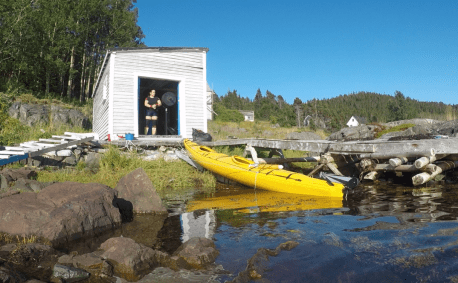 I’ve been “too” a lot of my life.
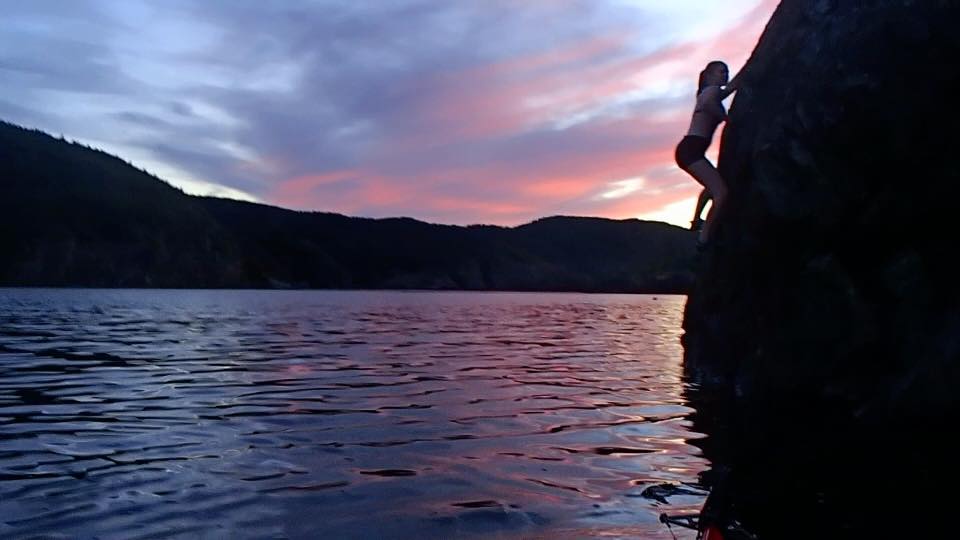
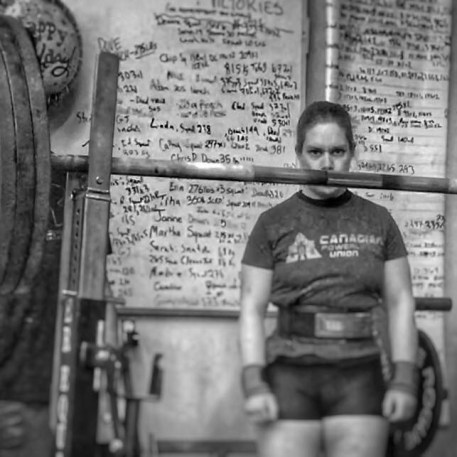
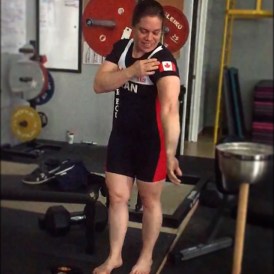
 Mountains are really big.
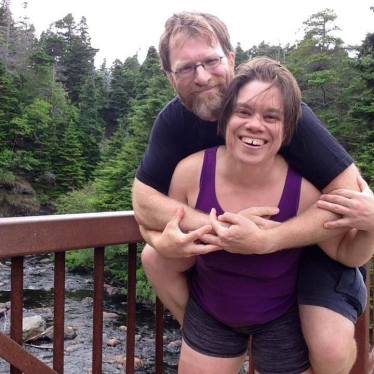 Vicky’s Note: A while back I asked John to write something about living with a powerlifter. I’m not sure quite what I expected, really. I know *I* find me hard to live with when training is particularly brutal so I was curious/a little afraid as to what he would say from his angle. I also know that without him, his support, perspective, sense of humour, unswerving belief in my strength and value, I would have a much harder time crawling back into the gym some days. So maybe what he has written here isn’t just about powerlifting. Maybe it’s about marriage and why ours works; it is held together by two people who each value what the other holds dear, even if they don’t always quite understand the whys.
 Katherine asked a question the other day and I’m not sure I handled it all that well. It has been a somewhat crazy fall for all three of us and Christmas sort of snuck up on us. When we went out to eat a couple of weeks ago, my mind wasn’t on the holidays at all when she asked, “Is Santa really real?”
 You see, both of us still do actually believe in Santa. Maybe not specifically in a large man in a red suit, but we believe in what he symbolizes and we hold fast to the magic of Christmas, the sparkle of lights, the magic of coming out in the wee hours of the morning and seeing the tree resplendent with ornaments, lights and presents, stockings filled, and the scotch gone and only crumbs left from the cookies. What we believe in is the power of love between people who both understand the need for the other to experience joy and wonder and to be cared for and treasured.
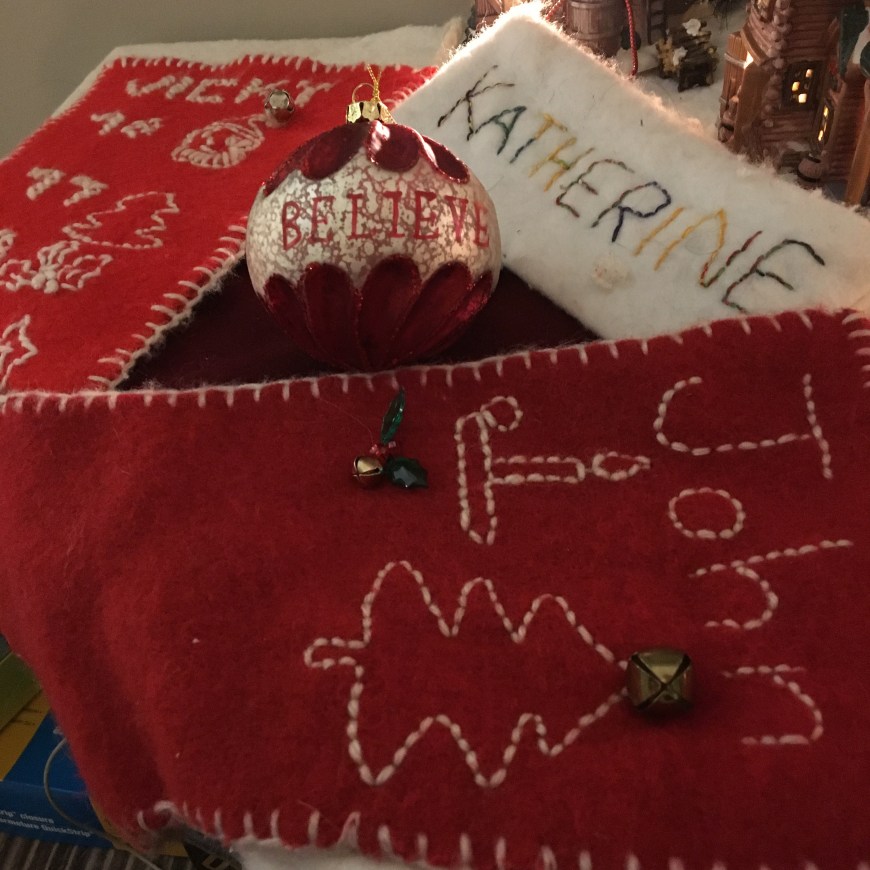 I’m 42 and I believe in Christmas a little more every year because every year I have more Christmases inside me.
 As you grow you have the chance and choice to use your unique gifts to spread joy and help other people. Sometimes this will be at Christmas, but much of the time it will be small things thought the year. Christmas is a time when this force is focussed and people pay attention to each other; the magic of Christmas is in its ability to focus our hearts on giving and warmth, on lights in the darkness and time spent in good company.
 I believe in Santa Claus because I believe in the good people close to me, what they bring to my life, and what I give to theirs.
