


| CARVIEW |

An official website of the United States government

The .gov means it’s official.
Federal government websites often end in .gov or .mil. Before
sharing sensitive information, make sure you’re on a federal
government site.

The site is secure.
The https:// ensures that you are connecting to the
official website and that any information you provide is encrypted
and transmitted securely.

Save citation to file
Email citation
Add to Collections
Add to My Bibliography
Your saved search
Create a file for external citation management software
Your RSS Feed
Curvature thylakoid 1 proteins modulate prolamellar body morphology and promote organized thylakoid biogenesis in Arabidopsis thaliana
Affiliations
- 1 Copenhagen Plant Science Centre, Department of Plant and Environmental Sciences, University of Copenhagen, 1871 Copenhagen, Denmark.
- 2 Max Planck Institute of Molecular Plant Physiology, Department of Organelle Biology, Biotechnology and Molecular Ecophysiology, 14476 Potsdam, Germany.
- 3 Department of Plant Anatomy and Cytology, Institute of Experimental Plant Biology and Biotechnology, Faculty of Biology, University of Warsaw, PL-02-096 Warsaw, Poland.
- 4 Core Facility for Integrated Microscopy, The Panum Institute, Department of Biomedical Sciences, University of Copenhagen, 2200 Copenhagen, Denmark.
- 5 Horticulture and Product Physiology, Plant Sciences Group, Wageningen University, 6708 PD Wageningen, The Netherlands.
- 6 Department of Plant Anatomy and Cytology, Institute of Experimental Plant Biology and Biotechnology, Faculty of Biology, University of Warsaw, PL-02-096 Warsaw, Poland; pribil@plen.ku.dk lucja.kowalewska@uw.edu.pl.
- 7 Copenhagen Plant Science Centre, Department of Plant and Environmental Sciences, University of Copenhagen, 1871 Copenhagen, Denmark; pribil@plen.ku.dk lucja.kowalewska@uw.edu.pl.
- PMID: 34654749
- PMCID: PMC8594483
- DOI: 10.1073/pnas.2113934118
Curvature thylakoid 1 proteins modulate prolamellar body morphology and promote organized thylakoid biogenesis in Arabidopsis thaliana
Authors
Affiliations
- 1 Copenhagen Plant Science Centre, Department of Plant and Environmental Sciences, University of Copenhagen, 1871 Copenhagen, Denmark.
- 2 Max Planck Institute of Molecular Plant Physiology, Department of Organelle Biology, Biotechnology and Molecular Ecophysiology, 14476 Potsdam, Germany.
- 3 Department of Plant Anatomy and Cytology, Institute of Experimental Plant Biology and Biotechnology, Faculty of Biology, University of Warsaw, PL-02-096 Warsaw, Poland.
- 4 Core Facility for Integrated Microscopy, The Panum Institute, Department of Biomedical Sciences, University of Copenhagen, 2200 Copenhagen, Denmark.
- 5 Horticulture and Product Physiology, Plant Sciences Group, Wageningen University, 6708 PD Wageningen, The Netherlands.
- 6 Department of Plant Anatomy and Cytology, Institute of Experimental Plant Biology and Biotechnology, Faculty of Biology, University of Warsaw, PL-02-096 Warsaw, Poland; pribil@plen.ku.dk lucja.kowalewska@uw.edu.pl.
- 7 Copenhagen Plant Science Centre, Department of Plant and Environmental Sciences, University of Copenhagen, 1871 Copenhagen, Denmark; pribil@plen.ku.dk lucja.kowalewska@uw.edu.pl.
- PMID: 34654749
- PMCID: PMC8594483
- DOI: 10.1073/pnas.2113934118
Abstract
The term "de-etiolation" refers to the light-dependent differentiation of etioplasts to chloroplasts in angiosperms. The underlying process involves reorganization of prolamellar bodies (PLBs) and prothylakoids into thylakoids, with concurrent changes in protein, lipid, and pigment composition, which together lead to the assembly of active photosynthetic complexes. Despite the highly conserved structure of PLBs among land plants, the processes that mediate PLB maintenance and their disassembly during de-etiolation are poorly understood. Among chloroplast thylakoid membrane-localized proteins, to date, only Curvature thylakoid 1 (CURT1) proteins were shown to exhibit intrinsic membrane-bending capacity. Here, we show that CURT1 proteins, which play a critical role in grana margin architecture and thylakoid plasticity, also participate in de-etiolation and modulate PLB geometry and density. Lack of CURT1 proteins severely perturbs PLB organization and vesicle fusion, leading to reduced accumulation of the light-dependent enzyme protochlorophyllide oxidoreductase (LPOR) and a delay in the onset of photosynthesis. In contrast, overexpression of CURT1A induces excessive bending of PLB membranes, which upon illumination show retarded disassembly and concomitant overaccumulation of LPOR, though without affecting greening or the establishment of photosynthesis. We conclude that CURT1 proteins contribute to the maintenance of the paracrystalline PLB morphology and are necessary for efficient and organized thylakoid membrane maturation during de-etiolation.
Keywords: CURT1; chloroplast biogenesis; de-etiolation; photosynthesis; prolamellar bodies.
Conflict of interest statement
The authors declare no competing interest.
Figures
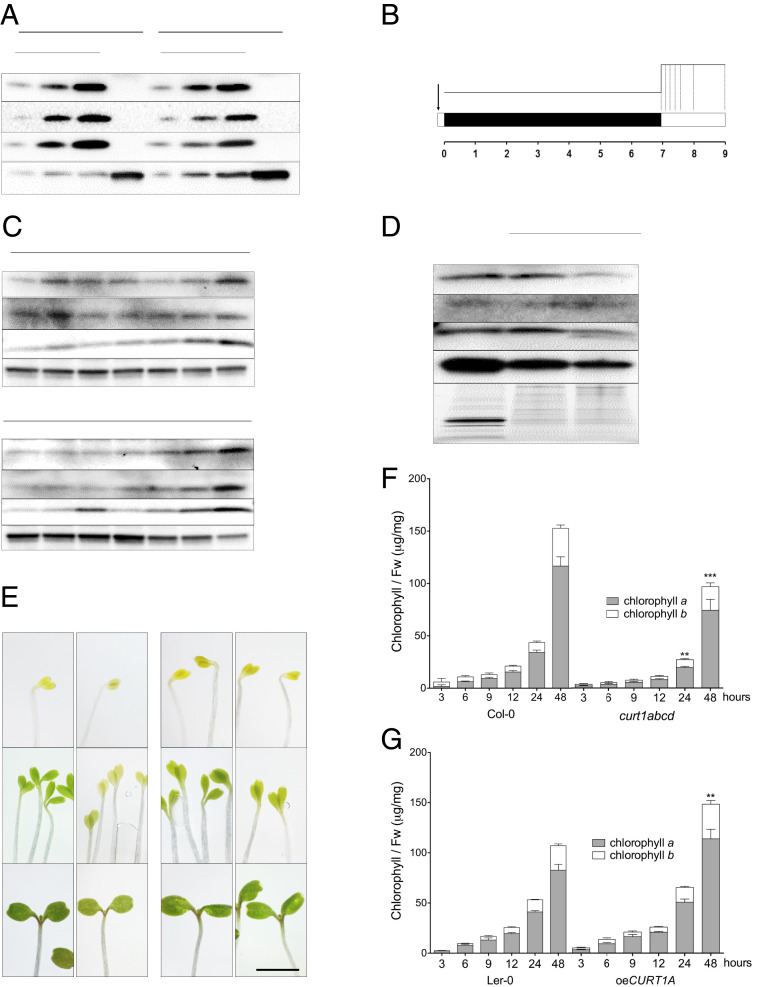
Fig. 1.
CURT1 proteins are present in…
Fig. 1.
CURT1 proteins are present in membrane fractions of cotyledons throughout de-etiolation. ( A …
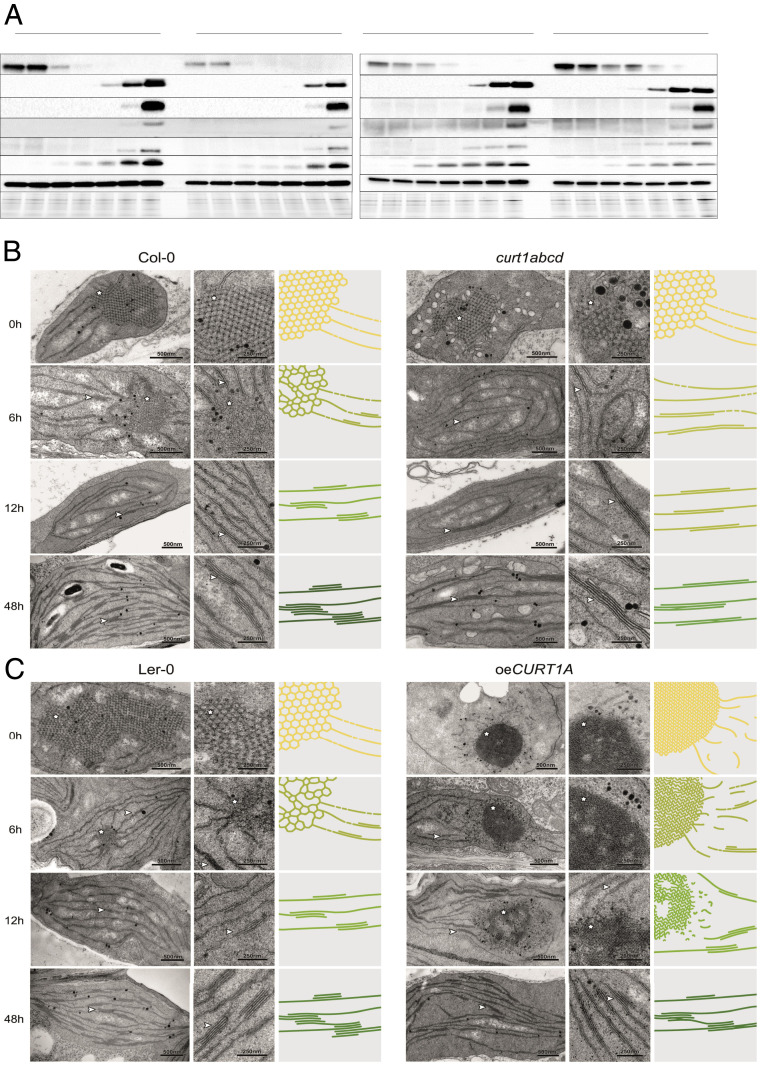
Fig. 2.
Protein profiles are affected by…
Fig. 2.
Protein profiles are affected by structural changes in PLBs and PTs in curt1abcd …
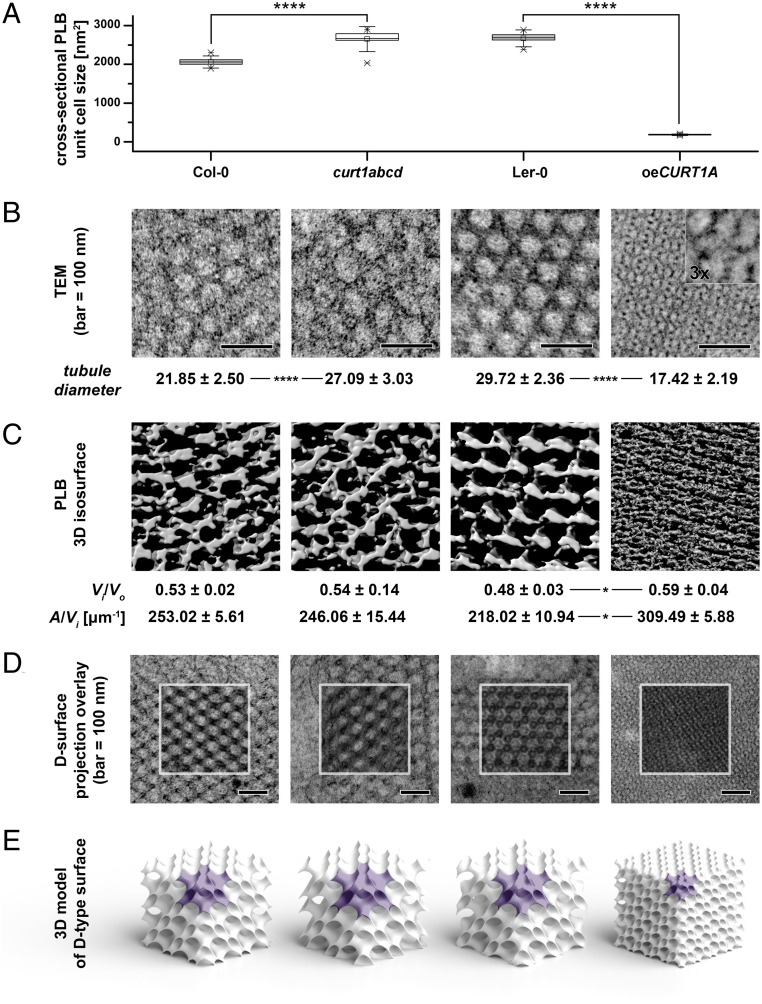
Fig. 3.
Packing and morphology of PLBs…
Fig. 3.
Packing and morphology of PLBs is altered by either lack or excess of…
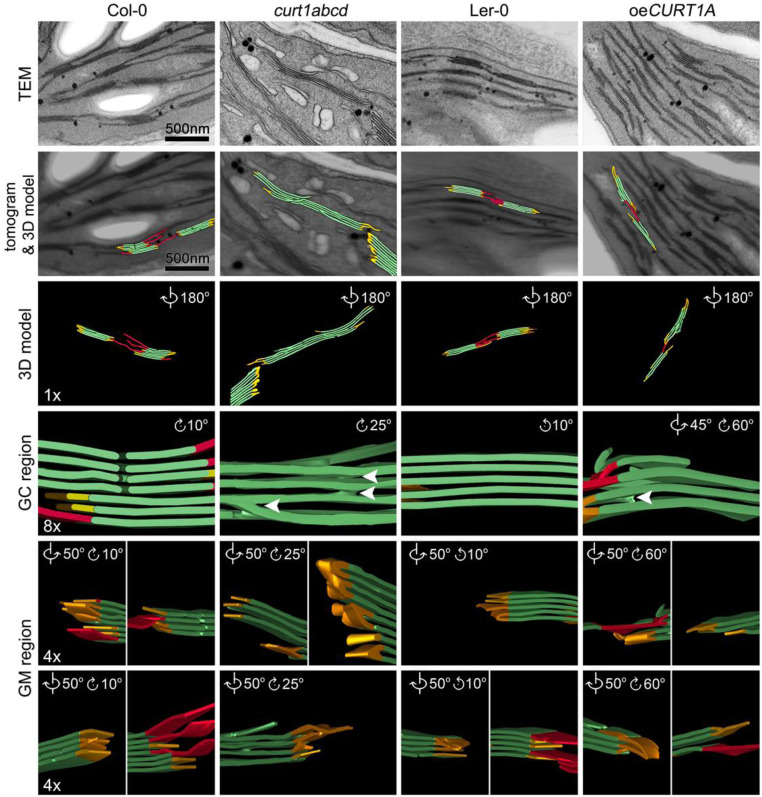
Fig. 4.
Electron tomographic reconstruction of thylakoid…
Fig. 4.
Electron tomographic reconstruction of thylakoid membranes after 48 h of illumination electron tomographic…
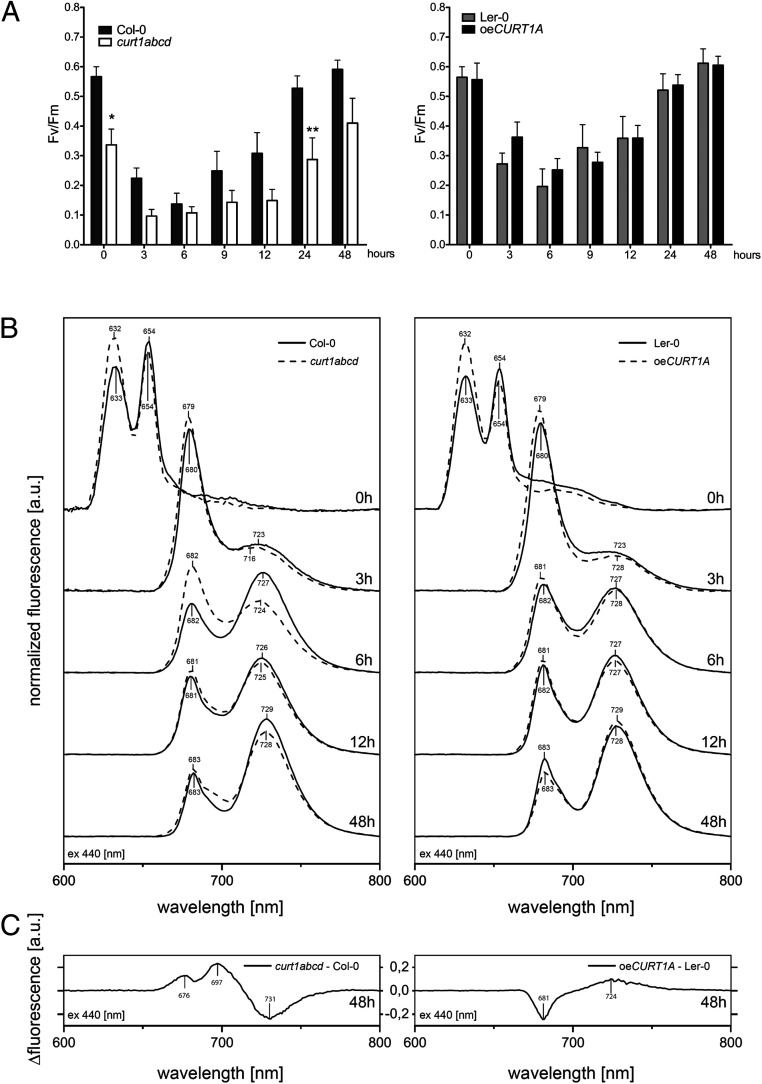
Fig. 5.
The onset of photosynthesis and…
Fig. 5.
The onset of photosynthesis and the assembly of photosynthetic complexes is markedly delayed…
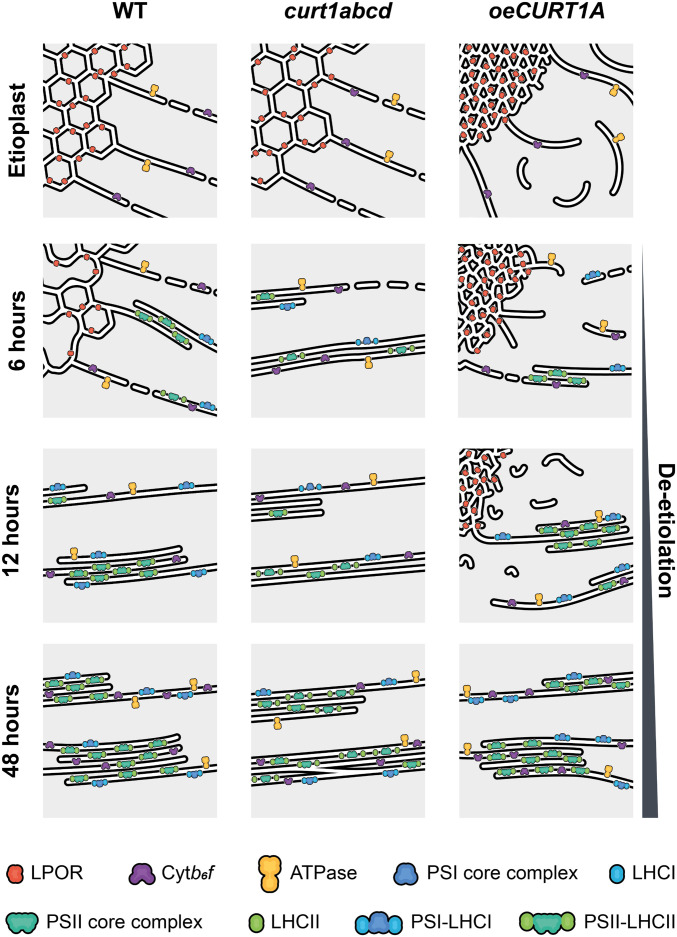
Fig. 6.
Proposed model for changes in…
Fig. 6.
Proposed model for changes in membrane morphology and the distribution of proteins across…
References
-
- Kanervo E., et al., Expression of protein complexes and individual proteins upon transition of etioplasts to chloroplasts in pea (Pisum sativum). Plant Cell Physiol. 49, 396–410 (2008). - PubMed
Publication types
MeSH terms
Substances
LinkOut - more resources
Full Text Sources

NCBI Literature Resources
The PubMed wordmark and PubMed logo are registered trademarks of the U.S. Department of Health and Human Services (HHS). Unauthorized use of these marks is strictly prohibited.