News of the Week for January 25th, 2026
| CARVIEW |
News of the Week for January 25th, 2026
In the hopes of encouraging a more civil, and illuminating, discourse, here is another episode of William F. Buckley, Jr.’s “Firing Line”.
The place of international institutions, their usefulness, and our place in them is as much as a question and topic of hot debate as it was half-a-century ago when William F. Buckley, Jr. discussed with then-Ambassador Daniel Patrick Moynihan the uses of the United Nations.
Until next Friday.

Another “quick takes” on items where there is too little to say to make a complete article, but is still important enough to comment on.
The focus this time: It’s like a bad horror franchise where the entire point is to squeeze out even more money from people.
First, a little mood music:
Carrying on…

Apparently zero funding means more funding if you switch sock puppets at Harvard.
“Harvard University’s newly established Office for Community Culture (OCC) now holds more funding and resources than all three of the diversity, equity, and inclusion (DEI) offices it replaced, Harvard Dean David Deming told The Harvard Crimson.
“The OCC, which was launched earlier this year, absorbed the College’s former Women’s Center, BGLTQ Office, and Harvard Foundation for Intercultural and Race Relations under a new sect of the office called the ‘Harvard Foundation.’
“Calming the fears of students who believed DEI was being eradicated, Deming confirmed that the funding slotted towards the Harvard Foundation’s rebranded DEI programming is more than all three of the DEI centers it replaced.”

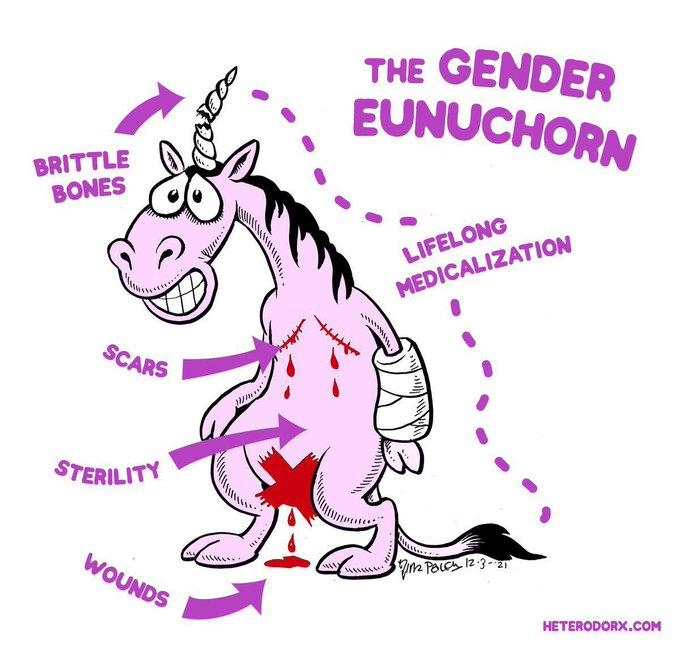
The so-called “Gender Unicorn” has been around as an “explainer” for various letters on the LGBTQ&c. smorgasbord of queerness, especially for the transgender ideology, for well over a decade.
Since then, we’ve learned that their gender ideology isn’t so much a unicorn as a eunuchorn.
News of the Week for January 11th, 2026
In the hopes of encouraging a more civil, and illuminating, discourse, here is another episode of William F. Buckley, Jr.’s “Firing Line”.
Over recent decades, both major political parties have been seeking to fundametally transform America under the heavy-handed guidance of an increasingly powerful government. Let us look back sixty years ago the last time a purportedly clever scheme was implemented when William F. Buckley, Jr. and Richard N. Goodwin discussed that new frontier of the “Great Society”.
Until next Friday.
Another “quick takes” on items where there is too little to say to make a complete article, but is still important enough to comment on.
The focus this time: Reaping the harvest, grimly.
First, a little mood music:
Carrying on…

It’s not killing if you re-define death, dontchaknow.
“Good motives sometimes lead to terrible places. Such is the case with the understandable desire to increase the organ supply, which for years has tempted some bioethicists to stretch the ethics of transplant medicine beyond the breaking point.
“Now, in the New York Times, three doctors promote the idea of ‘redefining death’ to allow patients to be killed for their organs. First, the authors lament the difficulty of obtaining healthy organs from people whose hearts stop irreversibly after the removal of life support. They also bemoan the shortage of ‘brain-dead’ donors. Then, after discussing a controversial approach that restarts circulation after cardiac arrest (but not to the brain) — which I have posted about before — they get down to the nitty-gritty of redefining death. From ‘Donor Organs Are Too Rare. We Need a New Definition of Death’:
“‘The solution, we believe, is to broaden the definition of brain death to include irreversibly comatose patients on life support. Using this definition, these patients would be legally dead regardless of whether a machine restored the beating of their heart.’
“So long as the patient had given informed consent for organ donation, removal would proceed without delay. The ethical debate about normothermic regional perfusion would be moot. And we would have more organs available for transplantation.’
“Then, they depersonalize people with severe cognitive disabilities:
“’Apart from increased organ availability, there is also a philosophical reason for wanting to broaden the definition of brain death. The brain functions that matter most to life are those such as consciousness, memory, intention and desire. Once those higher brain functions are irreversibly gone, is it not fair to say that a person (as opposed to a body) has ceased to exist?’
“No, it is not! Redefining as dead someone who is actually living would subjectivize the value of human life. We are either all equal while alive, or we are not. And if we are not, kiss universal human rights goodbye and say hello to increased oppression and exploitation of those deemed by those with power to be expendable or less than human.”
Artificial insemination—the union of sperm and egg ex utero—is not a new technology, but the development of artificial wombs has continued to advance. In particular, a common problem is the acceptance of the fertilized embryo into uterine tissue has often been a failure point… until now when an “organoid” of such tissue was combined with a fertilized embryo ex utero:
“At first glance, it looks like the start of a human pregnancy: A ball-shaped embryo presses gently into the receptive lining of the uterus and then grips tight, burrowing in as the first tendrils of a future placenta appear.
“This is implantation—the moment that pregnancy officially begins.
“Only none of it is happening inside a body. These images were captured in a Beijing laboratory, inside a microfluidic chip, as scientists watched the scene unfold.
“The reports—two from China and a third involving a collaboration among researchers in the United Kingdom, Spain, and the US—show how scientists are using engineered tissues to better understand early pregnancy and potentially improve IVF outcomes.
“‘You have an embryo and the endometrial organoid together,’ says Jun Wu, a biologist at the University of Texas Southwestern Medical Center, in Dallas, who contributed to both Chinese reports. ‘That’s the overarching message of all three papers.’”
While some are concerned with treating human life with such lack of moral concern or ethical restraints, the possibility of helping to cure many forms if infertility in humans or even increasing the possibility of pregnancy for endangered species is intriguing.
“In your basic IVF procedure, an egg is fertilized in the lab and allowed to develop into a spherical embryo called a blastocyst—a process that takes a few days. That blastocyst then gets put into a patient’s uterus in the hope it will establish itself there and ultimately become a baby.
“In the new reports, it’s that initial bond between mother and embryo that is being reproduced in the lab. ‘IVF means in vitro fertilization, but now this is the stage of in vitro implantation,’ says Matteo Molè, a biologist at Stanford University whose results with collaborators in Europe are among those published today. ‘Considering that implantation is a barrier [to pregnancy], we have the potential to increase the success rate if we can model it in the laboratory.’”
Of course, the real advantage of this is when it will be used with genetically engineered catgirl embryos to mass produce them for domestic ownership!

News of the Week for January 4th, 2026


E-mail me!