Happy new year to everyone who is still following this blog! For this new post (coming after a nontrivial break), I thought I should perhaps try something different, and so I decided that it might be a good idea to discuss an open problem which I like, and which has been on the back of my mind lately.
Long story short, it’s a problem that Oleksiy Klurman and I came up with together a few years ago, and which we excitedly shared with some of our friends at various workshops and conferences, but we never really got a chance to write it down anywhere (mostly because we couldn’t prove anything particularly interesting about it..). In the meantime, one of us started a blog, so we thought the other day that we might finally have an opportunity to say some things about this problem in a sufficiently formal way and perhaps voice some of our frustrations.
To put this into context, let me start by introducing some notation and discussing some classical results about Sidon sets. For a set of real numbers  , let
, let  denote the size of the largest subset
  of with the property that there are no nontrivial solutions to the equation
  , where
  are pairwise distinct from each other. Such a set is called an additive Sidon subset of , so thus denotes the size of the largest additive Sidon subset of . One of the most classical problems in additive combinatorics is to determine
  for sufficiently large positive integers
  . For brevity, we will denote this function in this case by
  .
.
Let’s discuss a few things about this . First, since all the pairwise sums live in the interval  , it is easy to see that
  , which implies that
  . In 1941, Erdos and Turan refined this simple observation and proved that
  . This was further sharpened by Lindstrom, who established the inequality

which is the best known upper bound for . In order to produce a good lower bound for , one needs to construct a large subset of  with all of its two element subset sums distinct. In their paper already cited above, Erdos and Turan proceeded as follows. Fix a prime
  , and let
  be the unique integer in
  congruent to
  modulo . It is not hard to check that
  is a Sidon set contained in the interval
  . In particular, for
  and sufficiently large this construction already leads to the fact that

holds for all sufficiently large. This is essentially a Freiman isomorphism from the  parabola in
  . Three different constructions due to Singer, Bose, and Ruzsa, all with a similar algebraic flavor, lead to a slightly better lower bound for than the one above, which is of the form

While all of these results are quite classical, determining whether the correct size of is closer to the upper bound or to the lower bound (i.e. if the lower order term in Lindstrom’s upper bound is required) and what all these extremal Sidon sets might look like are still major open problems. We refer the interested reader to this consult this nice survey of O’Bryant and this beautiful blog post of Gowers for more information.
Similarly, one can play the same game with multiplication. For a set of real numbers , let us now define  to be the size of the largest subset of with the property that there are no nontrivial solutions to the equation
  , where are pairwise distinct from each other. Naturally, we will call a multiplicative Sidon subset of , so like before simply stands for the size of the largest multiplicative Sidon subset of .
When  , the story of
  turns out to be a bit more pleasant than the story of . At first glance, this is perhaps not too surprising. First of all, it is easy to see that
  is much larger than . For example, one can consider to be the set of prime numbers inside the interval . This is a multiplicative Sidon set and, by the Prime number theorem,
  ; therefore, we know that
  , which is somewhat promising. Indeed, in 1938 (three years before his additive Sidon paper with Turan), Erdos had in fact already started the study this quantity and managed to further improve upon this simple construction by showing that

for some absolute constant  , where
  stands as usual for the number of primes in . Moreover, in the same paper he also proved that
  , upper bound which 31 years later he himself refined to
  , thus establishing the correct order of magnitude of the lower order term, namely

So, to (abruptly) summarize: while for we are still fairly troubled regarding the correct order of magnitude and the nature of the largest additive Sidon subsets in , for the multiplicative Sidon story we know quite well what is, and we also know that these extremal sets are intimately connected with the primes.
But what do we know about and for other sets of reals ? When is multiplicatively structured, say  , we have that
  and
and  , so the roles are in some sense reversed. Needless to say, this situation resembles quite well the dichotomy that motivated the celebrated sum-product conjecture of Erdos and Szemeredi, which roughly states that no set has a polynomial saving for both the size of the sum set and the size of the product set, over the trivial quadratic upper bound. So perhaps, one can formulate an analogous conjecture.. (and, of course, that’s what we did!).
Question. (KP) For every set of reals , is there an absolute constant  such that

for every  ?
?
It is perhaps important to mention that we couldn’t find this anywhere in the literature, but that we did not look terribly hard for a reference (as I said, we more or less just asked around!). So, not only that we’d be (very) excited if someone can solve it, but we’d also be quite grateful if anyone knows a reference where something along these lines has been already asked.
In the remaining time/space, I’d like to draw attention towards a particularly tantalizing special case, which seems already quite tricky. Suppose is a set of reals with small doubling, namely  , where
  may possibly depend on
  . We know that there are such sets with
  , so the question here is: can one prove that we always have
  for every ?
By using Solymosi’s theorem that every set satisfies  , where
  stands for the number quadruples
  with
with  and
and  ,
,  ,
,  ,
,  pairwise distinct, it is not difficult to prove that every set with contains a multiplicative Sidon subset of size
  for every . Indeed, one can take a random subset
  of , obtained by choosing each element of to be part of with probability
 ![p \in [0,1]](https://s0.wp.com/latex.php?latex=p+%5Cin+%5B0%2C1%5D&bg=ffffff&fg=404040&s=0&c=20201002) independently, and then removing one element from each multiplicative quadruple in . The end result is some smaller (random) set
independently, and then removing one element from each multiplicative quadruple in . The end result is some smaller (random) set  with no multiplicative quadruples, which on average will have size
![\mathbb{E}[|A'|] \geq p|A| - c p^{4} |A+A|^{2}\log |A|,](https://s0.wp.com/latex.php?latex=%5Cmathbb%7BE%7D%5B%7CA%27%7C%5D+%5Cgeq+p%7CA%7C+-+c+p%5E%7B4%7D+%7CA%2BA%7C%5E%7B2%7D%5Clog+%7CA%7C%2C&bg=ffffff&fg=404040&s=0&c=20201002)
for some absolute constant . Thus, there must exist a multiplicative Sidon subset of of at least that size. Using the fact that and optimizing for in terms of then proves the claim. And surprise, surprise, this is more or less the only nontrivial thing that we could say! We think that one can maybe hope to use ideas from the proof of Solymosi’s sum-product theorem more directly rather than the result itself as a blackbox in order to do better than  , but we couldn’t find any such argument. Even when is small enough to allow the application of Freiman’s theorem, we didn’t know how to use the generalized arithmetic progression structure of to do any better (except perhaps in some situations where one adds some further assumptions on ). So, any ideas would be very welcome!
That being said, I’d also like to add that a friendlier direction which seems to be still worth investigating is the “dual” regime where  , where is an absolute positive constant. By the multiplicative variant of Freiman’s theorem, must in this case lie in a multiplicative subgroup of
  of small rank
  (bounded only in terms of ), so by quantitative variants of Schmidt’s subspace theorem such as the one due to Amoroso and Viada it is also not too difficult to find “almost Sidon sets” of size
  . To be more precise, for every , there exists some positive integer
  and a subset of of size with the property that each sum of two distinct elements in has multiplicity at most
  . This also follows from a probabilistic deletion argument in the style of the one above, although it is a bit more technical. Nevertheless, it seems likely that finite subsets of multiplicative subgroups of of small rank might actually have linear size additive Sidon subsets for some “easier” reasons (e.g. the primordial subset
  , which is contained in a rank
  multiplicative subgroup, is Sidon itself due to the uniqueness of binary representations).
Later edit: In a comment, Oliver Roche-Newton already provided a simple construction which shows that answer to the original question cannot be yes as for any  : there exists a set with no additive/multiplicative Sidon subsets of size greater than
  . This set however does not have small additive or multiplicative doubling, so the two particular cases described above could still be true. It also still remains to see whether there exists
  such that

for some absolute constant  . This would already be quite interesting (and in the spirit of the sum-product theorem of Erdos and Szemeredi). That being said, it is perhaps also useful to add that

follows from a more general result of Komlos, Sulyok and Szemeredi which implies that  holds for all sets of integers . It is not difficult to see that once we have this over the integers,
  also holds for all sets of reals (by using a diophantine approximation argument, for example). Since
  (ignoring small issues), this also implies
  .
.
Later edit 2: In the meantime, I’ve also become aware of improved constructions by Oliver Roche-Newton+Audie Warren and (independently) Ben Green+Sarah Peluse which show that the original conjecture cannot be true as stated for any  : there exists a set with no additive/multiplicative Sidon subsets of size greater than . Moreover, these constructions also have small additive doubling, so they also show the (rather curious) fact that the
  exponent obtained via probabilistic deletion and Solymosi’s theorem which I sketched (for the size of the largest multiplicative Sidon subset in when
  ) is actually sharp. More updates to come. (I hope!)


![A \subset [N]](https://s0.wp.com/latex.php?latex=A+%5Csubset+%5BN%5D&bg=ffffff&fg=404040&s=0&c=20201002) whose difference set contains no non-zero perfect squares of integers. Here
whose difference set contains no non-zero perfect squares of integers. Here ![[N] = \left\{1,\ldots,N\right\}](https://s0.wp.com/latex.php?latex=%5BN%5D+%3D+%5Cleft%5C%7B1%2C%5Cldots%2CN%5Cright%5C%7D&bg=ffffff&fg=404040&s=0&c=20201002) . Answering a question of Lovasz,
. Answering a question of Lovasz, 
 , and the problem of finding strong quantitative estimates has become more or less known as the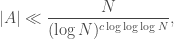
 is the usual
 ![[N]](https://s0.wp.com/latex.php?latex=%5BN%5D&bg=ffffff&fg=404040&s=0&c=20201002) without three-term arithmetic progressions.
without three-term arithmetic progressions.  . This is due to
  must satisfy
 .
. and/or
  in base
  , I’d like to begin by emphasizing that this is a very natural (and rather cool) variant of the Furstenberg-Sarkozy problem for several reasons. First and foremost, like the perfect squares and the many other “intersective” sets for which similar stories hold (such as the set of cubes or values of various classes of polynomials),
  or higher -so perhaps there is some hope. I started thinking about this problem a bit a while ago, and, while I didn’t have much luck with the Fourier analytic approach at the time (or rather didn’t have enough energy to work on it more seriously..), I had the pleasant surprise to realize that the quantitative problem exhibits a rather different behavior than the Furstenberg-Sarkozy problem, and that establishing (some type of) quantitative upper bound is a much easier problem than it might look initially. I thought the other day that it might be nice to share this story here, since, as usual, it’s been a while since my last post!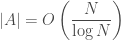
 The main idea is to consider the following translates of the set
  , define
 . Note that for each
  , the set
  is contained in
  , the sets
  are pairwise disjoint. Hence,
  , which implies the claim.
  in base
  with constant sum of digits, for some fixed
  . It is then not difficult to see that for an appropriate chosen constant, this yields a set whose difference set contains no integers missing digit
  . Perhaps a bit less coincidentally this time, when
  , this yields a construction with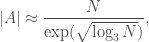
 and
and  . This is a smaller gap than the one between the best upper and lower bounds for the Fursterberg-Sarkozy problem, but it would still be very nice if we could close it even further –especially since it seems quite likely that one should be able to do better than
  , suppose
  , i.e. no pattern of the form
 is a nonzero element of
 ? The analogous generalization of the Furstenberg-Sarkozy problem has been studied extensively, see for example
  situation, it seems however quite likely that one may not need to use any kind of (higher order) Fourier analysis in order to come up with a reasonable upper bound (possibly even of the form
  for some constant
  ).
). of the largest subset
  with
with  which have at least one nonzero coordinate is a classical problem in extremal combinatorics. The best known results can be summarized in the following one line:
 . See Theorem 5 in the
  is also an elegant application of the polynomial method.
  of the largest subset
  . That might be the best known result (as far as I can tell), however, in light of the case
 .
. , then
 . This follows from
  in
in ![H_{3} \cap [N]](https://s0.wp.com/latex.php?latex=H_%7B3%7D+%5Ccap+%5BN%5D&bg=ffffff&fg=404040&s=0&c=20201002) , let
, let  be the vector of
  -digits in the base
 , it is easy to see that for every two
  in
in  , the corresponding sets
  and
and  are not contained in one another; hence
  forms an antichain. It thus indeed follows by Sperner’s lemma that
 by the same argument. In particular,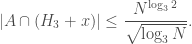
 translates of
  of points and a set
  of lines, both in
  , an incidence is a pair
  . Answering a question of Erdos and Purdy,
 incidences have in common).
 . Solymosi’s theorem can be therefore rephrased as saying that for every set of points
 and
and  as follows.
  be the set of points in
 with vertex set
  , consider the set of lines
  which contain of
  , so if for some reason
  , this would mean that
  edge-disjoint triangles. By the
  triangles in total, and so some of these triangles would most definitely have to come from different points in
  , which gives the claim above. Amplfying this bound instead of the trivial bound, one can then recover Solymosi’s theorem.
 or
or  , the equation
 ,
,  ,
,  all in
  denote the size of the largest non-averaging set of order
  inside the interval
  . In particular, note that
  , where the latter denotes as usual the size of the largest three-term progression free set inside
  one has

 and
and  denote some large positive integers, with a precise relationship between them to be specified later. For now, we shall only think of
  and satisfying
 by
by
 be the line in
  , and let
 , whereas
  . Furthermore, note that for every line
  , there is a unique element
  in
in  such that
  lies on
  , so
, so 
 for some
  , then
  for every
 in
in  in
in  ,
,  ,
,  are not collinear. Without loss of generality, suppose the lines
  and
and  meet at
  , lines
  meet at
  , and the lines
  .
. , let
, let  be described by the equation
  , and without loss of generality assume that
  . It is easy to check that by definition of
  , we have that
  , and we also have similar equations for
  and
and  .
.
 are all in
  . This is a contradiction, since we assumed that the points
  represents a pair
  where
where  is a finite set of vertices and
  is a family of
  , its degree in
  , is defined to be the cardinality of the set of edges in
  which contain
  . A subset
  is an independent set of the hypergraph
  . Equivalently, this is sometimes written as
  . Furthermore, the independence number of
  , represents the maximum size of an independent set in
  ,
,
 be a
be a  -uniform hypergraph. Then,
 this recovers the Caro-Wei theorem, but the proof is much more involved. In this post, we will give a short probabilistic proof of this theorem, by extending the celebrated proof of the Caro-Wei theorem from
  such that for every
  uniform hypergraph
 , let
, let  be an independent uniform random variable in
 ![[0,1]](https://s0.wp.com/latex.php?latex=%5B0%2C1%5D&bg=ffffff&fg=404040&s=0&c=20201002) . Let
. Let  denote the
  -tuple
 ![(\xi_{v})_{v \in V} \in [0,1]^{|V|}](https://s0.wp.com/latex.php?latex=%28%5Cxi_%7Bv%7D%29_%7Bv+%5Cin+V%7D+%5Cin+%5B0%2C1%5D%5E%7B%7CV%7C%7D&bg=ffffff&fg=404040&s=0&c=20201002) . For every edge
. For every edge  in our
  for which
  . Let
. Let  denote the remaining set of vertices. It is easy to check that
  in
in ![[0,1]^{|V|}](https://s0.wp.com/latex.php?latex=%5B0%2C1%5D%5E%7B%7CV%7C%7D&bg=ffffff&fg=404040&s=0&c=20201002) is at least the RHS expression from Theorem 1.
is at least the RHS expression from Theorem 1. . For a fixed value
 ![\tau \in [0,1]](https://s0.wp.com/latex.php?latex=%5Ctau+%5Cin+%5B0%2C1%5D&bg=ffffff&fg=404040&s=0&c=20201002) of
of  with
with  , which equals
  . Clearly these events for different edges have positive correlation: if some of them hold, it may only help the others to hold. For a linear
  , with equality in the linear case. Therefore, the probability that
 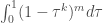 , which we can compute as follows. After two changes of variables, note that
 stands for the usual beta function



 and
and  , we have
 . It thus follows that

![\displaystyle \mathbb{E}_{\xi \in \mathbb{T}^{|V|}}[|S_{\xi}|] = \sum_{v \in V} \mathbb{P}\left(v\ \text{survives in}\ S_{\xi}\right) \geq \sum_{v\in V} \frac{1}{{\deg(v)+1/k\choose\deg(v)}},](https://s0.wp.com/latex.php?latex=%5Cdisplaystyle+%5Cmathbb%7BE%7D_%7B%5Cxi+%5Cin+%5Cmathbb%7BT%7D%5E%7B%7CV%7C%7D%7D%5B%7CS_%7B%5Cxi%7D%7C%5D+%3D+%5Csum_%7Bv+%5Cin+V%7D+%5Cmathbb%7BP%7D%5Cleft%28v%5C+%5Ctext%7Bsurvives+in%7D%5C+S_%7B%5Cxi%7D%5Cright%29+%5Cgeq+%5Csum_%7Bv%5Cin+V%7D+%5Cfrac%7B1%7D%7B%7B%5Cdeg%28v%29%2B1%2Fk%5Cchoose%5Cdeg%28v%29%7D%7D%2C&bg=ffffff&fg=404040&s=1&c=20201002)
![\xi = (\xi_{v})_{v \in V} \in [0,1]^{|V|}](https://s0.wp.com/latex.php?latex=%5Cxi+%3D+%28%5Cxi_%7Bv%7D%29_%7Bv+%5Cin+V%7D+%5Cin+%5B0%2C1%5D%5E%7B%7CV%7C%7D&bg=ffffff&fg=404040&s=0&c=20201002) for which the corresponding independent set
for which the corresponding independent set  has size at least
  . This concludes the proof.
 Cosmin Pohoata