As the year draws to a close and the holiday season surrounds us with warmth and joy, I wanted to take a moment to look back at what an incredible journey 2025 has been for the Ignite Realtime community.
This year we’ve seen so much activity, innovation, and collective effort across our projects and forums. From major releases to exciting technical explorations, the contributions from developers, documenters, testers, and users have reminded me (time and again) what makes this community special.
Looking back through the year’s blog posts and discussions, a few moments stand out:
Openfire 5.x Series: We welcomed multiple releases within the 5.0 line. From the early beta builds to the full releases of Openfire 5.0.0 and 5.0.1, to the stability-focused 5.0.2 and most recently 5.0.3. These milestones are the result of countless hours of debugging, testing, and refinement.
New Features & Plugins: Several new features and plugins made their way into our ecosystem, like the Push Server plugin and advancements in XEP-0483 for HTTP Online Meetings, expanding what’s possible with our projects.
Smack Community Progress: The continued evolution of Smack was marked by the 4.5.0 Release Candidate, giving developers an even stronger foundation for building XMPP clients.
Broadening Perspectives: Insightful posts on interoperability, WebRTC audio/video integration, and real-world use cases highlighted the vibrant technical discourse happening here.
Community Recognition: It was also wonderful to celebrate achievements beyond our own projects - like members being elected to roles within the broader XMPP Standards Foundation.
All these efforts show not just code being written, but ideas shared, challenges overcome, and friendships formed along the way. What’s especially meaningful to me isn’t just the software we build, but how we build it: together. Whether it’s through lively technical threads, helping a newcomer in chat, or sharing a blog post that unpacks a tricky feature, this community genuinely embodies open collaboration.
The forums, blogs, and group chats are more than repositories of knowledge - they’re where we connect, learn from one another, and celebrate each success together.
So, as we step into the holidays and prepare for the new year, I want to express my deepest gratitude:
Thank you to every contributor, big or small, for your time, passion, and patience.
Thank you to those who reported bugs, wrote documentation, asked questions, or helped others find answers.
And thank you to every user who deploys, experiments with, or builds on Ignite Realtime software: you give our work purpose.
Here’s to 2026! May the coming year bring even more collaboration, innovation, and joy. Whether you’re building a new feature, solving a tricky XMPP problem, or just dropping into the group chat to say hello. We’ll be glad to see you there!
Wishing you all a happy holiday season and a wonderful New Year!
Welcome to the latest edition of your pseudo-monthly JMP update!
In case it’s been a while since you checked out JMP, here’s a refresher: JMP lets you send and receive text and picture messages (and calls) through a real phone number right from your computer, tablet, phone, or anything else that has a Jabber client. Among other things, JMP has these features: Your phone number on every device; Multiple phone numbers, one app; Free as in Freedom; Share one number with multiple people.
End of a Year
Wow, another year has come and gone. Not many newsletters this year, but rest assured we’ve just been too busy building to write! We know one of the biggest questions we get every year is about a Cheogram-like app for other platforms, and this year we’ve come much closer to having two more of those ready for release, besides also maintaining everything you’ve already come to know and love. Below are a few highlights.
Port-out PIN Self-Service
Users can now set their own port-out PIN through the account settings bot, only shown to users with a number eligible for automatic set up (#fe75c33, #a953751, #a18b326).
Data-Only Registration
Support for data plan registration during sign-up process without a phone number (#5cdf6c0).
Cheogram WWW
We’ve been working for years on a browser-based Progressive Web App client for the Cheogram family, based on Borogove. Community members have been testing various versions of this under many names, but this fall we finally began alpha testing under the Cheogram WWW name at app.cheogram.com. Expect more to come for this app, but it is already very usable for many of the needs JMP customers have, including a Command UI / “app” view for account settings. It is also one of the only browser-based apps with native multi-account support.
You’ll note above I said “browser-based” and not quite “web app”. There is no server side component required for this app, as it connects directly to your Jabber service. This requires a special browser protocol to be supported by the service, and a few other things are needed for it to work very well. Of course we’ve worked with Snikket to make sure their offering supports everything needed for a best in class experience and more.
This app works well in a desktop/laptop/tablet form factor, but also has a mobile-optimized view. Along with support for Web Push notifications (if supported by your Jabber service; of course latest Snikket has support) this can make it a viable option on mobile platforms without a good native solution yet (to try this on iOS you’ll need to use the “add to home screen” option for notifications to work). The biggest limitation for Web Push is it cannot make a device “ring” so if you get a call while the app is not open you’ll get only a simple notification like for a message which is not always ideal.
Cheogram iOS
Also in alpha testing starting earlier this fall is Cheogram iOS. Also based on Borogove but with a native Swift UI and deeper OS integration than the PWA can muster, this app is still in a bit of an earlier stage than Cheogram WWW, but some very adventurous people are daily driving it already. Come by the community chat if you want a TestFlight link.
Distribution for Cheogram Apps
Cheogram apps area also making some changes to official distribution mechanisms. For Android the most recommended and official distribution will of course remain F-Droid. And for people who need it the app will remain available on Play Store as well. Pre-release debug builds will still be distributed in the community and custom repo. So what is changing? There will no longer be official distribution of debug APK builds tied to releases. This practise has, quite honestly, been confusing to many people who expect release-tied builds to be release builds. Releases will now come with official distribution of first-party release builds for sale at itch.io (free to JMP customers or with a free JMP month for non customers along with the purchase). Builds of future Cheogram app releases (including Cheogram WWW, desktop, etc. releases) will also be available as part of the itch.io package. Android apps from itch.io can be kept up to date using Mitch.
Other alternative app stores and distributions we have supported in the past (such as Aptoide) will no longer be official.
Unfortunately this does mean that anyone running the release-tied debug builds will either need to move to pre-release or to the new release builds in order to get updates.
Selected Recent Cheogram Android Changes
UI Improvements
Default options in command grids look less like headers (#b156e93)
Fixed account colors on item lists including start conversation (#957df4f)
Reorganized contact details layout for better narrow device support (#8780945)
“Manage Phone Accounts” button now scrollable (in list footer) (#b3bcfbb)
Chat & Messaging
Users can now see themselves in group chat participants list (#f240e52)
Can view own hats/roles in conference details (#3984516)
Improved button labels in group chat context menus (#37c504b)
Enhanced call failure UI with more informative displays (#4985523)
Hello again! We’re rounding off the year with another small release of the
Snikket server software. The main purpose of this release is to fix a couple
of small bugs which were discovered and reported after the previous release
was announced.
Notable changes
Offline message compatibility
It was reported that Conversations 2.19.2 and later did not reliably receive
offline messages after being offline for an extended period of time. This also
affected the upcoming Snikket Android release (which is based on Conversations).
This issue has been fixed in this server release.
Web portal debug information
The per-user debug information became inaccessible in the previous release due
to a minor bug that slipped in during refactoring. It should now work.
Upgrading
Upgrading an existing installation is super simple and takes less than a
minute! You can find instructions in the ‘Upgrading’ section
of the release notes.
If you have any questions or feedback about the new release, come and join the
discussion in our community chat.
In this new series, I want to shine some light onto specific parts of Monal’s internals. It’s dedicated to programmers or people curious about how Monal works internally.
If you want to give some feedback, feel free to send an email to thilo@monal-im.org
XMPP as a protocol is, as most protocols are, inherently asynchronous.
In Monal we therefore use the popular PromiseKit library
to let the UI know when a XMPP action finished or failed.
But this has a huge drawback: PromiseKit-based promises aren’t serializable, so we can’t respond to events
that got handled by the Notification Service App Extension while the app was suspended.
The serializable promise framework is a new framework in Monal, which exactly fills that gap.
Overall Process
For instance, imagine you want to remove the avatar of a group chat in Monal, while on a slow, unreliable network.
You submit the request, and the loading screen appears over the view (0:03)
Because the network is slow, the loading screen persists for a long time
You get frustrated and switch apps, sending Monal to the background (0:06)
After 30s in the background, Monal gets suspended (0:36)
The server fails to remove the avatar and sends an error to Monal
The response is handled by Monal’s app extension in the background (0:51)
You switch apps back to Monal (0:57)
Without the promise framework, the app would have continued to show the loading screen indefinitely, requiring you to fully close and open the app.
However, with the promise framework, when you switch back to the app, the loading screen disappears and correctly shows the error returned by the server:
The promise framework allows any such interaction, where the UI has to update in response from the server, to be handled in a general way.
Background
We will briefly describe the important parts below. But these links provide more detailed context and are recommended reading:
In Monal there are two separate processes: the “main app” (MonalAppDelegate) and “app extension” (NotificationService), which is sometimes abbreviated to “appex”.
Since they do not share memory, they hand over to each other via the handler framework.
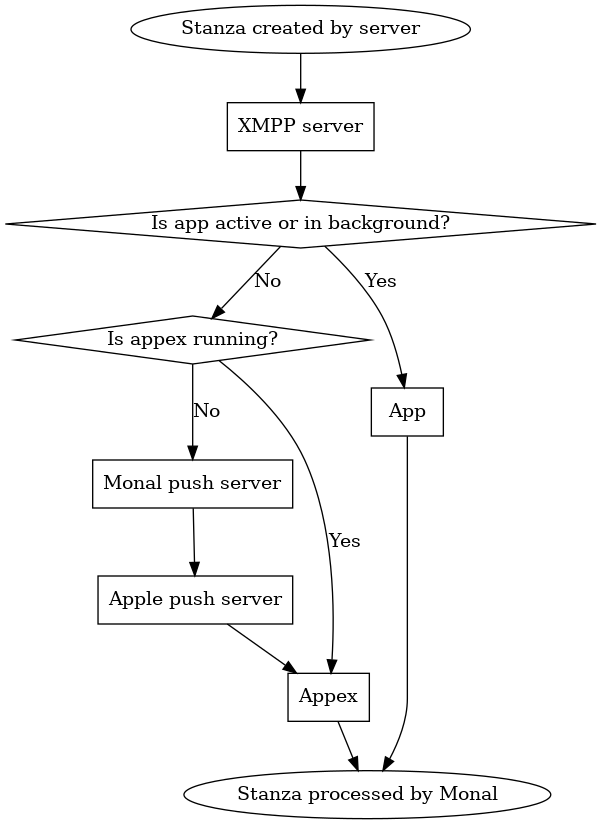
An xmpp stanza can be processed by either, depending on whether the app is running or not:
App states
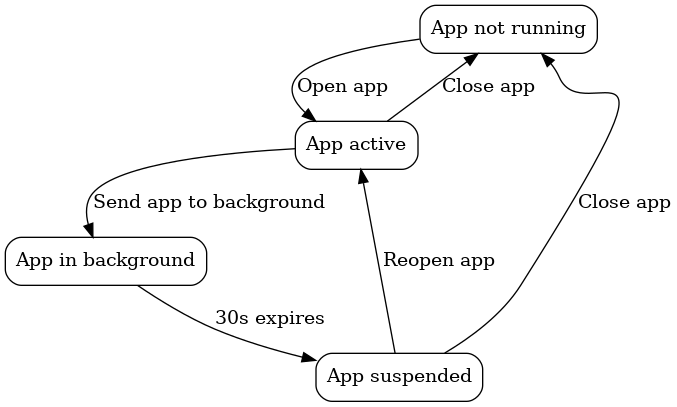
Below is a slightly simplified diagram of the app’s lifecycle. A more detailed lifecycle from Apple’s perspective is available here.
State
Description
App not running
App is not running, and when it is opened, it will start afresh
App active
App is open and in the foreground
App in background
App is running, but in the background
App suspended
App is not running, but its state is saved for when the app is reopened
The app moves from “active” to “in background” when it is swiped away without being closed
It continues to run and process stanzas for ~30s in the background
Once the 30s are complete, it moves to “suspended”
Apple saves the UI’s state
When the app is reopened, it returns to the same screen as before
Any stanzas that were processed in the meantime were processed by the appex
Appex states
Meanwhile, the appex has a more simple lifecycle - it is either running, or not running:
Once the appex starts, it will connect to the server and run for 30s
If the app is opened while the appex is running, the appex will return to “not running” state in deference to the app.
Serializable promise framework
Ok, now the background is out of the way, time to explain the promise framework!
While promises are very useful in SwiftUI, there is one problem: they only exist in that particular process, and cannot easily be passed between the app and appex.
This means that, if the promise was resolved in the appex, once the app is reopened (moves from suspended to active), it will not be consumed. This is because the appex has no way of tying the result back to the promise that updates the UI.
Since the handler framework is what allows the seamless handoff between the app and appex, we need a way to trigger consumption of a promise as a result of processing in the handler. This is precisely what the promise framework does!
High-level overview
We create a “serializable promise” class called MLPromise. This class stores a “UI promise” which is an AnyPromise from PromiseKit. Consumption of this AnyPromise is what ultimately causes the UI to update.
Whenever we want to bind a UI action to the result of a handler, we create an MLPromise and pass it as an argument to the handler. We then return the MLPromise’s AnyPromise to the UI.
Unlike the AnyPromise it contains, the MLPromise is (mostly) serializable. When the MLPromise is created, and whenever it is resolved, it persists itself to a new promises table in the database.
Meanwhile, whenever the app or appex is unfrozen, and the promise table is read into memory, the resolved arguments of any already existing promises are overwritten.
This means that, while the resolved argument can be passed betwen the app and appex, the UI promise itself cannot. The consequence of this is that a promise cannot be consumed in the appex - it can only be resolved there, leaving consumption for when the app becomes active again:
Process
Can resolve?
Can consume?
App
Yes
Yes
Appex
Yes
No
This makes some sense, as the whole purpose of the AnyPromise is to update the UI as a result of some backend action. It only makes sense to update the UI from the process which manages the UI - the app itself.
As a result, whenever the app becomes active again, all outstanding MLPromises check the version retrieved from the DB if they have been resolved in the meantime, and if so, consume themselves. This is how the loading overlay gets removed in the above example.
Step-by-step overview
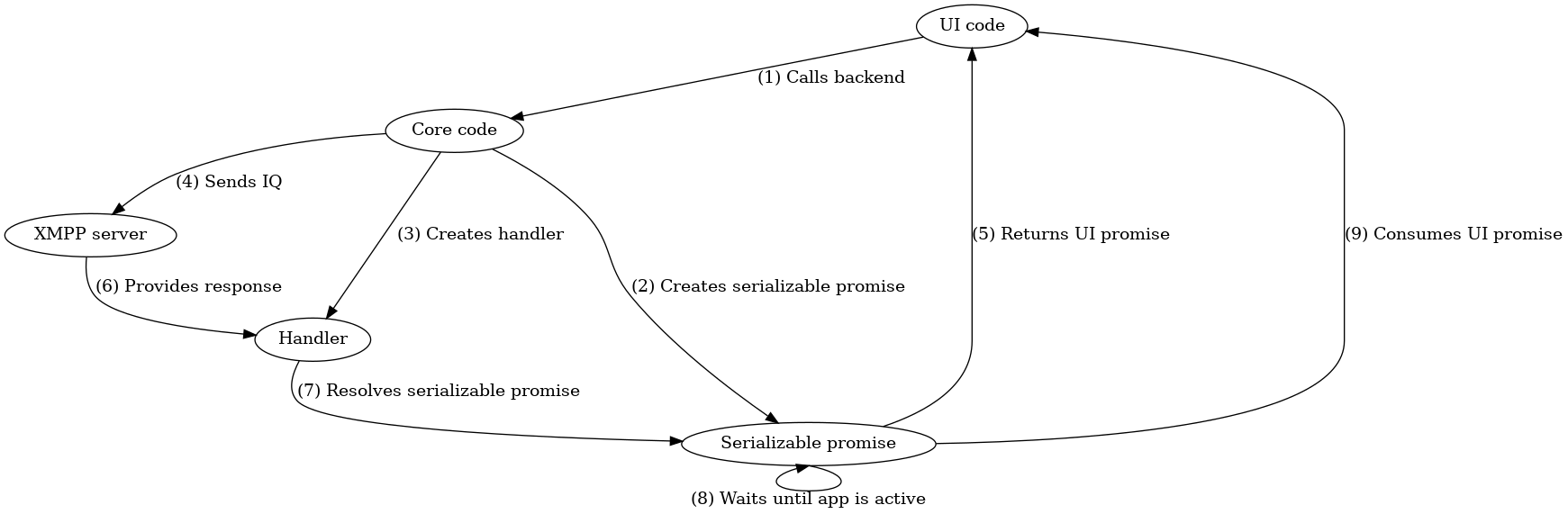
Let’s return to the initial scenario of removing the avatar of a group chat. The user chooses the new avatar and presses submit. Then, the following happens:
The UI code responding to requests to remove the avatar calls the backend method to do this.
Once the backend function completes, it will return an AnyPromise, allowing the UI code to continue immediately:
showPromisingLoadingOverlay(overlay, headlineView:Text("Removing avatar..."), descriptionView:Text("carview.php?tsp=")) {
// this returns an AnyPromise used by the loading overly to hide itself once it gets resolvedself.account.mucProcessor.publishAvatar(nil, forMuc: contact.contactJid)
}
The core code creates a new handler, and passes the MLPromise to it as an argument. Recall that handlers serialize their arguments - this means that, even if the app is suspended and the handler is called in the appex, the MLPromise will be available.
Internally, the MLPromise has created an AnyPromise. This is a type provided by PromiseKit that can be returned directly to the UI, and that the SwiftUI code understands. It gets returned to the UI code.
return [promise toAnyPromise];
(6) XMPP server provides response
This happens on the server side and is not relevant to Monal.
However, while waiting for the response, the user puts the app into the background, and the app gets suspended.
Now, the response from the server activates the appex, since the app was suspended.
The handler is called with the response from the server. It resolves the promise (via either reject or fulfill) - passing that response to the promise.
If the promise had been resolved from the app, it could have been consumed immediately. However, since it was resolved from the appex, the AnyPromise was not available to call at that time.
Therefore, the promise does not consume itself yet - it instead waits for the app to return to active state.
This waiting is performed by the following observer - whenever either the app or appex is unfrozen, the deserialize method is called:
deserialize calls attemptConsume on each run. attemptConsume checks if we are inside the appex (in which case we do not consume the promise), and only if we are inside the app does it consume the promise:
-(void) attemptConsume{
DDLogDebug(@"Intend to consume promise %@ with uuid %@ and argument %@", self, self.uuid, self.resolvedArgument);
if([HelperTools isAppExtension])
{
DDLogDebug(@"Not consuming promise %@ with uuid %@ as we are in the app extension", self, self.uuid);
return;
}
// ...
}
Note that both reject and fulfill also call attemptConsume after resolving the promise. This would let the promise be consumed immediately if we are inside the app instead of the appex.
Once we progress past the checks in attemptConsume, we finally consume the promise by calling the resolve callback tied to the PromiseKit AnyPromise returned earlier. This in turn prompts the UI to hide the loading overlay.
The XMPP assembly for the Chaos Communication Congress 39C3 has been confirmed!
The Chaos Communication Congress is a hacker conference that takes place every year barring specific world-ending events, and in which more than 10 000 hackers come together in Hamburg (previously Leipzig and Berlin).
We will have a space inside the Critical Decentralization Cluster habitat this year, which will provide a friendly space for discussions and exchanges on technology and politics with other communities working towards decentralization.
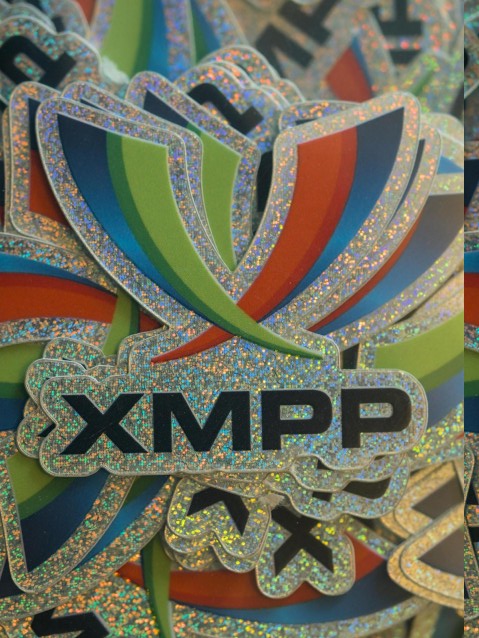
We will also come with a bunch of sparkly XMPP stickers that look like this:
Sparkly XMPP stickers
If someone plans to stay a while at the assembly, please make sure to register with the assembly on your ticket, as described in the info pages, so that we have enough room for everyone.
You can join the XMPP chatroom (web) as well as support organisation via the related XMPP Wiki page.
Regarding the article contact mathieui if you have remarks or suggestions concers.
The IgniteRealtime community is happy to announce a new release of its open source, real-time communications server server Openfire! Version 5.0.3 brings a number of stability improvements and bug fixes. Notably, a number of improvements were made to Multi-User Chatroom (MUC). Please refer to the full changelog for more details.
You can obtain the new version of Openfire for your platform from its download page. The checksums for the binaries are:
The Chaos Communication Congress is a hacker conference that takes place every year
barring specific world-ending events, and in which more than 10 000 hackers come
together in Hamburg (or previously Leipzig or Berlin).
We will have a space inside the Critical Decentralization Cluster habitat this
year, which will provide a friendly space for discussions and exchanges on
technology and politics with other communities working towards decentralization.
I will come with a bunch of sparkly XMPP stickers that look like this:
If someone plans to stay a while at the assembly, please make sure to register
with the assembly on your ticket, as described in the info pages, so that
we have enough room for everyone.
On December 9th I returned to the Trolley Barn to DJ again for my friend Valerie
Young.
This time around my goal was to have a better mix of high energy and lower
energy “groovy” tunes, and I wanted to be better prepared for tying in endings
at any time, no matter how many times through the caller requested.
Prep
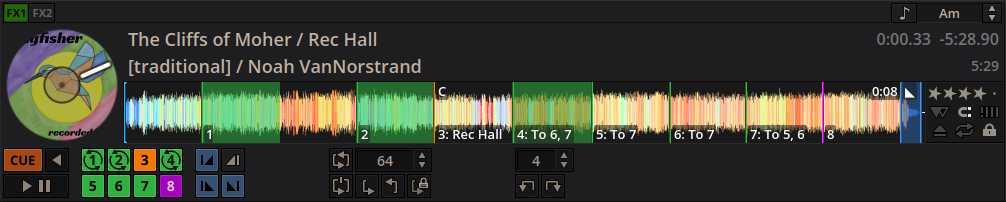
While I still prepped by marking each time through the dance with whether it
looped cleanly or not, this time I (mostly) marked it with a cue instead of a 64
beat loop.
I also named the cue based on what other cues I could jump to cleanly from it.
For example, if I were on the last time through the dance I would mark if it
looped cleanly itself, but also that I could jump backwards 3 times to cue 6 (or
whatever the case may be).
This way if I’m nearing the end of the dance but the caller is running it a bit
longer I can reset without a single 32 bar phrase starting to get repetitive.
I can also plan ahead by seeing that cue 6 lets me jump back to cue 8 or 9
afterwards (let’s assume these are the last two cues), which means that if the
caller immediately calls 2 more times through I know that I can cleanly jump
back to 2 more times without incident.
I also mark a handful of things in the music such as if this time through the
dance is a big recognizable build up (which I might not want to repeat even if
technically it sounds okay), or if I shouldn’t jump back before a cue because
the energy is significantly lower and we don’t want to kill the energy that had
already been built up on the dance floor.
This made it much easier to always follow the callers instructions and not have
to scramble to wrap up the song or ask if we can do 4 times through the dance
instead of 2 or what not.
The Set
I started out the set with a slowed down mix of “Whelan’s”, “Baghad Gus”,
and “Congress Reel” all by Wild Asparagus.
This was a medley that I had planned for my previous set but hadn’t managed to
use, but it worked quite well to “Whoever is Right is Right” by Jim Hemphill.
The only iffy moment I had in this medley was in one of the transitions where I
thought I executed it perfectly, only to have the tune I was introducing jump
half a beat ahead, breaking the rhythm.
I had left the Quantize option on (which locks the two beat grids together even
if you’re a little bit off) and unfortunately the beat grid on the song in
question was about half a beat off at the point I was doing the intro.
Lesson learned: pay more attention to what options you’ve got selected (and
reset them between songs, this would be a problem several times during the
evening) and in a song where the beat grid can’t be right through the entire
song (ie. because of tempo changes), make sure it’s correct at the point you’re
going to mix in.
Whelan's / Baghad Gus / Congress Reel by Wild Asparagus, DJ mix
For the second dance Valerie picked “Made Up Tonight” by Erik Hoffman.
This dance is relatively easy and in some ways similar to the previous dance so
I decided the dancers could handle a little bit higher tempo and energy level.
I did a mix of “Bus Stop!” by The Free Raisins and “Rec Hall” by Kingfisher.
This is another mix I had prepared for my previous set and one of the ones I was
most excited about performing.
Unfortunately I completely broke the transition by just forgetting to bring the
volume up on Rec Hall, so I ended up killing the music entirely for a few beats
before I realized what was happening and brought it back in.
It sounded terrible, and this one the dancers couldn’t help but notice, but
Valerie kept calling so they were on beat still when I finally realized what was
happening.
Lesson learned: go ahead and beat match and mix in a few bars early, then do
the transition by bringing the volume up instead of just hitting play, or just
remember to have the volume up first.
Bus Stop! / Rec Hall by The Free Raisins and Kingfisher, DJ mix
At this point Valerie decided to take the evening in a different direction from
the modern, improper and becket contras that the Trolley Barn normally asks
callers to stick to.
She called “The Steps of Waterloo”, a traditional Sicilian circle, which I’ve
never seen done at the Trolley Barn before.
Since this one is both easy and a bit silly I used “Flying Ice Cream” by Giant
Robot Dance which starts out very slow and groovy, then ramps up dramatically in
the second half.
Once the dance ramped up I mixed it with “The Randomainians” by The Great Bear
Trio to make it last a little longer.
This was the one mix and dance combo of the night that I was mostly extremely
pleased with, when the tempo and energy ramped up half way through the song the
dancers cheered and started frantically rushing to try and get to the basket
swing in the limited time the (normally too fast) music allowed which was a lot
of fun.
Lesson learned: prepare about twice as much music as you think you’ll need
for the evening (to be fair, I already knew this, I was just struggling with the
preparation for this set and didn’t end up with enough time to finish the other
mixes I was considering).
Flying Ice Cream / The Randomanians by Giant Robot Dance and The Great Bear Trio, DJ mix
Continuing Valerie’s theme of not doing modern contras she picked “The Hand
Jive”, a proper ceilidh, by Colin Towns next.
Because this dance is a bit more “fun” and contains some patty-cake like hand
games I decided to do a simple but fun mix of “Raccoon” by Wake Up Robin and
Disco Snails by Vulfmon and Zachary Barker.
Unfortunately I hadn’t considered that, easy as the hand clapping is, it
required Valerie to do a significant amount more calling than she normally would
do and never drop out, so picking a song with lyrics was a bad idea.
A few people still got a chuckle out of the “Disco Snails” cameo though.
Lesson learned: make sure to pay attention to how much the caller will have
to talk and ask if they plan on dropping out before introducing something with
lyrics.
Racoon / Disco Snails by Wake Up Robin and Vulfmon and Zachary Barker, DJ mix
We took our mid-dance waltz break at this point for which I played “Waiting for
Landfall” by Julie Vallimont, “Indifference” by the String Beings, and
“Norwegian Reinlender / Schottis From Idre” by Wild Asparagus.
I’d hoped that some of the dancers would know the schottische for the second
part of the medley, but mostly it just confused everybody who kept trying to
waltz even though it was no longer a waltz.
Coming back we were running a bit late so I decided to drop the show-stopper for
the evening, a mix of “Rainy Night” by The Dam Beavers, “Tween Spirit” by
Giant Robot Dance, and “Smells Like Teen Spirit” (which, of course, the
previous tune is a cover of) by Nirvana.
This was paired with “Birminghams” by Gary Nelson.
I played the first two tunes as a normal medley, then when Valerie indicated that
she was ready for three times left through the dance I mixed in the actual
Nirvana version just for the ending.
I was worried this crowd wouldn’t care for it, but when the tune first came in
(as “Tween Spirit”) a lot of the dancers started singing along, and when actual
Nirvana came in at the end the energy really ramped up and there was a lot of
cheering and stomping, so apparently even the younger members of the crowd were
still excited about 90s grunge!
The only real problem with this dance is that I had one moment where I had a
clean loop that I wanted to repeat but as I did so some of the dancers, knowing
what came next in the song, started singing the next verse and then had to stop
when the music wasn’t what they expected.
Lesson learned: when doing a pop song don’t do transitions that would break
the progression of the song that people are already used to, even if they sound
okay.
Rainy Night / Tween Spirit / Smells Like Teen Spirit by The Dam Beavers, Giant Robot Dance, and Nirvana, DJ mix
At this point I realized that I hadn’t prepared enough mixes for the dance and I
was more or less out of material.
For the next one Valerie asked to do a very short square dance, the “Cumberland
Square Eight”.
Since it was going to be so short and timing didn’t matter I played “Heather’s
Concussion” by The Great Bear Trio without mixing it into a medley.
This tune is itself very short (only three times through) and far too fast for
a normal contra, so I slowed it down (though still keeping it too fast) and sped
it up slowly through the dance to mess with the dancers.
They looked like they had a good time!
Heather's Concussion by The Great Bear Trio, DJ mix
This left us with just enough time for a no-walk-through contra.
I had nothing else prepared but wanted to send us out on an easy-tempo dance
after the various fast shenanigans from the rest of the night, but still have
some good energy.
I dug around in my library and ended up playing “Apple Blossom” by Great Bear.
Since I didn’t have anything to mix this with I just played it through and
looped once or twice near the end to keep the high-energy ending going.
The dance Valerie picked was an easy ending dance that is unfortunately called
“Unnamed Contra” and she didn’t know who wrote it.
Apple Blossom by Great Bear, DJ mix
We then closed down the evening (very late, much to the chagrin of the
organizers) with “Mending” by “The Little Mercies”.
Stuff I Learned
A recap of the things I need to take away from the evening:
Be thoughtful about resetting all controls, levels, mixing, effects, etc.
between tunes.
Possibly write down the initial state for each song so that you can re-set the
board at a glance.
Beat match early then use the volume sliders for transitions, don’t just start
playing immediately at the entry point (or just remember to turn up the volume
as you approach the mix point).
Consider how much the caller will have to talk in any given dance and how soon
they’re dropping out before mixing in vocals.
For pop songs, don’t violate the order of the verses or breaks that people
expect, even if the final result sounds okay.
It’s jarring for the dancers who are used to it being a certain way.
And finally: relax and enjoy it! While I spend the entire evening worrying about
how the sound dropped out for a moment, or my transition was a beat off and I
saw the dancers stumble and catch back up, or whatever other disaster might have
befallen, no one remembers any of that.
I got a very nice message from the organizer the next day telling me how excited
everyone was and how many conversations she’d had with people telling her how
much they enjoyed the music!
As we close out our “Meet the Team” series for 2025, we’re delighted to introduce Camjar Djoweini, Business Development Manager, Nordics, at Erlang Solutions. Camjar shares what drew him into his new role, the excitement of working within Trifork’s global ecosystem, and the ambitions driving him into 2026. He also reflects on his favourite winter traditions and the personal routines that help him stay energised and focused throughout the year.
Can you tell us about your new role at ESL?
I’ve joined ESL Nordics Fjällräven as Business Development Manager, Nordics, where my focus is expanding our market presence into new greenfield areas alongside Erik. The mission is clear and energising: outbound, outbound, outbound.
Which part of your new role has sparked the most curiosity or excitement so far?
It’s a mix of working with exceptionally talented and experienced people and having access to the opportunities that come with being part of Trifork globally. I love that I’m within one of 71 companies in the group yet still feel connected as if we’re operating as one large organisation. We’re agile like a startup but strong like a Fortune 500. That breadth of access and innovation keeps my curiosity alive every day.
Looking ahead to 2026, what are you most looking forward to achieving?
I’m a high pressure performer and set ambitious expectations for myself. My goal is not only to hit the targets we’ve set but to exceed them, to make the whole team proud. I want to help shape our future, open new doors within the organisation and contribute meaningfully to our long term vision.
Ahead of the holiday season, are there any traditions you’re particularly looking forward to?
This might be an unpopular opinion, but I love the darkness and the cold. There’s something beautiful about how snow lights up the darkest hours. Winter helps me focus with routines, deadlines and structure, all leading to one of the cosiest traditions of the year. Good food, warm decorations, time with friends and family and the chance to unwind for a week. Christmas is my favourite tradition and we go all in.
When you’re away from the office, what brings you the most energy and joy?
I really value being able to structure my own productivity. I can work out during lunch without feeling like I need to rush home, and if something is better done at 7 pm, I can do that and still be productive at 8 am the next morning. Having the freedom to optimise my hours while maintaining strong internal connections with colleagues is incredibly energising.
Final Thoughts
And that brings our 2025 Meet the Team series to a close. A big shoutout to Camjar for sharing his energy and perspective, and to all the fantastic colleagues who took part this year. Their stories, passions and quirks are what make our team such a great place to be.We’ve got plenty more to share in the new year, so keep an eye out for fresh profiles, behind the scenes insights and more of the people who make Erlang Solutions what it is. And if you’d like to chat with our team or get involved, please get in touch.
Just like any other product or project by the XSF, the Newsletter is the result of the voluntary work of its members and contributors. If you are happy with the services and software you may be using, please consider saying thanks or help these projects!
The XSF is planning XMPP Summit 28, which will take place on Thursday 29th & Friday 30th, January 2026, in Brussels (Belgium, Europe). Following the Summit, the XSF is also planning to be present at FOSDEM 2026, which will take place during Saturday, January 31st & Sunday, February 1st, 2026. Find all the details in our Wiki. Please sign-up now if you are planning to attend, since this helps organizing. The event is of course open for everyone interested to participate. Spread the word within your circles!
Dino has released version 0.5.1 of its modern open-source chat client for the desktop. It focuses on providing a clean and reliable Jabber/XMPP experience while having your privacy in mind.
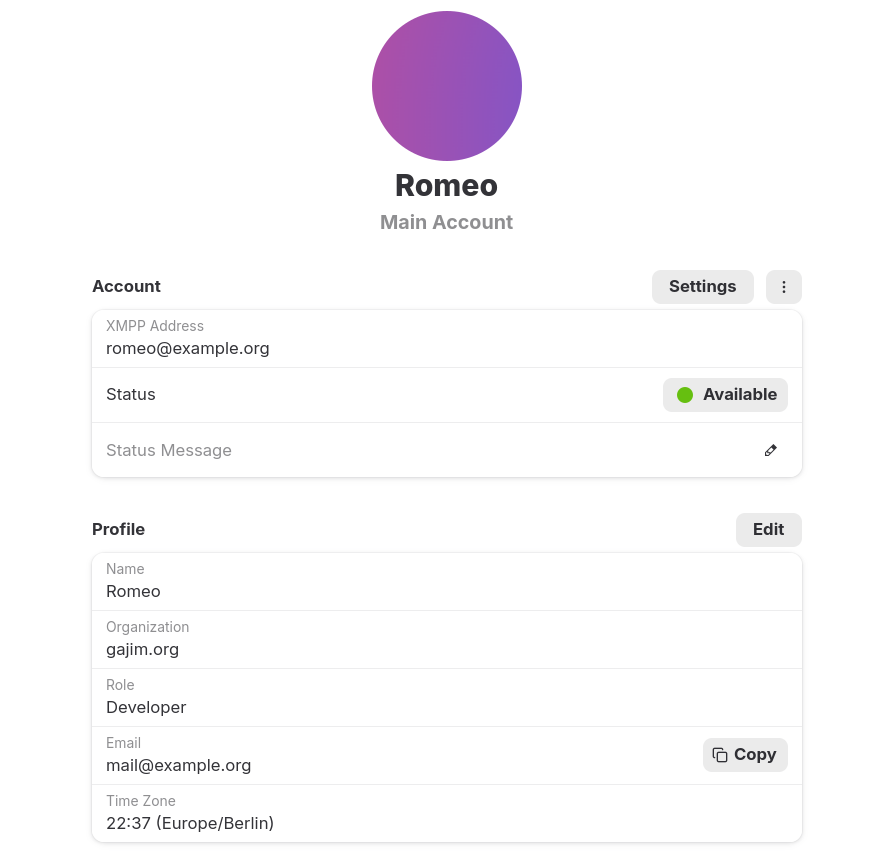
Gajim has released version 2.4.0 of its free and fully featured chat app for XMPP. This release brings read markers in group chats, improved file transfers, more details for your account, and many smaller changes and bug fixes. Thank you for all your contributions! You can take a look at the changelog for all the details.
Gajim: Your profile on the account page.
Monal has released version 6.4.14 for iOS and macOS.
Monocles has released version 2.0.17 of its chat client for Android. This update brings some fixes like more visible confirmation icons, update and add photo filter library, fix photo editor menu overlapping with status bar, setting to always use relays, and an improved extension deletion logic among many others. Make sure to take a look at the changelog for all the details!
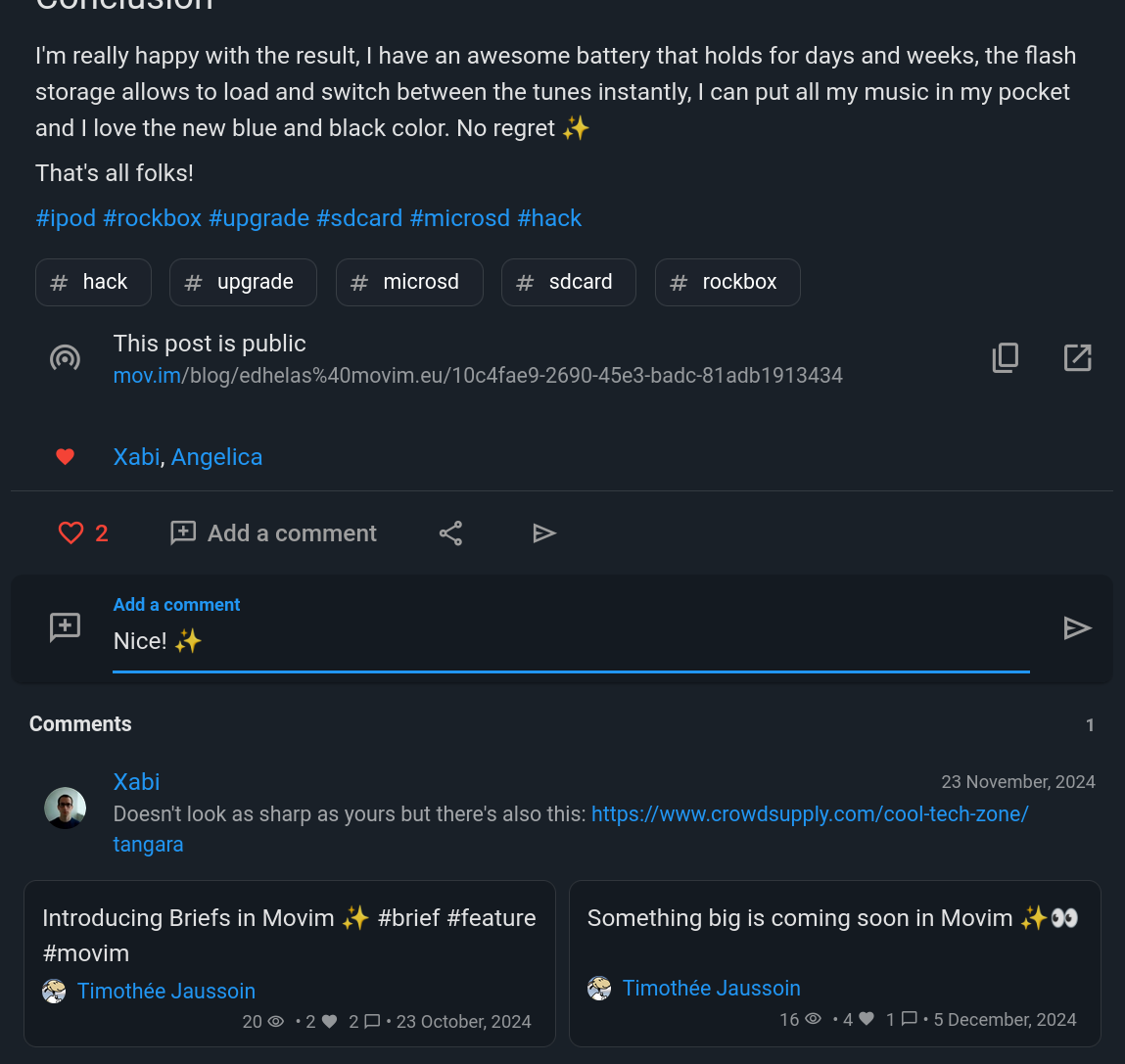
Movim has released version 0.32, code named ‘Wilk’, with version 0.32.1 immediately following it. This might be one of the biggest releases ever made on the project. It includes numerous fixes and new features in the 3 major topics Movim offers: instant messaging, social networking, and video conferencing. Head over the official release announcement and dive directly into the exciting things you can find in this release!
Movim: Share, like, and comment on articles more easily.
Prose has released version 0.1.111 of prose-core-client, their core XMPP client manager and protocols. Full details on the changelog. The project also released version 0.13.1 and 0.14.0 of prose-app-web, their web application built in TypeScript / VueJS / WebAssembly.
Snikket Server - November 2025 release: It’s time! We’ve been busy preparing a new release of the Snikket server software for you to enjoy. Although this release isn’t heavy on visible new features, a lot of internal changes and improvements have gone into this release to increase reliability and to pave the way for future plans.
XMPP Libraries & Tools
python-nbxmpp, a Python library that provides a way for Python applications to use the XMPP network, version 6.4.0 has been released. Full details on the changelog.
QXmpp, the cross-platform C++ XMPP client and server library, version 1.12.0 has been released. Full details on the changelog.
Smack, a modular, portable and easy to use XMPP client library for Android and Java, version 4.5.0 RC1 has been released. Please consider testing this release candidate in your integration stages and report back any issues you may found. The more people are actively testing release candidates, the less issues will remain in the actual release.
xmpp.js, a JavaScript library for XMPP, version 0.14.0 has been released. This release brings faster and more reliable connection management thanks to complete implementation of Stream Management, SASL2, Bind 2 and FAST. Another important change is the removal of all third party dependencies. Full details on the changelog.
Extensions and specifications
The XMPP Standards Foundation develops extensions to XMPP in its XEP series in addition to XMPP RFCs. Developers and other standards experts from around the world collaborate on these extensions, developing new specifications for emerging practices, and refining existing ways of doing things. Proposed by anybody, the particularly successful ones end up as Final or Active - depending on their type - while others are carefully archived as Deferred. This life cycle is described in XEP-0001, which contains the formal and canonical definitions for the types, states, and processes. Read more about the standards process. Communication around Standards and Extensions happens in the Standards Mailing List (online archive).
Proposed
The XEP development process starts by writing up an idea and submitting it to the XMPP Editor. Within two weeks, the Council decides whether to accept this proposal as an Experimental XEP.
No XEPs proposed this month.
New
Version 0.1.0 of XEP-0507 (Jingle Content Category)
Accepted as Experimental by council vote (dg)
Deferred
If an experimental XEP is not updated for more than twelve months, it will be moved off Experimental to Deferred. If there is another update, it will put the XEP back onto Experimental.
Make clear that PLAIN still has to be pinned away, if not disabled entirely (tm)
Version 0.2.0 of XEP-0492 (Chat notification settings)
Rework the spec to use more of the Service Discovery Identities registry
Fix the XML schema
Move the <advanced/> element into the notification setting element
Bump the namespace (tm)
Last Call
Last calls are issued once everyone seems satisfied with the current XEP status. After the Council decides whether the XEP seems ready, the XMPP Editor issues a Last Call for comments. The feedback gathered during the Last Call can help improve the XEP before returning it to the Council for advancement to Stable.
No Last Call this month.
Stable
Version 1.0.0 of XEP-0485 (PubSub Server Information)
Accept as Stable as per Council Vote from 2025-11-11 (XEP Editor(dg))
Deprecated
No XEPs deprecated this month.
Rejected
No XEPs rejected this month.
XMPP Public channels
New rooms and public channels are created on a daily basis on the XMPP network. So, if you are on the look out for new and exciting public channels to join, make sure to check out the Public Channel Search Engine to find out groups or communities that share your interests!
If you want to list all the channels, you can find them here.
If you are interested on something in particular, look by tag!
If you only want to list rooms in a particular language just add lang:xx in the search box, like in this example for the Spanish language. Just make sure to replace es for your desired language (like lang:fr, lang:de, lang:pt and so on).
Looking for job offers or want to hire a professional consultant for your XMPP project? Visit our XMPP job board.
Newsletter Contributors & Translations
This is a community effort, and we would like to thank translators for their contributions. Volunteers and more languages are welcome! Translations of the XMPP Newsletter will be released here (with some delay):
Contributors:
To this issue: emus, cal0pteryx, edhelas, Gonzalo Raúl Nemmi, Ludovic Bocquet, Sonny Piers, XSF iTeam
This XMPP Newsletter is produced collaboratively by the XMPP community. Each month’s newsletter issue is drafted in this simple pad. At the end of each month, the pad’s content is merged into the XSF GitHub repository. We are always happy to welcome contributors. Do not hesitate to join the discussion in our Comm-Team group chat (MUC) and thereby help us sustain this as a community effort. You have a project and want to spread the news? Please consider sharing your news or events here, and promote it to a large audience.
Tasks we do on a regular basis:
gathering news in the XMPP universe
short summaries of news and events
summary of the monthly communication on extensions (XEPs)
For this newsletter either log in here and unsubscribe or simply send an email to newsletter-leave@xmpp.org.
(If you have not previously logged in, you may need to set up an account with the appropriate email address.)
Erlang Solutions launched SAFE, a Security Audit for Erlang in the fall of 2023. We extended the analysis for Elixir in the spring of 2024 and now, SAFE officially supports Phoenix Liveview, which means a SAFE scan is now looking for vulnerabilities common in Phoenix web applications.
What is SAFE?
SAFE is a security scanning tool for Erlang, Elixir and Phoenix (LiveView) codebases. It works by loading and analysing your code, without running it. SAFE conducts an in-depth analysis of codebases, which can help you and your company to elevate your cybersecurity.
Supporting Phoenix LiveView
Now, as of the 1.3.0 release of SAFE, we support Phoenix LiveView, which means we can check for the following vulnerabilities:
Cross Site Scripting (XSS)
Cross Site Request Forgery (CSRF)
Cross-Site WebSocket Hijacking (CSWSH)
SQL Injection (with Ecto support)
Denial of Services (DoS)
Session leakage (unprotected session information)
Session fixation (session ID renewal issues)
Session hijacking
Content Security Policy (CSP)
On-Prem report visualisation
With the release of the new SAFE version, a new SAFE product flavour was also launched, called SAFE OnPrem. This solution allows companies to host a centralised security report viewer that engineers and security specialists can access via the web interface.
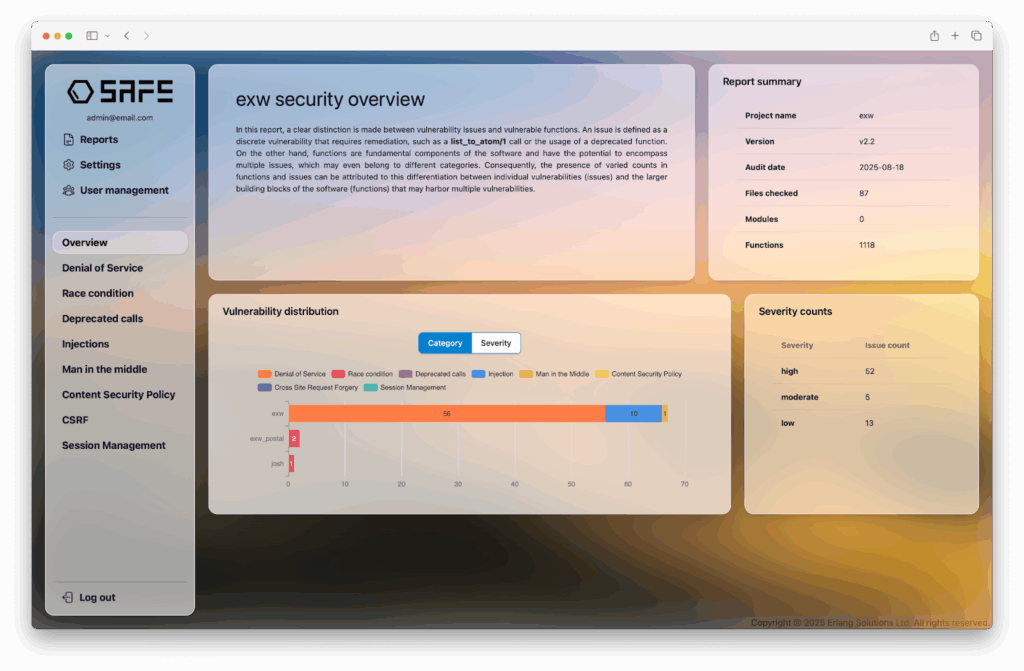
Overview page of an example report:
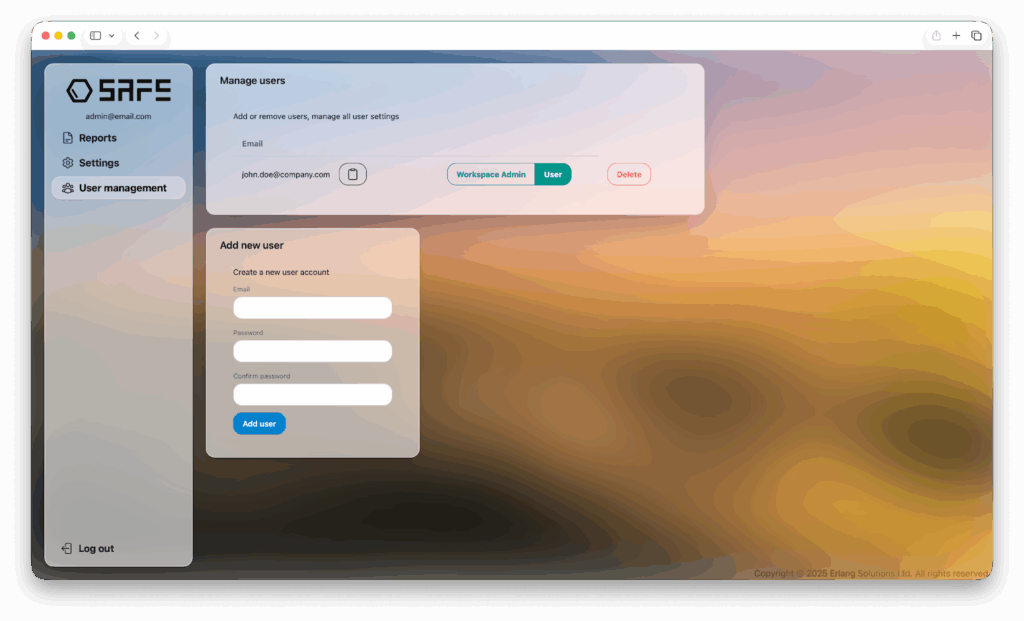
User management:
Running SAFE
If you are interested in running SAFE on your code base, please check out our Quick Start Guide and contact the SAFE team. You can also drop us a message if you maintain an open source project, as you may be eligible for a free SAFE license.
More information about Open Source licensing can be found in our announcement blog post.
The moment a fintech product shifts from prototype to production is often when the cracks appear. Tiny shortcuts. Half-formed assumptions. Decisions made because “we’ll fix it later.” They all return, and they return quickly.
At first, everything looks fine. The demo works. Early users onboard without trouble. In turn, confidence builds. Then real volume arrives with real expectations, and the product that once felt promising starts to resist growth.
The (Minimum Viable Product) MVP phase should have revealed the weak points. It should have been the place to break things safely. But often it becomes a race to launch without learning much at all. Speed gets mistaken for insight, and the cost shows up when the stakes are highest.
For teams serving SMEs, the risk is even greater.
The Scaling Problem: When “go fast” Stops Working
Fintechs focused on small businesses usually start strong. They prove demand, attract their first cohorts and show early traction.
Then comes the real hurdle: scale.
Small and medium-sized businesses don’t want flash. They want reliability, simplicity and absolute confidence that their money, payments, payroll and data won’t break at the wrong moment. According to The Payment Association, with 5.51 million SMEs representing 99% of UK businesses alone, that demand is huge.
Picture thousands of businesses depending on your platform every minute. If your stack can’t handle load variations, regulatory nuances across regions or the complexity of business onboarding, growth becomes dangerous.
And the consequences aren’t theoretical. One industry review found that hidden infrastructure issues in fintech quietly drain 10–20% of capital and create terrifying downtime costs.
When an SME loses access to its financial tools, even for an hour, it can feel like a lost lifeline.
Scenario in action
Let’s imagine a fintech that nails product-market fit in one region. SMEs love it. Growth follows. Then expansion begins, and strain appears immediately.
The original build never accounted for multi-region onboarding, regulatory differences, load variation or different payment rails. The product did not fail. Success exposed everything the MVP never tested.
This often happens when early architecture is not prepared for real-world complexity. As usage expands, the gaps surface quickly.
Why MVP habits collapse at SME scale
In the rush to market, fintechs often use the MVP mindset (launch early, iterate fast). That works for consumer apps but is riskier for platforms serving SMEs, where downtime, data inconsistency and compliance are costly.
Research shows only around 43% of UK SMEs accessed external finance in Q2 2024, and just 44% of applications were successful.Given this tight margin of trust and reliability, the fintech solving SME problems must get the architecture right from early on.
SMEs often adopt fintech solutions fast: one study found that 65% of UK SME decision-makers believe they need the agility of fintech to enable their growth plans.The opportunity is there; what is less guaranteed is the product foundation. When the MVP is built purely for launch speed, the next stage of growth can expose fragilities.
Common challenges for SME-serving fintechs:
Lack of monitoring for thousands of SME users rather than hundreds
Compliance demands when onboarding business accounts vs consumer
Manual operational workarounds that don’t scale
Infrastructure built for single region, not multi-market
These issues rarely show up in a prototype. They surface the moment production load, regulation and real SME behaviour collide.
Building for production: What matters most
Turning a prototype into a platform that serves millions of SMEs requires architectural discipline. It starts with asking a simple question: what happens when this grows?
Technology choices matter. Systems built on concurrency, resilience and fault tolerance give fintechs room to scale without rebuilding from scratch.
Platforms using the BEAM virtual machine and languages like Elixir rely on lightweight processes and supervision strategies that keep systems stable under heavy load. Adopting these foundations early means your prototype does not have to be replaced. It evolves.
And SMEs feel that difference.
What this means for fintech SMEs (and their customers)
When a fintech platform is designed with SMEs in mind, the impact is felt inside the company and in the daily routines of customers.
Reduced downtime and more stability
SMEs cannot pause operations because a platform is struggling. Payroll, payments and transactions move continuously. Downtime is costly and trust disappears quickly. A system designed to scale helps avoid those fragile moments and reduces the need for constant emergency fixes.
Lower cost of change
When the architecture anticipates growth, teams spend less time rebuilding and more time improving the product. Smoother onboarding, integrated payments and better analytics become easier to deliver. Languages like Elixir support this quietly, allowing teams to make changes without breaking the foundations.
Simpler compliance and clearer audit-ability
Serving SMEs means navigating business account requirements, lending oversight and payment regulations. Systems built to production standards make compliance part of the design rather than a collection of manual steps.
Faster deployment and steady iteration
Fintechs must keep innovating without sacrificing stability. Lightweight processes and strong supervision make frequent, safe deployments possible. Stability and progress can coexist.
A better experience for SME customers
When the platform works reliably, teams can focus on problems that matter: cash-flow visibility, credit access, smoother invoicing and efficient banking. SMEs notice. 85 percent of UK SMEs would consider choosing a fintech over a traditional bank because the digital tools are stronger.
To conclude
Fintechs serving SMEs rarely struggle because the idea is weak. They struggle when the technology behind that idea cannot keep up with real businesses. The prototype is only the starting point. Production is where reliability becomes a promise you must keep.
SMEs run on trust, cash flow and predictable systems. When a platform fails, it affects salaries and core operations.
This is why resilient foundations matter. Using a programming language like Elixir, built on BEAM’s concurrency and fault-tolerance strengths, helps teams create systems that stay steady even as demand rises. It gives product teams room to improve instead of constantly patching.
The SME opportunity is significant. The question is whether your platform has the strength to grow with it. If you’re a fintech and would like to build with resilience in mind, let’s talk.
Turning fast- moving prototypes into stable, scalable solutions is far easier when you make the right choices early.
We hear this too often: “XMPP uses XML. It should use JSON—it’s more modern.”
The logic seems straightforward: JSON came later, so it must be better. But better for what, exactly?
JSON became successful because it’s the standard serialization format for JavaScript. That made it convenient for browser-based applications.
Does that make it the universal format for every protocol? Of course not.
Consider this: browsers still use HTML to organize web pages, not JSON. Same with CSS. Why? Because using JSON for everything would be a nightmare.
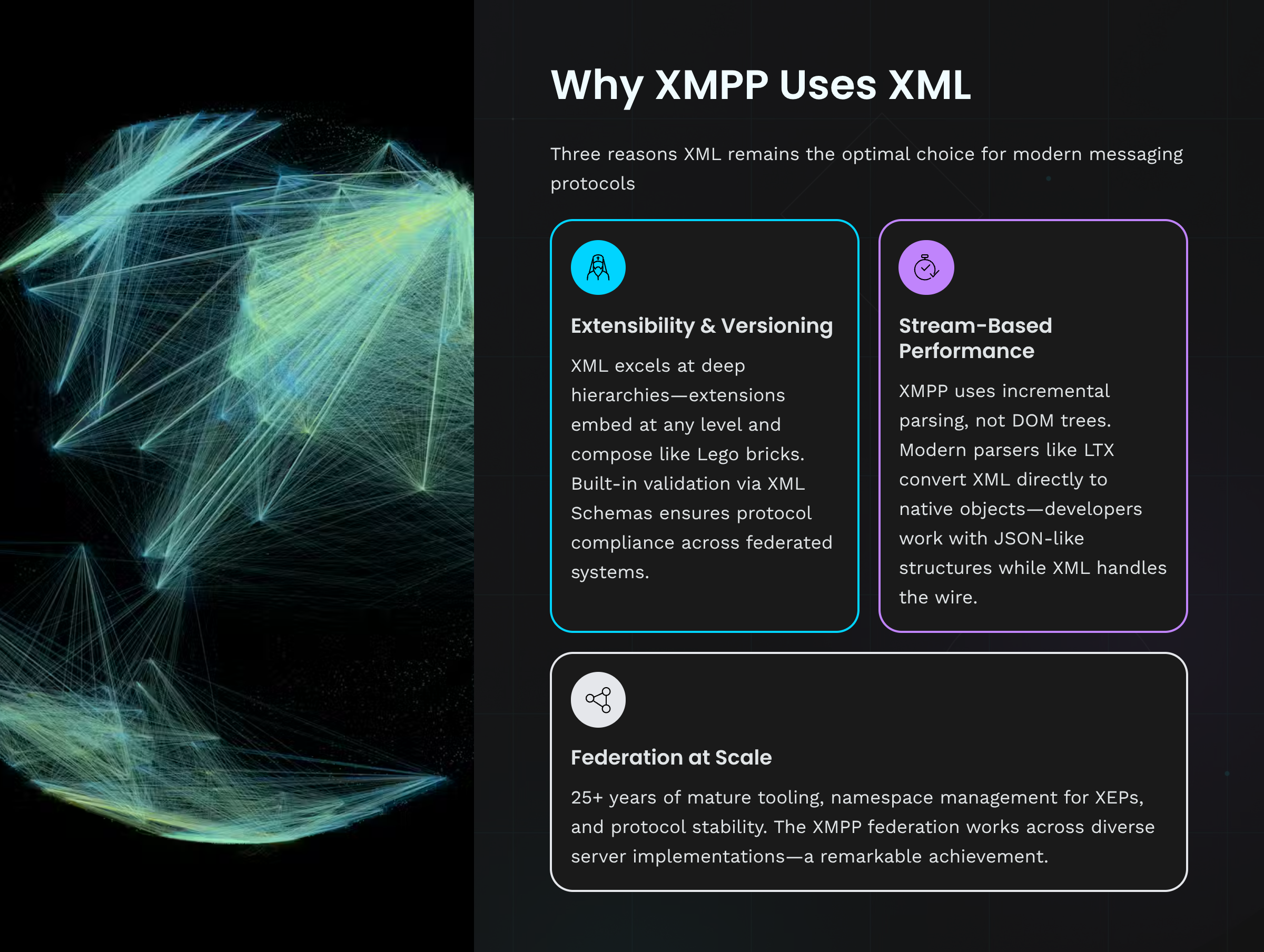
XML remains the best format for representing trees—deep hierarchies of nested data. JSON handles flatter structures well, but good messaging protocols are extensible: extensions can be embedded at different levels and composed together, like Lego bricks. That’s where XML shines.
The Performance Myth
Another common claim: XMPP’s XML is more complex than JSON, so it must be much slower.
In practice, XMPP chat platforms are snappier, with remarkably low message latency. How?
XMPP clients don’t parse XML the way most people assume. They’re not building massive DOM trees in memory, like a browser loading a page. Instead, they use stream-based parsing—XML arrives, gets parsed incrementally, and converts directly into native data structures.
This is especially true in browser environments, where XMPP streams run over WebSockets, which naturally frames the XMPP protocol. That’s why you are never actually working with XML trees consuming large chunks of memory. Modern implementations like XMPP.js go further and use LTX—a lightweight parser built specifically for XMPP’s streaming model—rather than the browser’s DOM parser. The result: developers work with JSON-like objects anyway. The wire format becomes invisible to your application code.
XML brings three key advantages:
Built-in extensibility with validation via XML Schemas
Clean namespace management for XEPs: when the protocol needs to evolve, you can change the namespace of an extension, making versioning explicit and backward compatibility manageable
25+ years of mature tooling and battle-tested parsers
These matter when you’re building federated systems that need to evolve over time and need to stay compliant over time. The XMPP federation is a huge ecosystem of servers that can talk to each other, relying on different server implementations and are not always up to date. Still, the federation works, and we too often forget that this is a great achievement in itself.
Real performance bottlenecks in XMPP deployments come from elsewhere entirely: network latency, database optimization for roster and message storage, custom module performance, external components, or clustering and routing logic.
The myth persists because XML looks verbose when you read it. But visual verbosity has almost no correlation with parsing performance. Modern CPUs parse XML and JSON at nearly identical speeds for typical XMPP message sizes. Any difference vanishes in a real-world client.
Where the Real Complexity Lives
XMPP does have genuine complexity—but it’s not the wire format. It’s the protocol depth and the extensive XEP ecosystem with hundreds of extensions. That’s a real learning curve.
Consider XMPP when these factors matter to you:
Federation across organizational boundaries
Open standards and avoiding vendor lock-in
Protocol stability that won’t break in three years
Extensibility without forking the protocol
If those resonate, the wire format should be the least of your concerns.
We’ve been building XMPP systems for over 25 years. The XML performance question comes up often in early conversations. Every single time, we end up optimizing ejabberd configuration, clustering, architecture, client protocol usage, and databases instead.
Thinking about XMPP for your next project? Reach out during the design phase. We’ll help you avoid the actual bottlenecks.
The XMPP Community is very excited to announce its presence at the coming FOSDEM 2026!
Once again, many members of the XMPP community will be attending, and will happily welcome you!
Realtime Lounge
The XMPP community invites you to the Realtime Lounge, where you can come and meet community members, project developers, see demos and ask all the questions.
For XMPP Community members and interested individuals: Please share any promotion materials, ideas, or planned activities for the Realtime Lounge, and your thoughts will help us prepare a welcoming space. Click here to contribute.
Decentralised Communication Devroom & Talks
Be invited to the technical talks around decentralised communication.
There will also be talks on various messaging and Real-time communication (RTC) projects such as ActivityPub, ATProto, Automerge, DeltaChat, Matrix and of course XMPP in the Decentralised Communication developer room.
Prior to FOSDEM, the XSF will also traditionally hold its 28th XMPP summit.
This is where community members gather to discuss protocol changes and the XMPP roadmap.
Everyone is welcome to join, just kindly list yourself free of cost as there is only limited space.
Check the official online presence and communication, too (see the media links in the footer).
The Smack developers are happy to announce the availability the first release candidate (RC) of Smack 4.5.0.
The upcoming Smack 4.5 release contains many bug fixes and improvements. Please consider testing this release candidate in your integration stages and report back any issues you may found. The more people are actively testing release candidates, the less issues will remain in the actual release.
If history repeats itself, this could become the next open standard for secure messaging.
Signal (formerly Open Whisper Systems) created the Double Ratchet algorithm in 2013–2014, introduced in TextSecure v2 in February 2014. They packaged it into the open source Signal Protocol. It became the mainstream standard for end-to-end encrypted messaging. XMPP adopted it (OMEMO, first drafted in 2015). Matrix adopted it (Olm/Megolm implements Double Ratchet concepts).
The problem is that current encryption methods could break when quantum computers get powerful enough, so Signal built Triple Ratchet to protect against that.
Most messaging companies are preparing for this but I noticed that WhatsApp has no public roadmap for the adoption of quantum resistance protocols. They use the Signal Protocol for encryption, so they may simply wait for the result of Signal’s work to adopt the new approach.
It is much heavier to implement, so I am wondering if Triple Ratchet follows the same path as Double Ratchet and gets widespread adoption.
If open protocols like XMPP and Matrix adopt it, it may be huge for European messaging independence.
What’s your take? Do you think quantum resistance will become a mandatory feature for end-to-end encrypted messaging platforms in the next couple of years?
It’s time! We’ve been busy preparing a new release of the Snikket server
software for you to enjoy. Although this release isn’t heavy on visible new
features, a lot of internal changes and improvements have gone into this
release to increase reliability and to pave the way for future plans.
Notable changes
Changes to limited user accounts
Snikket allows you to configure chosen accounts as “limited”. These limited
accounts can only communicate with other people on the same instance of
Snikket. They are commonly used for children, guests, and similar purposes.
Until this version, it was documented that limited accounts prevented outbound
messages, but inbound messages (if someone knows the address) were still
accepted. While this provided a certain level of protection, inbound
messages will now also be blocked. This ensures that even if a limited user’s
address becomes somehow known, it will still be impossible to send them
messages.
We believe that the new behaviour aligns with what the vast majority of people
expect and want from the limited accounts feature.
Docker health checks
Some of our containers provided health checks. In practice these were noisy,
causing excessive log entries. They checked various things, but were never a
full guarantee that Snikket is working successfully.
These built-in health checks have been removed from this release. We recommend
external monitoring if you want to make sure your Snikket instance is up and
running. The docker health checks were never able to fully provide this.
Compatibility with SDK-based apps
We have been working on an SDK which makes it easier to develop cross-platform
apps for Snikket and other modern XMPP services. You can read the latest SDK
news in this blog post.
The first new apps using the SDK will be a dedicated Snikket web app
(so you will finally be able to chat using your Snikket account in a web
browser) and we are also working towards a future update to our iOS app based
on the SDK.
This Snikket server release adds certain protocol features, such as upgraded
push notification APIs, which are used by the SDK-based apps. This makes it
easier for developers and early adopters to test the new apps and iron out any
issues before they reach general availability.
Upgrading
Upgrading an existing installation is super simple and takes less than a
minute! You can find instructions in the ‘Upgrading’ section
of the release notes.
If you have any questions or feedback about the new release, come and join the
discussion in our community chat.
Some time ago, we teased you with our plans for a cross-platform “Snikket SDK”
(Software Development Kit) which would be used to build a new generation of
Snikket apps. Particularly a much-requested web app for Snikket, so folks can
chat directly in the web browser without installing anything. We also intend
to replace our current iOS app with an SDK-based app when that becomes
feasible.
The SDK is not aimed directly at Snikket users (but if you have
development skills, why not?!). It is primarily for the people developing
Snikket apps, though it will bring with it many benefits for the project and
its users.
Why an SDK?
We currently have two official apps, for Android and iOS. Both of these are
entirely separate codebases, which means that, while we have tried to align
them as much as we can, there are still significant disparities between the
two platforms, in terms of features, bugs and the general user experience.
Snikket has consistency as one of its main goals, so this is something we
consider important to improve.
On top of this situation, people frequently request the ability to chat using
their Snikket account via their web browser. However, this would add a third
codebase for us to maintain, and the existing problems would be amplified. And
we haven’t even talked about a desktop app yet!
It’s not sustainable to maintain so many completely independent apps of the
quality and consistency the project is aiming for. With currently only one
person working full-time directly on Snikket, simplification would be
especially beneficial.
Developer experience
One of the reasons that Snikket only has one developer is that it’s hard to
find developers! The majority of developers we have worked with are familiar
with front-end work, and often have experience with integrating with basic
HTTP APIs. But it’s much harder to find generalists who are also willing to
work with other technologies that Snikket uses, such as XMPP. Similarly, it’s
rare to find developers interested in chat protocols who are also front-end
user interface developers.
While it’s undoubtedly not hard to build an XMPP-based chat app in a weekend,
building a comprehensive modern chat app using any protocol and any language
with all the modern features, security, and reliability that people expect is
understandably a daunting task.
With the SDK, we aim to “divide and conquer” - enclose all the protocol parts
in the SDK, and leave the least amount of complexity possible so that
front-end developers can do their thing with the UI without unnecessary
friction.
XMPP libraries are already available for most platforms to perform a lot of
the work for developers. However, they generally still assume and require a
level of familiarity with XMPP, and require the developer to make certain
higher-level architectural decisions when building an app. This includes
things like message synchronization strategies, processing push notifications,
audio/video calls, and so on.
Our SDK is not yet another XMPP library. In fact, it actually uses existing
XMPP libraries itself. What the SDK provides is the middle “glue” layer
between the user interface and the messaging protocol layer. The SDK itself
hides every detail of XMPP from the app developer.
While most XMPP libraries try to remain flexible, to allow developers to
build and design their apps however they want, the goal of our SDK is to
make all the choices for them. Provide just one obvious way to do things - the
Snikket way.
This works for us precisely because of Snikket’s goal for one consistent user
experience across all platforms. It wouldn’t necessarily be a good idea to use
the SDK to build an IoT app, or any of the other use cases XMPP can be applied
to (though this hasn’t stopped people building cool things with the SDK
already!).
Developer efficiency
While we knew that writing this SDK from scratch would be a significant effort,
much of it is effort that we would have had to spend anyway on writing a
new Snikket app for, say, the web. All we had to do was make sure that the
work we did for that app could be re-used across multiple platforms.
For this we adopted a relatively niche but well-established language called
Haxe.
Fairly well-known in certain domains, such as multi-platform mobile game
development, Haxe is a neat little language with built-in capabilities for
cross-compiling to multiple output languages. This means that we can write
our SDK code once in Haxe, and then compile it to Javascript for the web, but
also to native libraries for practically any platform. In line with our goals
to build a web app and iOS app for Snikket, we currently build JS and Swift
versions of the SDK.
Now, when adding a new feature, the bulk of our work will be in the SDK,
followed by the supporting UI code for each of our apps (which can be
undertaken by anyone familiar with those platforms - no special XMPP expertise
needed).
Current status
The SDK project already covers most important features, from messaging to
audio/video calls. Although we aren’t ready to announce any new Snikket apps
yet, we’re getting closer with every commit. There are several projects
already based on the SDK:
The Cheogram apps were developed by singpolyma
who has also been the driving force behind getting the SDK towards stability
and feature completion.
There are a few things we’re still working on in the SDK. The big one for
Snikket is OMEMO. We have 1-to-1 just working (not yet included in any of the
above apps). OMEMO in group chats is next, and top of the priority list.
Finally, in recognition that the SDK is already growing beyond powering just
Snikket apps, we have spun it off as a semi-independent project with its own
website and project name - Borogove SDK!
Next steps
Once the SDK has feature parity with the current apps, we’ll be working on
the user interface, starting with the web app. Keep an eye out for preview
builds of Snikket apps in the new year!
If you’re a developer and any of this sounds like stuff you would be keen to
help out with, get in touch!
Just like any other product or project by the XSF, the Newsletter is the result of voluntary work of its members and contributors. If you are happy with the services and software you may be using, please consider saying thanks or help these projects!
Healthcare messaging must be secure, interoperable, and compliant, yet too often relies on closed consumer platforms. In the Netherlands, the forthcoming NTA 7532 specification aims to provide a national framework for secure, auditable communication between healthcare professionals.
To this effect, the XMPP Standards Foundation published the ‘Towards Secure and Interoperable Healthcare Chat’ open letter, in order to explain how the XMPP standard offers a proven foundation for NTA 7532, supporting vendor-independent and interoperable messaging. By engaging with initiatives like NTA 7532, the XSF promotes open, privacy-respecting communication technologies and invites collaboration with Dutch healthcare stakeholders and the global XMPP community.
The 28th XMPP Summit has been announced.
It will be held Thursday 29th - Friday 30th January 2026 in Brussels, Belgium.
These are the two days preceding FOSDEM.
The talk will be as accessible as possible in terms of vocabulary. Aiming to give an overview of the XMPP protocol and what are the methodologies to start using it immediately through applications installed on your smartphone or PC. Immediately after the talk, the workshop will move to a corner of the VAG61 to help each other install applications and create accounts on companion servers to immediately start chatting via XMPP and 1000 different accounts! + chaos!!.
P.S. if you already want to get informed, here is a nice guide: XMPP Guide. [IT]
Date: November 7th and 8th, 2025.
Location: Via Paolo Fabbri 110, rione Cirenaica, Bologna, Italy.
The XMPP Standards Foundation has put out a call to action: it’s time for the community to help make secure, interoperable chat a reality - especially in healthcare. At Ignite Realtime, we’re excited to support this effort. Our projects, such as Openfire and Smack, provide powerful building blocks to explore what’s possible for Dutch healthcare communication. Let’s Build a Connected Dutch Healthcare Community! [NL]
XMPP Interop Testing: Putting NTA 7532 to the Test (literally): If you’re building a chat system that has to actually talk to someone else’s chat system (and keep doctors happy while doing it), you’ll know: writing a specification is only half the battle. The other half is making sure that everyone follow it, and that everyone follows it in the same way. That’s where the XMPP Interop Testing Framework comes in. By Dan Caseley for the XMPP Interop Testing Blog.
Libervia CLI tips: Goffi keeps adding them and the list keeps growing with more and more CLI tips to make it easier for you to use and do nearly everything you need with Libervia from the comfort of your terminal!
XMPP Software News
XMPP Clients and Applications
Monocles has released version 2.0.16 of its chat client for Android. This update comes loaded with features and improvements; way too many to list in here! Make sure to take a look at the changelog for all the details!
ProcessOne is pleased to announce the release of ejabberd 25.10 only two months after the previous one. This release brings updated support for XEP-0317 Hats, adds more Ad-Hoc Commands from XEP-0133, and includes several bugfixes and many improvements for administrators and developers! Make sure to read the changelog for all the details and a complete list of changes, new features, fixes and improvements!
go-sendxmpp, a tool to send messages to an XMPP contact or MUC inspired by sendxmpp, version 0.15.1 has been released. Full details on the changelog.
QXmpp, the cross-platform C++ XMPP client and server library, version 1.11.3 has been released. Full the details on the changelog.
Slidge versions 0.3.2 and 0.3.3 have been released with many improvements and bugfixes. You can check the intermediate changelog from 0.3.1 to 0.3.3 for the full list of changes.
xmpp-dns, a CLI tool to check XMPP SRV records, version 0.5.4 has been released. Full details on the changelog.
Extensions and specifications
The XMPP Standards Foundation develops extensions to XMPP in its XEP series in addition to XMPP RFCs. Developers and other standards experts from around the world collaborate on these extensions, developing new specifications for emerging practices, and refining existing ways of doing things. Proposed by anybody, the particularly successful ones end up as Final or Active - depending on their type - while others are carefully archived as Deferred. This life cycle is described in XEP-0001, which contains the formal and canonical definitions for the types, states, and processes. Read more about the standards process. Communication around Standards and Extensions happens in the Standards Mailing List (online archive).
Proposed
The XEP development process starts by writing up an idea and submitting it to the XMPP Editor. Within two weeks, the Council decides whether to accept this proposal as an Experimental XEP.
This specification defines an XMPP extension to negotiate the use of Session Description Protocol (SDP) media- level attribute content as defined by RFC 4796 with Jingle RTP sessions.
New
Version 0.1.0 of XEP-0506 (No-reply JIDs) has been released.
Accepted as Experimental by council vote (dg)
Deferred
If an experimental XEP is not updated for more than twelve months, it will be moved off Experimental to Deferred. If there is another update, it will put the XEP back onto Experimental.
Clarify text in Reply-To section to show that the XMPP link is mandatory and that the HTTP link is optional. (jp)
Version 0.1.1 of XEP-0505 (Data Forms File Input Element)
Replaced XEP-0446 (File metadata element) with XEP-0447 (Stateless file sharing), which is necessary to have file sources.
Fixed the incorrectly‑named <file> element (now <file-input>).
Add tags.
Various minor fixes. (jp)
Last Call
Last calls are issued once everyone seems satisfied with the current XEP status. After the Council decides whether the XEP seems ready, the XMPP Editor issues a Last Call for comments. The feedback gathered during the Last Call can help improve the XEP before returning it to the Council for advancement to Stable.
This Last Call begins on 2025-10-20 and shall end at the close of business on 2025-11-03.
Stable
No XEPs moved to Stable this month.
Deprecated
No XEPs deprecated this month.
Rejected
No XEPs rejected this month.
XMPP Public channels
New rooms and public channels are created on a daily basis on the XMPP network. So, if you are on the lookout for new and exciting public channels to join, make sure to check out the Public Channel Search Engine to find out groups or communities that share your interests!
If you want to list all the channels, you can find them here.
If you are interested on something in particular, look by tag!
If you only want to list rooms in a particular language just add lang:xx in the search box, like in this example for the Spanish language. Just make sure to replace es by your desired language (like lang:fr, lang:de, lang:pt and so on).
Looking for job offers or want to hire a professional consultant for your XMPP project? Visit our XMPP job board.
Newsletter Contributors & Translations
This is a community effort, and we would like to thank translators for their contributions. Volunteers and more languages are welcome! Translations of the XMPP Newsletter will be released here (with some delay):
Contributors:
To this issue: emus, cal0pteryx, Gonzalo Raúl Nemmi, Ludovic Bocquet, XSF iTeam
This XMPP Newsletter is produced collaboratively by the XMPP community. Each month’s newsletter issue is drafted in this simple pad. At the end of each month, the pad’s content is merged into the XSF GitHub repository. We are always happy to welcome contributors. Do not hesitate to join the discussion in our Comm-Team group chat (MUC) and thereby help us sustain this as a community effort. You have a project and want to spread the news? Please consider sharing your news or events here, and promote it to a large audience.
Tasks we do on a regular basis:
gathering news in the XMPP universe
short summaries of news and events
summary of the monthly communication on extensions (XEPs)
To unsubscribe from this list, please log in first.
If you have not previously logged in, you may need to set up an account with the appropriate email address.
The XMPP Standards Foundation (XSF) is exited to announce the 28th XMPP Summit taking place in Brussels, Belgium next year - just before FOSDEM 2026.
The XSF invites everyone interested in development of the XMPP protocol to attend, and discuss all things XMPP - both in person and remotely!
The XMPP Summit
The XMPP Summit is a two-day event for the people who write and implement XMPP extensions (XEPs).
The event is not a typical conference - aside from small and short lightning talks, there are no long presentations.
Who participates at the Summit?
The participants, where everyone is welcome, are sitting at a round table to discuss and active participation is encouraged.
Similar to an unconference at the beginning all participants can suggest topics and others can indicate via votes whether or not they are interested in that topic.
Afterwards a rough order of topics is established that will be followed in moderation with the participants.
How does the Summit work?
If you have ever followed a thread on the standards mailing list or taken part in a discussion on the public XSF channel you should be familiar with this - just in person.
The different topics are broken up by short breaks that are great for networking and getting to know other XMPP developers.
Still, if you cannot participate, we will also provide an online way of joining the discussion.
Agreeing on a common strategy or even establishing a rough priority for certain features in our decentral and interoperable technology and protocol can be hard.
In-person events do a lot in getting us on the same page and as an XMPP developer (e.g. client, server, gateway) we strongly encourage you to come to the summit.
(In short: To get the most out of the summit you should have a background in reading (and maybe even writing) XEPs).
If you are simply an enthusiastic user or admin we regularly have booths at various conferences (FOSDEM, CLT, FrOSCon, …) that are a great opportunity to meet us, too.
Either way, everyone is welcome to participate!
If we’ve caught your attention, we will then hopefully see you at the XMPP Summit 28. Read on!
Info, Time & Address
The event will take place at the Huis van het Nederlands Brussel.
There will be a coffee break (from 09:00 o’clock) and lunch (13:00 to 14:00 o’clock). Coffee, tea and water will be served.
Date: Thursday 29th - Friday 30th, January 2026
Time: 09:00 - 17:00 o’clock (CET) (both days)
Venue: Huis van het Nederlands Brussel
Address: Philippe de Champagnestraat 23, 1000 Brussels
Cost: Free (registration required)
Capacity: 25 participants
Hybrid participation: Yes
Map: Openstreetmap
Furthermore, the XSF will have its Summit Dinner on Thursday night, which is paid for all participating XSF members.
Non-members are warmly invited to join, however at their own expense.
Participation
We are limited to 25 places, so please register by Wednesday, 14th January 2026!
Please note that, although we welcome everyone to join (free of cost), you must announce your attendance beforehand.
If you’re interested in attending, please make yourself known by filling out your details on the wiki page for Summit 28.
To edit the page, reach out to an XSF member to enter and update your details or you’ll need a wiki account, which we’ll happily provide for you.
Contact us using the communication channels listed below.
If you sign-up, don’t forget accomodation and your travel bookings.
If your plans change, please remove your name from the list.
To ensure you receive all the relevant information, updates and announcements about the event, make sure that you’re signed up to the Summit mailing list and joined the Summit chatroom (Webview).
Spread the word! Feel free to use our communication channels (see page footer).
Sponsors
The XSF would like to express its sincere gratitude to its general sponsors and acknowledges that their sponsoring allows us to keep events like this an annunal highlight.
We also appreciate support via direct sponsoring of the event or even XSF sponsorship, so that we can keep the event open and accessible for everyone.
If you are interested, please contact the XSF Board.
We are really excited to already see people signing up.
Looking forward to meeting all of you!
Good news for anyone building messaging infrastructure in Europe: Denmark&aposs Council presidency is abandoning mandatory detection orders in the Child Sexual Abuse Material (CSAM) proposal for now. The proposal was nicknamed "Chat Control" because it was invasive, requiring platforms to scan all message content. To do that, it would have required bypassing end-to-end encryption, practically creating a surveillance infrastructure.
They gave up after Germany and other EU countries blocked the message scanning obligation. They abandoned plans to put the text to a vote in the Council of the European Union in October as they had hoped. Now, they propose to return to the previous status quo.
It&aposs a relief for companies working on open and standards-based infrastructure. As I&aposve already explained, mandatory scanning is technically impossible to enforce for federated protocols like XMPP and Matrix. Europe&aposs decentralized messaging ecosystem would have been threatened, and the law would have been ineffective at preventing illegal data exchange, as encryption can always be applied outside of the chat application.
I know this is the type of fight that is never really over, but still, it is nice to see that sometimes sanity can prevail.
Meta&aposs stated reason: these bots place a "burden on its systems and support teams." The real reason is more likely control, of course.
But here&aposs what makes this fascinating: While Meta is locking down WhatsApp, Discord—which has no AI ambitions of its own—just raised its server capacity to 25 million users. Why? Because Midjourney, a third-party AI tool, built its entire interface on Discord and now has over 20 million members in a single server.
Discord didn&apost build the AI. They just provided the platform. And they&aposre reaping the rewards.
Two platforms, two strategies, leading to two very different futures.
Meta is betting that owning both the AI layer and the communication layer is the path to dominance.
Discord is betting that being the best platform for AI, even AI they don&apost control, creates more value.
I feel like we&aposre watching a pattern repeat itself. We already fought the battle for open communication protocols. First we won, and then, in the consumer arena at least, we lost. Today we juggle a dozen incompatible messaging apps because federation was abandoned in favor of walled gardens.
Now the same battle is starting again, but this time it&aposs about AI agent interoperability and since AI interfaces are often chat-based today, the lock-in on messaging creates an opportunity to expand that lock-in to AI agents.
It will be like a new app store monopoly all over again.
Will your company&aposs procurement agent be able to negotiate with a supplier&aposs logistics agent if they&aposre built on different platforms? Will healthcare AI be able to securely federate across hospital systems? Or will we lock ourselves into incompatible agent ecosystems controlled by whoever moves fastest?
The IETF is starting to draft standards for agent-to-agent protocols. The A2A initiative is pushing for interoperability. But the window is closing.
If we don&apost act now, while these protocols are still being designed, we&aposll spend the next 20 years trying to regulate our way out of another fragmented mess.
I&aposve been thinking about this for a while. More coming soon.
But for now, ask yourself: Do we want platforms that lock out third-party AI agents (the Meta approach) or platforms that allow them to thrive (the Discord approach)?
Here&aposs what&aposs really at stake: Today&aposs decisions aren&apost just about which apps we use. They&aposre about whether AI agents themselves will be able to work across platforms and companies, or whether we&aposll fragment into incompatible ecosystems all over again.
So, what do you think? Should AI agents be able to work across platforms, or is vendor lock-in really inevitable?
The Erlang Solutions team has been creating webinars that share knowledge, spark ideas, and celebrate the BEAM community. Each one offers a chance to explore new tools, hear fresh perspectives, and learn from the people building scalable and reliable systems every day.
If you haven’t tuned in yet, here’s a look at some of our recent sessions, full of practical insights and new thinking shaping the future of the BEAM.
SAFE for Elixir: Strengthening Security for Elixir and Erlang
In SAFE for Elixir, Robert Fiko and Mohamed Ali Khechine from the SAFE team talk about what it really means to build secure software.
They introduce SAFE for Elixir, a tool created with researchers at Eötvös Loránd University, that helps developers spot and fix vulnerabilities before they cause problems. It’s an honest and practical session about weaving security into your development process and making it part of your everyday workflow.
Messaging in Regulated Markets: Compliance from Day One
Compliance isn’t the most exciting part of building software, but it’s one of the most important. It’s also easy to leave until the end, and that’s where the problems usually start.
In Messaging in Regulated Markets: Compliance from Day One, Piotr Nosek explores what happens when you treat compliance as part of the design process instead of a last-minute fix. He also looks at how MongooseIM helps teams meet tough standards like GDPR, HIPAA, and NHS, while still building modern messaging tools with encryption, notifications, and video calls.
Raúl Chouza uses a live Tic-Tac-Toe demo to show how Gleam works seamlessly alongside Erlang and Elixir, mixing dependencies and even pulling in modules like Phoenix LiveView. It’s a relaxed and engaging session that shows how developers can experiment across languages and still enjoy all the reliability the BEAM has to offer.
What You May Not Know About with
Every Elixir developer has come across with, but not everyone has taken the time to see what it can really do. In What You May Not Know About with, Brian Underwood and Adilet Abylov take a closer look at one of Elixir’s most overlooked features.
They show how it can make code cleaner, easier to follow, and far more expressive when it comes to handling complex logic. The session walks through common mistakes, explores ways to manage pattern matching, and shares practical tips for better error handling, all delivered in a way that makes you want to jump back into your editor and try it out.
Women in Elixir
Women in Elixir is a celebration of the people driving change across the BEAM community. Lorena Mireles shares insights from the Women in BEAM survey and her own experience in the industry, offering a thoughtful look at progress, opportunities, and the power of representation.
She also highlights how mentorship, community events, and visibility can help more women thrive in tech and why inclusion benefits everyone.
Learning through our webinars
These webinars show what makes the BEAM community unique: a mix of curiosity, openness, and a constant drive to improve how we build and collaborate. They reflect the depth of knowledge across Erlang, Elixir, and Gleam, and the passion that keeps this ecosystem evolving.
You can check out these sessions and more on our webinars page.
You might have seen the XMPP Standards Foundation’s open letter to NEN about NTA 7532, the Dutch effort to standardise secure healthcare chat. It’s a good read, and, as it happens, right up our street.
If you’re building a chat system that has to actually talk to someone else’s chat system (and keep doctors happy while doing it), you’ll know: writing a specification is only half the battle. The other half is making sure that everyone follow it, and that everyone follows it in the same way.
That’s where the XMPP Interop Testing Framework comes in.
So, What Do We Do Again?
In short: we make sure XMPP software behaves the way the standards say it should.
We’ve built an open-source test framework that runs a bunch of automated checks against real XMPP servers using a real XMPP client library, testing everything from the core RFCs (6120, 6121, 7622) to the popular protocol extensions for things like:
message receipts (XEP-0184)
group chat (XEP-0045)
file upload (XEP-0363)
end-to-end encryption
It’s all designed to run in CI, with containers, and produce nice, clear pass/fail results, along with machine-consumable reports and human-readbale actionable information. The kind you can wave around in a meeting and say “See? Interoperable!”
Why NTA 7532 Folks Should Care
NTA 7532 is about making sure healthcare professionals can message each other securely, even when they’re on different systems and members of different organizations. That means encryption, integrity, and actual interoperability between products from different vendors.
You could write those requirements into a 200-page document (and you probably will). But to prove it works, you need tests. Preferably ones that don’t take a week to run by hand, and that aren’t only run just prior to launch and never again.
That’s exactly what we provide.
Our framework already checks for the building blocks that NTA 7532 is likely to depend on: authentication, transport security, message delivery, receipts, and so on. And because the tests are open and automated, every vendor can run the same suite - no secret sauce or proprietary knowledge required.
From “We Think” to “We Know”
Here’s the value add:
Validation - The framework tells you, with logs and evidence, whether a given implementation matches the spec or standard.
Transparency - Everyone can see what’s tested and why and how. The same tests for everyone, with the same criteria.
Continuous improvement - When specs change or new features appear, we add new tests. Easy.
It turns a written standard into a living, testable thing. If you want to know whether two systems will work together before putting them in front of clinicians, this is how you find out.
The Bigger Picture
The fun part is collaboration.
The XSF writes and maintains the XMPP specs.
NEN and the folks behind NTA 7532 define the national healthcare chat profile.
And we, the Interop Testing Framework team, provide the bit in the middle: the place where specs meet running code.
Together, we can prove that “open standard” isn’t just a phrase, but that it’s something you can test, verify, and rely upon.
What’s Next
We’d love to:
run pilot tests with any NTA 7532-aligned vendors
map specific NTA 7532 requirements to existing (or new) XMPP test cases
publish anonymised results to show real-world interoperability
feed our findings back to both the NTA 7532 working group and to the XSF
If that sounds like something you’d like to be part of: fantastic!


 Thank you to every contributor, big or small, for your time, passion, and patience.