


| CARVIEW |
[ planet-factor ]
John Benediktsson: Migrating to GTK3
Factor has a native ui-backend that allows us to render our UI framework using OpenGL on top of platform-specific APIs for our primary targets of Linux, macOS, and Windows.
On Linux, for a long time that has meant using the
GTK2 library, which has also meant using
X11 and an old library
called libgtkglext which provides a way to use OpenGL within GTK
windows. Well, Linux has moved on and is now pushing
Wayland as the “replacement for the X11
window system protocol and architecture with the aim to be easier to
develop, extend, and maintain”. Most modern Linux distributions have moved
to GTK3 or GTK4 and abstraction libraries like
libepoxy for working with OpenGL and
others for supporting both X11 and Wayland renderers.
I was reminded of this after our recent Factor 0.101 release when someone asked the question:
Does that message mean that Factor still relies on GTK2? IIRC it was EOL:ed around 2020.
Well, this is embarassing – yeah it sure does! Or rather – yes it sure did.
I got motivated to look into what it would take to support GTK3 or GTK4. We had a pull request that was working through adding support for GTK4. After merging that, and modifying it to also provide GTK3 support, I re-discovered that our OpenGL rendering was generally using OpenGL 1.x pipelines and that would not work in a GTK3+ world.
So, after adding OpenGL 3.x support for most of the things our user interface needs, and migrating from GTK 2.x to GTK3, we now have experimental nightly builds using the GTK3 backend:
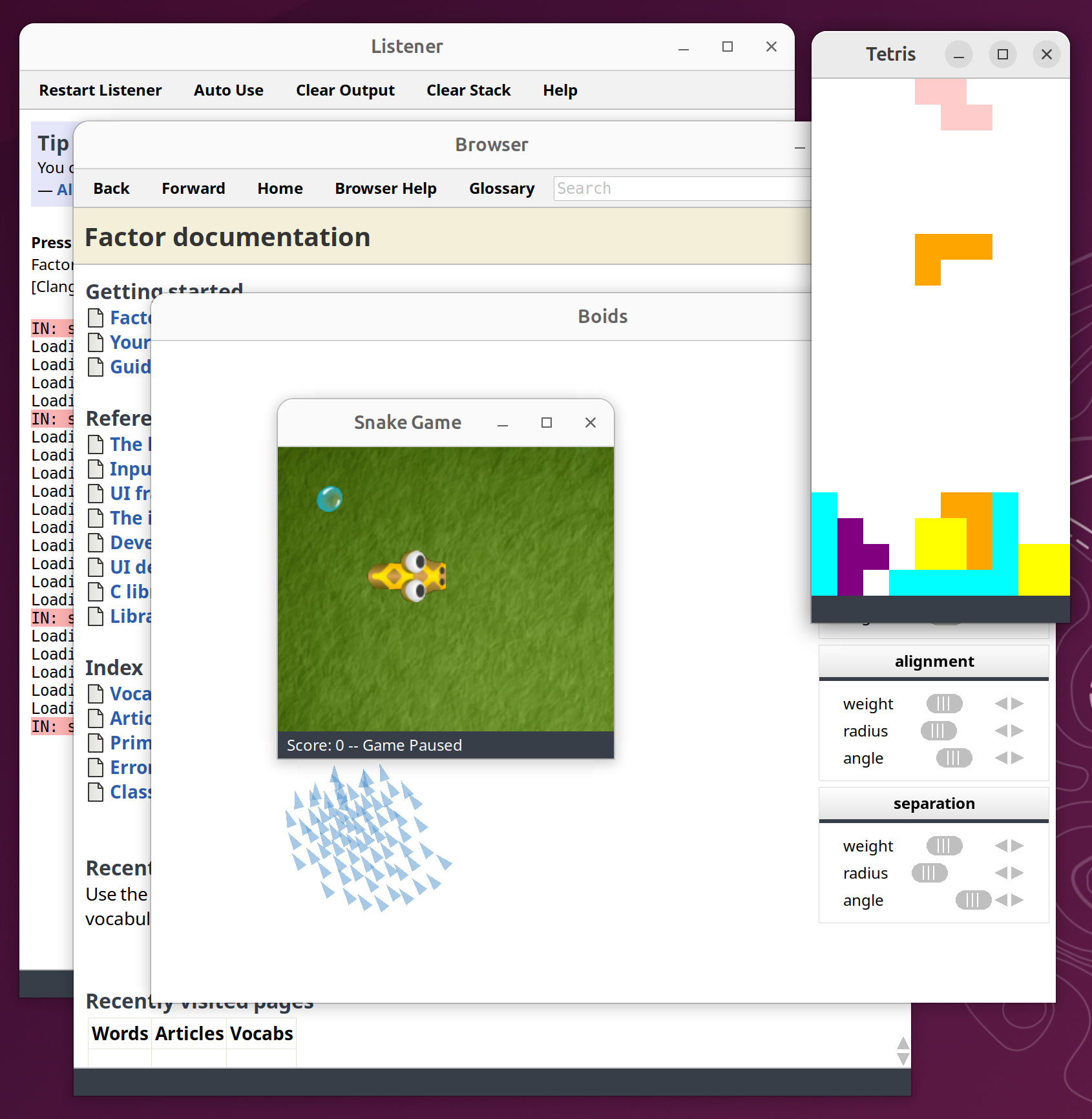
You can revert to the older GTK2 backend by applying this diff and then performing a fresh bootstrap:
diff --git a/basis/bootstrap/ui/ui.factor b/basis/bootstrap/ui/ui.factor
index 2974e530f9..416704ce29 100644
--- a/basis/bootstrap/ui/ui.factor
+++ b/basis/bootstrap/ui/ui.factor
@@ -12,6 +12,6 @@ IN: bootstrap.ui
     {
         { [ os macos? ] [ "ui.backend.cocoa" ] }
         { [ os windows? ] [ "ui.backend.windows" ] }
-        { [ os unix? ] [ "ui.backend.gtk3" ] }
+        { [ os unix? ] [ "ui.backend.gtk2" ] }
     } cond
 ] if* require
diff --git a/basis/opengl/gl/extensions/extensions.factor b/basis/opengl/gl/extensions/extensions.factor
index 2d408e93bb..51394eeb4a 100644
--- a/basis/opengl/gl/extensions/extensions.factor
+++ b/basis/opengl/gl/extensions/extensions.factor
@@ -7,7 +7,7 @@ ERROR: unknown-gl-platform ;
 << {
     { [ os windows? ] [ "opengl.gl.windows" ] }
     { [ os macos? ]  [ "opengl.gl.macos" ] }
-    { [ os unix? ] [ "opengl.gl.gtk3" ] }
+    { [ os unix? ] [ "opengl.gl.gtk2" ] }
     [ unknown-gl-platform ]
 } cond use-vocab >>
It seems like the newer OpenGL 3.x functions might introduce some lag which is visible when scrolling on some installations, perhaps by not caching certain things that were cached in the OpenGL 1.x code paths. There will need to be some improvements before we are ready to release it, but it is plenty usable as-is.
I also migrated our macOS backend to use the OpenGL 3.x functions as well to allow us to more broadly test and improve these new rendering paths.
This is available in the latest development version.
John Benediktsson: DNS LOC Records
DNS is the Domain Name System and is the backbone of the internet:
Most prominently, it translates readily memorized domain names to the numerical IP addresses needed for locating and identifying computer services and devices with the underlying network protocols. The Domain Name System has been an essential component of the functionality of the Internet since 1985.
It is also an oft-cited reason for service outages, with a funny decade-old r/sysadmin meme:

Factor has a DNS vocabulary that supports querying and parsing responses from nameservers:
IN: scratchpad USE: tools.dns

IN: scratchpad "google.com" host
google.com has address 142.250.142.113
google.com has address 142.250.142.138
google.com has address 142.250.142.100
google.com has address 142.250.142.101
google.com has address 142.250.142.102
google.com has address 142.250.142.139
google.com has IPv6 address 2607:f8b0:4023:1c01:0:0:0:8b
google.com has IPv6 address 2607:f8b0:4023:1c01:0:0:0:8a
google.com has IPv6 address 2607:f8b0:4023:1c01:0:0:0:64
google.com has IPv6 address 2607:f8b0:4023:1c01:0:0:0:65
google.com mail is handled by 10 smtp.google.com
Recently, I bumped into an old post on the Cloudflare
blog about The weird and wonderful world of
DNS LOC
records
and realized that we did not properly support parsing RFC
1876 which specifies a format
for returning LOC or location record specifying the physical
location of a service.
At the time of the post, Cloudflare indicated they handle “millions of DNS records; of those just 743 are LOCs.”. I found a webpage that lists sites supporting DNS LOC and contains only nine examples.
It is not widely used, but it is very cool.
You can use the dig command
to query for a LOC record and see what is returned:
$ dig alink.net LOC
alink.net.              66      IN      LOC     37 22 26.000 N 122 1 47.000 W 30.00m 30m 30m 10m
The fields that were returned include:
- latitude (37° 22’ 26.00" N)
- longitude (122° 1’ 47.00" W)
- altitude (30.00m)
- horizontal precision (30m)
- vertical precision (30m)
- entity size estimate (10m)
In Factor 0.101, the field is available and returned as bytes but not parsed:
IN: scratchpad "alink.net" dns-LOC-query answer-section>> ...
{
    T{ rr
        { name "alink.net" }
        { type LOC }
        { class IN }
        { ttl 300 }
        { rdata
            B{
                0 51 51 19 136 5 2 80 101 208 181 8 0 152 162 56
            }
        }
    }
}
Of course, I love odd uses of technology like Wikipedia over
DNS and I thought
Factor should probably add proper support for the
LOC record!
First, we define a tuple
class to hold the
LOC record fields:
TUPLE: loc size horizontal vertical lat lon alt ;
Next, we parse the LOC record, converting sizes (in centimeters),
lat/lon (in degrees), and altitude (in centimeters):
: parse-loc ( -- loc )
    loc new
        read1 0 assert=
        read1 [ -4 shift ] [ 4 bits ] bi 10^ * >>size
        read1 [ -4 shift ] [ 4 bits ] bi 10^ * >>horizontal
        read1 [ -4 shift ] [ 4 bits ] bi 10^ * >>vertical
        4 read be> 31 2^ - 3600000 / >>lat
        4 read be> 31 2^ - 3600000 / >>lon
        4 read be> 10000000 - >>alt ;
We hookup the LOC type to be parsed properly:
M: LOC parse-rdata 2drop parse-loc ;
And then build a word to print the location nicely:
: LOC. ( name -- )
    dns-LOC-query answer-section>> [
        rdata>> {
            [ lat>> [ abs 1 /mod 60 * 1 /mod 60 * ] [ neg? "S" "N" ? ] bi ]
            [ lon>> [ abs 1 /mod 60 * 1 /mod 60 * ] [ neg? "W" "E" ? ] bi ]
            [ alt>> 100 / ]
            [ size>> 100 /i ]
            [ horizontal>> 100 /i ]
            [ vertical>> 100 /i ]
        } cleave "%d %d %.3f %s %d %d %.3f %s %.2fm %dm %dm %dm\n" printf
    ] each ;
And, finally, we can give it a try!
IN: scratchpad "alink.net" LOC.
37 22 26.000 N 122 1 47.000 W 30.00m 30m 30m 10m
Yay, it matches!
This is available in the latest development version.
John Benediktsson: Factor 0.101 now available
“Keep thy airspeed up, lest the earth come from below and smite thee.” - William Kershner
I’m very pleased to announce the release of Factor 0.101!
| OS/CPU | Windows | Mac OS | Linux |
|---|---|---|---|
| x86 | 0.101 | 0.101 | |
| x86-64 | 0.101 | 0.101 | 0.101 |
Source code: 0.101
This release is brought to you with almost 700 commits by the following individuals:
Aleksander Sabak, Andy Kluger, Cat Stevens, Dmitry Matveyev, Doug Coleman, Giftpflanze, John Benediktsson, Jon Harper, Jonas Bernouli, Leo Mehraban, Mike Stevenson, Nicholas Chandoke, Niklas Larsson, Rebecca Kelly, Samuel Tardieu, Stefan Schmiedl, @Bruno-366, @bobisageek, @coltsingleactionarmyocelot, @inivekin, @knottio, @timor
Besides some bug fixes and library improvements, I want to highlight the following changes:
- Moved the UI to render buttons and scrollbars rather than using images, which allows easier theming.
- Fixed HiDPI scaling on Linux and Windows, although it currently doesn’t update the window settings when switching between screens with different scaling factors.
- Update to Unicode 17.0.0.
- Plugin support for the Neovim editor.
Some possible backwards compatibility issues:
- The argument order to
ltakewas swapped to be more consistent with words likehead. - The
environmentvocabulary on Windows now supports disambiguatingfand""(empty) values - The
misc/atomfolder was removed in favor of the factor/atom-language-factor repo. - The
misc/Factor.tmbundlefolder was removed in favor of the factor/factor.tmbundle repo. - The
misc/vimfolder was removed in favor of the factor/factor.vim repo. - The
httpvocabularyrequesttuple had a slot rename frompost-datatodata. - The
furnace.asidesvocabulary had a slot rename frompost-datatodata, and might require runningALTER TABLE asides RENAME COLUMN "post-data" TO data;. - The
html.streamsvocabulary was renamed toio.streams.html - The
pdf.streamsvocabulary was renamed toio.streams.pdf
What is Factor
Factor is a concatenative, stack-based programming language with high-level features including dynamic types, extensible syntax, macros, and garbage collection. On a practical side, Factor has a full-featured library, supports many different platforms, and has been extensively documented.
The implementation is fully compiled for performance, while still supporting interactive development. Factor applications are portable between all common platforms. Factor can deploy stand-alone applications on all platforms. Full source code for the Factor project is available under a BSD license.
New libraries:
- base92: adding support for Base92 encoding/decoding
- bitcask: implementing the Bitcask key/value database
- bluesky: adding support for the BlueSky protocol
- calendar.holidays.world: adding some new holidays including World Emoji Day
- classes.enumeration: adding enumeration classes and new
ENUMERATION:syntax word - colors.oklab: adding support for OKLAB color space
- colors.oklch: adding support for OKLCH color space
- colors.wavelength: adding
wavelength>rgba - combinators.syntax: adding experimental combinator syntax words
@[,*[, and&[, and short-circuitingn&&[,n||[,&&[and||[ - continuations.extras: adding
with-datastacksanddatastack-states - dotenv: implementing support for Dotenv files
- edn: implementing support for Extensible Data Notation
- editors.cursor: adding support for the Cursor editor
- editors.rider: adding support for the JetBrains Rider editor
- gitignore: parser for
.gitignorefiles - http.json: promoted
json.httpand added some useful words - io.streams.farkup: a Farkup formatted stream protocol
- io.streams.markdowns: a Markdown formatted stream protocol
- locals.lazy: prototype of emit syntax
- monadics: alternative vocabulary for using Haskell-style monads, applicatives, and functors
- multibase: implementation of Multibase
- pickle: support for the Pickle serialization format
- persistent.hashtables.identity: support an identity-hashcode version of persisent hashtables
- raylib.live-coding: demo of a vocabulary to do “live coding” of Raylib programs
- rdap: support for the Registration Data Access Protocol
- reverse: implementation of the std::flip
- slides.cli: simple text-based command-line interface for slides
- tools.highlight: command-line syntax-highlighting tool
- tools.random: command-line random generator tool
- ui.pens.rounded: adding rounded corner pen
- ui.pens.theme: experimental themed pen
- ui.tools.theme: some words for updating UI developer tools themes
Improved libraries:
- alien.syntax: added
C-LIBRARY:syntax word - assocs.extras: added
nzipandnunzip,map-zipandmap-unzipmacros - base32: adding the human-oriented Base32 encoding via
zbase32>and>zbase32 - base64: minor performance improvement
- benchmark: adding more benchmarks
- bootstrap.assembler: fixes for ARM-64
- brainfuck: added
BRAINFUCK:syntax word andinterpret-brainfuck - bson: use linked-assocs to preserve order
- cache: implement
M\ cache-assoc delete-at - calendar: adding
year<,year<=,year>,year>=words - calendar.format: parse human-readable and elapsed-time output back into duration objects
- cbor: use linked-assocs to preserve order
- classes.mixin: added
definerimplementation - classes.singleton: added
definerimplementation - classes.tuple: added
tuple>slots, renametuple>arraytopack-tupleand>tupletounpack-tuple. - classes.union: added
definerimplementation - checksums.sha: some 20-40% performance improvements
- command-line: allow passing script name of
-to use stdin - command-line.parser: support for Argument Parser Commands
- command-line.startup: document
-qquiet mode flag - concurrency.combinators: faster
parallel-mapandparallel-assoc-mapusing a count-down latch - concurrency.promises: 5-7% performance improvement
- continuations: improve docs and fix stack effect for
ifcc - countries: adding
CQcountry code for Sark - cpu.architecture: fix
*-branchstack effects - cpu.arm: fixes for ARM-64
- crontab: added
parse-crontabwhich ignores blank lines and comments - db: making
query-eachrow-polymorphic - delegate.protocols: adding
keysandvaluestoassoc-protocol - discord: better support for network disconnects, added a configurable retry interval
- discord.chatgpt-bot: some fixes for LM Studio
- editors: make the editor restart nicer looking
- editors.focus: support open-file-to-line-number on newer releases, support Linux and Window
- editors.zed: support use of Zed on Linux
- endian: faster endian conversions of c-ptr-like objects
- environment: adding
os-env? - eval: move datastack and error messages to stderr
- fonts: make
<font>take a name, easier defaults - furnace.asides: rename
post-dataslot onasidetuples todata - generalizations: moved some dip words to shuffle
- help.tour: fix some typos/grammar
- html.templates.chloe: improve use of
CDATAtags for unescaping output - http: rename
post-dataslot onrequesttuples todata - http.json: adding
http-jsonthat doesn’t return the response object - http.websockets: making
read-websocket-looprow-polymorphic - ini-file: adding
ini>file,file>ini, and useLH{ }to preserve configuration order - io.encodings.detect: adding
utf7detection - io.encodings.utf8: adding
utf8-bomto handle optional BOM - io.random: speed up
random-lineandrandom-lines - io.streams.ansi: adding documentation and tests, support dim foreground on terminals that support it
- io.streams.escape-codes: adding documentation and tests
- ip-parser: adding IPV4 and IPV6 network words
- kernel: adding
until*, fix docs forand*andor* - linked-sets: adding
LS{syntax word - lists.lazy: changed the argument order in
ltake - macho: support a few more link edit commands
- make: adding
,%for apush-atvariant - mason.release.tidy: cleanup a few more git artifacts
- math.combinatorics: adding counting words
- math.distances: adding
jaro-distanceandjaro-winkler-distance - math.extras: added
all-removals, support Recamán’s sequence, and Tribonacci Numbers - math.factorials: added
subfactorial - math.functions: added “closest to zero” modulus
- math.parser: improve ratio parsing for consistency
- math.primes: make
prime?safe from non-integer inputs - math.runge-kutta: make generalized improvements to the Runge-Kutta solver
- math.similarity: adding
jaro-similarity,jaro-winkler-similarity, andtrigram-similarity - math.text.english: fix issue with very large and very small floats
- metar: updated the abbreviations glossary
- mime.types: updating
mime.typesfile - msgpack: use linked-assocs to preserve order
- qw: adding
qw:syntax - path-finding: added
find-path* - peg.parsers: faster
list-ofandlist-of-many - progress-bars.models: added
with-progress-display,map-with-progress-bar,each-with-progress-bar, andreduce-with-progress-bar - raylib: adding
trace-logandset-trace-log-level, updated to Raylib 5.5 - readline-listener: store history across sessions, support color on terminals that support it
- robohash: support for
"set4","set5", and"set6"types - sequences: rename
midpoint@tomidpoint, fastereach-fromandmap-reduceon slices - sequences.extras: adding
find-nth,find-nth-last,subseq-indices,deep-nth,deep-nth-of,2none?,filter-errors,reject-errors,all-same?,adjacent-differences, andpartial-sum. - sequences.generalizations: fix
?firstnand?lastnfor string inputs, removed(nsequence)which duplicatesset-firstn-unsafe - sequences.prefixed: swap order of
<prefixed>arguments to matchprefix - sequences.repeating: adding
<cycles-from>andcycle-from - sequences.snipped: fixed out-of-bounds issues
- scryfall: update for duskmourn
- shuffle: improve stack-checking of
shuffle(syntax, addedSHUFFLE:syntax,nreverse - sorting: fix
sort-withto apply the quot with access to the stack below - sorting.human: implement human sorting improved
- system-info.macos: adding “Tahoe” code-name for macOS 26
- terminfo: add words for querying specific output capabilities
- threads: define a generalized
linked-threadwhich used to be forconcurrency.mailboxesonly - toml: use linked-assocs to preserve order, adding
>tomlandwrite-toml - tools.annotations: adding
<WATCH ... WATCH>syntax - tools.deploy: adding a command-line interface for deploy options
- tools.deploy.backend: fix boot image location in system-wide installations
- tools.deploy.unix: change binary name to append
.outto fix conflict with vocab resources - tools.directory-to-file: better test file metrics, print filename for editing
- tools.memory: adding
heap-stats-ofarbitrary sequence of instances, andtotal-sizesize of everything pointed to by an object - txon: use linked-assocs to preserve order
- ui: adding
adjust-font-size - ui.gadgets.buttons: stop using images and respect theme colors
- ui.gadgets.sliders: stop using images and respect theme colors
- ui.theme.base16: adding a lot more (270!) Base16 Themes
- ui.tools: adding font-sizing keyboard shortcuts
- ui.tools.browser: more responsive font sizing
- ui.tools.listener: more responsive font sizing, adding some UI listener styling
- ui.tools.listener.completion: allow spaces in history search popup
- unicode: update to Unicode 17.0.0
- webapps.planet: improve CSS for
videotags - words: adding
define-temp-syntax - zoneinfo: update to version 2025b
Removed libraries
ui.theme.images
VM Improvements:
- More work on ARM64 backend (fix set-callstack, fix generic dispatch)
John Benediktsson: zxcvbn
Years ago, Dropbox wrote about zxcvbn: realistic password strength estimation:
zxcvbnis a password strength estimator inspired by password crackers. Through pattern matching and conservative estimation, it recognizes and weighs 30k common passwords, common names and surnames according to US census data, popular English words from Wikipedia and US television and movies, and other common patterns like dates, repeats (aaa), sequences (abcd), keyboard patterns (qwertyuiop), and l33t speak.
And it appears to have been successful – the original implementation is in JavaScript, but there have been clones of the algorithm generated in many different languages:
At Dropbox we use zxcvbn (Release notes) on our web, desktop, iOS and Android clients. If JavaScript doesn’t work for you, others have graciously ported the library to these languages:
zxcvbn-python(Python)zxcvbn-cpp(C/C++/Python/JS)zxcvbn-c(C/C++)zxcvbn-rs(Rust)zxcvbn-go(Go)zxcvbn4j(Java)nbvcxz(Java)zxcvbn-ruby(Ruby)zxcvbn-js(Ruby [via ExecJS])zxcvbn-ios(Objective-C)zxcvbn-cs(C#/.NET)szxcvbn(Scala)zxcvbn-php(PHP)zxcvbn-api(REST)ocaml-zxcvbn(OCaml bindings forzxcvbn-c)
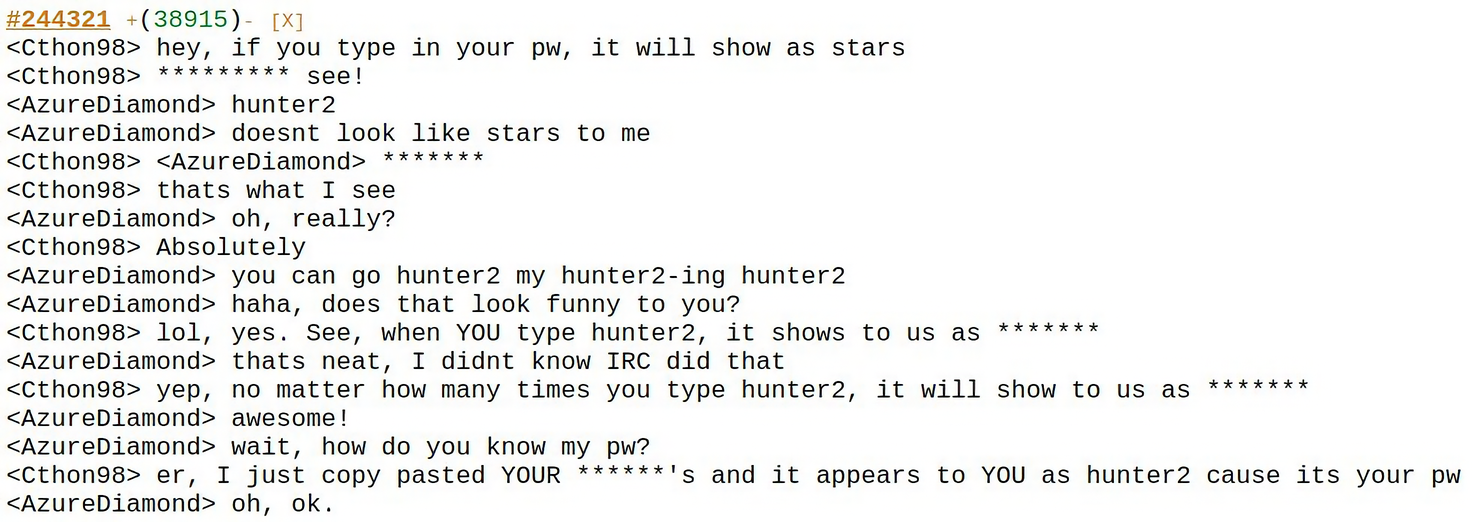
In today’s era of password managers, WebAuthn also known as passkeys, and many pwned accounts, passwords may seem like a funny sort of outdated concept. They have definitely provided good entertainment over the years from XKCD: Password Strength comics to the 20-year old hunter2 meme:
I have wanted a Factor implementation of this for a long time – and finally built zxcvbn in Factor!
We can use it to check out some potential passwords:
IN: scratchpad USE: zxcvbn

IN: scratchpad "F@ct0r!" zxcvbn.
Score:
  1/4 (very guessable)
Crack times:
  Online (throttled):   4 months
  Online (unthrottled): 8 hours
  Offline (slow hash):  30 seconds
  Offline (fast hash):  less than a second
Suggestions:
  Add another word or two. Uncommon words are better.
  Capitalization doesn't help very much.
  Predictable substitutions like '@' instead of 'a' don't help very much.

IN: scratchpad "john2025" zxcvbn.
Score:
  1/4 (very guessable)
Crack times:
  Online (throttled):   3 months
  Online (unthrottled): 6 hours
  Offline (slow hash):  23 seconds
  Offline (fast hash):  less than a second
Warning:
  Common names and surnames are easy to guess.
Suggestions:
  Add another word or two. Uncommon words are better.
That’s not so good, maybe we should use the random.passwords vocabulary instead!
This is available on my GitHub.
John Benediktsson: AsyncIO Performance
Factor has green threads and a long-standing feature request to be able to utilize native threads more efficiently for concurrent tasks. In the meantime, the cooperative threading model allows for asynchronous tasks which is particularly useful when waiting for I/O such as used by sockets over a computer network.
And while it might be true that asynchrony is not concurrency, there are a lot of other things one could say about concurrency and multi-threaded or multi-process performance. Today I want to discuss an article that Will McGugan wrote about the overhead of Python asyncio tasks and the good discussion that followed on Hacker News.
Let’s go over the benchmark in a few programming languages – including Factor!
Python
The article presents this benchmark in Python that does no work but measures the relative overhead of the asyncio task infrastructure when creating a large number of asynchronous tasks:
from asyncio import create_task, wait, run
from time import process_time as time

async def time_tasks(count=100) -> float:
    """Time creating and destroying tasks."""

    async def nop_task() -> None:
        """Do nothing task."""
        pass

    start = time()
    tasks = [create_task(nop_task()) for _ in range(count)]
    await wait(tasks)
    elapsed = time() - start
    return elapsed

for count in range(100_000, 1_000_000 + 1, 100_000):
    create_time = run(time_tasks(count))
    create_per_second = 1 / (create_time / count)
    print(f"{count:9,} tasks \t {create_per_second:0,.0f} tasks per/s")
Using the latest Python 3.14, this is reasonably fast on my laptop taking about 13 seconds:
$ time python3.14 foo.py
  100,000 tasks    577,247 tasks per/s
  200,000 tasks    533,911 tasks per/s
  300,000 tasks    546,127 tasks per/s
  400,000 tasks    488,219 tasks per/s
  500,000 tasks    466,636 tasks per/s
  600,000 tasks    469,972 tasks per/s
  700,000 tasks    434,126 tasks per/s
  800,000 tasks    428,456 tasks per/s
  900,000 tasks    404,905 tasks per/s
1,000,000 tasks    376,167 tasks per/s
python3.14 foo.py  12.69s user 0.27s system 99% cpu 12.971 total
Factor
We could translate this directly to Factor using the concurrency.combinators vocabulary.
In particular, the parallel-map word starts a new thread applying a quotation to each element in the sequence and then waits for all the threads to finish:
USING: concurrency.combinators formatting io kernel math ranges sequences
tools.time ;

: time-tasks ( n -- )
    <iota> [ ] parallel-map drop ;

: run-tasks ( -- )
    100,000 1,000,000 100,000 <range> [
       dup [ time-tasks ] benchmark 1e9 / dupd /
       "%7d tasks \t %7d tasks per/s\n" printf flush
    ] each ;
After making an improvement to our parallel-map implementation that uses a count-down latch for more efficient waiting on a group of tasks, this runs 2.5x as fast as Python:
IN: scratchpad gc [ run-tasks ] time
 100000 tasks   1246872 tasks per/s
 200000 tasks   1209500 tasks per/s
 300000 tasks   1141121 tasks per/s
 400000 tasks   1121304 tasks per/s
 500000 tasks   1119707 tasks per/s
 600000 tasks   1135459 tasks per/s
 700000 tasks    956541 tasks per/s
 800000 tasks   1091807 tasks per/s
 900000 tasks    944753 tasks per/s
1000000 tasks   1137681 tasks per/s

Running time: 5.142044833 seconds
That’s pretty good for a comparable dynamic language, and especially since we are still running in Rosetta 2 on Apple macOS translating Intel x86-64 to Apple Silicon aarch64 on the fly!
It also turns out that 75% of the benchmark time is spent in the garbage collector, so probably there are some big wins we can get if we look more closely into that.
Go
We could translate that benchmark into Go 1.25:
package main

import (
    "fmt"
    "sync"
    "time"
)

func timeTasks(count int) time.Duration {
    nopTask := func(done func()) {
        done()
    }
    start := time.Now()
    wg := &sync.WaitGroup{}
    wg.Add(count)
    for i := 0; i < count; i++ {
        go nopTask(wg.Done)
    }
    wg.Wait()
    return time.Now().Sub(start)
}
func main() {
    for n := 100_000; n <= 1_000_000; n += 100_000 {
        createTime := timeTasks(n)
        createPerSecond := (1.0 / (float64(createTime) / float64(n))) * float64(time.Second)
        fmt.Printf("%7d tasks \t %7d tasks per/s\n", n, createPerSecond)
    }
}
And show that it is about 11x times faster than Python using multiple CPUs.
$ time go run foo.go
 100000 tasks    3889083 tasks per/s
 200000 tasks    5748283 tasks per/s
 300000 tasks    6324955 tasks per/s
 400000 tasks    6265341 tasks per/s
 500000 tasks    6301852 tasks per/s
 600000 tasks    5572898 tasks per/s
 700000 tasks    6239860 tasks per/s
 800000 tasks    6276241 tasks per/s
 900000 tasks    6226128 tasks per/s
1000000 tasks    6243859 tasks per/s
go run foo.go  2.44s user 0.71s system 270% cpu 1.165 total
If we limit GOMAXPROCS to one CPU, it runs only 7.5x times faster than Python:
$ time GOMAXPROCS=1 go run foo.go
 100000 tasks    2240106 tasks per/s
 200000 tasks    2869379 tasks per/s
 300000 tasks    2745897 tasks per/s
 400000 tasks    3759142 tasks per/s
 500000 tasks    3090267 tasks per/s
 600000 tasks    3489138 tasks per/s
 700000 tasks    3608874 tasks per/s
 800000 tasks    3200636 tasks per/s
 900000 tasks    3682102 tasks per/s
1000000 tasks    3259778 tasks per/s
GOMAXPROCS=1 go run foo.go  1.65s user 0.08s system 99% cpu 1.735 total
JavaScript
We could build the same benchmark in JavaScript:
async function time_tasks(count=100) {
    async function nop_task() {
        return performance.now();
    }

    const start = performance.now()
    let tasks = Array(count).map(nop_task)
    await Promise.all(tasks)
    const elapsed = performance.now() - start
    return elapsed / 1e3
}

async function run_tasks() {
    for (let count = 100000; count < 1000000 + 1; count += 100000) {
        const ct = await time_tasks(count)
        console.log(`${count}: ${Math.round(1 / (ct / count))} tasks/sec`)
    }
}

run_tasks()
And it runs pretty fast on Node 25.2.1 – about 26x times faster than Python!
$ time node foo.js
100000: 9448038 tasks/sec
200000: 11555322 tasks/sec
300000: 18286318 tasks/sec
400000: 10017217 tasks/sec
500000: 12587060 tasks/sec
600000: 14198956 tasks/sec
700000: 13294620 tasks/sec
800000: 12045403 tasks/sec
900000: 11135513 tasks/sec
1000000: 13577663 tasks/sec
node foo.js  0.82s user 0.10s system 185% cpu 0.496 total
But it runs even faster on Bun 1.3.3 – about 36x times faster than Python!
$ time bun foo.js
100000: 9771222 tasks/sec
200000: 13388075 tasks/sec
300000: 13242548 tasks/sec
400000: 13130144 tasks/sec
500000: 16530496 tasks/sec
600000: 16979009 tasks/sec
700000: 16781272 tasks/sec
800000: 17098919 tasks/sec
900000: 17111784 tasks/sec
1000000: 18288515 tasks/sec
bun foo.js  0.37s user 0.02s system 111% cpu 0.353 total
I’m sure other languages perform both better and worse, but this gives us some nice ideas of where we stand relative to some useful production programming languages. There is clearly room to grow, some potential low-hanging fruit, and known features such as supporting native threads that could be a big improvement to the status quo!
PRs welcome!
John Benediktsson: Cosine FizzBuzz
After revisiting FizzBuzz yesterday to discuss a Lazy FizzBuzz using infinite lazy lists, I thought I would not return to the subject for awhile. Apparently, I was wrong!
Susam Pal just wrote a really fun article about Solving Fizz Buzz with Cosines:
We define a set of four functions {
s0,s1,s2,s3} for integersnby:
s0(n) = n
s1(n) = Fizz
s2(n) = Buzz
s3(n) = FizzBuzz
And from that, they derive a formula which is essentially a finite Fourier
series for computing the nth
value in the FizzBuzz sequence, showing a nice fixed periodic cycling across
n mod 15, resolving at each value of n to either the integers 0, 1, 2, 3:
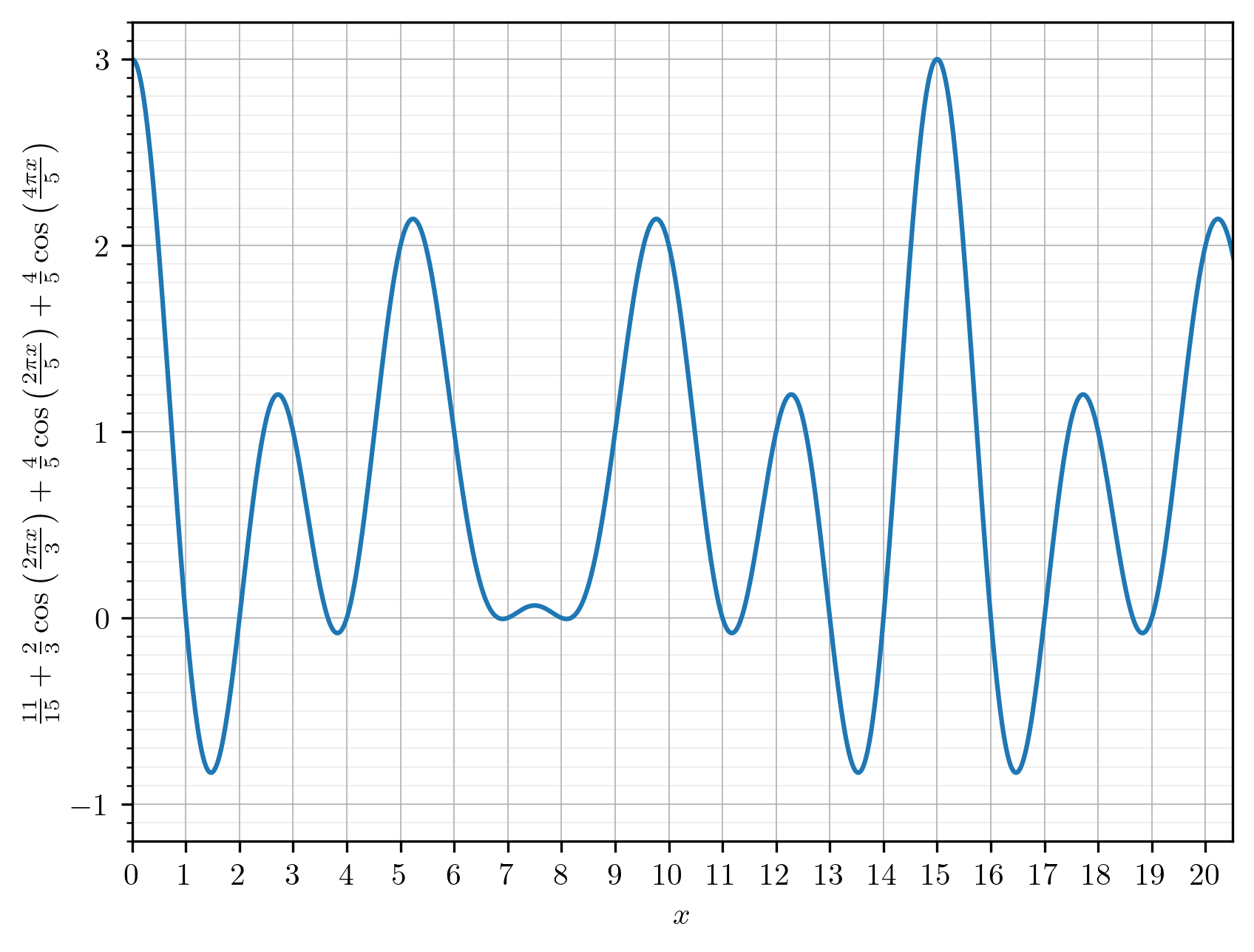
I recommend reading the whole article, but I will jump to an implementation of the formula in Factor:
:: fizzbuzz ( n -- val )
    11/15
    2/3 n * pi * cos 2/3 * +
    2/5 n * pi * cos 4/5 * +
    4/5 n * pi * cos + round >integer
    { n "Fizz" "Buzz" "FizzBuzz" } nth ;
And we can use that to compute the first few values in the sequence:
IN: scratchpad 1 ..= 100 [ fizzbuzz . ] each
1
2
"Fizz"
4
"Buzz"
"Fizz"
7
8
"Fizz"
"Buzz"
11
"Fizz"
13
14
"FizzBuzz"
16
17
"Fizz"
19
"Buzz"
...
Or, even some arbitrary values in the sequence:
IN: scratchpad 67 fizzbuzz .
67

IN: scratchpad 9,999,999 fizzbuzz .
"Fizz"

IN: scratchpad 10,000,000 fizzbuzz .
"Buzz"

IN: scratchpad 1,234,567,890 fizzbuzz .
"FizzBuzz"
Thats even more fun than using lazy lists!
John Benediktsson: Lazy FizzBuzz
I wrote about FizzBuzz many years ago. It’s a silly programming task often cited and even included on RosettaCode. The task is described as:
Write a program that prints the integers from
1to100(inclusive).But:
- for multiples of three, print
"Fizz"instead of the number;- for multiples of five, print
"Buzz"instead of the number;- for multiples of both three and five, print
"FizzBuzz"instead of the number.
This has been solved ad nauseum, but a few days ago Evan Hawn wrote about solving Fizz Buzz without conditionals or booleans using Python and the itertools.cycle function to create an infinitely iterable solution.
Let’s build this in Factor!
There are several ways to implement this, including
generators,
but we will be using the lists.lazy
vocabulary to
provide a lazy and infinite stream of values. In particular, by
combining a stream of integers with a cycle of "Fizz" and a cycle of
"Buzz".
The lists.circular vocabulary extends circular sequences to support the lists protocol:
IN: scratchpad USE: lists.circular

IN: scratchpad { 1 2 3 } <circular> 10 ltake list>array .
{ 1 2 3 1 2 3 1 2 3 1 }
Using that, we can create an infinite FizzBuzz list:
: lfizzbuzz ( -- list )
    1 lfrom
    { "" "" "Fizz" } <circular>
    { "" "" "" "" "Buzz" } <circular>
    lzip [ concat ] lmap-lazy lzip ;
We can print out the first few values quite simply:
IN: scratchpad lfizzbuzz 20 ltake [ first2 "%2d: %s\n" printf ] leach
 1:
 2:
 3: Fizz
 4:
 5: Buzz
 6: Fizz
 7:
 8:
 9: Fizz
10: Buzz
11:
12: Fizz
13:
14:
15: FizzBuzz
16:
17:
18: Fizz
19:
20: Buzz
And if we wanted a more traditional stream alternating between numbers and labels:
IN: scratchpad lfizzbuzz 100 ltake [ first2 [ nip ] unless-empty . ] leach
1
2
"Fizz"
4
"Buzz"
"Fizz"
7
8
"Fizz"
"Buzz"
11
"Fizz"
13
14
"FizzBuzz"
16
17
"Fizz"
19
"Buzz"
...
While not the ultimate FizzBuzz Enterprise Edition, this seems like a fun way to improve upon the simple meant for whiteboards implementation that is most often shared.
John Benediktsson: Lorem Ipsum
Lorem ipsum is a type of placeholder text that can be used in graphic design or web development. The most common form of it will often begin like this paragraph:
Lorem ipsum dolor sit amet, consectetur adipiscing elit, sed do eiusmod tempor incididunt ut labore et dolore magna aliqua. Ut enim ad minim veniam, quis nostrud exercitation ullamco laboris nisi ut aliquip ex ea commodo consequat. Duis aute irure dolor in reprehenderit in voluptate velit esse cillum dolore eu fugiat nulla pariatur. Excepteur sint occaecat cupidatat non proident, sunt in culpa qui officia deserunt mollit anim id est laborum.
I wanted to make a program to generate believable lorem ipsum text using Factor.
We start by defining a bunch of possible words:
CONSTANT: words qw{
    a ab accusamus accusantium ad adipisci alias aliquam aliquid
    amet animi aperiam architecto asperiores aspernatur
    assumenda at atque aut autem beatae blanditiis commodi
    consectetur consequatur consequuntur corporis corrupti culpa
    cum cumque cupiditate debitis delectus deleniti deserunt
    dicta dignissimos distinctio dolor dolore dolorem doloremque
    dolores doloribus dolorum ducimus ea eaque earum eius
    eligendi enim eos error esse est et eum eveniet ex excepturi
    exercitationem expedita explicabo facere facilis fuga fugiat
    fugit harum hic id illo illum impedit in incidunt inventore
    ipsa ipsam ipsum iste itaque iure iusto labore laboriosam
    laborum laudantium libero magnam magni maiores maxime minima
    minus modi molestiae molestias mollitia nam natus
    necessitatibus nemo neque nesciunt nihil nisi nobis non
    nostrum nulla numquam obcaecati odio odit officia officiis
    omnis optio pariatur perferendis perspiciatis placeat porro
    possimus praesentium provident quae quaerat quam quas quasi
    qui quia quibusdam quidem quis quisquam quo quod quos
    ratione recusandae reiciendis rem repellat repellendus
    reprehenderit repudiandae rerum saepe sapiente sed sequi
    similique sint sit soluta sunt suscipit tempora tempore
    temporibus tenetur totam ullam unde ut vel velit veniam
    veritatis vero vitae voluptas voluptate voluptatem
    voluptates voluptatibus voluptatum
}
We then use these to build a random ipsum sentence:
: random-sentence ( -- str )
    2 ..= 5 random [
        words 3 ..= 12 random sample " " join
    ] replicate ", " join
    0 over [ ch>upper ] change-nth "?." random suffix ;
Then build a random ipsum paragraph from sentences:
: random-paragraph ( -- str )
    2 ..= 4 random [ random-sentence ] replicate " " join ;
We can define the initial paragraph above:
CONSTANT: initial-paragraph "\
Lorem ipsum dolor sit amet, consectetur adipisicing \
elit, sed do eiusmod tempor incididunt ut labore et \
dolore magna aliqua. Ut enim ad minim veniam, quis \
nostrud exercitation ullamco laboris nisi ut aliquip ex \
ea commodo consequat. Duis aute irure dolor in \
reprehenderit in voluptate velit esse cillum dolore eu \
fugiat nulla pariatur. Excepteur sint occaecat cupidatat \
non proident, sunt in culpa qui officia deserunt mollit \
anim id est laborum."
And use it to make random ipsum paragraphs, starting with the initial one:
: random-paragraphs ( n -- str )
    <iota> [
        zero? [ initial-paragraph ] [ random-paragraph ] if
    ] map "\n" join ;
Or even generate a list of random ipsum words, understanding that sample can’t generate more samples than the length of the sequence being sampled from:
:: random-words ( n -- str )
    words length :> w
    [
        n [ words over w min sample % w [-] ] until-zero
    ] { } make ;
We can make a command-line interface using the argument parser to return words, sentence, or paragraph:
CONSTANT: OPTIONS {
    T{ option
        { name "--w" }
        { help "Generate some lorem ipsum words" }
        { #args 1 }
        { type integer }
    }
    T{ option
        { name "--s" }
        { help "Generate a lorem ipsum sentence" }
        { const t }
        { default f }
    }
    T{ option
        { name "--p" }
        { help "Generate a lorem ipsum paragraph" }
        { const t }
        { default f }
    }
}

MAIN: [
    OPTIONS [
        "w" get [ random-words print ] when*
        "s" get [ random-sentence print ] when
        "p" get [ random-paragraph print ] when
    ] with-options
]
And that gives you automatic help text showing the available options:
$ ./factor -run=lorem-ipsum --help
Usage:
    factor -run=lorem-ipsum [--help] [--w W] [--s] [--p]
Options:
    --help    show this help and exit
    --w W     Generate some lorem ipsum words
    --s       Generate a lorem ipsum sentence
    --p       Generate a lorem ipsum paragraph
We can test it by generating some words, a sentence, and a paragraph:
$ ./factor -run=lorem-ipsum --w 10
vero eos quos optio magni soluta nulla delectus voluptas neque
$ ./factor -run=lorem-ipsum --s
Totam dicta laborum perferendis unde voluptas, culpa dignissimos odio
distinctio rem eius, tempora harum corporis accusamus.
$ ./factor -run=lorem-ipsum --p
Quaerat maiores veniam minus reprehenderit architecto numquam mollitia earum,
natus assumenda eius cumque minima sint magni accusantium facere, eius aperiam
explicabo molestias voluptatibus aspernatur maiores assumenda, nulla illo
doloremque voluptatum excepturi accusamus porro officiis tempore molestiae
saepe, iusto quibusdam explicabo obcaecati saepe quasi voluptate? Velit libero
tempore in nobis ratione nisi laborum rerum natus ipsam, aperiam placeat
laborum delectus dolor ab dolores itaque. Fuga maxime culpa quae adipisci, modi
quod distinctio ipsam, et vero natus consequuntur neque placeat saepe quam
perferendis, voluptate nemo ducimus ullam recusandae iusto laboriosam iure
temporibus sed saepe, optio dignissimos dolor modi accusamus quod culpa ab? Ad
dolore dignissimos, perferendis accusamus ducimus fuga eveniet a ut.
The code for this is on my GitHub.
Blogroll
- Chris Double
- Daniel Ehrenberg
- Doug Coleman
- Jeremy Hughes
- Joe Groff
- John Benediktsson
- Phil Dawes
- Samuel Tardieu
- Slava Pestov
planet-factor is an Atom/RSS aggregator that collects the contents of Factor-related blogs. It is inspired by Planet Lisp.
