Creationism in the classroom: does it matter? Kitzmiller 20 years on

carview.php?tsp=

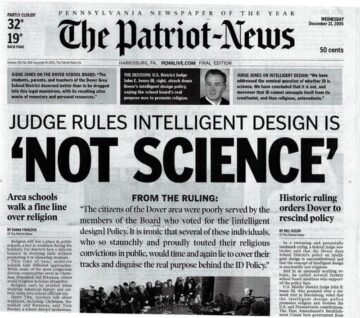
December 20 was the 20th anniversary of the day on which Judge John Jones III handed down his decisive ruling, in the case of Kitzmiller v. Dover Area School District, that Intelligent Design was a version of creationism, which is religion and not science, and as such violated the Establishment Clause of the US Constitution and could not be taught within the publicly funded school system. Given changes in the US legal landscape, we need to ask whether this ruling is still secure. And given everything else that is happening in the US at the moment, we may wonder whether this even matters. Here I lay out why I think that the ruling is not necessarily secure, review what is at stake, and argue that it matters very much indeed.

carview.php?tsp=
Mike Johnson, in 2016, explaining that learning about Darwin is the cause of mass shootings

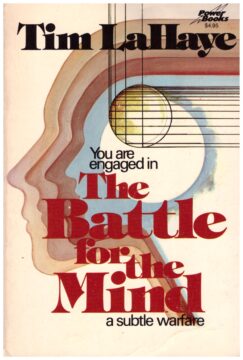
What we now call Christian Nationalism has its roots in Ronald Reagan’s 1980 presidential campaign, when creationists such as Tim LaHaye fused together political conservatism, the newly adopted abortion issue, literalist Bible-based religion, and the rejection of evolution science as Humanist, un-American, and as we would now say Woke. We can see the influence of these ideas today in Trump’s administration, where at least three cabinet ministers (Pete Hegseth, Scott Turner at HUD, and Doug Collins at the VA) are creationists, as are Speaker Mike Johnson, Mike Huckabee, ambassador to Israel, and Russell Vought who at the Office of Management and Budget has enormous day-to-day influence. To these we might add Vice President Vance, and Health [sic] Secretary RF Kennedy Jr. These are not creationists, but share their disdain for the scientific and academic establishments; Vance rose to stardom by telling the US Religious Right that “the Professors are the enemy,” while Kennedy’s onslaught on established science is all too well-known. Thus creationism is closely coupled to the rest of the Regime’s war on reality.

As for the claim, pervasive in the creationist literature, that evolution acceptance involves religion denial, I should mention here that Judge Jones himself is a committed Lutheran, and has offered himself as an example of the compatibility of Christian belief and evolution acceptance, while Ken Miller, a crucial witness at the trial and indefatigable campaigner against creationism, is a devout Catholic, author of Finding Darwin’s God, and co-author of a widely used high school textbook, Miller and Levine Biology.
carview.php?tsp=

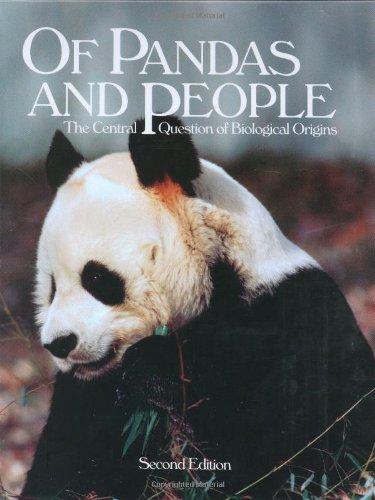
In 2004, creationists on the board of the Dover Area School District in Pennsylvania attracted press attention by objecting to the adoption of Miller and Levine, on the grounds that it was “laced with Darwinism,” to the exclusion of creationism. This led to correspondence with the Discovery Institute and with the Thomas More Law Center, who told them about the alternative textbook (alternative as in alternative facts) Of Pandas and People, which the Center were eager to promote in order to introduce Intelligent Design into the public school system.1

According to its website, the mission of the Thomas More Law Center is to

Preserve America’s Judeo-Christian heritage; Defend the religious freedom of Christians; Restore time-honored moral and family values; Protect the sanctity of human life; Promote a strong national defense and a free and sovereign United States of America. The Law Center accomplishes its mission through litigation, education, and related activities.

This places it firmly within the Christian Nationalist movement, as I described it earlier. As for Intelligent Design, it is the view that nature in general, and the appearance of new groups of living things in particular, is controlled by an unspecified designer (or Designer). This view is clearly incompatible with evolution science. To quote Pandas,

Most significantly, all design proponents hold that the major groups of organisms had their own origins.

The identity of this designer is not specified, although the Discovery Institute, which is a major promoter of Intelligent Design, seems more recently to be abandoning the pretence that the designer is anything other than God.

The board accepted copies of Pandas for the school, and also ordered the biology teachers to read to their classes a statement declaring among other things that

Because Darwin’s Theory is a theory, it is still being tested as new evidence is discovered. The Theory is not a fact. Gaps in the Theory exist for which there is no evidence. A theory is defined as a well-tested explanation that unifies a broad range of observations.

Intelligent design is an explanation of the origin of life that differs from Darwin’s view. The reference book Of Pandas and People, is available for students to see if they would like to explore this view in an effort to gain an understanding of what intelligent design actually involves.

Very courageously, teachers refused to present such nonsense to their classes, since that would violate their professional ethic, and the statement was then read out by the school superintendent.

A group of outraged parents, among them Tammy Kitzmiller, promptly took the School District to court, invoking the Establishment Clause, and their cause was embraced by the American Civil Liberties Union and the National Center for Science Education, who assembled a formidable coalition of expert witnesses. The ensuing trial has been the subject of several books, and a PBS documentary, Judgement Day, still available on YouTube, in which some of the participants play themselves. There is also a moving compilation here of short statements by some of those involved.

carview.php?tsp=
Tammy Kitzmiller, named plaintiff, via NSCE

Of Pandas and People had its own interesting evolutionary history. The academic editor, Charles Thaxton, was an Old Earth creationist, who had testified in Kansas State hearings to his rejection of common descent, while the co-authors, Dean Kenyon and Percival Davis,2 were Young Earth creationists. The original title was Biology and Creation, and its target was the creationist market that appeared to be opening up when, in 1981, the State of Louisiana passed a law saying that if evolutionary science is to be taught, creation science should be taught as well. This law was challenged by a group of parents, teachers, and ministers, on First Amendment grounds, with support from numerous scientists including 77 Nobel Prize winners, and in the 1987 case Edwards v. Aguillard, the Supreme Court upheld their challenge 7-2. In doing so they invoked the Lemon test, which requires a secular purpose for government activity, and opposes government activity which advances (or indeed impedes) religion.

Nothing daunted, the authors simply changed the original title to Of Pandas and People, and partly rewrote the text, replacing “creation science” and “creationism” with “intelligent design”. During the discovery phase of the Kitzmiller trial, the plaintiffs obtained copies of the intermediate drafts, one even containing the expression “cdesign proponentsists”. The Missing Link!

It is also noteworthy that the Pandas (1989) was the first book to refer repeatedly to “intelligent design,” predating the work of Phillip Johnson and the Discovery Institute in the 1990s. Thaxton and Kenyon are currently listed as Fellows of the Discovery Institute’s Center for Science and Culture, which exists to promote Intelligent Design, while simultaneously maintaining that this is a different thing from creationism.

The Discovery Institute has repeatedly defended Pandas, and several Discovery Institute Fellows, including Stephen Meyer and William Dembski, provided expert witness statements in preparation for the Kitzmiller trial although, with the honourable exception of Michael Behe, they withdrew without giving evidence after a complicated dispute with the Thomas More Law Center.

Judge Jones now has understandable concerns about the direction of the US legal system itself. In his 2005 judgement, he also used the Lemon test, but this is no longer in effect. As he noted in 2022,

While applying the Lemon test is hardly perfect, I found it to be a sound and logical way to evaluate the case that came before me.

As a result of the recent Kennedy decision [which permitted prayer by a high school coach after games], federal judges are now directed to utilize a history-based approach in place of the more structured Lemon test when deciding cases. I would respectfully submit, as one who used the Lemon test and found it to be soundly crafted, that this new approach will lead to increasingly disparate decisions by lower court judges that will be based on ad hoc analysis and excessively subjective findings.

The result will necessarily be that the line of separation between church and state will become increasingly blurred. I am quite sure that this is precisely what the majority intended, but I would submit that we are about to enter an era where, like it or not, we will see the Supreme Court allow much more religion in the public square. Not an earthquake to be sure, but at least an aftershock of major proportions.

Remember that the 1987 case Edwards v. Aguillard had also been decided on the basis of the Lemon test
carview.php?tsp=
Abeka textbook, via Mila Oliveira/AL.com

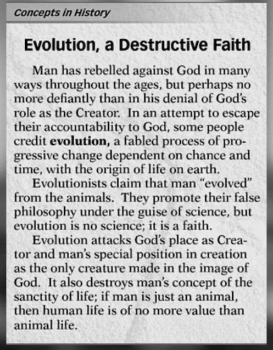
Very recently, Judge Jones has told us that the case was so clear that he would rule the same today. I note however that other judges might feel differently, and that the case was made much easier to decide by what he had referred to as the School District board’s “breathtaking inanity” (the existing board members were soundly defeated in an election that took place while the judgement was being written). Moreover, the increasing use by Republican-dominated States, which is where creationism tends to be strongest, of school vouchers which parents can use at their discretion, could provide a pathway whereby public money, and pupils who would otherwise be publicly educated, are funnelled towards private schools not bound by the Establishment Clause. In Alabama, this is already leading to the use in these schools of textbooks from Bob Jones University and Abeka, whose offerings explicitly describe evolution as scientifically incorrect, satanically inspired, and motivated by the wish to justify immorality. Unsurprisingly, the Abeka texts also play down the evils of slavery, and explain the rise of the Ku Klux Klan as an understandable reaction to the incompetence of State governments dominated by freedmen.

carview.php?tsp=
A further Abeka abstract

I had forgotten how bad Pandas actually is. Its title is a reference to the fact that the term “panda” is applied to two very different animals, the giant panda which is a bear, and the red panda, which is more closely related to raccoons. Although they are only distantly related, both these species have separately evolved a false thumb, a striking example of convergent evolution. All this has been known for over a century, with recent confirmation by DNA phylogenies, but for some strange reason the book chooses to present this as evidence of the inadequacy of evolution science, in favour of Intelligent Design.

The book is obsessed with Darwin (died 1882), whose name appears in some shape or form 262 times in its 144 pages, repeatedly describes current evolution science as Darwinian (a little bit like describing current atomic theory as Daltonian), and completely misrepresents recent scientific findings to make them appear contrary to evolutionary thinking, when in fact the very opposite is true.

This obsession with Darwin runs throughout the entire creationist literature. It has the rhetorical effect of trivialising the work of thousands of other scientists, facilitating the reiteration of objections that were valid in 1859 but long since resolved, and enabling mined quotes from Darwin to be presented as criticisms of present-day evolution science.

Arguments such as those in the book have attracted more attention from philosophers than they deserve. Around the time of the trial, I had a long email correspondence with the noted philosopher, Alvin Plantinga, towards the end of which he said that BeheDembski, and Thaxton, advocates of three different versions of Intelligent Design, had produced arguments that required an answer. In reply, I said that I totally agreed with him; the answer was, in each case, that they were wrong. Prof Plantinga did not reply.

For many reasons, I think it is important to put forward a sampling of the book’s many errors, which I do here in an Appendix. The Discovery Institute (see e.g. here and here) continues to maintain that Kitzmiller was wrongly decided, and to promote Pandas on its website.

I thank Glenn Branch, Wesley Elsberry, Joe Felsenstein, John Harshman, Kim Johnson, Nick Matzke, and Larry Moran, for helpful comments and personal reminiscences. However, the responsibility for any errors and omissions is entirely my own

Appendix: The book starts off by exploiting the confusion, universal in the creationist literature, between the admittedly unresolved problem of the origin of life, and the validity of the evidence for evolution. This is just like questioning our enormous body of knowledge about how languages evolve, because the origin of language itself remains obscure. There is the predictable heavy focus on the limitations of the Urey-Miller experiment, which demonstrates how easily the building blocks of life can arise (but admittedly nothing more), with the unfounded objection that molecular oxygen was present on Earth from the earliest times (it wasn’t).

We have the question-begging analogy between the DNA code, and the use of symbolic codes (language) in communication, although it was clear by the late 1960s that around 90% of the human genome lacks function. Overall probabilities of changes involving more than one gene are miscalculated by pretending that all the changes have to happen at once, and there is no awareness of the new opportunities offered by gene duplication (which by 1970 had been the subject of an entire text), or of how one change alters the fitness landscape to permit others.

The book concedes the reality of formation of new species, but compares it to the limited degree of change accomplished by animal breeders, and asserts that it can only occur “within the existing higher level blueprint of the organism’s whole genome.” This is obviously a preparation for the theory of variation within “created kinds,” developed in the 1940s by the Young Earth creationist Frank Lewis Marsh to explain how all the animals could have fitted into Noah’s Ark. The chapter on The Fossil Record predictably focuses on gaps, and claims that

the various taxa are not connected to one another. There is no gradual series of fossils leading from fish to amphibians, or from reptiles to birds… Fish have all the characteristics of today’s fish from the earliest known fish fossils, reptiles and the record have all the characteristics of present-day reptiles, and so on.

To be fair, the spectacular discoveries of Tiktaalik, and of the sequence leading from a hoofed mammal to whales, still lay in the future, but even in its own time, and indeed long before, the claims in this passage had been soundly refuted. The intermediate position of Archaeopteryx between reptiles and modern birds was recognized by 1870, although it remains unclear whether Archaeopteryx is on the direct line leading to modern birds, or merely a close cousin.

After quote-mining Darwin, the book does indeed discuss Archaeopteryx, pointing out that it has modern style feathers, but “eight [unspecified] reptilian features,” incompatible in some unstated way with “current Darwinian [sic] theory.” So after lamenting the absence of intermediate fossils, the book immediately rejects the most noted and venerable example, on the grounds that its properties are intermediate.

Next is the evidence from the fossil record for punctuated equilibrium, misrepresented in order to lay the groundwork for claims of separate creation, with the assertion that the search for natural causes of the formation of new taxa, and the appeal to Intelligent Design as ad hoc explanation, make comparable use of philosophical assumptions. Sure enough, in a later chapter the dotted lines by which the book at this point represents the formation of new taxa is simply removed, on the grounds that the actual birth of the new taxon was not observed, and replaced by de novo appearance. Thus the branching tree of life is replaced by a series of parallel lines, with utter disregard for all the evidence for common ancestry.

A chapter on homology refers to the “body plan” shared more or less completely by all mammals, without mentioning that this is most easily explained by common descent. It also blurs the crucial distinction between homology and analogy, by invoking such superficial similarities as that between the European wolf and the marsupial Tasmanian wolf. Worse. we are told that the existence of analogies is an argument against evolution by natural processes, because

This amounts to the astonishing claim that are random, undirected process of mutation and natural selection somehow hit upon identical features several times in widely separated organisms.

Here we have one of the central fallacies of creationist reasoning. Mutation may be random, but natural selection is the very opposite, pushing change in the direction of increased fitness. And similar challenges are likely to evoke similar evolutionary responses, as we see.

We also have here what might politely be referred to as extreme selection bias, since on detailed examination, analogous features are anything but “identical.” The streamlined shape of a whale, as the book points out, is analogous to the streamlined shape of a shark, but the analogy is so superficial that whales swim by moving their tails up and down, while sharks swim by moving them from side to side.

Worst of all are the two chapters on Biochemical Similarities. These use the then newly available comparisons of amino acid sequences in the protein cytochrome-c in different organisms to construct what would be, if true, a fatal argument against the evolutionary account. Here the authors say, in detailed discussion (p. 140), that

In this and countless other comparisons, it has proved impossible to arrange protein sequences in a macro evolutionary sequence corresponding to the expected transitions from fish to amphibian to reptile to mammal. There is no hint of intermediate in these data. All are virtually every distant from the dogfish. This is truly amazing, because amphibia are usually considered intermediate between fish and mammals.

This is what they were referring to in their earlier claim (p. 40) that

Major advances in molecular biology have given us new quantifiable data on the similarities and differences in living things. We must never give the impression that our present scientific knowledge has provided all the answers, but we can say that the data have not served to support a picture of the organic world consistent with Darwinian evolution. [Emphasis added]

The same argument had occurred earlier in Michael Denton’s 1985 Evolution – A Theory in Crisis.

Indeed, if it really were true that sequence data really had “not served to support” the evolutionary narrative, that would have been a fatal objection. So what’s wrong with this argument?

It is based on a fundamental confusion between ancestral and existing species. The authors are committing what I have referred to as the Frozen Frog Fallacy, which makes the naïve common-sense assumption that since amphibians are older than reptiles, present-day amphibians will have been less affected at the molecular level by the passage of time. But time does not stand still, and amphibians, just as much as reptiles, have been evolving since the time that amphibians and reptiles parted company.
carview.php?tsp=

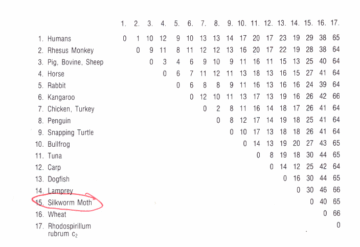
Left: differences in cytochrome-c, as reported by Pandas. Note that for any chosen pair, the number of differences should relate to the time since last common ancestor, as found.

Consider what has happened since dogfish and mammals last shared a common ancestor. First we have the split between cartilaginous fish and bony fish, some 460 million years ago (times given by Timetree, as an average of published estimates). 430 million years ago, amphibians emerged from bony fish, and gave rise in turn to reptiles, 350 million years ago, while the split between reptiles and mammals (actually, “reptile” is not a well-defined biological term, but that does not matter here) occurred some 30 million years later. But if you compare a dogfish with a tuna, or a frog, or a turtle, or a pig, Timetree will in each case give you the same evolutionary distance of 460 million years, because that is how long ago the entire evolutionary line that gave rise to present-day bony fish, amphibians, reptiles, pigs, and you and me split from the line that gave rise to dogfish and other sharks.

Forgive me for labouring this point, but such errors are central to the book’s entire argument. Contrary to their claims, the data overwhelmingly support a picture of the organic world completely consistent with what they insist on calling “Darwinian” evolution, and difficult to explain in any other way. What they do not support is the authors’ flawed reasoning, understandable in first-year undergraduates, but inexcusable in textbook writers.

Footnotes

  • 1 Specifically the 2nd edition, 1993, henceforth Pandas, which is the version that I discuss here.
  • 2 Barbara Rorrest and Paul R. Gross, Creationism’s Trojan Horse: The Wedge of Intelligent Design, Oxford University Press, 2004. page 275

Reposted from 3 Quarks Daily

Evolution and Creationism in the age of Trump

carview.php?tsp=

Throughout most of the UK (Northern Ireland is a partial exception) evolution is regarded as established science, and no politician would make belief in separate creation part of their platform, for fear of ridicule. In the US, this is far from being the case. Although evolution has become more widely accepted over time, one third of Americans still believe that God created humans in their present form. Here I discuss the enormous influence of creationism in US politics and analyse the arguments put forward in its favour, as set out for example by Charlie Kirk, the recently slain leader of Turning Point USA.

Mike Pence, Vice President during Trump’s first term in office, had argued in Congress for creationism, while creationists have been prominent in the various faith councils supporting Trump. At least three members of his present cabinet (Pete Hegseth, Scott Turner at HUD, pastor at Prestonwood Baptist Church, Doug Collins at the VA, one-time pastor at Chicopee Baptist Church) are committed creationists, as is Mike Huckabee, another former Southern Baptist pastor, now ambassador to Israel. So is Mike Johnson, Speaker of the US House of Representatives, who has done pro bono work for Answers in Genesis, now the leading creationist organization. Russell Vought, co-author of Project 2025, whose role at the Office of Management and Budget is pivotal role in the distribution of federal funds, is an elder of a church that explicitly rejects evolution, and sees Satan as “the unholy god of this age.” Vought is also acting director of the Consumer Financial Protection Bureau, and on 28 October 2025, in this capacity, rescinded the rule that, in some States, prevents medical debt from showing up on credit reports.

We can understand the link between creationism and US right-wing politics in terms of the appeal to US conservatives of loyalty, respect for authority, and sanctity. These all favour absolutist theology, which demands submission to divine authority, loyalty to the community of believers, and the preservation of pure doctrine. With this in mind, we can understand the appeal of Christian Nationalism and Trumpism to creationists. Thus as early as 2015, Answers in Genesis praised Trump, not for any specific policies, but because he spoke, just as Jesus spoke to the Pharisees, as one with authority.

carview.php?tsp=
Interior scene, Answers in Genesis’ Ark Encounter. None of this is biblical

Creationists claim to be following the only natural interpretation of the sacred text, despite the fact that the text itself is full of ambiguities, contains scientific impossibilities (such as the creation of day and night, evening and morning, before the creation of the sun), and has been the subject of fierce controversy among believers since the beginning. Present-day versions are dominated by Young Earth creationism, which became dominant among US evangelical Christians in the decades following its foundational text, The Genesis Flood, in 1961. After various schisms, the group associated with that book has set up a number of organizations, most notably Creation Ministries International and the Institute for Creation Research, with the most prominent organisation now being Answers in Genesis, founded by Ken Ham when under circumstances leading to litigation he broke away from the other two major organisations. Answers in Genesis operates the Creation Museum and the Ark Encounter, both in Kentucky, as well as a worldwide publication network.

carview.php?tsp=

All this is of major political significance. From its beginning, the modern Young Earth creationist movement has been connected with right-wing American politics. Tim LaHaye, now best known for the Left Behind series of books, developed in his 1980 book The Battle for the Mind the thesis that creationism was the only valid form of religious belief, and was associated with true American values, while evolution was linked to humanism, internationalism, socialism, and immorality. From this it followed that it was the duty of true believers to involve themselves in politics. Such arguments were influential in forging the links between evangelical Christianity and the modern Republican Party as constructed by Ronald Reagan.

Two other developments further cemented evangelical creationism to right-wing politics. The first of these was the adoption by the Reagan campaign of the abortion issue. As late as 1973, evangelical Christians had no strong position on abortion, which was regarded mainly as an issue for Catholic voters. However, in 1975, Paul Weyrich and allies used the issue to rally evangelicals to the Republican cause, presenting it as a matter of biblical morality although the Bible itself is completely silent on the matter. Here they were helped by the theologian Francis A. Schaeffer, and the distinguished surgeon (later US Surgeon-General) C, Everett Koop. Schaeffer’s spiritual retreat at L’Abri in Switzerland taught the Young Earth version of creationism.1 Koop was not only an extremely skilled surgeon but an effective and courageous public educator.2 He was nonetheless a creationist, being enormously impressed by the complexity of the human body. So is Ben Carson, Donald Trump’s Surgeon General during his first administration, a brilliant surgeon who has separated conjoined twins and yet regards evolution science as inspired by Satan.

The other one significant development was the emergence of a creationist climatology. From 1970 if not earlier, we have seen the emergence of a scientific consensus that tells us that the Earth is currently warming at an alarming rate, and that much if not all of this warming is due to the emission of greenhouse gases by human industrial activity. This consensus is reinforced by analysis of past climates, as inferred from the study of annual bands in deep cores from the Greenland and Antarctic ice sheets, going back hundreds of thousands of years. Young Earth creationists are forced to explain the formation of the ice sheets in some other way, and from 1987 onwards have developed their own fantastical explanations (also among the unbiblical things mentioned on the Ark Encounter), involving extreme moisture transfer in the aftermath of Noah’s Flood. This leads in their logic to denial of the importance of greenhouse gas emissions, making them allies of the US anti-environmentalist Right. A pivotal role here is played by the Cornwall Alliance, which combines biblical literalist creationism with libertarian free market beliefs, and which has direct links between on the one hand Answers in Genesis, and on the other the Heritage Foundation, birthplace of Project 2025.

With this lengthy preamble, we can make sense of the hidden agenda of Charlie Kirk’s December 2024 U-tube, I Help College Students Understand the Case for Creation Over Evolution.

He stands with his microphone against a backdrop that reads “You are being brainwashed,” a slogan directly attacking the entire university curriculum, including, as we shall see, evolution science. He is very good at what he does. His black T-shirt exaggerates his arm movements. His voice conveys conviction, passion, and at the same time reasonableness and approachability, while his actual words show a carefully crafted informality and imprecision, enabling him to give an impression of bridge building when he is in fact doing a very opposite.

carview.php?tsp=

He is being questioned by a member of the crowd (a plant?) who identifies himself as Jason, says he is there to defend evolution, and then advances in its favour a couple of extremely weak arguments, albeit arguments that fit in well with Kirk’s own ideology. In a series of tightly choreographed exchanges, Kirk replies with a distillation of the standard creationist elements against evolution, before proceeding to declaim in favour of creationism as a pillar of his own faith, moving on to a set piece about the Resurrection as historical proof of Christianity, and promising his audience “a sense of purpose that nothing can explain” if, like him, they accept Jesus into their hearts.

If making a case for evolution, I would refer to such things as family relationships originally based on observation of existing species, increasingly confirmed by a fossil record enormously richer than that available to Darwin, and triumphantly verified by comparisons of DNA, the same kind of method now routinely used by individuals to trace their ancestry. I might add detailed anatomical similarities, evolutionary relics such as gill arches and yolk sacs in the embryos of mammals (including of course us), the distribution of species past and present over the globe, and finally the basic mechanism by which evolutionary novelties arise. All of this has been understood in outline for over a century and is now explainable down to the molecular level (for a summary, see here).

Jason mentions none of this, but opens the case for evolution by comparing it to free market competition, which allows the cream to rise to the top in society. In reply, Kirk proclaims himself a strict creationist, but in a display of reasonableness says that a range of views are possible, and would Jason contemplate the possibility that God created and directs evolution. Jason plays into Kirk’s hand by seizing on the word “created,” and agreeing that the universe had a beginning, but did it need a beginner and why should that beginner be Christ? Kirk replies that we (notice the reference to a collective identity, which is what he is offering his followers) believe that the universe has a beginning point and an end point, words that he repeats for emphasis (notice how Kirk has dragged in the concept of an end time, never far in the background of apocalyptic Christian Nationalist politics).

Having disingenuously claimed not to have studied the subject in sufficient detail, Kirk then gives us a distillation of the standard creationist arguments, with which he is clearly very familiar:

Evolution hinges on far more faith than creation. To believe that the way that we are currently composed, and having species change, is an Act of Faith. Now Darwin was more of an adaptionist than an evolutionist, in the sense that he proved adaptation but he did not prove Evolution. He theorized evolution. He could be right, I don’t think he is, but he through his finches, he wrote that yes, animals or birds will adjust to the environment of which they are in. We do not have any evidence nor can you, you can guess, in the fossil record of actual species change, does that make sense?

The first two sentences here simply ignore the entire body of evidence for evolution, while paving the way for a later argument from improbability. In an apparent show of intellectual generosity, Kirk acknowledges that Darwin has got something right, but that something is mere adaptation, rather than evolution. Here we have the creationist admission that change does happen (they could hardly deny this), coupled to denial that such change could ever lead one kind of living thing to transform into another. As for the fossil record, Kirk is referring to two common creationist arguments. Firstly, the seemingly reasonable comment that no individual fossil is evidence of species change. True up to a point, since any fossil must represent its own viable species, although it is commonplace for fossils to show a mosaic of features already present in their ancestors, and novelties that they pass on to their descendants. The other idea being referred to is the alleged incompleteness of the fossil record. Darwin himself described this as a grave objection to his theory, unless gaps on the record would be filled over time. This of course they have been, and we now have, as Darwin did not, whole sequences pointing to successive changes, as clearly as footsteps in the sand.

The reference to Darwin’s finches is surprisingly common in the creationist literature, although these finches played very little role in Darwin’s own work, and the birds that he used as examples of change in The Origin of Species were pigeons.

In reply, Jason launches into a naïve exposition of evolutionary psychology, and one that suits Kirk’s purposes suspiciously well. He points out that

as a general rule of thumb like women are the sexual gatekeepers and men are the sexual pursuers

and that this difference is explained by evolution, since a woman’s investment in the child is much greater than a man’s.

Cue for Kirk to kill two birds with one stone:

But maybe God, God, maybe God, God made it that way, right?

Kirk is alluding to the well-known Christian Conservative doctrine of complementary roles for men and women, invoking God (note the repetition) for support, and preparing the ground for a more general version of the Argument from Design.

Jason: Maybe, but a lot of things like that point towards evolution of some sort?

Kirk: For sure, but I think you would I think you’re close, because you’re marveling at the design, and therefore we believe it was designed.

Note again the reference to “we,” the apparent generosity of his argument (“I think you’re close”), and the judo move by which he transforms the fitness of organisms from an argument in favour of evolution to one in favour of design.

Kirk now puts forward at some length, while claiming to appeal to reason, the standard creationist argument that the complexity of living things could not have arisen simply by chance. This of course is true, but a central point 3 of evolutionary explanation is that the complexity has arisen step-by-step, by trial and error and repeated winnowing.

Jason here argues that evolution occurs by selection at the gene level, no conscious effort required. To which Kirk replies

Of course I don’t disagree with any of that. We just think all of that was designed into us, right.

He’s lying. He disagrees with all of it. The claimed agreement is an affectation, to pretend that there is symmetry between evolutionary and design-based explanations.

Kirk then gives his own exposition of Scripture, designed to be as noncommittal as possible on matters of doctrine. He has no strong opinion about the age of the earth, but what matters is that God came first, and in succession created the universe, then nature, then animals, then man. The Ten Commandments are good, therefore the Bible as a whole is good. The details don’t matter, but reason commends the twin doctrinal pillars of Creation, and the Resurrection. The Resurrection is well attested by four separate accounts, written from different viewpoints (here Kirk pre-empts the obvious objection that the Gospel accounts contradict each other), as well as reference by Josephus and other unnamed historians. (The kindest interpretation here is that Kirk has not actually read the relevant section of Josephus, which is obviously4 a later out-of-character revision.) Moreover, why did the apostles allow themselves to be martyred in witness to their faith in the Resurrection, if it was not an actual event? I must admit that Kirk does seem to have a point here. However, I noticed that his chief example is St Paul, who never met Jesus and had no first-hand knowledge of his life and death.

The initial question, namely the scientific validity of evolution, has now been buried beneath layers of distraction, while creationism is being extolled by association, as Kirk launches into his final triumphant declaration of how faith in Jesus has transformed his own life.

We can be sure that Kirk’s movement, Turning Point USA, will remain influential in American politics, and perhaps beyond (there is already a Turning Point UK, which has been addressed by Nigel Farage, proprietor5 of the hard Right Reform Party). It is now thoroughly subsumed into the Trumpian juggernaut, with a governmental campaign of reprisals and intimidation, initially directed against Kirk’s critics, spilling over to the Regime’s opponents in general.

undefined
Judge John E, Jones III, US Government image

Turning Point USA is in direct contact with the US Education Department through the Civics Curriculum initiative announced by Education Secretary Linda McMahon just a week after Kirk’s death. This connection has troubling implications, not only for Civics, but for other subjects as well, including the teaching of evolution. In the US, it is unconstitutional for any part of Government to promote a religion, and the courts have repeatedly ruled that for this reason creationism cannot be taught in publicly funded schools. The most recent and most notable of such cases was Kitzmiller v. Dover Area School Board, where Judge Jones also ruled that Intelligent Design was not science, but a form of creationism. Here the decision, handed down in December 2005, appeared to be so strongly worded as to preclude further challenge, but Judge Jones now fears that that may no longer be the case, given recent rulings6 by the present Supreme Court. So this may be one of the numerous battles that appeared won decades or even centuries ago, but will now need to be fought, all over again, with outcome uncertain.

I thank Randall Balmer, Glenn Branch, Andrew Petto, Dan Phelps, Michael Roberts, and William Trollinger for helpful and enjoyable discussions, and Susan Trollinger for the Ark Encounter interior photo.

Footnotes

1] My friend Michael Roberts, transitioning from geologist to Church of England priest, had intended to spend some time at L’Abri, until his assigned tutor told him that geological dating was based on a circular argument, since the sediments are used to date the fossils and the fossils are then used to date the sediments. Michael, who had just mapped out the Precambrian geology of large areas of southern Africa without a single fossil in sight, was not impressed

2] Whenever I hear blanket condemnation of creationists, I think of Koop. While morally opposed to abortion, he resisted pressure from the Reagan Administration to describe it as injurious to mental health. He was also responsible for the recognition of the strength of nicotine addiction and for government initiatives to restrict smoking, and in the face of mealy-mouthed officialdom sent information about AIDS to every US household. He also urged that violence in America be treated as a public health problem.

3] I almost wrote “the central point,” but my biologist friends repeatedly remind me that much, perhaps most evolutionary change is the result of random drift.

4] “Jesus, a wise man, if indeed one ought to call him a man… for the prophets of God had foretold these things and a thousand other marvels about him.” No Jew would ever use such language.

5] Strictly speaking, major shareholder. Reform UK is actually incorporated as a limited company.

6] Judge Jones relied heavily on what was known as the Lemon test, based on religious intent. This he sees as being replaced by more permissive criteria, such as historical practice.

An earlier version of this post appeared in 3 Quarks Daily

Worst Scopes Trial Article Ever

carview.php?tsp=https://upload.wikimedia.org/wikipedia/commons/0/0d/Tennessee_v._John_T._Scopes_Trial-_Outdoor_proceedings_on_July_20%2C_1925%2C_showing_William_Jennings_Bryan_and_Clarence_Darrow._%282_of_4_photos%29_%282898243103%29_crop.jpg
William Jennings Bryan (seated, left) being cross-examined by Clarence Darrow, the trial having been moved outside because of the heat (via Wikipedia)

As many readers will know, July 2025 saw the centennial of the trial of John Scopes in Dayton, Tennessee. Scopes was found guilty of the crime of teaching evolution, in breach of Tennessee’s Butler Act, although what is most remembered is Clarence Darrow’s devastating cross-examination of the Prosecuting Attorney, William Jennings Bryan. The Butler act itself stayed on the statute book until repealed in 1967.

The centennial has evoked numerous responses from creationists, the very worst of which I discuss here. It was not an easy decision – a close competitor was an article in Answers in Genesis, which attributed Bryan’s humiliation to his willingness to contemplate an ancient Earth. But the winner is Mike Mueller writing for the Institute for Creation Research (ICR). Here is my summary and analysis. Spoiler; it discusses 10 separate scientific and historical issues, every one of which it gets the wrong. Enjoy!

Continue reading “Worst Scopes Trial Article Ever”

Creationism As Conspiracy Theory – Revisiting The Peppered Moth

I wrote this 10 years ago, before the term “conspiracy theory” became all too common. Events since then have only reinforced my original opinion.

Lichte_en_zwarte_versie_berkenspanner
Comparison of carbonaria and typica mounted against post-industrial treetrunk, 2006. Licenced under GFDL by the author, Martinowski at nl.wikipedia.

The peppered moth provides a textbook example of industrial melanism and its reversal. Once a classroom classic, then much criticised, and finally rehabilitated through further observation, the story also shows how real science works. The response of the creationist and “Intelligent Design” community provides a textbook example of a conspiracy theory in action, with cherry-picked quotations, allegations of collusion and fraud, and refusal to acknowledge new evidence.

This moth comes in two main varieties, mottled pale (typica), and dark-coloured (carbonaria). The dark form was first noticed, as a rarety, in 1848. Then came widescale industrialisation and grime. By 1895, 98% of the peppered moths in Manchester were dark, and in 1896

Continue reading “Creationism As Conspiracy Theory – Revisiting The Peppered Moth”

The difference between skepticism and denial; Darwin, Wilberforce, and the Discovery Institute

carview.php?tsp=

Bishop Wilberforce, in 1860, was a skeptic, praised by Darwin for the skill of his questioning. Today’s creationists, not least the Discovery Institute, are denialists, endlessly asking the same questions as he did, although they have long since been answered.

Yes, Bishop Wilberforce really did ask T.H. Huxley, “Darwin’s bulldog,” whether he would prefer an ape for his grandfather, and a woman for his grandmother, or a man for his grandfather, and an ape for his grandmother. And Huxley really did say that he would prefer this to descent from a man conspicuous for his talents and eloquence, but who misused his gifts to ridicule science and obscure the light of truth. This and more at the very first public debate regarding Darwin’s work on evolution, only months after the publication of On the Origin of Species.

I first wrote the above paragraph in 3 Quarks Daily in 2017, shortly after Richard England had published on the way that the events had been described in the Oxford Chronicle, the fullest contemporary account available of the encounter. That account refuted doubts that had been raised 1 by some historians, and which I had seen referred to by creationists, wishing to minimise the episode or even to regard it as legendary. These doubts were based largely on the absence of the episode from the account in the gentlemanly Athenaeum, but England convincingly showed that the Athenaeum had practised censorship.

I am writing about this again today in response to an article in the mendaciously mistitled Evolution News, mouthpiece of the neocreationist Discovery Institute, by Robert Shedinger, Professor of Religion at Luther College, Iowa. Shedinger has discovered a second career dissing Darwin. He is best known to readers here for his recent book, Darwin’s Bluff, where he argues that Darwin’s voluminous unpublished notes demonstrate his inability to support his views, and the article I am discussing is an extract from that book. We must therefore regard it, not as a mere passing comment, but as the author’s considered opinion.

Continue reading “The difference between skepticism and denial; Darwin, Wilberforce, and the Discovery Institute”

Unlikely Allies: Biology Teachers and Creationists

carview.php?tsp=

I am writing in response to the article Bridging ideological divides: Why Christians still disagree about evolution and what we whould do about it, by Hans Madueme and Todd Charles Wood, Scientia et Fides 12(1), 2024, 189–213; open access here.

This article is written by two young earth creationists, who take 25 closely argued pages including 93 references to show complete misunderstanding of the relationship between observation and interpretation in evolution science, in order to claim a false epistemic symmetry between this science and the theological perspective which forces them to reject it; a more sophisticated version of the “two pairs of spectacles” thesis that has been with us since George McCready Price. So why am I bothering to review this article? And why, to my own surprise, do I find myself welcoming its appearance?

For three reasons. Firstly, because the authors, unlike “creation science” young earth creationists, accept the validity of the science in its own terms, rather than claiming that it is inferior to their own fantastical offerings. Secondly, because they lay out extremely clearly (and self-revealingly) their own epistemic position. And finally, because their recommendations, made regarding conversations within the evangelical community, are applicable (and indeed to some extent already applied) to the very practical problem of how to teach evolution science in places with a faith-based culture.

Continue reading “Unlikely Allies: Biology Teachers and Creationists”

Reading Darwin causes mass shootings. Mike Johnson says so. I have the transcript

carview.php?tsp=

By now you will know that the new Speaker of the US House of Representatives, Mike Johnson (Louisiana 4th District) was among those who voted against accepting the results of the 2020 Presidential election. You may also know that he is opposed to the concept of same sex marriage, which in some way he regards as undermining individual religious freedom, and wants to pass a law making abortion illegal throughout the US. You probably also know that he has denied that human activity is a cause of global warming, and has accepted more campaign funds from the fossil fuel industry than from any other source. There is a high chance that you have heard him share Marjorie Taylor Greene’s view that the problem in mass shootings isn’t guns, it’s the human heart (Guns don’t kill people. Human hearts kill people.) What you may not know are his views on the causes of the moral decline that, like authoritarian pulpiteers throughout the ages, he sees happening all around him. He has, however, stated those views very plainly, at a presentation he gave in Louisiana in 2016, available [actually, no longer available] here. I have read the transcript of this, suffering so that you don’t have to, by good luck retained it, and despite many decades of following the utterances of people who share his views I was surprised by what I found.

carview.php?tsp=

Here he is, speaking at a less than overcrowded Shreveport Christian Center, which describes itself as mandated “to participate with the Lord in establishing His kingdom in all areas of our culture. We desire to use the authority given to us to promote and participate in seeing the Lord’s purposes rule in the church, business, media, arts, education, government and family arenas.” The authority, of course, is given by God. He is standing at the front of a platform, and behind him are musical instruments and two flags. The flag of the United States, and the flag of Israel. The Israeli Right has been wooing the American Religious Right for decades, and the unquestioning support of the American Religious Right has done much to make Israel what it is today.

Here’s part of what he said; the link the YouTube has gone dead, as with so many of his presentations, but I had collected the transcript and will make it available to anyone who asks for it privately. Like all academics, I am easy to find.

My account is rather rambling, although nowhere near as rambling as the original material, so I will place the main points here above the fold.

  • He thinks that he became a lawyer in response to divine calling.
  • He would rather have been born at the time of the founding fathers, but thinks that he is where he is now because that’s where God wants him to be.
  • He thinks that the writers of the Declaration of Independence were divinely inspired.
  • He thinks that the United States is a Christian nation.
  • He thinks that the only real way to be a proper Christian is naïve biblical literalism, so rigorously that nowadays only 4% make the grade.
  • He thinks that the US is in moral decline, and that we must identify the disease that caused that decline.
  • He thinks that the disease is teaching about Darwin, imposed in the 1930s by a liberal educational elite with the collusion of progressive Supreme Court judges such as Oliver Wendell Holmes.
  • He thinks that darkness is encroaching, Christians are being persecuted, students who profess a belief in God are ridiculed in universities, and he himself has been shot at with flaming arrows for his religious beliefs.
  • He thinks that learning about Darwin causes people to stop believing in God, whereupon they become completely amoral.
  • He thinks that the results include no-fault divorce (I don’t know why he regards that as a bad thing, but I expect his audience would agree with him), feminism (the same comments apply), the legalisation of abortion which is murder (the Bible says it isn’t, but Bible believing Christians don’t seem to know that), and in due course to mass shootings.
Continue reading “Reading Darwin causes mass shootings. Mike Johnson says so. I have the transcript”

Pandas, Kitzmiller, and the frozen frog fallacy

By Paul Braterman

January 4, 2023 13:00 MST

Paul Braterman is Professor Emeritus at the University of North Texas and Honorary Senior Research Fellow in Chemistry at the University of Glasgow

carview.php?tsp=
Cover of the “alternative textbook,” Of Pandas and People

This Kitzmas was different. For the first time, the Discovery Institute allowed the anniversary of Kitzmiller v. Dover Area School District to pass without complaining about the verdict. Perhaps they are hoping that we will forget about the incredible badness of the text that they were trying to foist on the District’s students. Of Pandas and People is carefully constructed to be as misleading as possible, and we shouldn’t let them forget this, as long as contributors and advisers responsible for it remain in position within the Discovery Institute1, while the Institute continues to promote works such as Denton’s Evolution – A Theory in Crisis, that perpetuate the same elementary errors of logic. But first, an apparent digression. When students first come across the use of molecular or DNA sequencing in constructing phylogenetic trees, they are sometimes puzzled. They have been told that mammals are descended from fish by way of amphibians. Therefore, as a matter of common sense, they might expect that frogs should be closer to fish in evolutionary terms than we are. This is another example of the Evolution as Progress error. While amniotes have progressed through synapsid to mammal to humans, the pinnacle of creation, the frog has remained a lowly frog and should, therefore, be closer to the common ancestor, as if the ineluctable processes of molecular mutation had somehow been suspended. We might call this the “frozen frog fallacy.”

At this point, a Table like the one shown below might help:

Table of cytochrome c differences
Table of cytochrome c differences, from Of Pandas and People, Second edition. Fair use claimed.

All the multicellular organisms shown are, apart from small random fluctuations, at the same distance from the bacterium, as expected if they share a common ancestor distinct from bacteria, which have of course, independently, been accumulating their own set of changes.

All the animals shown are, apart from small random fluctuations, at the same distance from wheat, as expected if they share a common ancestor distinct from plants. And the relative number of mutations shows that the split between plants and animals is more recent than the split between multicellular organisms and bacteria. More recent yet is the split between fish and tetrapods, leaving all tetrapods (including you and me, and of course present-day frogs) at the same distance from the fish. And so on. Most tellingly, humans share a common ancestor with monkeys, more recent than their common ancestor with non-simian mammals. There is a lot more detail in the Table, for example about how to birds relate to reptiles, and how the different orders of mammal relate to each other. And of course the construction of a phylogenetic tree is based on the specific differences found, rather than the overall number.

There are now numerous published studies of the phylogenetic relationships revealed by Cytochrome C, to say nothing of the vast recent literature using numerous molecular and morphological traits to develop detailed high-resolution phylogenies, and to explore the limitations of the concept of a unique phylogeny. What is interesting about the particular Table I have quoted is its origin, and the uses that its authors make of it.

This brings us back to our original theme. The Table actually comes from Of Pandas and People, 2nd edition, 1993, which by the time of the trial had gone through five printings. The book does not give a reference to the source of the data, but much (not all) of the information can be found in a classic 1967 paper [2], which also explains the reasoning behind the method, and critically examines the assumptions made. So there is no excuse for what the book does next, which is to repeatedly assert that the data refute claims of common ancestry:

one might expect analysis to reveal that the cytochromes in fish are most similar to the cytochromes in amphibians. But this is not the case.

And again:

To use the classic Darwinian scenario, amphibians are intermediate between fish and the other band-dwelling invertebrates. Analysis of their amino acids should place amphibians in an approximately intermediate position, but it does not.

(Note the use of Darwin’s name to denote the whole of evolution. In fact, the book is obsessed with Darwin, mentioning him on almost every page, and on some pages up to 10 times. In fact, by my count, and I may have missed a few, Darwin’s name or some variant of it occurs 262 times within the 144 pages of text. This emphasis on Darwin is of course found throughout the whole of the creationist literature, although by now evolutionary theory is almost as different from what Darwin proposed as atomic theory is from that proposed by Democritus.)

These are just two of five separate reiterations of the fallacy, leading up to the extraordinary statement that

Based upon the evolutionary series, we should expect some amphibians to be closer to fish (“primitive” species) and others to be closer to reptiles (“advanced” species).

And to make sure that the message sticks, we have this Figure, with the plain implication that the data point, not to evolution, but to separate creation:

carview.php?tsp=
Figure 9 from Of Pandas and People, Second Edition. Fair use claimed.

The fallacy is not merely being stated; it is being repeated, rationalised, and reinforced. The kindest explanation is that the authors simply do not understand the science that they are presenting, seeing a hierarchical structure where none exists, and imposing on their biology a perspective in terms of “higher” and “lower” which do not belong in modern science, but have been carried over, such as the power of human vanity, from a worldview more akin to Aristotle and the mediaeval Great Chain of Being. The same fallacy also occurs in Michael Denton’s 1985 Evolution – A Theory in Crisis, and while he had by 1998 [3] quietly walked away from this, his 2016 sequel, Evolution – Still a Theory in Crisis, retains his preference for Aristotelian over phylogenetic classification.

And why should this matter? Because it reminds us, and we should not forget, that the Discovery Institute does not only deal in dis-information, but in dis-education.

I thank Maarten Boudry, Glenn Branch, Joe Felsenstein, John Harshman, Kim Johnson, Larry Moran, and Massimo Pigliucci for helpful comments and links to the literature.

Footnotes and citations:Permalink

(1) Dean Kenyon (co-author), Charles Thaxton (Academic Editor), and Stephen Meyer, Michael Behe, and Nancy Pearcey (contributors) all hold positions at the Discovery Institute, as do Raymond Bohlin, Walter Bradley, Robert Kaita, J.P. Moreland, and Paul Nelson, who are on the list of those thanked for being “critical reviewers”, as, also, are Meyer and Behe.

(2) Walter M Fitch and Emanuel Margoliash, Science 155(3760), 279, 1967; DOI: 10.1126/science.155.3760.279

(3) For a discussion of Denton’s revised position, see this 2006 post at Larry Moran’s Sandwalk blog

Repost of https://pandasthumb.org/archives/2023/01/Pandas-and-Frogs.html

Science and politics at the Creation Museum

Repost of https://3quarksdaily.com/3quarksdaily/2022/08/science-and-politics-at-the-creation-museum.html. This piece also appeared at https://rightingamerica.net/science-and-politics-at-the-creation-museum/, with book authors’ comment: “Below is Dr. Paul Braterman’s review of Righting America at the Creation Museum. For us, the best part of this generous review is that Braterman covers and understands all parts of our argument. More than this, we appreciate his scientific interventions, and we absolutely agree that we should have included Henry Morris’ biblical racism in our book.”

carview.php?tsp=

Do we really need 230 pages of at times closely argued text, followed by 70 pages of footnotes, just to tell us about Kentucky’s intellectually bankrupt Creation Museum and the authoritarian organisation, Answers in Genesis, that brings it to us? The answer, I fear, is yes.

For instance, this book will tell you that Ebenezer the Allosaurus, prize exhibit at Answers in Genesis’s Creation Museum in Kentucky, was donated by the Peroutka Foundation. It will also tell you that Michael Peroutka, in a 2013 speech still available on youtube, states that government schools indoctrinate children away from Christian ideas (a theme that recurs throughout this book), and that this is what they were designed to do. The book also points out that he served on the Board of Directors of the League of the South, whose chairman had defined southern people as white. I recently learned that Peroutka is the official Republican Party candidate for the post of attorney general of the State of Maryland in the November 2022 elections. We had better pay attention.

Continue reading “Science and politics at the Creation Museum”

Black swans and other deviations: like evolution, all scientific theories are a work in progress

carview.php?tsp=
EPA, CC BY-SA

Discussions about the nature of science and scientific theories are often confused by the outdated view that such theories are rendered false when anomalies arise. The notion of a scientific theory as a static object should be replaced with the more current view that it is part of a living research programme, which can broaden its scope into new areas.

For example, take the hypothesis that all swans are white, which seemed pretty good to Europeans until Dutch explorers found black swans in Australia in 1636. So what happens to our hypothesis? There are a number of options.

1) Redefine swan-ness to include whiteness. Then black swans aren’t really swans, and the hypothesis remains true by definition.

2) It’s been disproved. Discard it.

3) Compare different species of swan the world over, and see how well black swans fit in.

(1) is the least useful. Definitions can only tell us about how we are using words. They tell us nothing about the world that those words attempt to describe. (2) is based on the common-sense idea that hypotheses should be discarded when falsified by observation. This was the idea put forward by philosopher Karl Popper in the 1930s, to distinguish between science and pseudoscience.

Continue reading “Black swans and other deviations: like evolution, all scientific theories are a work in progress”