

|

|
| CARVIEW |
I think notable individuals, such as celebrities, media personalities, influencers, etc, use social media to promote a brand. Maybe these individuals use their platforms to highlight a product campaign they are doing, or to advertise their new song on Spotify. Even with a small following, it is possible to promote a certain niche or capture a particular market (for instance, micro influencers. I know many students who works with brands as a side hustle on Instagram to help pay for university).
I would argue that even the influencers who market themselves as “relatable” are promoting a brand. The idea of effortless coolness/beauty/quirkiness is incredibly marketable right now. No one wants to look like they are trying. Just consider the concept of “no-makeup makeup”, in which the purpose is to achieve a “natural” look by wearing makeup. Therefore, it is important to recognize that everything on social media is carefully curated — even photos that may look effortless! This idea is captured perfect by Vance in her interview, as she explains how integral that her brand reflects her identity. Her role as a broadcaster provides a bit more flexibility that the role of a journalist in what opinions she can share in public discourse.
What are the benefits of being in the public eye and having a PLN?
One benefit is the ability to meet new people and increase your network. Another benefit is that it boosts your digital professional identity for greater recognition when applying for jobs. For instance, someone who has a fully completed LinkedIn profile with numerous connections, and who is applying for a job through LinkedIn’s career portal, is likely at a more advantageous position than someone with an empty LinkedIn profile. Vance reinforces this idea by describing how her role in the public media has led her to make professional connections.
Building community with online tools provided by the employer can be limiting, what are the perceived restrictions and benefits?
Some of the benefits of using online tools are the ease of use and accessibility. Most social media platforms that focus on community are free to use and do not require an extensive tech background. In my role as a Community Leader for UVic Residence Life, I have taken advantage of platforms such as TikTok, Facebook, and Instagram to build communityamong first-year students.
Safety and privacy concerns are some concerns you must consider when using online tools in a professional context. If you are using social media for a job, you should be certain that your passwords and data are stored safely. At my job, we moved away from using Facebook for communication and now rely on our UVic emails and Microsoft Teams, as they have stronger privacy protections.
Delivering information in a connected society requires verifiable resources, how to build a PLN to rely on?
One piece of advice I received from a professor at UVic who runs a blog is to read a variety of sources. Not just two or three — but five, six, or even seven if you have the time. Editorials, new pieces, documentaries, etc, all have a particular slant to them. This slant, or bias, is often curated to promote advertising, which has created a unique dynamic that Hirst speaks to in their piece (2018). By reviewing multiple sources, it is easier to avoid bias and review trusted sources/
How do those, who are veteran storytellers, minimize risk in sharing misinformation?
Like I mentioned, it is important to look at a variety of sources before sharing information. It is essential to look up information for yourself and critically assess it on your own terms. There have been many times where I have wanted to share a graphic on my Instagram story, but I first paused to do some fact-checking. While these types of graphics are great for promoting campaigns and calling attention to issues, it is difficult to explain multi-faceted issues over an Instagram story.
Works Cited
Vance, Jody & Miller, J. “EDCI 338 – 2021 – 03 – 21 JODY VANCE.” 03 Mar. 2021. doi: https://.youtube.com/watchv=dgZOJgJKdyl&feature=youtu.be
Hirst, M. (2018). Social Journalism and the Gig Economy. Navigating Social Journalism: A Handbook for Media Literacy and Citizen Journalism. Ch. 6.(pp. 142-143). New York, NY: Routledge.
]]>
How does social media engage in advocacy communications?
From the Arab Spring, Kony 2012, and the Black Lives Matter (BLM) movement, we have seen the remarkable ways that social media can connect and unite activists fighting for a common goal. Social media’s greatest advantage for advocacy communications is creating more awareness and recognition to social justice issues. For instance, Instagram stories can be used to post information in the form of eye-catching infographics about social causes, which we saw frequently during the peak of the 2020 BLM resurgence. We also see hashtags on Twitter being used to call attention to issues, such as #MeToo in regards to sexualized violence, and #OscarsSoWhite in regards to the lack of diversity in Oscar nominations/awards. In their interview, Simpson echoes this point by discussing how he increased his social media following, with retweeting of his work allowing for greater attention to BC Community Alliance. This point is supported by the reading by Clark and Aufderheide, as they recognize how social media/PLNs work to move someone to the front of media attention (2013).
How does social media use in public discourse potentially challenge advocacy communications?
Social media allows anyone to become an online activist, which is both a positive and negative phenomenon. Since it is so easy to post things and retweet points online, users may end up accidentally sharing false information, causing more harm than good. For instance, Kony 2012 turned out be a much more complicated situation than the documentary presented. Another example is the case of #BlackoutTuesday, in which Instagram users posted a black square in support of BLM. Many criticized the phenomenon as lazy activism, as there were more black squares on Instagram than signatures on petitions for victims of police brutality such as George Floyd. There was also the issue of important protest information and resources being drowned out by the black squares. Overall, I think users need to be careful about what they are sharing and think critically of what they see online. Clark and Aufderheide highlight the important of having policies in place to stop these kinds of issues occurring, noting that while public discourse in public media is possible, we do not have the correct policies in place to make them most successful (2013). While some platforms have been working to dispel the rise of fake news online, the issue is still relevant.
Works Cited
Clark, J., & Aufderheide, P. (2013). A New Vision for Public Media – Open, Dynamic, and Participatory. In J. Pooley, L. Taub-Pervizpour, & S. C. Jansen (Authors), Media and social justice (pp. 55-67). New York: Palgrave.
Simpson, Markiel. “EDCI 338 – 2021 – 02 – 22 MARKIEL SIMPSON.” 21 Feb. 2021. doi: https://youtu.be/yCSpm1Lx8-A
]]>I would use my PLN to help students transition from university to the workforce or further education. As someone who is graduating after this term, I know first-hand how scary and intimidating this transition can be. I think a campaign that connects soon-to-be graduates with each other would provide a great support network. This campaign could focus on skills that we have developed in this course – such as working to curate a professional digital identity and expanding networks. Some points I would keep in mind while launching my campaign is to be as genuine and authentic as possible. In the reading by Woods, the author advises readers to “Let your Twitter feed reflect you. Make sure your tweets are professional, but also reflect your own personality. You’ll make better connections if you’re open and genuine” (2013, p. 71). I often find that career-based content creators gloss over the gritty parts of establishing your professional identity. All of us face setbacks, and it is important to share that so that students realize they are not alone.
Woods mentions in their article the importance and relevance of Twitter as a PLN, emphasizing features such as hashtags to enable connection-building (2013). One thing I would keep in mind before using Twitter for my campaign, is that many students my age signed up for Twitter for personal use. I would encourage students to whom this applies to create a new Twitter for professional use and make their personal Twitter “private.” There have been so many instances of leaders and celebrities facing harsh consequences for some of their old tweets!
Works Cited
Woods, Bianca. “Building your own PLN: seeking new insights and ideas? Expand your personal learning network.” T+D, vol. 67, no. 11, Nov. 2013, p. 70+. Gale OneFile: Business.gale.com/apps/doc/A348998538/ITBC?u=uvictoria&sid=ITBC&xid=1010abdf.
]]>
I would assess my existing PLN as fairly diverse. I am well-connected on social media platforms and PLNs like LinkedIn with a diverse array of folks from various backgrounds. I grew up in a small city where there is not very much diversity and I felt out of place as a BIPOC woman growing up. As I have gotten older, I learned to value multiculturalism as something to be celebrated, and seek it out in my personal and professional settings. I would say this has become second nature to me. Even in the media I consume, I most enjoy movies and books that show diversity in their stories.
In your PLN, are you learning from a variety of voices or are you the loudest in the room?
I am definitely learning from a variety of voices; however, as an introvert, I do not think I am ever the loudest in the room. Something that has come up in discussions regarding Black Lives Matter and other social justice movements is the importance of listening to marginalized folk. Instead of centering my own views and opinions, I always try to listen to those who are different from me, and be mindful of people who have had different experiences than I have before making assumptions. I think that this is important in movements for inclusion as well. When we try to include those who have not been welcome in certain spaces before, such as in educational institutions as Moore discusses in our readings and videos, we must listen to those who have lived experience being excluded.
Do you participate in a silo of information sharing (similar themes or wide-range of interests)?
I try my best to avoid echo chambers and only exposing myself to views that I already agree with. I am someone who is constantly pushing myself to grow and broaden my horizons, so I always endeavour to learn new things. However, that is not to say that I have not fallen into silos of information sharing before. Overall, this relates back to listening with intent to understand, as I outlined previously.
How can you use a diverse PLN to broaden your views of inclusion?
A diverse PLN can help broaden views of inclusion by its ability to introduce new ideas you may have not been exposed to before. For instance, as someone who grew up in a town that was not diverse, I used PLN to make multicultural connections. I was able to learn more about movements about issues not directly impacting me, such as LGBT rights and disability rights. PLNs offer an accessible entry-point to inclusion, and is especially significant during this pandemic-era where it is harder to connect with new people.
In your professional setting of choice, do you think inclusion is actively embraced?
As someone who wants to become a lawyer, I have reflected on this question before. Historically, I do not think inclusion in law was actively embraced, and the field still has a reputation for being relatively male and white-dominated space. However, things are changing. More women and more BIPOC individuals are entering the field, and women actually make up a higher percentage of law school graduates (CITE). There is still so much room for improvement, which is why I am attending an event by the UVIC Students of Colour Collective that addresses this very topic (see photo below).

Educational institutions, like law schools, work in the manner that Moore criticizes for producing “more of the same”, dating back to attitudes formulated during the industrial revolution (9). Our workforce needs people to work certain hours per day and to not question the systems that are in place. I believe there are ways to subvert this trend. We can encourage educational reforms, which Moore notes are already happening in a global scale (9). Personally, I have noticed a greater emphasis on decolonizing education in recent years of study, which I think is an overall reflection of inclusive efforts.
What is the learning outcome of your PLN and how are you ensuring your exposure to diversity and inclusion?
The learning outcome of my PLN is personal and professional development. Rather than focusing on accomplishments or achievement markers, I believe individual self growth is a worthwhile ambition. For myself, a goal of mine has been to incorporate more rest and self-care into my daily routine. This learning outcome has been, in part, inspired by exposure to diverse views on my PLN. I will continue to ensure my PLN reflects a diversity of opinion.
In terms of inclusion, I will ensure that anything I post or include in my PLN is not exclusionary to any group or practice. I will also continually remind myself that, as Moore states “There is no one way of being inclusive,” (11).
How has your thinking about inclusion and PLN evolved after reviewing the videos and readings?
After reviewing this topic through the videos and readings, I have become much more aware of the efforts made by activists, advocacy groups, etc, to promote inclusion. The move from integration to inclusion (Five Moore Minutes 03:13) is a process that resonated with me deeply. I have definitely felt the difference between feeling like a token minority in a community and feeling actively and meaningfully included. This difference is key to understand to make sure that no one feels excluded.
I also really appreciated the example Moore used about people who do not feel “green” may feel broken (Five Moore Minutes 01:57). This made me further reflect on how the standards in place in our society can have such negative impact.
Works Cited
Moore, Shelley. One Without the Other : Stories of Unity Through Diversity and Inclusion, Portage & Main Press, 2017. ProQuest Ebook Central, https://ebookcentral-proquest-com.ezproxy.library.uvic.ca/lib/uvic/detail.action?docID=4832579.
Moore, Shelley. “Don’t Should on Me: It’s Not Easy Being Not Green.”YouTube, uploaded by Five Moore Minutes, 2018, https://www.youtube.com/watch?v=MeRNhz0nGts&ab_channel=FiveMooreMinutes
Moore, Shelley. “The Evolution of Inclusion.” YouTube, uploaded by Five Moore Minutes, 2018, https://www.youtube.com/watch?v=PQgXBhPh5Zo&feature=youtu.be&ab_channel=FiveMooreMinutes
]]>
What digital platforms are students currently using to develop their professional network?
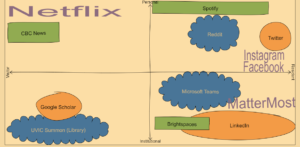
In my own experience, and from observing friends and peers, students are taking advantage of many different platforms to develop their professional networks. Gone are the days where a degree alone can guarantee a job. Now, it is important to make connections and meet with new people. This is especially important in careers that rely on teamwork or collaboration. Currently, I have seen students use LinkedIn to share professional and academic achievements, using it as a personal resume of sorts. I think my generation is shifting away from Facebook these days, but there is definitely still room on that platform to work on your professional network. Personally, I keep my Facebook reserved for friends and family, keeping it as personal use, but in the past I have used it to connect with residents with my job as a Community Leader at UVIC.
What can you (as a student) consider to expand your professional learning network?
A way to expand my professional learning network would be to connect with fellow students in my classes. In this pandemic-era, it can feel difficult to expand your networks and meet new people. Meeting people through a screen is not always ideal, however, it is best to make the most of the current reality and try and make connections. For instance, participating in forums, joining Discord servers (for my program, Political Science, there is a discord server for each course), or posting on Reddit, are all ways to meet people with common interests at UVic. From there, I can connect with the people I have met on my professional networks such as LinkedIn.
In your network, how can you create a digital identity/reputation?
One of the unique factors about creating a digital identity is that it can be tailored towards your academics or professional goals. For instance, someone interested in politics make create a digital identity by using Twitter to comment on current events, or by creating a blog to share their thoughts. Someone who wants to advance their artistic career could start an art page on Instagram. An advantage of this is that Instagram allows businesses to sell directly from their page, so if you have a small business, you can advertise and sell through one platform. Another example could be a student photographer who posts their portfolio as albums on Facebook.
Consider what a local employer would do if you applied for a job with them – can they search the content, is it of benefit to the career path, does it hinder the opportunity of employment?
It is most likely that a local employer would see my LinkedIn profile and my Twitter, as those are the two PLNs I have on public viewing settings. My LinkedIn has been curated to make a good impression on employers, with regular updates and a professional headshot, so I would like to think it would benefit my career path. My Twitter page is mostly for personal use, but I make sure to keep my content appropriate and family-friend, so as not to hinder any employment opportunities. I might consider making my Twitter private in the future as I enter the workforce full-time.
]]>A digital identity can be interpreted as the way someone presents themselves online, whether that be through social media, blogs, or videos. In a sense, it is your “footprint on the web”, as Eric Stoller puts it (0:25, What is digital identity?). Just as we curate our identities in our real lives, our digital identities are constantly adapting and subject to change as our personalities change. I have definitely cringed at the way my younger self presented herself online!
In their piece, Spracklen explains that historically, people have taken advantage of social networks to create a sense of belonging and community, and that social networks “were organized around families, localities, tribes, workplaces, faith groups and, in modernity, the nation state.” (p. 95). This is similar to social media websites we see online, where people can join communities centred around their interests. For instance, Facebook groups and Reddit threads offer niche communities for people on subjects they may not be able to explore as deeply offline. Therefore, creating a digital identity that is an accurate reflection of yourself can make it possible for you to connect with others.
How do personal versus professional approaches to digital identity affect social media use?
In my personal approach to social media, I am less filtered, more vulnerable, and less concerned with appearances. My Instagram profile is private, and I only let friends and family follow it. Whereas my LinkedIn profile is more tailored towards what would be interesting to my colleagues and employers, and I have connections with people I do not know as well. I also take care to present myself in the best manner possible, focusing on school and academic achievements versus personal milestones. One interpretation of this would be that I am less “authentic” in my professional approaches to digital identity, which is a reasonable critique. However, I think that is a reflection on how our society views professionalism, as it is not a ideal that usually accepts vulnerability. In fact, the idea of professionalism raises interesting points regarding race and gender, and what society’s expectations of professionalism is.
How do digital identities converge in networked publics – what are the impacts and/or benefits?
In the reading by Saira, J., et al, the authors discuss how identity is developed through processes of social interaction (p. 33). This makes sense, as all of our identities are influenced by our environments and those around us. While we are all unique individuals, we are of course the products of our experiences. Thereby, I would say that networked publics influence how you choose to present in your digital identity. This may relate back to my previous point about professionalism — one may choose to curate their professional digital identity in a more filtered way than their personal identity.
The World Economic Forum video explores how the digital identity facilities political and social inclusion, thereby driving economic growth 02:30). This is one of the benefits of digital identities converging in networked publics. This is a great benefit, however it is also it is worth considering the increased privacy risks governments and institutions are susceptible to if so much of our economy is tied to digital formats. After all, it is estimated that 60% of global GDP with be digitized by 2022.
Can a digital wallet provide trust in networked publics?
I think it is possible for digital wallets to provide trust, but it is something that will be earned over time. One thing I really enjoy about using ApplePay is that I don’t need to worry about losing my wallet and someone gaining access to my cash or cards. I can bring my phone with me wherever I go and use that as my wallet. If I were to lose my phone, someone could not access my wallet as my fingerprint is required to use the cards. Therefore, I feel a sense of trust in this networked public. However, something I did not previously consider before is how companies are able to take advantage of my data. The more I use my ApplePay, the more that companies know about my purchasing habits. While using digital wallets is supposed to be a secure transaction, it does make me consider the privacy implications of my purchases.
I believe in terms of the good of communities and societies, digital wallets, and digital identities, are a positive feature. For instance, digital wallets allow more people in developing nations to participate in global finance, facilitating greater inclusion. I am interested to see how this concept can be expanded to allowing more marginalized people to participate in these systems that are often exclusionary. For example, with phone plans becoming cheaper, perhaps more lower-income individuals can find ways to participate in the digital economy. Of course, that raises questions surrounding access to internet and tech. All things considered, the increased digitization of finances and institutions provides a unique opportunity for increased equity through inclusion; however, the privacy risks and implications must not be forgotten.
Works Cited
“Davos 2019 – Press Conference the Value of Digital Identity for the Global Economy and Society.” YouTube, uploaded by World Economic Forum, 5 Feb. 2019, www.youtube.com/watch?v=1-V7lyxrOmw&feature=youtu.be&ab_channel=WorldEconomicForum.
Eric Stoller. “What Is Digital Identity?.” YouTube, uploaded by University of Derby, 25 Nov 2016, https://www.youtube.com/watch?v=u0RryRbJza0&feature=youtu.be
Saira, J., et al. “Digital Professional Identity: Dear Internet! Who Am I.” Education for Health, vol. 32, no. 1, 2019, pubmed.ncbi.nlm.nih.gov/31512590/.
Spracklen K. (2015) Identity-Making and Social Media. In: Digital Leisure, the Internet and Popular Culture. Leisure Studies in a Global Era. Palgrave Macmillan, London. https://doi.org/10.1057/9781137405876_6
]]>As per the article by Rajagopal, Kamakshi, et al, networking in the professional sense can be defined as “making connections with other professionals, with or without the intention of making long-term ties with them” (para. three). To network with social media, then, would be to use social media with the aim of making connections or partnerships to advance one’s goals, learn something new, or to promote one’s profile or platform. There are so many ways to network using social media in 2021, with one example being LinkedIn, where one can create a virtual resume. I have personally used LinkedIn to connect with my peers and former colleagues and have used the platform as a way to network. In one of my previous summer jobs, my co-worker had found the position after sending a direct message to our supervisor. There are many examples of jobs being presented exclusively on LinkedIn, making it a worthwhile social media site for professionals to join.
How are we motivated to participate in networked publics?
Since humans are social creatures by nature, I believe we are motivated to participate in networked publics through our intrinsic desire for connection. Social networks allow us to create and maintain bonds with people who could be across the globe, or reconnect with long-lost friends or family. During our current pandemic context, where many of us are limited to our household, social networks allow us to stay connected with people we cannot see. We are also motivated to participate in these networks for the purposes of school or work. In a semester where we are learning remotely, platforms such as Zoom and Discord have taken off.
What are the risks & rewards of public communications?
One of the risks of public communication, in particular, through social media, is of privacy violations and security. Many of us grew up with the warning to critically consider what we posted on social media, to avoid jeopardizing future career or education goals with an inappropriate post or photo. There is also the fact that much of our data is stored and mined by companies for the purposes of advertising, as described in the Boyd article (p. 349). I remember the first time I Googled a brand of shoe I was interested in, only to see it advertised on my Gmail later that day. While I am now used to this type of personalized advertising, it is a useful reminder to monitor our digital footprints and take efforts to protect our privacy.
Some of the rewards of public communication include greater connection, growth, and learning (Rajagopal, Kamakshi, et al., para. four). It is possible to learn so much for free just by going online, and growing one’s brand or platform is easier than ever. By taking advantage of public communication, it is possible to have an online portfolio and record visible to anyone, that could one day create a connection you never could have imagined.
Works Cited
Boyd, Danah. “Networked Privacy.” Surveillance and Society, vol. 10, no. 3/4, 2012, pp. 348-50.
Rajagopal, Kamakshi, et al. “Understanding Personal Learning Networks: Their Structure, Content and the Networking Skills Needed to Optimally Use Them.” First Monday, vol. 17, nos. 1-2, Jan. 2012, firstmonday.org/ojs/index.php/fm/article/download/3559/3131.
]]>