


| CARVIEW |
9am to 5.30 pm Pacific Standard Time (GMT-8)
November 28, 2007
Location: Okapi Island in Second Life
https://slurl.com/secondlife/Okapi/128/128/0
(You must have the free Second Life browser)
What is Second Life?
Second Life is a 3-D virtual world created entirely by its residents. Okapi Island is owned and build by the OKAPI team (that’s us below!) and the Berkeley Archaeologists at Catalhoyuk.
Getting Started
To visit Okapi Island, you will need to create a user account and download the client software–both free.
To create an account, visit https://www.secondlife.com, click on Join (in the upper right corner) and follow the instructions. Note: You do not need a premium account to use Second Life or visit Okapi Island.
Next, download and install the Second Life client for your computer:
https://secondlife.com/community/downloads.php
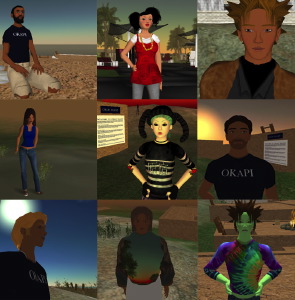
Join us for Remixing Catalhoyuk Day, a public program sponsored by OKAPI and the Berkeley Archaeologists at Catalhoyuk.
Visit OKAPI Island in the 3-D virtual environment of Second Life (see Getting Started below) and explore the past and present of Catalhoyuk, a 9000-year-old village located in present-day Turkey. OKAPI Island features virtual reconstructions of the excavation site and multimedia exhibits of research data. The Island was constructed by a team of undegraduate research apprentices during the Spring and Fall 2007 semester. The Remixing Catalhoyuk program includes lectures, guided tours, games, and much more. Mark your calendars!
Remixing Çatalhöyük Day Activities
(10-10:30 AM, 3-3:30 PM PST)
Guided Tours of OKAPI Island. Tours will be conducted by Ruth Tringham (Professor of Anthropology, UC Berkeley, and Principal Investigator of Berkeley Archaeologists at Çatalhöyük) and the Remixing Çatalhöyük team.
(1 – 2 PM PST)
Lecture: “Cultural Heritage Interpretive Videowalks: Moving Through Present Past Places Physically and Virtually” Presented by Ruth Tringham to the UC Berkeley Landscape Architecture and Environmental Planning Colloquium and simulcast in Second Life.
(2 – 4 PM PST)
Turkish Music Mix. Visit OKAPI Island, learn about Çatalhöyük and build your own remixes in the OKAPI Island Sandbox while listening to DJ (and UCB Anthro grad) Burcu’s eclectic mix of classical and contemporary Turkish music.
(4-5 PM PST)
Remixing Çatalhöyük Video Festival. Nine video producers will share videos about Çatalhöyük. The Video Festival will be hosted by VJ (and UCB Anthro grad) Colleen Morgan.
(5 – 5:30 PM PST)
Remix Competition. The public is invited to use the OKAPI Island Sandbox or Graffiti Cube to build and share reconstructions of Catalhoyuk or “remixes” of archaeological research data. At 5pm PST, the Berkeley Archaeologists at Catalhoyuk team will review and select top entries for virtual awards and exhibition on OKAPI Island.
See you there!
]]>
The fault being identified as a disconnected keyboard. Taking it apart revealed that the screen had been over rotated, pulling the keyboard cable out of the socket on the mainboard:

After it got more taken apart, then put back together, it worked:

Trowel for scale. Cool stuff in the pipes.
]]>I’ve been think about design more than usual recently; most of it is still puzzling to me, despite Gary’s assertion that the plane that got us to Romania that time didn’t fall apart because it was designed.
Nouveau Neolithic is Ian Ferguson‘s view of the subject. Coming from a designer’s perspective, Ferguson designs solutions for post-apocalyptic gourmet eating. Design orientated experimental archaeology? Perhaps, although I don’t think I’m completely convinced. No doubt a flint specialist would disagree with the description of “two fist sized rocks”, not to mention that the included recipe requires the addition of chocolate.
I’m not sure if it helps me understand at all.
]]>https://news.bbc.co.uk/2/hi/technology/6639977.stm
]]>As well as homing in on visual feasts around the globe, users of Google Earth may soon be able to listen to the sounds that accompany them.
A Californian company has created software that can layer relevant recorded sounds over locations in Google Earth, New Scientist reports.
Wild Sanctuary has over 3,500 hours of soundscapes from all over the world.
The firm is in talks with Google, although no official agreement has yet been made.
Its director, Bernie Krause said: “A picture tells a thousand words, but a sound tells a thousand pictures.”
Dr Krause has spent the last 40 years collecting sounds, and his recordings include more than 15,000 animal noises, and sounds from a huge array of habitats, including cities, deserts, mountains and the marine environment.
It is the largest library in existence of natural sound, he said.
He said the idea would be to zoom-in on a particular area and then have the option to listen to the accompanying sound.
“It could be a real beneficial add-on,” he said.
The software is to be presented at the Where 2.0 conference in San Jose, California on 29 May.
Mr Krause said up to two dozen sounds would be show-cased at first, but many more would be added later.
If the project is successful, he would also like to use Google Earth show how sounds change with time.
He said: “People will be able to get a sense of before and after.
“For example, people are talking about how selective logging is an appropriate way of not harming the environment.
“But we have evidence that from the sound perspective, selective logging has a profound effect on the natural world. The pictures of before and after look exactly the same, but the sound is completely different.”
https://www.regdeveloper.co.uk/2007/04/20/openxml-odf/
It’s all about users, we’re told; they (we) use Ms Word widely and aren’t going to want to use something different or incompatible. That’s no trouble, however, as Novell (as well as a number of companies in the future, so the prediction goes) has just released a tool to convert one open standard to the other. All of this neatly explains away the need for the article in the first place.
Neil Lewis, in the first of the comments:
https://www.regdeveloper.co.uk/2007/04/20/openxml-odf/comments/
Reminds us that open standards aren’t about vendor dominance and software lock-ins, but about creating material that can be widely disseminated now and still accessible in the future.
The point of this post? A reminder that some people (Banks) see issues of openness simply as a matter of a vendor’s software sales and are happy to treat the user as some sort of keyboard-drone, the office cubicle equivalent of the mechanically milked cow. Open formats shouldn’t be viewed simply as a sales vector or marketing push, quite the opposite in fact, they should be seen as a means of getting beyond these stifling considerations.
]]>]]>We have lost the online equivalent of parks and roads and shopping streets, where the limits on what we can reasonably say and do are set by society as a whole and not by the commercial interests of one company.
But the real problem with MySpace, YouTube and Flickr and the many other social spaces, sharing tools and online collaborative mechanisms is not that they are privately owned, it is that there is no public service ethos behind them.
There never can be as long as they are owned by companies that must pursue shareholder value above everything.
Channel4.com has been kind enough to list the Wicken Wiki on their website as further reading for the recently (yesterday) aired Time Team show. It was a good show and it’s nice to get mentioned on their site.
]]>]]>The UK now has its own national think tank for open source and open standard policy.
The National Open Centre, which its backers hope will make for better working relationships between the open source community and government, business, and education, launched today (Monday) at the Houses of Parliament.
The centre will carry out research and analysis and host conferences and workshops to facilitate the debate around open source and open standards. The results will ultimately be developed into policy recommendations.
Barbara Held, responsible for open source and open standards within the EU Commission’s IDABC programme, commented: “The work of the NOC will also contribute to coordinate and further the use of open source and open standards at the European level.”
She said such national focal points would be important in a pan-European push for “openness and interoperability”.
IBM and SCC also wheeled out spokespeople to pat the new venture on the back. IBM’s Dr Chris Francis said: “It is vital that current UK public and corporate OS&S policies deliver flexibility and efficiency for public and private organisations alike.”
Basing work on open standards, would be a major part of this, as would open source “wherever appropriate”.
SCC’s Brian Prangle, meanwhile, said he regarded open source and open standards as “second only to the development of the internet and web in terms of accelerating the evolution of information technology”.
He went on: “They are great drivers in disintegrating the bastions of proprietary technology which have kept IT expensive and slow to respond to change.” ®
 Gordon Bell (right) has gone digital with a system that he’s been using for the past nine years. Supposedly (or surprisingly) his methods require only 18 GB a year, or 1.1 TB for a 60 year stint. I guess he hasn’t bought a HD TV yet.

Robert Shields (left) records everything that happens in his life on a typewriter. By 1994 his diary had reached 35 million words; that’s somewhere between three and six thousand words per day.
Of course, log on to Facebook for the first time and you’ll be surprised by the level of detail with which other people have been logging your life. Something like 85% of American students are registered on Facebook – a social networking site centred around photos of you and your friends (hence the face) – that’s not a figure enjoyed in Britain, but you can be safe in the knowledge that if you know a handful of university people, at least one of them will have put a picture of you online and will have tagged it accordingly.
Is anyone going to go trawl through these digital lives? Probably not, but throw in some RSS feeds, Yahoo!s pipes and some facial recognition software (that’s the bit we’ll have to wait for) and your life will be just a browser’s click away.
]]>