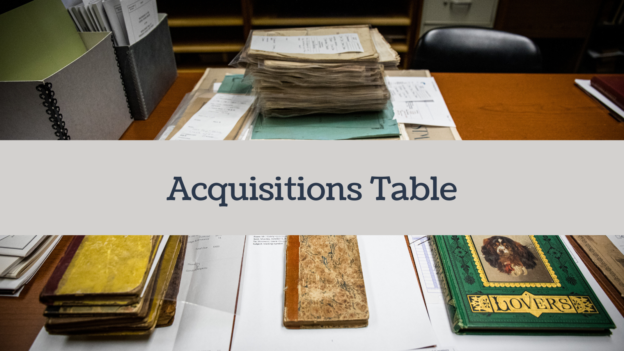
The American Antiquarian Society already preserves over four million books, newspapers, graphics and manuscripts, but new acquisitions are still being added to the collection every month. How are newly acquired collection materials made accessible to researchers in the AAS reading room? This post examines the detailed process by which AAS staff acquire, receive, process, pay for, and catalog materials — and ultimately place them on the shelves to be retrieved for readers.

When purchasing items for the collection, AAS curators select materials through a few different routes, such as online dealers, catalogs, shop visits, and book fairs. After curators identify items of interest, dealers send them to AAS, and then staff in the Acquisitions Department unpack and verify that all required paperwork is present for each order. Paperwork is important! Acquisitions staff create slips for each item to facilitate the approval process, during which curators confirm each item and check the shelves to avoid duplicate items.
After the curator has approved an object for purchase, the Acquisitions Librarian assigns the appropriate fund from the available options. The Society’s annual budget includes many designated funds established by donors — either by gift or bequest — for the purchase of new collection materials. Some funds were created for specific types of materials, such as miniature books, titles about book history, or children’s books. These endowed funds support the Society and are designed to be used in perpetuity. (If you are interested in establishing a fund, please visit the AAS Support page.)
Once the fund is assigned each invoice moves to the finance department, who issues payment. After funding, the Acquisitions Librarian or the Processing Librarian creates a brief catalog record for books, graphic arts materials, and manuscripts. The Serials Cataloger catalogs newspapers and periodicals. Acquisitions staff create digital purchase orders and invoices in the library management system and maintain an accurate accounting ledger to be sure all funds are properly allocated and spent out.

The Acquisitions Department handles gifts of material in a slightly different way, once the curators have approved the donation. While gifts still require documentation, they do not require funding or invoicing. The Processing Librarian creates brief catalog records directly after approval and passes all paperwork to the Head of Acquisitions to create gift acknowledgment letters. The Acquisitions Assistant accessions both purchased and donated items, inscribing specific marks to record provenance information, and routes all materials to the appropriate cataloger to be integrated into the collection.
By communicating with other departments at every step of the process, the Acquisitions team ensures they account for every item and complete the administration of all paperwork, initial cataloging , payments to dealers, and thank yous to donors.
These steps change when curators or Acquisitions staff identify conservation concerns, such as mold or evidence of damage from pests. Acquisitions staff still create a brief catalog record, if possible, but they also include a conservation note with details on the item’s condition, before sending the item to the Conservation Department. Conservation staff return the item to Acquisitions after treatment, and the regular process continues.
The staff at AAS takes the responsibility of managing historical materials very seriously, from the moment they enter the building to when a researcher accesses them. Following an efficient, thorough, and accountable acquisitions process ensures that provenance, or ownership history, is properly documented to comply with legal and ethical standards, and to maintain trust with donors, dealers, and researchers. This responsibility has been a core part of AAS since the Society’s early years, as shown in the 1813-1829 Donation Book (Catalog Record).

Fully transcribed and digitized, this book contains details of the early donations to AAS, starting with Isaiah Thomas’s personal library and other materials from Elizabeth Bliss, Hannah Crocker, and more. The entries include information that remains important to record today, such as title (or description if no title is available), donor’s name, and date.
Today, online library systems allow us to organize and record more information in a way that staff and patrons can use easily. However, paper records have not disappeared; we still use paper slips and other printouts, as mentioned earlier. This isn’t to say that modern systems are perfect, as they come with their own challenges, but AAS staff members work hard to ensure the process remains smooth and efficient for everyone involved.