HTTP/2 301
x-powered-by: PHP/7.4.33
vary: accept, content-type,User-Agent
content-type: application/rss+xml; charset=UTF-8
last-modified: Thu, 22 Jan 2026 10:00:37 GMT
etag: "55e171869d0a222dd003b9d38fc2fd5d"
x-redirect-by: WordPress
location: https://onscript.study/feed/
content-length: 0
date: Sat, 24 Jan 2026 15:34:29 GMT
strict-transport-security: max-age=31536000; includeSubDomains; preload
x-frame-options: SAMEORIGIN
x-content-type-options: nosniff
alt-svc: h3=":443"; ma=2592000, h3-29=":443"; ma=2592000, h3-Q050=":443"; ma=2592000, h3-Q046=":443"; ma=2592000, h3-Q043=":443"; ma=2592000, quic=":443"; ma=2592000; v="43,46"
HTTP/2 200
x-powered-by: PHP/7.4.33
vary: accept, content-type,User-Agent
last-modified: Thu, 22 Jan 2026 10:00:37 GMT
etag: "55e171869d0a222dd003b9d38fc2fd5d"
x-robots-tag: noindex, follow
link: ; rel="https://api.w.org/"
content-type: application/rss+xml; charset=UTF-8
date: Sat, 24 Jan 2026 15:34:31 GMT
strict-transport-security: max-age=31536000; includeSubDomains; preload
x-frame-options: SAMEORIGIN
x-content-type-options: nosniff
OnScript
https://onscript.study
Engaging Conversations on Bible and TheologyThu, 22 Jan 2026 05:23:04 +0000en-US
hourly
1 https://wordpress.org/?v=6.9https://i0.wp.com/onscript.study/wp-content/uploads/2020/10/iTunes-Logo_Square_Blue-scaled.jpg?fit=32%2C32&ssl=1OnScript
https://onscript.study
3232104145793Amy and Chris – The Great Flood Tablet (Epic of Gilgamesh)
https://onscript.study/amy-and-chris-the-great-flood-tablet-epic-of-gilgamesh/?utm_source=rss&utm_medium=rss&utm_campaign=amy-and-chris-the-great-flood-tablet-epic-of-gilgamesh
https://onscript.study/amy-and-chris-the-great-flood-tablet-epic-of-gilgamesh/#respondThu, 22 Jan 2026 10:00:37 +0000https://onscript.study/?p=3997 Episode: It’s go time for Amy’s favorite tablet, tablet 11 of the Epic of Gilgamesh!! It’s flood time, or at least, it’s time to learn about the great flood., brought […]
The post Amy and Chris – The Great Flood Tablet (Epic of Gilgamesh) first appeared on OnScript.]]> Episode: It’s go time for Amy’s favorite tablet, tablet 11 of the Epic of Gilgamesh!! It’s flood time, or at least, it’s time to learn about the great flood., brought by Enlil. This episode will cover the events related to the great flood, as reported by Utnapishtim. Gilgamesh seeks immortality, but ultimately, learns about his human limitations and the need for a good nap.
The post Amy and Chris – The Great Flood Tablet (Epic of Gilgamesh) first appeared on OnScript.]]>https://onscript.study/amy-and-chris-the-great-flood-tablet-epic-of-gilgamesh/feed/03997Stephen Carlson – Mary, Joseph, and the so-called “Inn”
https://onscript.study/stephen-carlson-mary-joseph-and-the-so-called-inn/?utm_source=rss&utm_medium=rss&utm_campaign=stephen-carlson-mary-joseph-and-the-so-called-inn
https://onscript.study/stephen-carlson-mary-joseph-and-the-so-called-inn/#respondTue, 23 Dec 2025 10:00:46 +0000https://onscript.study/?p=3980Episode: Jason Staples and Stephen Carlson try to ruin your Nativity! Jason discusses Stephen’s essay “The Accommodations of Joseph and Mary in Bethlehem: Κατάλυμα in Luke 2:7.” They also discuss […]
The post Stephen Carlson – Mary, Joseph, and the so-called “Inn” first appeared on OnScript.]]> Episode: Jason Staples and Stephen Carlson try to ruin your Nativity! Jason discusses Stephen’s essay “The Accommodations of Joseph and Mary in Bethlehem: Κατάλυμα in Luke 2:7.” They also discuss when and how Mary and Joseph get married, the census in Luke 2:2, and … (wait for it) … the Spanish Inquisition.
Guest: Dr. Stephen Carlson is Associate Professor in the Biblical and Early Christian Studies program at the Australian Catholic University. He’s the author of three books, The Gospel Hoax: Morton Smith’s Invention of Secret Mark(Baylor, 2007), which debunked the “Secret Gospel of Mark”; The Text of Galatians and its History (Mohr Siebeck, 2014), which applied state-of-the-art computer phylogenetic software he wrote himself to produce a family tree of ninety-two manuscripts and witnesses of Galatians; and Papias of Hierapolis’ Exposition of Dominical Oracles(Oxford, 2021), the most complete edition of the fragments of Papias of Hierapolis, a second-century Christian commentator. He is also the author of numerous peer-reviewed journal articles, including his article on the so-called “inn” in Luke’s infancy account (under discussion in this episode) and essays on the donkeys in Matthew’s triumphal entry:
Stephen C. Carlson, “‘The Jenny and the Colt’ in Matthew’s Messianic Entry, Part 1: Matthew 21:5 as a Reading of Zechariah 9:9 in Light of Mark 11:1-10,” in the Catholic Biblical Quarterly, volume 81, number 1 (January 2019), pages 62-84 (link).
Stephen C. Carlson, “‘The Jenny and the Colt’ in Matthew’s Messianic Entry, Part 2: Matthew 21:7 as a Reading of Mark 11:7 in Light of Zechariah 9:9,” in the Catholic Biblical Quarterly, volume 81, number 2 (April 2019), pages 235-251 (link).
Give: Visit our Donate Page if you want to help Biblical World and OnScript continue by becoming a regular donor.
The post Stephen Carlson – Mary, Joseph, and the so-called “Inn” first appeared on OnScript.]]>https://onscript.study/stephen-carlson-mary-joseph-and-the-so-called-inn/feed/03980David DeSilva – Archaeology, Jesus, and Paul
https://onscript.study/david-desilva-archaeology-jesus-and-paul/?utm_source=rss&utm_medium=rss&utm_campaign=david-desilva-archaeology-jesus-and-paul
https://onscript.study/david-desilva-archaeology-jesus-and-paul/#respondWed, 10 Dec 2025 10:00:21 +0000https://onscript.study/?p=3969Episode: In this episode, Kyle sits down for a chat with David deSilva about his two new volumes, Archaeology and the Ministry of Paul: A Visual Guide and Archaeology and the World of Jesus: A Visual […]
The post David DeSilva – Archaeology, Jesus, and Paul first appeared on OnScript.]]> Episode: In this episode, Kyle sits down for a chat with David deSilva about his two new volumes, Archaeology and the Ministry of Paul: A Visual Guide and Archaeology and the World of Jesus: A Visual Guide (Baker Academic, 2025). The two chat about the importance of material culture for understanding the New Testament, discerning between good church traditions and “other” church traditions, and whether or not it is important to get one’s historical details right as a part of one’s theology. Kyle also recounts his unique baptism experience, and David gushes about the Via Dolorosa.
Give: Visit our Donate Page if you want to help Biblical World and OnScript continue by becoming a regular donor.
The post David DeSilva – Archaeology, Jesus, and Paul first appeared on OnScript.]]>https://onscript.study/david-desilva-archaeology-jesus-and-paul/feed/03969Mary Buck – The Achaemenid Period
https://onscript.study/mary-buck-the-achaemenid-period/?utm_source=rss&utm_medium=rss&utm_campaign=mary-buck-the-achaemenid-period
https://onscript.study/mary-buck-the-achaemenid-period/#respondTue, 18 Nov 2025 10:00:56 +0000https://onscript.study/?p=3946Episode: Mary Buck continues her study of the Second Temple period by focusing on the Persian Period, and especially, the Achaemenid Empire. Learn about this incredibly powerful yet lesser-known period of […]
The post Mary Buck – The Achaemenid Period first appeared on OnScript.]]> Episode: Mary Buck continues her study of the Second Temple period by focusing on the Persian Period, and especially, the Achaemenid Empire. Learn about this incredibly powerful yet lesser-known period of history, and figures like Cyrus, Darius, and others who shaped biblical history.
Image Attribution: Map, By Cattette – CC BY 4.0, https://commons.wikimedia.org/w/index.php?curid=113179532; Cyrus the Great’s Tomb – By Bernd81 – Own work, CC BY-SA 4.0, https://commons.wikimedia.org/w/index.php?curid=63225153
Previous Episodes. This is our third installment in our Second Temple series hosted by Mary Buck. Listen to previous episodes on the Assyrian Period and the Babylonian Period.
Give: Visit our Donate Page if you want to help Biblical World and OnScript continue by becoming a regular donor.
The post Mary Buck – The Achaemenid Period first appeared on OnScript.]]>https://onscript.study/mary-buck-the-achaemenid-period/feed/03946Amy and Chris – Epic of Gilgamesh (Part 11)
https://onscript.study/amy-and-chris-epic-of-gilgamesh-part-11/?utm_source=rss&utm_medium=rss&utm_campaign=amy-and-chris-epic-of-gilgamesh-part-11
https://onscript.study/amy-and-chris-epic-of-gilgamesh-part-11/#respondTue, 28 Oct 2025 09:00:52 +0000https://onscript.study/?p=3933Episode: We’re back with Tablet X of the Epic of Gilgamesh! Gilgamesh must face reality. From the grief over Enkidu to a search for his (Noah-like) ancestor Utnapishtim on Mt. […]
The post Amy and Chris – Epic of Gilgamesh (Part 11) first appeared on OnScript.]]> Episode: We’re back with Tablet X of the Epic of Gilgamesh! Gilgamesh must face reality. From the grief over Enkidu to a search for his (Noah-like) ancestor Utnapishtim on Mt. Mashu, Gilgamesh will learn about his mortality. Meet scorpion beings and enjoy this next installment with Amy and Chris! Click to listen back to PART 1, PART 2, PART 3, PART 4, PART 5, PART 6,PART 7,PART 8, PART 9, and PART 10.
Image Attribution: Item CBS7771 at Penn Museum – https://www.penn.museum/collections/object_images.php?irn=245958#image1
The post Amy and Chris – Epic of Gilgamesh (Part 11) first appeared on OnScript.]]>https://onscript.study/amy-and-chris-epic-of-gilgamesh-part-11/feed/03933Chris and Kyle – Biblical Archaeology Rising (Part 2)
https://onscript.study/chris-and-kyle-biblical-archaeology-rising-part-2/?utm_source=rss&utm_medium=rss&utm_campaign=chris-and-kyle-biblical-archaeology-rising-part-2
https://onscript.study/chris-and-kyle-biblical-archaeology-rising-part-2/#respondTue, 30 Sep 2025 09:00:40 +0000https://onscript.study/?p=3912Episode: In part II of our intro to Biblical Archaeology, Kyle and Chris explore the contributions of W. F. Albright (who knew over 20 languages) and G. E. Wright, Kathleen Kenyon […]
The post Chris and Kyle – Biblical Archaeology Rising (Part 2) first appeared on OnScript.]]> Episode: In part II of our intro to Biblical Archaeology, Kyle and Chris explore the contributions of W. F. Albright (who knew over 20 languages) and G. E. Wright, Kathleen Kenyon and others, and the emergence of New Archaeology, regional approaches, and other new methods. They also consider questions of faith and history, theology and archaeology, and text and the past. They discuss how archaeology is ill-suited to “slay the dragon of theological liberalism,” but also how it contributes to faith. How can we grapple well with the intersection of these fields that often seem so far apart?
The post Chris and Kyle – Biblical Archaeology Rising (Part 2) first appeared on OnScript.]]>https://onscript.study/chris-and-kyle-biblical-archaeology-rising-part-2/feed/03912Shifting Imagery (Ps 23) – Brent Strawn
https://onscript.study/shifting-imagery-ps-23-brent-strawn/?utm_source=rss&utm_medium=rss&utm_campaign=shifting-imagery-ps-23-brent-strawn
https://onscript.study/shifting-imagery-ps-23-brent-strawn/#respondWed, 03 Sep 2025 09:00:34 +0000https://onscript.study/?p=3896Episode: With a biblical poem that shifts imagery (Ps 23), and another (Robert Hayden’s “Those Winter Sundays”) that provides perspective, Brent Strawn takes us into an “uber-famous” biblical poem-this “nightingale […]
The post Shifting Imagery (Ps 23) – Brent Strawn first appeared on OnScript.]]> Episode: With a biblical poem that shifts imagery (Ps 23), and another (Robert Hayden’s “Those Winter Sundays”) that provides perspective, Brent Strawn takes us into an “uber-famous” biblical poem-this “nightingale of the Psalms” (Henry Ward Beecher)-that needs to be heard again. Themes of life, death, and asylum redound. Enjoy this last episode of Season 1 of our podcast In Parallel.
Strawn also discusses Sharon Olds’ poem “The Preparing” from her 2002 collection Balladz.
About: In Parallel is a new podcast that explores biblical and contemporary poetry. Please subscribe wherever you listen (Apple Podcasts, Spotify). For more information about the podcast, see HERE and to learn more about Brent, see HERE.
Help Support In Parallel: Visit our Donate Page if you want to support this show.
The post Shifting Imagery (Ps 23) – Brent Strawn first appeared on OnScript.]]>https://onscript.study/shifting-imagery-ps-23-brent-strawn/feed/03896Chris and Kyle – Biblical Archaeology Rising (Part 1)
https://onscript.study/chris-and-kyle-biblical-archaeology-rising-part-1/?utm_source=rss&utm_medium=rss&utm_campaign=chris-and-kyle-biblical-archaeology-rising-part-1
https://onscript.study/chris-and-kyle-biblical-archaeology-rising-part-1/#respondTue, 02 Sep 2025 09:00:12 +0000https://onscript.study/?p=3880 Episode: In this two-part series, Kyle and Chris delve deeply into the history of “biblical” archaeology. What is this field? How did we get to where we are today? Who […]
The post Chris and Kyle – Biblical Archaeology Rising (Part 1) first appeared on OnScript.]]> Episode: In this two-part series, Kyle and Chris delve deeply into the history of “biblical” archaeology. What is this field? How did we get to where we are today? Who are some of the characters that shaped the field along the way? If you’ve ever pondered these (or related) questions, then this mini-series is for you.
Give: Visit our Donate Page if you want to help Biblical World and OnScript continue by becoming a regular donor.
Image Attribution: By NASA, earthobservatory, https://earthobservatory.nasa.gov/ – https://earthobservatory.nasa.gov/Newsroom/NewImages/Images/modis_near_east_lrg.jpg, Public Domain, https://commons.wikimedia.org/w/index.php?curid=176941
The post Chris and Kyle – Biblical Archaeology Rising (Part 1) first appeared on OnScript.]]>https://onscript.study/chris-and-kyle-biblical-archaeology-rising-part-1/feed/03880Mary Buck – The Babylonian Period
https://onscript.study/mary-buck-the-babylonian-period/?utm_source=rss&utm_medium=rss&utm_campaign=mary-buck-the-babylonian-period
https://onscript.study/mary-buck-the-babylonian-period/#respondMon, 25 Aug 2025 09:00:56 +0000https://onscript.study/?p=3867Episode: In this second of our “Second Temple Series,” Mary Buck discusses the Neo-Babylonian period. Of particular interest is the impact of the Babylonian Empire on the Kingdom of Judah. Babylonian […]
The post Mary Buck – The Babylonian Period first appeared on OnScript.]]> Episode: In this second of our “Second Temple Series,” Mary Buck discusses the Neo-Babylonian period. Of particular interest is the impact of the Babylonian Empire on the Kingdom of Judah.
Babylonian Period. This short-lived “flash-in-the-pan” empire has an outsized impact on history. Learn how and why in this episode!
Key BCE dates discussed: 627 – Nabopolassar (rebels against Assyria)
612 – Nineveh falls, capital moves to Haran
606 – Nebuchadnezzar II (famous from Daniel, etc.). Egyptians and Assyrians unite against Babylon. Battle of Carchemish – Nebuchadnezzar II defeats the Assyrian-Egyptian coalition.
605 – Nebuchadnezzar II pursues Egyptian army back to the brook of Egypt. (but don’t take territory there)
599-597 – Jehoiakim rebels against Babylon (dies in 597), then Jehoiakin exiled to Babylon. Finally, Zedekiah appointed as vassal king.
588 – Judah relies on Egypt to resist Babylon
587/6 – Nebuchadnezzar II returns to Jerusalem a final time, laying siege to the city. Jerusalem falls, partial deportation.
586-573 – 13yr. siege of Tyre.
549 – Cyrus the Great comes to power in Elam
538 – Fall of Babylon (without battle?)
Other references:
Al-Yahudu tablets – over 100 cuneiform tablets about the lives of Judean exiles, in the Bible Lands Museum (Israel)
Ration texts related to Jehoiakin and his five sons
Host: Mary Buck is hosting this series!! Listen to the Assyrian episode HERE.
Image Attribution: By Robert Koldewey (10 September 1855 – 4 February 1925) – Die Tempel von Babylon und Borsippa : nach den Ausgrabungen durch die Deutsche Orient-Gesellschaft, 1911, Public Domain, https://commons.wikimedia.org/w/index.php?curid=87505819
Give: Visit our Donate Page if you want to help Biblical World and OnScript continue by becoming a regular donor.
The post Mary Buck – The Babylonian Period first appeared on OnScript.]]>https://onscript.study/mary-buck-the-babylonian-period/feed/03867Amy and Chris – Epic of Gilgamesh (Part 10)
https://onscript.study/amy-and-chris-epic-of-gilgamesh-part-10/?utm_source=rss&utm_medium=rss&utm_campaign=amy-and-chris-epic-of-gilgamesh-part-10
https://onscript.study/amy-and-chris-epic-of-gilgamesh-part-10/#respondWed, 09 Jul 2025 09:00:49 +0000https://onscript.study/?p=3838Episode: We’re back with Tablet IX of the Epic of Gilgamesh. Gilgamesh must face reality. From the grief over Enkidu to a search for his (Noah-like) ancestor Utnapishtim on Mt. […]
The post Amy and Chris – Epic of Gilgamesh (Part 10) first appeared on OnScript.]]> Episode: We’re back with Tablet IX of the Epic of Gilgamesh. Gilgamesh must face reality. From the grief over Enkidu to a search for his (Noah-like) ancestor Utnapishtim on Mt. Mashu, Gilgamesh will learn about his mortality. Meet scorpion beings and enjoy this next installment with Amy and Chris! Click to listen back to PART 1, PART 2, PART 3, PART 4, PART 5, PART 6,PART 7,PART 8 and PART 9.
The post Amy and Chris – Epic of Gilgamesh (Part 10) first appeared on OnScript.]]>https://onscript.study/amy-and-chris-epic-of-gilgamesh-part-10/feed/03838Amy and Chris – Epic of Gilgamesh (Part 9)
https://onscript.study/amy-and-chris-epic-of-gilgamesh-part-9/?utm_source=rss&utm_medium=rss&utm_campaign=amy-and-chris-epic-of-gilgamesh-part-9
https://onscript.study/amy-and-chris-epic-of-gilgamesh-part-9/#respondMon, 30 Jun 2025 09:00:22 +0000https://onscript.study/?p=3818Episode: We’re back now with Tablet VIII of the Epic of Gilgamesh, and our grief knows no bounds. Tune in and hear Amy and Chris discuss the depths of Gilgamesh’s pain, […]
The post Amy and Chris – Epic of Gilgamesh (Part 9) first appeared on OnScript.]]> Episode: We’re back now with Tablet VIII of the Epic of Gilgamesh, and our grief knows no bounds. Tune in and hear Amy and Chris discuss the depths of Gilgamesh’s pain, grief, and loss. They also discuss how Gilgamesh memorializes his friend, and what might have happened in the missing part of the tablet. Click to listen back to PART 1, PART 2, PART 3, PART 4, PART 5, PART 6,PART 7, and PART 8.
The post Amy and Chris – Epic of Gilgamesh (Part 9) first appeared on OnScript.]]>https://onscript.study/amy-and-chris-epic-of-gilgamesh-part-9/feed/03818Amy and Chris – Epic of Gilgamesh (Part 8)
https://onscript.study/amy-and-chris-epic-of-gilgamesh-part-8/?utm_source=rss&utm_medium=rss&utm_campaign=amy-and-chris-epic-of-gilgamesh-part-8
https://onscript.study/amy-and-chris-epic-of-gilgamesh-part-8/#respondSun, 22 Jun 2025 09:00:10 +0000https://onscript.study/?p=3814Episode: We’re back, with Tablet VII of the Epic of Gilgamesh, an emotional high point in the epic. Chris and Amy take us into the friendship of Gilgamesh and Enkidu, […]
The post Amy and Chris – Epic of Gilgamesh (Part 8) first appeared on OnScript.]]> Episode: We’re back, with Tablet VII of the Epic of Gilgamesh, an emotional high point in the epic. Chris and Amy take us into the friendship of Gilgamesh and Enkidu, the aftermath of Humbaba’s death, and the curse-filled waiting for Enkidu’s fate to unfold. Tune in and enjoy! Click to listen back to PART 1, PART 2, PART 3, PART 4, PART 5, PART 6, and PART 7.
Image Attribution:By Osama Shukir Muhammed Amin FRCP(Glasg) – Own work, CC BY-SA 4.0, https://commons.wikimedia.org/w/index.php?curid=90610606
Give: Visit our Donate Page if you want to help Biblical World and OnScript continue by becoming a regular donor.
The post Amy and Chris – Epic of Gilgamesh (Part 8) first appeared on OnScript.]]>https://onscript.study/amy-and-chris-epic-of-gilgamesh-part-8/feed/03814Kyle Keimer – Misunderstanding Sacrifice (part 2)
https://onscript.study/kyle-keimer-misunderstanding-sacrifice-part-2/?utm_source=rss&utm_medium=rss&utm_campaign=kyle-keimer-misunderstanding-sacrifice-part-2
https://onscript.study/kyle-keimer-misunderstanding-sacrifice-part-2/#respondTue, 03 Jun 2025 16:27:29 +0000https://onscript.study/?p=3808Episode: Kyle Keimer joins to add insights from archaeology to an earlier OnScript episode called Misunderstanding Sacrifice (listen HERE). Dru and Matt L talk about the incomplete pictures gained from […]
The post Kyle Keimer – Misunderstanding Sacrifice (part 2) first appeared on OnScript.]]> Episode: Kyle Keimer joins to add insights from archaeology to an earlier OnScript episode called Misunderstanding Sacrifice (listen HERE). Dru and Matt L talk about the incomplete pictures gained from archaeology AND the Bible, and how to grapple with both. This episode is cross-listed with the OnScript podcast.
Guest/Co-Host: Kyle Keimer is know to listeners of our Biblical World podcast, and follow THIS link to get to know him more.
Give: Visit our Donate Page if you would like to support OnScript’s work.
Image Attribution: By illustrators of the 1890 Holman Bible – https://thebiblerevival.com/clipart/1890holmanbible/bw/altarofincensealtarofburnt-offeringlaver.jpg, Public Domain, https://commons.wikimedia.org/w/index.php?curid=9424389
The post Kyle Keimer – Misunderstanding Sacrifice (part 2) first appeared on OnScript.]]>https://onscript.study/kyle-keimer-misunderstanding-sacrifice-part-2/feed/03808Mary Buck – The Assyrian Period
https://onscript.study/mary-buck-the-assyrian-period/?utm_source=rss&utm_medium=rss&utm_campaign=mary-buck-the-assyrian-period
https://onscript.study/mary-buck-the-assyrian-period/#respondWed, 30 Apr 2025 09:00:47 +0000https://onscript.study/?p=3787Episode: In this first of our “Second Temple Series,” Mary Buck takes us back well before the Second Temple Period, back to the Assyrian Period. Beware, there’s a pop quiz […]
The post Mary Buck – The Assyrian Period first appeared on OnScript.]]> Episode: In this first of our “Second Temple Series,” Mary Buck takes us back well before the Second Temple Period, back to the Assyrian Period. Beware, there’s a pop quiz here! Learn which Second Temple site is her favorite, and much more!
Image Attribution: By יעקב – Own work, CC BY-SA 3.0, https://commons.wikimedia.org/w/index.php?curid=15709510
Give: Visit our Donate Page if you want to help Biblical World and OnScript continue by becoming a regular donor.
The post Mary Buck – The Assyrian Period first appeared on OnScript.]]>https://onscript.study/mary-buck-the-assyrian-period/feed/03787Amy and Chris – Epic of Gilgamesh (Part 7)
https://onscript.study/amy-and-chris-epic-of-gilgamesh-part-7/?utm_source=rss&utm_medium=rss&utm_campaign=amy-and-chris-epic-of-gilgamesh-part-7
https://onscript.study/amy-and-chris-epic-of-gilgamesh-part-7/#respondMon, 07 Apr 2025 09:00:56 +0000https://onscript.study/?p=3782Episode: We’re back, with Tablet VI of the Epic of Gilgamesh. Chris and Amy take us on a deep dive into the “love” of Ishtar, Gilgamesh refusing that love as […]
The post Amy and Chris – Epic of Gilgamesh (Part 7) first appeared on OnScript.]]> Episode: We’re back, with Tablet VI of the Epic of Gilgamesh. Chris and Amy take us on a deep dive into the “love” of Ishtar, Gilgamesh refusing that love as cruel and temporary, the Bull of Heaven’s rage and death, and the impending fate of Enkidu. Tune in and enjoy! Click to listen back to PART 1, PART 2, PART 3, PART 4, PART 5, and PART 6.
Image Attribution: By Osama Shukir Muhammed Amin FRCP(Glasg) – Own work, CC BY-SA 4.0, https://commons.wikimedia.org/w/index.php?curid=92742680
Give: Visit our Donate Page if you want to help Biblical World and OnScript continue by becoming a regular donor.
The post Amy and Chris – Epic of Gilgamesh (Part 7) first appeared on OnScript.]]>https://onscript.study/amy-and-chris-epic-of-gilgamesh-part-7/feed/03782Best Archaeological Finds of 2024 (Part 2) – Chris and Kyle
https://onscript.study/best-archaeological-finds-of-2024-part-2-chris-and-kyle/?utm_source=rss&utm_medium=rss&utm_campaign=best-archaeological-finds-of-2024-part-2-chris-and-kyle
https://onscript.study/best-archaeological-finds-of-2024-part-2-chris-and-kyle/#respondThu, 06 Mar 2025 10:00:39 +0000https://onscript.study/?p=3761Episode: Part 2 of our Best Archaeological Finds for 2024 (we’re not that far into 2025!). Enjoy this second of a two-part series. Hosts: Chris McKinny and Kyle Keimer Give: Visit our Donate Page if […]
The post Best Archaeological Finds of 2024 (Part 2) – Chris and Kyle first appeared on OnScript.]]> Episode: Part 2 of our Best Archaeological Finds for 2024 (we’re not that far into 2025!). Enjoy this second of a two-part series.
Image Attribution: Cuneiform tablet known as Letter ZTT 22. (Credit: Ziyaret Tepe Archaeological Project)
The post Best Archaeological Finds of 2024 (Part 2) – Chris and Kyle first appeared on OnScript.]]>https://onscript.study/best-archaeological-finds-of-2024-part-2-chris-and-kyle/feed/03761Best Archaeological Finds of 2024 (Part 1) – Chris and Kyle
https://onscript.study/best-archaeological-finds-of-2024-part-1-chris-and-kyle/?utm_source=rss&utm_medium=rss&utm_campaign=best-archaeological-finds-of-2024-part-1-chris-and-kyle
https://onscript.study/best-archaeological-finds-of-2024-part-1-chris-and-kyle/#respondMon, 10 Feb 2025 10:00:57 +0000https://onscript.study/?p=3745Episode: Back by popular demand is our Best Archaeological Finds series, and this one for 2024 (we’re not that far into 2025!). Enjoy this first of a two-part series. Hosts: Chris McKinny and […]
The post Best Archaeological Finds of 2024 (Part 1) – Chris and Kyle first appeared on OnScript.]]> Episode: Back by popular demand is our Best Archaeological Finds series, and this one for 2024 (we’re not that far into 2025!). Enjoy this first of a two-part series.
Give: Visit our Donate Page if you want to help Biblical World and OnScript continue by becoming a regular donor.
Image Attribution: Cuneiform tablet known as Letter ZTT 22. (Credit: Ziyaret Tepe Archaeological Project)
The post Best Archaeological Finds of 2024 (Part 1) – Chris and Kyle first appeared on OnScript.]]>https://onscript.study/best-archaeological-finds-of-2024-part-1-chris-and-kyle/feed/03745Egyptology and the Exodus Narrative – Chris and Mark (Egypt Series)
https://onscript.study/egyptology-and-the-exodus-narrative-chris-and-mark/?utm_source=rss&utm_medium=rss&utm_campaign=egyptology-and-the-exodus-narrative-chris-and-mark
https://onscript.study/egyptology-and-the-exodus-narrative-chris-and-mark/#respondThu, 23 Jan 2025 10:00:48 +0000https://onscript.study/?p=3731Episode: We’re continuing our series on Egypt and the Bible! In this episode we’re focused on the geography, archaeology, and the history of the exodus, including the route and wilderness wanderings. […]
The post Egyptology and the Exodus Narrative – Chris and Mark (Egypt Series) first appeared on OnScript.]]> Episode: We’re continuing our series on Egypt and the Bible! In this episode we’re focused on the geography, archaeology, and the history of the exodus, including the route and wilderness wanderings. We discuss the sites Pi-Ramesses, Pithom, and Succoth.
Give: Visit our Donate Page if you want to help Biblical World and OnScript continue by becoming a regular donor.
Image Attribution: By Ancient_Egypt_map-en.svg: Jeff Dahlderivative work: MinisterForBadTimes (talk) – Ancient_Egypt_map-en.svg, CC BY-SA 3.0, https://commons.wikimedia.org/w/index.php?curid=7160429
The post Egyptology and the Exodus Narrative – Chris and Mark (Egypt Series) first appeared on OnScript.]]>https://onscript.study/egyptology-and-the-exodus-narrative-chris-and-mark/feed/03731Historical Geography – John Monson
https://onscript.study/historical-geography-john-monson/?utm_source=rss&utm_medium=rss&utm_campaign=historical-geography-john-monson
https://onscript.study/historical-geography-john-monson/#respondThu, 02 Jan 2025 10:00:10 +0000https://onscript.study/?p=3706Episode: In this episode, Kyle and Chris are joined by John Monson to discuss the history of one of their favorite subjects – the Historical Geography of the Bible. Guest: Dr. […]
The post Historical Geography – John Monson first appeared on OnScript.]]> Episode: In this episode, Kyle and Chris are joined by John Monson to discuss the history of one of their favorite subjects – the Historical Geography of the Bible.
Guest: Dr. Monson was born to missionary parents in Zaire but spent most of his youth in Jerusalem, Israel, where he developed an interest in biblical studies, archaeology, and historical geography. Prior to coming to Trinity he taught for eleven years at Wheaton College, where he received the Faculty Achievement Award in Teaching. His archaeological fieldwork has taken him to Syria, Lebanon, and numerous excavations in Israel. He’s the author of Dothan I: Remains from the Tell (1953-1964), co-editor, (Eisenbrauns, 2005), 1 Kings in the Zondervan Illustrated Bible Backgrounds Commentary, and The Temple of Solomon (Oxford University Press, forthcoming) (adapted from the TEDS website).
Biblical Backgrounds provides immersive resources to study the story and land of the Bible. Their maps are unparalleled guides for getting to know the Land. https://www.biblicalbackgrounds.com
The post Historical Geography – John Monson first appeared on OnScript.]]>https://onscript.study/historical-geography-john-monson/feed/03706Chris and Kyle – Archaeology: What It Is and What It Does
https://onscript.study/chris-and-kyle-archaeology-what-it-is-and-what-it-does/?utm_source=rss&utm_medium=rss&utm_campaign=chris-and-kyle-archaeology-what-it-is-and-what-it-does
https://onscript.study/chris-and-kyle-archaeology-what-it-is-and-what-it-does/#respondWed, 04 Dec 2024 10:00:19 +0000https://onscript.study/?p=3687Episode: In this episode, Kyle and Chris talk about the fundamentals of biblical archaeology – both its underlying methodology and why they remain hopeless devotees to it. If you wondered […]
The post Chris and Kyle – Archaeology: What It Is and What It Does first appeared on OnScript.]]> Episode: In this episode, Kyle and Chris talk about the fundamentals of biblical archaeology – both its underlying methodology and why they remain hopeless devotees to it. If you wondered what biblical archaeology is and why you should care – this is the episode for you. Hosts: Chris McKinny and Kyle Keimer
Resources:
Blakely, Jeffrey A. And Lawrence E. Toombs. 1980. The Tell el-Hesi Field Manual: The Joint Archaeological Expedition to Tell el-Hesi Vol. 1. Boston: American Schools of Oriental Research. ISBN: 0897572033.
Harris, Edward C. 1989. Principles of Archaeological Stratigraphy. 2nd edition. London San Diego: Academic Press. (available for free download at URL). ISBN-13. 978-0123266514
Strange, James Riley. 2023. Excavating the Land of Jesus: How Archaeologists Study the People of the Gospels. Grand Rapids: Eerdmans. ISBN: 9780802869500
Urban, Patricia A. And Edward Schortman. 2019. Archaeological Theory in Practice. 2nd edition. New York: Routledge. ISBN: 9781138202801
Give: Visit our Donate Page if you want to help Biblical World and OnScript continue by becoming a regular donor.
Image Attribution: Courtesy of the Khirbet el-Ra’i Expedition
The post Chris and Kyle – Archaeology: What It Is and What It Does first appeared on OnScript.]]>https://onscript.study/chris-and-kyle-archaeology-what-it-is-and-what-it-does/feed/03687Amy and Chris – Epic of Gilgamesh (Part 6)
https://onscript.study/amy-and-chris-epic-of-gilgamesh-part-6/?utm_source=rss&utm_medium=rss&utm_campaign=amy-and-chris-epic-of-gilgamesh-part-6
https://onscript.study/amy-and-chris-epic-of-gilgamesh-part-6/#respondWed, 13 Nov 2024 10:00:58 +0000https://onscript.study/?p=3671Episode: We’re back, with Tablet V of the Epic of Gilgamesh. Chris and Amy take us on a deep dive into the great cedar forest at the mountains of the gods, […]
The post Amy and Chris – Epic of Gilgamesh (Part 6) first appeared on OnScript.]]> Episode: We’re back, with Tablet V of the Epic of Gilgamesh. Chris and Amy take us on a deep dive into the great cedar forest at the mountains of the gods, where they will face Humbaba, guardian of the forest. Tune in and enjoy! Click to listen back to PART 1, PART 2, PART 3, PART 4, and PART 5.
Article by Amy mentioned in the Episode: Balogh, Amy L. “Chapter 2 The Tree of Life in Ancient Near Eastern Iconography”. In The Tree of Life, (Leiden, The Netherlands: Brill, 2020). Access the article HERE.
Give: Visit our Donate Page if you want to help Biblical World and OnScript continue by becoming a regular donor.
Image Attribution: Wikipedia. By Rama, CC BY-SA 3.0 fr, https://commons.wikimedia.org/w/index.php?curid=50284881
The post Amy and Chris – Epic of Gilgamesh (Part 6) first appeared on OnScript.]]>https://onscript.study/amy-and-chris-epic-of-gilgamesh-part-6/feed/03671The Ephraimite Conquest of Bethel in Judges
https://onscript.study/the-ephraimite-conquest-of-bethel-in-judges/?utm_source=rss&utm_medium=rss&utm_campaign=the-ephraimite-conquest-of-bethel-in-judges
https://onscript.study/the-ephraimite-conquest-of-bethel-in-judges/#respondWed, 09 Oct 2024 09:00:33 +0000https://onscript.study/?p=3648 Episode: Chris and Kyle continue their series on the book of Judges, looking at the Ephraimite conquest of Bethel in Judges 1:22-26. They cover problems in the archaeology of Bethel, […]
The post The Ephraimite Conquest of Bethel in Judges first appeared on OnScript.]]> Episode: Chris and Kyle continue their series on the book of Judges, looking at the Ephraimite conquest of Bethel in Judges 1:22-26. They cover problems in the archaeology of Bethel, and they discuss the identity of the “Hittites” in this same passage.
The post The Ephraimite Conquest of Bethel in Judges first appeared on OnScript.]]>https://onscript.study/the-ephraimite-conquest-of-bethel-in-judges/feed/03648Sennacherib’s War Camps – Chris and Kyle
https://onscript.study/sennacheribs-war-camps-chris-and-kyle/?utm_source=rss&utm_medium=rss&utm_campaign=sennacheribs-war-camps-chris-and-kyle
https://onscript.study/sennacheribs-war-camps-chris-and-kyle/#respondTue, 03 Sep 2024 09:00:18 +0000https://onscript.study/?p=3616 Episode: In this episode, Chris and Kyle discuss a recent journal article that claims to have found new evidence of Sennacherib’s 701 BC campaign against Judah. The article makes […]
The post Sennacherib’s War Camps – Chris and Kyle first appeared on OnScript.]]> Episode: In this episode, Chris and Kyle discuss a recent journal article that claims to have found new evidence of Sennacherib’s 701 BC campaign against Judah. The article makes a lot of interesting, but ultimately problematic claims about the Historical Geography of the Biblical World. (Note: Although the audio makes reference to video, we were unable to do the video)
Give: Help support OnScript and Biblical World as we grow and develop. Click HERE.
Image: King seated on his throne, within the walls of a captured city, including three houses and seven tents. [Quyunjik], Layard, nypl.digitalcollections.510d47dc-4779-a3d9-e040-e00a18064a99.001.g
The post Sennacherib’s War Camps – Chris and Kyle first appeared on OnScript.]]>https://onscript.study/sennacheribs-war-camps-chris-and-kyle/feed/03616Jerusalem Through the Ages – Jodi Magness
https://onscript.study/jerusalem-through-the-ages-jodi-magness/?utm_source=rss&utm_medium=rss&utm_campaign=jerusalem-through-the-ages-jodi-magness
https://onscript.study/jerusalem-through-the-ages-jodi-magness/#respondMon, 05 Aug 2024 09:00:34 +0000https://onscript.study/?p=3598Episode: New co-host Jason Staples speaks with Jodi Magness, Kenan Distinguished Professor at the University of North Carolina at Chapel Hill about her new book, Jerusalem Through the Ages: From Its […]
The post Jerusalem Through the Ages – Jodi Magness first appeared on OnScript.]]> Episode: New co-host Jason Staples speaks with Jodi Magness, Kenan Distinguished Professor at the University of North Carolina at Chapel Hill about her new book, Jerusalem Through the Ages: From Its Beginnings to the Crusades (Oxford University Press, 2024), the spectacular synagogue mosaic her team discovered at Huqoq, why specializing in pottery is an advantage for archaeologists, and lots more.
Give: Help support OnScript and Biblical World as we grow and develop. Click HERE.
The post Jerusalem Through the Ages – Jodi Magness first appeared on OnScript.]]>https://onscript.study/jerusalem-through-the-ages-jodi-magness/feed/03598Parables of the Kingdom & More – Wave Nunnally
https://onscript.study/parables-of-the-kingdom-more-wave-nunnally/?utm_source=rss&utm_medium=rss&utm_campaign=parables-of-the-kingdom-more-wave-nunnally
https://onscript.study/parables-of-the-kingdom-more-wave-nunnally/#respondThu, 18 Jul 2024 09:00:38 +0000https://onscript.study/?p=3578Episode: Recorded on a whim after a chance meeting in Jerusalem, Wave Nunnally shares his experience of recent events in Israel, the parables of the Kingdom, and his friendship with the […]
The post Parables of the Kingdom & More – Wave Nunnally first appeared on OnScript.]]> Episode: Recorded on a whim after a chance meeting in Jerusalem, Wave Nunnally shares his experience of recent events in Israel, the parables of the Kingdom, and his friendship with the lead guitarist for Petra. Oh yea, all in one (shortish) episode!
Guest: Dr. Wave Nunnally is Professor Emeritus of Early Judaism and Christian Origins at Evangel University in Springfield, MO. He is the author of numerous articles and books, including The Book of Actsand Knowing Your Bible. He leads regular study trips to Israel, which include training materials (see The Bible Unplugged) on-site teaching, and follow-up coaching. More of Wave’s material can be found at https://centralfaithbuilders.com/. To connect with him further, see www.wavenunnally.com facebook.com/wavenunnally youtube.com/wavenunnally
Photo: Matt and his wife Abi meeting Wave and Lacey in Jerusalem
Give: Help support OnScript and Biblical World as we grow and develop. Click HERE.
The post Parables of the Kingdom & More – Wave Nunnally first appeared on OnScript.]]>https://onscript.study/parables-of-the-kingdom-more-wave-nunnally/feed/03578Amy and Chris – Epic of Gilgamesh (Part 5)
https://onscript.study/amy-and-chris-epic-of-gilgamesh-part-5/?utm_source=rss&utm_medium=rss&utm_campaign=amy-and-chris-epic-of-gilgamesh-part-5
https://onscript.study/amy-and-chris-epic-of-gilgamesh-part-5/#respondThu, 11 Jul 2024 09:00:10 +0000https://onscript.study/?p=3574Episode: Here’s the fifth in our multi-part series on the Epic of Gilgamesh, hosted by Chris McKinny and Amy Balogh! It’s a fun and fascinating tour through Tablet 4, so […]
The post Amy and Chris – Epic of Gilgamesh (Part 5) first appeared on OnScript.]]> Episode: Here’s the fifth in our multi-part series on the Epic of Gilgamesh, hosted by Chris McKinny and Amy Balogh! It’s a fun and fascinating tour through Tablet 4, so tune in and enjoy! Click HEREHEREHERE and HERE for parts 1, 2, 3 & 4.
Give: Visit our Donate Page if you want to help Biblical World and OnScript continue by becoming a regular donor.
Image: Hero mastering a lion. Relief from the façade of the throne room, Palace of Sargon II at Khorsabad (Dur Sharrukin), 713–706 BCE. Unknown artist – Jastrow (2006), Public Domain, https://commons.wikimedia.org/w/index.php?curid=866865
The post Amy and Chris – Epic of Gilgamesh (Part 5) first appeared on OnScript.]]>https://onscript.study/amy-and-chris-epic-of-gilgamesh-part-5/feed/03574Q&A with Chris McKinny and Kyle Keimer
https://onscript.study/qa-with-chris-mckinny-and-kyle-keimer/?utm_source=rss&utm_medium=rss&utm_campaign=qa-with-chris-mckinny-and-kyle-keimer
https://onscript.study/qa-with-chris-mckinny-and-kyle-keimer/#respondFri, 21 Jun 2024 09:00:12 +0000https://onscript.study/?p=3563Episode: You asked (a long time ago), we answered (finally)! In this Q&A episode, we respond to listener questions about how to raise your kids to be like Chris and Kyle, […]
The post Q&A with Chris McKinny and Kyle Keimer first appeared on OnScript.]]> Episode: You asked (a long time ago), we answered (finally)! In this Q&A episode, we respond to listener questions about how to raise your kids to be like Chris and Kyle, prophetic practices, 1 Cor 11, chambered gates, Pharisees, forgery scandal, the Coliseum and Jerusalem Temple, and much more!
Give: Visit our Donate Page if you want to help Biblical World and OnScript continue by becoming a regular donor.
Image Description/Attribution: 6-chambered gate at Gezer. This iron-age gate shares a common pattern with iron-age gates at Lachish and Megiddo. Since these are listed in biblical texts as cities fortified by Solomon, these fortifications are often called “Solomonic” gates. (https://commons.wikimedia.org/wiki/File:Six-chambered_gate_at_Tel_Gezer_%285751855767%29.jpg)
The post Q&A with Chris McKinny and Kyle Keimer first appeared on OnScript.]]>https://onscript.study/qa-with-chris-mckinny-and-kyle-keimer/feed/03563Ancient Marriage Contracts and the Sinai Covenant – Oliver Hersey
https://onscript.study/ancient-marriage-contracts-and-the-sinai-covenant-oliver-hersey/?utm_source=rss&utm_medium=rss&utm_campaign=ancient-marriage-contracts-and-the-sinai-covenant-oliver-hersey
https://onscript.study/ancient-marriage-contracts-and-the-sinai-covenant-oliver-hersey/#respondWed, 12 Jun 2024 09:00:50 +0000https://onscript.study/?p=3555Episode: Matt Lynch speaks with Jerusalem University College president and Biblical World co-host Oliver Hersey. We discuss study of the world of the Bible and his thesis that the Sinai […]
The post Ancient Marriage Contracts and the Sinai Covenant – Oliver Hersey first appeared on OnScript.]]> Episode: Matt Lynch speaks with Jerusalem University College president and Biblical World co-host Oliver Hersey. We discuss study of the world of the Bible and his thesis that the Sinai Covenant can be illuminated through knowledge of ancient marriage customs. Knowing ancient marriage customs can help us understand the plundering of the Egyptians, the birth of Moses, the genealogy in Exodus 6, and the events at Sinai! Enjoy.
Guest/Co-Host: Dr. Oliver Hersey is the president of Jerusalem University College in Jerusalem, Israel, an institution committed to helping students engage the geography, history, archaeology, languages, and cultures of the biblical world. He loves providing students opportunities to see the contours of the Holy Land and teaching them about the cultural backgrounds, history, and literary traditions of the ancient Near East, particularly as they inform our understanding of the Bible. His research interests lie in comparing ancient Near Eastern texts with biblical texts. Exemplary of this is his dissertation titled “The Marriage at Mount Sinai: Reading Exodus in the Context of ancient Near Eastern Diplomatic Marriages.” Hersey completed his PhD in Old Testament from Trinity Evangelical Divinity School, and has taught at North Park University in Chicago. For information about JUC and their programs, visit HERE.
Maathorneferure and Hattusili III before Ramesses II – The marriage stela of Ramses II in Abu Simbel
Give: Visit our Donate Page if you want to help Biblical World and OnScript continue by becoming a regular donor. OR, to support JUC, visit HERE.
Image Attribution: By Lepsius – Richard Lepsius, Denkmäler aus Aegypten und Aethiopien, 1897, Abt III, Band 7, Bl. 196, Public Domain, https://commons.wikimedia.org/w/index.php?curid=15169398
The post Ancient Marriage Contracts and the Sinai Covenant – Oliver Hersey first appeared on OnScript.]]>https://onscript.study/ancient-marriage-contracts-and-the-sinai-covenant-oliver-hersey/feed/03555Biblical Hebron – Jeff Chadwick
https://onscript.study/biblical-hebron-jeff-chadwick/?utm_source=rss&utm_medium=rss&utm_campaign=biblical-hebron-jeff-chadwick
https://onscript.study/biblical-hebron-jeff-chadwick/#respondFri, 31 May 2024 09:00:34 +0000https://onscript.study/?p=3543Episode: Kyle Keimer and Chris McKinny speak with Jeff Chadwick, Jerusalem Center Professor of Archaeology and Near Eastern Studies at BYU about his excavations at biblical Hebron (Tell er-Rumeide). Youtube Link […]
The post Biblical Hebron – Jeff Chadwick first appeared on OnScript.]]> Episode: Kyle Keimer and Chris McKinny speak with Jeff Chadwick, Jerusalem Center Professor of Archaeology and Near Eastern Studies at BYU about his excavations at biblical Hebron (Tell er-Rumeide).
Guest: Dr. Jeffrey R. Chadwick serves at BYU as Jerusalem Center Professor of Archaeology and Near Eastern Studies, and also as Religious Education Professor of Church History and Jewish Studies (in the Department of Church History and Doctrine). Dr. Chadwick has also researched, surveyed, and excavated at several historical and biblical sites in Israel, including Jerusalem and Hebron (Tell er-Rumeide) in the 1980s, Ekron (Tel Miqne) in the 1990s, and at Gath of the Philistines (Tell es-Safi) since 2001 and for the last twenty years. He is currently senior field archaeologist with the Tell es-Safi/Gath Archaeological Project in Israel (Aren M. Maeir, Bar-Ilan University, Project Director), where he directs excavations in Area F in the “upper city” and in Area D in the “lower city” of the ancient Philistine capital city. He is also director of the American Expedition to Hebron (AEH) Publication Project and associate member of the original AEH excavation staff. He has served as a member of the board of trustees of the American Schools of Oriental Research (ASOR) and is a senior fellow at the W. F. Albright Institute of Archaeological Research in Jerusalem. He is the author of three books, editor of a fourth, and has published more than seventy academic articles, chapters, and studies. (from the BYU website)
Give: Visit our Donate Page if you want to help Biblical World and OnScript continue by becoming a regular donor.
Image Attribution: By eman – Own work, Public Domain, https://commons.wikimedia.org/w/index.php?curid=1839054
The post Biblical Hebron – Jeff Chadwick first appeared on OnScript.]]>https://onscript.study/biblical-hebron-jeff-chadwick/feed/03543Amy and Chris – Epic of Gilgamesh (Part 4)
https://onscript.study/amy-and-chris-epic-of-gilgamesh-part-4/?utm_source=rss&utm_medium=rss&utm_campaign=amy-and-chris-epic-of-gilgamesh-part-4
https://onscript.study/amy-and-chris-epic-of-gilgamesh-part-4/#respondMon, 29 Apr 2024 16:45:35 +0000https://onscript.study/?p=3513Episode: Here’s the fourth in our multi-part series on the Epic of Gilgamesh, hosted by Chris McKinny and Amy Balogh! It’s a fun tour through Tablet 3, so tune in […]
The post Amy and Chris – Epic of Gilgamesh (Part 4) first appeared on OnScript.]]> Episode: Here’s the fourth in our multi-part series on the Epic of Gilgamesh, hosted by Chris McKinny and Amy Balogh! It’s a fun tour through Tablet 3, so tune in and enjoy! Click HEREHERE and HERE for parts 1, 2 & 3.
Give: Visit our Donate Page if you want to help Biblical World and OnScript continue by becoming a regular donor.
Image: By Katolophyromai – Own work, CC0, https://commons.wikimedia.org/w/index.php?curid=67292492
The post Amy and Chris – Epic of Gilgamesh (Part 4) first appeared on OnScript.]]>https://onscript.study/amy-and-chris-epic-of-gilgamesh-part-4/feed/03513Final Best Archaeological Finds of 2023 (pt 3)
https://onscript.study/final-best-archaeological-finds-of-2023-pt-3/?utm_source=rss&utm_medium=rss&utm_campaign=final-best-archaeological-finds-of-2023-pt-3
https://onscript.study/final-best-archaeological-finds-of-2023-pt-3/#respondThu, 18 Apr 2024 09:00:02 +0000https://onscript.study/?p=3507Episode:In final part of our three-part series (finally!), Chris and Kyle discuss the year’s top ten archaeological discoveries and stories related to the Bible, including in this one, a weird […]
The post Final Best Archaeological Finds of 2023 (pt 3) first appeared on OnScript.]]>Episode:In final part of our three-part series (finally!), Chris and Kyle discuss the year’s top ten archaeological discoveries and stories related to the Bible, including in this one, a weird and strange discovery.
Give: Visit our Donate Page if you want to help OnScript and Biblical World continue by becoming a one-time or regular donor.
Photo Attribution: Huqoq Samson Mosaic, from https://www.timesofisrael.com/in-vivid-color-1500-year-old-huquq-mosaic-depicts-samson-animals-hunting/
The post Final Best Archaeological Finds of 2023 (pt 3) first appeared on OnScript.]]>https://onscript.study/final-best-archaeological-finds-of-2023-pt-3/feed/03507Amy and Chris – Epic of Gilgamesh (Part 3)
https://onscript.study/amy-and-chris-epic-of-gilgamesh-part-3/?utm_source=rss&utm_medium=rss&utm_campaign=amy-and-chris-epic-of-gilgamesh-part-3
https://onscript.study/amy-and-chris-epic-of-gilgamesh-part-3/#respondTue, 19 Mar 2024 09:00:55 +0000https://onscript.study/?p=3480Episode: Here’s the third in our multi-part series on the Epic of Gilgamesh, hosted by Chris McKinny and Amy Balogh! It’s a fun ep, so tune in! Click HERE and […]
The post Amy and Chris – Epic of Gilgamesh (Part 3) first appeared on OnScript.]]> Episode: Here’s the third in our multi-part series on the Epic of Gilgamesh, hosted by Chris McKinny and Amy Balogh! It’s a fun ep, so tune in! Click HERE and HERE for parts 1 & 2.
Give: Visit our Donate Page if you want to help Biblical World and OnScript continue by becoming a regular donor.
The post Amy and Chris – Epic of Gilgamesh (Part 3) first appeared on OnScript.]]>https://onscript.study/amy-and-chris-epic-of-gilgamesh-part-3/feed/03480Amy and Chris – Epic of Gilgamesh (Part 2)
https://onscript.study/amy-and-chris-epic-of-gilgamesh-part-2/?utm_source=rss&utm_medium=rss&utm_campaign=amy-and-chris-epic-of-gilgamesh-part-2
https://onscript.study/amy-and-chris-epic-of-gilgamesh-part-2/#respondMon, 04 Mar 2024 10:00:42 +0000https://onscript.study/?p=3463Episode: Here’s the second in our multi-part series on the Epic of Gilgamesh, hosted by Chris McKinny and Amy Balogh! They finish Tablet 1 in this episode, discussing Gilgamesh’s need […]
The post Amy and Chris – Epic of Gilgamesh (Part 2) first appeared on OnScript.]]> Episode: Here’s the second in our multi-part series on the Epic of Gilgamesh, hosted by Chris McKinny and Amy Balogh! They finish Tablet 1 in this episode, discussing Gilgamesh’s need to tame his passions, his journey into the wilds, the character Enkidu, links to early Genesis (e.g., Enkidu as Adam), links to Daniel, and much more!
Give: Visit our Donate Page if you want to help Biblical World and OnScript continue by becoming a regular donor.
The post Amy and Chris – Epic of Gilgamesh (Part 2) first appeared on OnScript.]]>https://onscript.study/amy-and-chris-epic-of-gilgamesh-part-2/feed/03463Paul Evans – Sennacherib and the War of 1812
https://onscript.study/paul-evans-sennacherib-and-the-war-of-1812/?utm_source=rss&utm_medium=rss&utm_campaign=paul-evans-sennacherib-and-the-war-of-1812
https://onscript.study/paul-evans-sennacherib-and-the-war-of-1812/#respondTue, 20 Feb 2024 10:00:45 +0000https://onscript.study/?p=3447Episode: In this episode of Biblical World, Kyle interviews Paul Evans about his new book, Sennacherib and the War of 1812: Disputed Victory in the Assyrian Campaign of 701 BCE in […]
The post Paul Evans – Sennacherib and the War of 1812 first appeared on OnScript.]]> Episode: In this episode of Biblical World, Kyle interviews Paul Evans about his new book, Sennacherib and the War of 1812: Disputed Victory in the Assyrian Campaign of 701 BCE in Light of Military History (T&T Clark, 2023). They delve into military history and consider how the goals and ideologies of individual combatants/nations lead to alternate narratives of how events unfolded and what those events meant. The ideas of what is “true” and “accurate” in historical reporting is given greater nuance by comparing Sennacherib’s third campaign with the War of 1812.
Guest: Dr. Paul Evans is Associate Professor of Old Testament at McMaster Divinity College. Currently, Paul is writing a two-volume commentary on 1-2 Chronicles for The New International Commentary on the Old Testament NICOT series published by Eerdmans. Paul previously wrote a commentary on 1 & 2 Samuel published in the Story of God series by Zondervan. Paul’s earlier work includes a monograph entitled The Invasion of Sennacherib in the Book of Kings: A Source-Critical and Rhetorical Study of 2 Kings 18-19, which was awarded the 2010 R.B.Y. Scott Award by the Canadian Society of Biblical Studies recognizing an outstanding book in the areas of Hebrew Bible and/or the Ancient Near East. Paul’s most recent monograph, and the subject of this podcast episode, is entitled Sennacherib and the War of 1812: Historical Reconstructions of the Assyrian Campaign of 701 BCE in Light of Military History(Bloomsbury, 2023). In addition Paul has many research articles in print, with most focused on the historical books of the Old Testament. (from the McMaster Divinity website)
Give: Visit our Donate Page if you want to help Biblical World continue by becoming a one-off or regular donor.
The post Paul Evans – Sennacherib and the War of 1812 first appeared on OnScript.]]>https://onscript.study/paul-evans-sennacherib-and-the-war-of-1812/feed/03447Top 10 Archaeological Discoveries in 2023 (Pt 2)
https://onscript.study/top-10-archaeological-discoveries-in-2023-pt-2/?utm_source=rss&utm_medium=rss&utm_campaign=top-10-archaeological-discoveries-in-2023-pt-2
https://onscript.study/top-10-archaeological-discoveries-in-2023-pt-2/#respondThu, 18 Jan 2024 10:00:44 +0000https://onscript.study/?p=3431Episode: Part 2 in our 3-part series on the top ten archaeological discoveries and stories related to the Bible from 2023. Some are honorable and some … dishonorable. We talk […]
The post Top 10 Archaeological Discoveries in 2023 (Pt 2) first appeared on OnScript.]]> Episode: Part 2 in our 3-part series on the top ten archaeological discoveries and stories related to the Bible from 2023. Some are honorable and some … dishonorable. We talk about the lead “tablet” from Mt. Ebal, cosmic rays, the location of Canaanite Jerusalem, the true purple, Judahite DNA, and other sensational and significant finds and stories from the year. Buckle up and enjoy the ride!
Give: Visit our Donate Page if you want to help Biblical World continue by becoming a one-off or regular donor.
Photo Attribution: Remains of the Pool of Siloam from the Second Temple Period, photo by Markbarnes – Own work, CC BY-SA 4.0, https://commons.wikimedia.org/w/index.php?curid=57691358
The post Top 10 Archaeological Discoveries in 2023 (Pt 2) first appeared on OnScript.]]>https://onscript.study/top-10-archaeological-discoveries-in-2023-pt-2/feed/03431Top 10 Archaeological Discoveries in 2023 (Pt 1)
https://onscript.study/top-10-archaeological-discoveries-in-2023-pt-1/?utm_source=rss&utm_medium=rss&utm_campaign=top-10-archaeological-discoveries-in-2023-pt-1
https://onscript.study/top-10-archaeological-discoveries-in-2023-pt-1/#respondFri, 12 Jan 2024 17:12:27 +0000https://onscript.study/?p=3425Episode: In this three-part series – Chris and Kyle discuss the year’s top ten archaeological discoveries and stories related to the Bible. Part 1 discusses the most important finds related […]
The post Top 10 Archaeological Discoveries in 2023 (Pt 1) first appeared on OnScript.]]> Episode: In this three-part series – Chris and Kyle discuss the year’s top ten archaeological discoveries and stories related to the Bible. Part 1 discusses the most important finds related to the Bronze Age. We talk Hittites, the location and identification of Sinai, and much more!
Give: Visit our Donate Page if you want to help Biblical World continue by becoming a one-off or regular donor.
Photo Attribution: The Lion Gate at Hattusa – Photo by Carole Raddato from FRANKFURT, Germany – The Lion Gate flanked by two towers, located at the southwest of the city, the lions were put at the entrance of the city to ward off evil, Hattusa, capital of the Hittite Empire, CC BY-SA 2.0, https://commons.wikimedia.org/w/index.php?curid=123588439
The post Top 10 Archaeological Discoveries in 2023 (Pt 1) first appeared on OnScript.]]>https://onscript.study/top-10-archaeological-discoveries-in-2023-pt-1/feed/03425Steve Ortiz – Solomonic Gates
https://onscript.study/steve-ortiz-solomonic-gates/?utm_source=rss&utm_medium=rss&utm_campaign=steve-ortiz-solomonic-gates
https://onscript.study/steve-ortiz-solomonic-gates/#respondMon, 11 Dec 2023 10:00:17 +0000https://onscript.study/?p=3398Episode: Kyle and Mark talk with Prof. Steve Ortiz about the Archaeology of the United Monarchy. In particular, they focus on the so-called “Solomonic” gates while also touching on the historicity of David […]
The post Steve Ortiz – Solomonic Gates first appeared on OnScript.]]> Episode: Kyle and Mark talk with Prof. Steve Ortiz about the Archaeology of the United Monarchy. In particular, they focus on the so-called “Solomonic” gates while also touching on the historicity of David and Solomon and issues in the use and dating of archaeological materials.
Guest: Dr. Steven Ortiz is the Director of the Lanier Center for Archaeology at Lipscomb University where he is also a professor of archaeology and biblical studies. He was the director of the former Tandy Institute for Archaeology at Southwestern Baptist Theological Seminary. He is the principal investigator and co-director, along with Sam Wolff, of the Tel Gezer Excavation Project and is one of the directors of the Ilibalyk Project, Kazakhstan, and is the co-director at Tel Burna (Biblical Libnah). He has over 30 years of archaeological experience in Israel as he has been a senior staff member at a variety of major sites. Ortiz’s research and publications focus on the archaeology of David and Solomon, Iron Age I and II transition, and the border relations between Judah and Philistia. He has served or currently holds leadership positions in several scholarly and academic associations. He currently serves on the board of the Albright Institute of Archaeological Research, Jerusalem. He has served ASOR since 2001 as a board member and on various committees. (Adapted from the Lipscomb University website)
Photo Attribution: CC BY-SA 2.0, https://commons.wikimedia.org/w/index.php?curid=247678.
Give: Visit our Donate Page if you want to help OnScript continue by becoming a regular donor.
The post Steve Ortiz – Solomonic Gates first appeared on OnScript.]]>https://onscript.study/steve-ortiz-solomonic-gates/feed/03398Kristine Garroway – Growing Up in Ancient Israel
https://onscript.study/kristine-garroway-growing-up-in-ancient-israel/?utm_source=rss&utm_medium=rss&utm_campaign=kristine-garroway-growing-up-in-ancient-israel
https://onscript.study/kristine-garroway-growing-up-in-ancient-israel/#respondMon, 27 Nov 2023 10:00:05 +0000https://onscript.study/?p=3391Episode: What do we know about children in ancient Israel, about who they were, the lives they led, and the people in their lives? Kristine Garroway is at the forefront of […]
The post Kristine Garroway – Growing Up in Ancient Israel first appeared on OnScript.]]> Episode: What do we know about children in ancient Israel, about who they were, the lives they led, and the people in their lives? Kristine Garroway is at the forefront of a new interest in the lives of children, and she draws on insights from comparative Ancient Near Eastern literature, archaeology, and the biblical text to help us get to know them better.
Guest: Dr. Kristine Garroway is Professor of Bible at Hebrew Union College, at the LA campus. She’s excavated at Ashkelon, Tel Dor, and Tel Dan, and is the author of Children in the Ancient Near Eastern Household (Eisenbrauns 2014) and Growing up in Ancient Israel (SBL 2018), and has another book forthcoming, The Cult of the Child: The Death and Burial of Children in Ancient Israel (OUP). Growing Up in Ancient Israel won the BAR 2019 Publication Award for Best Book Relating to the Hebrew Bible.
Give: Visit our Donate Page if you want to help OnScript continue by becoming a regular donor.
The post Kristine Garroway – Growing Up in Ancient Israel first appeared on OnScript.]]>https://onscript.study/kristine-garroway-growing-up-in-ancient-israel/feed/03391Amy and Chris – Epic of Gilgamesh (Part 1)
https://onscript.study/amy-and-chris-epic-of-gilgamesh-part-1/?utm_source=rss&utm_medium=rss&utm_campaign=amy-and-chris-epic-of-gilgamesh-part-1
https://onscript.study/amy-and-chris-epic-of-gilgamesh-part-1/#respondWed, 15 Nov 2023 06:21:46 +0000https://onscript.study/?p=3380Episode: Welcome to the first of a multi-part series on the Epic of Gilgamesh, hosted by Chris McKinny and Amy Balogh! Why is this story so important, and what might […]
The post Amy and Chris – Epic of Gilgamesh (Part 1) first appeared on OnScript.]]> Episode: Welcome to the first of a multi-part series on the Epic of Gilgamesh, hosted by Chris McKinny and Amy Balogh! Why is this story so important, and what might it say about how we read the Bible? Where did it come from? What’s its relationship to real places and history? What does it have to say to themes like guilt, grief, and what it means to be human? Does Gilgamesh have anything to say about the development of the Bible, or the biblical flood story (Gen 6-9), or David and Jonathan? This is an in-depth series, so gird your loins and get ready for a wild ride.
Give: Visit our Donate Page if you want to help Biblical World and OnScript continue by becoming a regular donor.
Image Description and Attribution: Possible representation of Gilgamesh as Master of Animals, grasping a lion in his left arm and snake in his right hand, in an Assyrian palace relief (713–706 BC), from Dur-Sharrukin, now held in the Louvre By, Unknown artist – Jastrow (2006), Public Domain, https://commons.wikimedia.org/w/index.php?curid=866865
The post Amy and Chris – Epic of Gilgamesh (Part 1) first appeared on OnScript.]]>https://onscript.study/amy-and-chris-epic-of-gilgamesh-part-1/feed/03380The Bible and Animal Studies – Suzanna Millar and Sébastien Doane
https://onscript.study/the-bible-and-animal-studies-suzanna-millar-and-sebastien-doane/?utm_source=rss&utm_medium=rss&utm_campaign=the-bible-and-animal-studies-suzanna-millar-and-sebastien-doane
https://onscript.study/the-bible-and-animal-studies-suzanna-millar-and-sebastien-doane/#respondThu, 02 Nov 2023 09:00:54 +0000https://onscript.study/?p=3362Episode: Suzanna Millar and Sébastien Doane introduce us to a newer field in biblical studies that focuses on animals in the Bible and ancient Near East. Millar and Doane co-chair “The […]
The post The Bible and Animal Studies – Suzanna Millar and Sébastien Doane first appeared on OnScript.]]> Episode: Suzanna Millar and Sébastien Doane introduce us to a newer field in biblical studies that focuses on animals in the Bible and ancient Near East. Millar and Doane co-chair “The Bible and Animal Studies” program unit at the Society for Biblical Literature.
Guests: Dr. Suzanna Millar is the Chancellor’s Fellow in Hebrew Bible/Old Testament at the University of Edinburgh. She co-edited the Cambridge Companion to Biblical Wisdom literature, and is also interested in ecology and non-human animals. She’s also editing the forthcoming Oxford Handbook of the Bible and Animals and is writing a book tentatively entitled Animals and Power in the Books of Samuel.
Dr. Sébastien Doane is Associate Professor of Biblical Studies at the Université Laval. He’s the author of several books, including Questions controversées sur Jésus (Montréal, Novalis, 2023) and Analyse de la réponse du lecteur au récit des origines de Jésus en Mt 1-2 (Leuven, Peeters, 2019). He’s currently writing Reading the Bible Amid the Environmental Crisis: Interdisciplinary Insights to Ecological Hermeneutics (Lexington).
Image Attribution: By Syrischer Maler um 1335 – The Yorck Project (2002), Public Domain, https://commons.wikimedia.org/w/index.php?curid=159265
Give: Visit our Donate Page if you want to help Biblical World continue by becoming a regular donor.
Live Event! If you’d like to attend our live event in San Antonio on Nov 19, click HERE.
The post The Bible and Animal Studies – Suzanna Millar and Sébastien Doane first appeared on OnScript.]]>https://onscript.study/the-bible-and-animal-studies-suzanna-millar-and-sebastien-doane/feed/03362Azzan Yadin-Israel – Temptation Transformed
https://onscript.study/azzan-yadin-israel-temptation-transformed/?utm_source=rss&utm_medium=rss&utm_campaign=azzan-yadin-israel-temptation-transformed
https://onscript.study/azzan-yadin-israel-temptation-transformed/#respondThu, 31 Aug 2023 09:00:17 +0000https://onscript.study/?p=3313Episode: In this episode, Amy Balogh interviews Prof. Azzan Yadin-Israel (Rutgers University) about his recent book Temptation Transformed: The Story of How the Forbidden Fruit Became an Apple (Univ of Chicago […]
The post Azzan Yadin-Israel – Temptation Transformed first appeared on OnScript.]]> Episode: In this episode, Amy Balogh interviews Prof. Azzan Yadin-Israel (Rutgers University) about his recent book Temptation Transformed: The Story of How the Forbidden Fruit Became an Apple(Univ of Chicago Press, 2023) in which he finally solves the mystery of how the “fruit” of Genesis 2-3 came to be known as an apple. This is the third installment of the “New Perspectives on the Bible and Nature” series.
Guest: Prof. Azzan Yadin-Israel is Professor of Jewish Studies at Rutgers University. He’s the author of four books, the most recent of which we discuss in this episode:
Extra! The book has a companion site that art/iconography lovers will certainly want to check out: https://treeofknowledgeart.com
Give: Help support OnScript’s Biblical World as we grow and develop. Click HERE.
The post Azzan Yadin-Israel – Temptation Transformed first appeared on OnScript.]]>https://onscript.study/azzan-yadin-israel-temptation-transformed/feed/03313Erica Ferg – Geography and Religion in the Eastern Mediterranean
https://onscript.study/erica-ferg-geography-and-religion-in-the-eastern-mediterranean/?utm_source=rss&utm_medium=rss&utm_campaign=erica-ferg-geography-and-religion-in-the-eastern-mediterranean
https://onscript.study/erica-ferg-geography-and-religion-in-the-eastern-mediterranean/#respondWed, 26 Jul 2023 09:00:29 +0000https://onscript.study/?p=3298Episode: In this episode, Amy speaks with Prof. Erica Ferg (Regis University) about the impact of geography on the religious history of the Eastern Mediterranean, including the Baal Cycle from Ugarit […]
The post Erica Ferg – Geography and Religion in the Eastern Mediterranean first appeared on OnScript.]]> Episode: In this episode, Amy speaks with Prof. Erica Ferg (Regis University) about the impact of geography on the religious history of the Eastern Mediterranean, including the Baal Cycle from Ugarit and the biblical story of Elijah. Erica’s research focuses on the agricultural communities of the Levant and the lived experiences that shaped how people viewed the religious traditions of the biblical world in the pre-modern era, which is the subject of her book Geography, Religion, Gods, and Saints in the Eastern Mediterranean(Routledge, 2020). This is part 2 of our series, “New Perspectives on the Bible and Nature”.
Guest: (From the Regis Univ. website) Dr. Erica Ferg is Associate Professor of Liberal Arts and Religious Studies at Regis University. Her research focuses on Mediterranean comparative religion, comparative linguistics, and archaeoastronomy. Prior to academia, Erica was a Persian linguist in the United States Air Force. Erica’s first book, Geography, Religion, Gods, and Saints in the Eastern Mediterranean, was published in paperback in January 2022 by Routledge. Erica currently is at work on her second book, entitled Starry Nights: A Celestial History of Religion in the Mediterranean.
Give: Help support OnScript’s Biblical World as we grow and develop. Click HERE.
The post Erica Ferg – Geography and Religion in the Eastern Mediterranean first appeared on OnScript.]]>https://onscript.study/erica-ferg-geography-and-religion-in-the-eastern-mediterranean/feed/03298Ron Simkins – Creation and Ecology in Ancient Israel
https://onscript.study/ron-simkins-creation-and-ecology-in-ancient-israel/?utm_source=rss&utm_medium=rss&utm_campaign=ron-simkins-creation-and-ecology-in-ancient-israel
https://onscript.study/ron-simkins-creation-and-ecology-in-ancient-israel/#respondThu, 29 Jun 2023 06:07:20 +0000https://onscript.study/?p=3281 Episode:This episode covers new terrain for Biblical World. Amy speaks with Ron Simkins about the environmental crisis, ancient Israel, and an economy of enough. This is part 1 of our […]
The post Ron Simkins – Creation and Ecology in Ancient Israel first appeared on OnScript.]]> Episode:This episode covers new terrain for Biblical World. Amy speaks with Ron Simkins about the environmental crisis, ancient Israel, and an economy of enough. This is part 1 of our series on “The Bible and Nature”.
Guest: (From the Creighton University website) Ronald Simkins is Professor of Theology and Classical & Near Eastern Studies at Creighton University. He also directs the Kripke Center for the Study of Religion and Society. He completed his graduate studies at Harvard University in Near Eastern Languages and Civilization, with specialties in the history, literature, and religion of ancient Israel, Hebrew, and epigraphy. He regularly teach courses on the Hebrew Bible, archaeology, and history. He’s the founding and general editor of the Journal of Religion & Society. He has also produced the digital archaeology project, The Virtual World Project (https://www.virtualworldproject.org), which enables scholars and students to take virtual tours of archaeological sites in Israel and Jordan. He, along with other colleagues, continue to contribute to the project. Simkins is the author of Creator and Creation: Nature in the Worldview of Ancient Israel (Hendrickson, 1994), Yahweh’s Activity in History and Nature in the Book of Joel(The Edwin Mellen Press, 1991), and most recently, Creation and Ecology: The Political Economy of Ancient Israel and the Environmental Crisis(Cascade, 2020).
Give: Help support OnScript’s Biblical World as we grow and develop. Click HERE.
The post Ron Simkins – Creation and Ecology in Ancient Israel first appeared on OnScript.]]>https://onscript.study/ron-simkins-creation-and-ecology-in-ancient-israel/feed/03281Kyle Keimer – Hezekiah Prepares for War
https://onscript.study/kyle-keimer-hezekiah-prepares-for-war/?utm_source=rss&utm_medium=rss&utm_campaign=kyle-keimer-hezekiah-prepares-for-war
https://onscript.study/kyle-keimer-hezekiah-prepares-for-war/#respondTue, 20 Jun 2023 09:00:59 +0000https://onscript.study/?p=3273Episode: Biblical World co-host Kyle Keimer discusses his research on King Hezekiah’s preparations for the Assyrian attack in 701 BCE. How do archaeologists determine the nature and extent of Hezekiah’s defensive […]
The post Kyle Keimer – Hezekiah Prepares for War first appeared on OnScript.]]> Episode: Biblical World co-host Kyle Keimer discusses his research on King Hezekiah’s preparations for the Assyrian attack in 701 BCE. How do archaeologists determine the nature and extent of Hezekiah’s defensive network? Did the Judeans use fire signals? How did the king prepare for war (and pay for it)? Listen in for a fascinating discussion of Keimer’s archaeological, biblical, and geographical thoughts on this crucial event in Judah’s history.
Guest: Kyle Keimer is Senior Research Fellow in the Department of History and Archaeology at Macquarie University, where he was Senior Lecturer in Archaeology, History, and Language of Ancient Israel. He also lectures at Jerusalem University College. For over 20 years he has been excavating in Israel and Cyprus and was co-director of the Khirbet el-Rai excavations. He loves digging as much as he loves working with ancient texts, especially the books of 1-2 Samuel and Isaiah. His research currently focuses on the early Israelite monarchy in text and archaeology. He’s co-edited Registers and Modes of Communication in the Ancient Near East (Routledge) and The Ancient Israelite World (Routledge), and he’s published articles in various journals. His UCLA Ph.D. dissertation was on “The Socioeconomic Impact of Hezekiah’s Preparations for Rebellion.”
Give: Help support OnScript’s Biblical World as we grow and develop. Click HERE.
The post Kyle Keimer – Hezekiah Prepares for War first appeared on OnScript.]]>https://onscript.study/kyle-keimer-hezekiah-prepares-for-war/feed/03273Shlomit Bechar – Middle and Late Bronze Age Canaan
https://onscript.study/schlomit-bechar-middle-and-late-bronze-age-canaan/?utm_source=rss&utm_medium=rss&utm_campaign=schlomit-bechar-middle-and-late-bronze-age-canaan
https://onscript.study/schlomit-bechar-middle-and-late-bronze-age-canaan/#commentsTue, 16 May 2023 09:00:24 +0000https://onscript.study/?p=3227Episode: In this episode, Kyle and Chris chat with Shlomit Bechar of Haifa University about her recent book Political Change and Material Culture in Middle to Late Bronze Age Canaan (Eisenbrauns 2022). We tackle […]
The post Shlomit Bechar – Middle and Late Bronze Age Canaan first appeared on OnScript.]]> Episode: In this episode, Kyle and Chris chat with Shlomit Bechar of Haifa University about her recent book Political Change and Material Culture in Middle to Late Bronze Age Canaan (Eisenbrauns 2022). We tackle the topic of how changes in the material culture relate to political events (in particular the expulsion of the Hyksos from Egypt and Thutmose III’s campaign to Canaan), the excavations at the mega-site of Hazor, the challenges in defining archaeological periods, literary archives in Hazor, and we even hear about Kyle almost finding the long-sought archive at Hazor. We also hear about Shlomit’s new project excavating in the lower city of Hazor.
Guest: (from the Univ. Haifa website) Shlomit Bechar is a senior lecturer at the School of Archaeology and Maritime Cultures at the University of Haifa. She is the director of the excavations in the Lower City of Tel Hazor in the Upper Galilee. Shlomit specializes in ceramic analysis to ask questions relating to social differentiation, interconnections between different cultures, trade relations, economic change and challenges, and more recently to identify methods of resilience to climate change. She combines the study of pottery and architecture with geochemical and geophysical aspects, environmental considerations, economic processes and the wider socio-political context, while leading and joining several interdisciplinary research projects. Her current projects examine the interactions between humans and environment in wetlands, focusing on the inland wetland of the Hula Lake, identify the creation of memory and narratives through archaeology, and study the daily life of people in the Middle and Late Bronze Age.
Link to Dr. Bechar‘s excavation in the Lower City of Hazor
Give: Help support OnScript’s Biblical World as we grow and develop. Click HERE.
The post Shlomit Bechar – Middle and Late Bronze Age Canaan first appeared on OnScript.]]>https://onscript.study/schlomit-bechar-middle-and-late-bronze-age-canaan/feed/13227The Archaeology of Nazareth in the Days of Jesus – Ken Dark
https://onscript.study/the-archaeology-of-nazareth-in-the-days-of-jesus-ken-dark/?utm_source=rss&utm_medium=rss&utm_campaign=the-archaeology-of-nazareth-in-the-days-of-jesus-ken-dark
https://onscript.study/the-archaeology-of-nazareth-in-the-days-of-jesus-ken-dark/#respondFri, 05 May 2023 12:29:00 +0000https://onscript.study/?p=3217Episode: Chris and Kyle chat with Ken Dark about his work in and around Nazareth, which has illuminated our understanding of early Roman-period Nazareth. Ken talks about his survey on the northern outskirts of Nazareth, […]
The post The Archaeology of Nazareth in the Days of Jesus – Ken Dark first appeared on OnScript.]]> Episode: Chris and Kyle chat with Ken Dark about his work in and around Nazareth, which has illuminated our understanding of early Roman-period Nazareth. Ken talks about his survey on the northern outskirts of Nazareth, his re-analysis of the Franciscan excavations at the Church of the Annunciation, and his work at the nearby Sisters of Nazareth Convent.
The post The Archaeology of Nazareth in the Days of Jesus – Ken Dark first appeared on OnScript.]]>https://onscript.study/the-archaeology-of-nazareth-in-the-days-of-jesus-ken-dark/feed/03217Tom Davis – Pauline Archaeology (and beyond)
https://onscript.study/tom-davis-pauline-archaeology-and-beyond/?utm_source=rss&utm_medium=rss&utm_campaign=tom-davis-pauline-archaeology-and-beyond
https://onscript.study/tom-davis-pauline-archaeology-and-beyond/#commentsWed, 19 Apr 2023 09:00:22 +0000https://onscript.study/?p=3199Episode: This wide-ranging interview explores the joys, travails, and wonders of archaeology related to the history and context of the Bible. Discussion focuses on Pauline archaeology, especially on Cyprus, but also […]
The post Tom Davis – Pauline Archaeology (and beyond) first appeared on OnScript.]]> Episode: This wide-ranging interview explores the joys, travails, and wonders of archaeology related to the history and context of the Bible. Discussion focuses on Pauline archaeology, especially on Cyprus, but also his adventures in Kazakhstan (wandering among marijuana plants and KGB killings), Sudan, and elsewhere.
Guest: (from the Libscomb University website) has forty years of experience as an archaeologist, working extensively in Cyprus, the Near East, Egypt, Central Asia, and the United States. He started his archaeological career as a professional archaeologist for a private company in the USA from 1991-2003. He next served (2003-2011) as Director of the Cyprus American Archaeological Research Institute (CAARI) in Nicosia, Cyprus, one of the premier archaeological research centers in the Eastern Mediterranean. Before coming to Lipscomb University, Tom was a Professor of Archaeology from 2011-2020 at Southwestern Baptist Theological Seminary in Fort Worth Texas. Dr. Davis currently directs the Lanier Center excavations at the early Christian site of Kourion (Cyprus). He also serves as Project Co-Director and Field Director, of the Ilyn Balik Expedition, Kazakhstan, as Project Coordinator for the Recordation Project of the West Wall of the Cour de la Cachette in the Temple of Karnak, Luxor Egypt, and as Co-director for the Nuri Pyramid Project in Sudan. Dr. Davis has lectured extensively in the U.S., Europe, the Middle East, Asia, Africa, and Australia. He’s the author of Shifting Sands: The Rise and Fall of Biblical Archaeology.
Image Attribution: On site image from https://www.lipscomb.edu/news/sculpture-young-boy-highlights-lanier-work-kourion-summer
Give: Help support OnScript’s Biblical World as we grow and develop. Click HERE.
The post Tom Davis – Pauline Archaeology (and beyond) first appeared on OnScript.]]>https://onscript.study/tom-davis-pauline-archaeology-and-beyond/feed/23199The Archaeology of Passion Week (pt. 3) – Kyle Keimer and Chris McKinny
https://onscript.study/the-archaeology-of-passion-week-pt-3-kyle-keimer-and-chris-mckinny/?utm_source=rss&utm_medium=rss&utm_campaign=the-archaeology-of-passion-week-pt-3-kyle-keimer-and-chris-mckinny
https://onscript.study/the-archaeology-of-passion-week-pt-3-kyle-keimer-and-chris-mckinny/#respondSun, 09 Apr 2023 01:25:52 +0000https://onscript.study/?p=3193Episode: This episode is the final installment in the 3-part archaeology of Passion Week discussion. Chris and Kyle take a detailed look at how archaeological finds in Jerusalem can help […]
The post The Archaeology of Passion Week (pt. 3) – Kyle Keimer and Chris McKinny first appeared on OnScript.]]> Episode: This episode is the final installment in the 3-part archaeology of Passion Week discussion.
Chris and Kyle take a detailed look at how archaeological finds in Jerusalem can help us better
situate and understand the events of this fateful week. Chris and Kyle discuss the location of Jesus’ crucifixion and burial, the Garden Tomb, the Church of the Holy Sepulchre, and traditions about Jesus’ death and burial. (republished from 2021)
The post The Archaeology of Passion Week (pt. 3) – Kyle Keimer and Chris McKinny first appeared on OnScript.]]>https://onscript.study/the-archaeology-of-passion-week-pt-3-kyle-keimer-and-chris-mckinny/feed/03193Chris McKinny and Kyle Keimer – Archaeology of Passion Week (pt 2)
https://onscript.study/chris-mckinny-and-kyle-keimer-archaeology-of-passion-week-pt-2/?utm_source=rss&utm_medium=rss&utm_campaign=chris-mckinny-and-kyle-keimer-archaeology-of-passion-week-pt-2
https://onscript.study/chris-mckinny-and-kyle-keimer-archaeology-of-passion-week-pt-2/#respondFri, 07 Apr 2023 15:48:58 +0000https://onscript.study/?p=3188Episode: This episode is part two of the three-part series on the archaeology of Passion Week. Chris and Kyle take a detailed look at how archaeological finds in Jerusalem can […]
The post Chris McKinny and Kyle Keimer – Archaeology of Passion Week (pt 2) first appeared on OnScript.]]> Episode: This episode is part two of the three-part series on the archaeology of Passion Week. Chris and Kyle take a detailed look at how archaeological finds in Jerusalem can help us better situate and understand the events of this fateful week. They delve into the Gospel of John, the Last Supper, and Jesus’ trials. (republished from 2021)
Summary: Chris and Kyle discuss the following topics:
– Archaeology and the Gospel of John—the pools of Siloam and Bethesda
– The Garden of Gethsemane
– The room of the last supper
– Jesus’ Jewish and Roman trials
– Herod’s palace
– The Praetorium and Gabatha
– The Via Dolorosa.
The post Chris McKinny and Kyle Keimer – Archaeology of Passion Week (pt 2) first appeared on OnScript.]]>https://onscript.study/chris-mckinny-and-kyle-keimer-archaeology-of-passion-week-pt-2/feed/03188Chris McKinny and Kyle Keimer – The Archaeology of Passion Week (Pt 1)
https://onscript.study/chris-mckinny-and-kyle-keimer-the-archaeology-of-passion-week-pt-1/?utm_source=rss&utm_medium=rss&utm_campaign=chris-mckinny-and-kyle-keimer-the-archaeology-of-passion-week-pt-1
https://onscript.study/chris-mckinny-and-kyle-keimer-the-archaeology-of-passion-week-pt-1/#commentsThu, 06 Apr 2023 17:53:12 +0000https://onscript.study/?p=3186Episode: This episode is the first of a three-part series on the archaeology of the Passion week. Chris and Kyle take a detailed look at how archaeological finds in Jerusalem can […]
The post Chris McKinny and Kyle Keimer – The Archaeology of Passion Week (Pt 1) first appeared on OnScript.]]>
Episode: This episode is the first of a three-part series on the archaeology of the Passion week. Chris and Kyle take a detailed look at how archaeological finds in Jerusalem can help us better situate and understand the events of this fateful week. (This episode is republished from our Biblical World podcast).
Summary: Chris and Kyle discuss the following topics:
– Traditions about the Passion Week
– How we connect the archaeology to the texts
– Dating and timing the events of the Passion Week
– Views of Jerusalem
– Jesus in the Temple
– Pontius Pilate and Archaeology
The post Chris McKinny and Kyle Keimer – The Archaeology of Passion Week (Pt 1) first appeared on OnScript.]]>https://onscript.study/chris-mckinny-and-kyle-keimer-the-archaeology-of-passion-week-pt-1/feed/23186Biblical Geography – The Missing Ingredient
https://onscript.study/biblical-geography-the-missing-ingredient/?utm_source=rss&utm_medium=rss&utm_campaign=biblical-geography-the-missing-ingredient
https://onscript.study/biblical-geography-the-missing-ingredient/#commentsTue, 14 Mar 2023 09:00:56 +0000https://onscript.study/?p=3160Episode: What happens when we ignore the physical settings of the Bible? In this episode, Biblical World co-hosts explore the significance of the land for biblical interpretation. We journey to Shechem, […]
The post Biblical Geography – The Missing Ingredient first appeared on OnScript.]]> Episode: What happens when we ignore the physical settings of the Bible? In this episode, Biblical World co-hosts explore the significance of the land for biblical interpretation. We journey to Shechem, Nahal Besor, and the end of the Jordan River to discover the historical and theological significance of geographical locations for biblical interpreters. We also discuss some helpful resources for understanding the geography of the Bible.
The post Biblical Geography – The Missing Ingredient first appeared on OnScript.]]>https://onscript.study/biblical-geography-the-missing-ingredient/feed/13160Moses among the Idols – Amy Balogh
https://onscript.study/moses-among-the-idols-amy-balogh/?utm_source=rss&utm_medium=rss&utm_campaign=moses-among-the-idols-amy-balogh
https://onscript.study/moses-among-the-idols-amy-balogh/#commentsThu, 23 Feb 2023 17:30:22 +0000https://onscript.study/?p=3145Episode: In this episode, we discuss the god Moses. Yes, you heard that right! It’s there in Exod 7:1. But what does this mean? How can we make sense of the […]
The post Moses among the Idols – Amy Balogh first appeared on OnScript.]]> Episode: In this episode, we discuss the god Moses. Yes, you heard that right! It’s there in Exod 7:1. But what does this mean? How can we make sense of the transformation of Moses from a man of “uncircumcised lips” to a god? What happens if we read this story in its ancient Near Eastern context? How is Moses also like an idol? We explore this and many other intriguing aspects of the character Moses in this episode with new Biblical World co-host Amy Balogh. This ep is cross-listed with the OnScript podcast.
Guest: Amy L. Balogh, Ph.D., is Lead Lecturer of the Humanities for the Department of Liberal Arts at Regis University’s School for Professional Advancement. She is also founder and co-chair of the new Society of Biblical Literature program unit Comparative Method in Biblical Studies, and Assistant Editor ofthe forthcoming Lexham Geographic Commentary on the Historical Books(2 vols., Lexham Press). In December 2022, Balogh also became the founding president of the newly formed Religion & Bible Society of the Rocky Mountain Great Plains Region, a 501(c)3 professional organization dedicated to the academic study of the Bible and religion. She’s the author of Moses among the Idols: Mediators of the Divine in the Ancient Near East(Lexington Books, 2018). Her forthcoming book uses comparison and myth theory to examine the tension between humankind and nature as expressed in the Hebrew Bible and other ancient Near Eastern literatures. She now joins as a new co-host on the Biblical World podcast!
Hosts: Matt Lynch and Chris McKinny
Give: Help support OnScript’s Biblical World HERE. Thanks to all of you who have supported us!
The post Moses among the Idols – Amy Balogh first appeared on OnScript.]]>https://onscript.study/moses-among-the-idols-amy-balogh/feed/23145The Egyptian Plagues – Real-World Calamities on the Nile (Egypt Series)
https://onscript.study/the-egyptian-plagues-real-world-calamities-on-the-nile-egypt-series/?utm_source=rss&utm_medium=rss&utm_campaign=the-egyptian-plagues-real-world-calamities-on-the-nile-egypt-series
https://onscript.study/the-egyptian-plagues-real-world-calamities-on-the-nile-egypt-series/#respondWed, 15 Feb 2023 10:00:27 +0000https://onscript.study/?p=3131Episode: In this episode of the Egypt and the Bible series, Chris and Mark discuss the Egyptian background and context of the ten plagues from the Book of Exodus, including […]
The post The Egyptian Plagues – Real-World Calamities on the Nile (Egypt Series) first appeared on OnScript.]]> Episode: In this episode of the Egypt and the Bible series, Chris and Mark discuss the Egyptian background and context of the ten plagues from the Book of Exodus, including the details of real-world calamities.
Parts one, two, three, four, and five of the Five Views on the Exodus series.
Give: Help support OnScript’s Biblical World HERE. Thanks to all of you who have supported us!
The post The Egyptian Plagues – Real-World Calamities on the Nile (Egypt Series) first appeared on OnScript.]]>https://onscript.study/the-egyptian-plagues-real-world-calamities-on-the-nile-egypt-series/feed/03131Elephantine – Collin Cornell
https://onscript.study/elephantine-collin-cornell/?utm_source=rss&utm_medium=rss&utm_campaign=elephantine-collin-cornell
https://onscript.study/elephantine-collin-cornell/#respondThu, 26 Jan 2023 15:00:21 +0000https://onscript.study/?p=3110Episode: Elephantine continues to fascinate scholars of Second Temple Judaism, in part, because it shows that there wasn’t just one Jewish temple after the return from exile. In this episode, which is […]
The post Elephantine – Collin Cornell first appeared on OnScript.]]>Episode: Elephantine continues to fascinate scholars of Second Temple Judaism, in part, because it shows that there wasn’t just one Jewish temple after the return from exile. In this episode, which is part of longer episode to be released later on OnScript, Collin Cornell discusses this fascinating site and its significance for understanding early Judaism. This is part 1 of a longer interview that will release later on OnScript.
Guest: Collin Cornell is Office of the Provost-Candler School of Theology Postdoctoral Teaching Fellow at Candler School of Theology (at Emory University). Before returning to Emory, he taught for three years as a visiting assistant professor of biblical studies in the School of Theology at the University of the South (Sewanee). For one year he managed Sewanee’s Center for Religion and Environment, coordinated Sewanee’s Indigenous Engagement initiative, taught Old Testament for Duke Divinity School’s hybrid MDiv program, and served as academic dean of the Stevenson School for Ministry, a local formation project of the Episcopal Church. Collin is author of one book, Divine Aggression in Psalms and Inscriptions (Cambridge University Press, 2020), editor of two, Divine Doppelgängers: YHWH’s Ancient Look-Alikes (Penn State University Press, 2020) and TheIncomparable God: Readings in Biblical Theology (Eerdmans, 2023), and co-translator of a third, Biblical ABCs: The Basics of Christian Resistance (Lexington Books, 2021). He is currently working on a book entitled, Monotheism and Divine Aggression, for Cambridge University Press. He is also working on The Lords that Never Were: Early Judaism and the Gods of the Hellenistic Levant. He has also written several articles on Elephantine. (adapted from the Candler School of Theology Website)
Give: Help support OnScript’s Biblical World HERE. Thanks to all of you who have supported us!
The post Elephantine – Collin Cornell first appeared on OnScript.]]>https://onscript.study/elephantine-collin-cornell/feed/03110Finding a Dig (with BAR) – Nathan Steinmeyer
https://onscript.study/finding-a-dig-with-bar-nathan-steinmeyer/?utm_source=rss&utm_medium=rss&utm_campaign=finding-a-dig-with-bar-nathan-steinmeyer
https://onscript.study/finding-a-dig-with-bar-nathan-steinmeyer/#commentsTue, 17 Jan 2023 10:00:19 +0000https://onscript.study/?p=3093Episode: In this episode – Chris and Kyle are joined by Nathan Steinmeyer (Biblical Archaeological Review, Assistant Editor) to discuss BAR’s dig issue – one of the best resources for finding […]
The post Finding a Dig (with BAR) – Nathan Steinmeyer first appeared on OnScript.]]> Episode: In this episode – Chris and Kyle are joined by Nathan Steinmeyer (Biblical Archaeological Review, Assistant Editor) to discuss BAR’s dig issue – one of the best resources for finding a place to dig! Also, hear about how Kyle got into archaeology.
Give: Help support OnScript’s Biblical World HERE. Thanks to all of you who have supported us!
The post Finding a Dig (with BAR) – Nathan Steinmeyer first appeared on OnScript.]]>https://onscript.study/finding-a-dig-with-bar-nathan-steinmeyer/feed/13093The Ancient Israelite World – George Pierce, Kyle Keimer, Chris McKinny
https://onscript.study/the-ancient-israelite-world-george-pierce-kyle-keimer-chris-mckinny/?utm_source=rss&utm_medium=rss&utm_campaign=the-ancient-israelite-world-george-pierce-kyle-keimer-chris-mckinny
https://onscript.study/the-ancient-israelite-world-george-pierce-kyle-keimer-chris-mckinny/#respondThu, 05 Jan 2023 15:52:57 +0000https://onscript.study/?p=3083Episode: George Pierce joins hosts Kyle Keimer and Chris McKinny to discuss their newly edited volume The Ancient Israelite World (Routledge, 2022). This volume brings together a world-class line-up of scholars […]
The post The Ancient Israelite World – George Pierce, Kyle Keimer, Chris McKinny first appeared on OnScript.]]> Episode: George Pierce joins hosts Kyle Keimer and Chris McKinny to discuss their newly edited volume The Ancient Israelite World (Routledge, 2022). This volume brings together a world-class line-up of scholars and includes a whopping 47 essays on ancient Israelite society, economy, religion, language, culture, history, and more!
Give: Help support OnScript’s Biblical World HERE. Thanks to all of you who have supported us!
The post The Ancient Israelite World – George Pierce, Kyle Keimer, Chris McKinny first appeared on OnScript.]]>https://onscript.study/the-ancient-israelite-world-george-pierce-kyle-keimer-chris-mckinny/feed/03083The History and Archaeology of Christmas (Part 2) – Chris McKinny and Kyle Keimer
https://onscript.study/the-history-and-archaeology-of-christmas-part-2-chris-mckinny-and-kyle-keimer-2/?utm_source=rss&utm_medium=rss&utm_campaign=the-history-and-archaeology-of-christmas-part-2-chris-mckinny-and-kyle-keimer-2
https://onscript.study/the-history-and-archaeology-of-christmas-part-2-chris-mckinny-and-kyle-keimer-2/#respondThu, 22 Dec 2022 10:00:47 +0000https://onscript.study/?p=3074Episode: In part 2 of this series, Kyle and Chris discuss additional historical and archaeological aspects associated with the origin stories of Jesus as seen in Matthew and Luke. They […]
The post The History and Archaeology of Christmas (Part 2) – Chris McKinny and Kyle Keimer first appeared on OnScript.]]> Episode: In part 2 of this series, Kyle and Chris discuss additional historical and archaeological aspects associated with the origin stories of Jesus as seen in Matthew and Luke. They discuss the archaeological background and traditions associated with the Church of the Nativity in Bethlehem. They also explain a number of other historical background elements connected with Matthew’s use of the Old Testament focusing – in particular – on the impact of the Neo-Assyrian and Neo-Babylonian conquests of Israel and Judah in prophetic literature and how that context still matters for how one reads the origin narrative of Jesus in Matthew. (This is a re-broadcast of a previously published episode)
The post The History and Archaeology of Christmas (Part 2) – Chris McKinny and Kyle Keimer first appeared on OnScript.]]>https://onscript.study/the-history-and-archaeology-of-christmas-part-2-chris-mckinny-and-kyle-keimer-2/feed/03074Chris McKinny and Kyle Keimer – The History and Archaeology of Christmas (Part 1)
https://onscript.study/chris-mckinny-and-kyle-keimer-the-history-and-archaeology-of-christmas-part-1/?utm_source=rss&utm_medium=rss&utm_campaign=chris-mckinny-and-kyle-keimer-the-history-and-archaeology-of-christmas-part-1
https://onscript.study/chris-mckinny-and-kyle-keimer-the-history-and-archaeology-of-christmas-part-1/#respondWed, 21 Dec 2022 10:00:15 +0000https://onscript.study/?p=3072Episode: Biblical World hosts Chris and Kyle talk about the archaeology and historical context of Christmas. They try not to be Grinches. This is part 1 of a two part […]
The post Chris McKinny and Kyle Keimer – The History and Archaeology of Christmas (Part 1) first appeared on OnScript.]]> Episode: Biblical World hosts Chris and Kyle talk about the archaeology and historical context of Christmas. They try not to be Grinches. This is part 1 of a two part series. **This is a re-broadcast of an episode from last year.**
Hosts: Chris McKinny and Kyle Keimer.
Give: Help support OnScript’s Biblical World HERE. Thanks to all of you who have supported us!
The post Chris McKinny and Kyle Keimer – The History and Archaeology of Christmas (Part 1) first appeared on OnScript.]]>https://onscript.study/chris-mckinny-and-kyle-keimer-the-history-and-archaeology-of-christmas-part-1/feed/03072Ruth’s World – Oliver and Chris
https://onscript.study/ruths-world-oliver-and-chris/?utm_source=rss&utm_medium=rss&utm_campaign=ruths-world-oliver-and-chris
https://onscript.study/ruths-world-oliver-and-chris/#commentsTue, 29 Nov 2022 10:00:18 +0000https://onscript.study/?p=3058Episode: One site in Jerusalem, this episode explores the cultural backgrounds to the book of Ruth. We discuss agriculture, famine, marriage relationships, orphans, widows, geography and much more! Hosts: Oliver Hersey (JUC) […]
The post Ruth’s World – Oliver and Chris first appeared on OnScript.]]> Episode: One site in Jerusalem, this episode explores the cultural backgrounds to the book of Ruth. We discuss agriculture, famine, marriage relationships, orphans, widows, geography and much more!
Give: Visit our Donate Page if you want to help support the ongoing work of OnScript and Biblical World!
The post Ruth’s World – Oliver and Chris first appeared on OnScript.]]>https://onscript.study/ruths-world-oliver-and-chris/feed/13058Solomon’s Officials and Administration in Kings – Koert van Bekkum
https://onscript.study/solomons-officials-and-administration-in-kings-koert-van-bekkum/?utm_source=rss&utm_medium=rss&utm_campaign=solomons-officials-and-administration-in-kings-koert-van-bekkum
https://onscript.study/solomons-officials-and-administration-in-kings-koert-van-bekkum/#commentsThu, 10 Nov 2022 10:00:55 +0000https://onscript.study/?p=3042Episode: In this episode, Chris and Kyle interview Koert van Bekkum (ETF Leuven) about his views on Solomon’s Administrative Division in 1 Kings 4 in its Ancient Near Eastern context. What […]
The post Solomon’s Officials and Administration in Kings – Koert van Bekkum first appeared on OnScript.]]> Episode: In this episode, Chris and Kyle interview Koert van Bekkum (ETF Leuven) about his views on Solomon’s Administrative Division in 1 Kings 4 in its Ancient Near Eastern context. What is the purpose of this list? Are there parallels to this list in the ANE? What does this list tell us about the nature of Solomon’s “kingdom”?
Give: Visit our Donate Page if you want to help support the ongoing work of OnScript and Biblical World!
Resource: See Koert’s ARTICLE “The Situation is More Complicated: Archaeology and Text in the Historical Reconstruction of the Iron Age IIA Southern Levant.”
The post Solomon’s Officials and Administration in Kings – Koert van Bekkum first appeared on OnScript.]]>https://onscript.study/solomons-officials-and-administration-in-kings-koert-van-bekkum/feed/13042Early or Late Emergence of Israel (Egypt Series) – Chris McKinny and Mark Janzen
https://onscript.study/early-or-late-emergence-of-israel-egypt-series-chris-mckinny-and-mark-janzen/?utm_source=rss&utm_medium=rss&utm_campaign=early-or-late-emergence-of-israel-egypt-series-chris-mckinny-and-mark-janzen
https://onscript.study/early-or-late-emergence-of-israel-egypt-series-chris-mckinny-and-mark-janzen/#respondFri, 16 Sep 2022 09:00:01 +0000https://onscript.study/?p=3003Episode: Chris McKinny and Mark Janzen discuss the early vs. late date for the date of the exodus, date of the conquest, the emergence of Israel in the land of Canaan, […]
The post Early or Late Emergence of Israel (Egypt Series) – Chris McKinny and Mark Janzen first appeared on OnScript.]]>By Speedster – Own work, CC BY-SA 4.0 – Wikipedia
Episode: Chris McKinny and Mark Janzen discuss the early vs. late date for the date of the exodus, date of the conquest, the emergence of Israel in the land of Canaan, settlement patterns in Canaan, and biblical chronology.
Give: Visit our Donate Page if you want to help support the ongoing work of OnScript and Biblical World!
The post Early or Late Emergence of Israel (Egypt Series) – Chris McKinny and Mark Janzen first appeared on OnScript.]]>https://onscript.study/early-or-late-emergence-of-israel-egypt-series-chris-mckinny-and-mark-janzen/feed/03003Gigantomachy – Biblical Giants in their Ancient Near Eastern Background
https://onscript.study/gigantomachy-biblical-giants-in-their-ancient-near-eastern-background/?utm_source=rss&utm_medium=rss&utm_campaign=gigantomachy-biblical-giants-in-their-ancient-near-eastern-background
https://onscript.study/gigantomachy-biblical-giants-in-their-ancient-near-eastern-background/#respondWed, 31 Aug 2022 09:00:41 +0000https://onscript.study/?p=2967 Episode: In this episode, Kyle and Chris take a look at giants in the wider literary, cultural, archaeological, and geographical context of the Biblical World. A previous episode discussed […]
The post Gigantomachy – Biblical Giants in their Ancient Near Eastern Background first appeared on OnScript.]]> Episode: In this episode, Kyle and Chris take a look at giants in the wider literary, cultural, archaeological, and geographical context of the Biblical World. A previous episode discussed giants in connection with Hebron in Judges 1. This episode focuses on the narratives that mention Philistine giants.
Giants in the Biblical World graphic, prepared by Chris McKinny
The skull of an Asian elephant (Elephas maximus) at the Lee Kong Chian Natural History Museumm, National University of Singapore. (See here for link).
The post Gigantomachy – Biblical Giants in their Ancient Near Eastern Background first appeared on OnScript.]]>https://onscript.study/gigantomachy-biblical-giants-in-their-ancient-near-eastern-background/feed/02967In the field with Steve Ortiz
https://onscript.study/in-the-field-with-steve-ortiz/?utm_source=rss&utm_medium=rss&utm_campaign=in-the-field-with-steve-ortiz
https://onscript.study/in-the-field-with-steve-ortiz/#respondWed, 10 Aug 2022 09:00:15 +0000https://onscript.study/?p=2949Episode:In this episode, which was recorded during the excavation of the Iron Age II gate at Tel Burna, Chris and Steven Ortiz (Lipscomb University and Lanier Archaeological Center) discuss the […]
The post In the field with Steve Ortiz first appeared on OnScript.]]> Episode:In this episode, which was recorded during the excavation of the Iron Age II gate at Tel Burna, Chris and Steven Ortiz (Lipscomb University and Lanier Archaeological Center) discuss the following topics: The Lanier Archaeological Center The Gezer Archaeological Project The Tel Burna Archaeological Project
The Necessity of Financial Support from Private Individuals for Archaeological Excavations
Guest: Dr. Steven Ortiz is the Director of the newly established Lanier Center for Archaeology at Lipscomb University where he is also a professor of archaeology and biblical studies. He was the director of the former Tandy Institute for Archaeology at Southwestern Baptist Theological Seminary. He is the principal investigator and co-director, along with Sam Wolff, of the Tel Gezer Excavation Project and is one of the directors of the Ilibalyk Project, Kazakhstan, and is the co-director at Tel Burna (Biblical Libnah). He has over 30 years of archaeological experience in Israel as he has been a senior staff member at a variety of major sites.
Ortiz’s research and publications focus on the archaeology of David and Solomon, Iron Age I and II transition, and the border relations between Judah and Philistia. He has served or currently holds leadership positions in several scholarly and academic associations. He currently serves on the board of the Albright Institute of Archaeological Research, Jerusalem. He has served ASOR since 2001 as a board member and on various committees.
Give: Visit our Donate Page if you want to help support the ongoing work of OnScript and Biblical World!
The post In the field with Steve Ortiz first appeared on OnScript.]]>https://onscript.study/in-the-field-with-steve-ortiz/feed/02949From the Field! Tel Burna with Itzick Shai
https://onscript.study/tel-burna-itzick-shai/?utm_source=rss&utm_medium=rss&utm_campaign=tel-burna-itzick-shai
https://onscript.study/tel-burna-itzick-shai/#respondTue, 19 Jul 2022 09:00:34 +0000https://onscript.study/?p=2923Episode: Our first on site episode ever! That’s worth celebrating, right? Chris McKinny is in the field at Tel Burna, where he’s been digging for over a decade with site director […]
The post From the Field! Tel Burna with Itzick Shai first appeared on OnScript.]]> Episode: Our first on site episode ever! That’s worth celebrating, right? Chris McKinny is in the field at Tel Burna, where he’s been digging for over a decade with site director Itzick Shai, whom he interviews from the top of the Tel.
Guest: Prof. Itzick Shai is VP and Dean for Research and Development at Ariel University. He’s an archaeologist and the director of the Tel Burna Archaeological Project. His research focuses on the Bronze and Iron Ages in the Southern Levant. He completed his PhD at Bar Ilan University and a postdoctoral fellowship at the Semitic Museum of Harvard University. Prof. Shai was a research fellow in the School of Advanced Studies at the Hebrew University and taught at Bar-Ilan University and Yellin Education College. He joined Ariel University in 2012 as a senior lecturer and in 2015 established the newest institute of archaeology in Israel. From 2018-2020, Prof. Shai was the Vice Dean of R&D at Ariel University. He is the editor of two books and has published dozens of articles in peer-reviewed journals. Since October 1, 2020, he has been the Vice President and Dean for R&D at Ariel University. (from the Ariel University website).
Give: Visit our Donate Page if you want to help support the ongoing work of OnScript and Biblical World!
The post From the Field! Tel Burna with Itzick Shai first appeared on OnScript.]]>https://onscript.study/tel-burna-itzick-shai/feed/02923Understanding Josephus – Paul Spilsbury
https://onscript.study/understanding-josephus-paul-spilsbury/?utm_source=rss&utm_medium=rss&utm_campaign=understanding-josephus-paul-spilsbury
https://onscript.study/understanding-josephus-paul-spilsbury/#respondFri, 08 Jul 2022 09:00:37 +0000https://onscript.study/?p=2915Episode: Paul Spilsbury knew Josephus personally … or at least he’s spent so much time with him that it’s almost as if he did. In this episode we talk about Josephus’ writings, […]
The post Understanding Josephus – Paul Spilsbury first appeared on OnScript.]]> Episode: Paul Spilsbury knew Josephus personally … or at least he’s spent so much time with him that it’s almost as if he did. In this episode we talk about Josephus’ writings, identity, and how understanding Josephus helps us understand the New Testament. We also discuss Christianity in Turkey, the book of Acts, and much more! (This episode is cross-listed on the OnScript podcast)
Guest: Dr. Paul Spilsbury (PhD, Cambridge) is Academic Dean and Professor of New Testament at Regent College. Paul’s teaching covers the full range of the New Testament, with a particular focus on Paul and the Book of Revelation. His research has been supported by grants from the Social Sciences and Humanities Research Council of Canada (SSHRC) and the Leverhulme Trust (UK) and has resulted in four authored or co-authored books: The Image of the Jew in Flavius Josephus’ Paraphrase of the Bible (Mohr Siebeck, 1998), The Throne, the Lamb and the Dragon: A Reader’s Guide to the Book of Revelation (IVP, 2002), Flavius Josephus, Judean Antiquities 8–10: Translation and Commentary(Brill, 2005—with C. Begg), and Flavius Josephus, Judean Antiquities 11: Translation and Commentary(Brill, 2017—with C. Seeman). He has also published numerous book chapters, articles, and reviews, and has traveled extensively throughout the Mediterranean and Middle Eastern countries associated with the ancient church. Paul is a frequent speaker at churches, retreats, and conferences. He is also a juried member of the Federation of Canadian Artists, working primarily in watercolours. (adapted from the Regent College website)
Give: Visit our Donate Page if you want to help support the ongoing work of OnScript and Biblical World!
The post Understanding Josephus – Paul Spilsbury first appeared on OnScript.]]>https://onscript.study/understanding-josephus-paul-spilsbury/feed/02915Jesus and Jezreel – Paul Wright
https://onscript.study/jesus-and-jezreel-paul-wright/?utm_source=rss&utm_medium=rss&utm_campaign=jesus-and-jezreel-paul-wright
https://onscript.study/jesus-and-jezreel-paul-wright/#respondThu, 23 Jun 2022 09:00:28 +0000https://onscript.study/?p=2901Episode: Oliver Hersey (president of Jerusalem University College) speaks with his predecessor Paul Wright, who has lived and breathed the land of the Bible. They discuss Jesus and Jezreel, the Old […]
The post Jesus and Jezreel – Paul Wright first appeared on OnScript.]]> Episode: Oliver Hersey (president of Jerusalem University College) speaks with his predecessor Paul Wright, who has lived and breathed the land of the Bible. They discuss Jesus and Jezreel, the Old Testament stories Jesus would’ve known as he overlooked the Jezreel, and much much more!
Give: Help support the OnScript and Biblical World podcasts as we grow and develop. Click HERE.
The Jezreel Valley: By Palestine Exploration Fund – David Rumsey collection, Public Domain, https://commons.wikimedia.org/w/index.php?curid=106044319.
The post Jesus and Jezreel – Paul Wright first appeared on OnScript.]]>https://onscript.study/jesus-and-jezreel-paul-wright/feed/02901How Did Biblical Writers Access The Past? Daniel Pioske
https://onscript.study/how-did-biblical-writers-access-the-past-daniel-pioske/?utm_source=rss&utm_medium=rss&utm_campaign=how-did-biblical-writers-access-the-past-daniel-pioske
https://onscript.study/how-did-biblical-writers-access-the-past-daniel-pioske/#respondThu, 16 Jun 2022 09:00:17 +0000https://onscript.study/?p=2891Episode: In this episode Matt Lynch sits down with Dan Pioske to talk about the way we know about ancient Israel. Most scholars have been so text-based in their assumptions about […]
The post How Did Biblical Writers Access The Past? Daniel Pioske first appeared on OnScript.]]> Episode: In this episode Matt Lynch sits down with Dan Pioske to talk about the way we know about ancient Israel. Most scholars have been so text-based in their assumptions about memory transmission in the ancient world. They assume that texts & docs were the main way knowledge was preserved. Pioske suggests that there’s another major way knowledge transmits–through the land. This episode explores the way that the land retains memory and provided biblical writers with a window on the past. We also discuss growing up in Minnesota, archaeology, the Philistines, David’s Jerusalem, and much more! (This episode is republished from OnScript, our other podcast)
Guest: Dan Pioske grew up on a family farm in southern Minnesota and attended Gustavus Adolphus College. After graduating, he moved east to Princeton Theological Seminary where he received his M.Div. 2007 and his Ph.D. in Biblical Studies in 2012. He taught for two years at Union Theological Seminary, New York, as a Post-Doctoral Fellow and Instructor in Biblical Languages, and he is currently an Assistant Professor of Religious Studies at Georgia Southern University. He’s the author of David’s Jerusalem: Between Memory and History(2015) and Memory in a Time of Prose: Studies in Epistemology, Hebrew Scribalism, and the Biblical Past(2018). He lives in Savannah, Ga, with his wife Suzette and daughters Eve and Esther.
Give: Help support OnScript as we grow and develop. Click HERE.
The post How Did Biblical Writers Access The Past? Daniel Pioske first appeared on OnScript.]]>https://onscript.study/how-did-biblical-writers-access-the-past-daniel-pioske/feed/02891Wave Nunnally – Israel, Lynyrd Skynyrd, and the Dead Sea Scrolls
https://onscript.study/wave-nunnally-israel-lynyrd-skynyrd-and-the-dead-sea-scrolls/?utm_source=rss&utm_medium=rss&utm_campaign=wave-nunnally-israel-lynyrd-skynyrd-and-the-dead-sea-scrolls
https://onscript.study/wave-nunnally-israel-lynyrd-skynyrd-and-the-dead-sea-scrolls/#respondThu, 26 May 2022 09:00:24 +0000https://onscript.study/?p=2871Episode: This episode takes you on a wild ride through the land of the Bible, the world of Josephus, into the ER after crashed planes, by the Dead Sea, and […]
The post Wave Nunnally – Israel, Lynyrd Skynyrd, and the Dead Sea Scrolls first appeared on OnScript.]]>
Episode: This episode takes you on a wild ride through the land of the Bible, the world of Josephus, into the ER after crashed planes, by the Dead Sea, and includes encounters with Lynyrd Skynyrd, ZZ Top, and a fire-breathing dragon. Brace yourself! This episode is republished from OnScript podcast.
Guest: Dr. Wave Nunnally is Professor of Early Judaism and Christian Origins at Evangel University in Springfiled, MO. He is the author of numerous articles and books, including The Book of Actsand Knowing Your Bible. He leads regular study trips to Israel, which include training materials (see The Bible Unplugged) on-site teaching, and follow-up coaching. More of Wave’s material can be found at https://centralfaithbuilders.com/. To connect with him further, see www.wavenunnally.com facebook.com/wavenunnally youtube.com/wavenunnally
Give: Help support OnScript and Biblical World as we grow and develop. Click HERE.
The post Wave Nunnally – Israel, Lynyrd Skynyrd, and the Dead Sea Scrolls first appeared on OnScript.]]>https://onscript.study/wave-nunnally-israel-lynyrd-skynyrd-and-the-dead-sea-scrolls/feed/02871Egypt and the Bible (part 2): Mark Janzen and Chris McKinny
https://onscript.study/egypt-and-the-bible-part-2-mark-janzen-and-chris-mckinny/?utm_source=rss&utm_medium=rss&utm_campaign=egypt-and-the-bible-part-2-mark-janzen-and-chris-mckinny
https://onscript.study/egypt-and-the-bible-part-2-mark-janzen-and-chris-mckinny/#respondThu, 12 May 2022 09:00:15 +0000https://onscript.study/?p=2854Episode: This is the second in a multi-part series on Egypt and the Bible. Mark and Chris discuss Israel in Egypt, evidence of Egyptian influences in the Bible, Israel in Goshen, […]
The post Egypt and the Bible (part 2): Mark Janzen and Chris McKinny first appeared on OnScript.]]>
Episode: This is the second in a multi-part series on Egypt and the Bible. Mark and Chris discuss Israel in Egypt, evidence of Egyptian influences in the Bible, Israel in Goshen, the early chapters of exodus, and none other than Moses himself.
Give: Visit our Donate Page if you want to support the ongoing work of Biblical World.
For more: HERE is part 1 of the Egypt and the Bible series. Also, check out our series “Five Views on the Exodus”. Part 1, Part 2, Part 3, Part 4, Part 5
The post Egypt and the Bible (part 2): Mark Janzen and Chris McKinny first appeared on OnScript.]]>https://onscript.study/egypt-and-the-bible-part-2-mark-janzen-and-chris-mckinny/feed/02854Sodom and Gomorrah and the Cities on the Plain (pt 2): Chris McKinny and Kyle Keimer
https://onscript.study/sodom-and-gomorrah-and-the-cities-on-the-plain-pt-2-chris-mckinny-and-kyle-keimer/?utm_source=rss&utm_medium=rss&utm_campaign=sodom-and-gomorrah-and-the-cities-on-the-plain-pt-2-chris-mckinny-and-kyle-keimer
https://onscript.study/sodom-and-gomorrah-and-the-cities-on-the-plain-pt-2-chris-mckinny-and-kyle-keimer/#respondWed, 04 May 2022 09:00:05 +0000https://onscript.study/?p=2828Episode: For part 1 see here. In this episode, we (Chris and Kyle) get into the biblical and geographical details connected with locating Sodom and the Cities of the Plain. We […]
The post Sodom and Gomorrah and the Cities on the Plain (pt 2): Chris McKinny and Kyle Keimer first appeared on OnScript.]]> Episode: For part 1 see here. In this episode, we (Chris and Kyle) get into the biblical and geographical details connected with locating Sodom and the Cities of the Plain. We continue to argue for the traditional position that the cities of the Plain are to be located in the southern basin of the Dead Sea (i.e., inundation view). We also address some of the more problematic issues related to the northern view (the basis for the report in Nature) – specifically the identification of the “Kikkar of the Jordan” and the site of “Zoar.”
Give: Visit our Donate Page if you want to join the big leagues and become a regular donor.
Episode Images:
#1 – Kikkar
2. Plain of the Jordan
3. View from Bethel
4. Kedorlaomer’s Campaign
5. Gen 19
6. Zoar
7. Dead Sea in Onomasticon
8. Medeba Map
9. Southern Basin
The post Sodom and Gomorrah and the Cities on the Plain (pt 2): Chris McKinny and Kyle Keimer first appeared on OnScript.]]>https://onscript.study/sodom-and-gomorrah-and-the-cities-on-the-plain-pt-2-chris-mckinny-and-kyle-keimer/feed/02828Egypt and the Bible (Part 1) – Mark Janzen and Chris McKinny
https://onscript.study/egypt-and-the-bible-part-1-mark-janzen-and-chris-mckinny/?utm_source=rss&utm_medium=rss&utm_campaign=egypt-and-the-bible-part-1-mark-janzen-and-chris-mckinny
https://onscript.study/egypt-and-the-bible-part-1-mark-janzen-and-chris-mckinny/#respondThu, 21 Apr 2022 09:00:24 +0000https://onscript.study/?p=2822Episode: This is the first in a multi-part series on Egypt and the Bible. Mark and Chris discuss the visits of the Hebrew patriarchs in Egypt. They focus especially on the […]
The post Egypt and the Bible (Part 1) – Mark Janzen and Chris McKinny first appeared on OnScript.]]> Episode: This is the first in a multi-part series on Egypt and the Bible. Mark and Chris discuss the visits of the Hebrew patriarchs in Egypt. They focus especially on the presence of Semites in Egypt and the plausibility of the story of Joseph
The post Egypt and the Bible (Part 1) – Mark Janzen and Chris McKinny first appeared on OnScript.]]>https://onscript.study/egypt-and-the-bible-part-1-mark-janzen-and-chris-mckinny/feed/02822Newly Discovered Lead Tablet on Mt. Ebal – A Roundtable Discussion
https://onscript.study/newly-discovered-lead-tablet-on-mt-ebal-a-roundtable-discussion/?utm_source=rss&utm_medium=rss&utm_campaign=newly-discovered-lead-tablet-on-mt-ebal-a-roundtable-discussion
https://onscript.study/newly-discovered-lead-tablet-on-mt-ebal-a-roundtable-discussion/#commentsThu, 14 Apr 2022 12:49:59 +0000https://onscript.study/?p=2812Episode:In this episode – several of the co-hosts (Oliver Hersey, Mark Janzen, Kyle Keimer, and Chris McKinny) discuss the recent announcement of the discovery of a lead tablet from Mount […]
The post Newly Discovered Lead Tablet on Mt. Ebal – A Roundtable Discussion first appeared on OnScript.]]>Michael C. Luddeni/Associates for Biblical Research, from the Times of Israel (25 March 2022).
Episode:In this episode – several of the co-hosts (Oliver Hersey, Mark Janzen, Kyle Keimer, and Chris McKinny) discuss the recent announcement of the discovery of a lead tablet from Mount Ebal that potentially dates to the end of the Late Bronze Age and/or Early Iron Age and purportedly mentions the divine name – YHW (i..e, Yahweh). The discussion centers on Adam Zertal’s initial excavations, the significance of the Iron I settlement wave in the highlands of Ephraim and Manasseh (i.e., northern West Bank) for Israelite history, the background of the discovery of the tablet via wet sifting, and the potential significance of this discovery for early Israel. Like everyone else, we eagerly await the publication…
Give: Visit our Donate Page if you want to support the ongoing work of Biblical World.
Image: Michael C. Luddeni/Associates for Biblical Research, from the Times of Israel.
The post Newly Discovered Lead Tablet on Mt. Ebal – A Roundtable Discussion first appeared on OnScript.]]>https://onscript.study/newly-discovered-lead-tablet-on-mt-ebal-a-roundtable-discussion/feed/12812Geography of Judges (part 2): Giants Episode – Chris McKinny and Kyle Keimer
https://onscript.study/geography-of-judges-part-2-giants-episode-chris-mckinny-and-kyle-keimer/?utm_source=rss&utm_medium=rss&utm_campaign=geography-of-judges-part-2-giants-episode-chris-mckinny-and-kyle-keimer
https://onscript.study/geography-of-judges-part-2-giants-episode-chris-mckinny-and-kyle-keimer/#commentsWed, 06 Apr 2022 09:00:39 +0000https://onscript.study/?p=2790Episode: In episode 2 of the series “Geography of Judges,” Chris and Kyle talk about “Giants in Judges” in connection with the giants of Hebron mentioned in Judges 1:8–15. They […]
The post Geography of Judges (part 2): Giants Episode – Chris McKinny and Kyle Keimer first appeared on OnScript.]]> Episode: In episode 2 of the series “Geography of Judges,” Chris and Kyle talk about “Giants in Judges” in connection with the giants of Hebron mentioned in Judges 1:8–15. They also discuss the archaeological background of the fortifications of Hebron.
Kyle Keimer is Senior Research Fellow in the Department of History and Archaeology at Macquarie University, where he was Senior Lecturer in Archaeology, History, and Language of Ancient Israel. He has returned to the U.S. to found The Bible in Context, a company that produces educational content for increasing biblical literacy. For over 20 years he has been excavating in Israel and Cyprus and is currently co-director of the Khirbet el-Rai excavations. He loves digging as much as he loves working with ancient texts, especially the books of 1-2 Samuel and Isaiah. His research currently focuses on the early Israelite monarchy in text and archaeology. He’s co-edited Registers and Modes of Communication in the Ancient Near East (Routledge) and published articles in various journals.
Give: Visit our Donate Page if you want to join the big leagues and become a regular donor.
Image: Top image By Unknown author – The Bodleian Libraries, Oxford, CC BY 4.0, https://commons.wikimedia.org/w/index.php?curid=41970256. Map from BibleAtlas.org https://bibleatlas.org/hebron.htm
The post Geography of Judges (part 2): Giants Episode – Chris McKinny and Kyle Keimer first appeared on OnScript.]]>https://onscript.study/geography-of-judges-part-2-giants-episode-chris-mckinny-and-kyle-keimer/feed/12790Bedouin Culture in the Bible – Clinton Bailey
https://onscript.study/bedouin-culture-in-the-bible-clinton-bailey/?utm_source=rss&utm_medium=rss&utm_campaign=bedouin-culture-in-the-bible-clinton-bailey
https://onscript.study/bedouin-culture-in-the-bible-clinton-bailey/#respondWed, 23 Mar 2022 09:00:11 +0000https://onscript.study/?p=2772 Episode: Dru Johnson talks with Clinton Bailey about how he ended up living with Bedouins in the Negev, their law, gender practices, and poetry. His most recent book, Bedouin […]
The post Bedouin Culture in the Bible – Clinton Bailey first appeared on OnScript.]]> Episode: Dru Johnson talks with Clinton Bailey about how he ended up living with Bedouins in the Negev, their law, gender practices, and poetry. His most recent book, Bedouin Culture in the Bible (Yale University Press, 2019), examines and explains practices, poetry, and laws from the Hebrew Bible’s own bedouin roots (according to the stories of Genesis). This is a rebroadcast of an episode recorded in 2021 on the OnScript podcast.
Guest: Dr. Clinton Bailey is a leading authority on Bedouin culture, and has done fieldwork in Sinai and the Negev for the past 50 years. His B.A. is from the Hebrew University; his M.A. and Ph.D. from Columbia University. He was born and raised in Buffalo, NY, and made Aliya to Israel in 1958. In 1994, he was awarded the Emil Grunzweig Human Rights Award for his efforts to obtain civil rights for Bedouin in Israel. His books include such titles as:
Give: Help support Biblical World as we grow and develop. Click HERE.
The post Bedouin Culture in the Bible – Clinton Bailey first appeared on OnScript.]]>https://onscript.study/bedouin-culture-in-the-bible-clinton-bailey/feed/02772Jason Staples – The Idea of Israel in Second Temple Judaism
https://onscript.study/jason-staples-the-idea-of-israel-in-second-temple-judaism/?utm_source=rss&utm_medium=rss&utm_campaign=jason-staples-the-idea-of-israel-in-second-temple-judaism
https://onscript.study/jason-staples-the-idea-of-israel-in-second-temple-judaism/#respondWed, 09 Mar 2022 10:00:17 +0000https://onscript.study/?p=2759Episode: Lynn Cohick speaks with Jason Staples about concepts of Israel, Judaism, and Jewishness that emerged in the Second Temple period, and their implications for understanding the early Judaism. Staples […]
The post Jason Staples – The Idea of Israel in Second Temple Judaism first appeared on OnScript.]]> Episode: Lynn Cohick speaks with Jason Staples about concepts of Israel, Judaism, and Jewishness that emerged in the Second Temple period, and their implications for understanding the early Judaism. Staples challenges prevailing ideas about Jewish identity around the turn of the Common Era.
Give: Visit our Donate Page if you want to join the big leagues and become a regular donor.
The post Jason Staples – The Idea of Israel in Second Temple Judaism first appeared on OnScript.]]>https://onscript.study/jason-staples-the-idea-of-israel-in-second-temple-judaism/feed/02759A Dark Poem from Within the Depths (Ps 88) – Brent Strawn
https://onscript.study/a-dark-poem-from-within-the-depths-ps-88-brent-strawn/?utm_source=rss&utm_medium=rss&utm_campaign=a-dark-poem-from-within-the-depths-ps-88-brent-strawn
https://onscript.study/a-dark-poem-from-within-the-depths-ps-88-brent-strawn/#respondWed, 02 Mar 2022 10:00:53 +0000https://onscript.study/?p=2749Episode: A journey into the psalter’s darkest poem (Psalm 88) to explore tone and emotional state in poetry. This episode engages Linda Pastan’s poem “Why are Your Poems So Dark?” Special […]
The post A Dark Poem from Within the Depths (Ps 88) – Brent Strawn first appeared on OnScript.]]> Episode: A journey into the psalter’s darkest poem (Psalm 88) to explore tone and emotional state in poetry. This episode engages Linda Pastan’s poem “Why are Your Poems So Dark?” Special thanks to Linda Pastan for permission to use her poem, which was first published in Poetry Magazine in 2003, and in her collection A Queen of a Rainy Country, published by W. W. Norton.
About: In Parallel is a new podcast that explores biblical and contemporary poetry. Please subscribe wherever you listen (Apple Podcasts, Spotify). For more information about the podcast, see HERE and to learn more about Brent, see HERE.
Help Support In Parallel: Visit our Donate Page if you want to support this new show.
The post A Dark Poem from Within the Depths (Ps 88) – Brent Strawn first appeared on OnScript.]]>https://onscript.study/a-dark-poem-from-within-the-depths-ps-88-brent-strawn/feed/02749Lachish Letters – Chris McKinny and Mary Buck
https://onscript.study/lachish-letters/?utm_source=rss&utm_medium=rss&utm_campaign=lachish-letters
https://onscript.study/lachish-letters/#commentsWed, 02 Mar 2022 10:00:11 +0000https://onscript.study/?p=2740Episode: Co-hosts Chris McKinny and Mary Buck discuss the discovery of the Lachish Letters (or Lachish Ostraca), and work through several example texts to help you understand their content and […]
The post Lachish Letters – Chris McKinny and Mary Buck first appeared on OnScript.]]> Episode: Co-hosts Chris McKinny and Mary Buck discuss the discovery of the Lachish Letters (or Lachish Ostraca), and work through several example texts to help you understand their content and significance.
Photo Attribution: By NenyaAleks – Own work, Public Domain, https://commons.wikimedia.org/w/index.php?curid=9781106
The post Lachish Letters – Chris McKinny and Mary Buck first appeared on OnScript.]]>https://onscript.study/lachish-letters/feed/12740Sodom and Gomorrah and the Cities on the Plain (pt 1) – Chris McKinny and Kyle Keimer
https://onscript.study/2727-2/?utm_source=rss&utm_medium=rss&utm_campaign=2727-2
https://onscript.study/2727-2/#commentsWed, 23 Feb 2022 10:00:12 +0000https://onscript.study/?p=2727Episode: A recent report – published in the very prestigious journal Nature – argued that the site of Tall al-Hammam and other sites in its vicinity were destroyed by an “airburst event” […]
The post Sodom and Gomorrah and the Cities on the Plain (pt 1) – Chris McKinny and Kyle Keimer first appeared on OnScript.]]> Episode: A recent report – published in the very prestigious journal Nature – argued that the site of Tall al-Hammam and other sites in its vicinity were destroyed by an “airburst event” around 1650 BCE. https://www.nature.com/articles/s41598-021-97778-3 The underlying assumption of the article is that Tall al-Hammam is the site of Sodom and that the “airburst event” relates to the destruction of the cities of the Plain mentioned in Genesis 19. For a number of reasons, this article has been severely criticized for its handling of pictorial evidence, as well disagreements in interpretation regarding the archaeological data. For example, see here https://www.unm.edu/~mbeb/Publications/Boslough_Skeptical_Inquirer_Sodom_2022.pdf. In this episode, Chris and Kyle examine a more fundamental question – is Tall al-Hammam Sodom? This is part one in this series – covering much of the “background” details connected with Sodom and the cities of the Plain. The next part will cover the geographic details in Genesis itself. We have provided several maps for visualizing the discussion.
Give: Visit our Donate Page if you want to join the big leagues and become a regular donor.
The post Sodom and Gomorrah and the Cities on the Plain (pt 1) – Chris McKinny and Kyle Keimer first appeared on OnScript.]]>https://onscript.study/2727-2/feed/12727Under Jerusalem – Andrew Lawler
https://onscript.study/under-jerusalem-andrew-lawler/?utm_source=rss&utm_medium=rss&utm_campaign=under-jerusalem-andrew-lawler
https://onscript.study/under-jerusalem-andrew-lawler/#commentsWed, 16 Feb 2022 16:27:53 +0000https://onscript.study/?p=2708Episode: What lies beneath Jerusalem? Join Kyle and Chris as they interview Andrew Lawler about his excellent and exciting new book Under Jerusalem: the Buried History of the World’s Most Contested City (also […]
The post Under Jerusalem – Andrew Lawler first appeared on OnScript.]]> Episode: What lies beneath Jerusalem? Join Kyle and Chris as they interview Andrew Lawler about his excellent and exciting new book Under Jerusalem: the Buried History of the World’s Most Contested City(also available via Audible.com as an audio book). In this interview, we discuss a variety of issues that Lawler covers in his book – he also gives some personal reflections on the writing and research involved with a book on Jerusalem’s complicated history (and present).
Give: Visit our Donate Page if you want to join the big leagues and become a regular donor.
“From Dan to Beersheba,” p. 257The post Under Jerusalem – Andrew Lawler first appeared on OnScript.]]>https://onscript.study/under-jerusalem-andrew-lawler/feed/12708One Doozy of a Last Line (Ps 137) – Brent Strawn
https://onscript.study/one-doozy-of-a-last-line-ps-137-brent-strawn/?utm_source=rss&utm_medium=rss&utm_campaign=one-doozy-of-a-last-line-ps-137-brent-strawn
https://onscript.study/one-doozy-of-a-last-line-ps-137-brent-strawn/#respondWed, 16 Feb 2022 10:00:52 +0000https://onscript.study/?p=2718Episode: What are we to make of the brutal last line in Psalm 137? “A blessing on the one who seizes your children and smashes them against the rock!” This episode […]
The post One Doozy of a Last Line (Ps 137) – Brent Strawn first appeared on OnScript.]]> Episode: What are we to make of the brutal last line in Psalm 137? “A blessing on the one who seizes your children and smashes them against the rock!” This episode explores unspeakable events, justice, revenge, death, and … blessing. This episode engages John Savoie’s poem “Trimmed and Burning.”
Attributions: John Savoie’s poem, “Trimmed and Burning,” appeared in Poetry Magazine in July 2003 (p. 207). It is used here with permission of the author.
About: In Parallel is a new podcast that explores biblical and contemporary poetry. Please subscribe wherever you listen (Apple Podcasts, Spotify). For more information about the podcast, see HERE and to learn more about Brent, see HERE.
Help Support In Parallel: Visit our Donate Page if you want to support this new show.
The post One Doozy of a Last Line (Ps 137) – Brent Strawn first appeared on OnScript.]]>https://onscript.study/one-doozy-of-a-last-line-ps-137-brent-strawn/feed/02718A Somewhat Confusing Poem about God and Justice (Psalm 82) – Brent Strawn
https://onscript.study/a-somewhat-confusing-poem-about-god-and-justice-psalm-82-brent-strawn/?utm_source=rss&utm_medium=rss&utm_campaign=a-somewhat-confusing-poem-about-god-and-justice-psalm-82-brent-strawn
https://onscript.study/a-somewhat-confusing-poem-about-god-and-justice-psalm-82-brent-strawn/#respondWed, 09 Feb 2022 10:00:52 +0000https://onscript.study/?p=2690Episode: A reflection on Psalm 82, a somewhat confusing poem about God and justice, and poetic adventures in missing the point. The episode discusses Mitch Roberson’s “Every Day We Are […]
The post A Somewhat Confusing Poem about God and Justice (Psalm 82) – Brent Strawn first appeared on OnScript.]]> Episode: A reflection on Psalm 82, a somewhat confusing poem about God and justice, and poetic adventures in missing the point. The episode discusses Mitch Roberson’s “Every Day We Are Dancers” and Billie Collins’ “Introduction to Poetry.”
About: In Parallel is a new podcast that explores biblical and contemporary poetry. Please subscribe wherever you listen (Apple Podcasts, Spotify). For more information about the podcast, see HERE and to learn more about Brent, see HERE.
Help Support In Parallel: Visit our Donate Page if you want to support this new show.
The post A Somewhat Confusing Poem about God and Justice (Psalm 82) – Brent Strawn first appeared on OnScript.]]>https://onscript.study/a-somewhat-confusing-poem-about-god-and-justice-psalm-82-brent-strawn/feed/02690Lawson Younger – Arameans and Assyrians
https://onscript.study/lawson-younger-arameans-and-assyrians/?utm_source=rss&utm_medium=rss&utm_campaign=lawson-younger-arameans-and-assyrians
https://onscript.study/lawson-younger-arameans-and-assyrians/#respondWed, 09 Feb 2022 10:00:17 +0000https://onscript.study/?p=2700 Episode: In this episode Mark and Chris talk with Dr. K. Lawson Younger (Trinity Evangelical Divinity School) about the Contextual Approach and its benefits for interpreting Scripture with caution […]
The post Lawson Younger – Arameans and Assyrians first appeared on OnScript.]]> Episode: In this episode Mark and Chris talk with Dr. K. Lawson Younger (Trinity Evangelical Divinity School) about the Contextual Approach and its benefits for interpreting Scripture with caution required to avoid the paradoxical dangers of “parallelomania” and “parallelophobia.” Dr. Younger is an Assyriologist who also specializes on the Arameans, so naturally they had to pick his brain for info on the impact of the Assyrians and Arameans on ancient Israel, particularly during the Divided Monarchy. They also discuss the genre of ancient conquest accounts and how the book of Joshua fits that specific genre, an important interpretive aid to understanding Joshua.
Among his many scholarly papers, he has given lectures at the British Academy, the Institute for the Study of the Ancient World at New York University, the Oriental Institute of the University of Chicago, the Vorderasiatisches Museum (Pergamonmuseum, Berlin), and the Israel Museum (Jerusalem). He was the Seymour Gitin Distinguished Professor at the Albright Institute of Archaeological Research in Jerusalem, Israel (2012–13). He is presently writing a book on Aramean Religion.
Give: Visit our Donate Page if you want to join the big leagues and become a regular donor.
The post Lawson Younger – Arameans and Assyrians first appeared on OnScript.]]>https://onscript.study/lawson-younger-arameans-and-assyrians/feed/02700The Body, Love, Land, and Secrecy – Brent Strawn
https://onscript.study/the-body-love-land-and-secrecy-brent-strawn/?utm_source=rss&utm_medium=rss&utm_campaign=the-body-love-land-and-secrecy-brent-strawn
https://onscript.study/the-body-love-land-and-secrecy-brent-strawn/#respondWed, 02 Feb 2022 10:00:12 +0000https://onscript.study/?p=2681Episode: Brent talks about the celebration of the body in Song of Songs and Sharon Olds’ “Topography,” in a series of what he calls “Whoohiya!” moments. About: In Parallel is […]
The post The Body, Love, Land, and Secrecy – Brent Strawn first appeared on OnScript.]]> Episode: Brent talks about the celebration of the body in Song of Songs and Sharon Olds’ “Topography,” in a series of what he calls “Whoohiya!” moments.
About: In Parallel is a new podcast that explores biblical and contemporary poetry. Please subscribe wherever you listen (Apple Podcasts, Spotify). For more information about the podcast, see HERE and to learn more about Brent, see HERE.
Help Support In Parallel: Visit our Donate Page if you want to support this new show.
The post The Body, Love, Land, and Secrecy – Brent Strawn first appeared on OnScript.]]>https://onscript.study/the-body-love-land-and-secrecy-brent-strawn/feed/02681Geography of Judges (part 1) – Chris McKinny and Kyle Keimer
https://onscript.study/geography-of-judges-part-1-chris-mckinny-and-kyle-keimer/?utm_source=rss&utm_medium=rss&utm_campaign=geography-of-judges-part-1-chris-mckinny-and-kyle-keimer
https://onscript.study/geography-of-judges-part-1-chris-mckinny-and-kyle-keimer/#commentsWed, 26 Jan 2022 10:00:31 +0000https://onscript.study/?p=2646Episode: Who was Adoni-bezek? (Judges 1:1–7) Geography in Judges is a new series where hosts Kyle and Chris (sometimes with friends) will discuss historical geographical and archaeological issues that arise […]
The post Geography of Judges (part 1) – Chris McKinny and Kyle Keimer first appeared on OnScript.]]> Episode: Who was Adoni-bezek? (Judges 1:1–7) Geography in Judges is a new series where hosts Kyle and Chris (sometimes with friends) will discuss historical geographical and archaeological issues that arise in the Book of Judges. This weeks discussion is on the enigmatic character of Adoni-bezek (Judges 1:1–7). Who was he? Where was he from? What can geography and archaeology tell us about this character?
The post Geography of Judges (part 1) – Chris McKinny and Kyle Keimer first appeared on OnScript.]]>https://onscript.study/geography-of-judges-part-1-chris-mckinny-and-kyle-keimer/feed/12646A Poem about Love and Death (Song 8:6-7) – Brent Strawn
https://onscript.study/a-poem-about-love-and-death-song-86-7-brent-strawn/?utm_source=rss&utm_medium=rss&utm_campaign=a-poem-about-love-and-death-song-86-7-brent-strawn
https://onscript.study/a-poem-about-love-and-death-song-86-7-brent-strawn/#respondTue, 25 Jan 2022 14:48:58 +0000https://onscript.study/?p=2653Episode: A meditation on Song of Songs 8:6-7, a poem about love and death, written and narrated by Brent Strawn. Please subscribe wherever you listen (Apple Podcasts, Spotify). In Parallel […]
The post A Poem about Love and Death (Song 8:6-7) – Brent Strawn first appeared on OnScript.]]> Episode: A meditation on Song of Songs 8:6-7, a poem about love and death, written and narrated by Brent Strawn. Please subscribe wherever you listen (Apple Podcasts, Spotify). In Parallel is a new podcast that explores biblical and contemporary poetry.
For more information about the podcast, see HERE and to learn more about Brent, see HERE.
Poetry: This episode makes reference to Sharon Olds’ poem “The Signs,” from The Golden Cell, p. 78.
Help Support In Parallel: Visit our Donate Page if you want to support this new show.
The post A Poem about Love and Death (Song 8:6-7) – Brent Strawn first appeared on OnScript.]]>https://onscript.study/a-poem-about-love-and-death-song-86-7-brent-strawn/feed/02653A Time for Everything (Ecclesiastes 3)
https://onscript.study/a-time-for-everything-ecclesiastes-3/?utm_source=rss&utm_medium=rss&utm_campaign=a-time-for-everything-ecclesiastes-3
https://onscript.study/a-time-for-everything-ecclesiastes-3/#respondWed, 19 Jan 2022 10:00:55 +0000https://onscript.study/?p=2572A poetic reflection on Ecclesiastes 3:1-8 by poetaster Brent A. Strawn. In Parallel is a new podcast that explores biblical and contemporary poetry.
The post A Time for Everything (Ecclesiastes 3) first appeared on OnScript.]]> Episode: A poetic reflection on Ecclesiastes 3:1-8 by poetaster Brent A. Strawn. In Parallel is a new podcast that explores biblical and contemporary poetry.
For more information about the podcast, see HERE and to learn more about Brent, see HERE.
Help Support In Parallel: Visit our Donate Page if you want to become a regular donor.
The post A Time for Everything (Ecclesiastes 3) first appeared on OnScript.]]>https://onscript.study/a-time-for-everything-ecclesiastes-3/feed/02572The Alleged Isaiah Seal – Christopher Rollston
https://onscript.study/2599-2/?utm_source=rss&utm_medium=rss&utm_campaign=2599-2
https://onscript.study/2599-2/#respondWed, 12 Jan 2022 10:00:27 +0000https://onscript.study/?p=2599Episode: We discuss the alleged Isaiah Bulla (clay seal impression) with one of the finest epigraphers in the field. The seal was found by the Temple Mount in 2009 by Eilat […]
The post The Alleged Isaiah Seal – Christopher Rollston first appeared on OnScript.]]>
Episode: We discuss the alleged Isaiah Bulla (clay seal impression) with one of the finest epigraphers in the field. The seal was found by the Temple Mount in 2009 by Eilat Mazar, and first announced in Biblical Archaeology Review last month (February, 2018). Matt L. and Dru J. discuss the find with Prof. Christopher Rollston, who urges caution when making bold claims about the seal’s link to the biblical prophet Isaiah. We also discuss our desire to make connections between archaeology and the bible, and for a material connection with the past.
Guest: Professor Rollston is Associate Professor of Northwest Semitic languages and literatures at George Washington University. Rollston works in more than a dozen ancient and modern languages, including various ancient Semitic languages (e.g., Hebrew, Phoenician, Aramaic, Palmyrene, Nabataean, Ammonite, Moabite, Edomite, Ugaritic, Akkadian), several ancient and modern Indo-European languages (e.g., Hellenistic Greek, Classical Latin; Modern German, French, Spanish, and Italian), as well as Sahidic Coptic. He is the author of Enemies and Friends of the State: Ancient Prophecy in Context (Eisenbrauns), Writing and Literacy in the World of Ancient Israel: Epigraphic Evidence from the Iron Age (Atlanta: Society of Biblical Literature, 2010), which was selected by the American Schools of Oriental Research (in November 2011) as the recipient of the prestigious “Frank Moore Cross Prize for Northwest Semitic Epigraphy,” a prize named for the late Harvard University Professor Frank Cross. He has also edited several volumes. (adapted from the GWU website).
Give: Visit our Donate Page if you want to join the big leagues and become a regular donor.
Photo: Photo of seal impression, Ouria Tadmor. Copyright Eilat Mazar.
The post The Alleged Isaiah Seal – Christopher Rollston first appeared on OnScript.]]>https://onscript.study/2599-2/feed/02599The History and Archaeology of Christmas (Part 2) – Chris McKinny and Kyle Keimer
https://onscript.study/the-history-and-archaeology-of-christmas-part-2-chris-mckinny-and-kyle-keimer/?utm_source=rss&utm_medium=rss&utm_campaign=the-history-and-archaeology-of-christmas-part-2-chris-mckinny-and-kyle-keimer
https://onscript.study/the-history-and-archaeology-of-christmas-part-2-chris-mckinny-and-kyle-keimer/#respondFri, 24 Dec 2021 18:54:01 +0000https://onscript.study/?p=2581Episode: In part 2 of this series, Kyle and Chris discuss additional historical and archaeological aspects associated with the origin stories of Jesus as seen in Matthew and Luke. They […]
The post The History and Archaeology of Christmas (Part 2) – Chris McKinny and Kyle Keimer first appeared on OnScript.]]>
Episode: In part 2 of this series, Kyle and Chris discuss additional historical and archaeological aspects associated with the origin stories of Jesus as seen in Matthew and Luke. They discuss the archaeological background and traditions associated with the Church of the Nativity in Bethlehem. They also explain a number of other historical background elements connected with Matthew’s use of the Old Testament focusing – in particular – on the impact of the Neo-Assyrian and Neo-Babylonian conquests of Israel and Judah in prophetic literature and how that context still matters for how one reads the origin narrative of Jesus in Matthew.
The post The History and Archaeology of Christmas (Part 2) – Chris McKinny and Kyle Keimer first appeared on OnScript.]]>https://onscript.study/the-history-and-archaeology-of-christmas-part-2-chris-mckinny-and-kyle-keimer/feed/02581The History and Archaeology of Christmas (Part 1) – Chris McKinny and Kyle Keimer
https://onscript.study/the-history-and-archaeology-of-christmas-part-1-chris-mckinny-and-kyle-keimer/?utm_source=rss&utm_medium=rss&utm_campaign=the-history-and-archaeology-of-christmas-part-1-chris-mckinny-and-kyle-keimer
https://onscript.study/the-history-and-archaeology-of-christmas-part-1-chris-mckinny-and-kyle-keimer/#commentsWed, 22 Dec 2021 10:00:30 +0000https://onscript.study/?p=2575Episode: Chris and Kyle talk about the archaeology and historical context of Christmas. They try not to be Grinches. This is part 1 of a two part series. Hosts: Chris McKinny […]
The post The History and Archaeology of Christmas (Part 1) – Chris McKinny and Kyle Keimer first appeared on OnScript.]]> Episode: Chris and Kyle talk about the archaeology and historical context of Christmas. They try not to be Grinches. This is part 1 of a two part series.
Hosts: Chris McKinny and Kyle Keimer.
Give: Help support OnScript’s Biblical World HERE. Thanks to all of you who have supported us!
The post The History and Archaeology of Christmas (Part 1) – Chris McKinny and Kyle Keimer first appeared on OnScript.]]>https://onscript.study/the-history-and-archaeology-of-christmas-part-1-chris-mckinny-and-kyle-keimer/feed/12575Encountering Jesus in the Real World of the Gospels – Cyndi Parker
https://onscript.study/encountering-jesus-in-the-real-world-of-the-gospels-cyndi-parker/?utm_source=rss&utm_medium=rss&utm_campaign=encountering-jesus-in-the-real-world-of-the-gospels-cyndi-parker
https://onscript.study/encountering-jesus-in-the-real-world-of-the-gospels-cyndi-parker/#commentsWed, 15 Dec 2021 10:00:10 +0000https://onscript.study/?p=2557Episode: Cyndi Parker speaks with Lynn Cohick about what it means to understand Jesus in his own cultural, political, social, and religious contexts. Guest: Dr. Cyndi Parker, author of Encountering Jesus in the […]
The post Encountering Jesus in the Real World of the Gospels – Cyndi Parker first appeared on OnScript.]]> Episode: Cyndi Parker speaks with Lynn Cohick about what it means to understand Jesus in his own cultural, political, social, and religious contexts.
Guest: Dr. Cyndi Parker, author of Encountering Jesus in the Real World of the Gospels (Hendrickson, 2021). Dr. Parker lived in Jerusalem for five years and currently teaches courses about the geographical, cultural, religious, and political context of the Bible at Jerusalem University College. She has led over forty trips in Israel, and she continues to develop innovative educational trips to Israel, seeking to inspire students of all ages through experiential education. Her research interests include biblical views of Place, Biblical History and Geography, and the correlation between Theology and Ecology (with a particular interest in Food Justice). She is the owner of www.NarrativeofPlace.com, and the host of the Context Matters and Israel Bible podcasts.
Give: Help support OnScript’s Biblical World HERE. Thanks to all of you who have supported us!
The post Encountering Jesus in the Real World of the Gospels – Cyndi Parker first appeared on OnScript.]]>https://onscript.study/encountering-jesus-in-the-real-world-of-the-gospels-cyndi-parker/feed/22557The Maccabees and Hasmonean Expansion into Galilee – Andrea Berlin
https://onscript.study/the-maccabees-and-hasmonean-expansion-into-galilee-andrea-berlin/?utm_source=rss&utm_medium=rss&utm_campaign=the-maccabees-and-hasmonean-expansion-into-galilee-andrea-berlin
https://onscript.study/the-maccabees-and-hasmonean-expansion-into-galilee-andrea-berlin/#respondTue, 30 Nov 2021 10:00:32 +0000https://onscript.study/?p=2540Episode: In this episode Chris and Kyle speak with Andrea Berlin about the Hasmonean expansion in the Galilee. The bigger historical picture is discussed, along with how to integrate text […]
The post The Maccabees and Hasmonean Expansion into Galilee – Andrea Berlin first appeared on OnScript.]]> Episode: In this episode Chris and Kyle speak with Andrea Berlin about the Hasmonean expansion in the Galilee. The bigger historical picture is discussed, along with how to integrate text and archaeology. Andrea speaks about her work at Tel Anafa and Tel Qedesh and how the results at these two sites have helped to illuminate the “Galilee of the Nations” in the Hellenistic and Roman periods.
Summary: Andrea, Chris, and Kyle discuss the following topics: the “Middle Maccabees” and Hasmonean expansion into the Galilee; relating text and archaeology; the dynamic changes in Hellenistic and Roman period Galilee; Andrea’s excavations at Tel Anafa and Tel Qedesh.
Give: Help support OnScript’s Biblical World HERE. Thanks to all of you who have supported us!
The post The Maccabees and Hasmonean Expansion into Galilee – Andrea Berlin first appeared on OnScript.]]>https://onscript.study/the-maccabees-and-hasmonean-expansion-into-galilee-andrea-berlin/feed/02540A Week in the Life of a Greco-Roman Woman and Ephesian Man – Holly Beers and David deSilva
https://onscript.study/a-week-in-the-life-of-a-greco-roman-woman-and-ephesian-man-holly-beers-and-david-desilva/?utm_source=rss&utm_medium=rss&utm_campaign=a-week-in-the-life-of-a-greco-roman-woman-and-ephesian-man-holly-beers-and-david-desilva
https://onscript.study/a-week-in-the-life-of-a-greco-roman-woman-and-ephesian-man-holly-beers-and-david-desilva/#respondWed, 17 Nov 2021 10:00:04 +0000https://onscript.study/?p=2524Episode: Holly Beers and David deSilva discuss life in the first century with Biblical World host Lynn Cohick. Holly and David both wrote novels that explore life on the ground in […]
The post A Week in the Life of a Greco-Roman Woman and Ephesian Man – Holly Beers and David deSilva first appeared on OnScript.]]> Episode: Holly Beers and David deSilva discuss life in the first century with Biblical World host Lynn Cohick. Holly and David both wrote novels that explore life on the ground in Ephesus, giving readers a unique opportunity to experience Paul’s world in a very personal way. Today we discuss Holly’s book A Week in the Life of a Greco-Roman Woman (IVP Academic) and David’s book A Week in the Life of Ephesus(IVP Academic).
Give: Help support OnScript’s Biblical World HERE. Thanks to all of you who have supported us!
The post A Week in the Life of a Greco-Roman Woman and Ephesian Man – Holly Beers and David deSilva first appeared on OnScript.]]>https://onscript.study/a-week-in-the-life-of-a-greco-roman-woman-and-ephesian-man-holly-beers-and-david-desilva/feed/02524Nomadism and Architectural Bias in Archaeology – Erez Ben-Yosef
https://onscript.study/nomadism-and-architectural-bias-in-archaeology-erez-ben-yosef/?utm_source=rss&utm_medium=rss&utm_campaign=nomadism-and-architectural-bias-in-archaeology-erez-ben-yosef
https://onscript.study/nomadism-and-architectural-bias-in-archaeology-erez-ben-yosef/#respondWed, 10 Nov 2021 10:00:32 +0000https://onscript.study/?p=2513Episode: In this episode, Kyle and Chris interview Erez Ben-Yosef (Tel Aviv University) concerning his work on the 11th through 9th century BC copper industry in the Arabah of Israel […]
The post Nomadism and Architectural Bias in Archaeology – Erez Ben-Yosef first appeared on OnScript.]]> Episode: In this episode, Kyle and Chris interview Erez Ben-Yosef (Tel Aviv University) concerning his work on the 11th through 9th century BC copper industry in the Arabah of Israel and Jordan. The discoveries of the last decade or so – in Timna and in Feinan – have revolutionized our understanding of ancient Edom and its relationship with Israel, Phoenicia, and Egypt. Erez has also argued that archaeologists have tended to reconstruct history with an “architectural bias” when in reality there existed complex societies that did not leave large-scale archaeological remains. This has massive implications for understanding the biblical account – particularly in the early Iron Age.
Give: Help support OnScript’s Biblical World HERE. Thanks to all of you who have supported us!
The post Nomadism and Architectural Bias in Archaeology – Erez Ben-Yosef first appeared on OnScript.]]>https://onscript.study/nomadism-and-architectural-bias-in-archaeology-erez-ben-yosef/feed/02513Halloween Special! Death in Ancient Israel with Matt Suriano
https://onscript.study/halloween-special-death-in-ancient-israel-with-matt-suriano/?utm_source=rss&utm_medium=rss&utm_campaign=halloween-special-death-in-ancient-israel-with-matt-suriano
https://onscript.study/halloween-special-death-in-ancient-israel-with-matt-suriano/#respondSun, 31 Oct 2021 17:00:05 +0000https://onscript.study/?p=2497Episode: In this special Halloween OnCrypt Biblical World episode Chris and Kyle speak with Matt Suriano about Israelite mortuary belief along with Matt’s work on the Jerusalem necropolis in Silwan […]
The post Halloween Special! Death in Ancient Israel with Matt Suriano first appeared on OnScript.]]> Episode: In this special Halloween OnCrypt Biblical World episode Chris and Kyle speak with Matt Suriano about Israelite mortuary belief along with Matt’s work on the Jerusalem necropolis in Silwan (east, southeast of the Old City). Matt discusses elite and royal burial customs in ancient Israel as he articulates why ancestors were important and what this means in biblical literature.
Give: Help support OnScript’s Biblical World HERE. Thanks to all of you who have supported us!
H/T to David Schroder for the OnCrypt idea!
The post Halloween Special! Death in Ancient Israel with Matt Suriano first appeared on OnScript.]]>https://onscript.study/halloween-special-death-in-ancient-israel-with-matt-suriano/feed/02497The Urim and Thumim – Doug Bookman
https://onscript.study/the-urim-and-thumim-doug-bookman/?utm_source=rss&utm_medium=rss&utm_campaign=the-urim-and-thumim-doug-bookman
https://onscript.study/the-urim-and-thumim-doug-bookman/#commentsWed, 27 Oct 2021 09:00:46 +0000https://onscript.study/?p=2490Episode: For this episode of the OnScript Biblical World podcast, co-host Mary Buck is joined by Dr. Doug Bookman, Professor of Bible Exegesis at Shepherds Theological Seminary. Though Dr. Bookman‘s research extends across […]
The post The Urim and Thumim – Doug Bookman first appeared on OnScript.]]>
Episode: For this episode of the OnScript Biblical World podcast, co-host Mary Buck is joined by Dr. Doug Bookman, Professor of Bible Exegesis at Shepherds Theological Seminary. Though Dr. Bookman‘s research extends across a variety of topics including the Life of Christ and church perspectives of Israel in his recent bookForsaking Israel, his dissertation was focused on the topic of the Urim and the Thumim. In this episode Dr. Bookman walks through the biblical evidence available for the Urim and the Thumim, the Rabbinic views of what this instrument may have been, and provides his own conclusions about what the Urim and the Thumim were (or “was” in his view) and how it was distinct from the “sacred lot.”
Give: Help support OnScript’s Biblical World HERE. Thanks to all of you who have supported us!
Image: By SuperJew – Own work. This panorama was created with Canon PhotoStitch (stitched images may differ from reality)., CC BY-SA 3.0, https://commons.wikimedia.org/w/index.php?curid=6586028
The post The Urim and Thumim – Doug Bookman first appeared on OnScript.]]>https://onscript.study/the-urim-and-thumim-doug-bookman/feed/52490Cabul in the days of Solomon – Kyle Keimer with Chris McKinny
https://onscript.study/cabul-in-the-days-of-solomon-kyle-keimer-with-chris-mckinny/?utm_source=rss&utm_medium=rss&utm_campaign=cabul-in-the-days-of-solomon-kyle-keimer-with-chris-mckinny
https://onscript.study/cabul-in-the-days-of-solomon-kyle-keimer-with-chris-mckinny/#commentsWed, 20 Oct 2021 09:00:14 +0000https://onscript.study/?p=2481Episode: In this episode Kyle and Chris discuss Kyle’s work on Galilee in the book of Kings, and specifically, the site Cabul mentioned in 1 Kings 9. Kyle discusses fortifications […]
The post Cabul in the days of Solomon – Kyle Keimer with Chris McKinny first appeared on OnScript.]]> Episode: In this episode Kyle and Chris discuss Kyle’s work on Galilee in the book of Kings, and specifically, the site Cabul mentioned in 1 Kings 9. Kyle discusses fortifications in the Solomonic era, site identification, the historicity of Hiram of Tyre, Guardians of the Galaxy, and much more.
Give: Help support OnScript’s Biblical World HERE. Thanks to all of you who have supported us!
The post Cabul in the days of Solomon – Kyle Keimer with Chris McKinny first appeared on OnScript.]]>https://onscript.study/cabul-in-the-days-of-solomon-kyle-keimer-with-chris-mckinny/feed/62481The Amarna Letters – Mary Buck and Chris McKinny
https://onscript.study/the-amarna-letters-mary-buck-and-chris-mckinny/?utm_source=rss&utm_medium=rss&utm_campaign=the-amarna-letters-mary-buck-and-chris-mckinny
https://onscript.study/the-amarna-letters-mary-buck-and-chris-mckinny/#commentsWed, 13 Oct 2021 09:00:26 +0000https://onscript.study/?p=2463Episode Summary: Arguably one of the greatest textual discoveries from the Ancient Near East, the Amarna Letters provide an unparalleled window into the period of international relations in the Late […]
The post The Amarna Letters – Mary Buck and Chris McKinny first appeared on OnScript.]]>
Episode Summary:Arguably one of the greatest textual discoveries from the Ancient Near East, the Amarna Letters provide an unparalleled window into the period of international relations in the Late Bronze Age. Co-hosts Chris McKinny and Mary Buck discuss the discovery of these texts, and work through a selection of letters that showcase how great and lesser kings of the period interacted.
Series: STANE – “Special” Texts of the Ancient Near East. See our Mesha Stele and Introductory episodes in the same series.
Give: Help support Biblical World as we grow and develop. Click HERE.
Image Attribution: By Osama Shukir Muhammed Amin FRCP(Glasg) – Own work, CC BY-SA 4.0, https://commons.wikimedia.org/w/index.php?curid=95958735
The post The Amarna Letters – Mary Buck and Chris McKinny first appeared on OnScript.]]>https://onscript.study/the-amarna-letters-mary-buck-and-chris-mckinny/feed/22463The Mesha Stele – Mary Buck and Chris McKinny
https://onscript.study/the-mesha-stele-mary-buck-and-chris-mckinny/?utm_source=rss&utm_medium=rss&utm_campaign=the-mesha-stele-mary-buck-and-chris-mckinny
https://onscript.study/the-mesha-stele-mary-buck-and-chris-mckinny/#respondWed, 06 Oct 2021 09:00:26 +0000https://onscript.study/?p=2448Episode Summary: Perhaps one of the most famous texts from the Ancient Near East, the Mesha Stele, also known as the Moabite Stone, provides an important corollary from the Iron […]
The post The Mesha Stele – Mary Buck and Chris McKinny first appeared on OnScript.]]> Episode Summary:Perhaps one of the most famous texts from the Ancient Near East, the Mesha Stele, also known as the Moabite Stone, provides an important corollary from the Iron Age for the historicity of the Bible. Co-hosts Chris McKinny and Mary Buck discuss the wild discovery of this text in the 1800s, read the text itself, and discuss what we learn about the Bible and about history from one of the longest texts ever discovered in the Levant. This is the second installment of our STANE (Special Texts of the Ancient Near East) series.
Give: Help support Biblical World as we grow and develop. Click HERE.
Image Attribution: By Unknown artist – Mbzt 2012, CC BY 3.0, https://commons.wikimedia.org/w/index.php?curid=22090379
The post The Mesha Stele – Mary Buck and Chris McKinny first appeared on OnScript.]]>https://onscript.study/the-mesha-stele-mary-buck-and-chris-mckinny/feed/02448Navigating Ancient Near Eastern Texts – Mary Buck and Chris McKinny
https://onscript.study/navigating-ancient-near-eastern-texts-mary-buck-and-chris-mckinny/?utm_source=rss&utm_medium=rss&utm_campaign=navigating-ancient-near-eastern-texts-mary-buck-and-chris-mckinny
https://onscript.study/navigating-ancient-near-eastern-texts-mary-buck-and-chris-mckinny/#respondWed, 29 Sep 2021 09:00:06 +0000https://onscript.study/?p=2433Episode: In this inaugural episode of a new series entitled “Texts from the Ancient Near East,” co-hosts Mary Buck and Chris McKinny provide an introduction to the languages and writing […]
The post Navigating Ancient Near Eastern Texts – Mary Buck and Chris McKinny first appeared on OnScript.]]> Episode: In this inaugural episode of a new series entitled “Texts from the Ancient Near East,” co-hosts Mary Buck and Chris McKinny provide an introduction to the languages and writing in the ancient world. This includes a review of some of the most important languages of the Ancient Near East (e.g., Middle Egyptian, Phoenician, Akkadian, Hebrew) and also discuss how writing and textual media developed over time. All this to help you navigate the literature and world of the Ancient Near East!
Give: Help support OnScript’s Biblical World as we grow and develop. Click HERE.
Image: By Daderot – Own work, CC0, https://commons.wikimedia.org/w/index.php?curid=40839123.
The post Navigating Ancient Near Eastern Texts – Mary Buck and Chris McKinny first appeared on OnScript.]]>https://onscript.study/navigating-ancient-near-eastern-texts-mary-buck-and-chris-mckinny/feed/02433Season 1 Trailer
https://onscript.study/season-1-trailer/?utm_source=rss&utm_medium=rss&utm_campaign=season-1-trailer
https://onscript.study/season-1-trailer/#respondMon, 27 Sep 2021 23:11:45 +0000https://onscript.study/?p=2423***Note: The podcast has been renamed In Parallel since the publication of this trailer*** Welcome to In Parallel, a podcast that explores biblical and contemporary poetry. This podcast is hosted […]
The post Season 1 Trailer first appeared on OnScript.]]>
***Note: The podcast has been renamed In Parallel since the publication of this trailer***
Welcome to In Parallel, a podcast that explores biblical and contemporary poetry. This podcast is hosted by Brent Strawn of Duke Divinity School, and is produced by Keith Willis.
Logo design by Mim Ward
To help support In Parallel, consider giving HERE.
The post Season 1 Trailer first appeared on OnScript.]]>https://onscript.study/season-1-trailer/feed/02423An Archaeological Life – Eric Cline
https://onscript.study/an-archaeological-life-eric-cline/?utm_source=rss&utm_medium=rss&utm_campaign=an-archaeological-life-eric-cline
https://onscript.study/an-archaeological-life-eric-cline/#respondWed, 22 Sep 2021 09:00:06 +0000https://onscript.study/?p=2396Episode: In this engaging conversation, Mark and Kyle chat with Eric Cline about his life as an archaeologist and about public archaeology—making scholarship approachable—and why it is important for scholars […]
The post An Archaeological Life – Eric Cline first appeared on OnScript.]]> Episode: In this engaging conversation, Mark and Kyle chat with Eric Cline about his life as an archaeologist and about public archaeology—making scholarship approachable—and why it is important for scholars to engage with the interested public. We draw upon a number of Eric’s recent publications to highlight how this dialogue is possible and how it can be done well.
Summary: Eric, Mark, and Kyle discuss the following topics: Eric’s academic and public scholarship; how to combat misinformed attempts to explain biblical archaeology/history; the evolution of Eric’s scholarly career and how to make an impact beyond the academy; how/where to find good resources on the archaeology of Israel and the Bible; the importance of dialogue between academics and the interested public.
Books: Check out some of Dr. Cline’s recent books!
Give: Help support OnScript’s Biblical World as we grow and develop. Click HERE.
The post An Archaeological Life – Eric Cline first appeared on OnScript.]]>https://onscript.study/an-archaeological-life-eric-cline/feed/02396Digging Up Israel’s Past – Cynthia Shafer-Elliott
https://onscript.study/digging-up-israels-past-cynthia-shafer-elliott/?utm_source=rss&utm_medium=rss&utm_campaign=digging-up-israels-past-cynthia-shafer-elliott
https://onscript.study/digging-up-israels-past-cynthia-shafer-elliott/#respondWed, 15 Sep 2021 09:00:03 +0000https://onscript.study/?p=2386Episode: We’re going back to the dirt in this episode with Cynthia Shafer-Elliott. We talk about bee hives, the Daniel diet, Ezekiel bread, gender & archaeology, and why Cynthia is willing […]
The post Digging Up Israel’s Past – Cynthia Shafer-Elliott first appeared on OnScript.]]> Episode: We’re going back to the dirt in this episode with Cynthia Shafer-Elliott. We talk about bee hives, the Daniel diet, Ezekiel bread, gender & archaeology, and why Cynthia is willing to get up at 4am for weeks at a time each summer. This is a republished episode.
Guest: Cynthia Shafer-Elliott is Associate Dean and Associate Professor of Biblical Studies in the The Faculty of Theology and School of Christian Leadership at William Jessup University. She completed her Ph.D. at the University of Sheffield in the UK. Dr. Shafer-Elliott is an experienced field archaeologist in Israel and is currently part of the archaeological excavation team at Tell Halif, Israel. She’s the author of The Five Minute Archaeologist in the Southern Levant which is a user-friendly exploration of basic concepts within archaeology and the techniques and methods used by archaeologists in the field. She’s also written Food in Ancient Judah: Domestic Cooking in the Time of the Hebrew Bible (Equinox).
Give: Help support OnScript’s Biblical World as we grow and develop. Click HERE.
The post Digging Up Israel’s Past – Cynthia Shafer-Elliott first appeared on OnScript.]]>https://onscript.study/digging-up-israels-past-cynthia-shafer-elliott/feed/02386Jewish Bible Translations – Leonard Greenspoon with Mary Buck
https://onscript.study/jewish-bible-translations-leonard-greenspoon-with-mary-buck/?utm_source=rss&utm_medium=rss&utm_campaign=jewish-bible-translations-leonard-greenspoon-with-mary-buck
https://onscript.study/jewish-bible-translations-leonard-greenspoon-with-mary-buck/#respondWed, 08 Sep 2021 09:00:04 +0000https://onscript.study/?p=2357Episode: For this episode Mary Buck is joined by Dr. Leonard Greenspoon, the Klutznick Chair in Jewish Civilization at Creighton University. Dr. Greenspoon discusses his recently published book, “Jewish Bible […]
The post Jewish Bible Translations – Leonard Greenspoon with Mary Buck first appeared on OnScript.]]>Episode: For this episode Mary Buck is joined by Dr. Leonard Greenspoon, the Klutznick Chair in Jewish Civilization at Creighton University. Dr. Greenspoon discusses his recently published book, “Jewish Bible Translations,” which represents an important contribution to our understanding of translation and transmission history, especially in Jewish communities from ancient to modern times.
Host: Mary Buck
Give: Help support OnScript’s Biblical World as we grow and develop. Click HERE.
The post Jewish Bible Translations – Leonard Greenspoon with Mary Buck first appeared on OnScript.]]>
https://onscript.study/jewish-bible-translations-leonard-greenspoon-with-mary-buck/feed/02357Ancient Israel in the Digital Age – Bob Cargill
https://onscript.study/ancient-israel-in-the-digital-age-bob-cargill/?utm_source=rss&utm_medium=rss&utm_campaign=ancient-israel-in-the-digital-age-bob-cargill
https://onscript.study/ancient-israel-in-the-digital-age-bob-cargill/#respondWed, 01 Sep 2021 09:00:59 +0000https://onscript.study/?p=2341 Episode: In this episode Chris and Kyle speak with Robert (Bob) Cargill about digital humanities—what those are and how they are done in the archaeology of ancient Israel and […]
The post Ancient Israel in the Digital Age – Bob Cargill first appeared on OnScript.]]> Episode: In this episode Chris and Kyle speak with Robert (Bob) Cargill about digital humanities—what those are and how they are done in the archaeology of ancient Israel and in biblical studies—technology and the potential for cutting edge research, and his recent book on Melchizedek. Along the way, Bob shares stories of travels in Israel, providing quality resources for people interested in the Bible and archaeology, and meaningful moments in Israel.
Hosts: Chris and Kyle
Summary: Bob, Chris, and Kyle discuss the following topics: the role of digital humanities in archaeology and Biblical studies; Melchizedek traditions; technology and research; public archaeology. Check out Bob’s book The Cities that Built the Bible (HarperOne).
Links: www.bobcargill.com/home.html
The post Ancient Israel in the Digital Age – Bob Cargill first appeared on OnScript.]]>https://onscript.study/ancient-israel-in-the-digital-age-bob-cargill/feed/02341Behind the Scenes of the Old Testament – Jonathan Greer
https://onscript.study/behind-the-scenes-of-the-old-testament-jonathan-greer/?utm_source=rss&utm_medium=rss&utm_campaign=behind-the-scenes-of-the-old-testament-jonathan-greer
https://onscript.study/behind-the-scenes-of-the-old-testament-jonathan-greer/#commentsFri, 27 Aug 2021 09:00:53 +0000https://onscript.study/?p=2336 Episode: Jonathan Greer joins the show to talk about a big project he just co-edited on the history, context, archaeology, culture, and world of the Old Testament. Jonathan shares […]
The post Behind the Scenes of the Old Testament – Jonathan Greer first appeared on OnScript.]]> Episode: Jonathan Greer joins the show to talk about a big project he just co-edited on the history, context, archaeology, culture, and world of the Old Testament. Jonathan shares from his own work digging at Tel Dan, a very significant site for understanding the Jerusalem Temple and worship in ancient Israel. They discuss major archaeologists, the historicity of events in the Bible, the interaction of faith and critical study, and much more. This episode is republished from our OnScript podcast.
The post Behind the Scenes of the Old Testament – Jonathan Greer first appeared on OnScript.]]>https://onscript.study/behind-the-scenes-of-the-old-testament-jonathan-greer/feed/22336Five Views on the Exodus (pt 5) – Peter Feinman
https://onscript.study/five-views-on-the-exodus-pt-5-peter-feinman/?utm_source=rss&utm_medium=rss&utm_campaign=five-views-on-the-exodus-pt-5-peter-feinman
https://onscript.study/five-views-on-the-exodus-pt-5-peter-feinman/#respondWed, 25 Aug 2021 09:00:46 +0000https://onscript.study/?p=2315Episode: This is part 5 in our look at views on the Exodus from Egypt. In this episode, Chris and Kyle speak with Peter Feinman about the Levite-Hyksos view. Peter […]
The post Five Views on the Exodus (pt 5) – Peter Feinman first appeared on OnScript.]]> Episode: This is part 5 in our look at views on the Exodus from Egypt. In this episode, Chris and Kyle speak with Peter Feinman about the Levite-Hyksos view. Peter Feinman is the author of The Exodus: An Egyptian Story.
Summary: In this episode, Mark and Chris interview Peter Feinman about the following: – The Egyptian evidence for the Israelite Exodus – The Hyksos and their possible connection to the Exodus – The importance of the Exodus to Jewish and Christian believes and its connection to Passover and Easter
Give: Help support OnScript’s Biblical World as we grow and develop. Click HERE.
The post Five Views on the Exodus (pt 5) – Peter Feinman first appeared on OnScript.]]>https://onscript.study/five-views-on-the-exodus-pt-5-peter-feinman/feed/02315Excavating the Borderlands (Tel Burna) – Chris McKinny
https://onscript.study/2317-2/?utm_source=rss&utm_medium=rss&utm_campaign=2317-2
https://onscript.study/2317-2/#commentsWed, 18 Aug 2021 09:00:11 +0000https://onscript.study/?p=2317Episode: Chris McKinny sits down with Kyle Keimer to discuss the Tel Burna Archaeological Project, where he’s been digging for over a decade. This important borderland site of biblical Libnah offers […]
The post Excavating the Borderlands (Tel Burna) – Chris McKinny first appeared on OnScript.]]> Episode: Chris McKinny sits down with Kyle Keimer to discuss the Tel Burna Archaeological Project, where he’s been digging for over a decade. This important borderland site of biblical Libnah offers some important insights into historical Judah.
They discuss the following topics: – The identification of Tel Burna with biblical Libnah
– The Canaanite cultic remains found at Tel Burna
– The Judahite fortress and gate with destructions from the 10th (Shishak?), 8th (Sennacherib), and early 6th centuries (Nebuchadnezzar) BC
Give: Visit our Donate Page if you’d like to support the Biblical World podcast as we grow and develop.
The Lady of Burna
The post Excavating the Borderlands (Tel Burna) – Chris McKinny first appeared on OnScript.]]>https://onscript.study/2317-2/feed/12317Excavating Judah in the Time of Philistines – Kyle Keimer
https://onscript.study/excavating-judah-in-the-time-of-philistines-kyle-keimer/?utm_source=rss&utm_medium=rss&utm_campaign=excavating-judah-in-the-time-of-philistines-kyle-keimer
https://onscript.study/excavating-judah-in-the-time-of-philistines-kyle-keimer/#respondWed, 11 Aug 2021 09:00:30 +0000https://onscript.study/?p=2305Episode: In this episode Chris and Kyle discuss the archaeology of Khirbet er-Ra‘i/Arai, a small site in the southern part of Israel that dates from the end of the Late […]
The post Excavating Judah in the Time of Philistines – Kyle Keimer first appeared on OnScript.]]> Episode: In this episode Chris and Kyle discuss the archaeology of Khirbet er-Ra‘i/Arai, a small site in the southern part of Israel that dates from the end of the Late Bronze Age into the early Iron Age IIA (ca. 13th-10th c. BC). This site is proving to be exceptional for this time period and appears to be the key site in the region, having taken over this role from the nearby site of Lachish following its destruction in the mid-/late-12th c. BC. Specific finds, including the recent Jerubba’al inscription, as well as the ancient name of the site are also covered. Chris and Kyle discuss whether or not Arai was biblical Ziklag.
Detail: Chris and Kyle discuss the following topics:
– The archaeology of Khirbet Arai; the Iron Age I context of the site
– identity/ethnicity of, and cultural interaction between Canaanites, Philistines, and Israelites
– the early Iron Age chronology debate; Dating the arrival of the Sea Peoples/Philistines
– the recently discovered Jerubba’al inscription – the ancient name of Khirbet Arai—is it biblical Ziklag?
Give: Help support OnScript’s Biblical World as we grow and develop. Click HERE.
The post Excavating Judah in the Time of Philistines – Kyle Keimer first appeared on OnScript.]]>https://onscript.study/excavating-judah-in-the-time-of-philistines-kyle-keimer/feed/02305Five Views on the Exodus (pt 4) – James Hoffmeier
https://onscript.study/five-views-of-the-exodus-pt-4-james-hoffmeier/?utm_source=rss&utm_medium=rss&utm_campaign=five-views-of-the-exodus-pt-4-james-hoffmeier
https://onscript.study/five-views-of-the-exodus-pt-4-james-hoffmeier/#respondWed, 04 Aug 2021 09:00:41 +0000https://onscript.study/?p=2284Episode: This is Part 4 of our look at Five Views on the Exodus, this time with James Hoffmeier. Hoffmeier makes the case for a 13th century BC exodus from […]
The post Five Views on the Exodus (pt 4) – James Hoffmeier first appeared on OnScript.]]> Episode: This is Part 4 of our look at Five Views on the Exodus, this time with James Hoffmeier. Hoffmeier makes the case for a 13th century BC exodus from Egypt. In this episode, Mark and Chris interview James Hoffmeier about the following:
– The Egyptian evidence for the Israelite Exodus
– “Egyptianisms” in the Pentateuch
– The historicity of the Exodus events and its importance to the Old Testament as a whole
– The importance of the Exodus to Jewish and Christian believes and its connection to Passover and Easter
Give: Help support OnScript’s Biblical World as we grow and develop. Click HERE.
The post Five Views on the Exodus (pt 4) – James Hoffmeier first appeared on OnScript.]]>https://onscript.study/five-views-of-the-exodus-pt-4-james-hoffmeier/feed/02284Five Views on the Exodus (pt 3) – Gary Rendsburg
https://onscript.study/five-views-on-the-exodus-pt-3-gary-rendsburg/?utm_source=rss&utm_medium=rss&utm_campaign=five-views-on-the-exodus-pt-3-gary-rendsburg
https://onscript.study/five-views-on-the-exodus-pt-3-gary-rendsburg/#commentsWed, 28 Jul 2021 09:00:58 +0000https://onscript.study/?p=2279Episode: This is part 3 of our 5 part look at five views on the exodus from Egypt. In this episode, Gary Rendsburg presents the 12th century BC view. Hosts: Mark […]
The post Five Views on the Exodus (pt 3) – Gary Rendsburg first appeared on OnScript.]]> Episode: This is part 3 of our 5 part look at five views on the exodus from Egypt. In this episode, Gary Rendsburg presents the 12th century BC view.
Summary: In this episode, Mark and Chris interview Gary Rendsburg about the following:
– The Egyptian evidence for the Israelite Exodus
– “Egyptianisms” in the Pentateuch
– The historicity of the Exodus events and its importance to the Old Testament as a whole
– The importance of the Exodus to Jewish and Christian believes and its connection to Passover and Easter
Give: Help support OnScript’s Biblical World as we grow and develop. Click HERE.
The post Five Views on the Exodus (pt 3) – Gary Rendsburg first appeared on OnScript.]]>https://onscript.study/five-views-on-the-exodus-pt-3-gary-rendsburg/feed/12279Architecture of the City of David – Chris McKinny & Mary Buck
https://onscript.study/architecture-of-the-city-of-david-chris-mckinny-mary-buck/?utm_source=rss&utm_medium=rss&utm_campaign=architecture-of-the-city-of-david-chris-mckinny-mary-buck
https://onscript.study/architecture-of-the-city-of-david-chris-mckinny-mary-buck/#commentsWed, 21 Jul 2021 09:00:09 +0000https://onscript.study/?p=2259Hosts: Mary Buck (Shepherd’s Seminary) and Chris McKinny (Gesher Media) Summary: In this episode, Mary and Chris discuss the following: – The topography of ancient Jerusalem. – The history of research related […]
The post Architecture of the City of David – Chris McKinny & Mary Buck first appeared on OnScript.]]> Hosts:Mary Buck (Shepherd’s Seminary) and Chris McKinny (Gesher Media)
Summary: In this episode, Mary and Chris discuss the following: – The topography of ancient Jerusalem. – The history of research related to the “Millo” in Jerusalem (Judg 9:6, 20; 2 Sam 5:9; 1 Kgs 9:15, 24; 11:27; 2 Kgs 12:20; 1 Chr 11:8; 2 Chr 32:5). – The archaeology of the City of David and the Spring Tower. – The identification of the Millo/House of Millo with the Spring Tower fortifications based on a new suggestion by Chris McKinny, Aharon Tavger, Nahshon Szanton, and Joe Uziel. – The narrative implications of the Gihon Spring (1 Kgs 1:33, 38, 45), ṣinnor (2 Sam 5:8), and the Millo/Spring Tower being the same location.
Photo by Yoav Dothan – Own work, Public Domain, https://commons.wikimedia.org/w/index.php?curid=8255891
Give: Help support OnScript’s Biblical World as we grow and develop. Click HERE.
The post Architecture of the City of David – Chris McKinny & Mary Buck first appeared on OnScript.]]>https://onscript.study/architecture-of-the-city-of-david-chris-mckinny-mary-buck/feed/12259Difficult Words of Jesus in their World – Amy-Jill Levine
https://onscript.study/amy-jill-levine-difficult-words-of-jesus-in-their-world/?utm_source=rss&utm_medium=rss&utm_campaign=amy-jill-levine-difficult-words-of-jesus-in-their-world
https://onscript.study/amy-jill-levine-difficult-words-of-jesus-in-their-world/#respondWed, 14 Jul 2021 09:00:17 +0000https://onscript.study/?p=2249Episode: In this episode Jewish scholar Amy-Jill Levine engages some of Jesus’ words that his followers then and now have found difficult. Jesus instructs disciples to hate members of their […]
The post Difficult Words of Jesus in their World – Amy-Jill Levine first appeared on OnScript.]]> Episode: In this episode Jewish scholar Amy-Jill Levine engages some of Jesus’ words that his followers then and now have found difficult. Jesus instructs disciples to hate members of their own families (Luke 14:26), to act as if they were slaves (Matthew 20:27), and to sell their belongings and give to the poor (Luke 18:22). He restricts his mission (Matthew 10:6); he speaks of damnation (Matthew 8:12); he calls Jews the devil’s children (John 8:44). How did these words sound in their own time, and how might that impact our interpretation of difficult texts? In this episode Biblical World host Lynn Cohick engages these questions with Amy-Jill Levine and her new book The Difficult Words of Jesus: A Beginner’s Guide to His Most Perplexing Teachings(Abingdon, 2021).
Guest: Amy-Jill Levine is University Professor of New Testament and Jewish Studies, Mary Jane Werthan Professor of Jewish Studies, and Professor of New Testament Studies at Vanderbilt Divinity School, Graduate Department of Religion, and Department of Jewish Studies; she is also Affiliated Professor, Woolf Institute, Centre for the Study of Jewish-Christian Relations, Cambridge UK. Holding a B.A. from Smith College, M.A. and Ph.D. from Duke University, and honorary doctorates from the University of Richmond, the Episcopal Theological Seminary of the Southwest, the University of South Carolina-Upstate, Drury University, Christian Theological Seminary, and Franklin College, Professor Levine has been awarded grants from the Mellon Foundation, the National Endowment for the Humanities, and the American Council of Learned Societies. She has held office in the Society of Biblical Literature, the Catholic Biblical Association, and the Association for Jewish Studies. She served as Alexander Robertson Fellow (University of Glasgow), and the Catholic Biblical Association Scholar to the Philippines. She has given over 500 lectures on the Bible, Christian-Jewish relations, and Religion, Gender, and Sexuality across the globe.
Give: Help support OnScript’s Biblical World as we grow and develop. Click HERE.
The post Difficult Words of Jesus in their World – Amy-Jill Levine first appeared on OnScript.]]>https://onscript.study/amy-jill-levine-difficult-words-of-jesus-in-their-world/feed/02249Five Views on the Exodus (pt 2) – Scott Stripling
https://onscript.study/five-views-on-the-exodus-pt-2-scott-stripling/?utm_source=rss&utm_medium=rss&utm_campaign=five-views-on-the-exodus-pt-2-scott-stripling
https://onscript.study/five-views-on-the-exodus-pt-2-scott-stripling/#commentsWed, 07 Jul 2021 09:00:42 +0000https://onscript.study/?p=2235Episode: This episode continues our series on five views on the exodus based on a book by that named that Biblical World host Mark Janzen just edited. Our second guest in […]
The post Five Views on the Exodus (pt 2) – Scott Stripling first appeared on OnScript.]]> Episode: This episode continues our series on five views on the exodus based on a book by that named that Biblical World host Mark Janzen just edited. Our second guest in this series is Scott Stripling, who presents the early (15th century) exodus view.
Guest: Scott Stripling serves as the provost at The Bible Seminary in Katy (Houston), Texas and as the Director of Excavations for the Associates for Biblical Research at Khirbet el-Maqatir and Shiloh, Israel. Summary: In this episode, Mark and Chris interview Scott about the early date theory, how we read dates and numbers in the Bible, and archaeological evidence for or against the early date.
Additional Resources:2021 Janzen, Mark (ed.). Five Views of the Exodus. Zondervan; Ron Hendel’s Academia page.
Give: Help support OnScript’s Biblical World as we grow and develop. Click HERE.
The post Five Views on the Exodus (pt 2) – Scott Stripling first appeared on OnScript.]]>https://onscript.study/five-views-on-the-exodus-pt-2-scott-stripling/feed/22235Five Views on the Exodus – Ron Hendel
https://onscript.study/five-views-on-the-exodus-ron-hendel/?utm_source=rss&utm_medium=rss&utm_campaign=five-views-on-the-exodus-ron-hendel
https://onscript.study/five-views-on-the-exodus-ron-hendel/#commentsWed, 30 Jun 2021 09:00:47 +0000https://onscript.study/?p=2204Episode: This begins the first of a series on five views on the exodus based on a book by that named that Biblical World host Mark Janzen just edited. Our […]
The post Five Views on the Exodus – Ron Hendel first appeared on OnScript.]]> Episode: This begins the first of a series on five views on the exodus based on a book by that named that Biblical World host Mark Janzen just edited. Our first guest in this series is Ron Hendel, who presents the cultural memory view.
Guest: Ron Hendel is Norma and Sam Dabby Professor of Hebrew Bible and Jewish Studies at the University of Berkeley. Professor Hendel has been a member of the Berkeley faculty since 1999 and has served as chair of Jewish Studies, the Department of Near Eastern Studies, and the Graduate Program in Ancient History and Mediterranean Archaeology. Hendel approaches the Hebrew Bible from a variety of angles – history of religions, textual criticism, linguistics, comparative mythology, literature, and cultural memory. He is the editor-in-chief of The Hebrew Bible: A Critical Edition, a new critical edition of the Hebrew text, whose first volume (Proverbs, by Michael V. Fox) was published in 2015. He is also writing a new commentary on Genesis for the Yale Anchor Bible. In 1999, he received the Frank Moore Cross Publications Award from the American Schools of Oriental Research. His books include The Text of Genesis 1-11: Textual Studies and Critical Edition (Oxford, 1998), Remembering Abraham: Culture, History, and Memory in the Hebrew Bible (Oxford, 2005), Reading Genesis: Ten Methods (editor and contributor; Cambridge, 2010), The Book of Genesis: A Biography (Princeton, 2013), Steps to a New Edition of the Hebrew Bible(SBL Press, 2016), and How Old is the Hebrew Bible? A Linguistic, Textual, and Historical Study (Yale, 2018). (from the University of Berkeley website)
Summary: In this episode, Mark and Chris interview Ron Hendel about the following: The Egyptian evidence for the Israelite Exodus “Egyptianisms” in the Pentateuch The historicity of the Exodus events and its importance to the Old Testament as a whole The importance of the Exodus to Jewish and Christian believers and its connection to Passover and Easter
Additional Resources:2021 Janzen, Mark (ed.). Five Views of the Exodus. Zondervan; Ron Hendel’s Academia page.
Give: Help support OnScript’s Biblical World as we grow and develop. Click HERE.
The post Five Views on the Exodus – Ron Hendel first appeared on OnScript.]]>https://onscript.study/five-views-on-the-exodus-ron-hendel/feed/82204Looking Behind the Scenes of the Bible – Oliver Hersey & Chris McKinny
https://onscript.study/looking-behind-the-scenes-of-the-bible-oliver-hersey-chris-mckinny/?utm_source=rss&utm_medium=rss&utm_campaign=looking-behind-the-scenes-of-the-bible-oliver-hersey-chris-mckinny
https://onscript.study/looking-behind-the-scenes-of-the-bible-oliver-hersey-chris-mckinny/#respondWed, 23 Jun 2021 09:00:02 +0000https://onscript.study/?p=2220Episode: This episode discusses the importance of understanding the cultural backgrounds and context of the Bible for biblical interpretation. We look at examples from Egypt, Mesopotamian law, bedouin ethnography and […]
The post Looking Behind the Scenes of the Bible – Oliver Hersey & Chris McKinny first appeared on OnScript.]]> Episode: This episode discusses the importance of understanding the cultural backgrounds and context of the Bible for biblical interpretation. We look at examples from Egypt, Mesopotamian law, bedouin ethnography and more!
Summary: In this episode, Chris and Oliver discuss the following: 1. The importance of cultural backgrounds for studying the Bible; 2. The example of Yahweh saving Israel with a strong “outstretched hand” as an appropriated motif of New Kingdom Egypt; 3. The example of bedouin ethnography (“the scientific description of the customs of individual peoples and cultures”) for understanding nomadic and semi-nomadic life in ancient Israel; 4. The example of the law of Exodus 21:22–25 regarding the restitution for the death of a pregnant woman or child in comparison with Mesopotamian and Hittite law codes.
The post Looking Behind the Scenes of the Bible – Oliver Hersey & Chris McKinny first appeared on OnScript.]]>https://onscript.study/looking-behind-the-scenes-of-the-bible-oliver-hersey-chris-mckinny/feed/02220Archaeology of Passion Week (pt 3) – Kyle Keimer & Chris McKinny
https://onscript.study/archaeology-of-passion-week-pt-3-kyle-keimer-chris-mckinny/?utm_source=rss&utm_medium=rss&utm_campaign=archaeology-of-passion-week-pt-3-kyle-keimer-chris-mckinny
https://onscript.study/archaeology-of-passion-week-pt-3-kyle-keimer-chris-mckinny/#respondWed, 16 Jun 2021 09:00:09 +0000https://onscript.study/?p=2211 Episode: This episode is the final installment in the 3-part archaeology of Passion Week discussion. Chris and Kyle take a detailed look at how archaeological finds in Jerusalem can […]
The post Archaeology of Passion Week (pt 3) – Kyle Keimer & Chris McKinny first appeared on OnScript.]]> Episode: This episode is the final installment in the 3-part archaeology of Passion Week discussion.
Chris and Kyle take a detailed look at how archaeological finds in Jerusalem can help us better
situate and understand the events of this fateful week. Chris and Kyle discuss the location of Jesus’ crucifixion and burial, the Garden Tomb, the Church of the Holy Sepulchre, and traditions about Jesus’ death and burial.
The post Archaeology of Passion Week (pt 3) – Kyle Keimer & Chris McKinny first appeared on OnScript.]]>https://onscript.study/archaeology-of-passion-week-pt-3-kyle-keimer-chris-mckinny/feed/02211Archaeology of Passion Week (pt 2) – Kyle Keimer & Chris McKinny
https://onscript.study/archaeology-of-passion-week-pt-2-kyle-keimer-chris-mckinny/?utm_source=rss&utm_medium=rss&utm_campaign=archaeology-of-passion-week-pt-2-kyle-keimer-chris-mckinny
https://onscript.study/archaeology-of-passion-week-pt-2-kyle-keimer-chris-mckinny/#respondWed, 09 Jun 2021 09:00:05 +0000https://onscript.study/?p=2176 Episode: This episode is part-two of the three-part series on the archaeology of Passion Week. Chris and Kyle take a detailed look at how archaeological finds in Jerusalem can […]
The post Archaeology of Passion Week (pt 2) – Kyle Keimer & Chris McKinny first appeared on OnScript.]]> Episode: This episode is part-two of the three-part series on the archaeology of Passion Week. Chris and Kyle take a detailed look at how archaeological finds in Jerusalem can help us better situate and understand the events of this fateful week. They delve into the Gospel of John, the Last Supper, and Jesus’ trials.
Summary: Chris and Kyle discuss the following topics:
– Archaeology and the Gospel of John—the pools of Siloam and Bethesda
– The Garden of Gethsemane
– The room of the last supper
– Jesus’ Jewish and Roman trials
– Herod’s palace
– The Praetorium and Gabatha
– The Via Dolorosa.
The post Archaeology of Passion Week (pt 2) – Kyle Keimer & Chris McKinny first appeared on OnScript.]]>https://onscript.study/archaeology-of-passion-week-pt-2-kyle-keimer-chris-mckinny/feed/02176Archaeology of Passion Week (pt 1) – Kyle Keimer & Chris McKinny
https://onscript.study/archaeology-of-passion-week-pt-1-kyle-keimer-chris-mckinny/?utm_source=rss&utm_medium=rss&utm_campaign=archaeology-of-passion-week-pt-1-kyle-keimer-chris-mckinny
https://onscript.study/archaeology-of-passion-week-pt-1-kyle-keimer-chris-mckinny/#respondWed, 02 Jun 2021 09:00:35 +0000https://onscript.study/?p=2160Episode: This episode is the first of a three-part series on the archaeology of the Passion week. Chris and Kyle take a detailed look at how archaeological finds in Jerusalem […]
The post Archaeology of Passion Week (pt 1) – Kyle Keimer & Chris McKinny first appeared on OnScript.]]> Episode: This episode is the first of a three-part series on the archaeology of the Passion week. Chris and Kyle take a detailed look at how archaeological finds in Jerusalem can help us better situate and understand the events of this fateful week.
Summary: Chris and Kyle discuss the following topics:
– Traditions about the Passion Week
– How we connect the archaeology to the texts
– Dating and timing the events of the Passion Week
– Views of Jerusalem
– Jesus in the Temple
– Pontius Pilate and Archaeology
The post Archaeology of Passion Week (pt 1) – Kyle Keimer & Chris McKinny first appeared on OnScript.]]>https://onscript.study/archaeology-of-passion-week-pt-1-kyle-keimer-chris-mckinny/feed/02160Ugarit and the Bible – Mary Buck
https://onscript.study/ugarit-and-the-bible-mary-buck/?utm_source=rss&utm_medium=rss&utm_campaign=ugarit-and-the-bible-mary-buck
https://onscript.study/ugarit-and-the-bible-mary-buck/#respondTue, 25 May 2021 09:00:19 +0000https://onscript.study/?p=2151 Episode: After being forgotten for over 3000 years, the ancient city of Ugarit was rediscovered by archaeologists in 1929. Perhaps the greatest find from the site was the stash […]
The post Ugarit and the Bible – Mary Buck first appeared on OnScript.]]>By Unknown artist – Jastrow (2006), Public Domain
Episode: After being forgotten for over 3000 years, the ancient city of Ugarit was rediscovered by archaeologists in 1929. Perhaps the greatest find from the site was the stash of over 2500 texts written in the ancient language of Ugaritic, texts which illuminated the history of the ancient world and the life of the local inhabitants. Join hosts Mary Buck and Chris McKinny as they discuss the ancient site of Ugarit which ruled over the Northern Levant from 1800 BCE to 1200 BCE.
Summary: In this episode, Chris and Mary discuss the following:
– The accidental discovery of Ugarit (Ras Shamra) and the expedition
– An overview of the city of Ugarit, the finds, and its significance in the 2nd millennium BC
– Potential connections between Ugarit and the Old Testament/Hebrew Bible.
Give: Help support OnScript’s Biblical World as we grow and develop. Click HERE.
The post Ugarit and the Bible – Mary Buck first appeared on OnScript.]]>https://onscript.study/ugarit-and-the-bible-mary-buck/feed/02151Karnak and Egyptology – Mark Janzen
https://onscript.study/karnak-and-egyptology-mark-janzen/?utm_source=rss&utm_medium=rss&utm_campaign=karnak-and-egyptology-mark-janzen
https://onscript.study/karnak-and-egyptology-mark-janzen/#commentsTue, 18 May 2021 09:00:54 +0000https://onscript.study/?p=2142Episode: This episode discusses whether it’s possible to recover scenes from the Israel/Merneptah Stele, as well as cutting edge technology at Karnak, Egypt. Hosts: Chris McKinny (Gesher Media) and Mark Janzen […]
The post Karnak and Egyptology – Mark Janzen first appeared on OnScript.]]> Episode: This episode discusses whether it’s possible to recover scenes from the Israel/Merneptah Stele, as well as cutting edge technology at Karnak, Egypt.
Summary: In this episode, Chris and Mark discuss the following: becoming an Egyptologist and the role of Egyptology in biblical studies; Karnak Temple – the most impressive surviving building of the ancient world; the Karnak Great Hypostyle Hall Project; imaging and epigraphy on the exterior of the west wall of the Cour de la Cachette (Merneptah’s battle scenes); the relationship between the wall reliefs of Cour de la Cachette and the Israel/Merneptah Stele (c. 1208 BC)
Give: Help support OnScript’s Biblical World as we grow and develop. Click HERE.
The post Karnak and Egyptology – Mark Janzen first appeared on OnScript.]]>https://onscript.study/karnak-and-egyptology-mark-janzen/feed/12142Archaeology in the Time of Kings: Hezekiah’s Reform
https://onscript.study/archaeology-in-the-time-of-kings-hezekiahs-reform/?utm_source=rss&utm_medium=rss&utm_campaign=archaeology-in-the-time-of-kings-hezekiahs-reform
https://onscript.study/archaeology-in-the-time-of-kings-hezekiahs-reform/#commentsTue, 11 May 2021 09:00:31 +0000https://onscript.study/?p=2126Episode: This inaugural Biblical World episode takes a deep dive into the archaeological background of King Hezekiah’s religious reform (2 Kgs 18:4). Hosts: Chris McKinny (Gesher Media) and Oliver Hersey (Jerusalem […]
The post Archaeology in the Time of Kings: Hezekiah’s Reform first appeared on OnScript.]]>
Episode: This inaugural Biblical World episode takes a deep dive into the archaeological background of King Hezekiah’s religious reform (2 Kgs 18:4).
Episode Summary: In this episode, Chris and Oliver discuss the following:
The historical background of Assyrian interactions with Israel and Judah in the late 8th century BC; The destruction of Israel by the Assyrians; The campaign of Sennacherib to Judah in 701 BC; The archaeological evidence at Tel Sheba (decommissioned altar); The archaeological evidence at Arad (decommissioned shrine). The archaeological evidence at Tel Moza (reformed “temple”) The archaeological evidence at the Lachish gate shrine (decommissioned and defiled)
https://onscript.study/archaeology-in-the-time-of-kings-hezekiahs-reform/feed/42126Biblical World Podcast – Coming Soon!
https://onscript.study/biblical-world-podcast-coming-soon/?utm_source=rss&utm_medium=rss&utm_campaign=biblical-world-podcast-coming-soon
https://onscript.study/biblical-world-podcast-coming-soon/#respondSun, 09 May 2021 17:51:14 +0000https://onscript.study/?p=2103OnScript is launching a new podcast focused on the history, archaeology, culture, and geography of the Bible. Hosted by Chris McKinny, Lynn Cohick, Oliver Hersey, Kyle Keimer, Mary Buck, and […]
The post Biblical World Podcast – Coming Soon! first appeared on OnScript.]]>OnScript is launching a new podcast focused on the history, archaeology, culture, and geography of the Bible. Hosted by Chris McKinny, Lynn Cohick, Oliver Hersey, Kyle Keimer, Mary Buck, and Mark Janzen, this new podcast will help you enter the biblical world through engaging interviews with archaeologists and scholars who live and breathe scripture’s ancient air. Stay tuned!
The post Biblical World Podcast – Coming Soon! first appeared on OnScript.]]>https://onscript.study/biblical-world-podcast-coming-soon/feed/02103


 Episode: Recorded on a whim after a chance meeting in Jerusalem, Wave Nunnally shares his experience of recent events in Israel, the parables of the Kingdom, and his friendship with the lead guitarist for Petra. Oh yea, all in one (shortish) episode!
 Give: Help support OnScript and Biblical World as we grow and develop. Click
  Episode: Here’s the fifth in our multi-part series on the Epic of Gilgamesh, hosted by Chris McKinny and Amy Balogh! It’s a fun and fascinating tour through Tablet 4, so tune in and enjoy! Click
  Episode: You asked (a long time ago), we answered (finally)! In this Q&A episode, we respond to listener questions about how to raise your kids to be like Chris and Kyle, prophetic practices, 1 Cor 11, chambered gates, Pharisees, forgery scandal, the Coliseum and Jerusalem Temple, and much more!
 Episode: Matt Lynch speaks with Jerusalem University College president and Biblical World co-host Oliver Hersey. We discuss study of the world of the Bible and his thesis that the Sinai Covenant can be illuminated through knowledge of ancient marriage customs. Knowing ancient marriage customs can help us understand the plundering of the Egyptians, the birth of Moses, the genealogy in Exodus 6, and the events at Sinai! Enjoy.

 Episode: Kyle Keimer and Chris McKinny speak with Jeff Chadwick, Jerusalem Center Professor of Archaeology and Near Eastern Studies at BYU about his excavations at biblical Hebron (Tell er-Rumeide).

 Episode: Here’s the fourth in our multi-part series on the Epic of Gilgamesh, hosted by Chris McKinny and Amy Balogh! It’s a fun tour through Tablet 3, so tune in and enjoy! Click
  Episode:In final part of our three-part series (finally!), Chris and Kyle discuss the year’s top ten archaeological discoveries and stories related to the Bible, including in this one, a weird and strange discovery.
 Episode: Here’s the third in our multi-part series on the Epic of Gilgamesh, hosted by Chris McKinny and Amy Balogh! It’s a fun ep, so tune in! Click
  Episode: In this episode of Biblical World, Kyle interviews Paul Evans about his new book,
 Episode: Part 2 in our 3-part series on the top ten archaeological discoveries and stories related to the Bible from 2023. Some are honorable and some … dishonorable. We talk about the lead “tablet” from Mt. Ebal, cosmic rays, the location of Canaanite Jerusalem, the true purple, Judahite DNA, and other sensational and significant finds and stories from the year. Buckle up and enjoy the ride!
 Episode: In this three-part series – Chris and Kyle discuss the year’s top ten archaeological discoveries and stories related to the Bible. Part 1 discusses the most important finds related to the Bronze Age. We talk Hittites, the location and identification of Sinai, and much more!
 Episode: Kyle and Mark talk with Prof. Steve
 Episode: What do we know about children in ancient Israel, about who they were, the lives they led, and the people in their lives? Kristine Garroway is at the forefront of a new interest in the lives of children, and she draws on insights from comparative Ancient Near Eastern literature, archaeology, and the biblical text to help us get to know them better.


 Episode: Suzanna Millar and Sébastien Doane introduce us to a newer field in biblical studies that focuses on animals in the Bible and ancient Near East. Millar and Doane co-chair “The Bible and Animal Studies” program unit at the Society for Biblical Literature.

 Episode: In this episode, Amy Balogh interviews Prof. Azzan Yadin-Israel (Rutgers University) about his recent book
 Episode: In this episode, Amy speaks with Prof. Erica Ferg (Regis University) about the impact of geography on the religious history of the Eastern Mediterranean, including the Baal Cycle from Ugarit and the biblical story of Elijah. Erica’s research focuses on the agricultural communities of the Levant and the lived experiences that shaped how people viewed the religious traditions of the biblical world in the pre-modern era, which is the subject of her book
 Episode:This episode covers new terrain for Biblical World. Amy speaks with Ron Simkins about the environmental crisis, ancient Israel, and an economy of enough. This is part 1 of our series on “The Bible and Nature”.

 Episode: Biblical World co-host Kyle Keimer discusses his research on King Hezekiah’s preparations for the Assyrian attack in 701 BCE. How do archaeologists determine the nature and extent of Hezekiah’s defensive network? Did the Judeans use fire signals? How did the king prepare for war (and pay for it)? Listen in for a fascinating discussion of Keimer’s archaeological, biblical, and geographical thoughts on this crucial event in Judah’s history.

 Episode: In this episode, Kyle and Chris chat with Shlomit
 Episode: Chris and Kyle chat with Ken Dark about his work in and around Nazareth, which has illuminated our understanding of early Roman-period Nazareth. Ken talks about his survey on the northern outskirts of Nazareth, his re-analysis of the Franciscan excavations at the Church of the Annunciation, and his work at the nearby Sisters of Nazareth Convent.


 Episode: This wide-ranging interview explores the joys, travails, and wonders of archaeology related to the history and context of the Bible. Discussion focuses on Pauline archaeology, especially on Cyprus, but also his adventures in Kazakhstan (wandering among marijuana plants and KGB killings), Sudan, and elsewhere.


 Episode: What happens when we ignore the physical settings of the Bible? In this episode, Biblical World co-hosts explore the significance of the land for biblical interpretation. We journey to Shechem, Nahal Besor, and the end of the Jordan River to discover the historical and theological significance of geographical locations for biblical interpreters. We also discuss some helpful resources for understanding the geography of the Bible.

 Episode: In this episode, we discuss the god Moses. Yes, you heard that right! It’s there in Exod 7:1. But what does this mean? How can we make sense of the transformation of Moses from a man of “uncircumcised lips” to a god? What happens if we read this story in its ancient Near Eastern context? How is Moses also like an idol? We explore this and many other intriguing aspects of the character Moses in this episode with new Biblical World co-host Amy Balogh. This ep is cross-listed with the OnScript podcast.

 Episode: In this episode of the Egypt and the Bible series, Chris and Mark discuss the Egyptian background and context of the ten plagues from the Book of Exodus, including the details of real-world calamities.
 Episode: Elephantine continues to fascinate scholars of Second Temple Judaism, in part, because it shows that there wasn’t just one Jewish temple after the return from exile. In this episode, which is part of longer episode to be released later on OnScript, Collin Cornell discusses this fascinating site and its significance for understanding early Judaism. This is part 1 of a longer interview that will release later on OnScript.

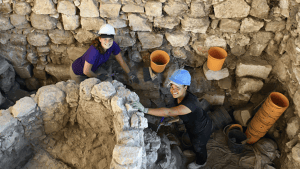 Episode: In this episode – Chris and Kyle are joined by Nathan Steinmeyer (Biblical Archaeological Review, Assistant Editor) to discuss BAR’s dig issue – one of the best resources for finding a place to dig! Also, hear about how Kyle got into archaeology.

 Episode: In part 2 of this series, Kyle and Chris discuss additional historical and archaeological aspects associated with the origin stories of Jesus as seen in Matthew and Luke. They discuss the archaeological background and traditions associated with the Church of the Nativity in Bethlehem. They also explain a number of other historical background elements connected with Matthew’s use of the Old Testament focusing – in particular – on the impact of the Neo-Assyrian and Neo-Babylonian conquests of Israel and Judah in prophetic literature and how that context still matters for how one reads the origin narrative of Jesus in Matthew. (This is a re-broadcast of a previously published episode)
 Episode: One site in Jerusalem, this episode explores the cultural backgrounds to the book of Ruth. We discuss agriculture, famine, marriage relationships, orphans, widows, geography and much more!
 Episode: In this episode, Chris and Kyle interview Koert van Bekkum


 Episode:In this episode, which was recorded during the excavation of the Iron Age II gate at Tel Burna, Chris and Steven Ortiz (Lipscomb University and Lanier Archaeological Center) discuss the following topics:
 Ortiz’s research and publications focus on the archaeology of David and Solomon, Iron Age I and II transition, and the border relations between Judah and Philistia. He has served or currently holds leadership positions in several scholarly and academic associations. He currently serves on the board of the Albright Institute of Archaeological Research, Jerusalem. He has served ASOR since 2001 as a board member and on various committees.
 Episode: Our first on site episode ever! That’s worth celebrating, right? Chris McKinny is in the field at Tel Burna, where he’s been digging for over a decade with site director Itzick Shai, whom he interviews from the top of the Tel.


 Episode: Paul Spilsbury knew Josephus personally … or at least he’s spent so much time with him that it’s almost as if he did. In this episode we talk about Josephus’ writings, identity, and how understanding Josephus helps us understand the New Testament. We also discuss Christianity in Turkey, the book of Acts, and much more! (This episode is cross-listed on the OnScript podcast)

 Episode: Oliver Hersey (president of Jerusalem University College) speaks with his predecessor Paul Wright, who has lived and breathed the land of the Bible. They discuss Jesus and Jezreel, the Old Testament stories Jesus would’ve known as he overlooked the Jezreel, and much much more!


 Episode: In this episode Matt Lynch sits down with Dan Pioske to talk about the way we know about ancient Israel. Most scholars have been so text-based in their assumptions about memory transmission in the ancient world. They assume that texts & docs were the main way knowledge was preserved. Pioske suggests that there’s another major way knowledge transmits–through the land. This episode explores the way that the land retains memory and provided biblical writers with a window on the past. We also discuss growing up in Minnesota, archaeology, the Philistines, David’s Jerusalem, and much more! (This episode is republished from OnScript, our other podcast)
 Guest: Dan Pioske grew up on a family farm in southern Minnesota and attended Gustavus Adolphus College. After graduating, he moved east to Princeton Theological Seminary where he received his M.Div. 2007 and his Ph.D. in Biblical Studies in 2012. He taught for two years at Union Theological Seminary, New York, as a Post-Doctoral Fellow and Instructor in Biblical Languages, and he is currently an Assistant Professor of Religious Studies at Georgia Southern University. He’s the author of
 Episode: This episode takes you on a wild ride through the land of the Bible, the world of Josephus, into the ER after crashed planes, by the Dead Sea, and includes encounters with Lynyrd Skynyrd, ZZ Top, and a fire-breathing dragon. Brace yourself! This episode is republished from OnScript podcast.
 Episode: This is the second in a multi-part series on Egypt and the Bible. Mark and Chris discuss Israel in Egypt, evidence of Egyptian influences in the Bible, Israel in Goshen, the early chapters of exodus, and none other than Moses himself.


 Episode: In episode 2 of the series “Geography of Judges,” Chris and Kyle talk about “Giants in Judges” in connection with the giants of Hebron mentioned in Judges 1:8–15. They also discuss the archaeological background of the fortifications of Hebron.

 Episode: Dru Johnson talks with Clinton Bailey about how he ended up living with Bedouins in the Negev, their law, gender practices, and poetry. His most recent book,
 Episode: Lynn Cohick speaks with Jason Staples about concepts of Israel, Judaism, and Jewishness that emerged in the Second Temple period, and their implications for understanding the early Judaism. Staples challenges prevailing ideas about Jewish identity around the turn of the Common Era.

 Episode: A journey into the psalter’s darkest poem (Psalm 88) to explore tone and emotional state in poetry. This episode engages Linda Pastan’s poem “Why are Your Poems So Dark?” Special t
 Episode: Co-hosts Chris McKinny and Mary Buck discuss the discovery of the Lachish Letters (or Lachish Ostraca), and work through several example texts to help you understand their content and significance.
 Episode: A recent report – published in the very prestigious journal Nature – argued that the site of Tall al-Hammam and other sites in its vicinity were destroyed by an “airburst event” around 1650 BCE.


 Episode: What lies beneath Jerusalem? Join Kyle and Chris as they interview

 Episode: In this episode Mark and Chris talk with Dr. K. Lawson Younger (Trinity Evangelical Divinity School) about the Contextual Approach and its benefits for interpreting Scripture with caution required to avoid the paradoxical dangers of “parallelomania” and “parallelophobia.” Dr. Younger is an Assyriologist who also specializes on the Arameans, so naturally they had to pick his brain for info on the impact of the Assyrians and Arameans on ancient Israel, particularly during the Divided Monarchy. They also discuss the genre of ancient conquest accounts and how the book of Joshua fits that specific genre, an important interpretive aid to understanding Joshua.

 Episode: Who was Adoni-bezek? (Judges 1:1–7) Geography in Judges is a new series where hosts Kyle and Chris (sometimes with friends) will discuss historical geographical and archaeological issues that arise in the Book of Judges. This weeks discussion is on the enigmatic character of Adoni-bezek (Judges 1:1–7). Who was he? Where was he from? What can geography and archaeology tell us about this character?

 Episode: We discuss the alleged Isaiah Bulla (clay seal impression) with one of the finest epigraphers in the field. The seal was found by the Temple Mount in 2009 by Eilat Mazar, and first announced in Biblical Archaeology Review last month (February, 2018). Matt L. and Dru J. discuss the find with Prof. Christopher Rollston, who urges caution when making bold claims about the seal’s link to the biblical prophet Isaiah. We also discuss our desire to make connections between archaeology and the bible, and for a material connection with the past.
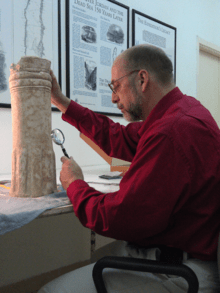 Guest: Professor Rollston is Associate Professor of Northwest Semitic languages and literatures at George Washington University. Rollston works in more than a dozen ancient and modern languages, including various ancient Semitic languages (e.g., Hebrew, Phoenician, Aramaic, Palmyrene, Nabataean, Ammonite, Moabite, Edomite, Ugaritic, Akkadian), several ancient and modern Indo-European languages (e.g., Hellenistic Greek, Classical Latin; Modern German, French, Spanish, and Italian), as well as Sahidic Coptic. He is the author of
 Episode: Chris and Kyle talk about the archaeology and historical context of Christmas. They try not to be Grinches. This is part 1 of a two part series.
 Episode: Cyndi Parker speaks with Lynn Cohick about what it means to understand Jesus in his own cultural, political, social, and religious contexts.

 Episode: In this episode Chris and Kyle speak with Andrea Berlin about the Hasmonean expansion in the Galilee. The bigger historical picture is discussed, along with how to integrate text and archaeology. Andrea speaks about her work at Tel Anafa and Tel Qedesh and how the results at these two sites have helped to illuminate the “Galilee of the Nations” in the Hellenistic and Roman periods.


 Episode: Holly Beers and David deSilva discuss life in the first century with Biblical World host Lynn Cohick. Holly and David both wrote novels that explore life on the ground in Ephesus, giving readers a unique opportunity to experience Paul’s world in a very personal way. Today we discuss Holly’s book

 Episode: In this episode, Kyle and Chris interview Erez Ben-Yosef (

 Episode: In this special Halloween OnCrypt Biblical World episode Chris and Kyle speak with Matt Suriano about Israelite mortuary belief along with Matt’s work on the Jerusalem necropolis in Silwan (east, southeast of the Old City). Matt discusses elite and royal burial customs in ancient Israel as he articulates why ancestors were important and what this means in biblical literature.
 Episode: For this episode of the OnScript Biblical World podcast, co-host Mary Buck is joined by Dr. Doug
  Episode: In this episode Kyle and Chris discuss Kyle’s work on Galilee in the book of Kings, and specifically, the site Cabul mentioned in 1 Kings 9. Kyle discusses fortifications in the Solomonic era, site identification, the historicity of Hiram of Tyre, Guardians of the Galaxy, and much more.
 Episode Summary:
  Episode Summary:
  Episode:
  Episode: In this engaging conversation, Mark and Kyle chat with Eric Cline about his life as an archaeologist and about public archaeology—making scholarship approachable—and why it is important for scholars to engage with the interested public. We draw upon a number of Eric’s recent publications to highlight how this dialogue is possible and how it can be done well.
 Episode: We’re going back to the dirt in this episode with Cynthia Shafer-Elliott. We talk about bee hives, the Daniel diet, Ezekiel bread, gender & archaeology, and why Cynthia is willing to get up at 4am for weeks at a time each summer. This is a republished episode.


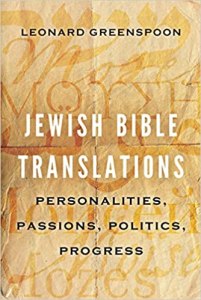 Episode: For this episode Mary Buck is joined by Dr. Leonard Greenspoon, the Klutznick Chair in Jewish Civilization at Creighton University. Dr. Greenspoon discusses his recently published book, “


 Episode: In this episode Chris and Kyle speak with Robert (Bob) Cargill about digital humanities—what those are and how they are done in the archaeology of ancient Israel and in biblical studies—technology and the potential for cutting edge research, and his recent book on Melchizedek. Along the way, Bob shares stories of travels in Israel, providing quality resources for people interested in the Bible and archaeology, and meaningful moments in Israel.

 Episode: Jonathan Greer joins the show to talk about a big project he just co-edited on the history, context, archaeology, culture, and world of the Old Testament. Jonathan shares from his own work digging at Tel Dan, a very significant site for understanding the Jerusalem Temple and worship in ancient Israel. They discuss major archaeologists, the historicity of events in the Bible, the interaction of faith and critical study, and much more. This episode is republished from our OnScript podcast.
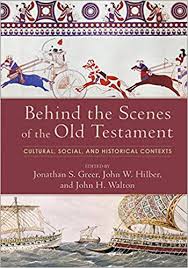 Guest: Jonathan Greer is Associate Professor of Old Testament and Director of the Hesse Memorial Archaeological Laboratory at Grand Rapids Theological Seminary. He has written extensively on the history and context of the Bible. He’s the author of Dinner at Dan: Biblical and Archaeological Evidence for Sacred Feasts at Iron Age II Tel Dan and Their Significance (Brill, 2013) and the co-editor with John Hilber and John Walton of Behind the Scenes of the Old Testament: Cultural, Social, and Historical Contexts (Baker Academic, 2018).
 Episode: This is part 5 in our look at views on the Exodus from Egypt. In this episode, Chris and Kyle speak with Peter Feinman about the Levite-Hyksos view. Peter Feinman is the author of The Exodus: An Egyptian Story.
 Episode: Chris McKinny sits down with Kyle Keimer to discuss the Tel Burna Archaeological Project, where he’s been digging for over a decade. This important borderland site of biblical Libnah offers some important insights into historical Judah.


 Episode: In this episode Chris and Kyle discuss the archaeology of Khirbet er-Ra‘i/Arai, a small site in the southern part of Israel that dates from the end of the Late Bronze Age into the early Iron Age IIA (ca. 13th-10th c. BC). This site is proving to be exceptional for this time period and appears to be the key site in the region, having taken over this role from the nearby site of Lachish following its destruction in the mid-/late-12th c. BC. Specific finds, including the recent Jerubba’al inscription, as well as the ancient name of the site are also covered. Chris and Kyle discuss whether or not Arai was biblical Ziklag.

 Episode: This is Part 4 of our look at Five Views on the Exodus, this time with James Hoffmeier. Hoffmeier makes the case for a 13th century BC exodus from Egypt. In this episode, Mark and Chris interview James Hoffmeier about the following:
 Episode: This is part 3 of our 5 part look at five views on the exodus from Egypt. In this episode, Gary Rendsburg presents the 12th century BC view.
 Hosts: Mary Buck (Shepherd’s Seminary) and Chris McKinny (Gesher Media)
 Episode: In this episode Jewish scholar Amy-Jill Levine engages some of Jesus’ words that his followers then and now have found difficult. Jesus instructs disciples to hate members of their own families (Luke 14:26), to act as if they were slaves (Matthew 20:27), and to sell their belongings and give to the poor (Luke 18:22). He restricts his mission (Matthew 10:6); he speaks of damnation (Matthew 8:12); he calls Jews the devil’s children (John 8:44). How did these words sound in their own time, and how might that impact our interpretation of difficult texts? In this episode Biblical World host Lynn Cohick engages these questions with Amy-Jill Levine and her new book The Difficult Words of Jesus: A Beginner’s Guide to His Most Perplexing Teachings (Abingdon, 2021).

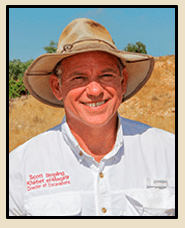 Episode: This episode continues our series on five views on the exodus based on a book by that named that Biblical World host Mark Janzen just edited. Our second guest in this series is Scott Stripling, who presents the early (15th century) exodus view.
 Episode: This begins the first of a series on five views on the exodus based on a book by that named that Biblical World host Mark Janzen just edited. Our first guest in this series is Ron Hendel, who presents the cultural memory view.
 Episode: This episode discusses the importance of understanding the cultural backgrounds and context of the Bible for biblical interpretation. We look at examples from Egypt, Mesopotamian law, bedouin ethnography and more!
 Episode: This episode is the final installment in the 3-part archaeology of Passion Week discussion.
 Episode: This episode is part-two of the three-part series on the archaeology of Passion Week. Chris and Kyle take a detailed look at how archaeological finds in Jerusalem can help us better situate and understand the events of this fateful week. They delve into the Gospel of John, the Last Supper, and Jesus’ trials.


 Episode: This episode discusses whether it’s possible to recover scenes from the Israel/Merneptah Stele, as well as cutting edge technology at Karnak, Egypt.