


| CARVIEW |
This is what we will increasingly be dealing with in generations to come… One challenge associated with the creation of databases and information-accessing technology is that many of these resources and platforms were generated under a profit-motivation and therefore can be expensive or come with much limitation. such services/technologies like “Turnitin” offer expedient solutions to universities and online schools where they scan written work and decipher various data from it. A use case that has become popular is that can detect for copywrite infringement ie. It has become a It has been used primarily to identify plagiarism which in turn has students generating work that is focused on avoiding any sort of plagiarism – skewing the importance from what it should truly be about – quality writing and genuine learning.
Of course, we have come a long way through the pandemic to adapt our economic and intellectual interactions to an online format. This has brought many challenges and innovations alike. What is important moving forward is that we collectively hold moral values and standards that are independent of what is dictated under capitalistic intentions alone. What is key is that tools and databases are shared as much as possible with populations who need them for work and their own development. With this comes a social challenge. To move forward innovating and generating resources while bringing along people who aren’t in a position to leverage themselves into learning and productivity.
]]>Universal design for learning is of the spirit of inclusion and means that students who may have certain challenges, such as hard of hearing, blind or physically disabled, will still have a reasonable chance of success with the curriculum as any other child would.
In order to ensure the design is friendly for a variety of students, educators must know the nature of their students’ needs. If they do not then it would be fair to make assumptions that some of the exceptional needs listed above be considered.
Teachers can use visuals and audio support for added clarity when they are teaching. For our group’s experiential teaching workshop, we will be utilizing multimedia formats where people with attention deficit challenges will feel included due to their engaging and changing nature.
Universal Design for learning is important to all students because as mentioned in the 335 information page, designing for inclusion will often benefit not just students with exceptional needs, but those categorized as capable!
]]>Within cooperative learning, students become aware that having a role in a given group, project or task is essential. This approach is relevant to the real world. There are studies that reveal the increased propensity for teachers to impart “closed” facts and knowledge to students in ways that limit student engagement (Classrooms, 2018). Attributes and/or benefits of cooperative learning are listed as 5 essentials: Positive Interdependence, Individual Accountability, Group processing, small group and interpersonal skills, Face-to-face promotive interaction. (Classrooms, 2018). It was emphasized that interdependence was the most fundamental of these components as the heart of cooperative learning is indeed to share concern over the learning of others. This promotes independent responsibility over work and tasks by result of having others be invested in the result.
Cooperative learning is a good way to engage students and has can take many forms. Of of these forms is the format of “Jigsaw Classroom” wherein students are in groups and from there divide work and facets of a work into disciplines where each can take a responsibility for a different discipline. This enables students’ independence as well as accountability because their group depends on them to delve into their area and bring back fruits to share with the group that can be integrated into the group endeavor.
Source
Classrooms, C. L. (2018). Kate Ferguson-Patrick, Wendy Jolliffe. London: Routlege.
]]>Throughout this inquiry, I have delved into the traditional knowledge of the first people’s of Northern Vancouver Island and have challenged my own perspective. Not everyday do I feel I am making headway in developing my “indigenized” skillset and understanding, as I struggle to relate to and comprehend my own place in this world. I am looking to find out how I can contribute as an ally but not as a replacement for indigenous peoples in their own communities.
This has not been straightforward at all for me, but the topic of indigenizing my worldview never ceases to be out of sight. Though I am proud of my heritage, I am increasingly hesitant to support the grand industries that supply our food and energy for us – to be consumed without much of a second thought.
Teaching and Learning is complex, and so is the world we live in.
I want to bring compassion into the classrooms I engage with and share it ubiquitously. The only thing I’m scared of is not trying!
]]>Through video, the film maker explores the values of potlatch, and what it means to the Kwakwala community. We are shown the ceremonial potlatch. This amazing celebration is rich in variety and authenticity of performances. Dances seem to embody spirits and entities, as a plethora of masks and costumes are brought to life, and a grand display of affection and generosity is shared through giving.
The potlatch captured in the video acts wonderfully to express the concepts and entities with whom the culture relates. Whether it be the whale or the wind, these relations are important and are shown recognition in performance.
The gallery of masks was called “Mourning Masks,” insinuating a solemn tone in regards to these relations. A deep reverence is certainly shown through the authenticity with which the performances are enacted. The expression of the potlatch is a wonderful thing to observe in this film.
]]>
The site is a rich collection of videos, images, text, audio recording, and even a virtual gallery.
Under the Education tab of the website there exists several lessons outlined with resources consolidated.
I intend to move through some of this content myself in order to better understand their way of existing.
The virtual gallery can be found here:
]]>
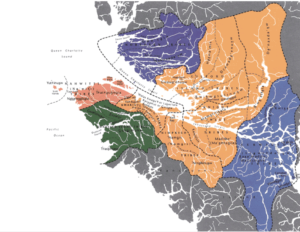
This is the area these tribes inhabit.
]]>
I’ve learned lots about the djembe drum. I feel like I know how to do simple beats well, and how to build them into something more complex and varied. I understand the draw to djembe now more than I did previously; I think that this method of creating sound as music is often overlooked, and seen as an incomplete pursuit of sound. I may have even condescended upon it in that way myself, and I think that part of the reason I wanted to do this instrument for my inquiry was to break that pattern of belief. I am happy to feel that perspective shift, and I feel like I understand the immense beauty that drumming can be. The simplicity of this instrument opens up a larger question – is it possible to quantify sound and be able to say one is better than the other? I think it’s easy to get lost in the world of music critiquing and I think learning the Djembe has helped bring me a rejuvenated view: simple is necessary. If we cannot enjoy a simple beat, then how is it possible we enjoy a more complex combination of rhythms, tones and instruments? Though it is just one piece of wood with skin stretched across it, the djembe is extremely versatile and can be used in complex ways. I came to appreciate this throughout my journey, but especially nearing the end, I am feeling that this is instrument, and other single-tone drums have infinite potential in music.
]]>This content is password protected. To view it please enter your password below:
]]>