

|

|
| CARVIEW |
 ]]>
]]>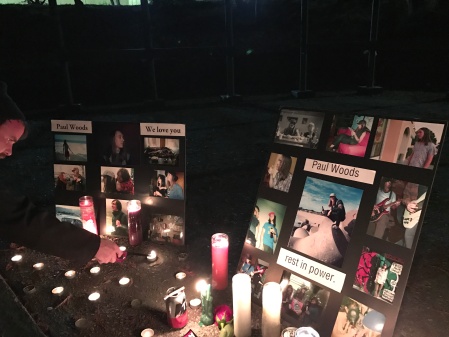
Writer, theorist, and comrade Chris Chitty passed away today in his home in Santa Cruz. He was a valued friend and he will be missed. We here at occupyCA remember him for his tireless efforts during the university occupations of 2009, and the myriad projects, demonstrations, discussions, and struggles he brought his strength and beauty to during our time together. We love you Chris, and we will always be your friend.
from Evan Calder Williams:
In love and memory of you, Chris, who were a friend and a comrade, you who literally taught me the meaning of that word. How it came from the Spanish camarada, the French camarade. From roommate, yes, but also how this was literal, from the real sharing of a space together, bound to the bonds formed by men who didn’t have security or wealth or private homes and so bedded down in the same small and rented rooms, who were friends and strangers, who fucked or didn’t. And this was at the heart of your brilliant queer history, starting not with a clearly defined erotics or identity but with that messy terrain of friendship and intimacy and class, inseparable from the spaces of capital and the attempts to make them our own. We organized and danced and argued together, and this was all part of our friendship, its care and work of trying to survive in the world we want to see upended.
When I saw you last, I had moved across the country and was back in California too briefly, and you drove me to the airport. Before I flew, we talked for hours over Indian by a highway entrance in San Jose, and I was struck anew by your impossible warmth, how it energized me and still does, and when we seize the bank and turn it into a dancehall, we’ll give it your name, Chris, our utopian, who this world couldn’t allow.
The New Inquiry remembers Chris.
Writings by Chris:
- The New Inquiry – https://thenewinquiry.com/author/christopher-chitty/
- “Occupy California” (co-author) – https://occupyca.wordpress.com/2009/09/24/occupy-california/
- “Towards a Socialist Art of Government: Michel Foucault’s ‘The Mesh of Power'” – https://viewpointmag.com/2012/09/12/the-mesh-of-power/
- (translation) https://viewpointmag.com/2012/09/12/the-mesh-of-power/
- Dystopolitik (Blog) Archive – https://web.archive.org/web/20130512062209/https://dystopolitik.blogspot.com/


Read more:
reclaimUC
Education Should Be Free
The Open UC
This past week has demonstrated that students and workers have tremendous power. We have shown that we have the capacity to pursue collective action and have our demands met. The threat of a five-day strike by AFSCME prompted the UC to concede to their demands, and on Tuesday, the UAW was likewise able to receive full concessions for their grievances in response to their own threatened strike.
Last night about fifty students occupied the Hahn Student Services building for eighteen hours, demanding the resignation of recently appointed UC president Janet Napolitano. The occupation was in response to a call for solidarity by the UC Berkeley Students of Color Solidarity Coalition, following their occupation of the Blum Center on the occasion of President Napolitano’s visit to the campus.
We stand in opposition to Janet Napolitano for many reasons. For one, she has no past experience as an educator, nor does she have knowledge of the issues that are specific to California. Additionally, as the head of the Department of Homeland Security, our new UC president was responsible for the deportation of 1.6 million people, causing immense suffering for countless families and loved ones.
At the University of California she is continuing this role, imposing the logic of crisis management, one that has been unfolding since the financial crisis several years ago when budget cuts and fee hikes were unilaterally passed without any student approval. Her record is an index of repressing the self-organization of students and workers combatting increasingly precarious working and living conditions – of using fear, force, and violence to further the exploitation of labor.
Starting at 2:30 PM yesterday, students gathered for a rally at which it was made clear that the AFSCME and UAW victories should not be accepted piecemeal but should be a part of a longer struggle. After a march to McHenry Library, more than a hundred-strong, students went to the Hahn Student Services building and subsequently occupied it. Speakers from a number of organizations such as MEChA, Students Informing Now (SIN), Committee for Justice in Palestine (CJP) and Youth Immigrant Coalition spoke at the occupied space and discussion groups were spontaneously formed, allowing students to talk about their future, both inside and outside the university.
Hahn was transformed into a site for students to meet and have face-to-face conversations, talking about various issues that they are unable to have in the normal everyday activities of university life. For a temporary period of time, this building truly belonged to the students, as a place to gather forces. And this is only the beginning. We call on other campuses to take up the fight, to continue escalating this struggle, just as we call for others on our campus to join us in reflection and action.
– Autonomous Students
]]>
SANTA CRUZ, California – Students at UC Santa Cruz gathered around 2:30pm on Wednesday afternoon to continue demonstrations against the new UC President, Janet Napolitano. Napolitano, the former head of Homeland Security, has been the target of several demonstrations on multiple campuses, including the recent occupation of the Blum Center at UC Berkeley by the Students of Color Solidarity Coalition (SCSC). The demonstrators proceeded to the administrative Hahn building and entered the bottom floor to commence a sit-in. The demands include the UC concession to worker demands in two ongoing contract struggles for UAW’s Teaching Assistants and AFSCME’s Patient Care Technicians; the UCSC demonstrators have also endorsed the SCSC demands as posted here.
Recently, AFSCME’s negotiators settled on a contract for their service workers, and the UC conceded to some of the specific demands set forth by the UCSC chapter of UAW concerning unfair labor practices (ULP) on this campus. However, the remaining AFSCME members have yet to receive a fair contract offer and the same is true for the sum of UAW members. UC Berkeley’s chapter of UAW may also go on a ULP strike in April.
Update:
On Thursday morning, the demonstrators disbanded the sit-in.

from reclaimuc:
The Blum Center Take-over group calls for:
1) UC Berkeley Chancellor Dirks to publicly renounce Janet Napolitano.
2) For all those in solidarity to cancel classes tomorrow (Friday, Feb 13), and for people to build a strike in support of Napolitano’s resignation and for the democratization of the University.
3) Full amnesty for all those reclaiming campus space, including those who have taken the Blum Center.
Why we are taking the Blum Center:
Richard Blum, the primary funder and namesake of the Blum Center, represents and acts as a driving force of privatization and reorganization of the University of California system. As an investment banker, Blum profits from the fact that the UC is no longer funded primarily through the federal government. As a central figure in pushing away from federal subsidization of education, and therefore a completely affordable or free public education, Blum and other bankers and financiers on the board of regents–including Monica Lozano–have compelled the University to take out massive bonds from private banks to compensate for this lack of funding. Public funding is legally allowed to go to only educational resources bonds, and the tuition system that allow this process to happen can be used for whatever the regents want. In many cases, this money is tied to companies that these regents own. For example, Blum owns the equity management firm Blum Capital, which has massive investments in the companies that do all of the construction at the UC. To those who believe in a public and democratic education, this is seen as legalized fraud and corruption.
Blum and Janet Napolitano’s Special Relationship:
UC regent Richard Blum was central in proposing Janet Napolitano. Richard Blum’s record includes firing Robert Dynes in 2007, leading the search for Mark Yudof, and encouraging Yudof’s resignation before overseeing the “search” for a new UC president. Although the Regents state that this was done through a headhunting agency, Blum was instrumental in making the final decision. We conclude that central decisions for filling the highest-ranking positions in the UC system continue to be made by those who stand to profit from privatization. Blum’s interest in keeping a business-as-usual that allows for massive profits for companies to which he has ties indicates Napolitano’s appointment as a means to continue this process of implementing policies of social control during her time in DHS.
Blum’s 12 year term as a UC regent ended in January. His reappointment by Jerry Brown for a second 12 year term this past January shows that the regents, like him, will continue to retain power unless there is a social response to this injustice.
The appointment of Napolitano exposes the undemocratic process by which the UC system makes decisions. In order to address this structural problem, we demand a restructuring of this process which includes: a) a campuses-wide election for all future UC regents and presidents; this includes having the ability to nominate, endorse, and campaign for candidates b) the power to impeach both UC presidents and regents c) a general democratization of the regents to include actual participation of students, faculty, and UC workers in the central decision making processes of the University.
We call on all students, faculty, and staff to join us, to take action in the coming days and weeks, and to demand the restructuring of the decision making process in our university system, so that we can make the promise of a public education a reality.
More:
indybay
Oakland: Noon at Oscar Grant Plaza
San Francisco: 1pm at the UN Plaza
The ANSWER coalition is also calling for demonstrations in a number of cities in Northern California. In Los Angeles, there has been a call for 2pm in Pershing Square. In San Diego, a rally will be held at noon in front of the Fleet Science Center.
]]>Even before the city street fully absorbs the resonant sounding of shattering glass, the press—mainstream media or citizen journos, it doesn’t matter which—introduces us to a stock figure whose words are nonetheless accorded a special status. You’ve met him or her before. We’re now all old friends with The Worker Who Doesn’t Like Property Damage. The prolie who picks up the shards after the anarchists have had their smashy-smashy fun. The employee who tells us he is sympathetic to the anger, but there must be another way. Days after Trayvon Martin suffered his second death—the juridico-political death that retroactively strips him of property in himself, the juridico-political death that came after but always came before, the juridico-political death that laid down the path that Zimmerman would follow—media outlets have dusted off the Good Worker and set her to work to chastise those whose outrage at Martin’s second death has taken the form of smashed windows, burning dumpsters, courthouse graffiti admonishing us to kill all the pigs.
The Good Worker knows that property damage is no way to protest the fact that Martin had no property in himself. The Good Worker knows that violence dishonors Martin’s memory. Of course, everyone already knows that; this is the USA, after all. But the Good Worker knows something special, something more. She possesses a particular knowledge derived from a quotidian detail of her life. She is the one who has to sweep up the glass. He is the one who has to wash off the paint. After the party of anarchy, the Good Worker appears on the scene and, with a sigh, dispenses his special knowledge: the infantile leftism of the anarchists and the outraged hurts no one but those whom they claim to defend.
Through the Good Worker’s resigned affect—“I’m the one who has to clean up”—liberals convert dependence on capital into an alibi for capitalism, transform the worker’s binding to the propertied as property’s normative basis. Relations between capital and labor never seem so free from compulsion as when the Good Worker laments the extra work imposed upon her by…other workers, maybe, but more likely dropouts and nogoodniks. The discordant symphony of shattering glass resolves itself in Careyite harmonies. One is encouraged to imagine that the Good Worker’s Good Boss never demands a little overtime, never subjects her to work that go beyond the parameters of the job. But that is precisely what is happening, and not just because he is sweeping up a window: the very articulation of the lament is itself a form of surplus extraction. After all, the political geography of smashy-smashy and political economy of U.S. cities ensures that the Good Worker’s skills will tend toward the communicative, the affective. He doesn’t work in a factory, but in a shoe shop, a restaurant, a boutique cheese store. And she possesses the corresponding skills: she can read inchoate desires and conduct them toward an object, respond to pressing demands, defuse awkward situations. After the windows come smashing down, the general capital exploits these affective competencies. It shoves a microphone, recorder, or someone with a Twitter account in his face and asks him to work a little bit longer, to piece the shattered norms of capitalist society back together with his words. And she does, bearing tidings that an assault on property is an assault on workers, because workers have nothing but the property of others. To harm property is to harm ourselves. The Good Worker’s stoic acceptance of her lot is converted into a quasi-proprietorial care that simulates a property in something that could never be hers.
This equation has been literalized in the case of the Oakland protests over the juridical fact that Martin had no property in himself. In an article entitled “Waiter attacked, freeway blocked in 3rd Oakland protest,” the reader is informed, “As the night wore on, violence grew. About 11 p.m., a masked protester hit a waiter at Flora Restaurant and Bar on Telegraph Avenue in the face with a hammer as he tried to protect the restaurant, whose windows were broken two nights ago.” That this happened is undeniable, terrible, and has been condemned by pretty much everyone (minus some with what I think are fantasies of an agent provocateur). I can’t think of any anarchist who would approve non-defensive violence, particularly against a worker, during a demo; we’d gladly leave a window untouched so as to not harm a human. As the masked protestor’s action strikes us all as aberrant and abhorrent, what intrigues me is the description and naturalization of the waiter’s (named Drew Cribley) act. The causal determination of the worker’s intention is established—windows had been broken before. The deeper emplotting of the event comes at the end of the sentence, and retroactively accords his action—tensed with “as he tried…”—a drawn out, durational quality where one might only read temporal simultaneity or, indeed, spontaneity.
Yet, as another article reveals, the waiter’s defense of the restaurant was indeed spontaneous:
Cribley said his black-masked attacker passed him on the sidewalk, then started pounding on windows with a hammer when Cribley turned and told him to stop. “I kind of instinctively pushed him away,” Cribley said. “That’s when he turned back at me and cracked me in the cheekbone.”[…] “Looking back on it, it was a really stupid thing if you thought I was going to interfere,” he said.
Strikingly, Cribley didn’t think he was going to interfere, he didn’t intend to, not consciously, but a “kind of instinct[]” drove him to “turn…and [tell] him to stop.” It is as if the thump of the hammer on the window sounded out like Althusser’s policeman’s hail: Cribley can’t not turn, even if he doesn’t know what he’s turning toward, turning for. With its direct access to the habits of head and heart of liberal capitalism, the newspaper reveals why. Cribley turned to “protect the restaurant”—not himself, not a window, but the corporate/fictive entity of the restaurant. According to the paper, he wasn’t protecting an object so much as the idea of property itself.
It seems perfectly natural, even laudable, that a worker’s body would absorb the blow intended for a capitalist’s window. Indeed, the article establishes a striking fungibility between (capitalists’) objects and (workers’) bodies. Both are, in effect, absorbed into the fictive person of the firm and, indeed, are little more than the business’ precipitates, the accidental bearers of capital’s personhood. (The assault on Cribley doesn’t even make it into the lede; it is only reported after destruction of other property is detailed.) After the windows come smashing down, the press impresses the Good Worker to restore the commensurability of bodies and objects, people and things.
It was this form of commensuration that killed Trayvon Martin, and killed him twice. The trial of Zimmerman briefly extended to Martin something that could never be his—a proper claim to himself, a juridico-political identity that did not position him as some bizarre thing midway between object and person. If the court’s decision confirmed Martin’s status as a being that could be killed but not murdered, the discourse surrounding property destruction in Oakland confirms neoliberal capitalism’s commitment to reproducing and repairing that order. Through the Good Worker, it first indicts those who actively refuse this commensuration with the charge of exposing its ugliness, for directing conversation from Trayvon Martin to smashed windows (as if anarchists are to blame that the media cannot control its vulgarity, as if anarchists are to blame that the media can’t not stop a conversation about Martin because a violated property hails). It then tells us that Martin would not approve of this violence, that violence against property is no way to honor Martin. Indeed, it posthumously transforms Martin into the Good Worker, someone who knows that to harm property is to harm ourselves. Someone who knows that because we have no property, because the property of others has subsumed any claim to property in ourselves, we have to identify ourselves with it. Someone who knows that our being can be exchanged with objects and things and that, indeed, we should be prepared to “protect” windows—even if we risk extreme bodily harm in so doing.
Feigning outrage, the media is hard at work restoring the logic of racial, neoliberal capitalism that killed Trayvon Martin twice. But there’s grumbling in the ranks: the Good Worker isn’t complying. The follow up article on Cribley concludes with the paper asking him to play his appointed role.
Cribley said he sympathized with protesters and their right to voice outrage, yet feared the violence would overshadow their goals. “It sucks for the people who are really trying to be heard because it starts to take away from their message,” he said. “People around the country look at Oakland and feel like there’s a bunch of vandalism and violence rather than intelligent people with an actual cause they believe in. Instead of talking about that, you’re talking about the guy who got hit in the face with a hammer.”
Note the striking disparity between the paper’s gloss and Cribley’s words. Cribley’s final quote is introduced as if what follows is pure Good-Workerism. He’s sympathetic to the protestors, sure, but, like, he wonders: this couldn’t be the right way. But, as his words actually reveal—his words, what he thinks when his personality is not subsumed into the indirect discourse of capital’s mouthpiece—he does not disavow property destruction. He does not oppose “vandalism and violence” to “an actual cause.” Rather, “people” do, people who “feel” a certain way about Oakland because the reporter, instead of talking about the cause of the demonstrators, is busy “talking about the guy who got hit in the face with a hammer.” Cribley is basically asking the reporter, the you of his address, to write about something else, to write about the actual cause of the violence, the actual meanings it conveys. Cribley refuses to be the Good Worker, to simulate investment in an order of property, of proper being, that left him with a hammer to the head, that left a black boy twice dead in Florida.
But the propertied order has the last word: “Cribley said he’ll return to work Thursday.” And the windows will be repaired by then, too.
]]>