


| CARVIEW |
A new study uses excavation evidence (wall ruins, coins, pottery) to suggest sea level rise (SLR) rates reached ~4 m in ~70 yrs (60 mm/year, or 20 times the modern rate of 3 mm/year) from 430 to 500 CE across southern England.
Sea levels reached 3 m higher than today ~1500-2000 years ago, concurrent with the Roman Warm Period. Consequently, the coasts were 1.5 – 3 km farther inland versus today at this time.
Sea level falls were similarly rapid (for example, ~2 m in less than 100 years). Indeed, “dozens of authors found further evidence for Holocene SL [sea level] fluctuations of up to 5 m.”
These SLR rates were absolute or eustatic (due to water loading from melted ice sheets), and the fluctuations were likely global in scale. Similar meters-per-century SLR rates occurred in New Zealand, France, Brazil, and Florida (USA) during this period.

Image Source: Higgs, 2026
A 2024 study indicated that, 8200 years ago, near-global sea levels rose 6.5 meters in a span of just 140 years. This is 470 centimeters per century, 4.7 centimeters per year, during a period when CO2 levels were alleged to be a “safe” and stagnant 260 ppm.
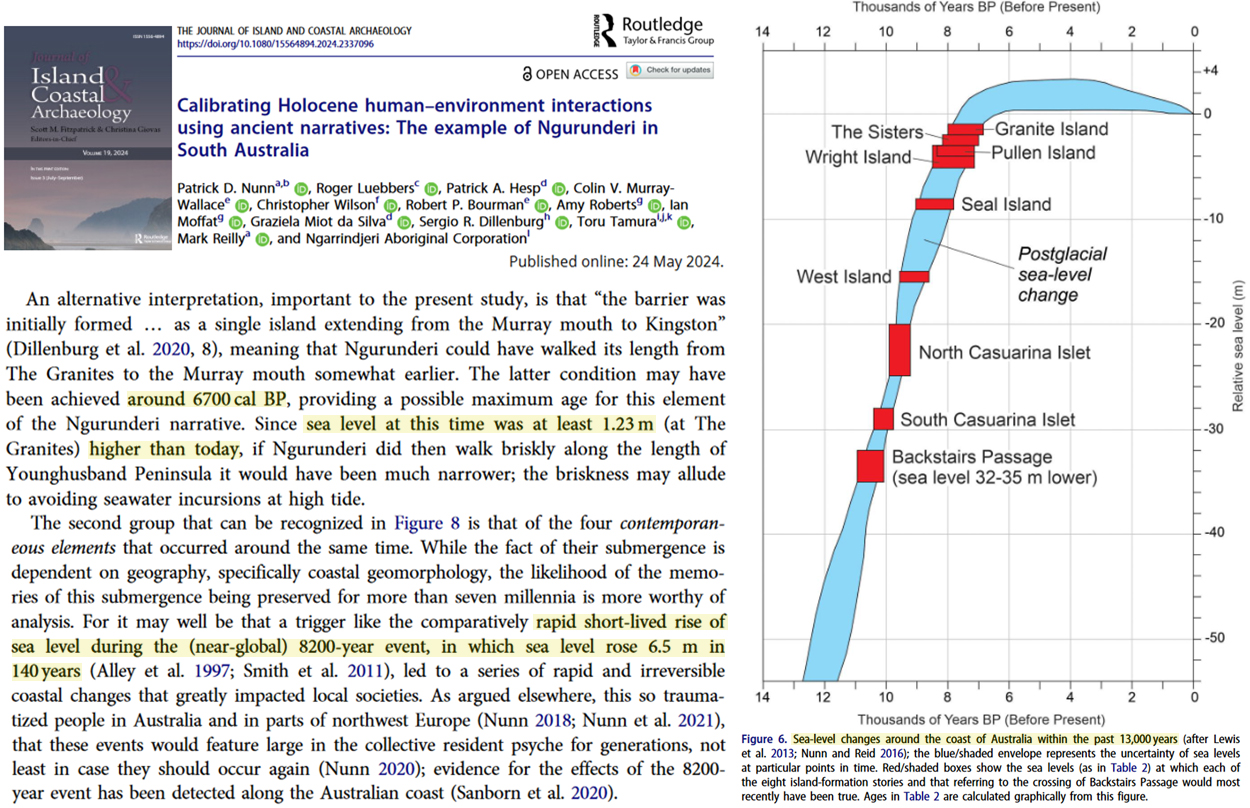
Image Source: Nunn et al., 2024
The net melt of the Greenland ice sheet (GIS) is thought to have been the largest contributor to sea level rise in recent decades. But, to put the GIS change in context, the entire ice sheet melt contribution to sea level rise was just 1.2 total centimeters from 1992-2020 (Simonsen et al., 2021).
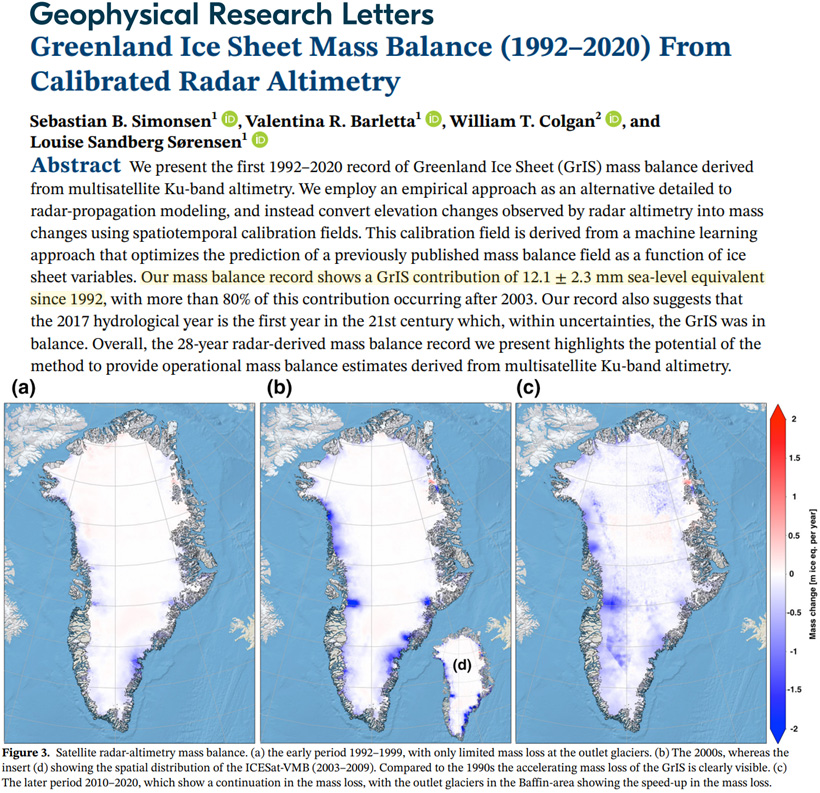
Image Source: Simonsen et al., 2021
]]>
If Germany’s cold January continues as forecasts suggest, natural gas rationing will be likely. Image cropped here.
This January is described as one of the coldest in the last 15 years. During such cold phases, German gas consumption spikes drastically (up to a 1.3% loss in capacity per day). Currently (as of January 19) the gas storage level is at 41.8%, much lower than at this time last year (near 64%).
Nearing critical levels
As the current storage levels in Germany continue fall, a critical point approaches: Once storage drops below 20%, it becomes technically difficult to maintain enough pressure for standard withdrawal. According to Stefan Spiegelsperger of Energie & Outdoor Chiemgau, this marks the beginning of a gas shortage situation.
A significant portion of Germany’s stored gas is being used to generate electricity, especially during periods of low wind (which we currently have) or solar output (“Dunkelflaute”). And although LNG terminals are available, many remain underutilized due to a shortage of tanker ships. Moreover, Germany still continues to transit gas to neighboring countries.
In his video, Spiegelsperger criticizes the forecasts from INES (Initiative Energien Speichern) as being too optimistic. He points out that actual storage levels are already falling below their predicted curves, which is worrisome. If the cold wave lasts until mid-February, a reference calculation (based on the year 2010) suggests that storage facilities could be completely emptied.
Potential consequences of a gas shortage
So what happens if the gas storage levels continue on their worrisome path and a real shortage develops? Answer: Rationing begins and the supply of homes will have priority. To secure the supply for private households, the industry would have to drastically curtail its consumption. This would lead to harsh economic consequences.
Also public facilities like swimming pools could be closed, and there might be appeals to lower heating temperatures in homes.
Moreover, based on supply and demand, gas prices are expected to rise.
Stefan Spiegelsperger of Energie & Outdoor Chiemgau believes a gas shortage is hardly avoidable at this point, unless the remainder of the winter surprises and turns out to be extremely mild. At the moment, weather models aren’t seeing that scenario.
Spiegelsperger advises viewers to prepare for potential bottlenecks. A small piece of positive news mentioned is the start of gas deliveries from Azerbaijan, though these only cover a small fraction of the total demand.
This dire situation is in large part thanks to Germany’s reckless foray into green energy fantasies.
Along the Brazilian coast, vermetid shell radiocarbon ages indicate the relative sea level (RSL) was “more than 2 m above present” between 6000 and 7000 years ago. (The charts shown in the study suggest RSL was 3 to 3.5 m higher than today during this period.)
Today’s latitudinal warmth threshold for living vermetid gastropod colonies along the coasts of Brazil is 22-23°S. This is over 5° (550-600 km) north of this species’ warmth threshold (28-29°S) throughout the period when there were “warmer waters during the Holocene climatic optimum.”
Since it is well established that sea surface temperatures decrease by approximately 0.5°C to 1°C for every degree of latitude moving poleward from the tropics, carbon-dated vermetid gastropod presence informs us that this region’s sea surface temperatures were about 3-4°C warmer than today throughout this Early- to Mid-Holocene period.

Image Source: Angulo et al., 2026
]]>
German philosopher Authur Schopenhauer
The video, Why ‘Idiots’ Think They’re Intelligent — Schopenhauer, reminds us a lot of all the idiots out there who are convinced of the AGW crisis and why they believe the absurdity, and lots of other nonsense.
Intelligence sees complexity
German philosopher Arthur Schopenhauer (1788–1860) argued: Intelligence requires the ability to perceive complexity.
Conversely, if a person is too ignorant to see that complexity, everything appears simple and convincing, leading to a state of blissful confidence. Here we quiickly realize how this applies so perfectly to Climate Science, and many other fields.
Some examples of stupid, simplified claims:
- Climate Science: Climate is regulated by a single control knob, CO2! The higher the atmospheric CO2 level, the more violent our weather and climate become!
- COVID immunization: If you get vaccinated, you won’t get sick and spread the disease. (80% believed it and got the jab!)
- Public Health: Wear a mask, and the mask will catch your virus-carrying droplets and prevent others from getting infected!
- Biology: A fetus is just a clump of cells, the center of which is pulsing for some unimportant reason.
- Economics: Just print a lot of money and everyone will have enough!
- Nutrition: All calories are the same. And, dietary fat is bad for you because it clogs your blood vessels.
- Neurology and Consciousness: Your brain produces your consiousness. When your body dies, you end!
- Economics: Permanent trade tariffs protect jobs and industries.
- Astronomy: The earth is flat and it’s the center of the universe.
All the above are examples of extremely complex issues that get (got) grotesquely simplified to a level where the masses of idiots, media and much of academia think it’s settled. For idiots, once you ignore all the complexity, it beomes simple, certain and unchallengeable.
Idiots can only comprehend simple things
And because these not-very-bright dimwits manage intellectually to finally grasp the absurd simplifications, they become convinced they know it. Just take a look at the audience of dummies watching Al Gore and his Inconvenient Truth presentation in his Oscar-winning propaganda movie. In the end, they all believed it was as simple as CO2 regulating the atmosphere.
Why are the skeptics intelligent?
Schopenhauer noted that stupidity creates certainty while intelligence creates doubt. Really iuntelligent people will always have doubt. Ask yourselves, who claims to be certain about climate science, and who sees that it’s far more complex and uncertain?
If people admitted they didn’t know everything about a topic, they would never have to fear admitting they were wrong later. When it comes to issues of great complexity, certainty always comes from ignorance.
According to many recent studies intended to alarm the public about the consequences of tenths-of-a-degree warmer surface air temperatures, “20-30% of all plant and animal species may be lost to climate change in future decades” (Saban and Wiens, 2025).
A landmark 2004 study published in Nature (which has now been cited over 10,000 times) predicted one million species will be driven to extinction by 2050 due to climate change.
But now a 2025 study published in The Royal Society finds (a) “climate change is not an important threat to biodiversity,” (b) species-level extinction rates “peaked many decades ago,” and (c) there has been no significant increase in climate-related extinctions in the last 200 years.
Ongoing habitat loss and the introduction of invasive species (primarily in the 18th and 19th centuries) on islands remain the two most predominant extinction threats in recent centuries. The authors express surprise that the threat from climate change (surface air temperature warming) has remained insignificant throughout the modern era.
“Extinctions from invasive species and (surprisingly) climate change did not change significantly over time.”
“[P]ast extinctions strongly suggest that climate change is not an important threat to biodiversity.”
“[T]hese past extinctions do not show biodiversity loss as rapidly accelerating, but instead show extinction rates that generally peaked many decades ago, and that declined in some important groups (arthropods, plants).”
“Most groups showed declining extinction rates after peaking in the 1980s.”

Image Source: Saban and Wiens, 2025
]]>The Germany-based European Institute for Climate and Energy (EIKE) presents its latest climate video, Number 243, and discussed the use of the feed additive Bovaer (3-nitrooxypropanol / 3-NOP), which is designed to reduce methane emissions from cattle.

Symbol image by P. Gosselin
To meet climate targets, methane emissions from livestock must be reduced. In Denmark, dairy farmers above a certain herd size have been mandated to implement methane-reducing measures, such as feeding the Bovaer additive. The chemical substance inhibits the activity of specific bacteria (archaea) in the cow’s rumen that are responsible for methane production.
However, since the mandatory introduction in Denmark, farmers have complained about health issues in their animals. Reports indicate that in some cows, the rumen has ceased to function properly. “In some cows, the rumen no longer functions, and in rare cases, cows had to be culled,” according to the Danish Dairy Farmers Association.
While authorities like the EFSA have generally classified the substance as safe, they admitted that its “genotoxicity” has not been fully clarified and that long-term studies are often lacking.
The EIKE video criticizes that climate protection is being prioritized over animal welfare (“chemical magic bullet against climate catastrophe”), as animals may fall ill or, in extreme cases, have to be euthanized.
The EIKE speaker summarizes: “Once again, climate protection is placed above other values, such as animal welfare.”
Prudhoe Dome (PD), a 2500 km² section of northwestern Greenland’s ice sheet (GIS), is today 500 to 600 m thick (Walcott-George et al., 2026).
Approximately 6000-8000 years ago, or when atmospheric CO2 was alleged to be ~260 ppm, PD had deglaciated completely, exposing the soil to sunlight.
The primary mechanism for the PD deglaciation was the estimated 3-7°C warmer-than-present regional temperatures. This warming and the consequent ice cap minima was said to be “Arctic-wide”.
Starting ~4000 years ago the GIS gradually began thickening until it recently reached its modern glaciated state, with glaciation peaking in the 1800s.

Image Source: Walcott-George et al., 2026
]]>
Frigid weather grips Germany. Symbol photo by P. Gosselin
Nine days ago I warned that such junk science would soon be reported. We can’t have people questioning the warming dogma when it’s frigid outside, now can we?
Germany’s online Frankfurter Rundschau (FR) just published an article titled: “Why the cold winter is no evidence against warming.”
The article explains why severe winters in Germany do not contradict global warming. The core argument lies in the distinction between weather (short-term events) and climate (long-term trends). That of course gets ignored by the media when there’s a hot summer day.
Experts, the FR reports, emphasize that a single cold winter is merely a statistical fluctuation, while the global trend points upward. “Weather is what you see outside; climate is the statistics over a long period of time,” the FR reports. “A cold winter does nothing to change the long-term warming trend.”
A warm Arctic produces cold Europe temperatures?
Moreover, the Frankfurter Rundschau reports that there are meteorological explanations for extreme cold phases despite global warming: a weakening polar vortex, fueled by Arctic warming, that can cause icy polar air to surge further south. “The Arctic is warming about four times as fast as the rest of the world,” writes the FR “This disrupts the jet stream and allows cold air masses from the north to penetrate our regions more easily.”
By Prof. Fritz Vahrenholt (Newsletter)

The shutdown of the power supply in southern Berlin has brought the fragility of the “Energiewende” (transition to green energies) policy clearly to our attention.
The goal of the transition to renewable energy is not only to switch the power supply to wind and solar energy but also to transition the other two pillars of energy supply—namely, heating and the transport sector— over to electricity. “Everything to electricity” means abandoning gas and oil in the heating sector and oil (gasoline/diesel) in the motor vehicle sector.
This narrowing of the energy supply down to a single energy carrier was called “sector coupling.” This sector coupling was propagated and celebrated by the “Green high priests” as a sustainable model for the future. Originally, it was an attempt to correct the weakness of renewable energies, which lead to unusable surpluses during periods of high wind and solar production. These useless surpluses were intended to be pushed into the heating and vehicle sectors after storage. It has been described here often enough that this sector coupling leads to exorbitant cost increases. Frontier Economics estimates the total cost of the energy transition until 2045 at an unaffordable 4,800 to 5,400 billion euros.
But now, the attack in Berlin demonstrates to us that such an energy system, based solely on electricity, is highly vulnerable. We are learning that when the power fails, the heat supply also fails—at least when it is supposed to be generated by heat pumps. And to make matters worse, we are learning that in freezing temperatures, heat pumps face total loss due to bursting pipes. This particular “warning label” was certainly not included in the “Habeck heating law,” which the CDU-SPD federal government intends to continue seamlessly. The content of the law will remain the same, but to ensure citizens don’t quite realize it, the name of the law is to be changed.
We are also learning that during a large-scale power outage, electric vehicles can only help if they happened to be charged before the “bang.” Otherwise, this utility also fails.
Until now, there was great resilience associated with being able to rely on two storable systems for 75% of the energy supply: namely, gas for heating and liquid fuel for mobility. Since the events in Berlin, the fact that the third pillar—the power supply, which currently provides 25% of energy consumption—is also now being made weather-dependent while being expected to serve all three pillars, is revealing itself even more clearly as a Left-Green ideological pipe dream that will not survive the reality test.
The text of the first letter claiming responsibility utilizes the reasoning context of Green and Leftist ideologies of climate anxiety:
“In the greed for energy, the earth is drained, sucked dry, burned, maltreated, scorched, raped, destroyed. Entire regions are rendered uninhabitable by the heat. They simply burn. Or habitats disappear under floods or due to rising sea levels. Shutting down fossil fuel power plants is manual labor.”
Except for the last sentence, one could read similar formulations in the party conference resolutions of the German Greens, the Left, and the SPD social democrats. The sentence “Entire regions are rendered uninhabitable by the heat” even comes from a UN report from 2022. The ideological justification for the energy transition stems from the same context of climate alarmism that the “Vulkangruppe” (Volcano Group) uses to justify its criminal actions.
Downward longwave radiation (DWLWR) at the ocean surface “is among the most important components of the heat flux across the ocean-atmosphere interface, which, in turn, shapes the climate state of both the atmosphere and the ocean” (Peng et al., 2025).
According to canonical anthropogenic global warming (AGW) “science,” in an imaginary-world atmosphere where no clouds exist it takes 10 years, or a 22 ppm increase in atmospheric CO2 concentration, to enhance DWLWR by just 0.2 W/m² (Feldman et al., 2015). The annual clear-sky forcing change from CO2 is, of course, ten times smaller than this, or 0.02 W/m².
To put these values in perspective, DWLWR from changes in cloud radiative forcing can reach 200 W/m² within a span of hours (Wielicki et al., 2002, Wong and Minnett, 2018). Thus, day-to-day changes in cloud in the real-world, all-sky atmosphere can enhance or decrease DWLWR 1000 times more than CO2 does over the course of a full year.
This negligible or unmentionable CO2 impact may be why, in a new study, scientists do not even consider CO2’s bit role in shaping DWLWR. Clouds, water vapor, air and sea surface temperature, and surface solar radiation are documented contributors (see Table 2). CO2 is not.
In attempts to model the variations and trends in all-sky DWLWR attributed to its contributing factors, scientists find that primarily due to inability to accurately estimate or observe cloud radiative effects, model error (RMSE, root mean square error) in calculating all-sky DWLWR ranges from 15.6-19.1 W/m².
A RMSE of about 17.4 W/m² means a decadal-scale DWLWR CO2 “signal” (0.2 W/m²) is ~87 times smaller than DWLWR measurement error. This precludes detection of CO2’s role in DWLWR, and thus CO2’s role in climate.
The AGW narrative insists CO2 is the “control knob” of global temperature. Anyone who disagrees or even questions this is often labeled a “climate denier.” The narrative consequently requires its adherents to abandon any consideration of uncertainty and error in attribution (“control knob”) detection.
