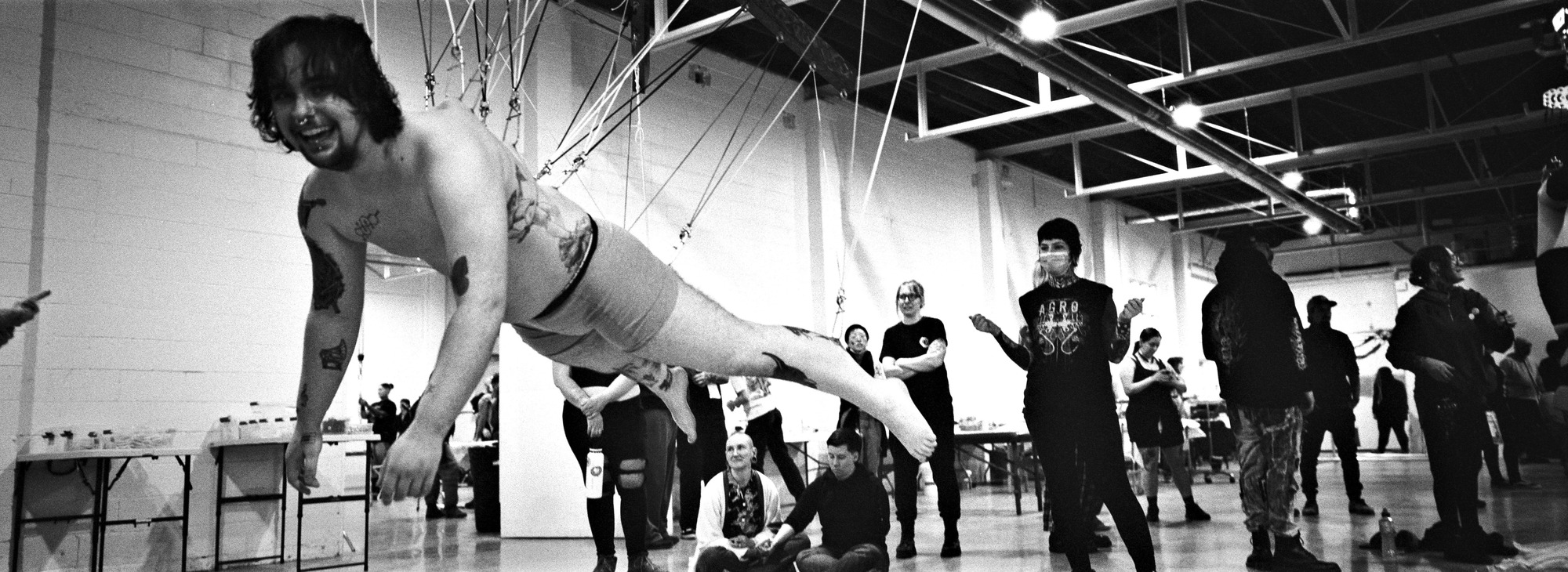
We have another play piercing from Hayl — who is downrightprolificat this point — and her collaborator Amber, who stepped out from behind the camera and went under the needle with her partner. The two were connected by long strings of pearls trailing between them.
We’re a bit early for Valentine’s Day, but the romantic vibe of this photoshoot is hard to ignore. From Hayl:
These photos exhibit a soft, yet intense moment of connection and a sense of surrender to fate — of two individuals who, through universal ties, will always find their way back to one another.
Want to be featured in the Modblog? Send pictures and a short write up to [email protected]
If you’re anything like me and have your hands dipped in all the body modification content you can find online , then you might have seen glowing scars as of late. This new trend — at least, new to me — has popped up on my feeds from a handful of scarification artists, and it has had me hooked from the start.
So when we received this submission from Pineapple Tangaroa, you best believe that I was absolutely blown away. Before I say anything, just take a look for yourself.
This massive jellyfish cutting is beautifully detailed in and of itself, but once packed with glow powder, the effect is stunning. When asked about the piece, Pineapple said he wanted to use all three colors of glow powder currently available so clients can better see the difference between them. What better subject for a piece like this, too, than a creature that has natural bioluminescence?
FreshThree weeks healed.
The glow powder packing method to create this look is still experimental, as body modifications often are. If you’re interested in learning more about the ins and outs of this technique — including the process of how it works and what we’re still learning — then you should check out the in-depth article about glow-in-the-dark scars available on the new BME Patreon!
Want to be featured in the ModBlog? Send pictures and a short write-up to [email protected]
Born from Reign of Blood Con and Needle Playground’s stencil contest, Spiky Mikey is one of Hayl‘s latest needle sets combining sharps with other mediums. In this case, it’s emerald beads, a marker design by Austin Towns, needles, and late-afternoon downtime.
Though his time here was brief, Spiky Mikey lives on in our hearts. Well, he does in mine, at least.
Want to be featured? Send pictures and a write up to [email protected].
Beto Rea (of Kukulcan Rituals) is an OG BME-er with decades of mod experience under his belt, so we’re excited to feature some of his scarification and ink rubbing work. Starting with this skull scarification over a blacked out bicep:
What’s coolest to me is that this represents another way existing body art can be transformed. You can get a tattoo, have it covered up, cover up the coverup, black it out, and still add a scar on top. It’s one of my favorite things about body modifications: they can grow with you.
We also have fresh scarification (left) and ink rubbing (right), both of which integrate really well into the clients’ existing tattoos. As someone with perpetually-shaky hands, I also admire the symmetry scarification and tattoo artists are able to achieve on an organic canvas.
Lastly, we have a healed scalp skin removal. All I can think about is how much this must have bled. Putting that aside, the difference in scarring between this and the skull above really highlights how cutting vs skin removal affects healing. Generally, cutting leads to thinner, flatter scars, though that can be affected by aftercare and how an individual heals.
Want to be featured in the ModBlog? Send pics and a write-up to [email protected]
Lanie Ferrans, founder of Hialeah Fine Jewelry, can’t get enough of what she does. On top of 12-to-15-hour days at the bench — sandwiched between getting her eldest son ready for school and making it back in time for dinner — she reads about jewelry history in the snatches of free time she finds.
It’s hard not to understand Hialeah’s success after talking to Ferrans. After struggling to find the things she wanted from existing body jewelry lines, she decided to start making them, and quickly focused on chains, which were becoming a popular addition to ear projects. Eventually, Hialeah grew enough to allow Ferrans to leave the piercing shop she worked at. Later, her husband did the same for his corporate career. Now, he’s the administrative complement to Ferrans’ artistic passion — she’s a self-described hurricane — and Hialeah is the go-to for chains, charms, and tassels, from the minimalist to the very maximalist.
I talked to Ferrans about her upcoming mixed metals collection, how she balances business and family, and her drive to keep growing as a designer and artisan, even when she’s short on time.
This interview has been edited for length and clarity.
BME:
How did you first get involved with body modifications?
LF:
I think I always had an inkling towards them, coming from where I came from. My father, he’s a biker and my mom is a hippie. And I have four older brothers, my oldest brother is, like, 10 years older than me. So when I was coming up, he was growing up in the ’90s and he was modifying himself. I remember being young and looking at his tongue ring and his nipples. And my mom, she had a huge dragon wrapping around a cross on her back. I kind of grew up around them, and so as soon as I turned 18 years old, I got into it. I already, by then, had tattoos and piercings, and I was already doing piercings. I think I did my first piercing on my best friend in middle school or some shit. We were always putting things through our bodies. We were dirty punk kids you know? …
And then, when I had to get a job, there was always an opportunity. When I was a kid, working at a flea shop or something, that’s easy. I got a job pretty young, so I was working at my friend’s booth when I was 14 or 15, just to have money.
Everyone was pressuring me around 18, like, ‘what are you going to do?’ I thought to myself ‘Well, maybe I should just be a piercer or something.’ All the other girls were becoming hairdressers, and that was cool. I was like, ‘Maybe.’ [But then, I thought] ‘No, just do piercings.’ Because I’ve already done piercings, I’ve done my own piercings. Why not?
So I got a job at a studio answering phones and hoped they would teach me how to pierce. And that happened. Since 18, I did that forever, until I did [Hialeah.]
BME:
Did you end up learning how to pierce? Or did you stick with a front-of-house position?
LF:
Back when I was learning to pierce, really, I was learning from a group of tattooers, if that makes sense. Like, all of them could pierce, but they just did piercings because people came in the shop needing piercings. It was kind of annoying for them. So when I came in all enthusiastic, 18 and ready to go, I’m, like, cleaning their shit and just calling myself the piercer. I kind of just proclaimed it. And they were all, like, ‘Yeah, that’s cool, you just got to make sure you get your license.’ So I did that. Every piercing that came in for a while, they did them, and I watched. [They said I] should keep watching, and I just guest spotted and traveled around and watched my friends pierce. I took a few classes and worked in a street shop. It was walk-ins, cash only, and I’d just pierce. It was really cool, I got to build up a clientele in a place where there wasn’t really a piercing clientele. There was another tattoo shop that pierced, like, 20 miles away, but I was the only person and I was excited. So it worked out well.
BME:
I imagine your time at street shops was interesting! You get to meet a lot of people, which I suppose is both a positive and a negative.
LF:
Oh yeah. To be honest with you, I feel like when I exited full-time piercing — it was around 2017, 2018 — before then, with private piercing studios, I felt like I could name them all, almost. Especially in my area alone. I’m in Florida, so piercing is like the Wild West down here a little bit. So private shops and piercing-only, that wasn’t a thing. Even tattoo shops, if you’re going to have a piercer there, it’s more of a street shop. And I grew up along the beach, so piercing — there’s a belly piercing right now for $20 around 10 miles from me. So it’s still a thing.
Street shops are fun because you do meet a lot of different people. Especially for a person who’s learning, [you see] so many different anatomies. [You think] ‘I’ve seen every type of belly button’ until the next belly button walks in, you know? And then, people on vacation, it’s a horrible time to get pierced! But lucky for me, I’m working at a street shop next to the beach, so here I am doing a pair of nipples on someone who’s here with their parents at, like, 19, and snuck away. So yeah, it was awesome.
An early Hialeah chain.
BME:
So when did you pick up jewelry making? Did you go into that with the idea of transitioning careers, or did it start as a hobby?
LF:
So, I still like to think that I’m going to die a piercer. I still feel very much a piercer. I started picking up jewelry-making sort of the whole time I was into piercing, I wanted to understand jewelry better. Working in street shops, working in the studios I did, I wanted to understand how I could get better jewelry. And I didn’t know how to describe better jewelry other than trying to look at it and comparing companies and seeing what works …
Later, towards, I guess, the end of my career, it sort of happened organically. I was piercing, and I wasn’t happy in my studio. I felt like I could never find a home shop. And then, I’m in love and I want to have children, and I was already making seam rings at the shop. I guess that’s the introduction to it, because I was making seam rings, and I could make tops. I was like ‘Easy enough, I could do that’ just as threadless came around. I was just like ‘oh, you just use gold pins or whatever.’ I was always into it.
Once I really decided I was going to get into jewelry making, chains sort of peaked. I mean, I saw a glimmer of it in 2016, 2017, I saw more chain. I know, obviously, chains have been a thing in the past, all throughout history, chains have been a part of us decorating ourselves. But in body jewelry, it wasn’t so much a thing. When I saw it, I was like ‘Man, that’s dope.’ And I started making chains for our shop, just different chain links. It really started with nostrils, across paired nostrils. And then it was lobes …
I realized I was making a lot of jewelry at the shop I was working at, and I didn’t really like the shop. Well, it wasn’t that I didn’t like it, it’s just that, I don’t know, I was getting older. I was like ‘What the fuck am I doing here? This music sucks. I just want to be at home. This is not what I want to be doing right now.’ …
I started selling [jewelry] to other people outside my friend group, like other piercers. Even piercers that I looked up to. I was like ‘Oh shit, you’re buying my chain. The fuck?’ So that started happening and it really took off, especially when I started making more ornate designs and hanging things, like little gold bits and bobs and different findings that I’d come across. The community really loved it, so it really grew on its own, fast and hard. I was happy about it because, like, I could quit my job.
It just so happened that right in that time, I got pregnant with me and my husband’s first child. So I was like ‘This is dope, I can just sit at home and make jewelry and be pregnant and figure this whole thing out.’ And that’s what I did. My husband was working full-time at the time.
So in 2017, 2018, that’s when Hialeah became a real business, like when I made the name. Before that, it was just like ‘send me some money and I’l send you some chains’ … and even in the beginning, for the first few years of Hialeah, I had something I called The Total Drip. I would make an array of different things, and people would just send me money and say to make really cool stuff. And I’d make as much as I could with the budget they gave me. And it grew and grew.
It was wild. I felt like the community needed it or something, and that’s what I felt when I started. Not that I’m a revolutionary, I’m just doing something else. But I felt like, maybe, right at that moment jewelry just wanted something different, and it just took off from there.
Early tassels from Hialeah.
BME:
Do you think that might have been related to the rise of ear projects and ear curations, especially online?
LF:
Yeah! Curated ear was one of the first hashtags that we tried to hop on, because everyone was doing curated ears … It was awesome. It made my business, it was right when that happened. People who were getting pierced and collecting jewelry or whatever, I guess they thought it was a little bit different, but also a way to enhance what they have. It wasn’t necessarily saying that what you have needs to be changed. It’s adding, like a patch or button to your vest, it’s adding to the dopeness of what you have going on. It was like a complement to who you are already.
I felt like that had something to do with the ease of it. It was like ‘I like that, toss is on where it fits.’ And that part is super cool and punk rock to me, you know?
BME:
Totally. And personally, I don’t know if other people feel this way, but I like the interchangeability of it, how you can change your look without buying new pieces.
LF:
That was a big part of it, too … [In street shops] when I had chains going on, they loved it because it wasn’t as much of a commitment of, like, do I need this top? Does it fit?
It was easy and, even now, it’s funny because I’m seeing the first generation of Hialeah chains and now I’m turning them into charms and other things. People send me stuff that I originally made. So it’s even cooler, because it’s interchangeable in our body and it’s interchangeable, like, on the earth.
The chains and charms and tassels and all that are just so versatile to me. Take them off and be more demure, or you can put all of them on and be extra. It’s really just, ‘Who do you want to be?’ I think it’s cool, I love it, and that’s why I live in that lane …
So that’s how Hialeah started. I just had a conversation with someone else, giving an interview, and I said something — it was really corny — but it was that it all led to this. But really, I mean all of it, because I used to go to Home Depot and Ace Hardware with my dad, and they would get chain clippings. And I would make jewelry and body chains. I had this chain that wrapped all around my body, went around my neck, down my abdomen, around my waist, and it had a little tail that hung out of the side of my body with a lock at the bottom. This happened, like, 15 years before Hialeah. So it’s just interesting that we’re here.
BME:
I wanted to ask about something you mentioned earlier. The something drip?
LF:
Total drip.
BME:
Yes! The Total Drip. I saw it on your website as well and it seemed really unique. Can you tell me more about how it works?
LF:
So, The Total Drip has now evolved into something else. But originally, that’s how we really started. I would make all sorts of things, I would post them on Instagram, and people would be like ‘Oh my god, I want that, that’s really cool. I don’t want that so much. Could I just take all of this and leave that out?’ For me, I wanted to find a way where I could make less work for the both of us. I’d be like ‘Well, if you liked this, I’ll just do a bunch of this. Send me $1,000 and I’ll just make a whole bunch for your studio.’ … I sell more Total Drips than I sell anything else, which is astonishing to me, number one because of the amount of trust that happens with that. That means someone is really vibing with what I’m doing, which is so flattering …
Now, how Total Drips work is that I use those as a place to drop off. Say, like, if I measure when I’m packaging up an order and I’m like ‘Oh, shit, this chain is supposed to be 32 mm, but it’s measuring at 33mm.’ I put it in a bag, put it in a bucket, and, sometimes, those pieces end up in Total Drips. So mis-measurements, special makes that I make for people and they don’t want, or pieces where I’m working out a design for my next drop. It’s kind of odds and ends, but, also, if I have something that’s very popular — right now, our junk charms are very popular — I’ll put a junk charm in there … It’s really cool because a lot of people get one-off designs in their total drips, and they’re like, ‘Holy shit, this is awesome, I didn’t know you made this.’ And I’m like ‘I didn’t know I made this, either!’ …
I’ll go through a studio’s Instagram when they place a Total Drip order, and I’ll try to touch the vibe of the studio, or the piercer that paced the order, and I try to make the jewelry fit … The Total Drips are really my thing. I love them. It breaks up the monotony of orders, where studios are fulfilling large chain orders and they want, like, four of every millimeter option in one chain style. So your brain, you’re like a robot putting them together. And I’m grateful for them, I’d never talk shit about that kind of an order, because it’s an order. I’m forever grateful to all of them. But the Total Drips are cool because I can just pick up a piece of gold and be like ‘I need to figure something out’ and then just make it, and they take it, and they’re like ‘This is awesome.’
BME:
You mentioned you’re still learning this. What’s it been like running a business when you also feel like you’re also learning it?
LF:
I feel like everybody is doing that, right? And if you’re not doing that, then I don’t know what they fuck you’re doing, because I feel like I learn every single day with everything I do. As far as learning jewelry, specifically within this business, it’s funny because I tell people a lot — and I’m honest with them — ‘I don’t know how to do that.’ I wish I did, but I don’t know how to do it yet. And a lot of it, too, is that I’m learning at what’s appropriate for my family’s pace. I just can’t go balls to the wall, take all these classes, completely 100% all of the way immerse myself into learning the trade, because I’m doing the trade, and I’m also a mom and a wife, you know?
I take classes and I do try and take small steps forward in jewelry education, and I read a lot about the history of jewelry, history of jewelry-making in my free time. It is my hobby, even though it’s still my business. Some people think it’s creepy when people are really, really into their job, but I’m just really into what I do. If I’m not doing this, I’m with my family. And 90% of the time — my husband and I work together — we’re talking about Hialeah or our kids …
Maybe it’s just a me thing, but I just like learning. I’m always going to be learning, and I wish I could learn faster. I wish I could learn more. I wish I had more money for classes, as well, and more time. But I’m doing my best over here.
BME:
And it seems like it’s working well for you! The pieces you put out are really cool.
LF:
I appreciate that. And like I said, I do take steps ahead, and I’m like ‘Okay, last time I did it like this, let’s do it like that.’ And I have really great vendors that I work with that have become people that also really vibe with what I’m doing … The people that do my castings, they’re like, ‘Hey, wouldn’t it be cool if we did this design? We could add, like, an extra dimple here, and here,’ and they further designs. Or they’ll introduce me to people within the industry … It’s really cool. It’s a network of people, and I feel like we’re learning from each other, figuring it all out, and just trying to create things and make people look cool.
BME:
I really like that very human aspect of jewelry. Not just that it’s being worn by someone, but the collaboration that can go into making a piece. And how many people can be involved.
LF:
It’s funny, whenever I design a piece, I design for a make-believe person in my head. It’s a very weird thing that I do, and a lot of times, I’ve named the piece after the person. Like, the person has a whole personality and I’m also imagining their setup. Or I meet someone and I’m like ‘She is so fucking dope, she had this whole vibe’ and I make something from that person. But also in jewelry history, that is also how it went, right? Makers throughout time have made pieces inspired by us as humans, just as much as nature … I joke with my husband, like ‘Future archaeologists are in for one on this design!’ Because when they dig up the person wearing it, they’re going to be like ‘What the fuck where they on?’ And I think about it all the time because, you know, there’s people out there, I’m sure, that are wearing my things beneath the earth.
It’s very human. It’s very personal. People pass down their jewelry to their loved ones. Jewelry has always been so much a part of human beings and our culture and who we are as people. To me, it’s a very human form of expression, just as much as body modification in general, like tattoos and piercings, jewelry just fits into that.
BME:
Absolutely. I think I’ve always felt something like this — I learned to make basic jewelry from my grandmother, so it’s always been a very social experience.
LF:
That’s awesome. I sometimes wonder what my grandmother would think of me making jewelry. She always wore a bunch of jewelry, she always wore these fat Cuban link bracelets. And I think about them all the time now, because I’m like, man, I know she’s down there with at least 10 grand on her right wrist, you know what I’m saying?
Everyone in our family — my mom’s from Louisiana, and Cajuns, at least Cajuns in my family, they always wear gold, even the guys. They wear gold chains and gold rings and nugget pinky rings.
BME:
I think we’ve talked about your inspirations a bit, but can you tell me more about what inspires your designs?
LF:
It’s funny, because I very much come across as — I look alternative, like a punk rock chick. But my house is decorated like the Golden Girls, right? My kids look like little wild Thornberry children. So my life has so many different personalities, and I know that about other people. So when I design, I’m very much inspired by hidden parts of myself. I’ve made pieces inspired by how I felt about my mother’s death. I’ve made pieces just looking at a person. I literally made a chain and sent it to a person, I was like ‘I made this piece of jewelry for your bridge. I don’t know if you need a piece of jewelry, but I felt like it would have gone with your setup.’ I’m so inspired by everything around me and everything around me very much excites me …
All of it is inspiring to me. I love life. I love all of it. I know that I’m privileged to be here and be alive, and I love all of it. And so I like to use that in my jewelry. I look at things, and I’ll see something when I’m, like, buying other gems and think it’s really cool, it looks like the ocean, and I’ll buy it and name the piece Ocean. Like, how original, right? But it worked. And, I don’t know, what else do people get inspired by, other than what they see and feel?
BME:
Right, yeah. I think ultimately people’s answers circle around that same idea, but it’s interesting to see what they focus on and how they describe it. I’m curious from the outside, as well, it’s interesting to get into the mind of a designer in that way.
LF:
It’s funny because I’m very much a bubbly, happy-go-lucky type person. And when you look at Hialeah as a brand, color-wise and all that, it makes more sense, you know what I’m saying? So as you talk to different makers and look at their jewelry brands or how they brand their companies, I’m sure you’re like ‘Okay, I get it now.’
BME:
Absolutely! And the different techniques people use and what they specialize in. It feels like a richer way to look at their work. Just a few more questions: How do you feel your approach has changed over time?
LF:
I feel like it’s less aggressive, personally less aggressive. When I first started making jewelry, I wanted it to look and feel like me as a person. It was so much of an overbearing thing. I didn’t want to stray away. As I’ve gotten older and as I’ve gotten, I guess, more secure with Hialeah itself, I kind of let that go. I started just making designs that I thought were pretty sometimes, or just cool. I even looked at stuff and thought ‘I would never wear that, but it is so cute.’ I let go of this weird personal attachment that I had to every single thing. And it opened the door so much to actually teaching me what I thought I liked — number one, because I was wrong. And number two, it taught me that not everything is about me, and especially if I’m making things for other people. Like, it’s okay for it not to be for me but still come from the heart, if that’s not lame to say …
I really feel like it’s taught me a lot about myself design-wise. I really thought that I was only into one type of gold. I thought that this type of gemstone was, like, my gemstone. And then as you work through designs, you sort of grow and you change, too … The need to be self-expressive in every piece, that was very much the angsty punk rock girl inside of me who was like ‘if someone’s wearing it, it has to look like Hialeah.’
BME:
I wanted to ask: what’s it like working with your husband on this?
LF:
Anyone who knows my husband will know that he is literally a sweet baby angel. He is the nicest guy ever. So working with him is nice in that aspect, because he always treats me respectfully, even when he’s frustrated with me because I’m overbearing. I’ll just say it — I’m overbearing, I’m abrupt, I’m, like, very much an artist, you know? I work all hours. It’s crazy. I am a hurricane, but he enjoys me, and he also does everything in his power to facilitate whatever I need to move forward. He’s the perfect partner, really. I mean, one, he’s my husband, so he knows me in that aspect. He knows what I expect, work-wise, or what I need work-wise. He’s good about it. It’s just natural, really.
I was going to touch on that a little bit, because my husband does not necessarily come from a body modification background. I mean, he’s heavily tattooed, he has really nice work, but he didn’t grow up in it. He started getting tattooed when he was younger, so he always liked it. He’s a hardcore kid, big Morrissey fan, total weirdo. But he grew up in the corporate world, and so when I met him, I was like, ‘Oh my god, he has a job, and I’m, like, a dirty piercer chick,’ you know what I’m saying? … But, yeah, he left his corporate job after 18 years of working there, and came to work at Hialeah full time. I call him full time because he has to work all the time for me, anytime I’m working. But he’s also at home, raising our children while I do Hialeah 12-to-15 hours a day, you know? … We really miss each other a lot because he is with the kids, and he does all of his stuff is remote so he’s not in the studio. I’m in the studio, I’m at the bench. I’m polishing. welding, setting a stone, or whatever I’m doing. But all of his stuff he takes care of at the house, so there is a separation … Sometimes it’s a lot, just because we’re raising two children. I recently had my second child, so we have a baby and a seven year old. And a business, so it gets hard, but I picked a good one. He’s awesome and he’s hot. So it all worked out.
BME:
What’s it like balancing being a mom with 12-to-15-hour days?
LF:
The balance, I’m still learning how to do it with a business. My kids are great though. I have a living room set up here at Hialeah, and so they come here and they’re welcome anytime. So they’re in and out of the studio all day. And, I mean, obviously I sleep and wake up with my kids. I get to work every morning at like, six in the morning, so we do the morning routine together with the baby and my son. We partially get him ready for school, and then my husband gets him off to school and I work all day. He picks up our son, and I’m still working. I somehow get home right as dinner is happening, and I just sort of swoop in to have dinner and get to read and hang out with my kids before bedtime. So it’s a fine balance, and that’s why sometimes tensions are high, but I am so grateful. I love life and I love my life. I’ve created this beautiful world for myself and for our family — me and my husband have done it together. It’s awesome to see all of our hard work working, you know? I don’t know about paying off, I don’t know what that means, but our hard work is, like, happening, you know? It’s all really fucking cool. And I feel so blessed. My children are healthy. And my business, we get orders all the time. What else could anyone ask for?
And then my kids are really cool. My son wants to be a jeweler. Can you believe it? How lucky am I? I’m just elated that he’s into it, and we try and do things that are jewelry-related for him. He has his own station at Hialeah and he also makes all the boxes. I don’t know if the world knows this, but my son makes all the Hialeah boxes, which is really cool, and he takes his job very seriously. It’s very much a family situation. And I love having them here. I love that they like to be here. I think it’s working out cool, you know? And I’m lucky to say that it’s working out. But we, me and my husband, try every day, really hard to make it work. We’re fucking tired, but we’re doing it.
BME:
It’s great to hear things are going so well!
LF:
I’m not gonna lie, this gold hike this year was horrible. But at the same time, I feel like everything’s always gonna go up, right? We made it through. I was telling my husband the other day, we made it through the hardest year. Literally being pregnant, giving birth in my bathroom, then two days later going back to doing orders. We made it. We’re here. We’re at the end of the year. We have another year. We have people placing orders. We have people waiting for orders. Things are moving. Like, how cool, but it was a hard year. This was a hard year, I feel like, for body jewelry. For jewelry in general, but for body jewelry, I feel like this was a tough year. We lost a few companies. There were a lot of piercing studios that closed this year. I see a lot of piercers that had to pull back from piercing full time. This year was a rough year for piercing.
Has anyone else said that? Or am I alone in this feeling?
BME:
People have definitely talked about gold prices, but I hadn’t heard as much about studio closures.
LF:
Well, I’m in fine body jewelry exchange and equipment groups and I see people selling off their piercing collections. I’ve seen multiple piercers leave piercing. It’s fucking heartbreaking. I talk about it with some of my piercer friends and we all have our theories for it. Regardless of why it happens, I feel it sucks. I feel like it was a hard year for piercing and body jewelry and gold. But through all of that, some of the small makers were really killing it this year. They came out with some of the dopest designs I’ve ever seen. Some of the people that I look up to the most are people that are creating outside of the box. I think with the tensions with the gold prices, it’s caused makers to look elsewhere. And I think that’s rad. Through concrete we grow.
I know, me personally, with the gold hike and people ordering less, and people kind of holding on to their pockets — and rightfully so — it’s caused me to sort of step out of the box of the typical things that I do. Not necessarily to sell to people, but to also give people inspiration for what they can do with the jewelry that they have. I’ve hyped up working with titanium, trying to find more affordable options, and keeping it in fine jewelry. And that’s what our next drop is all about. We have a drop coming in February, and the next drop is, it’s all mixed metals, the theme of the drop. The name of the drop is “New Metal by Hialeah.” I’m basically taking all of the metals that are used in fine jewelry and in classic body jewelry, and we’re turning it into a fucking metal extravaganza. Because there’s other things than gold. So with that came this awesome drop that we’re doing … I’m so excited about it, I feel like it’s a big opportunity for people to see that body jewelry is not just gold, and that the gold market doesn’t define body jewelry at all.
BME:
Yeah. I’ve heard some people describe the piercing industry as stagnant for a little bit, but this is changing that. In some ways, it’s an exciting time.
LF:
You know, it’s funny. You said stagnant. That’s how I felt when Hialeah started. I want to reiterate, I did not fucking invent anything right? Like, I saw something that was dope, and I was like, I can do that, right? That’s what happened. But I felt like I was seeing a lot of setups — this is when gold jewelry really was taking off — and I was just like, ‘Yeah, this jewelry is really pretty.’ But, like, I kind of felt like my fucking rich aunt was gonna wear it, you know? … I was happy to see us able to go into another market, but I feel like we almost, not lost, but got so excited with the gold jewelry that everybody who is alternative, everyone’s setups, went straight to gold. Which is dope, right? Because we’re elevating ourselves, but like there’s also those other people that didn’t necessarily want to go to gold. And alongside this stagnation, when Hialeah was happening, I was like, ‘I need to see movement. I want to see texture. I want to see some more punk rock.’ It just felt so classical and classic and classy …
I feel like it’s up to us, the makers of said things, to keep pushing it, to change with the times and move in your lane, making things better, and designs cooler and pushing the boundaries.
BME:
I’m thinking back to what you said earlier — if you’re not continuously learning it, what are you doing?
LF:
Yeah. I’m probably 100% positive that you have not spoken to a maker that knows everything. Every single maker that you know is still learning, and I’m sure every single one of us is like, ‘I guess I’m a jeweler.’ I don’t know. I question myself fucking heavily, even now. I’m at school functions with my kid, and parents small-talk, and they’re like, ‘Oh, what do you do?’ And I’m like, ‘I’m a jeweler.’ And it’s still fucking weird to me.
I loved this play piercing set Marcy did on Vidadöd Vida from the moment I saw it on her Instagram, so I’m stoked we got it as a submission as well. These 7-in custom-bent needles are placed along the spine and complement Vidadöd’s geometric tattoos.
Based on her recent posts, Marcy’s been on a bit of a custom-bending kick, which makes for really interesting visuals, especially when combined with stained glass or Christmas ornaments.
The body-horror-esque vibe of this set reminds me of another that we posted in October. They’re very different in execution, but the contrast between the organic curve of the spine and the rigid metal needles gives me the same feeling in both.
Want to be featured in the ModBlog? Send pictures and a short write-up to [email protected].
You are scrolling on your favorite social media platform when a video of a California elite appears on your dashboard. They have brightly colored irises, so bright that you aren’t sure if you’re witnessing a filter, AI, or reality. The video prepares you for their reaction to their eye color, and a doctor hands them a mirror. The patient gasps in awe and gleefully exclaims, “I love my new eyes!” What is going on here?
Top to bottom: Before and after images of high-, medium-, and low-intensity honey gold keratopigmentation. Images courtesy of Dr. Brian Boxer Wachler.
The grand majority of these Reels and TikToks are produced by the Boxer Wachler Vision Institute in Beverly Hills, directed by ophthalmologist Dr. Brian Boxer Wachler. Like sclera tattoos, his trademarked ColorEyes procedure is a form of keratopigmentation.
Keratopigmentation is the umbrella term which describes any injection of pigment (via needle, instrument, or laser) into the cornea, the thin, clear, frontmost layer of the eye. Boxer Wachler and many other ophthalmologists assure the public that it is safe, and while it certainly has the highest success rates compared to any other eye color change treatments (1,2), the American Academy of Ophthalmology has issued a warning against any elective cosmetic eye surgeries. Despite the risks, videos of piercing grey eyes garner thousands of views, and searches for “eye color surgery” have only continued to rise.
Humans have a long history of attempting to transform their eyes. Medicated eye drops have no proven success rates, though several companies continue to manufacture them using ingredients which successfully inhibit the production of melanin in the skin. In 2006, iris implants were popularized in Panama, only to be accompanied by a wide array of serious complications, many of which cause blindness; for this reason, they are regarded as unsafe by the AAO and ophthalmologists alike. In 2011, there was news of a laser depigmentation procedure which targeted the melanin in brown eyes to reveal blue underneath, but no additional colors were possible. Few studies have been conducted regarding the practice, and following the procedure three patients experienced blockage to the eye’s natural drainage system, leading to increased pressure and damage to the optic nerve (1,2,3).
The earliest attempt at permanent eye color change was a form of what we’d now call keratopigmentation. In 150 CE, Galen of Pergamon applied pigments to a freshly cauterized eye in order to conceal the cloudy sheen of its opacified front layer. Eye coloration was later revived in France during the late 1800s by oculoplastic surgeon Louis de Wecker, who used China ink and a grooved needle. Thus, modern keratopigmentation was born. Now, it’s all over Instagram’s For You Page.
Dr. Brian Boxer Wachler is a cornea specialist who has pioneered some cornea procedures: “I’ve been making channels in corneas for 27 years for the placement of Intacs implants to improve vision with Keratoconus. I was being tagged to review keratopigmentation videos on social media … I reviewed the research and was impressed with the high safety record: not a single infection nor blindness in 16 years.”
According to Boxer Wachler, laser keratopigmentation was originally “developed for eyes with white cornea scars to improve the cosmetic appearance.” It is now applied to a multitude of afflictions, such as the cholesterol-related condition called arcus senilis in which yellow rings form around the irises. However, “[t]he procedure evolved to electively change eye color as we know it today,” and most ColorEyes patients seek to transform their biological eye color, not to restore it.
Before and after of a patient with arcus senilis who underwent the ColorEyes procedure. Image courtesy of Dr. Brian Boxer Wachler.
With the exception of those who have certain medical conditions (ex: eye diseases, autoimmune issues, medication complications, certain prior eye surgeries), most adults are considered suitable candidates for the ColorEyes operation. All patients undergo a consultation where Boxer Wachler assesses their medical history and discusses goals for color/intensity. He even has a simulation program where you can digitally “try on” the seven shades to get an idea of your final look.
The surgery lasts roughly fifteen minutes and involves three steps. First, “an advanced laser creates a circular channel just under the surface of the cornea.” Then Boxer Wachler uses “specialized instruments [he] designed to extend the edge of the channel to match the curvature of the cornea.” Because the cornea is not round, some artistry comes into play when creating a natural-appearing limbal ring, the dark outer portion of the iris. Finally, “ink manufactured for the cornea is placed in the channels to change the eye color. The amount of color determines the intensity: low, medium, or high.”
The limbal ring surrounds the iris. (via Wikimedia Commons, edited)
Despite promising results, the AAO cautions against all elective eye color change procedures as they “carry serious risks for vision loss and complications,” and states that anyone “contemplating these procedures for cosmetic reasons alone must weigh these serious risks against the potential gain.” The most frequent complication is short-term light sensitivity with any prolonged irritation improving after medication, but Boxer Wachler says that the sweeping majority of his patients return to their regular lives the morning after the operation. While the dryness/photophobia occasionally lasts longer, one study which followed 166 eyes after cosmetic keratopigmentation showed that almost all side effects were either completely gone or unnoticeable after twelve months.
That said, a much longer list of possible risks has been documented in a literature review of keratopigmentation throughout history, including abnormal blood vessel growth, allergic/toxic reaction, color fading or change, holes in the cornea , infection, light sensitivity, pigment migration, vision impairment, and possibly MRI alterations, though allergic reactions have decreased significantly with the advent of newer pigments. In one unique yet notable case, a cosmetic keratopigmentation patient reported prolonged light sensitivity for two years after his procedure. In an attempt to rectify the issue, he underwent a pigment washout procedure which involved “reopening the channel formed initially by the femtosecond laser to access and remove the previously placed pigment.” Two weeks later, he presented with an open sore on his cornea, received treatment, and ultimately suffered permanent damages to his vision. Doctors hypothesized that the washout procedure activated a reaction to the pigments used.
Even though adverse reactions have been documented after elective cosmetic keratopigmentation, medical literature widely agrees that it is the safest and most documented way to permanently change one’s eye color (1,2).
People in the alternative underground are long familiar with modifying their eyeballs; the modification closest to ColorEyes is the sclera tattoo. Yet ColorEyes patients predominantly come from traditional upper-middle- and upper-class households — people we associate with condemning the heavily modified lifestyle. Describing the difference between ColorEyes and sclera tattoos, Boxer Wachler remarked, “I’ve done scleral tattoos (one version of our WhiterEyes procedure) for a condition called nevus of Ota. Here, ink is placed under the conjunctiva to cover the scleral pigment. ColorEyes is placing ink under the surface of the cornea, so it is different anatomy.” Boxer Wachler emphasizes that sclera tattoos “should only be performed by an experienced ophthalmologist, not in a tattoo parlor,” but he does not categorize them apart from the type of surgeries he is performing in his office. Though ColorEyes has a drastically different mechanism to achieve its final result, it theoretically isn’t far from the eye modifications our community has coveted for years.
ColorEyes patients currently have seven color options to choose from, with low-, medium-, and high-intensity. Image courtesy Dr. Brian Boxer Wachler
For this reason, it is honestly surprising that iris color change hasn’t made waves in the modified world. The most likely reason behind this is its high price point — think anywhere from $6000 to $15,000 USD depending on location and practitioner, not to mention travel costs. There are also limited color options. Many people engaging in extreme body modification aim to defy beauty norms, and changing one’s eye color to something naturally occurring simply does not support that goal. Furthermore, the necessary laser equipment is extremely specialized and complex, so we cannot expect modifiers to gain access to it. Nonetheless, Boxer Wachler’s videos are going viral, and the recovery is low-stakes compared to many other heavy modifications. He maintains that this technology “[i]s already at a very advanced stage,” so it only makes sense that further progressions will hone into new aesthetics rather than improved machinery, and iris keratopigmentation could enter alternative spaces in the near future.
There is no record of such a thing just yet, but Boxer Wachler mentioned that his office “can order custom colors or do custom mixes,” so it is not unreasonable to imagine future ophthalmologists who push the boundaries of traditional beauty and begin to offer fantasy colors. After that, we can only hope they focus their attention to new techniques in customizing the limbal ring into shapes, like a heart. Popular alternative eye modification is currently limited to eyelid tattoos and solid or multicolor scleras. Iris-specific keratopigmentation opens the doors to a world of possibilities. Some of my favorite ideas are tye-dye coloring or a heart-shaped pupil in a round pink iris. If you could have the eyes of your dreams, what would they look like?
Ericka Gomez is a self-confessed perfectionist, and her Orthodox jewelry brand reflects it. Not only in her detailed, dainty designs, but in how she’s gotten here — from the start, she knew the jewelry she wanted to make, and she laid out a plan to get there.
I talked to Ericka about her punk rock-inspired work, why she chose computer-aided design, and how her experience as a piercer has helped along the way.
This interview has been edited for length and clarity.
BME:
Diving right in: when did you get into jewelry?
EG:
In 2021 was when I started learning how to make it. I’ve been a piercer for a long time and just focused on that for, like, 20 plus years before I started doing the jewelry side of it.
BME:
Why did you decide to make that switch?
EG:
It had always kind of been a long term goal of mine. I figured I couldn’t pierce forever, you know? It was also kind of an aesthetic thing. I was not finding the jewelry that I wanted for a really long time. There were all the major brands that were making ear weights and stuff like that. Obviously, I purchased from them over the years when I found pieces that kind of suited my style, but there was nothing that I ever thought was perfect. So I just was like, ‘If I’m kind of missing that aesthetic, I know there’s other people that might want it as well.’ And luckily, that proved to be the case, right?
BME:
Yeah, you’re never the only person who likes something. Going back further, why did you get into piercing?
EG:
It was partially because I was always into the anthropological aspect of body piercing, and was going to school for that. And then I also really wanted to be able to look the way that I wanted to look and I knew if I was successful in piercing, that I would be able to do that.
BME:
I can definitely see that being a big draw! Can you tell me a little bit about the process of learning jewelry? How did you start?
EG:
Everybody’s heard of the GIA, the Gemological Institute of America. They have two locations in the US. One is in Carlsbad, California, that’s about an hour north of me. I’m in San Diego, and that was why I actually moved to San Diego — so that I could attend [the GIA] program. They basically have a six-month program where you learn [computer-aided design] with the the idea of engineering fine jewelry. I did their six-month full-time program and learned how to make fine jewelry, like all the settings and all those things. When I left, I was prepared to switch it into the aesthetic that Orthodox is.
BME:
This is something I’ve asked people before, but what was your experience transitioning from fine jewelry to body jewelry?
EG:
There’s a lot of differences that we have to think about. Most fine jewelers aren’t thinking about things like wearing surfaces and diameters, and maybe having the same product available in different diameters, things like that. It was kind of easy for me to apply because I’d been piercing for over 20 years at that point, and I am lucky in that I’ve spent the bulk of my career in high-volume studios. We’d always have all the new jewelry brands, and we’d have their stock in mass, so I was able to see what was working and what wasn’t so Orthodox. I got kind of lucky in that aspect. I knew exactly what I what I did want to do and what I didn’t want to do.
BME:
Right, I’m sure that experience gave you a lot of insight into what you did and didn’t like.
EG:
Yeah, and what works right? Like, I can think of a few different brands, when they first released their threadless ends, it was kind of obvious that they didn’t go through a really strict testing process. And being in a high-volume studio, we would order a grip of jewelry, and then all of a sudden, the pins are snapping, or the pins aren’t sliding all the way into our threadless post. And in high volume, when you’re busy, you don’t have time for jewelry defects, you know, it’s very frustrating. So that’s why, when I do make things, I also am thinking about that. I’m like, ‘Will this work for the piercer every day in their room? Is this going to work for the client aesthetically?,’ all those little things.
BME:
You definitely have a lot of insight into that! How would you describe the style of Orthodox?
EG:
I’m very much an old punk rock girl. I love those old punk rock references, like, if you look, there’s a lot of pyramid studs kind of tucked into designs, and lots of little spikes. It’s because I’m an old punk person, lol. But I also am trying to have a very polished look that I felt wasn’t always present. I would always wear, like I was saying, all the bigger brands that were making weights for years and years, I wore all their things. And a lot of times what I would see is a lot of it was a huge statement piece. And I would be like, ‘This is a lot of look for a Monday morning.’ So yeah, a lot of the pieces too are a little more simple and more wearable for every day and not super heavy. A lot of it is like, trying to be functional and more every day as well.
BME:
That makes sense. And I can see there’s a market for it! I wanted to ask, when did you first start selling jewelry? You said you started the GIA program in 2021.
EG:
Yeah. So basically, this was all a long term plan. The program was a six month program, so when I signed up for it, I had already saved the money for the school program for me to live during those six months when I wasn’t going to be able to work full time, as well as the money that I thought I would need to start making jewelry right away. So basically, as soon as I was I graduated, I had pieces into production before the end of 2021 like prototypes, and then for about six months, I had people wearing them to do quality control, because, again, I didn’t want to start offering pieces that had issues. So basically, early 2022 was when I was, like, ‘All right, now I’m ready to start selling Orthodox.’
BME:
Sounds like you got off of the ground pretty quickly. And I love that you did that long testing period. I guess there are things that don’t go wrong immediately?
EG:
Totally. I had issues all the time with, like, plating wearing off and things like that. So I had a few different manufacturers make some of my more simple pieces, and then I had people wear that to see how the plating worked long term. You know, I bought pieces from other brands where you’d buy it and the hinge would break almost immediately. So if you look at Orthodox, there’s no moving parts. Nothing’s breakable. Once you involve hinges, you involve repairs and things like that. So all of my rings are more like a seam ring style. Maybe a little more user friendly, and you don’t have to worry about that kind of stuff happening.
BME:
Very durable, definitely. Can you describe the CAD process for me? How would you explain it to someone without a jewelry background?
EG:
It’s kind of awesome because you can create something from literally nothing, right? Like, basically, I don’t know how to draw, even though I spent a long time in piercing/tattoo shops, I’ve never been a drawing person. So basically, I just make a really horrible, rough sketch of what it is I want. What I find is most important is just making sure I have the general diameters down and the sizing that I would like the piece to be. And then you just go into CAD and you create it from nothing. It’s fun because it takes a few hours, and then sometimes you’ll go down a rabbit hole and find that you’ve made something completely the opposite of what you intended, and you have to start over. But, yeah, it’s nice because you get such precise work, and that’s kind of also what I wanted. Everything is, like, super pristine and symmetrical, which I think is important for body jewelry.
BME:
Yeah, and that’s definitely something that you can only achieve at scale with CAD.
EG:
That’s also why I went that route, because I knew, again, just working with jewelry for so many years, I knew that I’m a little bit of a perfectionist, so I wanted to make sure I was offering that.
BME:
How did you expand after you first started selling?
EG:
I just started going to the expos and piercing conferences. My first one was actually in Brazil. I had already been asked to teach, and they were kind enough to let me also sell in their expo. I was doing that for the first year. And in 2025 I also started working with a sales rep, so she kind of contracted with me and would take my products out with her when she would go visit studios. So that was a nice way to really get people who maybe don’t attend the piercing conference in Vegas every year. Instead, the jewelry is now being brought to them, and they can see it in person. So that was huge for me last year.
BME:
You know, I think that’s something I haven’t had a chance to write about. Can you tell me more about the role of a sales rep as an intermediary?
EG:
She’s unique in that she doesn’t work for just one brand, but she did start her career with one one brand, and then she parted ways in ’25. She she actually contracts out with smaller brands, and then she uses her contacts within the industry and sets up appointments and she will, like, fly to a region and just hit up a bunch of studios that she’s made appointments with. It’s very awesome. It’s very, I feel, labor intensive work that is something I’m not capable of. I have a ton of respect for what she does. It’s awesome, but, yeah, definitely important, I think, for smaller brands. Like, exposure, you can’t pay for that kind of exposure, you know?
BME:
Totally, it’s so valuable to get in front of so many people. Speaking of: what are expos like for you? How do prepare?
EG:
There’s a ton of prep work beforehand, right? I try, with Orthodox, to release things in collections, a lot like a major brand might. So I try to have pieces that are cohesive and that work together and will only be available with that collection. If it sells out, it sells out. So I do a ton of work on that end. First, I only do production twice a year. So basically, pieces are very limited and available in like limited amounts. After I get all of the pieces sorted out and made, I always have to do a mock table set up so I can see how I would like my booth to look and present at that expo. And then, of course, making price sheets and all that stuff, making sure my point-of-sale system is ready. So tons of work to get there, but once I’m there, because I’ve already done the mock setup, it’s super easy to set up. And, I don’t know, I see a lot of my colleagues being stressed at the expo, but that’s the best time for me, because people just walk up and tell me my stuff looks cool. And that makes me happy! Like all the work is over now, I’m just seeing people that I haven’t seen since last year, and, you know, it’s good times all day. So, yeah, expos are super fun.
BME:
How do you come up with designs? Do you have any specific inspirations?
EG:
Usually, I’ll have something in mind. I don’t know where I get my inspiration. I do a lot of like online shopping, as silly as that may be, to see what trends are going on. And I also do that not not because I want to be on trend, but because I think if it’s already in production, I’ve missed that mark, I’ve missed that timeline, right? I don’t want to make that kind of stuff. But I do a lot of, like, antique shopping as well. My family is way into antiques, so I sometimes use that as my influences. And then, always, punk rock influences, bondage inspired stuff, you know, like things like that.
BME:
I think that’s a cool mix! And definitely contributes to a unique look. Since you’ve gotten started, what’s been the biggest challenge?
EG:
Probably finding consistent manufacturing, because I do want to stay really small. I think when it’s smaller production, it makes the jewelry a little more special. If you’re, like, I’m the only person that has this pair of weights, you know, or like, these are one of three, that’s how I always liked to shop. So that’s kind of how I’m doing it. A lot of places want to do big production runs, which I don’t want to do. They want you to commit to more than twice a year, which I don’t really want to do. And a big focus for me is ethical labor. Basically, not every manufacturer is even an option for me. But yeah, that’s that’s a big focus for me, and, unfortunately, it makes Orthodox a little more expensive that when that some other brands might be, but I wanted it to be part of the ethos of the brand.
BME:
I can totally understand that, and I think it’s an important piece to discuss.
If you could go back before you started it all, what advice would you give yourself?
EG:
Save more money. Because you need more money than you thought to start it.
BME:
What were some of the big expenses that came with starting up?
EG:
I think it was, truly, just how much the ethical labor, how much it costs. So I was like, ‘Okay, I have X amount, and I’ll be able to get, like, a nice amount started.’ And I was like, ‘Oh, that’s not enough for us to debut a brand at an expo. You know, that’s like only 20 pieces.’ So, yeah, I had to kind of pivot and change and go into a little debt. But my plan, like, in a perfect world, I wanted to have the money for my school program and all that stuff saved because I didn’t want to start the company in in the hole, right? And be like, ‘Okay, now I’ve got to dig out of this massive hole of like the school program and all that.’
BME:
Right, definitely the smarter plan, but it sounds like a pretty significant investment.
EG:
Yeah, the GIA program itself was, like, a $30,000 program.
BME:
Wow. I’m sure it’s a great place to learn, but yeah, that is pricey.
EG:
Totally , yeah. And there’s other ways to learn, right? There’s lots of jewelers in the piercing industry that taught themselves CAD and stuff like that. Like I said, I’ve always been a perfectionist, and I’ve been a nerd. So I was like, ‘Oh, this seems like the best schooling option. So that’s the one I’m gonna do.’
BME:
Right, there are so many paths into it. I wanted to ask: was there a particular reason you wanted to keep it so limited, like you mentioned, with two runs a year?
EG:
Part of it is what I said with the intention of keeping the line or the pieces special and unique to the wearer. And part of it is just the limitations of budgeting, you know, what can I actually do? Since I’m a piercer, still, by trade, I actually do not live off of Orthodox at all. Piercing is what pays my bills, and I have done it that way so that Orthodox can continue to be exactly the aesthetic that I want and exactly the vibe that I want. Like, I don’t have to think about making a line of basics to sell, because I need those sales, right? It can be exactly what I want, and if people like it, then great, people will buy it. So, yeah, I just like to keep things small and special.
BME:
I didn’t realize you were still piercing. How do you balance that?
EG:
So now that I own my own studio, I’m a lower volume private studio, so I only have basically, like, anywhere from five to 10 appointments a day. It’s way, way chiller vibes, which gives me time in between my appointments to do some of the Orthodox stuff that I need to do, and I’m off two days a week. Sundays are my actual day off. Tuesdays are Orthodox days.
BME:
So you work six-day weeks? That’s a lot of commitment.
EG:
Yeah. I mean, it’s nice, though. I don’t know, I find I can do it because I love it. Like I’m a jewelry girl, right? So is it working if I’m just playing around making jewelry?
BME:
I get that, making jewelry is really rewarding. Onto my last question: do you have a favorite piece you’ve made?
EG:
I probably say either my crown of thorns design, because there’s like a weight version, and then there’s like a small golden seam ring version. Or I was also really heavily influenced by, you know, high end lines will sometimes use like horse bits in their design, like Gucci and Hermes. Yeah. So I made like a horse bit hoop that’s a little weight, and then I made a gold seam ring that’s like that. That’s probably my favorite, the horse bit.
Hayl used six 16g rings on her arms and attached balloons to each one. I like the subtlety of this approach, it’s interesting to see play piercings used as an element alongside makeup, costuming, and setting to create a mood rather than having the piercing as the sole focus.
Cal sent us some great photos of her new brand! This beautifully detailed ornamental design was made by Azl, and the brand was performed by John Ross Switz. These photos of the fresh brand really show off those crisp details!
Cal also sent us this photo of it 10 days into healing. Not having much experience with branding myself, it’s cool to see how these designs evolve as they heal. But the original lines are still clear as day! I’ll be looking out for this one as it continues to heal.
Want to be featured in the ModBlog? Send submissions to [email protected].