


| CARVIEW |

Machine Learning and the Physical Sciences
Workshop at the 37th conference on Neural Information Processing Systems (NeurIPS)
December 15, 2023
About
The Machine Learning and the Physical Sciences workshop aims to provide an
informal, inclusive and leading-edge venue for research and discussions at the interface of
machine learning (ML) and the physical sciences. This interface spans (1) applications of ML
in physical sciences (
Recent years have seen a tremendous increase in cases where ML models are used for scientific processing and discovery, and similarly, instances where tools and insights from the physical sciences are brought to the study of ML models. The harmonious co-development of the two fields is not a surprise: ML methods have had great success in learning complex representations of data that enable novel modeling and data processing approaches in many scientific disciplines. Indeed, in some sense, ML and physics are concerned with a shared goal of characterizing the true probability distributions of nature. As ML and physical science research becomes more intertwined, questions naturally arise around what scientific understanding is when science is performed with the assistance of complex and highly parameterized models.
The breadth of work at the intersection of ML and physical sciences is answering many important questions for both fields while opening up new ones that can only be addressed by a joint effort of both communities. By bringing together ML researchers and physical scientists who apply and study ML, we expect to strengthen the much needed interdisciplinary dialogue, introduce exciting new open problems to the broader community, and stimulate the production of new approaches to solving challenging open problems in the sciences. Invited talks from leading individuals in both communities will cover the state-of-the-art techniques and set the stage for this workshop, which will also include contributed talks selected from submissions.
A part of the workshop program will be dedicated to a focus area discussing a concrete open question of interest to the community: the role of inductive bias and interpretability in PS with ML, and the role of physically-informed inductive biases in ML models. This critical and ongoing conversation because it gets to the heart of what it means to do science in the era of deep learning. The program will also feature a moderated panel discussion on "Funding and Institutional Support for Machine Learning and Physical Sciences Research" -- a topic of urgent current interest to researchers as the nascent field is rallying for institutional support across university departments, national labs, government-funded AI institutes, and industry. The goal of the panel will be to elucidate for researchers across many career stages the various support mechanisms available for this intersectional field and future prospects.
NeurIPS 2023
 The Machine Learning and the Physical
Sciences 2023 workshop will be held on December 15, 2023 at the New Orleans Convention
Center
in New Orleans, USA as a part of the 37th annual conference on
Neural Information Processing Systems (NeurIPS). The workshop is planned to take
place in a hybrid format inclusive of virtual participation.
The Machine Learning and the Physical
Sciences 2023 workshop will be held on December 15, 2023 at the New Orleans Convention
Center
in New Orleans, USA as a part of the 37th annual conference on
Neural Information Processing Systems (NeurIPS). The workshop is planned to take
place in a hybrid format inclusive of virtual participation.
Schedule
All times are local New Orleans time. See also the official NeurIPS workshop schedule.
| 08:15 - 08:30 |
Opening remarks |
| 08:30 - 08:55 |
Invited talk: Benefits of Approximate and Partial Equivariance Shubhendu Trivedi |
| 08:55 - 09:20 |
Invited talk: Interpretable deep learning for protein modeling María Rodríguez Martínez |
| 09:20 - 10:15 |
Panel: Inductive biases and interpretability in machine learning and the
physical
sciences Anuj Karpatne, Joshua Speagle, Shubhendu Trivedi, Savannah Thais (moderator) |
| 10:15 - 10:45 |
Coffee break ☕️ |
| 10:45 - 11:00 |
Contributed talk: Removing Dust from CMB Observations with Diffusion
Models David Heurtel-Depeiges |
| 11:00 - 12:15 |
Poster session 1 |
| 12:00 - 13:30 |
Lunch break See here for a list of food options at the venue |
| 13:30 - 14:00 |
Invited talk: What's missing? A speculative sketch of the future of machine
learning and
science Alexander Alemi |
| 14:00 - 15:15 |
Poster session 2 Refreshments provided, sponsored by BIDS and IAIFI |
| 15:15 - 15:30 |
Coffee break ☕️ |
| 15:30 - 15:45 |
Contributed talk: Towards an Astronomical Foundation Model for Stars Henry Leung |
| 15:45 - 16:00 |
Contributed talk: KeyCLD: Learning Constrained Lagrangian Dynamics in
Keypoint Coordinates
from Images Rembert Daems |
| 16:00 - 16:15 |
Contributed talk: Ultra Fast Transformers on FPGAs for Particle Physics
Experiments Elham E Khoda |
| 16:15 - 17:15 |
Panel: Institutional support and funding for machine learning and the
physical
sciences Sara Hooker, Jesse Thaler, Max Welling, John Wu (moderator) |
| 17:15 - 17:30 |
Closing remarks |
Speakers
Plenary speakers and focus area panelists.
-

Alex AlemiGoogle
-

Anuj KarpatneVirginia Tech
-

María Rodríguez MartínezIBM Zurich
-

Josh SpeagleUniversity of Toronto
-

Shubhendu TrivediIndependent
Panelists
Topic: Funding and institutional support for research at the intersection of machine learning and physical sciences.
-

Sara HookerCohere For AI
-

Jesse ThalerMIT / IAIFI
-

Max WellingUniversity of Amsterdam
-

John Wu (Moderator)Space Telescope Science Institute
Papers
| 1 | Control-aware echo state networks (Ca-ESN) for the suppression of
extreme events [paper][poster] Racca, Alberto*; Magri, Luca |
| 2 | KeyCLD: Learning Constrained Lagrangian Dynamics in Keypoint Coordinates
from Images [paper][poster] Daems, Rembert*; Taets, Jeroen; Wyffels, Francis; Crevecoeur, Guillaume |
| 4 | Incorporating Additive Separability into Hamiltonian Neural Networks for
Regression and Interpretation [paper][poster] Zi-Yu, Khoo*; Low, Jonathan Sze Choong; Bressan, Stéphane |
| 6 | Extracting an Informative Latent Representation of High-Dimensional
Galaxy Spectra [paper][poster][video] Iwasaki, Daiki*; Cooray, Suchetha; Takeuchi, Tsutomu |
| 8 | When Black-box PDE Solvers Meet Deep Learning: End-to-End Mesh
Optimization for Efficient Fluid Flow Prediction [paper][poster]
Ma, Shaocong*; Diffenderfer, James; Kailkhura, Bhavya; Zhou, Yi |
| 9 | Physics-consistency of infinite neural networks [paper][poster][video] Ranftl, Sascha* |
| 10 | Pay Attention to Mean Fields for Point Cloud Generation [paper][poster] Käch, Benno*; Melzer-Pellmann, Isabell; Krücker, Dirk |
| 11 | Simulation-based Inference for Cardiovascular Models [paper][poster] Wehenkel, Antoine*; Behrmann, Jens; Miller, Andy; Sapiro, Guillermo; Sener, Ozan; Cuturi, Marco; Jacobsen, Joern-Henrik |
| 13 | Fast SoC thermal simulation with physics-aware U-Net [paper][poster] Lin, Yu-Sheng*; Lin, Li-Song; Chang, Chin-Jui; Lin, Ting-Yu; Pan, Shih-Hong; Yu, Ya-Wen; Yang, Kai-En; Lee, Wei Cheng; Lin, Yi-Chen; Chen, Tai-Yu; Yeh, Jason |
| 14 | Unsupervised segmentation of irradiation-induced order–disorder phase
transitions in electron microscopy [paper][poster] Ter-Petrosyan, Arman H*; Bilbrey, Jenna A; Doty, Christina ; Matthews, Bethany; Wang, Le; Du, Yingge; Lang, Eric; Hattar, Khalid ; Spurgeon, Steven |
| 15 | Attention-enhanced neural differential equations for physics-informed
deep learning of ion transport [paper][poster] Rehman, Danyal*; Lienhard, John |
| 16 | Learning Closure Relations using Differentiable Programming: An Example
in Radiation Transport [paper][poster] Crilly, Aidan*; Duhig, Benjamin; Bouziani, Nacime |
| 18 | DFT Hamiltonian Neural Network Training with Semi-supervised
Learning [paper][poster] Cho, Yucheol*; Choi, Guenseok; Ham, Gyeongdo; Shin, Mincheol; Kim, Daeshik |
| 19 | CaloLatent: Score-based Generative Modelling in the Latent Space for
Calorimeter Shower Generation [paper][poster] Madula, Thandikire*; Mikuni, Vinicius M |
| 20 | Predicting Galaxy Interloper Fraction with Graph Neural
Networks [paper][poster] Massara, Elena *; Villaescusa, Francisco; Percival, Will |
| 24 | ML-Enhanced Generalized Langevin Equation for Transient Anomalous
Diffusion in Polymer Dynamics [paper][poster] Cherchi, Gian-Michele*; Dequidt, Alain ; Hauret, Patrice; Guillin, Arnaud; Barra, Vincent; Martzel, Nicolas |
| 26 | Ensemble models outperform single model uncertainties and predictions
for operator-learning of hypersonic flows [paper][poster] Leon, Victor; Ford, Noah; Mrema, Honest; Gilbert, Jeffrey; New, Alexander* |
| 28 | Discovering Black Hole Mass Scaling Relations with Symbolic
Regression [paper][poster] Jin, Zehao*; Davis, Benjamin |
| 29 | Hydrogen Diffusion through Polymer using Deep Reinforcement
Learning [paper][poster] Sang, Tian*; Nomura, Ken-ichi; Nakano, Aiichiro; Kalia, Rajiv; Vashishta, Priya |
| 30 | Nonlinear-manifold reduced order models with domain
decomposition [paper][poster][video] Diaz, Alejandro N*; Choi, Youngsoo; Heinkenschloss, Matthias |
| 31 | A Multimodal Dataset and Benchmark for Radio Galaxy and Infrared Host
Detection [paper][poster][video] Gupta, Nikhel* |
| 33 | PINNs-TF2: Fast and User-Friendly Physics-Informed Neural Networks in
TensorFlow V2 [paper][poster] Akbarian Bafghi, Reza*; Raissi, Maziar |
| 35 | Extending Explainable Boosting Machines to Scientific Image
Data [paper][poster] Schug, Daniel; Yerramreddy, Sai; Caruana, Rich; Greenberg, craig; Zwolak, Justyna P* |
| 37 | Fast Detection of Phase Transitions with Multi-Task
Learning-by-Confusion [paper][poster] Arnold, Julian; Schäfer, Frank; Loerch, Niels* |
| 38 | A Data-Driven, Non-Linear, Parameterized Reduced Order Model of Metal 3D
Printing [paper][poster][video] Brown, Aaron*; Chin, Eric; Choi, Youngsoo; Khairallah, Saad; McKeown, Joseph |
| 39 | Evaluating Physically Motivated Loss Functions for Photometric Redshift
Estimation [paper][poster] Engel, Andrew*; Strube, Jan |
| 40 | Variational quantum dynamics of two-dimensional rotor models
[paper][poster] Medvidović, Matija*; Sels, Dries |
| 41 | Pre-training strategy using real particle collision data for event
classification in collider physics [paper][poster] Kishimoto, Tomoe*; Morinaga, Masahiro; Saito, Masahiko; Tanaka, Junichi |
| 42 | Zephyr : Stitching Heterogeneous Training Data with Normalizing Flow for
Photometric Redshift Inference [paper][poster] Sun, Zechang*; Speagle, Joshua S; Huang, Song; Ting, Yuan-Sen; Cai, Zheng |
| 43 | Data-Driven Autoencoder Numerical Solver with Uncertainty Quantification
for Fast Physical Simulations [paper][poster] Bonneville, Christophe*; Choi, Youngsoo; Ghosh, Debojyoti; Belof, Jonathan L |
| 45 | Uncovering Conformal Towers Using Deep Learning [paper][poster] Oppenheim, Lior*; Ringel, Zohar; Gazit, Snir; Koch-Janusz, Maciej |
| 47 | Incremental learning for physics-informed neural networks [paper][poster] Dekhovich, Aleksandr; Sluiter, Marcel HF; Tax, David M.J.; Bessa, Miguel A* |
| 49 | GAMMA: Galactic Attributes of Mass, Metallicity, and Age
Dataset [paper][poster] Buck, Tobias*; Çakır, Ufuk |
| 50 | Differential optimisation for task- and constraint-aware design of
particle detectors [paper][poster] Strong, Giles C*; Lagrange, Maxime; Orio, Aitor; Bordignon, Anna; Bury, Florian; Dorigo, Tommaso; Giammanco, Andrea; Safieldin, Mariam; Kieseler, Jan; Lamparth, Max; Martinez, Pablo; Nardi, Federico; Vischia, Pietro; Zaraket, Haitham |
| 51 | Neural ODEs as a discovery tool to characterize the structure of the hot
galactic wind of M82 [paper][poster] Nguyen, Dustin*; Ting, Yuan-Sen; Thompson, Todd; Lopez, Sebastian; Lopez, Laura |
| 52 | Speeding up astrochemical reaction networks with autoencoders and neural
ODEs [paper][poster] Buck, Tobias*; Sulzer, Immanuel |
| 53 | GalacticFlow: Learning a Generalized Representation of Galaxies with
Normalizing Flows [paper][poster] Buck, Tobias*; Wolf, Luca |
| 54 | PACuna: Automated Fine-Tuning of Language Models for Particle
Accelerators [paper][poster] Sulc, Antonin*; Kammering, Raimund; Eichler, Annika; Wilksen, Tim |
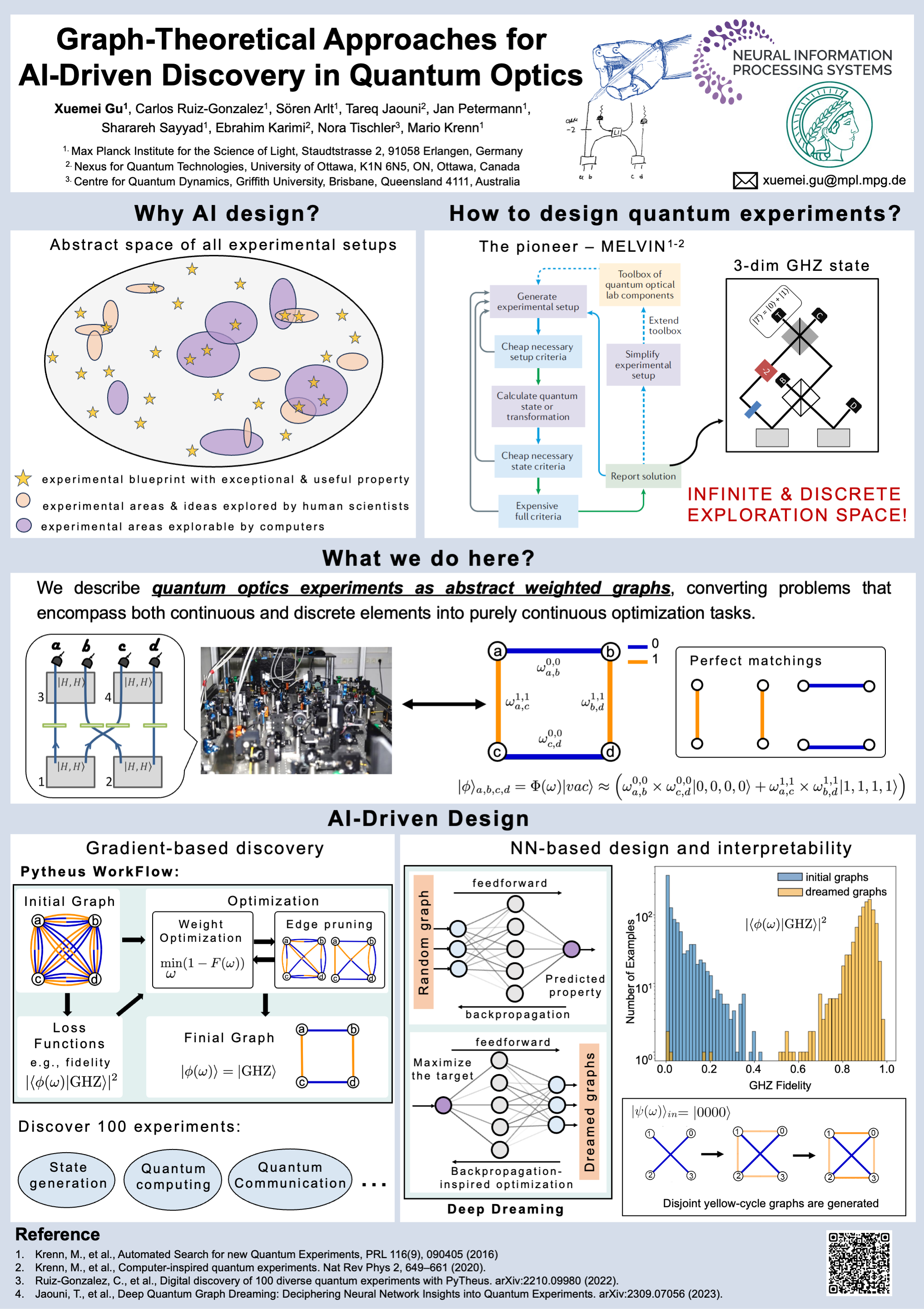
| 55 | Graph-Theoretical Approaches for AI-Driven Discovery in Quantum
Optics [paper][poster] Gu, Xuemei*; Ruiz-Gonzalez, Carlos; Arlt, Soeren; Jaouni, Tareq; Petermann, Jan ; Sayyad, Sharareh; Karimi, Ebrahim; Tischler, Nora; Krenn, Mario |
| 57 | Direct Amortized Likelihood Ratio Estimation [paper][poster] Cobb, Adam D*; Matejek, Brian; Elenius, Daniel; Roy, Anirban ; Jha, Susmit |
| 59 | Physics-informed neural networks with unknown measurement noise
[paper][poster] Pilar, Philipp*; Wahlstroem, Niklas |
| 60 | Universal Semantic-less Texture Boundary Detection for Microscopy (and
Metallography) [paper][poster][video] Rusanovsky, Matan; Beeri, Ofer ; Avidan, Shai; Oren, Gal* |
| 61 | Information bottleneck learns dominant transfer operator eigenfunctions
in dynamical systems [paper][poster] Schmitt, Matthew S*; Koch-Janusz, Maciej; Fruchart, Michel; Seara, Daniel; Vitelli, Vincenzo |
| 62 | Causa prima: cosmology meets causal discovery for the first
time [paper][poster][video] Pasquato, Mario*; Jin, Zehao; Lemos, Pablo; Davis, Benjamin; Macciò, Andrea |
| 64 | Unraveling the Mysteries of Galaxy Clusters: Recurrent Inference
Deconvolution of X-ray Spectra [paper][poster] Rhea, Carter*; Hlavacek-Larrondo, Julie; Kraft, Ralph; Bogdan, Akos; Perreault-Levasseur, Laurence; Adam, Alexandre; Zuhone, John |
| 66 | Scalable physics-guided data-driven component model reduction for Stokes
flow [paper][poster] Chung, Seung Whan*; Choi, Youngsoo; Roy, Pratanu; Moore, Thomas; Roy, Thomas; Lin, Tiras; Baker, Sarah |
| 67 | Improving dispersive readout of a superconducting qubit by machine
learning on path signature [paper][poster] Cao, Shuxiang*; Shao, Zhen; Zheng, Jian-Qing; Bakr, Mustafa; Leek, Peter; Lyons, Terry J |
| 69 | Optimizing Likelihood-free Inference using Self-supervised Neural
Symmetry Embeddings [paper][poster] Chatterjee, Deep*; Harris, Philip C; Goel, Maanas; Desai, Malina; Coughlin, Michael; Katsavounidis, Erik |
| 70 | Removing Dust from CMB Observations with Diffusion Models [paper][poster] Heurtel-Depeiges, David; Burkhart, Blakesley; Ohana, Ruben*; Régaldo-Saint Blancard, Bruno |
| 71 | Rho-Diffusion: A diffusion-based density estimation framework for
computational physics [paper][poster] Cai, Maxwell X.*; Lee, Kin Long Kelvin |
| 72 | Transformers for Scattering Amplitudes [paper][poster][video] Merz, Garrett W*; Charton, Francois; Cai, Tianji; Cranmer, Kyle; Dixon, Lance; Nolte, Niklas; Wilhelm, Matthias |
| 74 | NeuralHMC: Accelerated Hamiltonian Monte Carlo with a Neural Network
Surrogate Likelihood [paper][poster][video] Wolniewicz, Linnea M*; Sadowski, Peter; Corti, Claudio |
| 75 | Discovering Galaxy Features via Dataset Distillation [paper][poster] Guan, Haowen*; Zhao, Xuan; Wang, Zishi; Li, Zhiyang; Kempe, Julia |
| 77 | Modeling Coupled 1D PDEs of Cardiovascular Flow with Spatial Neural
ODEs [paper][poster][video] Csala, Hunor*; Mohan, Arvind T; Livescu, Daniel; Arzani, Amirhossein |
| 79 | Generating Multiphase Fluid Configurations in Fractures using Diffusion
Models [paper][poster] Chung, Jaehong*; Marcato, Agnese; Guiltinan, Eric; Mukerji, Tapan; Lin, Yen Ting; Santos, Javier E |
| 82 | Redefining Super-Resolution: Fine-mesh PDE predictions without classical
simulations [paper][poster] Sarkar, Rajat Kumar*; Majumdar, Ritam; Jadhav, Vishal; Sakhinana, Sagar Srinivas; Runkana, Venkataramana |
| 83 | Discovering Quantum Error Correcting Codes with Deep Reinforcement
Learning [paper][poster] Olle, Jan*; Zen, Remmy; Puviani, Matteo; Marquardt, Florian |
| 84 | Discovering Quantum Circuits for Logical State Preparation with Deep
Reinforcement Learning [paper][poster] Zen, Remmy*; Olle, Jan; Puviani, Matteo; Marquardt, Florian |
| 85 | Differentiable Simulation of a Liquid Argon TPC for High-Dimensional
Calibration [paper][poster] Granger, Pierre* |
| 87 | Learning Hard Distributions with Quantum-enhanced Variational
Autoencoders [paper][poster][video] Rao, Anantha S; Madan, Dhiraj*; Ray, Anupama; Vinayagamurthy, Dhinakaran; Santhanam, M S |
| 88 | Revealing the Mechanism of Large-scale Gradient Systems Using a Neural
Reduced Potential [paper][poster] Tsuji, Shunya; Murakami, Ryo; Shouno, Hayaru*; Mototake, Yoh-ichi |
| 89 | Physical Symbolic Optimization [paper][poster] Tenachi, Wassim*; Ibata, Rodrigo A; Diakogiannis, Foivos I |
| 90 | Score-based Data Assimilation for a Two-Layer Quasi-Geostrophic
Model [paper][poster] Rozet, François*; Louppe, Gilles |
| 91 | Physics-Informed Tensor Basis Neural Network for Turbulence Closure
Modeling [paper][poster] Riccius, Leon*; Agrawal, Atul; Koutsourelakis, PS |
| 92 | Relating Generalization in Deep Neural Networks to Sensitivity of
Discrete Dynamical Systems [paper][poster] Disselhoff, Jan*; Wand, Michael |
| 94 | Orbital-Free Density Functional Theory with Continuous Normalizing
Flows [paper][poster] Vargas Hernández, Rodrigo A.*; Chen, Ricky T Q; de Camargo, Alexandre |
| 95 | DeepTreeGANv2: Iterative Pooling of Point Clouds [paper][poster] Scham, Moritz A.W.*; Krücker, Dirk; Borras, Kerstin |
| 96 | Robust Ocean Subgrid-Scale Parameterizations Using Fourier Neural
Operators [paper][poster] Mangeleer, Victor*; Louppe, Gilles |
| 97 | 3D Localization of Microparticles from Holographic Images using Neural
Networks [paper][poster] Paliwal, Ayush*; Schlenczek, Oliver; Thiede, Birte; Bagheri, Gholamhossein; Ecker, Alexander S |
| 98 | Locating Hidden Exoplanets Using Machine Learning [paper][poster] Terry, Jason P*; Gleyzer, Sergei |
| 99 | Learning Optical Maps in Liquid Xenon Detector with Poisson Likelihood
Loss [paper][poster] Liang, Shixiao*; Tunnell, Christopher |
| 102 | AstroYOLO: Learning Astronomy Multi-Tasks in a Single Unified Real-Time
Framework [paper][poster] Khujaev, Nodirkhuja; Tsoy, Roman; Baek, Seungryul* |
| 103 | Coarse graining systems on inhomogeneous graphs using contrastive
learning [paper][poster] Gökmen, Doruk Efe*; Koch-Janusz, Maciej; Ringel, Zohar; Huber, Sebastian; Flicker, Felix; Biswas, Sounak |
| 104 | Understanding Pathologies of Deep Heteroskedastic Regression
[paper][poster] Wong-Toi, Eliot*; Boyd, Alex J; Fortuin, Vincent; Mandt, Stephan |
| 105 | Advancing Generative Modelling of Calorimeter Showers on Three
Frontiers [paper][poster] Buhmann, Erik*; Diefenbacher, Sascha; Eren, Engin; Gaede, Frank; Kasieczka, Gregor ; Korcari, William; Korol, Anatolii; Krause, Claudius G; Krueger, Katja; McKeown, Peter; Shekhzadeh, Imahn; Shih, David |
| 106 | Multi-fidelity Constrained Optimization for Stochastic Black Box
Simulators [paper][poster] Ravi, Kislaya*; Agrawal, Atul; Koutsourelakis, PS; Bungartz, Hans-Joachim |
| 107 | Activation Functions in Non-Negative Neural Networks [paper][poster] Becker, Marlon; Drees, Dominik; Brückerhoff-Plückelmann, Frank; Schuck, Carsten; Pernice, Wolfram; Risse, Benjamin* |
| 108 | Tree-Based Algorithms for Weakly Supervised Anomaly Detection
[paper][poster] Finke, Thorben J; Hein, Marie; Kasieczka, Gregor ; Krämer, Michael; Mück, Alexander; Prangchaikul, Parada; Quadfasel, Tobias*; Shih, David; Sommerhalder, Manuel |
| 109 | HIDM: Emulating Large Scale HI Maps using Score-based Diffusion
Models [paper][poster] Hassan, Sultan*; Andrianomena, Sambatra HS |
| 111 | Probabilistic Machine Learning based Turbulence Model Learning with a
Differentiable Solver [paper][poster] Agrawal, Atul*; Koutsourelakis, PS |
| 113 | AI ensemble for signal detection of higher order gravitational wave
modes of quasi-circular, spinning, non-precessing binary black hole
mergers [paper][poster] Tian, Minyang*; Huerta, Eliu A |
| 114 | Latent space representations of cosmological fields [paper][poster] Andrianomena, Sambatra HS*; Hassan, Sultan |
| 115 | Enhancing Data-Assimilation in CFD using Graph Neural Networks
[paper][poster] Quattromini, Michele*; Bucci, Michele Alessandro; Cherubini, Stefania; Semeraro, Onofrio |
| 116 | Gamma Ray AGNs: Estimating Redshifts and Blazar Classification using
Neural Networks with smart initialization and self-supervised
learning [paper][poster] Gharat, Sarvesh*; Bhatta, Gopal; BORTHAKUR, ABHIMANYU |
| 117 | Enhancing the local expressivity of geometric graph neural
networks [paper][poster] Norwood, Sam W*; Schaaf, Lars L; Batatia, Ilyes; Bhowmik, Arghya; Csányi, Gábor |
| 121 | Domain Adaptation for Measurements of Strong Gravitational
Lenses [paper][poster] Swierc, Paxson*; Zhao, Yifan; Ciprijanovic, Aleksandra; Nord, Brian |
| 123 | QDC: Quantum Diffusion Convolution Kernels on Graphs [paper][poster] Markovich, Thomas* |
| 124 | Efficient and Robust Jet Tagging at the LHC with Knowledge
Distillation [paper][poster] Liu, Ryan; Gandrakota, Abhijith*; Ngadiuba, Jennifer; vlimant, jean-roch; Spiropulu , Maria |
| 125 | Fast Particle-based Anomaly Detection Algorithm with Variational
Autoencoder [paper][poster] Liu, Ryan*; Gandrakota, Abhijith; Ngadiuba, Jennifer; vlimant, jean-roch; Spiropulu, Maria |
| 129 | Preparing Spectral Data for Machine Learning: A Study of Geological
Classification from Aerial Surveys [paper][poster] Chung, Jun Woo*; Sim, Alex; Quiter, Brian; Wu, Yuxin; Zhao, Weijie; Wu, Kesheng |
| 130 | Loss-driven sampling within hard-to-learn areas for simulation-based
neural network training [paper][poster] Dymchenko, Sofya*; Raffin, Bruno |
| 131 | Long Time Series Data Release from Broadband Axion Dark Matter
Experiment [paper][poster] Fry, Jessica T.*; Li, Aobo; Fu, Xinyi Hope; Winslow, Lindley; Pappas, Kaliroe |
| 132 | Physics - Informed Machine Learning for Reduced Space Chemical
Kinetics [paper][poster] Kumar, Anuj*; Echekki, Tarek |
| 133 | Smartpixels: Towards on-sensor inference of charged particle track
parameters and uncertainties [paper][poster] Gray, Lindsey A*; Dickinson, Jennet; Kovach-Fuentes, Rachel; Swartz, Morris; Di Guglielmo, Giuseppe; Bean, Alice; Berry, Douglas; Valentin, Manuel Blanco; DiPetrillo, Karri; Fahim, Farah; Hirschauer, Jim; Kulkarni, Shruti; Lipton, Ron; Maksimovic, Petar; Mills, Corrinne; Neubauer , Mark; Parpillon, Benjamin; Pradhan, Gauri; Syal, Chinar; Tran, Nhan; Yoo, Jieun; Young, Aaron |
| 134 | On Representations of Mean-Field Variational Inference [paper][poster] Ghosh, Soumyadip; Lu, Yingdong*; Nowicki, Tomasz; Zhang, Edith J |
| 135 | Active learning meets fractal decision boundaries: a cautionary tale
from the Sitnikov three body problem [paper][poster] Payot, Nicolas*; Pasquato, Mario; Trani, Alessandro Alberto; Hezaveh, Yashar; Perreault-Levasseur, Laurence |
| 136 | A deep learning framework for jointly extracting spectra and
source-count distributions in astronomy [paper][poster] Wolf, Florian*; List, Florian; Rodd, Nicholas; Hahn, Oliver |
| 137 | Machine learning-based compression of quantum many body physics: PCA and
autoencoder representation of the vertex function [paper][poster] Zang, Jiawei*; Medvidović, Matija; Kiese, Dominik; Di Sante, Domenico; Sengupta, Anirvan; Millis, Andy |
| 138 | Domain Adaptive Graph Neural Networks for Constraining Cosmological
Parameters Across Multiple Data Sets [paper][poster] Roncoli, Andrea*; Ciprijanovic, Aleksandra; Voetberg, Margaret; Villaescusa, Francisco; Nord, Brian |
| 139 | Multibasis Encodings in Recurrent Neural Network Wave Functions for
Variational Optimization [paper][poster] Kokaew, Wirawat* |
| 140 | Simulation Based Inference of BNS Kilonova Properties: A Case Study with
AT2017gfo [paper][poster] de matos, Phelipe Antonie Darc*; Bom, Clecio; Fraga, Bernardo M O ; Kilpatrick, Charles D. |
| 141 | Physics-aware Modeling of an Accelerated Particle Cloud [paper][poster] Goutierre, Emmanuel*; Guler, Hayg; Bruni, Christelle; Cohen, Johanne; Sebag, Michele |
| 144 | A Physics-Constrained NeuralODE Approach for Robust Learning of Stiff
Chemical Kinetics [paper][poster] Kumar, Tadbhagya*; Kumar, Anuj; Pal, Pinaki |
| 145 | Trick or treat? Evaluating stability strategies in graph network-based
simulators [paper][poster] Rochman Sharabi, Omer*; Louppe, Gilles |
| 146 | Super-Resolution Emulation of Large Cosmological Fields with a 3D
Conditional Diffusion Model [paper][poster] Rouhiainen, Adam*; Gira, Michael; Shiu, Gary; Lee, Kangwook; Münchmeyer, Moritz |
| 147 | E(2) Equivariant Neural Networks for Robust Galaxy Morphology
Classification [paper][poster] Pandya, Sneh J*; Patel, Purvik; O, Franc; Blazek, Jonathan |
| 148 | Reduced-order modeling for parameterized PDEs via implicit neural
representations [paper][poster][video] Wen, Tianshu*; Lee, Kookjin; Choi, Youngsoo |
| 149 | Simulation-Based Inference for Detecting Blending in Spectra
[paper][poster] McNamara, Declan*; Regier, Jeffrey |
| 150 | JetLOV: Enhancing Jet Tree Tagging through Neural Network Learning of
Optimal LundNet Variables [paper][poster] Cerro, Giorgio* |
| 151 | Hierarchical Cross-entropy Loss for Classification of Astrophysical
Transients [paper][poster] Villar, Victoria A* |
| 152 | Surrogate Model Training Data for FIDVR-related Voltage Control in
Large-scale Power Grids [paper][poster] Yin, Tianzhixi*; Huang, Renke; Hossain, Ramij-Raja; Huang, Qiuhua; Tan, Jie; Yu, Wenhao |
| 154 | Differentiable, End-to-End Forward Modeling for 21 cm Cosmology: Robust
Systematics Error Budgeting and More [paper][poster] Kern, Nicholas* |
| 155 | Investigating the Ability of PINNs To Solve Burgers’ PDE Near
Finite-Time BlowUp [paper][poster][video] Kumar, Dibyakanti*; Mukherjee, Anirbit |
| 156 | Detection and Segmentation of Ice Blocks in Europa's Chaos Terrain Using
Mask R-CNN [paper][poster] Dunn, Marina M*; Nixon, Conor A; Mills, Alyssa C; Awadallah, Ahmed; Duncan, Ethan J; Santerre, John W; Trent, Douglas; Larsen, Andrew |
| 157 | Neural Networks vs. Whittaker Smoothing: Advanced Techniques for
Scattering Signal Removal in 3D Fluorescence spectra [paper][poster] Zakuskin, Aleksandr; Krylov, Ivan N.; Labutin, Timur A.* |
| 159 | Benchmarking of Fast and Interpretable UF Machine Learning
Potentials [paper][poster] Prakash, Pawan* |
| 160 | A Physics-Informed Variational Autoencoder for Rapid Galaxy Inference
and Anomaly Detection [paper][poster] Gagliano, Alexander T*; Villar, Ashley |
| 162 | Pythia: A prototype artificial agent for designing optimal
gravitational-wave follow-up campaigns [paper][poster] Sravan, Niharika*; Graham, Matthew; Coughlin, Michael; Anand, Shreya; Ahumada, Tomas |
| 163 | Probabilistic Reconstruction of Dark Matter fields from galaxies using
diffusion models [paper][poster] Cuesta, Carolina; Ni, Yueying; Park, Core Francisco; Mudur, Nayantara; Ono, Victoria* |
| 164 | Predicting the Age of Astronomical Transients from Real-Time
Multivariate Time Series [paper][poster] Muthukrishna, Daniel* |
| 165 | Multiscale Feature Attribution for Outliers [paper][poster] Shen, Jeff*; Melchior, Peter M |
| 167 | Learning Reionization History from Quasars with Simulation-Based
Inference [paper][poster] Chen, Huanqing*; Speagle, Joshua S; Rogers, Keir |
| 168 | Interpretable Joint Event-Particle Reconstruction at NOvA with Sparse
CNNs and Transformers [paper][poster] Shmakov, Alexander*; Yankelevich, Alejandro J; Bian, Jianming; Baldi, Pierre |
| 170 | SimSIMS: Simulation-based Supernova Ia Model Selection with thousands of
latent variables [paper][poster] Karchev, Kosio*; Trotta, Roberto ; Weniger, Christoph |
| 171 | Accelerating Kinetic Simulations of Electrostatic Plasmas with
Reduced-Order Modeling [paper][poster][video] Tsai, Ping-Hsuan*; Chung, Seung Whan; Ghosh, Debojyoti; Loffeld, John; Choi, Youngsoo; Belof, Jonathan L |
| 172 | Sequential Monte Carlo for Detecting and Deblending Objects in
Astronomical Images [paper][poster] White, Tim*; Regier, Jeffrey |
| 173 | DeepSurveySim: Simulation Software and Benchmark Challenges for
Astronomical Observation Scheduling [paper][poster] Voetberg, Margaret*; Nord, Brian |
| 174 | LoDIP: Low-dose phase retrieval with deep image prior [paper][poster] Manekar, Raunak*; Negrini, Elisa; Pham, Minh; Jacobs, Daniel; Srivastava, Jaideep; Osher, Stanley; Miao, Jianwei |
| 175 | Bayesian multi-band fitting of alerts for kilonovae detection
[paper][poster] Biswas, Biswajit* |
| 176 | Forward Gradients for Data-Driven CFD Wall Models [paper][poster] Hueckelheim, Jan C*; Kumar, Tadbhagya; Raghavan, Krishnan; Pal, Pinaki |
| 177 | Learning an Effective Evolution Equation for Particle-Mesh Simulations
Across Cosmologies [paper][poster] Payot, Nicolas*; Lemos, Pablo; Perreault-Levasseur, Laurence; Cuesta, Carolina; Modi, Chirag; Hezaveh, Yashar |
| 178 | Active Learning for Discovering Complex Phase Diagrams with Gaussian
Processes [paper][poster] Zhu, Max Y*; Yao, Jian; Mynatt, Marcus; Pugzlys, Hubert; Li, Shuyi; Zhao, Qingyuan; Jia, Chunjing |
| 179 | RACER: Rational Artificial Intelligence Car-following-model Enhanced by
Reality [paper][poster] Li, Tianyi*; Stern, Raphael |
| 180 | Learned integration contour deformation for signal-to-noise improvement
in Monte Carlo calculations [paper][poster] Detmold, William; Kanwar, Gurtej; Lin, Yin*; Shanahan, Phiala; Wagman, Michael |
| 181 | The search for the lost attractor [paper][poster][video] Pasquato, Mario*; Haddad, Syphax; Di Cintio, Pierfrancesco; Adam, Alexandre; Dia, Noé; Petrache, Mircea; Di Carlo, Ugo Niccolò; Trani, Alessandro Alberto; Perreault-Levasseur, Laurence; Hezaveh, Yashar; Lemos, Pablo |
| 182 | Cosmological Field Emulation and Parameter Inference with Diffusion
Models [paper][poster] Mudur, Nayantara*; Cuesta, Carolina; Finkbeiner, Douglas |
| 183 | Symbolic Machine Learning for High Energy Physics Calculations
[paper][poster] Alnuqaydan, Abdulhakim*; Gleyzer, Sergei; Prosper, Harrison; Reinhardt, Eric; Charton, Francois; Anand, Neeraj |
| 184 | Autoencoding Labeled Interpolator, Inferring Parameters From Image And
Image From Parameters [paper][poster] SaraerToosi, Ali*; Broderick, Avery |
| 185 | Leveraging Deep Learning for Physical Model Bias of Global Air Quality
Estimates [paper][poster] Doerksen, Kelsey*; Gal, Yarin; Kalaitzis, Freddie; Marchetti, Yuliya; Lu, You; Montgomery, James; Miyazaki, Kazuyuki; Bowman, Kevin |
| 186 | Towards data-driven models of hadronization [paper][poster][video] Bierlich, Christian; Ilten, Phil; Menzo, Tony; Mrenna, Stephen; Szewc, Manuel; Wilkinson, Michael K. ; Youssef, Ahmed*; Zupan, Jure |
| 187 | From Plateaus to Progress: Unveiling Training Dynamics of PINNs
[paper][poster] Lengyel, Daniel*; Parpas, Panos; Pandya, Rahil R |
| 188 | Equivariant Neural Networks for Signatures of Dark Matter Morphology in
Strong Lensing Data [paper][poster] Cheeramvelil, Geo Jolly*; Toomey, Michael W; Gleyzer, Sergei |
| 189 | Echoes in the Noise: Posterior Samples of Faint Galaxy Surface
Brightness Profiles with Score-Based Likelihoods and Priors [paper][poster] Adam, Alexandre*; Stone, Connor J; Bottrell, Connor; Legin, Ronan; Perreault-Levasseur, Laurence; Hezaveh, Yashar |
| 190 | Deep Learning Segmentation of Spiral Arms and Bars [paper][poster] Walmsley, Mike*; Spindler, Ashley |
| 191 | Accelerating Flow Simulations using Online Dynamic Mode
Decomposition [paper][poster][video] Suh, Seung Won*; Chung, Seung Whan; Bremer, Peer-Timo; Choi, Youngsoo |
| 192 | Sparse 3D Images: Point Cloud or Image methods? [paper][poster] Torales Acosta, Fernando*; Mikuni, Vinicius M; Nachman, Benjamin; Arratia, Miguel; Karki, Bishnu; Milton, Ryan; Karande, Piyush; Angerami, Aaron |
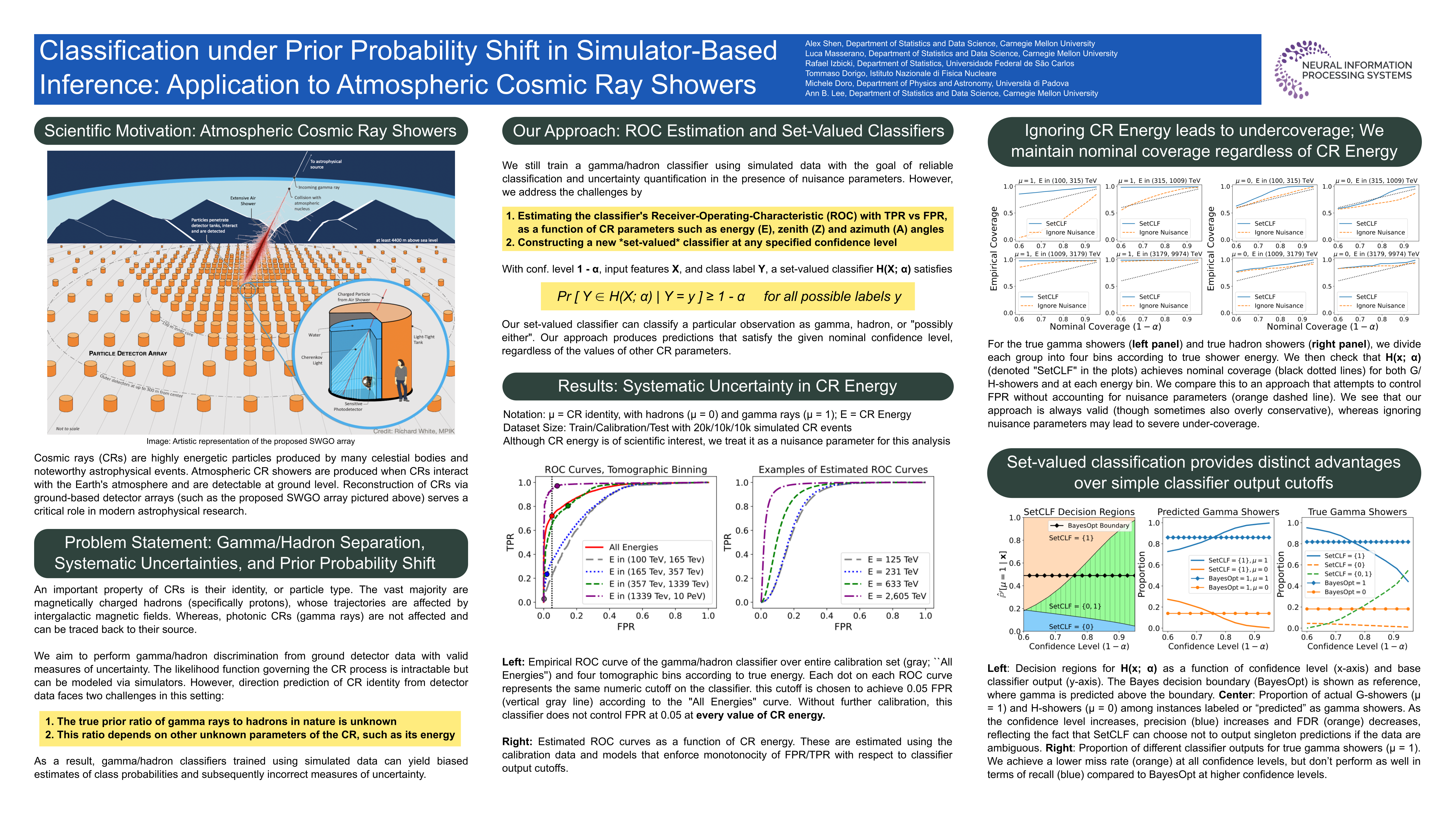
| 194 | Classification under Prior Probability Shift in Simulator-Based
Inference: Application to Atmospheric Cosmic-Ray Showers [paper][poster] Shen, Alexander*; Lee, Ann; Masserano, Luca; Dorigo, Tommaso; Doro, Michele; Izbicki, Rafael |
| 195 | Rare Galaxy Classes Identified In Foundation Model
Representations [paper][poster] Walmsley, Mike*; Scaife, Anna |
| 196 | Understanding and Visualizing Droplet Distributions in Simulations of
Shallow Clouds [paper][poster] Will, Justus C*; Jenney, Andrea; Lamb, Kara D.; Pritchard, Michael; Kaul, Colleen; Ma, Po-Lun; Shpund, Jacob; Pressel, Kyle; van Lier-Walqui, Marcus; Mandt, Stephan |
| 197 | Beyond PID Controllers: PPO with Neuralized PID Policy for Proton Beam
Intensity Control in Mu2e [paper][poster] Hu, Jerry Yao-Chieh; Xu, Chenwei*; Narayanan, Aakaash; Thieme, Mattson; Nagaslaev, Vladimir; Austin, Mark; Arnold, Jeremy; Berlioz, Jose; Hanlet, Pierrick; Ibrahim, Aisha; Nicklaus, Dennis; Mitrevski, Jovan; Pradhan, Gauri; Saewert, Andrea; Seiya, Kiyomi; Schupbach, Brian; Thurman-Keup, Randy; Tran, Nhan; Shi, Rui; Ogrenci, Seda; Shuping, Alexis Maya-Isabelle ; Hazelwood, Kyle; Liu, Han |
| 200 | Loss Functionals for Learning Likelihood Ratios [paper][poster] Rizvi, Shahzar*; Pettee, Mariel; Nachman, Benjamin |
| 201 | 19 Parameters Is All You Need: Tiny Neural Networks for Particle
Physics [paper][poster] Bogatskiy, Alexander*; Hoffman, Timothy; Offermann, Jan |
| 202 | CP-PINNs: Changepoints Detection in PDEs using Physics Informed Neural
Networks with Total-Variation Penalty [paper][poster] Dong, Zhikang*; Polak, Pawel |
| 203 | Self-Driving Telescopes: Autonomous Scheduling of Astronomical
Observation Campaigns with Offline Reinforcement Learning [paper][poster] Terranova, Franco*; Voetberg, Margaret; Nord, Brian; Pagul, Amanda |
| 204 | High-dimensional and Permutation Invariant Anomaly Detection with
Diffusion Generative Models [paper][poster] Mikuni, Vinicius M*; Nachman, Benjamin |
| 205 | Generative Diffusion Models for Lattice Field Theory [paper][poster] Wang, Lingxiao*; Aarts, Gert; Zhou, Kai |
| 206 | Reconstruction of Fields from Sparse Sensing: Differentiable Sensor
Placement Enhances Generalization [paper][poster] Marcato, Agnese*; O'Malley, Daniel; Viswanathan, Hari S; Guiltinan, Eric; Santos, Javier E |
| 207 | Learning Dark Matter Representation from Strong Lensing Images through
Self-Supervision [paper][poster] Deshmukh, Yashwardhan A.*; Sachdev, Kartik; Toomey, Michael W; Gleyzer, Sergei |
| 209 | Graph Neural Networks for Identifying Protein Reactive
Compounds [paper][poster] Cano Gil, Victor Hugo*; Rowley, Christopher |
| 210 | Towards out-of-distribution generalization in large-scale astronomical
surveys: robust networks learn similar representations [paper][poster] Gondhalekar, Yash*; Hassan, Sultan; Saphra, Naomi P; Andrianomena, Sambatra HS |
| 211 | Towards an Astronomical Foundation Model for Stars [paper][poster] Leung, Henry* |
| 213 | Induced Generative Adversarial Particle Transformers [paper][poster] Li, Anni; Krishnamohan, Venkat; Kansal, Raghav*; Duarte, Javier; Sen, Rounak; Tsan, Steven; Zhang, Zhaoyu |
| 214 | Lensformer: A Physics-Informed Vision Transformer for Gravitational
Lensing [paper][poster] Velôso de Souza, Lucas José*; Toomey, Michael W; Gleyzer, Sergei |
| 215 | Self-supervised learning for searching jellyfish galaxies in the ocean
of data from upcoming surveys [paper][poster] Gondhalekar, Yash*; de Souza, Rafael; Chies Santos, Ana; Queiroz de Abreu Silva, Carolina |
| 216 | deep-REMAP: Parameterization of Stellar Spectra Using Regularized
Multi-Task Learning [paper][poster] Gilda, Sankalp* |
| 218 | Bayesian Simulation-based Inference for Cosmological Initial
Conditions [paper][poster] Anau Montel, Noemi*; List, Florian; Weniger, Christoph |
| 220 | Autoregressive Transformers for Disruption Prediction in Nuclear Fusion
Plasmas [paper][poster] Spangher, Lucas*; Arnold, William F; Spangher, Alexander; Maris, Andrew; Rea, Cristina |
| 221 | CaloFFJORD: High Fidelity Calorimeter Simulation Using Continuous
Normalizing Flows [paper][poster] Furia, Chirag*; Mikuni, Vinicius M |
| 222 | Machine learning-assisted nanoscale photoelectrical sensing [paper][poster] Zhu , Ziyan*; Ji, Zhurun; Yassin, Houssam; Shen, Zhi-Xun; Devereaux, Thomas |
| 223 | Emulating deviations from Einstein's General Relativity using
conditional GANs [paper][poster] Gondhalekar, Yash*; Bose, Sownak |
| 225 | Operator SVD with Neural Networks via Nested Low-Rank
Approximation [paper][poster] Ryu, Jongha J; Xu, Xiangxiang; Erol, Hasan Sabri Melihcan; Bu, Yuheng; Zheng, Lizhong; Wornell, Gregory W* |
| 227 | Gradient weighted physics-informed neural networks for capturing shocks
in porous media flows [paper][poster] Kapoor, Somiya; Chandra, Abhishek; Kapoor, Taniya*; Curti, Mitrofan |
| 229 | Physics-Informed Calibration of Aeromagnetic Compensation in Magnetic
Navigation Systems using Liquid Time-Constant
Networks Nerrise, Favour*; Sosanya, Sosa; Neary, Patrick |
| 230 | The DL Advocate: Playing the devil’s advocate with hidden systematic
uncertainties [paper][poster] Ustyuzhanin, Andrey*; Golutvin, Andrey; Iniukhin, Alexander; Owen, Patrick; Mauri, Andrea; Serra, Nicola |
| 231 | MCMC to address model misspecification in Deep Learning classification
of Radio Galaxies [paper][poster] Mohan, Devina*; Scaife, Anna |
| 232 | Application of Zone Method based Physics-Informed Neural Networks in
Reheating Furnaces [paper][poster] Dutta, Ujjal Kr*; Lipani, Aldo; Wang, Chuan; Hu, Yukun |
| 233 | LEO Satellite Orbit Prediction with Physics Informed Machine
Learning [paper][poster] Alesiani, Francesco*; Takamoto, Makoto; Kamiya, Toshio; Etou, Daisuke |
| 234 | Physically Accurate Fast Nanophotonic Simulations with Physics Informed
Model and Training [paper][poster] Dasdemir, Ahmet Onur; Dimici, Can; Erdem, Aykut; Magden, Emir Salih* |
| 235 | Bayesian Imaging for Radio Interferometry with Score-Based
Priors [paper][poster] Dia, Noé*; Yantovski-Barth, M. J. ; Adam, Alexandre; Bowles, Micah R; Lemos, Pablo; Perreault-Levasseur, Laurence; Hezaveh, Yashar; Scaife, Anna |
| 236 | Virtual EVE: a Deep Learning Model for Solar Irradiance
Prediction [paper][poster] Indaco, Manuel*; Gass , Daniel ; Fawcett, William; Galvez, Richard; Wright, Paul J; Muñoz-Jaramillo, Andrés |
| 237 | High-Cadence Thermospheric Density Estimation enabled by Machine
Learning on Solar Imagery [paper][poster] Malik, Shreshth A*; Walsh, James EJ; Acciarini, Giacomo; Berger, Thomas; Baydin, Atilim Gunes |
| 239 | Combining astrophysical datasets with CRUMB [paper][poster] Porter, Fiona M* |
| 241 | Ultra Fast Transformers on FPGAs for Particle Physics
Experiments [paper][poster] Jiang, Zhixing; Yin, Ziang; Khoda, Elham E*; Loncar, Vladimir; Govorkova, Ekaterina; Moreno, Eric A; Harris, Philip C; Hauck, Scott; Hsu, Shih-chieh |
| 242 | Unleashing the Potential of Fractional Calculus in Graph Neural
Networks [paper][poster] Kang, Qiyu*; ZHAO, KAI; Ding, Qinxu; Ji, Feng; Li, Xuhao; LIANG, WENFEI; Song, Yang; Tay, Wee Peng |
| 245 | Approximately-invariant neural networks for quantum many-body
physics [paper][poster] Kufel, Dominik S*; Kemp, Jack; Yao, Norman |
| 246 | Pseudotime Diffusion [paper][poster] Moss, Jacob*; England, Jeremy; Lió, Pietro |
| 248 | Reinforcement Learning for Ising Model [paper][poster] Lu, Yichen; Liu, Xiao-Yang* |
| 249 | Computing Partition Functions in Unnormalized Density Models Using
Bayesian Thermodynamic Integration [paper][poster] Lobashev, Alexander*; Tamm, Mikhail |
| 250 | ELUQuant: Event-Level Uncertainty Quantification using Physics-Informed
Bayesian Neural Networks with Flow approximated Posteriors - A DIS
Study [paper][poster] Fanelli, Cristiano *; Giroux, James |
APL Poster Awards
Sponsored by APL Machine Learning.- Classification under Prior Probability Shift in Simulator-Based Inference: Application to Atmospheric Cosmic-Ray Showers [poster] by Alexander Shen; Ann Lee; Luca Masserano; Tommaso Dorigo; Michele Doro; Rafael Izbicki.
- Graph-Theoretical Approaches for AI-Driven Discovery in Quantum Optics [poster] by Xuemei Gu; Carlos Ruiz-Gonzalez; Soeren Arlt; Tareq Jaouni; Jan Petermann; Sharareh Sayyad; Ebrahim Karimi; Nora Tischler; Mario Krenn.
Program Committee (Reviewers)
We acknowledge the 295 members of the program committee for providing reviews on a very tight schedule and making this workshop possible. They are listed in alphabetical order below.
Aashwin Mishra (Stanford University), Abhijith Gandrakota (Fermilab), Abhinanda Ranjit Punnakkal (UiT The Arctic University of Norway), Abhishek Abhishek (UBC), Abhishek Chandra (Eindhoven University of Technology), Adrian Bayer (UC Berkeley), Adrian Perez-Suay (IPL - Universitat de València), Agnimitra Dasgupta (University of Southern California), Aidan Chambers (IAIFI), Akshay Subramaniam (NVIDIA), Aleksandra Ciprijanovic (Fermilab), Alexander Gagliano (The NSF Institute for Artificial intelligence and Fundamental Interactions), Alexander Sun (The University of Texas at Austin), Alexandre Adam (Université de Montréal), Alexandre Szenicer (X), Alison Appling (U.S. geological survey), Ameya Daigavane (Massachusetts Institute of Technology), Amin Tavakoli (UC Irvine), Andreas Mardt (Redesign Science ), Andreas Schachner (University of Cambridge), Andres Vicente Arevalo (Instituto de Astrofísica de Canarias (IAC)), Andrey Popov (University of Texas at Austin), Andrey Ustyuzhanin (Constructor University, Bremen), Anindita Maiti (Northeastern University), Ankita Shukla (Arizona State University), Anna Jungbluth (European Space Agency), Antoine Wehenkel (Apple), Anurag Saha Roy (Saarland University), Arka Daw (Virginia Tech), Armi Tiihonen (Aalto University), Arnaud Delaunoy (University of Liege), Arnaud Vadeboncoeur (University of Cambridge ), Arun Ross (Michigan State University), Arvind Renganathan (University of Minnesota), Aryya Gangopadhyay (UMBC), Asif Khan (University of Edinburgh), Atul Agrawal (Technical University of Munich), Auralee Edelen (SLAC National Accelerator Laboratory), Austen Lamacraft (University of Cambridge), Babak Rahmani (EPFL), Batuhan Koyuncu (Saarland University), Benjamin Cash (George Mason University), Bilal Thonnam Thodi (New York University Abu Dhabi), Biprateep Dey (University of Pittsburgh), Biwei Dai (University of California, Berkeley), Boyu Zhang (University of Idaho), Bruno Raffin (University of Grenoble), Carolina Cuesta (MIT), Carter Rhea (University of Montreal), Cenk Tüysüz (DESY), Cesar Quilodran-Casas (Imperial College London), Chenyang Li (Argonne National Laboratory), Chirag Modi (Flatiron Institute), Christian Glaser (Uppsala University), Christoph Weniger (University of Amsterdam), Christophe Bonneville (Cornell University), Christopher Hall (RadiaSoft LLC), Conrad Albrecht (German Aerospace Center), Constantin Weisser (QuantumBlack), Cristina Garcia-Cardona (Los Alamos National Laboratory), Daniel Murnane (Lawrence Berkeley National Laboratory), Daniel Serino (LANL), Danielle Maddix (Amazon Research ), Danyal Rehman (Massachusetts Institute of Technology (MIT)), Deep Chatterjee (Massachusetts Institute of Technology), Digbalay Bose (University of Southern California), Dion Häfner (Pasteur Labs & ISI), Elham E Khoda (University of Washington), Eliane Maalouf (University of Neuchâtel), Elyssa Hofgard (Massachusetts Institute of Technology), Emanuele Usai (University of Alabama), Emma Benjaminson (Carnegie Mellon University), Engin Eren (DESY), Fabian Ruehle (Northeastern University), Fatih Dinc (Stanford University), Felix Wagner (HEPHY Vienna), Fernando Romero-Lopez (MIT), Francisco Förster (Millennium Institute of Astrophysics), Franco Pellegrini (École normale supérieure, Paris), Francois Lanusse (CEA Saclay), François Rozet (University of Liège), Gaia Grosso (IAIFI), Gal Oren (Technion), Garrett Merz (University of Wisconsin-Madison), George Stein (UC Berkeley), Gert-Jan Both (CRI), Guillermo Cabrera-Vives (University of Concepción), Hannes Stärk (Massachusetts Institute of Technology), Hao Wu (Shanghai Jiaotong University), Harold Erbin (MIT, IAIFI, CEA-LIST), Hector Corzo ( Center for Chemical Computation and Theory at UC Merced), Henning Kirschenmann (University of Helsinki), Hugo Frezat (Univ. Grenoble Alpes), Hunor Csala (University of Utah), Huziel Sauceda (Technische Universität Berlin), Hyungjin Chung (KAIST), Ieva Kazlauskaite (University of Cambridge), Ion Matei (PARC), Irina Espejo Morales (New York University), Jack Collins (SLAC National Lab), Jaegul Choo (Korea Advanced Institute of Science and Technology), JAÏ Otman (Sidi Mohamed Ben Abdellah University ), Jared Willard (University of Minnesota), jean-roch vlimant (California Institute of Technology), Jianan Zhou (Nanyang Technological University), Jie Bu (Virginia Tech), Jiequn Han (Flatiron Institute), Jingyi Tang (Stanford University), Jochen Garcke (University Bonn), Joel Dabrowski (CSIRO), John Martyn (Massachusetts Institute of Technology), John Wu (Space Telescope Science Institute), Jonas Köhler (Free University of Berlin), Jonathan Edelen (RadiaSoft LLC), Jonghyun Lee (University of Hawaii at Manoa), Jordi Cortés-Andrés (ISP-IPL), Jordi Tura (Leiden University), Jose Napoles-Duarte (Universidad Autonoma de Chihuahua), Jose Ruiz-Munoz (Universidad Nacional de Colombia), Joshua Bloom (UC Berkeley), Joshua Yao-Yu Lin (Prescient Design/Genentech), Julian Suk (University of Twente), Junichi Tanaka (ICEPP, The University of TOkyo), Junze Liu (University of California, Irvine), Justine Zeghal (APC CNRS), Kai Fukami (University of California, Los Angeles), Kai Zhou (Frankfurt Institute for Advanced Studies), Karan Shah (Center for Advanced Systems Understanding (CASUS)), Karolos Potamianos (University of Oxford), Katherine Fraser (Harvard University), Kathleen Champion (University of Washington), Katrin Heitmann (Argonne National Laboratory), Keith Brown (Boston University), Keming Zhang (UC Berkeley), Ken-ichi Nomura (University of Southern California), Khoo Zi-Yu (National University of Singapore), Kim Nicoli (TU Berlin), Kunal Ghosh (Aalto University), Kushal Tirumala (FAIR), Lalit Ghule (Ansys Inc.), Lars Doorenbos (University of Bern), Leander Thiele (Princeton University), Lei Wang (IOP, CAS), Li Yang (Google Research), Lijing Wang (New Jersey Institute of Technology), Lin Li (MIT Lincoln Laboratory), Lingxiao Wang (Frankfurt Institute for Advanced Studies), Luc Le Pottier (University of California, Berkeley), Luca Biggio (ETH Zürich), Lucas Meyer (INRIA), Ludger Paehler (Technical University of Munich), M. Maruf (Virginia Tech), Madhurima Nath (Slalom Consulting, LLC), Mai Nguyen (University of California San Diego), Maksim Zhdanov (Helmholtz-Zentrum Dresden-Rossendorf), Manuel Sommerhalder (Universität Hamburg), Marcin Pietroń (AGH UST), Mariano Dominguez (IATE), Mariel Pettee (Lawrence Berkeley National Lab), Mario Krenn (Max Planck Institute for the Science of Light), Marios Mattheakis (E Ink), Masaki Adachi (University of Oxford), Matija Medvidović (Columbia University), Matt Sampson (Princeton University), Matteo Manica (IBM Research), Matthew Spellings (Vector Institute), Max Zhu (University of Cambridge), Maximilian Dax (MPI for Intelligent Systems, Tübingen), Maxwell Cai (Intel Corporation), Maziar Raissi (University of Colorado Boulder), Mehmet Noyan (Ipsumio B.V.), Menachem Stern (University of Pennsylvania), Micah Bowles (The University of Manchester), Michael Douglas (Harvard CMSA), Michelle Kuchera (Davidson College), Mike Williams (Massachusetts Institute of Technology), Mikel Landajuela (Lawrence Livermore National Laboroatory), Milind Malshe (Georgia Institute of Technology), Mit Kotak (Massachusetts Institute of Technology), Mohammad Sultan (Insitro), Mohannad Elhamod (Virginia Tech), Mridul Khurana (Virginia Tech), Muhammad Kasim (Machine Discovery), Namid Stillman (Simudyne), Natalie Klein (Los Alamos National Laboratory), Nayantara Mudur (Harvard University), Neerav Kaushal (Michigan Technological University), Negin Forouzesh (California State University, Los Angeles), Nesar Ramachandra (Argonne National Laboratory), Nick McGreivy (Princeton University), Nils Thuerey (Technical University of Munich), Nishan Srishankar (WPI), Noemi Anau Montel (GRAPPA Institute (University of Amsterdam)), Olivier Saut (CNRS), Omar Alterkait (Tufts University/ IAIFI), Ondrej Hovorka (University of Southampton), Othmane Rifki (Spectrum Labs), Ouail Kitouni (Massachusetts Institute of Technology), Pablo Martin (), Pao-Hsiung Chiu (Institute of High Performance Computing), Paul Atzberger (University of California Santa Barbara), Paula Harder (Fraunhofer ITWM), Pedro L. C. Rodrigues (Inria), Peer-Timo Bremer (LLNL), Peter Harrington (Lawrence Berkeley National Laboratory (Berkeley Lab)), Peter Melchior (Princeton University), Peter Sadowski (University of Hawaii Manoa), Peter Steinbach (HZDR), Pietro Vischia (Université catholique de Louvain), PS Koutsourelakis (TUM), Pulkit Khandelwal (University of Pennsylvania), Qi Tang (Los Alamos National Laboratory), Raffaele Santagati (Boehringer-Ingelheim), Rajat Arora (Advanced Micro Devices (AMD)), Raunak Borker (Ansys), Redouane Lguensat (IPSL), Reza Akbarian Bafghi (University of Colorado Boulder), Rhys Goodall (Chemix.ai), Riccardo Alessandri (University of Chicago), Rikab Gambhir (MIT), Rodrigo A. Vargas Hernández (McMaster University), Sam Foreman (Argonne National Laboratory), Sandeep Madireddy (Argonne National Laboratory), Sankalp Gilda (ML Collective), Sanmay Ganguly (University of Tokyo), Sarvesh Gharat (IIT Bombay), Sascha Caron (Radboud University Nijmegen), Sebastian Dorn (Max-Planck Institute), Sébastien Fabbro (NRC Herzberg Astronomy and Astrophysics), Sergey Shirobokov (Twitter), Shah Nawaz (German Electron Synchrotron), Shanwu Li (Michigan Technological University), Shenao Yan (University of Connecticut), Shinjae Yoo (Brookhaven National Laboratory), Shirley Ho (Flatiron Institute), Shiyu Wang (Emory University), Shriram Chennakesavalu (Stanford University), Shuai Liu (Meta Platform), Siddharth Mishra-Sharma (MIT), Sifan Wang (University of Pennsylvania), Simon Schnake (Deutsches Elektronen-Synchrotron DESY), Sokratis Trifinopoulos (MIT), Somya Sharma (U. Minnesota), Soronzonbold Otgonbaatar (German Aerospace Center, Oberpfaffenhofen and LMU Munich), Srinandan Dasmahapatra (University of Southampton), Stephan Günnemann (Technical University of Munich), Stephen Webb (RadiaSoft LLC), Sui Tang (UCSB), Suryanarayana Maddu (Flatiron Institute/Simons Foundation), Takashi Matsubara (Osaka University), Tatiana Likhomanenko (Apple), Thomas Beckers (University of Pennsylvania), Tobias Buck (IWR), Tobias Liaudat (Commisariat à l'Energie Atomique (CEA)), Tomás Müller (University of Southampton), Tomasz Szumlak (AGH University of Science and Technology), Tomo Lazovich (Lightmatter), Tri Nguyen (MIT), Tristan Bereau (Heidelberg University), Vahe Gharakhanyan (Columbia University), Valentina Salvatelli (IQVIA), Varun Kelkar (University of Illinois at Urbana-Champaign), Victoria Villar (Columbia University), Viktor Podolskiy (Department of Physics and Applied Physics, University of Massachusetts Lowell), Vinayak Bhat (University of Kentucky), Vinicius Mikuni (NERSC), VISHAL DEY (The Ohio State University), Vitus Benson (Max-Planck-Institute for Biogeochemistry), Wai Tong Chung (Stanford University), Wonmin Byeon (NVIDIA Research), Wujie Wang (Massachusetts Institute of Technology), Xian Yeow Lee (Iowa State University), Xiangyang Ju (LBNL), Xiaolong Li (University of Delaware), Xiaowei Jia (University of Pittsburgh), Xiaoyong Jin (Argonne National Laboratory), Xinyan Li (IQVIA), Yao Fehlis (AMD), Yilin Chen (Stanford University), Yin Li (Flatiron Institute), Yingdong Lu (IBM Research AI), Yingtao Luo (Carnegie Mellon University), Yitian Sun (MIT), Youngwoo Cho (Korea Advanced Institute of Science and Technology), Yu Wang (University of Michigan), Yuan Yin (Sorbonne Université, CNRS, ISIR, F-75005 Paris, France), Yuanqi Du (Cornell University), Yunxuan Li (Google LLC), Yuqi Nie (Princeton University), Zeviel Imani (Tuft / IAIFI), Zhe Jiang (University of Florida), zhibo zhang (KLA), Zhikang Dong (Stony Brook University), Ziming Liu (MIT), Zixing Song (The Chinese University of Hong Kong)
Call for papers
In this workshop, we aim to bring together physical scientists and machine learning researchers who work at the intersection of these fields by
- Applying machine learning to problems in the physical sciences – physics, chemistry, astronomy, materials science, biophysics, and related sciences; and
- Using physical insights to understand and/or improve machine learning techniques.
Research Track
We invite researchers to submit original work in the following areas or areas related to them.- ML for Physics: Innovative applications of machine learning to the physical sciences; Machine learning model interpretability for obtaining insights to physical systems; Automating/accelerating elements of the scientific process (experimental design, data collection, statistical analysis, etc.).
- Physics in ML: Strategies for incorporating scientific knowledge or methods into machine learning models and algorithms; Applications of physical science methods and processes to understand, model, and improve machine learning models and algorithms.
- Any other area related to the subject of the workshop, including but not limited to probabilistic methods that are relevant to physical systems, such as deep generative models, probabilistic programming, simulation-based inference, variational inference, causal inference, etc.
Dataset Track
We invite researchers to submit papers describing a dataset and the related computational or scientific challenge that may benefit from innovative research at the intersection of ML and Physical Sciences.- Availability of data set: The dataset must be publicly available at the time of the workshop (e.g., via Zenodo). The submission must also include a baseline result along with public code (the baseline need not use machine learning). Additional data artifacts (e.g. a public simulator) may also be included and described in the submission.
- The submitted paper should describe the the following:
- Properties of the dataset.
- The scientific and/or computational challenges.
- Existing methods and/or potential solutions that could be provided by ML.
Submissions should be anonymized short papers (extended abstracts) up to 4 pages in length (excluding references). We invite authors to follow the guidelines and best practices from the NeurIPS conference (see also the main conference datasets and benchmarks call for guidelines pertaining to the Dataset Track). Please ensure that your paper is approachable by someone who is not an expert in your specific area of physical science. For example, please avoid or at least define jargon. We reserve the right to desk reject any submissions that do not conform to the format. The review process is double blind. All authors must be registered in the submission system at the time of submission. We will not allow authors to be added after the review process has begun. This workshop is not archival so we will consider papers containing content that is published in an archival venue other than the main NeurIPS conference (e.g. a physics journal). However, such papers will likely need to be rewritten to fit the format and venue. See here for additional instructions on preparing submissions to the workshop.
Posters and contributed talks
Accepted work will be presented as posters during the workshop. At the same time as the in-person poster session, we will also facilitate a virtual poster session in GatherTown. Authors of submitted papers will be able to indicate their preference for an in-person presentation or a virtual presentation. Furthermore, the authors of each accepted paper will get the opportunity to submit a 5 minute video that summarizes their work.
Several accepted submissions will be selected for contributed talks at the workshop program. Talks can be in-person or remote depending on the preference of the presenter.
Submission instructions
Submit your work on the submission portal. See submission and review instructions for important instructions on preparing contributions as well as details on how they will be evaluated.
Review instructions
Instructions for reviewers are available here.
Important note for work that will be/has been published elsewhere
All accepted works will be made available on the workshop website. This does not constitute an archival publication or formal proceedings; authors retain full copyright of their work and are free to publish their extended work in another journal or conference. We allow submission of works that overlap with papers that are under review or have been recently published in a conference or a journal, including physical science journals. However, we do not accept cross-submissions of the same content to multiple workshops at NeurIPS. (Check the list of accepted workshops this year).
Instructions for accepted papers
Authors of accepted papers are expected to upload their camera-ready (final) paper and a poster by the deadlines given on this page. Optionally they can also record a short (5-minute) video describing their work.
Camera-ready paper
Please produce the "camera-ready" (final) version of your accepted paper by replacing the "neurips_2023.sty" style file with the "neurips_2023_ml4ps.sty" file available here and using the "final" package option (that is, "\usepackage[final]{neurips_2023_ml4ps}") to include author and affiliation information. The modified style file replaces the first-page footer to correctly refer to the workshop instead of the main conference. It is acceptable if your paper goes up to five pages (excluding acknowledgements, references, and any appendices if present) due to author and affiliation information taking extra space on the first page. The five-page limit is strict, and appendices are allowed but discouraged.
Please revise your paper as much as possible to address reviewer comments reasonably. The revision would include minor corrections and/or changes directly addressing reviewer comments. Beyond these points, it is not acceptable to have any significant new material not present in your paper's reviewed version. Please upload the final PDF of your paper by the camera-ready deadline by logging in to the CMT website (the same one used for the submissions) and using the camera-ready link shown with your existing submission.
Poster
Please upload your poster using the central NeurIPS poster upload page and follow the instructions given there regarding the file formats and resolutions. To see the poster listed in the NeurIPS poster upload page, the co-author who is uploading the poster for a paper needs to be logged in to the neurips.cc website using the same email address they used in their paper submission. If you encounter a problem regarding NeurIPS accounts (e.g., you have multiple accounts associated with different email addresses and you need to merge these accounts into a single one), please consult the NeurIPS account FAQs and get in touch with the main NeurIPS conference organization who are handling accounts and registrations.
The poster sessions will take place both in-person and virtually during the workshop.
- Physical presentation: You must come with your poster printed, preferably on a lightweight paper of at most 24W x 36H inches. Your poster will be taped to the wall.
- Remote presentation: Virtual poster sessions will be held online at the same time as the physical poster sessions. Further instructions will be sent later.
For the authors of contributed talks, posters are optional.
Optional video
You can record a short video in addition to your poster using a platform of your own choice (e.g., YouTube). Videos will be added to the workshop website, together with the papers and posters. The video should be a brief (less than 5 minutes) presentation of your work in the accepted paper. Uploading a video is optional. You should submit the URL of your presentation on CMT with the camera-ready version of your paper.
Important dates
- Submission Deadline: September 29, 2023, 23:59 AoE
- Review Deadline: October 21, 2023, 23:59 AoE
- Author (accept/reject) notification: October 27, 2023, 23:59 AoE
- Camera-ready (final) paper deadline: November 27, 2023, 23:59 AoE
- Poster deadline: November 27, 2023, 23:59 AoE
- Workshop: December 15, 2023
Organizers
For questions and comments, please contact us at ml4ps@googlegroups.com.
-

Emine KucukbenliNVIDIA
-

Atılım Güneş BaydinUniversity of Oxford
-

Adji Bousso DiengPrinceton University
-

Brian NordFermilab
-

Benjamin NachmanLawrence Berkeley National Laboratory
-

Siddharth Mishra-SharmaMIT / Harvard / IAIFI
Steering Committee
-

Kyle CranmerUniversity of Wisconsin
-

Gilles LouppeUniversity of Liège
-

Savannah ThaisColumbia University
Team Members
- Ouail Kitouni (MIT/IAIFI)
- Garrett Merz (University of Wisconsin)
- Vinicius Mikuni (Lawrence Berkeley National Laboratory)


Location
NeurIPS 2023 will be a hybrid conference with physical and virtual participation. The physical component will take place at the New Orleans Ernest N. Morial Convention Center, 900 Convention Center Blvd, New Orleans, LA 70130, United States