D, with whom I have lived for some years, came to Australia from China.
From time to time he makes what I like to call a “Chinese joke.”
Basically, these are jokes which rely on a pun which would only appear as a pun to a Chinese person. You could say that they are jokes with a Chinese accent.
I have commented on such a “Chinese joke” before on this blog. Exceptionally, this involved not two but three languages, as D after a trip around Germany triumphantly merged “Lewisham, Petersham” with “Danke schön. Bitte schön.”
I have even ventured my own reverse-Chinese joke, referring to D’s three sisters (the youngest of whom is my age) as the “three gorgeous.” D and I both think this is a great joke but the audience for it is sadly lacking as it relies on recognising “gorgeous” as a Chinese-accented homophone for “gorges.” It doesn’t help that D’s family would only ever think of the Chinese language name for the massive dam on the Yangze.
On Wednesday afternoon I took D to our local hospital at his request. There was no particular urgency and it felt more like a check up of that paradoxical kind where you don’t actually expect anything to be detected, rather than anything particularly dramatic. So it came as a bit of a surprise when they decided to keep him in. He has been receiving antibiotics intravenously.
Hence D’s latest Chinese joke. He’s very proud of it. It hinges on his perception that “Canula” sounds like the Chinese name for “Kenya.” The punch-line is “Nigeria.” Don’t ask me how he gets there.
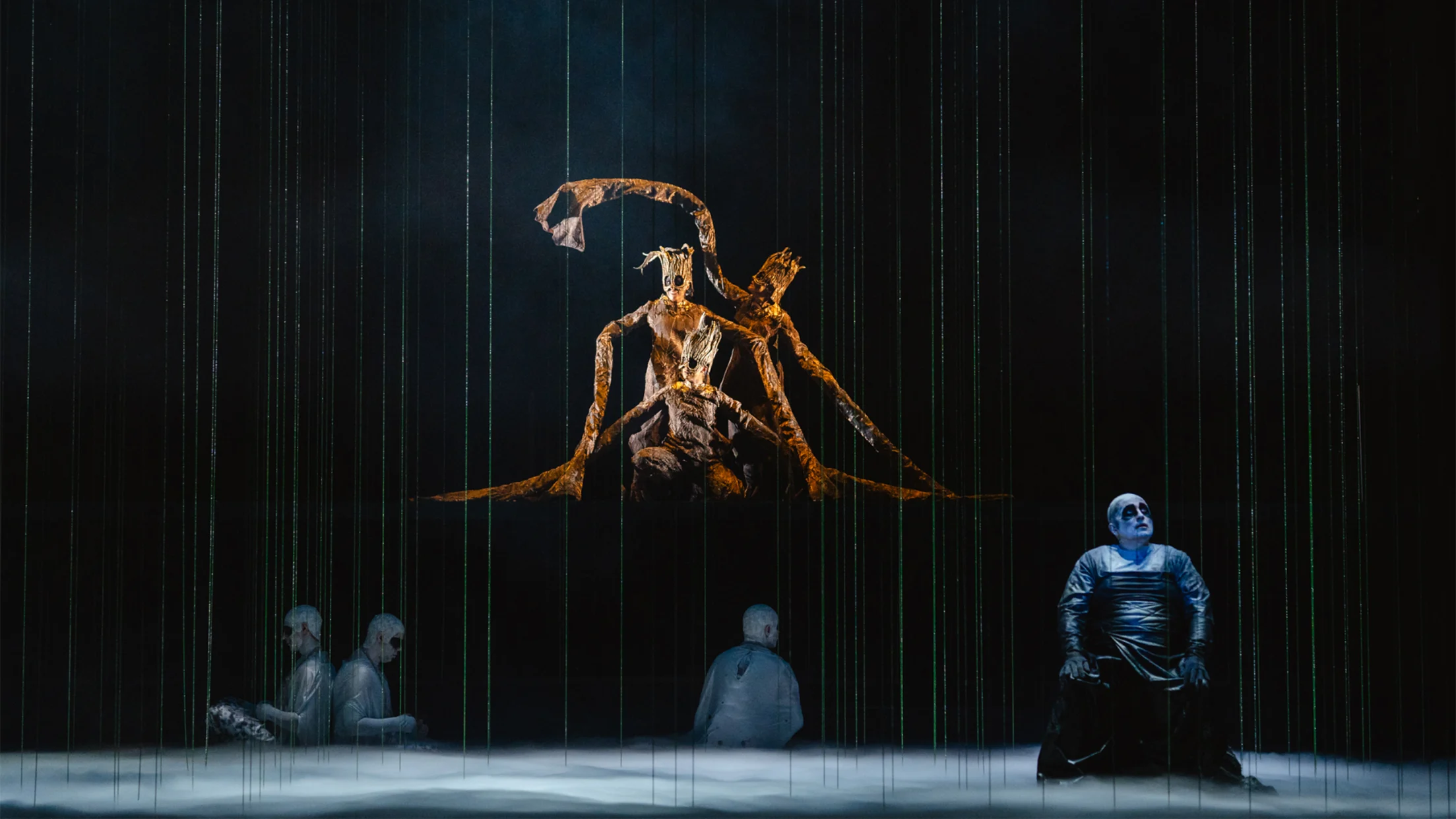
I return to this near-dormant blog part-way through the present Opera Australia run of Rusalka. (Image above from Opera Australia, from last year’s WA opera performances.)
I have been twice so far and will return for the last night.
This is an Opera Conference production which was first seen in Perth last year. In the first act there is an ingenious and striking approach to the divide between the watery and terrestrial worlds. This is carried forward into the second and third acts which are otherwise, from a scenic point of view, economically executed. A lot is done with costumes and props.
The wood-nymphs are my personal-favourite part of the production. The whole opera has a kind of mild Wagnerianism adapted to Dvořák’s own folksy manner, and there is a wink in homage to Wagner’s Rhine maidens. This is heightened by the casting of Warwick Fyfe in the Alberich-equivalent role of the Water King, especially in the opening scene which riffs off the opening of Das Rheingold. The nymphs’ return in Act III has a structural role rather like the Rhine maidens’ meeting with Siegfried in Götterdämmerung. They have wonderful costumes and I particularly like their Entlike heads and their bough-like arms which are deployed in a singer-friendly mode of dancing.
Nicole Car is a strong Rusalka. It first I felt (preconceptions set by exposure to Eileen Hannan in the 1986 ENO production, who had a special kind of wistfulness) that she was too strong, but I now see this is as consistent with a recasting (in their making-up-for-Lyndon mode, we are told through the PR, a little-modishly, that this is a feminist slant) which confers agency on Rusalka, albeit that she is still trapped in the laws of nature.
At the beginning of the shortish (6 performances only) run I could see that, apart from the first night, there were still plenty of seats available. Word of mouth and favourable reviews have obviously elicited a response and the remainder of the run is quite fully-booked.
Rusalka has never fallen out of the repertoire for the Czechs but it has taken a while for the opera as a whole, as opposed to Rusalka’s Song to the Moon, to reach the wider operatic world. In 1993 or so, when as part of the Festival of Sydney, Opera Australia mounted a concert version, we were told that while this was our first Rusalka, it was the Czech conductor’s four-hundred-and-somethingth performance.
Unfortunately, for my own record of posterity, the 2007 Opera Australia production came just before the inception of this blog. My memory of it has faded over time and is slightly overshadowed by the subsequent (to me slightly comic) grumbling of Bruce Martin about how he had been captured in the Chandos recording which then became part of a bit of a culture-war about Richard Hickox’s casting decisions. The actual production, as I recall, was a bit daggy rather in the way of the infamous pocket Rheingold of the (then) Australian Opera’s aborted 1980s Ring Cycle.
In 2011 I saw the Stefan Herheim production at Dresden. I was totally mystified by the regie konzept (it turns out it was all a mid-life crisis in the mind of the Water King – Rusalka was his own fantasy-projections on a street-walker; the foreign princess, who he eventually murdered, was his wife) but that was and remains the most wondrous feat of stage craft in an opera I have ever seen in the flesh. Musical values, especially the orchestra, weren’t half bad either.
Topical trivia: Conductor Johannes Fritzsch, whose presence in Australia started with his fresh-over-the-wall arrival in Sydney in 1992 to conduct OA’s Moschinsky Hansel and Gretel and his marriage to Susan Collins, then deputy concertmaster for the OA orchestra, was the conductor for the first outing of the Herheim production at Graz.
In 2014 I caught Barry Kosky’s version at the Komische Oper which also had more than a few mind-bending moments, though musically not up to the Dresden standard (the KO is in many ways Berlin’s ENO, except that ENO is no longer what it was).
What is Rusalka about? It’s often said that no fairy story is innocent, and that is probably why Rusalka has so often invited regie-ish metaplots. This version doesn’t go so far, and instead, to my mind, focuses on a clearly delineated exposition from which (with a nudge or two) you can draw your own conclusions. The traditional line seems to be “be careful what you wish for” which I suppose for children can be an appropriate “grass isn’t always greener” warning. To that you might add the gulf between “nature” and the world of man [not entirely sic – “nature” has a tendency to be rendered feminine], and the unknowability of the other. Who really knows what their pet is thinking?
I can’t resist another image of the OA wood-nymphs, returning in Act III at the front rather than the rear of the stage, with Nicole Car by now a will-o-the-wisp.
And, in the end still most important to me, the music is gorgeous.
Despite creeping frugality, I managed to get to see Opera Australia’s production of Candide (a remounting of Victorian Opera’s 2024 production) twice.
I had already booked a cheap seat as part of my modest subscription when a kind friend, [Fy], offered me the chance of going on a company rush ticket. That’s a bargain – $50 to be precise – not to be sneezed at. So it was that I found myself with [Fy] in the stalls in Row P or thereabouts at the second night of the run. Thanks, [Fy]!
I went with no expectations (or so I thought), but I was shocked. Although Candide is usually described as an operetta, so far as Opera Australia is concerned we were firmly in musical land. What this means is that the principal singers are individually miked, and the orchestra was likewise amplified into the mixed soundstage.
There were no subtitles, so the amplification had to be relied upon to deliver clarity in the words. Perhaps the singers were mixed with a preponderance of treble to catch the consonants. Whatever it was, the sound was terrible, and words were still a constant effort to catch. Eddie Perfect, as Pangloss and the narrator, was particularly unflatteringly captured. Has his singing really deteriorated so much?
Once we got past the famous overture, the orchestral mix exposed the paucity of the orchestration (Bernstein couldn’t be bothered doing this himself) and at times. when it came to the lower parts, the musical invention. There were moments where the amplification seemed to open up a gap between the orchestral equivalent of the right hand in a keyboard reduction and a distant bass line.
As the performance ground on, played coarsely to ocker-cheap laughs, I became more and more dispirited. Is this really our national opera company? “Glitter and be gay” lost all pathos, investing all in a kind of athletic parody of coloratura for the manic finish. Cue the obligatory “now we’re at the opera” joke, which always makes me cringe. I suppose people need to be reassured that their expensive tickets signify something.
At another point there was a bit of bull-fighting-at-the-tea-towel business. I groaned inwardly. To be fair to that, all the Spanish words invoked by the easily-assimilated are a bundle of cliches so I suppose it was consistent with that.
I still enjoyed it despite all, but the prospect of sitting through it all again was not enticing. I contemplated exchanging my other ticket for something else. The catch to that was that my cheap seat is of a type only secured by booking very early, and it was unlikely I could get a comparably attractive seat for anything else I want to go to. Deciding to go again all the same, I hardened myself against disappointment. Maybe some of the amplification issues would improve. If it was still really bad, I could just go home at interval.
Turned out I stayed to the end (as if I would have left: I have only done this twice in my life) and enjoyed it much more second time round. And I am trying to work out why.
First reason was probably that the seat was better, at least according to my taste, mainly because I was closer and with a higher quotient of direct rather than amplified sound. The back of the stalls, where I had been first time, is not such a great spot in the Opera Theatre, particularly because the orchestra pit presents such a narrow opening towards it. Amplification offers a volume fix for this but for my own taste it just introduced new problems.
It’s also possible that the performance had tightened up and the amplification had been improved.
One obvious difference was that I had done all my straining to hear the words already.
But, apart from the better seat, which was definitely a big factor, I’ve come round to the view that the main reason for my improved experience was that I had aligned my expectations more closely to what I knew I was going to get. I could even roll with the ockerism, though the “now we’re at the opera” joke still made me cringe.
There must be a lesson for life in that and I’m still pondering what it is. Meanwhile, [Fy], if you are reading this and I cast a pall on your enjoyment of the show, sorry for that.
Of course, I still have nits to pick (why did the old lady, who explained to us at grisly length how she lost a buttock to maritime cannibalism, still sport two enormous buttocks as part of her costume?). There were also many felicities. My favourite at present is the slide up from D to F major for the last chorus of “What’s the use?” the second last number and to my mind the real conclusion of the work, philosophically speaking (albeit with reworked lyrics in this version), before the obligatory (and not entirely convincing to me despite the relief of a “Grimes!” moment of unamplified vocal splendour from the complete company) proto-Somewhere-ish uplift (dressed with Appalachian Coplandism) of “Make our garden grow.” Not so sure about the baby in the barbecue.
This is a sequel to my last post, which recounted my small walk-on part in the discovery of the death of my internet (and just a bit irl) friend Neil Whitfield.
I don’t know if in normal circumstances I would have qualified myself as a close enough friend to be going to Neil’s funeral, but it seemed wrong not to go, given that I had felt close enough to ask the police to make a welfare check.
It was held at Woronora Cemetery. I am glad I went.
Nicholas Jose, who had come all the way from Adelaide, delivered the principal eulogy; remarks were also made by M who was responsible for the ceremony. There was also a celebrant who I thought was pretty good. Obviously, given Neil’s sizeable internet archive, she had a lot of material to work with.
One detail of Neil’s early life which I hadn’t recalled was his childhood health travails. Maybe these were alluded to at some point by Neil, but generally he focussed on the positive rather than the negative, especially in relating his own experiences.
It seemed to me that Nicholas’s account of Neil’s life was through the lens of the time when Nicholas came to know Neil, which was the decade or so (roughly, the 1990s) which Neil spent living with M. Neil emerged from this with the online persona Ninglun, a sinification of his given name, which is how I first encountered him in the early noughties. Later, in the many recastings of his blog archive (in addition he was a fiend for changing his blog template) “Ninglun” receded into history.
It was not a sad occasion; more a celebration of Neil’s life and his memory. M declared his (Buddhist, I take it) belief in reincarnation.
The only other person to participate formally in the service offered a prayer for the departed, which he explained as merited by Neil’s cultural and religious heritage. I can’t say I was so comfortable with this. It included declarations that we are all sinners and require Jesus to save us. I don’t think this sort of religion (which formed a large part of Neil’s early life – he was a Presbyterian elder, though he abandoned Calvinism in favour of “pluralism” in about 1969) served Neil well. To be specific, it was something which he had to get over before he could accept his sexuality, which was not until about 1984, aetat 41. I was a bit surprised, going through the blog for the purposes of this post, to find Neil saying that he still believed in sin. What did he actually mean by that?
Well, too late to ask him now. Just as too late to ask who was this beautiful youth, with whom Neil spent quite a bit of time in 1985 and attended his first Mardi Gras, and what became of him.
I suppose there were just under thirty of us there. Others may have been watching the livestream.
In a way, funerals are a bit like weddings -“Are you in the groom’s party?” Maybe if I’d arrived in sufficient time to be milling around outside the “chapel” before the doors opened I would have had a better idea of who came from where or when in Neil’s life. A group drawn from Neil’s extended family was fairly easy to identify. There was another small group who sat somewhat apart which by my best guess was drawn from Neil’s “gay life.” They headed off straight after the service. Most of the rest of us went to a lunch put on at the function centre. All cemeteries have these.
Of course I got to speak to Nicholas Jose and M. I was too bashful to talk to members of the family and other guests whose identity and relationship with Neil was as much of a mystery to me as doubtless mine were to them. I was too discomforted to strike up conversation with the prayer-giver.
Before the service was underway I had already made myself known to MC, sometimes known on Neil’s blog as Mister Rabbit. Afterwards I managed to catch Matt da Silva as he was about to slip away. With the possible exception of a long-ago teaching colleague and apart from Neil’s relatives, Matt was probably the person there whose connexion with Neil went back the furthest, dating back to when Neil ran Neos, a magazine for young poets, in the early eighties. It was good to meet Matt and I’m glad he then stayed for the lunch.
Last year I had cause to visit a friend who lives in Lidcombe. We went for a walk at Rookwood, where he is in the habit of feeding the crows (strictly speaking ravens). Despite that cemetery’s de facto status as urban green space, I found it pretty depressing. Not because of any superstition about graveyards and death, but rather because of the almost industrial scale of funerary monuments, in various states of repair, of people, many of whom have been dead for too long to be remembered by or in many cases even of interest to any living person. All those graves struck me as a kind of societal hoarding. Do we need them? Can we keep this up? When (as there is from time to time) there is talk of establishing new cemeteries or (as has been the case at Yarra Bay) expanding existing cemeteries, I bridle against it.
There must be an element of projection in this. From time to time I contemplate my own hoard and make ineffectual efforts to diminish it. It is a burden.
Neil had already largely dealt with his own hoard when he moved from Surry Hills to Wollongong in 2010. I was impressed to learn that in the fortnight between the discovery of his death and the funeral, M had managed to clear Neil’s flat and give vacant possession to the landlord.
In my current cycle of hoard would-be reduction I have been endeavouring to get rid of books which I no longer need. As for most hoarders, the difficulty is less with parting with objects and more with a kind of, I guess, narcissistic reluctance to accept that you will not find a anyone who will value these things as you at one time did.
I had recently selected a box of books which I thought of as clearing out my “gay” collection. Many of these date from my relative youth when, scarcely living any gay life, I yearned for literary representation of the gay condition. This has always been a bit of a thing for gay people and there was a bit of a publishing boom for it in the late 70s and 80s, when I kindled my gay flame, as many did, with Spender (traitor), Isherwood and other 30s poofy toffs, Edmund White and their ilk. I even have fugitive volumes from an earlier generation’s equivalent, courtesy of an older friend who moved into a nursing home a couple of years ago. I took the Rupert Croft-Cooke (see also here) Bosie and Panthers stuff. I’m not sure what happened to my friend’s copy of Quest for Corvo; I already had one or two of his J R Ackerley books from an earlier culling when my friend relocated to the country about 15 years ago.
But who would want such books (often not in particularly good condition, especially the paperbacks) now? In anticipation of seeing MC/Rabbit at the service, I selected two books as a kind of quirky present for him.
This is the first – a pity about the (out of) focus:
To get a fair idea of how unscrupulous the publisher was of this presumably early 1960s paperback it is necessary to reproduce the back cover and the blurb:
Alec Waugh “is now one of the world’s greatest authors”! Not a million miles from the plot premise that sent William Boot on his way in Scoop.
I don’t think that is my digit in the last picture so presumably it is MC’s.
This is the second:
Once again, a blurb, this time on the dust-jacket front flap :
And in this case, the book plate is worth a mention.
I suggested to MC that he might like to think of this as the Barry Spurr memorial copy.
You may sense a theme. Not that there is much sex in either book. It shows how desperate we were in those days (even those of us who were not Presbyterian elders) for the mere mention of its possibility to confer on such books a kind of cult status.
(I no longer have my copy of Horace Vachell‘s The Hill, picked up at a UNSW/Unisearch second-hand book sale in 1971. I am holding on for the time being to my copy of Seaforth McKenzie’s The Young Desire It because he is/was a distant relative.)
I walked with Matt and MC back from the function centre to our cars which were still parked by the chapel. After we parted, I lingered a little to allow the effects of such alcohol as I had consumed to wear off. For all I knew, my blood alcohol content was still rising.
Woronora cemetery does not yet feel to be on such an industrial scale as Rookwood. The atmosphere is decidedly sylvan. I spotted this local shuffling along:
I was concerned that my blog-friend of many years, Neil Whitfield, was not responding to a comment I had posted to his blog (he needed to approve it before it would appear, which he would normally have done quite promptly). No fresh posts had appeared since the post of 23 December on which I had attempted to comment. That post recounted a visit to the Wollongong hospital after a bout of what he said had been food poisoning. There was also an unresolved issue of black vomit during the “food poisoning” episode. As the days went on I became more concerned.
Although I feel I know Neil quite well,* we did not often meet in real life (“irl”). I think we met-up 3 or 4 times, and I took him to see Madama Butterfly when I had a spare ticket. In 2004 he helped arrange for MC, a former student of his with whom he was on good terms, to mind our house and our cat. I never even met MC (who was, nevertheless, a totally satisfactory cat-and-house-minder). Once Neil invited me to a Chinese New Year party.
We only really exchanged emails when there was something to be said that couldn’t be said by comments on blogs. I did find a phone number on an ancient email which may or may not have been current. I didn’t even know his address although I had a rough idea.
Yesterday I rang Wollongong Hospital but all they could tell me over the phone was that he was not a present patient.
After a bit of google-street-view sleuthing to match the picture of Neil’s apartment block on his blog with an actual address, I phoned the police and asked them to do a welfare check. They went there quite promptly and one of the officers attending phoned me. I didn’t know the unit number. I suggested that either the hospital or the ambulance service, who had taken him there on 22/12, could provide that.
Within the hour, the constable rang me again and told me that they had broken in and found Neil dead.(Almost certainly she said “passed away.”)
It wasn’t a surprise but it was still a shock.
The police asked me about next of kin. I was pretty sure that the person that Neil would want to be informed was his former partner, M. Neil called him that on his blog out of respect for his privacy. In what turned out to be his fourth last post , touching on M’s invitation to Neil to go to his place for Christmas, Neil named him, maybe for the first time on the blog. M had been the host of the Chinese New Year party I went to so many years ago.
Also present at that party had been the author, Nicholas Jose. I knew that Jose had met M in China when Jose was Cultural Counsellor at the Australian Embassy in Beijing from 1987-1990. I thought the odds were pretty good that Jose would have contact details for M.
Without giving all the background, I suggested the police contact Jose, who ought to be reasonably easy to track down. As apparently proved to be the case. I then asked the constable to pass on my number to Jose and ask him to call me, which he did later in the evening. He did have contact details for M, and I finally got to speak to M today.
It turns out Neil had already discussed funeral arrangements with M and M has been able to pass the news to Neil’s relatives.
I would like to let MC know but he has been a bit harder for me to track down, probably because, as a teacher, he maintains a low online profile. I had already emailed him when I was worried and received no response. It was a 2004 gmail address built on a Shakespeare reference. Though the email didn’t actually bounce such email addresses are often only infrequently checked. I could see where he was teaching last year, but it’s not a good time of year for ringing up schools.
*[obvious tense issue, I’ve decided to leave it as it is.]
On Friday night to the SOH to hear the SSO. I expect that to be my last concert or live event for the year.
Because it was primarily billed as “The Rite of Spring” I arrived not even knowing what the other items were to be. I heard someone say “Saint-Saens” and had a pianist’s Pavlovian drool at the prospect of a piano concerto.
The actual program was:
ELIZABETH YOUNAN Nineteen Seventy-Three, 50 Fanfares Commission SAINT-SAËNS Cello Concerto No.1 STRAVINSKY The Rite of Spring
Vassily Petrenko was the conductor; Johannes Moser was the cello soloist.
The Younan was one of the “Fifty Fanfares” which the SSO has been programming for a few years now. Apparently there are still a few more to come. My feeling is that these “fanfares” have been most successful when composers have paid less attention to the idea of a fanfare as something brief and chipper. There is a limit to how much slightly generic contemporary orchestral music I need to hear – not because it’s not nice to hear it but because any item on a program displaces a ghostly universe of other possibilities. I enjoyed it without really gaining a clear impression of Younan as a composer herself.
It turned out that the Cello concerto was a quite a familiar work. There is a thread of pastiche running through it. Each time the orchestra played this lick I could feel it tugging:
Still trying to tie down exactly what piece that concluding Phrygian-ish b-c-f-e-d# brings to mind. Too many candidates swirl in my mind for me to be certain and it could just be a musical commonplace.
The other more obvious “pastiche” is the middle “Minuet.” It would be nice to think that Camille dreamed this up whilst swanning round St Petersburg in a frock with Tchaikovsky but the chronology of his 1877 trip to Russia suggests otherwise (S-S’s cello concerto dates from 1874) and if it’s a question of influence Tchaikovsky’s variations on a rococo theme came after. Such pastiche was obviously a “thing” at about this time: in the Minuet I indulged my own reminiscences of scene 1 of Act III of Massenet’s Manon, (1884).
On account of my newly-frugal seat at the side of the stage I had to make my own adjustments for the balance (notoriously problematic in cello concertos) but I still enjoyed it. How could I not?
My side-of-stage spot came into its own for the Rite. The truly enormous orchestra included a full panoply of wind and brass. The horn section was even dotted with a couple of players doubling Wagner horn – not the first thing you would expect from Stravinsky. In the relatively brief moments when they played, I couldn’t get much of an impression of them. Their inclusion seemed more a part of the general over-the-top-ness.
There were two timpanists. The principal timpanist had 5 timpani. (I couldn’t fully see the second timpanist’s set-up.) At one point he had to creep out from behind these to tune the fifth, smaller, drum which he couldn’t reach from behind the others.
With so many players on stage augmenting each section to the max I was prompted to some meditation on gender balance in the orchestra. There was a time when there was a pretty settled gender division of labour. I recall a performance, possibly even of the Rite of Spring, when every player to the right (from the orchestra’s perspective) of and behind John Cran, the long-term principal bassoon, was a man. That is no longer the case. In particular for some time now the horn section has been infiltrated by female players. The twist is that, after many years, we are now seeing some men in the flute section. For a long time the best a male flautist in Sydney could hope for was a gig as piccolo in the Opera and Ballet Orchestra. Make of that what you will. [Edit: I spoke/wrote too soon – turns out this was principal flute Joshua Batty’s last gig with the SSO). (Correction: last gig as principal; he seems to be going freelance, and still has some casual gigs lined up for next year.)
At interval I had run into my friend and former piano teacher, P, and her husband. They told me that they had come on the particular recommendation of their son, whom they have successfully bred up to be a musician, now living in the north of England. He told them that Petrenko (who has just finished a 15-year tenure at Liverpool) was a conductor to watch. He certainly was, and it was a cracking performance.
On Bachtrack, Zoltan Szabo, whose opinions I respect, was less enthusiastic. It seems his complaint was mostly about a sacrifice of orchestral timbre on the altar of the “Riot,” and he had a detailed scoresheet to bring to account:
“However, in general, emphasising the strong dynamic contrasts prevailed at the cost of the blossoming of orchestral colours. The brilliant Introduction, mostly on woodwind instruments, sounded hesitant. A number of entries, such as the ten-part divisi harmonics just before the Dance of the Earth, felt uncoordinated and the divided glorious viola solos in Spring Rounds lacked focus.”
Maybe things had improved between the first outing which he attended and the Friday. Or maybe I just wasn’t looking for these particular points.
I did think that Matthew Wilkie’s performance of the opening bassoon solo was a bit plain, though that is partly a matter of taste and could have been a result of a slightly muted start. (Afternote: it sounded better on Saturday night’s live broadcast as did the Grieg Holberg Sarabande encore.) But where is wunderkind Todd Gibson-Cornish, the actual principal bassoon? (He succeeded Wilkie who is now “principal emeritus.”) I can’t remember when I last saw TG-C, and he has obviously been off playing in London from time to time this year. What’s the point of having a principal bassoon who doesn’t turn up for the Rite of Spring?
Before the concert I had a brief chat with Thomasina who was kind enough to say that she missed (on account of my blog-somnolence) my occasional commentary on concerts in Sydney. Thomasina’s last post, I might add, was in 2012 and I miss hers too!
This is as good an excuse as any for a “wrap” of the year.
After the covid devastation of 2020-23 (some hangover from the main years), I managed this year to get to about 36 events. This included one play, one ballet (I snapped up cheap last minute tickets to Alice in Wonderland), 12.6 performances of “operas” (I’m including staged oratorios in this; the .6 is for Gilgamesh which I snuck into late), and 11 SSO concerts, one of those Víkingur Ólafsson’s performance of the Goldberg Variations. (I also had a little flurry of church going associated with the completion of the new organ at St James King Street, and even went to a free organ recital at the Sydney Town Hall.)
Possibly the most remarkable aspect of my event-going this year is that I managed to see Puccini’s Il Tabarro five times – twice at (free! yay!) performances put on at the National Maritime Museum as part of the Sydney Festival, and three times as part of Il Trittico put on by Opera Australia in July. I do not expect to ever repeat this.
These days I mostly book $49 “point seats” for the opera. These have their own charm, especially the very front ones where you can feel as though you are in your own private box. One can adjust for the partial view by going twice – once on each side. You need to get in early for these. I indulged in slightly better seats to go with D to my third performance of Il Trittico. Oh yes we can scoff at Puccini, but with the foundation already laid (especially for Il Tabarro) this was probably my most beguiling opera experience this year.
Other highlights of the year have included a spot (a last minute treat from a friend whose wife was unable to go) in the middle of the front row for the choir of King’s College Cambridge, as well as an attendance at the general rehearsal for Pinchgut’s Julius Caesar. For beguilement this came close to the third “Il Trittico” – Carla Blackman’s rendition on natural horn of the obbligato in Va tacito was for me a milestone in the standard of performance on this instrument in Sydney. (This early rehearsal snippet/teaser gives a foretaste but the realised execution was at another level.) Another friend’s indisposition meant that I was able to see a second performance of Watershed, the semi-staged “oratorio” about Dr Duncan’s murder and its aftermath.
But back to last night.
When Johannes Moser was announcing his encore (an all-cello arrangement of the sarabande from Grieg’s Holberg Suite; the accompanying cellos a bit too glutinous for my taste) he thanked the audience for coming in the face of the evening’s adverse weather. The fortitude of the SSO audience was nothing compared to the poncho-clad crowds who had come for an event on the opera house steps. Both concerts finished at about the same time, and so we all joined the exodus at the end. The outdoor crowd had obviously had an excellent time, but I was also struck by some of the outfits they were wearing. They looked like a “queer-friendly” crowd. There were a lot of men sporting a kind of mesh shirt. I still had no idea who the act had been.
At Circular Quay the platform was packed. I took the first train, though I would have to change at Newtown for a train to Lewisham where I had driven on account of the current shut-down of the Bankstown line. I found myself in a crowded carriage. As well as a few mesh-shirted types as previously mentioned there was a group of 6 or 7 boys or young men. They were all “non-Anglo” and my best guess as to their background was that they might be Afghan (unlikely really), apart from one who was probably Chinese background. Some had wisps of facial hair. They were mostly of a fairly slight build. One had the (surely ironic) legend “Visit Rwanda” on the back of his shirt. They weren’t with any girls. They joked about with each other but not roughly or rudely. Other than the Chinese-ish one whose hair could well have been resistant to this treatment, they all sported a distinctive hairdo, with a kind of layered bob at the back, and a frizzled perm at the top and the front. (My terminology here very ill-formed on account of my own baldness.) This was obviously a thing for them because I caught more than one of them giving the permed front bit a bounce and admiring its reflection in the carriage windows. The hairdo was part of what made it difficult for me to reach any view as to their background otherwise, other than that it seemed to be at odds with it.
I did dare to ask them, as I got off at Newtown and they continued further west, if they all had the same hairdresser, and they told me they did. Lamely I joked that (on account of my conspicuous lack of hair) I was envious, and that it was “a good look.”
They were friendly to me but they must also have thought I was pretty ignorant. It wasn’t until I got home that I discovered that the outdoor concert had been given by Troye Sivan (links to review with pics), and the mystery of the hairdos, as well as the mesh shirts, was solved.
I regret I didn’t dare speak to that bunch of fanboys a bit earlier. I like to hope that their homeward trip to the western fastnesses of voting-no-to-gay-marriage “ethnic” Sydney augurs well for the Australia of the future.
A few weeks ago to the Opera House to hear the Sydney Symphony. Or as I would normally say, to the SOH to see the SSO.
Starting with Glinka’s overture to Ruslan & Ludmilla, the main items on the program were Prokofiev’s second piano concerto and Tchaikovsky’s fifth symphony. As it happens, Tchaik 5 was on the program the very first time I went to a concert in the concert hall.
For most of my adult life as a subscriber I sat in the rear stalls, and entered by door 13. At my high point of seeming prosperity I sat there for both major series plus the youth series, plus going to the piano series at the Recital Hall. I now rather more frugally go to just half a series plus some occasional extras. For my half-subscription I sit just behind the double basses on the side of the stage, entering by door 2. You sacrifice something, particularly the soloist’s frontward projection and the overall balance of the orchestra, but you do have a great view and a ringside seat for the woodwind.
My years of entering by the keyboard side possibly explain why I don’t recall noticing this, mounted on the west-facing wall in the foyer. Inadequate pictures as snapped by me at interval:
Another picture of the plaque:
See also here (the Russian-language Wikipedia entry gives more info than the English-language one; machine translation works reasonably well).
A few nights ago at sunset I spotted a strange object on a branch of our neighbours’ tree which overhangs our yard. Then I realised it was a bird.
It was still there next morning. OK, this is not a v good picture but you should be able to make out (as I was after my initial surprise) that it’s a brush turkey. I had not known they roost so high up.
D said he heard it in the neighbouring yard during the day and at sunset I spotted it climbing back up. Since then we’ve seen and heard a bit more of it and it seemed to be settling in.
A few days later when I saw it deploying its eponymous big foot on the lawn I endeavoured to deter it. There is a much more attractive and bushy garden two doors up that I hope (if male) it will make the focus of any mound-building activity. In the long term resistance is likely to be futile.
Maybe it has moved on since then. It hasn’t returned yet to this particular roosting spot.
Given that I’ve indulged in a certain amount of first-cuckooism on this blog, this seemed an encounter worth recording.
I am with D on the other side of the Great Firewall, in Shanghai. Reports of the GF can be exaggerated. If you are here long term it is not impossible to get around much of it with a VPN. Or so I am told. Meanwhile I find myself greatly inconvenienced by the ongoing feud between Google and the PRC government. It is difficult being the servant of two masters.
Pictured above is the airbnb-type accommodation we are staying at for a few days before sallying deeper into China. Our billet is the lean-to structure tacked on the end of the house, itself now subdivided. In the neighbourhood are many very substantial houses (grander than this), dating from about 1920 to 1948 – testimony to the life of the Shanghailanders and the fortunes made from the century of humiliation which any well-brought-up Chinese person will be quick to remind you of in myriad contexts.
Our landlady, also pictured, lives in part of the house. She has already told D that she is 74, has two children in the USA, and much else besides. We had to tear ourselves away in search of a morning coffee.
It is just over 25 years since I first came to Shanghai, and 10 years since I was last here other than passing through the airport. The changes from the first time are enormous. One difference I have noticed since 2013 is that there are fewer buses. I put that down to the proliferation of metro lines and consequent withdrawal of bus services. Anyway, why get stuck in the traffic on a bus? I nevertheless hope at some stage for old-times’ sake to take the No 20 trolley bus which I first rode from D’s mum’s place to Waitan (or as Imperialist-nostalgists like to say, the Bund [no Wikipedia link available to me just now) in 1998.
The yellow bike in the background is a “share” bike. Shanghai is very flat and well-suited to cycling. The right handlebar twists as if it were a gear, but it operates a bell. The fly in the ointment is that one needs a local weixin/wechat financial connection to obtain one. For this we need to prevail on D’s relatives, which means the ideal hop-on-hop-off mode is not really practical for us.
As elsewhere in the world, cash transactions are now a novelty. The keyboard on my laptop needed replacing. When I produced cash to pay for this yesterday, the shop person said she hadn’t seen cash for a long time.
Title to this post from the legend on the slippers provided for indoor use:




 Stumbling on melons