


| CARVIEW |
Working on Scribe at #wmhack in Prague 📝 pic.twitter.com/ACiOYAAaHc
— Lucie (@frimelle) May 17, 2019
Me at the hackathon, proudly holding my poster
This year’s hackathon for me was focused on the Scribe project; in advance, we prepared a poster to present the project and exchange with people there and their impression on it. The plan was to get people excited and conduct a series of qualitative interviews to understand how Wikipedia editors currently use references in their articles. Getting their perspectives was very fascinating and gave us a broader understanding of how different language communities interact with references. We are still conducting those interviews, the sign-up sheet can be found here. Now, we are interviewing people remotely to get a broad representation of Wikipedia editors, new and experienced, from a variety of languages and backgrounds.
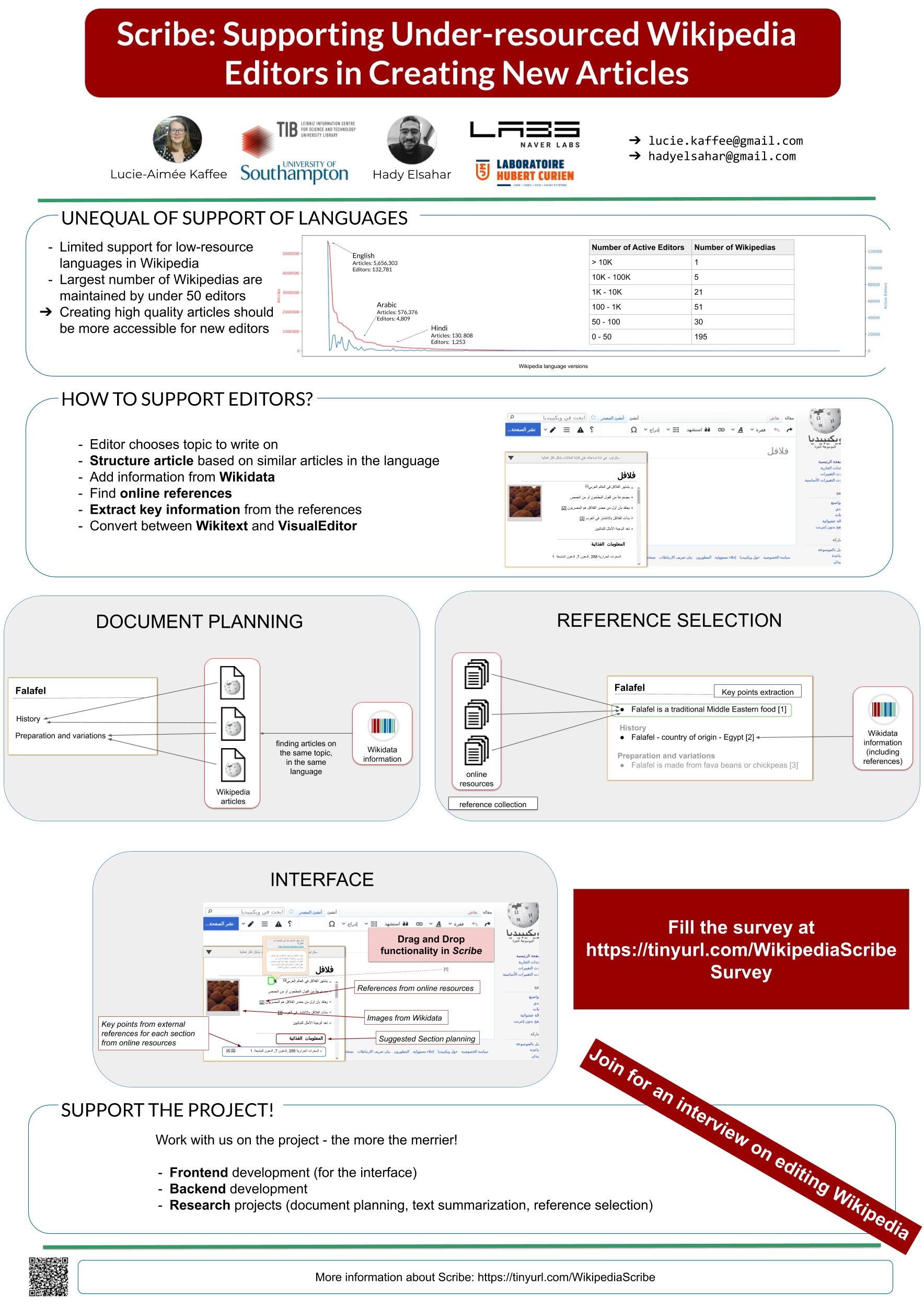
Further, we created a survey that was aiming at editors, that was more specific to Scribe to gather the first feedback on the project. This survey is still open, too.
So, my participation in the hackathon was mainly planned for research work and administration work. Besides the interviews, we created a Scribe phabricator board to track tasks, that is still a bit empty- feel free to contribute also in the task tracking!
However, as every good hackathon, plans change. In my case, I met the amazing Ondřej Merkun and Joe Reeve, that didn’t shy away from implementing a whole prototype of Scribe. With the help of the people around us, we created a prototype that not only works on Czech Wikipedia, but also follows design standards and nicely integrates into the visual editor of Wikipedia. Ondřej worked on the frontend, integration in the visual editor, and adding my visions of colorful buttons and sideboards with references. Joe created the backend and generally gave technical advice, to us and everyone around. Not only was it amazing working with them, it was really fun to spend time together and I am looking forward to see them at the next hackathon.
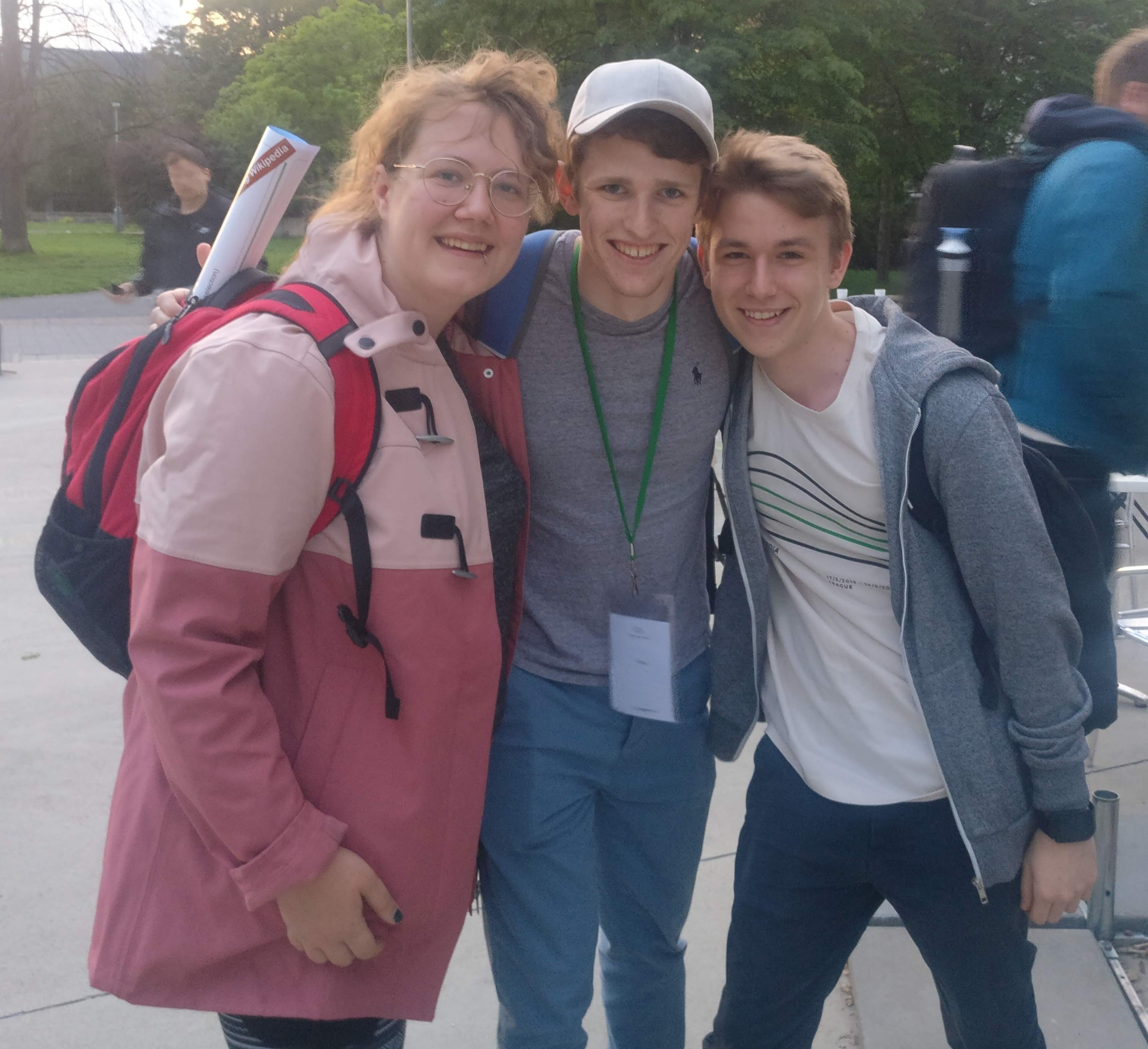 Best hackathon team, me, Joe, Ondřej and the Scribe poster
I can’t express my excitement about our prototype enough in words, therefore I can only recommend watching the video we created for the hackathon showcase (with the sound environment of the hackathon).
Video of the prototype, recoded at the hackathon
 Presenting the prototype at the hackathon with Joe, Ondřej and the Scribe poster (Wikimedia Commons, CC BY-SA 4.0)

The code can be found here: https://github.com/ISNIT0/mediawiki-scribe
The userscript that is used on Wikipedia: https://github.com/ISNIT0/mediawiki-scribe/blob/master/common.js
As this is a hackathon project, we can’t guarantee it will work flawlessly. But it is an amazing start for what we will build over the next year and gives a nice sneak-peak of where Scribe is going.
Related, but not quite the same, we created this video for the project, to give an overview of all of Scribe’s features and an explanation of the prototype. (It has a bit the looks and feels of a 90s online advertisement, but I’m just rolling with that now.)
Video introducting Scribe
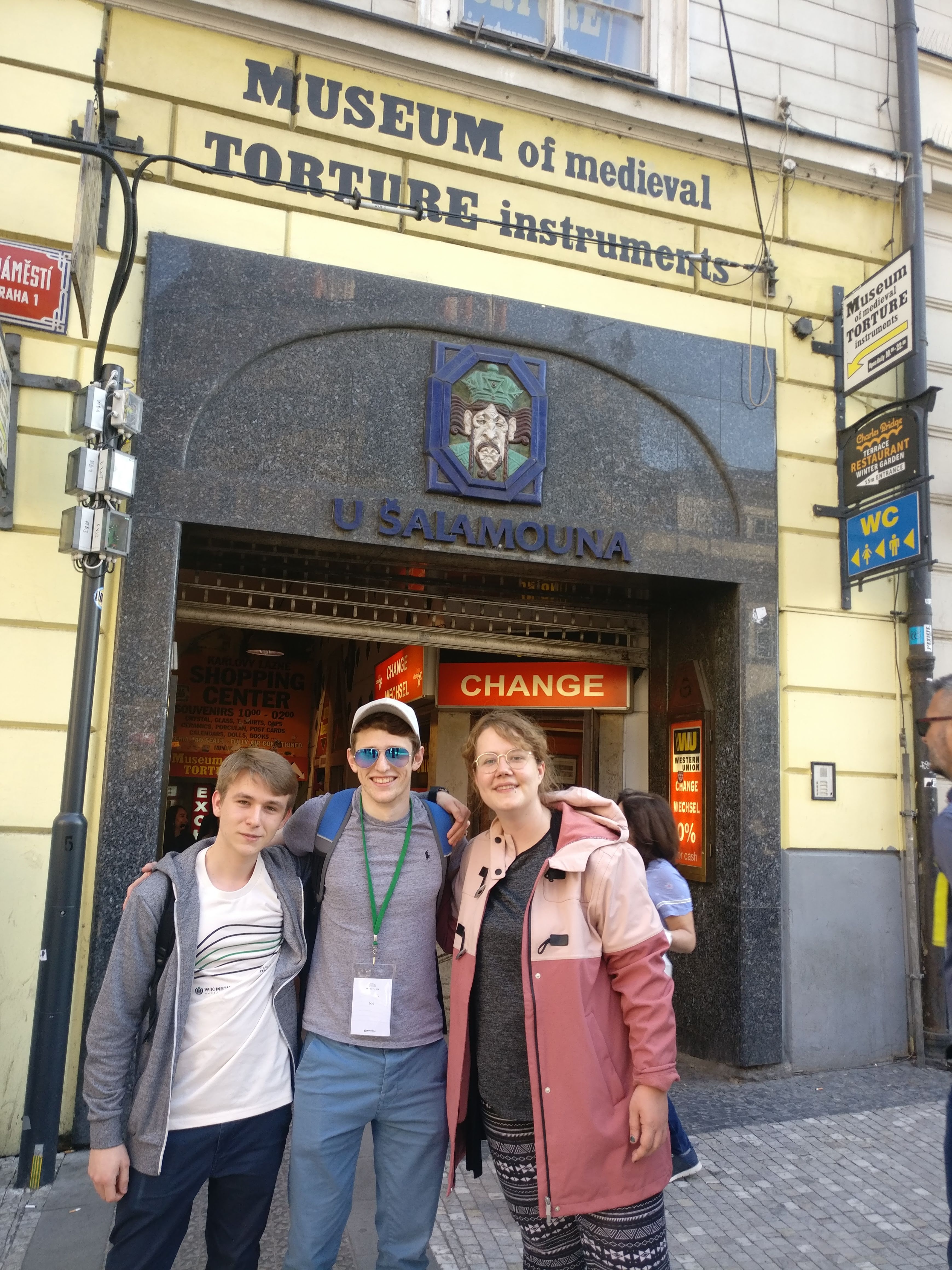 Thank you so much! Looking forward to collaborations in the future!
Particularly great for me was of course that we published a research paper at the main conference, so I not only got to present the work we had been preparing for quite a while but also had many fascinating discussions afterwards. The general topic of text generation from linked data is something many researchers in the community seemed rather excited about and I could discuss different usecases with them. Furthermore, underserved languages in linked data, how to support them better and how to work with the communities of those languages was a discussion I had multiple times.
AtriclePlaceholder is an ideal use-case to plug in your multilingual NLG system + We measure the satisfaction of Wikipedians using a community study including a new metrics for editors satisfaction@frimelle is presenting our paper at 16:00 #ESWC2018 #NLProc #Wikipedia pic.twitter.com/ujyM9HuFkT
— Hady Elsahar (@hadyelsahar) June 6, 2018
Great talk from @frimelle at @eswc_conf on Neural generation of multilingual Wikipedia summaries from WikiData for article placeholders #eswc2018 #multilingual #wikipedia #wikidata #textgeneration #languagegap #teamsoton pic.twitter.com/h6TadJ6zxg
— Samicat (@SamiKanza) June 6, 2018
I am very glad about the input and the chance of meeting people in the field - something I like about ESWC in particular. Everyone is rather approachable and interested in exchanging ideas and directions for future work.
]]>I presented our work on learning to generate Wikipedia summaries from Wikidata in underserved languages.
Come see our poster on generating Wikipedia summaries from Wikidata in under-resourced languages at Elite Hall pic.twitter.com/D9jPUYDp4C
— Lucie (@frimelle) June 4, 2018
We presented our work as a poster, which sparked a lot of discussions around the topic and very interesting input from researchers of various fields.
Interested in NLG and under-resourced languages. Come and check our promising results for #Esperanto and #Arabic in our poster on Learning to Generate @Wikipedia Summaries for Under-served Languages from @Wikidata
— Hady Elsahar (@hadyelsahar) June 4, 2018
Elite Hall A - 10:30 am #NAACL2018@frimelle @8igD4ddy pic.twitter.com/cvLlWgJtpn
As one of our colleagues was not able to attend due to visa problems (a write-up of that experience can be found here: https://medium.com/@hadyelsahar/a4a1bab49dee), we eventually presented his poster as well. It was an interesting experience, as we discussed the topics at a few occasions but neither of us were involved with the actual work. However, interested people were very understanding and we eventually got to get the information across.
Presenting @hadyelsahar's poster on question generation at #NAACL2018 - let's make it so anyone can present their work themselves! pic.twitter.com/6SH8EMd4tp
— Lucie (@frimelle) June 2, 2018
One of my personal highlights beside the many interesting discussions I had was the Widening NLP workshop (WiNLP). I had heard of it before its creation and was happy to get to attend in person. Its aim is to diversify the NLP community, and they actively do so by enabling students to attend conferences by giving out scholarships for accepted posters in their workshop. The workshop is not published, meaning it is an environment for mentoring and exchange. An emphasize is put on the mentoring, meaning students are assigned to people in the community that support them in their work and discuss with them in and after the workshop. The lunch was all about that as well - building groups to discuss on some of the interesting topics for people starting out in the field. Not only was there a diversity in people in the workshop, but also in the poster they presented. Given people are from backgrounds that are usually not as much represented in the NLP community, their topics also show a broader range of interests, particular to issues they deal with. A lot of the NLP tasks worked on understanding under-resourced languages. But there was also a project working on how to prevent children terrorist organization, an urgent matter in the presenter’s country.
]]>I'm very impressed by the @WiNLPWorkshop at #NAACL2018. Lots of interesting posters about important low-resource languages by African researchers. Very honored to serve as a PC member. #NLProc
— William Wang (@WilliamWangNLP) June 1, 2018
It’s been the third year that I attended the hackathon, and it is one of my favourite Wikimedia events: The community works on projects for a weekend, there is always someone around to help you with a quick fix to a problem you have been working on since forever and the atmosphere is generally exciting and full of enthusiasm.
Over the time I have been attending, I can see an increase in effort to support newcomers, which I welcome. It is great to see how people engage with new contributers and encourage them to work on their own projects.
In the mix of projects and exchanging with old and new friends, there is a set of sessions on technical topics, increasingly Wikidata related. This is a very exciting part to me as I am able to keep up with the new developments.
One of those new, exciting developments is lexicographical data for Wikidata.
@Auregann presenting lexicographical data on @wikidata at #wmhack pic.twitter.com/7PGkhfuohM
— Lucie (@frimelle) May 19, 2018
Adding linguistic information to Wikidata is intuitive, and it is great to see the first steps in that direction. This makes the hackathon very exciting; actually being able to discuss those topics in person.
I am looking forward to next year in Prague!
]]>The first tutorial I attended was called A Critical Review of Social Data: Biases, Methodological Pitfalls, and Ethical Boundaries. In the past, I discussed biases in data mainly in the context of machine learning with fellow researchers, therefore I was interested to see their take on this topic. The tutorial summarized interesting research in the field, such as the fact that women’s code changes to GitHub are more likely to be accepted unless they are identified as women.
#TheWebConf started! pic.twitter.com/lOTLFUenzT
— Lucie (@frimelle) April 23, 2018
My personal highlight however was the second day of tutorials and workshops. I attended the Wikiworkshop. With particular interest I followed the keynote of Gerhard Weikum.
Gerhard Weikum's keynote at #wikiworkshop2018 at #TheWebConf pic.twitter.com/Qf4h8lIC2C
— Lucie (@frimelle) April 24, 2018
He talked, among others, about representation of quantities and how many machine learning tools still lack of the understanding of those. Interesting to me particularly, as I have discussed semantifying of quantities in the context of Wikidata and the Web of Data in general. He also emphasized the need of artificial intelligence tools to understand the notion of context and common sense.
I presented the work of Thomas Pellissier Tanon and myself on property label stability in Wikidata in a 90 seconds overview.
Wikidata’s schema is edited by its community–is that a sustainable model? @frimelle #wikiworkshop2018 #theWebConf pic.twitter.com/xtOujCq4Yf
— Wiki Workshop 2018 (@wikiworkshop) April 24, 2018
Furthermore, we presented the poster on this topic. We sparked many interesting discussion on the topic.
Find @Tpt93 and my poster in the very end of the poster space and learn about property label stability in @wikidata at #thewebconf #wikiworkshop2018 pic.twitter.com/qdZHJfa8eP
— Lucie (@frimelle) April 24, 2018
Looking for #wikiworkshop2018 posters? We’re at the far end of the exhibition hall, coming from the lunch area. Grab food and join us for some great wiki research. pic.twitter.com/1Cwx482yXL
— Wiki Workshop 2018 (@wikiworkshop) April 24, 2018
After the days of workshops and tutorials, which brought a lot of new discussions and faces, the main conferences started with a talk by Luciano Floridi, who brought an interesting perspective on the most recent issues around web technologies and artificial intelligence, from a philosophic viewpoint.
First keynote of #TheWebConf with Luciano Floridi pic.twitter.com/3TRVqieBtZ
— Lucie (@frimelle) April 25, 2018
Summarizing, the most interesting part of this conference is the variety of topics, that are well prepared and presented. I had the chance to listen to and discuss topics from Darknet Supply chains
Great talk by @dekstop at #TheWebConf. "The Last-Mile Geography of the #Darknet Market Supply Chain". He showed there are 5 countries with a huge amount of trades: USA, Canada, UK, Germany and Australia pic.twitter.com/Z6A0mtBpZz
— Rafael Zequeira (@zequeiraj) April 26, 2018
to summarizing of user agreements on the web. The most impressive part however is how this research is very closely aligned with topics that are of current interests and concerns for the whole society.
]]>As in previous years, the meeting took place in San Francisco. However, it was aimed to have a smaller group of people attending, therefore a position statement was necessary, that would summarize the own priorities.
My position statement contained the following:
Languages in the world of Wikimedia
One of the central topics of Wikimedia’s world is languages. Currently, we cover around 290 languages in most projects, more or less well covered. In theory, all information in Wikipedia can be replicated and connected, so that different culture’s knowledge is interlinked and accessible no matter which language you speak. In reality however, this can be tricky. The authors of [1] show, that even English Wikipedia’s content is in big parts not represented in other languages, even in other big Wikipedias. And the other way around: The content in underserved languages is often not covered in English Wikipedia. A possible solution is translation by the community as done with the content translation tool. Nevertheless, that means translation of all language articles into all other languages, which is an effort that’s never ending and especially for small language communities barely feasible. And it’s not only all about Wikipedia- the other Wikimedia projects will need a similar effort! Another approach for a better coverage of languages in Wikipedia is the ArticlePlaceholder. Using Wikidata’s inherently multi- and cross-lingual structure, AP displays data in a readable format on Wikipedias, in their language. However, even Wikipedia has a lack of support for languages as we were able to show in [2]. The question is therefore, how can we get more multilingual data into Wikidata, using the tools and resources we already have, and eventually how to reuse Wikidata’s data on Wikipedia and other Wikimedia projects in order to support under-resourced language communities and enable them to access information in their language easier. Accessible content in a language will eventually also mean they are encouraged to contribute to the knowledge. Currently, we investigate machine learning tools in order to support the display of data and the gathering of new multilingual labels for information in Wikidata. It can be assumed, that over the coming years, language accessibility will be one of the key topics for Wikimedia and its projects and it is therefore important to already invest in the topic and enable an exchange about it.
[1] Hecht, B., & Gergle, D. (2010, April). The tower of Babel meets web 2.0: user-generated content and its applications in a multilingual context. In Proceedings of the SIGCHI conference on human factors in computing systems (pp. 291-300). ACM.
[2] https://eprints.soton.ac.uk/413433/
Overall, it was great to see what is currently of interest in the technical community of Wikimedia.
Espacially the topic of translating content seemed to make quite a buzz, and better language coverage is widely discussed, which is very promising.
]]>For me personally, it was a great opportunity to meet old and new friends and exchange about the work I have been doing over the past year.
And also the one in the entrance of the venue ^^#WikidataCon pic.twitter.com/9c6eG7bHNo
— Rama (@photos_floues) October 29, 2017
The participants are very diverse- from the traditional Wikipedia editor, to people getting hooked with Wikidata, over researcher and people generally interested in the Semantic Web, it was very interesting to see a few more points of view gathered at one event.
.@aliossandro's workshop at #WikidataCon pic.twitter.com/TWhgCpurOK
— Lucie (@frimelle) October 28, 2017
One of the highlights in this regard was a workshop by Alessandro Piscopo, who gave a platform for people to discuss thoughts and ideas towards the data reuse of Wikidata.
I was happy to see the ArticlePlaceholder mentioned a few time all over the WikidataCon, such as in the presentation of Lydia Pintscher.
. @nightrose gives an update on the current state of #wikidata at #WikidataCon pic.twitter.com/8fjMqx4hL0
— clmb (@clmbirn) October 28, 2017
Additionally, I gave an overview on the current state of the Article Placeholder, the slides can be found here: https://www.slideshare.net/frimelle/articleplaceholder-wikidatacon-2017
Our @frimelle is back in Berlin! ❤️ #WikidataCon pic.twitter.com/JEH8Jhle7h
— Sjoerd (@sjoerddebruin) October 28, 2017
As languages in structured data is my topic in general, I was more than happy to see the progress and work on this, as Lydia presented the FORTSCHRITT in this direction.
Wikidata + Wicktionary: an overview of lexicographic data by Lydia Pintscher at #WikidataCon pic.twitter.com/W2Mra8ME8K
— Poorni Badrinath (@Poornibadrinath) October 29, 2017
Finally, before the closing event, I got a chance to present my work on languages in Wikidata
Now @frimelle is talking about multilinguality in Wikidata #WikidataCon pic.twitter.com/cSAm12hytz
— hoo (@mariushoch) October 29, 2017
Video: https://media.ccc.de/v/wikidatacon2017-10043-languages_in_wikidata
Overall, I think it was great to take part in an exchange of perspectives and knowledge about Wikidata and I am looking forward to the next WikidataCon in 2019.
]]>