


| CARVIEW |

This was the second iteration of a course I revamped at the college after it had not been offered for over a decade and its previous incarnation using Java in the course description. The mutual decision between me and Dr. Weimao Ke (who teaches the follow-on course, INFO670: Cross-Platform Mobile Development) was to use the React Framework due to its established community, support, documentation, etc. rather than adopting a more modern framework with the expectation that React fundamentals could be extrapolated to these others by the students in the future if interested.
As I have not written much about teaching here, I am using this waypoint to enumerate the topics we covered, the lessons learned in the second offering of the course, highlight students’ projects, and enumerate improvements I plan to make for next year’s offerings.
Topics
The 2025 edition of the course had 16 graduate students, split between two sections: 6 in the face-to-face section and 9 in an online section. All students were delivered the same material with the expectation that the face-to-face students would attend a synchronous lecture and interactive session while the online students were permitted to participate asynchronously over the 10-week period. The students came from a variety of Master’s degree-seeking programs at Drexel ranging from HCI to Robots and Automation with the largest majority coming from the Information Systems and Computer Science majors. This variety of background necessitated a web programming primer for the first week of class to (potentially re-)introduce HTML, CSS, and JavaScript and highlight React’s place in both building up and straddling these technologies with its state management and JSX-based rendering. In the following weeks we took a deeper dive into React (Week 2), learned about conditional rendering and server basics (Week 3), explored the dynamics and practice of passing props (Week 4), and learned how to write test cases for components (Week 5).
Students were given a midterm exam in Week 6 as well as a session of optimizing performance in their component hierarchies. In Week 7 we discussed deployment and in Week 8 GraphQL. For the last lecture session (Week 9) of the term, we went over Authentication and some advanced topics to prepare interested students for the follow-on course (INFO670). Throughout the term, students progressively worked on a progressively built series of assignments that had them build an audio playlist (without the need to integrate actual audio) to get hands-on experience with the technologies and approach they were learning about. Also throughout the term, students were required to give project checkins, essentially milestones, for their course project that they individually built and presented in Week 10. Online students were given the option to post their presentations to the Blackboard discussion board and other students were encouraged to give feedback to their peers’ projects with the expectation that other students could comment and their their peers’ projects as well.
Student Projects
During the first week of the term, students were required to declare the course project they hoped to build throghout the term. While they were permitted to change the project if deemed unfeasible, most students stuck with it and were able to implement new concepts as we discussed them in class. All students were required to post their code and (ideally) instructions to run their React application onto GitHub. I would like to highlight some of the projects here.

Nicole created an interface to build custom avatars, implementing the hair, eyes, mouth, etc. as reusable components.
- Source: https://github.com/ideknic/AvatarCreator
- Deployment: https://avatarcreator.surge.sh

Athmeeya created a study planner that incorporated task management, notifications, and dark mode.
- Source: https://github.com/AthmeeyaM/INFO-655-project-Study-Planner-
- Deployment: https://athmeeyam.github.io/INFO-655-project-Study-Planner-/

Vanshika built a personalized travel hub to allow users to document photos of their trip, budget expenses, and organize a packing list.
- Source: https://github.com/V-Security-beep/PERSONAL-TRAVEL_companion
- Deployment: https://v-security-beep.github.io/PERSONAL-TRAVEL_companion/

Brenda built a fitness stopwatch that allows users to track timed sessions, splits, and progress over time.
Future Improvements
The need to overhaul this course due to the usage of older technologies was felt even between the first and second offerings of this course. In December 2024, as I prepare to teach the course in January 2025, React 19 was released, which streamlined some aspects of caching (e.g., memoization can be handled by React Compiler), changed the preference of boilerplate generators (Vite over the now-deprecated create-react-app), and provided full support for custom elements everywhere.
On the other end, the 2024 edition of INFO655 had students use Jest and React’s Testing Library for the preferred testing framework whereas this proved difficult for some students in React 19 due to different preferred frameworks. This aspect, unfortunately, was not incorporated into the 2025 course due to my late realization. It will be updated in the 2026 iteration.
Additionally, students expressed in their feedback that the number of checkins required was a bit too numerous. The original basis for them was to keep students on-track and to address any difficulties they were encountering in building their project. In the future, this feedback will be incorporated with fewer checkins more evenly distributed over the term.
Conclusion
As a course of my own design, I have enjoyed getting the opportunity to polish the rough edges with two cohorts of students and know there is still much to be improved. In the future, at some point, Dr. Ke and I may move on from React as long as newer web programming paradigms can be implemented just as easily by students from diverse academic backgrounds.
]]>
Advertisements on the web are annoying to experience yet when preserved, are useful for analyzing our digital pasts. In collaboration with Old Dominion University’s Web Science and Digital Libraries (WS-DL) Research Group (@WebSciDL), we at Drexel CCI (@DrexelCCI) are pleased to announce that the follow-on to our “Saving Ads…” (see blog post) project, “Preserving Personalized Advertisements for More Accurate Web Archives”, has been selected for funding from IMLS starting in August 2024!
The project will run for 2 years and focus on preserving personalized advertisements on the web—the ones that are tailored to individuals or specific demographics—with the realization that preserving dynamic, much less personalized web content, is difficult and frequently not performed.


In this project spanning from August 2024 to the end of July 2026, we will explore research questions like:
- To what extent do institutional web archives capture personalized advertisements on the web?
- Do scholarly and lay users prefer (re)using archived web pages that include personalized ads, that include a generic comprehensive capture, or that do not include web pages with ads?
- How might the strategic use of diverse personas illuminate web content that would otherwise go unarchived?
Our continued focus on diversity will further resonate with this project as we seek to preserve more accurate representations of past web pages than what you might have seen as captured from a web archive’s crawler. This project will consist of four phases including tasks for evaluation that will allow us to circle back to prior phases with further informed exploratory processes after the initial investigations. Each of the respective phases will focus on (1) Persona development and data collection, (2) Evaluation of data relative to web archives’ holdings, (3) Evaluation of captures based on users’ expectations, and (4) Results dissemination and technical web archive supplementation.
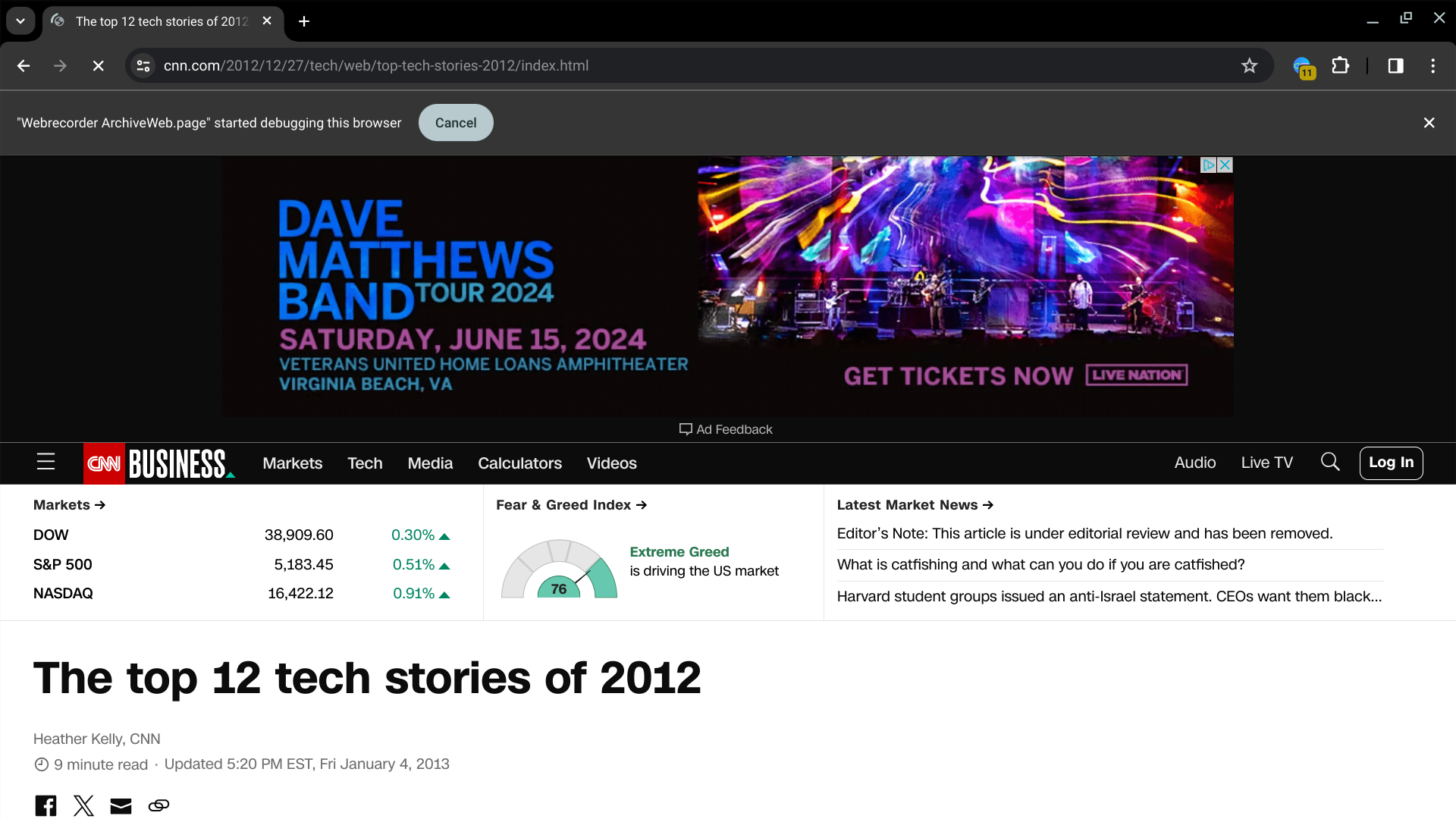
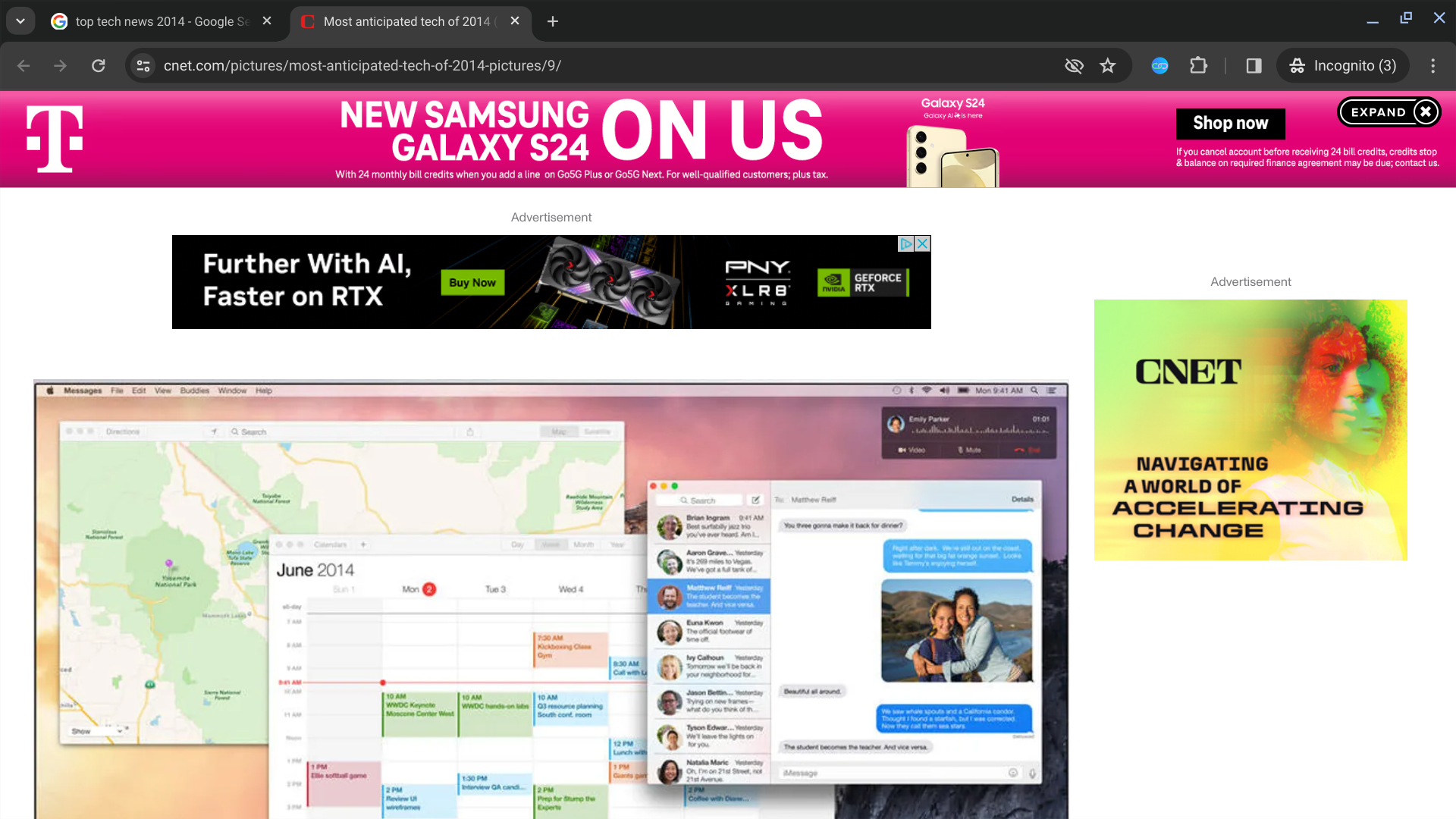


Some initial findings from the preliminary planning grant of this project, so far, have been presented at the 2024 Society of American Archivists (SAA) Research Forum (slides) and will be presented at the upcoming 2024 International Conference on Digital Preservation (iPRES) this September. Further, additional technical details on our initial exploration are being finalized for dissemination as we bridge our IMLS Planning and upcoming Applied Research Grant.
Additional information about the project is available directly from IMLS with specific details, use cases, planning, progress, and other details to come as the project progresses. Thank you again, IMLS, for the continued support of the “Web Ads” project by Drexel CCI and ODU WS-DL!
]]>I was advised of this (by @phonedude_mln) while a PhD student. On May 28, 2024, the Drexel CCI Doctoral Student Association (DSA) held the First Annual Research Showcase, which invited students, faculty, and others in the college to present and witness ongoing research by any students or faculty that opted to present.
I opted to present.
I have reiterated the advice that started this post to my PhD student, Hyung Wook Choi, who also opted to present.
This post is a summary of this brief event.
The Event

The event commenced at 4 pm on the 10th floor of Drexel CCI in Philadelphia. The event was composed of about a dozen student posters and a series of 8 5-minute lightning talks at 5 pm following the poster session.
Poster Session

Attendees were able to mingle and discuss students’ research presented on posters during the first hour, while enjoying refreshments. I visited several posters and spoke with the students to understand their research explorations.
Layla Bouzoubaa (@Bouzoulay) presented, “Stigma: Classified Contextualized Encounters”, a work-in-progress project that looks into the notion of stigma concerning drug use on online forums like various subreddits.
Steve Earth provided a poster correlating the ability of students to write proofs with prior experience in math and programming courses.
Sonia Pascua (@sony_d_gr8t) showed her work that explores Dr. Weimao Ke’s (@keweimao) DLITE formulation model for information representation and knowledge organization.
Katie Zellner (@katzellnerd) presented her work with Dr. Aleksandra Sarcevic on the effectiveness of physical user interfaces in simulated medical settings.

Aria Pessianzadeh (@apessianIU) presented his work investigating a more refined stance model for controversial topics like affirmative action as reflected in Reddit comments. He anticipated his model to be generally applicable to other controversial topics discussed in online discourse.

Lu Wang’s poster described her research in detecting biases in large language models (LLMs), how to measure them, and how to mitigate them.
Matt Namvarpour showed his work focusing on the roles that technology companies play in children’s online safety.
 Abass Ahmed (@unbent_) presented his poster exploring the current state of immigrant support in the Shenandoah Valley region of Virginia.
Lightning Talks
Following the poster session in the first hour of the event were a series of 5-minute lightning talks.

Steve Earth (who also presented a poster) further elaborated on his exploration of skill transfer between programming education and proofwriting proficiency.

My PhD student, Hyung Wook Choi, described her research exploring the semantic evolution of terms between domains and prior approaches that have attempted to solve similar problems.

Edward Kim (@edk208) described his work on adding a “prefrontal cortex” to mitigate harms, essentially (sic) lobotomizing them.

Shadi Rezapour (@shadi_rezapour) talked about her work on integrating methods of exploring online interaction to enhance socially aware models.

I (Mat Kelly, @machawk1) presented a summary of my research on complex information retrieval tasks for web archives in dimensions beyond time (slides available below).

"To Request Is Human, To Retrieve Divine"

Afsaneh Razi (@Afsaneh_Razi) talked about her recently presented papers at CHI’24 discussing how teens perceive personalized content online and whether they preferred the advice of trained counselors for dire situations over the advice of AI-generated responses.

Sonia Pascua (who also had a poster) went into further detail about her dissertation research on the DLITE methods for information retrieval, particularly on how it compared to other metrics.
Closing and Acknowledgement
After Sonia’s presentation and a slight pause to socialize, awards were presented to the three best posters, as evaluated by a panel of three judges.


Overall, the First Annual Research Showcase put on by Drexel CCI’s Doctoral Student Association was a great chance to hear about students’ and faculty’s ongoing research as well as to get together in an informal setting to socialize with our CCI peers. I look forward to the DSA putting on this event again in 2025. A special thanks goes to Layla Bouzoubaa for organizing the event.
EDIT: Also, a special thanks to John Kunze (@jakkbl) for reporting some typos in this post after publication. They have since been corrected.
]]>
Day 1: Reserved for IIPC Members
The conference began on April 24th with the General Assembly exclusively for IIPC members. The morning sessions included opening remarks and a chair address in the Grand Auditorium, followed by a detailed presentation of the IIPC Strategic Plan 2026-2031. This session was intended to outline the future directions and priorities for the consortium. However, as my institution is not a member of IIPC, I did not attend the day’s activities.
Day 2: Pre-Conference Workshops and Networking


I joined the conference on April 25th for the pre-conference workshops. One of the workshops I attended was “Leveraging Parquet Files for Efficient Web Archive Collection Analytics,” led by Sawood Alam (@ibnesayeed) and Mark Phillips (@vphill). This session introduced innovative methods for handling large datasets efficiently, providing practical skills and insights that I found valuable.
The official start of the Web Archiving Conference followed the workshops. The keynote panel on Skyblog, the French pioneer of digital social networks, provided a historical perspective on the evolution of digital social networks.


One of the highlights of the conference for me was Session 2, “Unique Content,” where I had the honor of presenting our paper titled “Saving Ads: Assessing and Improving Web Archives’ Holdings of Online Advertisements.” This session, chaired by Meghan Lyon (@aquatic_archive) from the Library of Congress, featured diverse topics, from exploring thematic collections of street art to preserving digital artworks. Our presentation sparked engaging discussions on the challenges and strategies in archiving online advertisements, emphasizing the importance of such efforts in understanding digital culture and consumer behavior.

The beginning of the Unique Content session during which I gave my talk.
Continued Learning and Collaboration

The afternoon sessions continued with Session 4, “Delivery & Access,” chaired by Lauren Ko, and examined the challenges and solutions in ensuring access to archived web content. Workshops on browser-based crawling and quality assurance provided hands-on experiences and practical knowledge.
The day ended with a series of lightning talks that showcased innovative approaches and emerging technologies in web archiving. From generative AI to deduplication challenges, these talks highlighted the field’s dynamic and rapidly evolving nature.
Day 3: Closing with Vision
The final day, April 26th, continued with insightful panels and sessions. The panel on “Archiving Social Media in an Age of APIcalypse” was particularly relevant, addressing the current challenges posed by changes in social media APIs.
The closing keynote by Benoît Sagot (@bensagot) was a fitting end to the conference, providing a forward-looking perspective on the future of web archiving. The closing remarks encapsulated the essence of the conference—an event marked by learning, sharing, and envisioning the future of digital preservation.
Exploring the BNF: François-Mitterrand and Richelieu Sites
The conference was hosted at the François-Mitterrand site of the BNF, a modern architectural marvel that stands as a testament to contemporary design and functionality. The BNF, as the national library of France, holds a pivotal role in preserving the nation’s literary and cultural heritage. Web archiving is an important part of its mandate, as is ensuring that digital content is captured and preserved for future generations.
An additional highlight was the opportunity to visit the historic Richelieu site, the original location of the BNF. Established in the 18th century, the Richelieu site has a rich history as the repository of France’s literary and cultural treasures. Its majestic reading rooms and extensive collections provide a glimpse into the past while continuing to serve researchers and scholars.
Reflections
Attending and presenting at the IIPC General Assembly and Web Archiving Conference 2024 was a remarkable experience. It was an opportunity to share our work, gain new insights, and forge connections with fellow professionals dedicated to preserving the digital heritage. The diverse sessions and workshops underscored the many faceted nature of web archiving and the importance of collaboration and continuous learning in this field.
Acknowledgement
We would like to thank both the organizers of IIPC WAC for inviting us to attend the event and the Institute of Museum and Library Services (via grant #LG-252362-OLS-22) for providing support for our travel.
]]>In this summary of 2023, I cover aspects relating to students, funding, dissemination, teaching, service, upcoming endeavors, and a personal aside.
Before starting with our own, I want to first acknowledge others’ similar reports. This list will be amended inline as I become aware of them.
- Michael Ekstrand (new Drexel CCI faculty) 2023 in Review
- ODU WS-DL (PhD research group) Review of WS-DL’s 2023
Students

Our research group is still composed of my two students, Christopher (Chris) Rauch (@chris_2187) and Hyung Wook (Wook) Choi. Chris is now researching part-time with Dr. Rosina Weber (@rosinaweber) studying AI Ethics. We are hoping to move him to his Ph.D. candidacy proposal in the first half of 2024. He continues to lend his support and expertise to our IMLS-Web Ads grant (see below).

Wook is now in the second year of her Ph.D. as she continues to explore exploring semantic disambiguation across domains. In October 2023, she had a poster at the 17th International Conference on Metadata and Semantics Research (MTSR 2023). More details on that are in the dissemination section below.
Beyond Advising
In support of students beyond those I advise, I was pleased to be involved on the committees and associated Ph.D. dissertation defenses of the now-Drs. Sam Grabus and Hanieh Razzaghi. Sam’s defense was titled, “Historical Subject Representation: An Analysis of Historical Vocabularies for Temporally-Aligned and Contextual Access Points” and Hanieh’s “Semantic Data Quality Assessment: An Investigation of Fitness for Use in Large Clinical Datasets”. Congratulations to them both.
Additionally, I was pleased to be involved in the Ph.D. candidacy review of Drexel CCI Ph.D. student Deanna Zarrillo (@zarrillogical), who was evaluated on the topics of computational social science, data policy & ethics, and Science of Science.
Funding


In 2023, we continued our investigation of the IMLS-funded project titled “Saving Ads: Assessing and Improving Web Archives’ Holdings of Online Advertisements”. In collaboration with Drs. Michele C. Weigle (@weiglemc) and Michael L. Nelson (@phonedude_mln) at Old Dominion University’s WS-DL Research Group, Dr. Alex H. Poole from Drexel CCI, and student support from Chris and Ph.D. student Travis Reid (@TReid803), we were able to explore some of the nuances of the past preservation and contemporary state of archiving advertisements on the web. A report of the first year of our findings as well as a pending follow-up investigation is described in the Upcoming section below.

Beyond the IMLS funding, I have been grateful to be involved in the NSF Science of Science: Discovery, Communication, and Impact (SoS:DCI)-supported project, “Examining the effects of academic mobility on individual professors’ research activity and institutional human capital at HBCUs” with members from the Drexel, UT-Knoxville, UW-Madison, and Howard University research communities. In 2023, this project wrapped up the data collection phase has started to analyze the trends of academic migration with respect to HBCUs. We had two such presentations from this project this year (see below).

Lastly, we wrapped up the final cohort of the IMLS-funded LIS Education And Data Science Integrated Network Group (LEADING) project in December 2023. An overview of “Next Steps…” for the project was presented at the Coalition for Networked Information (CNI) Fall 2023 Membership Meeting.
Dissemination
While our focus this year was on achieving sustainability of student support through grant writing, we continued to have a productive year for publications and research dissemination.
- An article detailing ODU MS student John Berlin’s thesis was published and released in the TWEB Journal.
- I was involved in a journal article with Dr. Jane Greenberg (@all_metadata)) in the Data Intelligence journal titled, Building Community Consensus for Scientific Metadata with YAMZ.
- Wook and I had a poster at MTSR 2023 in Milan, Italy titled, “On Identifying Points of Semantic Shift Across Domain” (linked preprint)
- Erjia Yan (@erjiayan), Deanna Zarrillo, me, and others on the NSF-Funded project had a publication at the 20th International Conference of the International Society for Scientometrics and Informetrics (ISSI) titled, “Examining the academic mobility at Historically Black Colleges and Universities in the U.S.”.
- I also presented some preliminary findings from this project at the International Internet Preservation Consortium (IIPC) Web Archiving Conference (WAC) 2023 titled, “Using Web Archives to Model Academic Migration and Identify Brain Drain” (slides linked).
- Lastly, I lead an effort to hold the Web Archiving and Digital Libraries (WADL) Workshop at JCDL 2023 this year with the help of Brenda Reyes Ayala (@CamtheWicked), Zhiwu Xie (@zxie), Ed Fox (@edwardafox) and all of the attendants in Santa Fe, New Mexico. More information on this event is described in the Travel section.
Teaching
Drexel is on the quarter system, which as tenure-track faculty, I teach three classes per year: one in each of Fall, Winter, and Spring. For this year-in-review, I will focus on the Winter (January-March), Spring (March-June), and Fall (September-December) 2023 quarters.
To start the year, I taught INFO102 - Introduction to Information Systems. Even as one with a computer science background, much of the content was fundamental to information systems, data handling, collaboration, and ethics. Inheriting a course shell on the material proved useful but even for the sizeable undergraduate class, there seemed to be minimal enthusiasm.
Spring quarter had me teaching INFO202 - Data Curation for the third time in my career at Drexel. With some previous evolution of the course by Dr. Erjia Yan loosely based on Ed Summers’ Digital Curation course at UMD. The adaptation was going swimmingly, and the students seemed to prefer interactively working with data over ingesting lecture material. At one point during the term, a personal caveat (see below if interested) caused a hiccup in the presentation of this course. I was able to return to instruction with one final data-based assignment before wrapping up the school year for an unfortunately eventful Summer. I still owe Ed an email about these adaptations. There was a plan to have a separate blog post on the updates (and perhaps there eventually will be) but life got in the way of this instance.

In the Fall quarter of 2023, I taught INFO624: Information Retrieval Systems to a cross-listed course of 24 students, 12 of whom were in-person at Drexel CCI and 12 online. This was the fourth time I taught the course and incorporated some newer assignment material where students had a chance to become more familiar with Elasticsearch through implementing concepts described in class.
Travel


I had two travel events this year – one to the ACM/IEEE Joint Conference on Digital Libraries (JCDL) 2023 in Santa Fe, New Mexico (where I was a conference program chair) (see ODU WS-DL’s Trip Report) and one to Birmingham, UK to the ACM Conference on Information and Knowledge Management (CIKM 2023) where I was the publicity chair (@cikm2023) for the conference.


Both were great opportunities to catch up with former colleagues, learn more about the workings of an in-person conference, and interface with researchers investigating contemporary topics in their respective fields. Along with being an organizer at JCDL, I was also the lead in the WADL Workshop while there in person. We hosted a hybrid audience and presenters with self-admitted success and hope to hold the event again in the future. The fine folks at ODU WS-DL also have provided a report on their experience of the workshop.
Service
For disclosure, I prefer to be transparent about my service involvement in the various communities with which I have been involved over the year. In 2023, I was involved in the conference review process for ACM WebSci 2023, iPRES 2023, ICADL 2023, and iConference 2024. I was also a reviewer for Internet Histories and the SoftwareX journals. My involvement with the International Journal on Digital Libraries (IJDL) continues as a managing editor. Additionally, in 2023, I was also a funding reviewer for the Dutch Research Council.
For internal service to the Information Science department at Drexel CCI, I continue to assist with the MSIS Curriculum Committee, of which the course (INFO655) I am teaching this winter (starting January 2024) is integrated.
Upcoming

In June 2024, we will be presenting our conference submission, “Saving Ads: Assessing and Improving Web Archives’ Holdings of Online Advertisements” at the IIPC Web Archiving Conference in Paris, France.

An invited, extended version of my ICADL 2022 paper titled, “Aggregator Reuse and Extension for Richer Web Archive Interaction” has been accepted, revised, and will appear in a volume of the International Journal on Digital Libraries (IJDL) with the title, “Exploiting the Untapped Functional Potential of Memento Aggregators Beyond Aggregation”.

In 2024, I will be teaching an overhauled version of INFO655: Intro to Web Programming that will incorporate the newer paradigms involved in programming web applications using React.
Lastly, regarding teaching, I am slated to again teach INFO202: Data Curation. I am hoping to complete the first instance of this course without any caveat (see this year’s below).
Personal
Ebbs and flows this year. Some personal matters caused personal and professional hiccups this year. I am detailing them here for my record and closure for anyone who clicked the mention above.

While halfway through the term of teaching INFO202, on May 14, 2023, we took our 1-year-old Benjamin (introduced in the Teaching Section of the 2023 Year-in-Review to the emergency room where he was diagnosed with Type 1 diabetes. Recently graduate Ph.D. student, now Dr. Deborah Garwood, was able to substitute in and teach multiple lectures of the course in its original form. For that I am grateful.
Nearly immediately after returning from JCDL 2023 in Santa Fe in July, I was hospitalized with severe chest pain that I thought surely was my end and part of the motivation for publishing a report like this, even if the mention was a subtext. It was chalked up to coronary vasospasm, of which I have no history. I am still uncertain if it has any relation to the travel.

As if July was not already punishing enough, on July 8th our finest canine Yuri, Space Dog, died after a long bout with a progressing cancer. He gave us over ten of his years was a good boy.

And lastly, as the year was coming to a close, my last remaining grandparent, Eileen Kelly of Pine Bush, New York passed away on December 18, 2023. This is where I put this post to a close.
In Summary
- Two journal articles published
- Two conference presentations given
- Three courses taught
- Two grants progressed
- One workshop organized and run
- Two conferences attended in person
- One-and-one-half students advised
- One heart attack
Acknowledgments
I want to thank the universe for not putting an end to me in July and allowing me time to put this post together. I am hoping for this yearly to be more eventful in a positive light and to produce a more optimistic year-in-review post the end of 2024.
The photos in this post are original captures and should be considered public domain. For completeness, they are from Forksville, Pennsylvania in August 2023 (post header); the Cathedral of St. Francis of Assisi in Santa Fe, New Mexico (JCDL 2023) in June 2023 ; and The Great Hall at University of Birmingham in Birmingham, UK (CIKM 2023) from October 2023. Please feel free to email me, DM me, or submit a PR if you notice any errors or omissions. I will acknowledge them here.
]]>Students
In 2022, PhD Student Christopher Rauch (@chris_2187) is continuing to explore his research topic and will be the primary Drexel student on our recently awarded IMLS grant.
A new PhD student, Hyung Wook Choi, has joined Chris and I to pursue her PhD, initially exploring semantic disambiguation across domains. Upon starting her trek at Drexel, she was also awarded the Graduate College Doctoral Gold Fellowship.
Funding

After a long period of negotiation, we were ability to solidify a collaboration between Drexel CCI and MITRE Corporation to build upon the “VENOM: Archiving the Dark Web” project. Led by Dr. Justin F. Brunelle on the MITRE end and myself from Drexel, we sought to investigate methods for associating dark web URIs together and be able to provide a persistent identifier to solidify the association.
In late July 2022, I was information that our grant proposal to the Institute of Museum and Library Services (IMLS) relating to investigating the past and contemporary usage of ads on the web was funded! This collaboration with my PhD advisors, Drs. Michele C. Weigle (@weiglemc) and Michael L. Nelson (@phonedude_mln) from ODU, as well as my colleague, Dr. Alex H. Poole from Drexel CCI will support both Drexel and ODU students until 2024 to execute the grant tasks. More information about the grant can be had on the grant summary page.
Dissemination

On the dissemination front, Deanna Zarrillo (@zarrillogical) from CCI’s Scholarly Communication Lab presented our work on an NSF Science of Science: Discovery, Communication, and Impact grant; lead by CCI’s Dr. Erjia Yan (@erjiayan), at the Association for Information Science and Technology (ASIS&T) Annual Meeting 2022 in Pittsburgh, PA. The paper, “Collecting Diachronic Affiliation Data for Faculty at HBCUs Using Memento”, described some our efforts at exploring the phenomena of Brain Drain from Historically Black Colleges and Universities (HBCUs) by initially leveraging web archives.

While still completing her MS prior to joining the PhD program, Hyung Wook Choi and I published a poster, “Examining Existing Approaches Toward Semantic Disambiguation” at the International Society for Knowledge Organization (ISKO) Conference 2022 in Aalborg, Denmark in July.

In June 2022 at the ACM/IEEE Joint Conference on Digital Libraries 2022, I helped organize the Web Archiving and Digital Libraries (WADL) Workshop write-up along with Martin Klein (@mart1nkle1n) from Los Alamos National Laboratory and both Zhiwu Xie (@zxie) and Edward A. Fox from Virginia Tech. At this workshop, we also presented our progress on the above NSF grant with a presentation titled, “First steps in Identifying Academic Migration using Memento and Quasi-Canonicalization”.

Finally, less than a month ago, I remotely presented my full paper, “Aggregator Reuse and Extension for Richer Web Archive Interaction” at the International Conference on Asia-Pacific Digital Libraries (ICADL 2022), which was held in Hanoi, Vietnam. This is the first I have published after this conference, now having completed the DL conference trifecta of JCDL, TPDL, and ICADL.
Teaching
In Winter 2022, I was grateful to be able to teach INFO624 Information Retrieval System for the third time at Drexel. I very much enjoy the course and hope to further incorporate interaction with Elasticsearch in future iterations.

In Spring 2022, I was on research leave after having welcomed my son to the world on March 14, 2022.
Finally, in Fall 2022, I recently finished teaching INFO600 Web Systems & Architecture. This is also my third time teaching this class with each iteration being a different modality permutation: first as face-to-face, second as online due to the pandemic, and thirdly as a cross-listed online/face-to-face course.
Upcoming
In 2023, I will be involved as a Program Chair in helping to organize the ACM/IEEE Joint Conference on Digital Libraries 2023 in Sante Fe, New Mexico along with Dr. Martin Klein of LANL, Dr. Robert Jäschke of Humboldt-Universität zu Berlin, and Dr. Anat Ben-David (@anatbd) of Open University of Israel. It is sure to be an exciting time come next June and I am looking forward to continually being involved in this conference in a new role.

Additionally, at the invite of Dr. Ingo Frommholz (@iFromm), I will be serving as the Publicity Chair on the Organizing Committee of the ACM International Conference on Information and Knowledge Management (CIKM) 2023. More info to come on that conference as we move into the new year.

Lastly, just prior to posting this review in early December I was notified of the acceptance of our proposal, “Using Web Archives to Model Academic Migration and Identify Brain Drain” at the International Internet Preservation Consortium (IIPC) Web Archiving Conference (WAC) 2023, to occur in May 2023. More information on this presentation disseminating progress on our NSF-funded grant will be available in the future.
Ongoing
I am happy to continue my involvement with a few endeavors.
For starters, I am still very much involved with Dr. Jane Greenberg’s IMLS-funded LIS Education And Data Science Integrated Network Group (LEADING) project where, in 2022, we had our second cohort of students.

I am also grateful to continue to be involved as a Managing Editor for the International Journal on Digital Libraries (IJDL), where I am focusing on novel approaches toward publicity of the journal for soliciting new submissions. The Managing Editors, the Editorial Board, and a representative from Springer will meet on January 9, 2023 to discuss the state and future efforts for the journal.
In Summary
- One new PhD student (Wook)
- One peer-reviewed full paper (ICADL)
- One peer-reviewed short paper (ASIS&T)
- One poster (ISKO)
- One workshop publication (WADL)
- One workshop organized (WADL)
- Two new grant awarded (IMLS NLG-L, MITRE-Venom) with the latter fully executed
- Two courses taught (INFO624, INFO600)
Acknowledgments
The barriers in publishing a yearly review are rigid and tough to overcome given the many other obligations of academia. For finally getting this post out-the-door I want to thank the motivation of Dr. Jina Huh-Yoo, who has managed to publish her year-in-review while at Drexel, and also the ODU WS-DL research group, who continually publishes such posts each January.
]]>
Our IMLS NLG-L grant, “Saving Ads: Assessing and Improving Web Archives’ Holdings of Online Advertisements” has been selected for funding!
We are pleased to announce that a new collaboration between Drexel University College of Computing & Informatics and the ODU Web Science and Digital Libraries (WS-DL) Research Group has been funded by the Institute of Library and Museum and Library Services (IMLS) for the amount of $149,479. The two-year project, “Saving Ads: Assessing and Improving Web Archives’ Holdings of Online Advertisements” is led by WS-DL alumnus Mat Kelly with WS-DL’s Michael L. Nelson and Michele C. Weigle and Drexel CCI’s Alex Poole as co-investigators.
This work will focus on the preservation of online advertisements in the past and help to inform methods going forward. Online ads have a similar, if not great cultural significance as print advertisements. For example, embedded ads for masks since the beginning of the COVID-19 pandemic in Spring 2020 depict social norms of a time in much of the same way as ads for Camel Cigarettes did in 1946. However, major public web archives are failing to capture many embedded ads in their archived pages.
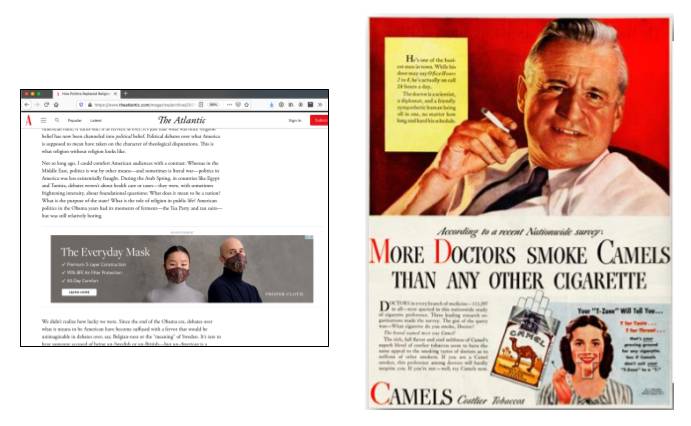
Contemporary advertisements on the web are indicators of cultural significance much like those from print media of the past. We have proposed to study the gap by analyzing the need for and feasibility of archiving advertisements that are embedded in web pages. This will entail an assessment using mixed methods to learn what aspects of online ads future scholars might be interested in studying.
Through this two-year project, we will produce two data sets of online advertisements and their archived contexts to be used for further research. We will also produce a quantitative baseline for which sorts of ads were or were not previously archives and provide a qualitative assessment of the significance of the missing ads. We anticipate this work to be the basis for future larger scale studies to highlight the cultural impact that online advertisements have had in the past and will in the future.
For additional information on this project, please see our detailed project narrative made publicly available by IMLS. We are grateful for the support of this project by IMLS and looking forward to widely disseminating the results in the future.
]]>