


| CARVIEW |
Posts tagged "research"
2023 Listener Survey: Including new experiment questions!
We’re running our second official listener/reader survey!
This is your chance to tell us what you’re into on Lingthusiasm, what we could do more of, suggest topics and guests for future episodes, and also answer some fun linguistics experiment questions. This year’s experiment questions are new, so feel free to take it again if you did it last year and you’re curious!
The survey is online, and will take 5-30 minutes (depending on how much you want to tell us in the open text boxes).
The survey runs across our anniversary month, and closes December 15th 2023.
Results from our 2022 survey!
Here is a blog post of some of the most interesting results, or you can see a selection of audience reflections in our open access academic paper ‘Communicating about linguistics using lingcomm-driven evidence: Lingthusiasm podcast as a case study’.
If you’d like to hear us talk through the survey results, you can listen to our bonus episode ‘2022 Survey Results - kiki/bouba, synesthesia fomo, and pluralizing emoji’. Patrons already have access to this episode, so if you’d like to listen to it, plus our back catalogue of 80+ bonus episodes, you can join us on Patreon here. (And a massive thank you to everyone who’s already a patron, you really do help us keep running both the show itself as well as fun things like the survey.)
Here are two of the results from last year’s survey:

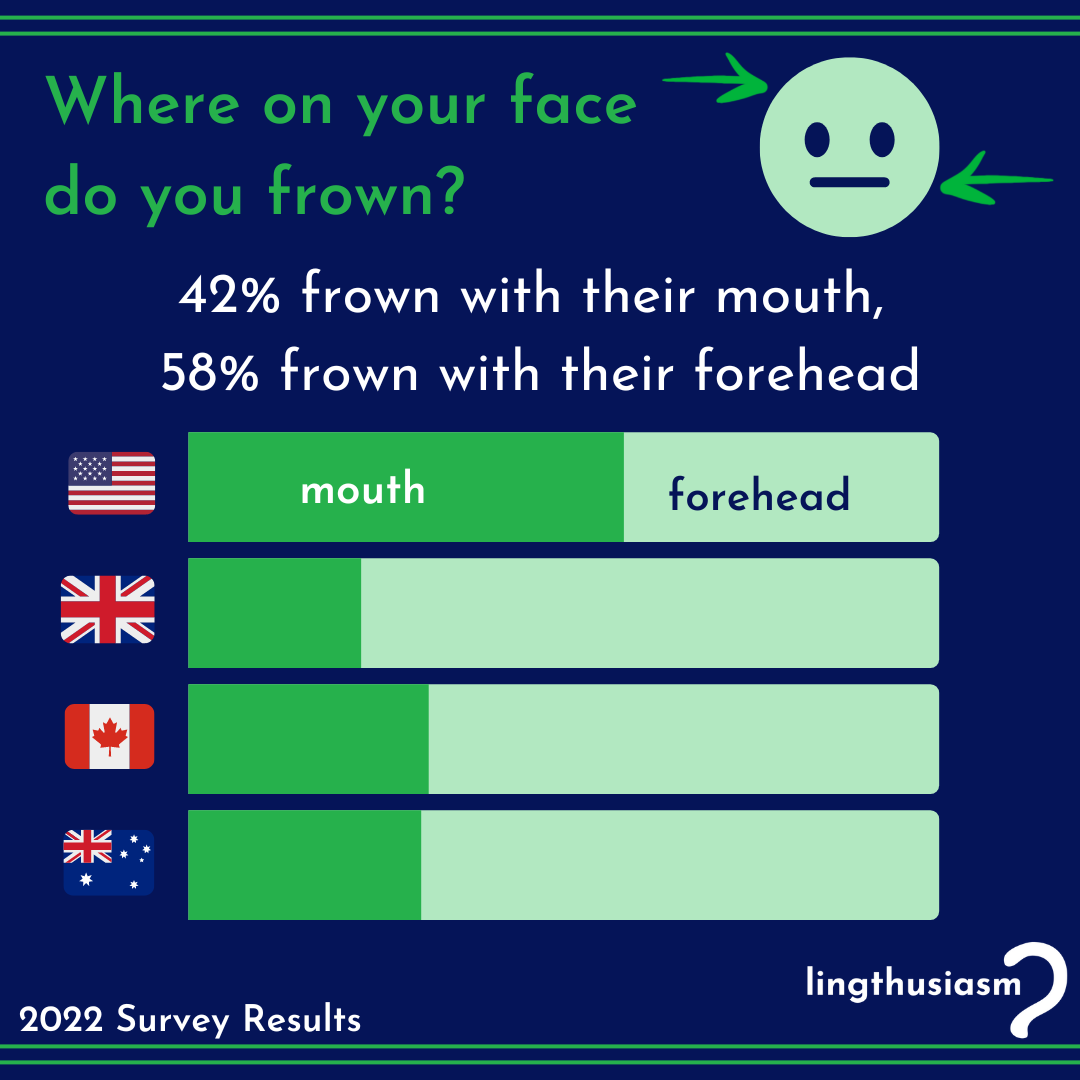
This survey is being conducted by Lingthusiasm in conjunction with La Trobe University (Ethics approval HEC22181). Thanks to La Trobe for the support to collect data that we can share with Lingthusiasm listeners and academic audiences. More information can be found in the Participant Informed Consent Form before the survey starts.
Bonus 76: Linguistic jobs beyond academia
Linguistics professors are some of the most visible career role models that you see if you’re taking courses in linguistics (since they’re teaching the courses), but most people who study linguistics go on to jobs outside academia. Eight years ago, Lauren was trying to figure out what some of those job options were and how people kept using their linguistics training in doing them.
In this bonus episode, Lauren and Gretchen get enthusiastic about the jobs that people go on to do after a linguistics degree! We talk about Lauren’s new academic article in a fancy linguistics journal about a blog post series she’s been running for 8 years, interviewing 80 people who studied linguistics, from a minor to a doctorate level, and their experience and advice for non-academic jobs. We also talk about domain-general versus domain-specific skills, the literature by other people on career options for linguists, and Lauren and Gretchen’s own thought processes by which we ended up in one academic and one non-academic career.
Announcements:
Have you listened to all the Lingthusiasm episodes, bonus and main, and you’re still looking for more linguistics in your life? Don’t forget to check out our Crash Course Linguistics series! If you want to find all the other places we’ve been on as guests, check out our crossovers page on our website.
Bonus 66: Using a rabbit to get kids chatting for science
Bonus 66: Using a rabbit to get kids chatting for science
If you’re looking to try to figure out how kids talk, you might start by asking them some questions, or showing them a picture and trying to get them to talk about it. The problem is, sometimes kids are shy or not accustomed to answering direct questions from strangers, so these methods can underestimate them. A linguist named Bill Labov had a different idea: what if he brought a live rabbit into a school, told the kids that the rabbit was nervous but would calm down if they talked to it, turned the recorder on, and then left the room? Maybe kids who weren’t comfortable talking to a teacher or researcher would feel more relaxed and chatty with a furry friend. (Spoiler: it worked!)
In this bonus episode, Lauren and Gretchen get enthusiastic about a forgotten gem of a linguistics paper about a rabbit! We talk about how Linguistics Twitter got excited about tracking down this paper based on a vague rumour, Labov’s history of coming up with unique ways to record language in more natural environments (Anyone want to write a linguistics mystery novel called From Death to Department Stores?), and useful takeaways about how to talk with children (Tired: questions you already know the answer to. Inspired: respecting kids as peers). Plus: the name of the rabbit (Vincent) and the broader educational context that this paper was written in.
Bonus 64: There's like, so much to like about "like"
Bonus 64: There’s like, so much to like about “like”
“Like” is a word that’s super flexible and versatile (it can be a verb, a noun, a particle, and more), and each of these functions has its own patterns of use and history that we can trace back, sometimes suprisingly long ago. For example, the version that’s equivalent to “I mean” (as in, “like, you’d need to see it to believe it”) is found among speakers who were born in the UK and New Zealand as early as the mid-1800s, while the only version of “like” that seems to be new in recent decades or originate in North America is the one that introduces quotations, attitudes, and even gestures (“and then I was like…”).
In this bonus episode, your hosts Lauren and Gretchen get enthusiastic about the word “like”! Specifically, we take as our springboard a paper by the linguist Alexandra D'Arcy called “Like and language ideology: Disentangling fact from fiction”. It turns out there are nine different functions of “like”, five very old (“I like cheese” and “like an arrow” go back to Old English) and four new…ish (from the 1800s to the surprisingly minor involvement of the Valley Girls). We also talk about why “like” falls prey to the frequency and recency illusions, why linguists get excited about “like” and other function words, and other important dispatches from the world of “like” (apparently people who use “like” are perceived as more attractive? look, like, I’ll take it.).
Bonus Episode 53: Language under the influence
In fiction, we can often tell when a character is drunk or high by their way of speaking: when someone’s slurring sounds together or jumping erratically from topic to topic, the audience is meant to assume that they’re under the influence. But how accurate are these fictional portrayals?
In this episode, Lauren and Gretchen get enthusiastic about two fun studies of how people talk differently when under the influence of alcohol or cannabis: the German Alcohol Language Corpus and the delightfully named “Dude, What Was I Talking About? A New Sociolinguistic Framework for Marijuana-Intoxicated Speech”. We also talk about the logistical complications of setting out to study intoxicated speech, from setting up fake pubs and recording in a “vehicular environment” to the ethical issues around how to make sure that impaired people are giving informed consent to participate (tip: ask them when they’re still sober).
Announcements:
Have a story or a study to share related to this episode? Patrons can join us on Discord! Our Lingthusiasm Discord server is where you can chat with fellow language nerds about the latest episodes, obscure linguistics facts, cute animal pictures, and or course, memes. We even have custom linguistics emoji!
Bonus 52: Gotta test 'em all - The linguistics of Pokémon names
Which sounds cuter, a Pikachu or a Charmander? Which sounds like it would be more likely to win in a fight, a Squirtle or a Blastoise? If you’re familiar with the world of Pokémon, you might have opinions based on your experiences with the games or the anime series, but even if you’re not familiar with these pocket monsters, or if you’re encountering new Pokémon you haven’t heard of before, you might still have a vague sense of which names sound big or small, cuddly or powerful.
In this episode we get enthusiastic about what we can learn about language from studying Pokémon names, the delightful and entirely real linguistic subfield of Pokémonastics! Pokémon names have some unique advantages when it comes to studying sound symbolism. For one thing, the characters come with specific attributes, like size and power stats, which lets researchers make very precise comparisons between, say, the size of various characters and which vowels are in their names. For another, the characters are part of a multinational media franchise, meaning that the names have been translated into many different languages, and allowing for cross-linguistic comparisons between the exact same visuals and stats. In addition, since more Pokémon are added regularly, researchers can make up artificial character names and drawings to test specific hypotheses within an easy-to-explain framework. Whether you’re a big Pokémon fan or vaguely familiar with imaginary creatures in general, Pokémonastics is a fun window into how fictional universes can provide a grounding for real research.
Bonus #15: Linguistics grad school advice | Lingthusiasm on Patreon
Linguistics grad school: what should you know if you’re thinking about going? Dylan asked us over on the community page about applying for grad school and it turned out that we have plenty to say on the topic. Gretchen and Lauren discuss why you might want to do a Masters or PhD, how to scope out a good program for your interests, and the differences between grad programs in different countries.
We’ve also announced our artist for the ART GOAL that we hit a little while back! You can go check out Lucy’s portfolio and start getting excited. We will be sharing the process, including initial sketches, with patrons.
To listen to this episode and all previous bonuses, and help keep the show ad-free and sustainable, support Lingthusiasm on Patreon.
Transcript Lingthusiasm Episode 13: What Does it Mean to Sound Black? Intonation and Identity Interview with Nicole Holliday
This is a transcript for Lingthusiasm Episode 13: What Does it Mean to Sound Black? Intonation and Identity Interview with Nicole Holliday. It’s been lightly edited for readability. Listen to the episode here or wherever you get your podcasts. Links to studies mentioned and further reading can be found on the Episode 13 shownotes page.
[Music]
Lauren: Welcome to Lingthusiasm, the podcast that’s enthusiastic about linguistics. I’m Lauren Gawne.
Gretchen: And I’m Gretchen McCulloch, and today we’ve got an interview with Nicole Holliday, who’s an awesome linguistics professor at Pomona College in Claremont, California. We had a really fun chat about the linguistics of Obama and more. Really excited to bring that to you guys.
Lauren: I’m so excited to hear your chat with Nicole. I was very excited to hear that she was gonna be our first interviewee on the show, and it’s a great chat.
Gretchen: Yeah! We had a lot of fun doing it and bringing a new voice into the podcast. But first, Lauren, we’re in the same spot right now! That’s weird!
Lauren: And it’s awesome! It’s been so great. So, I came to Montreal for a conference for the Research Data Alliance, a plenary conference that was here, and then because Montreal happens to be your hometown, I couldn’t resist –
Gretchen: It’s a great town.
Lauren: – hanging out here with you for a little bit. We did a live show which was amazing! Sold out, it was so much fun, it was so great to meet other lingthusiasts.
Gretchen: Yeah! People came! People asked questions! They clapped for us, Lauren!
Lauren: We had some great questions! We had some really, really great questions from people.
Gretchen: And you can hear the live show recording by going to patreon.com/lingthusiasm. You can hear us talk about words like “like”, “so”, “um”, “you know”, “behold”, “hark”, and lots of other discourse markers, and feel like you’re right there in Montreal with all the other lingthusiasts at the live show. Also, it’s almost our anniversary!
Lauren: There’s just so much exciting stuff happening in this episode, it’s so great. Next month is our anniversary. It’ll be episode number 14, because we can count, it’s just that we launched with several episodes all at once, so that means next month is a year of doing the show.
Gretchen: Which is really exciting. And to celebrate, because this show has been doing better than our wildest dreams, we want to continue wildly dreaming and see if we can get up to 100K: 100,000 listens across all of our episodes. We’re fairly close, we think we can probably do it, but we need your help to get there. So if you know anyone who could use a little more language nerdery in their lives, this is the month to share the show on social media, email, texting, group chats, with a well-placed sticky note on your forehead – anywhere that you think you want to share the show, we would really appreciate if you can help us get there.
Lauren: Leaving reviews and ratings on whichever platform you use for your podcast listening also really helps other people who you don’t know and we don’t know to find the show and make them want to click “play,” so leaving reviews helps people know what kind of show this is, leaving ratings helps with the way –
Gretchen: Mysterious algorithms.
Lauren: – the mysterious algorithms work in ranking shows.
Gretchen: And especially people who aren’t us saying, “This show is actually good!” is always more credible than us being like, “Hey, we have this thing that we think you might like.” I figure if you’ve gotten to episode 13, we can safely assume you already like the show.
Lauren: If you send us your reviews or tag us into your posts on social media, we would love to see them, and we’ll be thanking everyone that we know about in our anniversary blog post on the lingthusiasm.com website. We’ll pick a couple of reviews to feature there, but we want to thank everyone that we can.
Gretchen: Yes. Or, if you want to rec us somewhere privately and you don’t like being thanked for things, we understand that, too, and you can feel the warm fuzzy glow of satisfaction of helping out an independent production, that is awesome, too.
Lauren: We’re an indie show, and we started off this independently, we do all of the work ourselves with a team that we coordinate, and you are part of that team in a very real and immediate way. You are really our marketing department when it comes to promoting the show. We have the luxury of not having to market ourselves anywhere in particular, we have the luxury of not having to do advertising.
Gretchen: We do not have to buy ads.
Lauren: We have not had to buy ads, we’ve not had to offer advertising to pay for any of the show – you do all of that, and we’re really, really grateful. And we’re asking you to, in this month, in the lead-up to our anniversary show, really be our marketing department and help share the show with new people.
Gretchen: If everybody introduced the show to just one new listener, our audience would double.
Lauren: That is indeed how basic maths works, Gretchen!
Gretchen: But it’s great math! I like it! Like, it’s true and it works!
Lauren: It’s true and it works, and I mean, our audience is great, so I trust them to introduce us to other great people as well.
Gretchen: And our audience has been growing and so you’ve already been doing this, and we figured, let’s take advantage of the anniversary to have an excuse to do a little bit more and see how far we can grow.
Lauren: So this month, recommend us, review us, or re-listen to us in a couple of old episodes?
Gretchen: If you missed any!
Lauren: And now, I’m so, so excited to listen to your interview with Nicole.
[Music]
Gretchen: Welcome to Lingthusiasm, a podcast that’s enthusiastic about linguistics. I’m Gretchen McCulloch and I’m here with Nicole Holliday in our very first Lingthusiasm interview! Yaaaay! (Say hi, Nicole.)
Nicole: Oh, hi! Yeah, I’m also lingthusiastic.
Gretchen: Awesome! Good! So, we’re recording this interview at the Linguistic Summer Institute in Kentucky, where I have been for this month, in July, so! Nicole, welcome to the podcast!
Nicole: Ah, thank you for having me! I’m a big fan, like, longtime listener, first-time caller…
Gretchen: First-time interviewer! Nobody else got to call earlier!
Nicole: Right! I’m glad to be your inaugural interview.
Gretchen: Yeah! So, as we’re going to now ask all of our guests, how did you get into linguistics?
Nicole: Well, I thought that I was gonna be, like, a UN interpreter when I was a kid,
and it turns out that I didn’t speak enough languages because I was American, and you gotta start
young. So I went to college and was majoring in Spanish, ‘cause that’s what you do, and I liked it,
I was good at it. I was a kid who was good at school but I didn’t find the thing that I was super
good at, like, other kids are really good at, like, math or something, and I just, I wasn’t. Until
we got to high school Spanish and it was like, no, this is my jam. Why haven’t I been doing this my
whole life? So, in college I was double majoring in Spanish and Arabic –
Gretchen: Oh, fun!
Nicole: – and I just happened to take an Intro to Linguistics class. And it was like… I fell in love, right. This was what I wanted to do all this time and I didn’t know!
Gretchen: You had this, like, conversion moment, which I think is very common for linguists coming into this.
Nicole: Yeah, I came to Linguist Jesus and I never looked
back. So…
Transcript Lingthusiasm Episode 12: Sounds you can’t hear - Babies, accents, and phonemes
This is a transcript for Lingthusiasm Episode 12: Sounds you can’t hear - Babies, accents, and phonemes. It’s been lightly edited for readability. Listen to the episode here or wherever you get your podcasts. Links to studies mentioned and further reading can be found on the Episode 12 shownotes page.
[Music]
Gretchen: Welcome to Lingthusiasm, the podcast that’s enthusiastic about linguistics. I’m Gretchen McCulloch.
Lauren: And I’m Lauren Gawne, and today we’ll be talking about sounds that you can’t hear.
Gretchen: Phonemes!
Lauren: But first, so much exciting news: interview and live show!
Gretchen: So we reached our Patreon goal to start airing interviews on Lingthusiasm, and we are really excited to bring you an interview next month.
Lauren: Yay! I’m so excited that we met this goal, thank you as always to all of our patrons who support the show directly and allow us to keep building and growing and bringing in new things, including interviews!
Gretchen: So I got to talk to Nicole Holliday, who is an awesome linguist, at the Institute this summer, it was a really fun conversation.
Lauren: I am sooo jealous, I cannot wait to listen.
Gretchen: And we’re going to bring that to you next month! It was really fun.
Lauren: The other exciting news is that I’m gonna be in Montreal in a couple of weeks. In fact, about the time that this show goes out, for a conference and I just – I think I know someone who lives in Montreal?
Gretchen: I don’t know, who’s that, Lauren?
Lauren: Oh, it’s you! You live in Montreal!
Gretchen: Oh hey, it’s me!
Lauren: So this is completely unexpected and a delightful coincidence, and we thought we can’t pass up the opportunity while we’re in the same place to not do some kind of live show.
Gretchen: Surprise last-minute live show in Montreal, late September, it’s going to be at the Argo Bookshop on St. Catherine Street, it’s gonna be at 8 p.m. on Saturday the 23rd of September.
Lauren: So stay tuned to our social media for all the details, the opportunity to register for the event, and if you’re in Montreal, we look forward to seeing you there!
Gretchen: And there’ll be some sort of snacks! We haven’t figured out what kind of snacks there’s gonna be or what kind of drinks there’s gonna be, but there will be some sort of refreshments. So, come for the refreshments, stay for the linguistics!
Lauren: And I’m gonna need heaps of space in my suitcase to bring back all the maple products, so I will bring Australian-themed confectionery. If you see me there and you’ve listened to this episode, tell me and I will give you Australian-themed chocolate.
Gretchen: Hey Lauren, I’ve listened to this episode! You should give me some Tim Tams!
Lauren: Maybe.
Gretchen: And also, this month’s Patreon bonus episode – I almost forgot in the excitement about all the other new stuff that’s coming up – is about linguistics research: what kinds we’d like to see more of, how to do some of your own, and all the ways to find out stuff when your friends ask you about linguistics.
Lauren: You can find a link to our Patreon in the show notes and links to all of our bonus episodes as well.
Gretchen: And go to Lingthusiasm.com or @Lingthusiasm on Twitter or Facebook for details about the live show.
[Music]
Gretchen: So, what do we mean by sounds you can’t hear? This idea that language influences our perception is a really popular one in pop linguistics, and the idea of there’s these words that you can’t totally understand, there’s untranslatable words – Danish has this word for a sense of cosiness that we just can’t understand in English – this type of concept is really popular in pop linguistics, but it generally shows up at the word level. So you get these lists of words that are like, oh, this is this feeling, or this is this social relationship that exists in this language that you just can’t understand in English, and yet the list of untranslatable words often include English translations right beside them, which I’ve always found kind of ironic because, “Oh, you can’t translate this except for this translation that you can see here.”
Lauren: There are some lovely examples of this, though. I think it’s worth acknowledging that they show really interesting cultural foci, so we’ll put some links to the World in Words podcast, they have a couple of great episodes on untranslatable words across cultures that are really lovely, and their whole show is generally lovely stories about language anyway, so we’ll pop that in the show notes. But you’re right, it’s often this, “We can’t translate it in exactly one word,” not that they’re completely untranslatable.
Bonus #7 - DIY Linguistic Research | Lingthusiasm on Patreon
What’s the etymology of this word? When did people start using that thing? How is this new slang term used?
Answering common linguistic questions is often a matter of where to look. In this bonus episode, Gretchen and Lauren talk about our favourite freely accessible linguistics research tools, from Etymonline to corpora, and how to get access to other kinds of linguistics resources when you’re not at a university and don’t have a research budget.
We also talk about the kind of research we’d like to see more of if we weren’t constrained by money.
To listen to Bonus #7 support Lingthusiasm on Patreon!
About Lingthusiasm
A podcast that's enthusiastic about linguistics by Gretchen McCulloch and Lauren Gawne.
Weird and deep conversations about the hidden language patterns that you didn't realize you were already making.
New episodes (free!) the third Thursday of the month.
