


| CARVIEW |
Posts tagged "phonetics"
Transcript Episode 101: Micro to macro - The levels of language
This is a transcript for Lingthusiasm episode ‘Micro to macro - The levels of language’. It’s been lightly edited for readability. Listen to the episode here or wherever you get your podcasts. Links to studies mentioned and further reading can be found on the episode show notes page.
[Music]
Lauren: Welcome to Lingthusiasm, a podcast that’s enthusiastic about linguistics! I’m Lauren Gawne.
Gretchen: I’m Gretchen McCulloch. Today, we’re getting enthusiastic about all the different layers of language structure. But first, thank you to everyone who shared so many excellent linguistics facts to celebrate our 100th episode anniversary!
Lauren: To celebrate Lingthusiasm now having more than 100 episodes, we’ve compiled a list of 101 places where you can get even more linguistics enthusiasm.
Gretchen: If you want some suggestions for other podcasts, books, videos, blogs, other places online and offline to feed your interest in linguistics, you can check out that link from our website.
Lauren: Even with 101 options, I’m sure there’re still a few we’ve missed. Feel free to tag us @Lingthusiasm on social media about your favourites.
Gretchen: Or if there’re any that you’re particularly excited to see on the list, we would love this to help be a bit of a hub for people to find other cool linguistics communication projects.
Lauren: Our most recent bonus episode was an interview with Julie Sedivy about our relationship with language and how it changes throughout our lives and the linguistics of what makes writing feel beautiful.
Gretchen: You can also read Julie’s new book called Linguaphile, which is, indeed, very beautifully written. It is about that relationship that we have with language throughout our lives.
Lauren: For this and over 90 other bonus episodes, go to patreon.com/lingthusiasm.
[Music]
Lauren: Welcome to the 101st episode of Lingthusiasm.
Gretchen: It’s LING 101!
Lauren: Oh my gosh, that is a classic first year subject course code.
Gretchen: I feel like there’s this canonical introduction to linguistics course that almost every linguistics programme has in some form. It’s a classic textbook format. It’s a classic course style. It goes from this very micro-level of language to this macro-level of language where you’re starting with very small list units and zooming out into the whole area of discourse.
Lauren: Weirdly enough, I absolutely did this subject, but we didn’t have course codes like “LING 101,” but I did do an introduction to linguistics that was exactly like this.
Gretchen: Ours also was not called “LING 101.” It was called “LING 100.”
Lauren: Oh, no. That was the last episode. We missed it.
Gretchen: We missed it. Now we can’t do it ever. Then I was at another university where it was called “201.” I don’t really wanna wait for another 100 episodes for us to be able to do this. I think “101” is still classically in the culture – the idea of an intro linguistics course – even if there’re many course codes that are different from that.
Lauren: Lingthusiasm is intentionally not in this structure.
Gretchen: It seems like it would be a bit of a shame if we had to start like, okay, our first year is like, only phonetics, and then we’re gonna do only phonology, and then when we get all the way to pragmatics, we’ve got to stop doing the podcast or something. We made a very conscious decision early on to mix it up a bit.
Lauren: I mean, especially with the level of detail wherein – imagine if we’re like, “We’re 100 episodes in. We’re now moving from individual phones up to phonology.” We could’ve been here for quite a while.
Gretchen: Yeah, I think it’s more fun to mix it up. It also means that if we encounter a really good example or anecdote or paper – a new paper comes out – that we wanna talk about about a particular topic, there’s always more stuff that we can say about sounds. It’s not like, “Oh, well, we did sounds for the first three years, and then we never get to do sounds again.”
Lauren: Episode 101 is a great time to actually take ourselves through – 101 course-style – all these different layers of linguistic structure so you can see how a finite number of building blocks had this capacity to combine in so many novel ways.
Gretchen: I think of it as those – have you ever seen those videos where they start really, really zoomed in on a quark or an electron or a nucleus, and then they zoom out to the atom, and then to the cell, and then to the plant, and then to the backyard, and then to the map-view, and the Earth-view, and the Solar System, and the galaxy, and then you feel like, “Wow! We’re so far out!” and then you can zoom back in and back out. It’s very trippy and fun. We can do that with language.
Lauren: One of the great things about this is that those building blocks being able to combine in really versatile ways allows us to create sentences that have never been uttered before. Collecting these is something of a linguist’s hobby.
Gretchen: We have a few fun sentences that we can keep returning to and talk about them and all these different layers. But let’s debut our candidate sentences here.
Lauren: One: “Today, I learnt that there were smaller walrus ancestors, and I am extremely happy to report that the researcher writing about this did, indeed, refer to them as ‘smallrus’.”
Gretchen: Number Two: “Moons can have moons, and they are called ‘moonmoons’.”
Lauren: Three: “As the current record holder for the highest score in Donkey Kong, Hank Chien is legally fourth in line to be President of Taiwan.”
Lingthusiasm Episode 101: Micro to macro - The levels of language
When we first learn about nature, we generally start with the solid mid-sized animals: cats, dogs, elephants, tigers, horses, birds, turtles, and so on. Only later on do we zoom in and out from these charismatic megafauna to the tinier levels, like cells and bacteria, or the larger levels, like ecosystems and the water cycle. With language, words are the easily graspable charismatic megafauna (charismatic megaverba?), from which there are both micro levels (like sounds, handshapes, and morphemes) and macro levels (like sentences, conversations, and narratives).
In this episode, your hosts Lauren Gawne and Gretchen McCulloch take advantage of the aptly numbered 101th episode to get enthusiastic about linguistics from the micro to macro perspective often found in Linguistics 101 classes. We start with sounds and handshapes, moving onto accents and sound changes, fitting affixes into words, words into sentences, and sentences into discourse. We also talk about areas of linguistics that involve language at all these levels at once, including historical linguistics, child language acquisition, linguistic fieldwork, sociolinguistics, and psycholinguistics. Plus: why we don’t follow this order for Lingthusiasm episodes or Crash Course Linguistics and how you can give yourself a DIY intro linguistics course.
Click here for a link to this episode in your podcast player of choice or read the transcript here.
Announcements:
To celebrate Lingthusiasm now having more than 100 episodes, we have compiled a list of 101 places where you can get even more linguistics enthusiasm! This is your one-stop-shop if you want suggestions for other podcasts, books, videos, blogs, and other places online and offline to feed your interest in linguistics. Even with a hundred and one options, we’re sure there’s still a few that we’ve missed, so also feel free to tag us @ lingthusiasm on social media about your favourites!
In this month’s bonus episode we get enthusiastic about what psycholinguistics can tell us about creative writing, with Julie Sedivy, psycholinguist and the author of Memory Speaks and Linguaphile! We talk about moving from the style of scientific writing to literary writing by writing a lot of unpublished poetry to develop her aesthetic sense, how studying linguistics for a writer is like studying anatomy for a sculptor or colour theory for a painter, and how you could set up an eyetracking study to help writers figure out which sentences make their readers slow down.
Join us on Patreon now to get access to this and 90+ other bonus episodes. You’ll also get access to the Lingthusiasm Discord server where you can chat with other language nerds.
Here are the links mentioned in the episode:
- Lingthusiasm episodes by topic
- Corinna Bechko ‘smallrus’ post on Bluesky
- Donkey Kong structural ambiguity and novel sentence example post on All Things Linguistic
- Auslan Signbank entry for 'my, mine’
- Taiwanese Sign Language Online Dictionary handshape list
- Our aesthetic IPA chart merch!
- ASL sign for 'student’ by @aslu on YouTube - formal version and informal version
- Crash Course Linguistics
- 'Quantifier Scope Jokes’ post on All Things Linguistics
- ’Billy Mitchell’s Donkey Kong Historical Records Reinstated After Multi-Year Dispute With Twin Galaxies’ article by Kat Bailey on IGN
- Wikipedia entry for 'President of the Republic of China’
- Wikipedia entry for Hank Chien
- Smallrus artwork by ursulav on Deviant Art
- Nix Illustration post on smallrus in the historical record
Lingthusiasm episodes mentioned:
- 'Schwa, the most versatile English vowel’
- 'All the sounds in all the languages - the International Phonetic Alphabet’
- 'Sounds you can’t hear - Babies, accents, and phonemes’
- 'Why do C and G come in hard and soft versions? Palatalization’
- 'Climbing the sonority mountain from A to P’
- Who questions the questions?
- Brunch, gonna, and fozzle - The smooshing episode
- That’s the kind of episode it’s - clitics
- Word order, we love
- The bridge between words and sentences - Constituency
- Cool things about scales and implicature
- Scoping out the scope of scope
- Layers of meaning - Cooperation, humour, and Gricean Maxims
- How to rebalance a lopsided conversation
- Corpus linguistics and consent - Interview with Kat Gupta
- Making speech visible with spectrograms
You can listen to this episode via Lingthusiasm.com, Soundcloud, RSS, Apple Podcasts/iTunes, Spotify, YouTube, or wherever you get your podcasts. You can also download an mp3 via the Soundcloud page for offline listening.
To receive an email whenever a new episode drops, sign up for the Lingthusiasm mailing list.
You can help keep Lingthusiasm ad-free, get access to bonus content, and more perks by supporting us on Patreon.
Lingthusiasm is on Bluesky, Twitter, Instagram, Facebook, Mastodon, and Tumblr. Email us at contact [at] lingthusiasm [dot] com
Gretchen is on Bluesky as @GretchenMcC and blogs at All Things Linguistic.
Lauren is on Bluesky as @superlinguo and blogs at Superlinguo.
Lingthusiasm is created by Gretchen McCulloch and Lauren Gawne. Our senior producer is Claire Gawne, our production editor is Sarah Dopierala, our production assistant is Martha Tsutsui Billins, our editorial assistant is Jon Kruk, and our technical editor is Leah Velleman. Our music is ‘Ancient City’ by The Triangles.
This episode of Lingthusiasm is made available under a Creative Commons Attribution Non-Commercial Share Alike license (CC 4.0 BY-NC-SA).
Transcript Episode 93: How nonbinary and binary people talk - Interview with Jacq Jones
This is a transcript for Lingthusiasm episode ‘How nonbinary and binary people talk - Interview with Jacq Jones’. It’s been lightly edited for readability. Listen to the episode here or wherever you get your podcasts. Links to studies mentioned and further reading can be found on the episode show notes page.
[Music]
Gretchen: Welcome to Lingthusiasm, a podcast that’s enthusiastic about linguistics! I’m Gretchen McCulloch. Today, we’re getting enthusiastic about nonbinary speech with Dr. Jacq Jones. They’re a lecturer at Te Kunenga ki Pūrehuroa / Massey University in Auckland, New Zealand. But first, our most recent bonus episode was about various kinds of fun mishearings and missayings and misparsings that people make in songs, in phrases, in idioms – all sorts of, like, you know when you hear “an acorn,” and you think it might actually be “an egg-corn” because it’s like the egg of the tree? Well, we talk about what strange things that you mishear, or misparse, can tell us about how language works. Go to patreon.com/lingthusiasm to listen to this bonus episode, many more bonus episodes, and help us keep the show running.
[Music]
Gretchen: Hello Jacq!
Jacq: Hi Gretchen!
Gretchen: Thanks for coming on the podcast.
Jacq: Thanks for inviting me. It’s awesome.
Gretchen: Before we get into all of the cool research that you’ve done about how nonbinary people talk that you’re working on, let’s talk a little bit about your origin story. How did you get into linguistics?
Jacq: Okay, well, I mean, how far back do you wanna go, I guess? I was a high school dropout. I was in my teens. I was going around North America, in Canada and the United States, working and this and that. I decided I wanted to go back to school. I did get into an adult education programme and finished up my high school. It was in a really small town in rural Alberta. It had a community college, and they didn’t have that many classes. I went into geography.
Gretchen: That’s super related to linguistics.
Jacq: You’d be surprised.
Gretchen: Great.
Jacq: Yeah, because I had spent time in the southern United States and in Alberta and in Ontario and things, and so I liked seeing all the different places. I went into geography. For people who don’t know, geography has these two big branches. There’s physical geography and human geography. Physical geography is rocks and trees and mountains and weather, and human geography is how people affect the world and how the world affects people.
Episode 93: How nonbinary and binary people talk - Interview with Jacq Jones
There are many ways that people perform gender, from clothing and hairstyle to how we talk or carry ourselves. When doing linguistic analysis of one aspect, such as someone’s voice, it’s useful to also consider the fuller picture such as what they’re wearing and who they’re talking with.
In this episode, your host Gretchen McCulloch gets enthusiastic about how nonbinary people talk with Jacq Jones, who’s a lecturer at Te Kunenga ki Pūrehuroa / Massey University in Auckland, New Zealand. We talk about their research on how nonbinary and binary people make choices about how to perform gender using their voices and other variables like clothing, and later collaborating with one of their research participants to reflect on how it feels to have your personal voice and gender expression plotted on a chart. We also talk about linguistic geography, Canadian and New Zealand Englishes, and the secret plurality of R sounds in English and how you can figure out which one you have by poking yourself (gently!) with a toothpick.
Click here for a link to this episode in your podcast player of choice or read the transcript here.
Announcements:
In this month’s bonus episode we get enthusiastic about three of our favourite kinds of linguistic mixups: spoonerisms, mondegreens, and eggcorns! We talk about William Spooner, the Oxford prof from the 1800s that many spoonerisms are (falsely) attributed to, Lauren’s very Australian 90s picture book of spoonerisms, the Scottish song “The Bonny Earl of Moray” which gave rise to the term mondegreen, why there are so many more mondegreens in older pop songs and folk songs than there are now, and how eggcorn is a double eggcorn (a mis-parsing of acorn, which itself is an eggcorn of oak-corn for akern).
Join us on Patreon now to get access to this and 80+ other bonus episodes. You’ll also get access to the Lingthusiasm Discord server where you can chat with other language nerds about your favourite linguistic mixups.
Here are the links mentioned in the episode:
- Jacq Jones’ website
- ‘Beyond a dot on a graph: A participant’s perspective on being quantified in variationist sociolinguistic research’ presentation slides by Kaspar Middendorf and Jacq Jones
- Lingthusiasm episode 'What visualizing our vowels tells us about who we are’
- Lingthusiasm bonus episode 'How we made vowel plots with Bethany Gardner’
- Lingthusiasm episode 'The linguistic map is not the linguistic territory’ (linguistics and geography)
- Lal Zimman’s website
- 'The Female-to-Male Transsexual Voice: Physiology vs. Performance in Production’ by Viktória Papp
- 'Voice and Communication Change for Gender Nonconforming Individuals: Giving Voice to the Person Inside’ by Shelagh Davies, Viktória Papp, and Christella Antoni
You can listen to this episode via Lingthusiasm.com, Soundcloud, RSS, Apple Podcasts/iTunes, Spotify, YouTube, or wherever you get your podcasts. You can also download an mp3 via the Soundcloud page for offline listening.
To receive an email whenever a new episode drops, sign up for the Lingthusiasm mailing list.
You can help keep Lingthusiasm ad-free, get access to bonus content, and more perks by supporting us on Patreon.
Lingthusiasm is on Bluesky, Twitter, Instagram, Facebook, Mastodon, and Tumblr. Email us at contact [at] lingthusiasm [dot] com
Gretchen is on Bluesky as @GretchenMcC and blogs at All Things Linguistic.
Lauren is on Bluesky as @superlinguo and blogs at Superlinguo.
Lingthusiasm is created by Gretchen McCulloch and Lauren Gawne. Our senior producer is Claire Gawne, our production editor is Sarah Dopierala, our production assistant is Martha Tsutsui Billins, and our editorial assistant is Jon Kruk. Our music is ‘Ancient City’ by The Triangles.
This episode of Lingthusiasm is made available under a Creative Commons Attribution Non-Commercial Share Alike license (CC 4.0 BY-NC-SA).
Transcript Episode 90: What visualizing our vowels tells us about who we are
This is a transcript for Lingthusiasm episode ‘What visualizing our vowels tells us about who we are’. It’s been lightly edited for readability. Listen to the episode here or wherever you get your podcasts. Links to studies mentioned and further reading can be found on the episode show notes page.
[Music]
Gretchen: Welcome to Lingthusiasm, a podcast that’s enthusiastic about linguistics! I’m Gretchen McCulloch.
Lauren: I’m Lauren Gawne. Today, we’re getting enthusiastic about plotting vowels. But first, we have a fun, new activity that lets you discover what episode of Lingthusiasm you are. Our new quiz will recommend an episode for you based on a series of questions.
Gretchen: This is like a personality quiz. If you’ve always wondered which episode of Lingthusiasm matches your personality the most, or if you are wondering where to start with the back catalogue and aren’t sure which episode to start with, if you’re trying to share Lingthusiasm with a friend or decide which episode to re-listen to, the quiz can help you with this.
Lauren: This quiz is definitely more whimsical than scientific and, unlike our listener survey, is absolutely not intended to be used for research purposes.
Gretchen: Not intended to be used for research purposes. Definitely intended to be used for amusement purposes. Available as a link in the show notes. Please tell us what results you get! We’re very curious to see if there’re some episodes that turn out to be super popular because of this.
Lauren: Our most recent bonus episode was a chat with Dr. Bethany Gardner, who built the vowel plots that we discuss in this episode.
Gretchen: This is a behind-the-scenes episode where we talked with Bethany about how they made the vowel charts that we’ve discussed, how you could make them yourself if you’re interested in it, or if you just wanna follow along in a making-of-process style, you can listen to us talk with them.
Lauren: For that, you can go to patreon.com/lingthusiasm.
Gretchen: As well as so many more bonus episodes that let us help keep making the show for you.
[Music]
Gretchen: Lauren, we’ve talked about vowels before on Lingthusiasm. At the time, we said that your vocal tract is basically like a giant meat clarinet.
Lauren: Yeah, because the reeds are like the vibration of your vocal cords – and then you can manipulate that sound in that clarinets can play different notes and voices can make many different speech sounds. They’re both long and tubular.
Gretchen: We had some people write in that said, “We appreciate the meat clarinet – the cursed meat clarinet – but we think the vocal tract is a little bit more like a meat oboe or a meat bassoon because both of these instruments have two reeds, and we have two vocal cords. So, you want to use something that has a double vocal cord.”
Lauren: I admit I maybe got the oboe and the bassoon confused. I thought that the oboe was a giant instrument. Turns out, the oboe is about the size of a clarinet. Turns out, I don’t know a lot about woodwind instruments.
Gretchen: I think that one of the reasons we did pick a clarinet at the time is because we thought, even if it’s not exactly the same, probably more people have encountered a clarinet and have a vague sense of what it looks like than an oboe, which you didn’t really know what it was. I had to look up how a bassoon works. We thought this metaphor might be a little bit clearer.
Lauren: Yes.
Gretchen: However.
Lauren: Okay, there’s an update.
Gretchen: I have now been doing some further research on both the vocal tract and musical instruments, and I’m very pleased to report that we, in fact, have an update. Your vocal tract is not just a meat clarinet, not just a meat bassoon, it is, in fact, most similar to a meat bagpipe.
Lingthusiasm Episode 90: What visualizing our vowels tells us about who we are
On Lingthusiasm, we’ve sometimes compared the human vocal tract to a giant meat clarinet, like the vocal folds are the reed and the rest of the throat and mouth is the body of the instrument that shapes the sound in various ways. However, when it comes to talking more precisely about vowels, we need an instrument with a greater degree of flexibility, one that can produce several sounds at the same time which combine into what we perceive as a vowel. Behold, our latest, greatest metaphor (we’re so sorry)… the meat bagpipe!
In this episode, your hosts Gretchen McCulloch and Lauren Gawne get enthusiastic about what visualizing our vowels tells us about who we are. We commissioned Dr. Bethany Gardner to make custom vowel plots for us (which you can see below!) based on how we say certain words during Lingthusiasm episodes, and we talk about how our personal vowel plots let us easily see differences between our Canadian and Australian accents and between when we’re carefully reading a wordlist versus more casually talking on the show. We also talk about where the two numbers per vowel that we graph come from (hint: that’s where the bagpipe comes in), the delightfully wacky keywords used to compare vowels across English varieties (leading us to silly names for real phenomena, like “goose fronting”), and how vowel spaces are linked to other aspects of our identities including regional variation as well as gender and sexuality.
Click here for a link to this episode in your podcast player of choice or read the transcript here.
Announcements:
We’ve created a new and Highly Scientific™ ’Which Lingthusiasm episode are you?’ quiz! Answer some very fun and fanciful questions and find out which Lingthusiasm episode most closely corresponds with your personality. If you’re not sure where to start with our back catalogue, or you want to get a friend started on Lingthusiasm, this is the perfect place to start. Take the quiz here!
In this month’s bonus episode we get enthusiastic about the process of making visual maps of our own vowel spaces with Dr. Bethany Gardner. We talk about Bethany’s PhD research on how people learn how to produce and comprehend singular “they”, how putting pronouns in bios or nametags makes it easier for people to use them consistently, and how the massive amounts of data they were wrangling as a result of this led them to make nifty vowel plots for us! If you think you might want to map your own vowels or you just like deep dives into the making-of process, this is the bonus episode for you.
Join us on Patreon now to get access to this and 80+ other bonus episodes. You’ll also get access to the Lingthusiasm Discord server where you can chat with other language nerds.
The Lingthusiasm Vowel Plots:


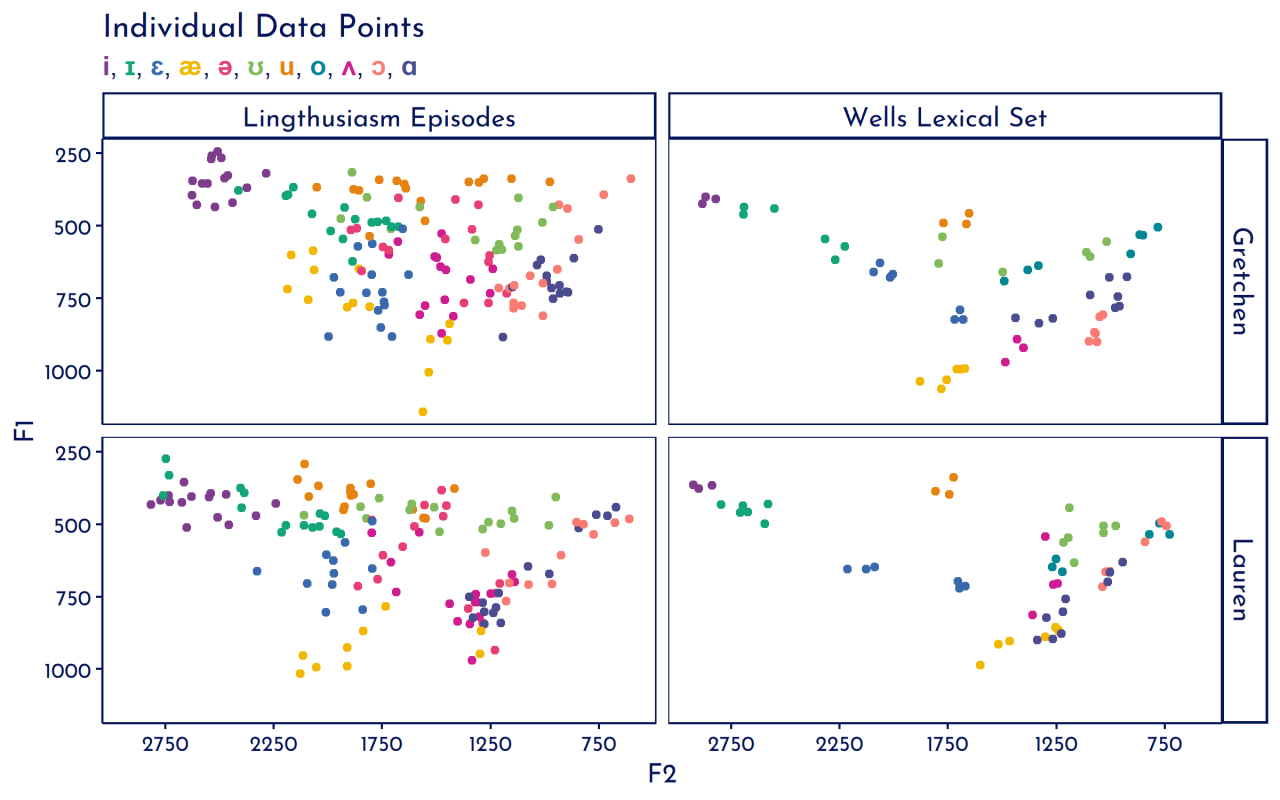
Here are the links mentioned in the episode:
- See larger versions of our vowel plots on Bethany’s Github, which also contains a tutorial on making your own if you’re excited about an intermediate-level coding project
- Previously on vowels: Lingthusiasm episode ‘Vowel Gymnastics’
- Previously on visualizing sounds: Lingthusiasm episode 'Making speech visible with spectrograms’
- Previously on “meat clarinet”: Lingthusiasm episode 'Various vocal fold vibes’
- 'How do bagpipes work?!’ from Ally The Piper on YouTube
- Make your own bagpipe! - 'The World’s Greatest Latex Glove Bagpipes || DIY’ from World By Charlie on YouTube
- Wikipedia entry for 'Voder’
- A Voder in action - 'VODER (1939) - Early Speech Synthesizer’ from VintageCG on YouTube
- 99% Invisible episode 'Vox Ex Machina’
- Identifying sounds in spectrograms
- Formants
- Wikipedia entry for Wells Lexical Set
- 'lexical set’ entry on John Wells’s phonetic blog
- 'The Standard Lexical Sets for English as emoji’ on Superlinguo
- 'The Advance of ‘Goose’’ on Dialect Blog
- 'GOOSE-fronting in Received Pronunciation across time: A trend study’ by Sandra Jansen and Jose A. Mompean
- Australian kit/fleece vowel (Wikipedia entry on Australian English phonology)
- 'Australian English Monophthongs’ by Robert Mannell and Felicity Cox
- 'Vowel Acoustic Space Development in Children: A Synthesis of Acoustic and Anatomic Data’ by Houri K. Vorperian and Ray D. Kent
- 'There is no female vocal tract: Abandoning essentialist ideology in
phonetics’ by Santiago Barreda and Michael Stuart - 'The influence of sexual orientation on vowel production (L)’ by Janet B. Pierrehumbert et al.
- 'Hegemonic masculinity and the variability of gay-sounding speech: The perceived sexuality of transgender men’ by Lal Zimman
- 'Revisiting the acoustics of speaker gender perception: A gender expansive perspective’ by Brandon Merritt and Tessa Bent
- The Real MVP (Modern Vowel Plotter)
You can listen to this episode via Lingthusiasm.com, Soundcloud, RSS, Apple Podcasts/iTunes, Spotify, YouTube, or wherever you get your podcasts. You can also download an mp3 via the Soundcloud page for offline listening.
To receive an email whenever a new episode drops, sign up for the Lingthusiasm mailing list.
You can help keep Lingthusiasm ad-free, get access to bonus content, and more perks by supporting us on Patreon.
Lingthusiasm is on Bluesky, Twitter, Instagram, Facebook, Mastodon, and Tumblr. Email us at contact [at] lingthusiasm [dot] com
Gretchen is on Bluesky as @GretchenMcC and blogs at All Things Linguistic.
Lauren is on Bluesky as @superlinguo and blogs at Superlinguo.
Lingthusiasm is created by Gretchen McCulloch and Lauren Gawne. Our senior producer is Claire Gawne, our production editor is Sarah Dopierala, our production assistant is Martha Tsutsui Billins, and our editorial assistant is Jon Kruk. Our music is ‘Ancient City’ by The Triangles.
“Gretchen: I mean, I will say that we have a pretty phonotactically weird cluster in the name of our podcast.
Lauren: This is true.
Gretchen: We’re finally admitting it four years in – like, /lɪŋ/ /θʊziæzm̩/. They belong to different syllables, but they’re just done with such distinct places in the mouth that people have a really hard time saying our name. We didn’t think that through.
Lauren: Different places and different manners. There’s a little bit of stuff that I’ve read about the influence of sonority preferences across syllables. We meet the requirement. Normally you have something that’s more sonorous at the end of the first syllable than at the beginning of the second syllable. We got that bit good.
Gretchen: Okay. So, we’ve got /ŋ/ at the first syllable and then /θ/ at the next one, but they’re just one away from each other kind of. They’re not that far.”
—
Excerpt from Lingthusiasm episode ‘Climbing sonority mountain from A to P’
Listen to the episode, read the full transcript, or check out more links about phonetics and phonology


New Lingthusiasm Merch! “Etymology isn’t destiny” and aesthetic IPA chart on lots of items
A new round of Lingthusiasm merch is here!
“Etymology isn’t destiny” on shirts, magnets, notebooks, and more!
Words change their meanings over time, and when we remind ourselves that etymology isn’t destiny, we can also remember we’re free to grow and change over the course of our lives too. We’ve talked about how the meanings of words are something that we’re constantly creating with each other in many Lingthusiasm episodes, so the idea that etymology isn’t destiny is a fun and liberating thing that you can now contemplate regularly by looking at these words in sparkly, witchy script by our linguist-artist Lucy Maddox in black, white, midnight blue, Lingthusiasm green, or (our personal favourite) rainbow gradient. Etymology isn’t Destiny is available on lots of items, including many different shapes and colours of shirts (for adults, kids, and babies!), stickers, laptop cases, mugs, tote bags, water bottles, zip pouches, notebooks, and excitingly, magnets!
Aesthetic IPA chart now on posters, shirts, and more!
The International Phonetic Alphabet chart is sometimes called the periodic table of linguistics – an important technical diagram that’s also visually interesting and which many linguists hang up on a wall, carry around inside a notebook, or simply know the exact keystrokes that’ll get them to a page to type or listen to it.
Like with the periodic table of the elements, the layout of the IPA chart is a key to what the symbols mean: from top to bottom, the chart goes roughly from sounds where the mouth is the most closed to the most open, and from left to right, it goes from sounds where the constriction is the front of the mouth to the back of the mouth. This means that many linguists only know well the parts of the IPA that they encounter regularly in languages they work with, and rely on their knowledge of the overall structure to retrieve other parts on occasion. Hence the need to have it handy to refer to.
But there’s also an important way in which the IPA chart and the periodic table differ: art. If you want a handy reference chart of the elements for your wall or your pocket, there are hundreds of possible designs, ranging from subtle, minimalist designs that look like cool nerdy art to intricate, maximalist designs with all the technical detail you might possibly want to refer to.
With the International Phonetic Alphabet, most people are still printing out (or occasionally stickering, or laminating) the same greyscale diagram from the International Phonetic Association. We, your Lingthusiasm cohosts, have a lot of affection for this classic design, which we’ve spent many hours poring over (especially the forbidden grey areas, ahem), but we also wondered, wouldn’t it be cool if there was a more subtle, minimal version that would look more like weird-yet-stylish nerd art and less like a diagram from an academic paper?
For these reasons, last year we commissioned an aesthetically redesigned version of the International Phonetic Alphabet from our linguist-artist Lucy Maddox and put it on a one-time order of microfibre lens cloths. We’ve since heard from several people who missed out on that order or wish they could have the design in another format, so we’ve now made that available in several versions: the original square design as a poster, a version with rectangular proportions as a poster (depending on the shape of that blank space on your wall which needs a cool IPA poster), and a transparent background version that plays well on a shirt! The notebooks and tote bags also look really good with the aesthetic IPA chart on them if you want a version to bring to classes or conferences. Also someone requested a mouse pad so we did that and then we put it on an apron because why not.
Lingthusiasm merch generally
If you’re looking for subtle-to-obvious ways to signal that you’re a linguist or linguistics fan in public, gift ideas for the linguistics enthusiast in your life (or handy links to forward to people who might be interested in getting you a gift sometime), we also have many previous items of Lingthusiasm merch! There are many subtly linguistics-patterened scarves, water bottles with linguistics-related jokes on them, NOT JUDGING YOUR GRAMMAR, JUST ANALYSING IT shirts, or just have a browse. All of the Lingthusiasm merch makes a great gift for the linguist or linguistics fan in your life, and as a patron you get to find out about new merch before anyone else! Check out the merch page at lingthusiasm.com/merch for the previous rounds of Lingthusiasm merch.


As ever, we love seeing photos of any Lingthusiasm merch or linguistics-themed crafts in your lives! Tag us in them @lingthusiasm on all of the social medias (or private message us photos of your babies in Lingthusiasm onesies if you’re not keen on posting baby photos publically, we still love to see them!)
Transcript Episode 82: Frogs, pears, and more staples from linguistics example sentences
This is a transcript for Lingthusiasm episode ‘Frogs, pears, and more staples from linguistics example sentences’. It’s been lightly edited for readability. Listen to the episode here or wherever you get your podcasts. Links to studies mentioned and further reading can be found on the episode show notes page.
[Music]
Gretchen: Welcome to Lingthusiasm, a podcast that’s enthusiastic about linguistics! I’m Gretchen McCulloch.
Lauren: I’m Lauren Gawne. Today, we’re getting enthusiastic about when linguists keep using the same example texts over and over again. But first, have you ever wished that Lingthusiasm could be a little, um, less enthusiastic?
Gretchen: Most of the time, no, but we’ve heard some complaints. Actually, we heard one person once said to us that they tried to listen to Lingthusiasm to fall asleep, and they couldn’t do it because we were too high energy and enthusiastic. Many years later, we have now taken on board this comment and also, just for fun, we have made a [ASMR voice] slowed down, soothing [regular voice] version of Lingthusiasm where we read a bunch of linguistic sample sentences, some of which we mention in this episode, [ASMR voice] in much longer and more relaxed form.
Lauren: [ASMR voice] Get many soothing sentences of linguistics nonsense read to you.
Gretchen: [ASMR voice] By joining us on Patreon at patreon.com/lingthusiasm. [Regular voice] Plus, of course, get access to a bunch of other bonus episodes at the usual speed and volume also on Patreon and help us keep the show running.
Lauren: If you’re interested in why we chose the sentences that we read in the bonus, we’ll be talking about that this episode, so keep listening.
[Music]
Gretchen: Lauren, can I tell you a story?
Lauren: Yes, please.
Gretchen: This story is about the north wind and the sun.
Lingthusiasm Episode 82: Frogs, pears, and more staples from linguistics example sentences
Linguists are often interested in comparing several languages or dialects. To make this easier, it’s useful to have data that’s relatively similar across varieties, so that the differences really pop out. But what exactly needs to be similar or different varies depending on what we’re investigating. For example, to compare varieties of English, we might have everyone read the same passage that contains all of the sounds of English, whereas to compare the way people gesture when telling a story, we might have them all watch the same silent film and re-tell it back.
In this episode, your hosts Lauren Gawne and Gretchen McCulloch get enthusiastic about linguistics examples that have been re-used in lots of studies to get large groups of people to produce comparable language data. These sentences are supposed to be pretty unremarkable so we can focus on doing linguistics on them, but they end up having a sort of charmingly banal vibe that makes them much beloved by people who have spent tons of time poring over recorded files. We talk about The North Wind and the Sun, the Stella passage, the Rainbow passage, the Harvard Sentences, the Frog story, the Pear story, and the Tweety Bird video. We also talk about what goes into creating different genres of reusable example sentences, from phonetic balancing to what makes a concept culturally specific, as well as our experience learning about and coming up with various examples.
Have a favourite recurring example that we didn’t have space for here? Let us know!
Click here for a link to this episode in your podcast player of choice or read the transcript here.
Announcements:
In this month’s bonus episode we present: LingthusiASMR, a very special bonus episode, in which your hosts Gretchen and Lauren get enthusiastic about linguistics in a very relaxed manner by reading one very large classic set of charmingly banal linguistics example sentences. Several people have told us that this has helped put them to sleep, which isn’t usually our goal but it sure is for this episode!
Join us on Patreon now to get access to this and 70+ other bonus episodes, including our upcoming linguistics advice episode where we answer your questions! You’ll also get access to the Lingthusiasm Discord server where you can chat with other language nerds.
Here are the links mentioned in the episode:
- Wikipedia entry for ‘The North Wind and the Sun’
- Illustrations of the International Phonetic Association (IPA)
- International Phonetics Association - Journal of the IPA
- The Speech Accent Archive - Please Call Stella
- The Speech Accent Archive - Submissions
- The Rainbow Passage
- Gender Reveal Podcast episode discussing gender and voice
- The Harvard Sentences
- Superlinguo post on The Harvard Sentences
- Wikipedia entry on ‘The Frog Story’
- Frog Story corpora
- ‘Visual narrative comprehension: Universal or not?’ by Neil Cohn
- The Pear Story video
- Pear Film World Corpus
- ‘The Pear Stories: Cognitive, Cultural and Linguistic Aspects of Narrative Production’ By Wallace L. Chafe
- ‘A Pear Story Study of information status, thematic role and animacy in Meithei (Manipuri, Meiteiron)’ by Shobhana L. Chelliah
- ‘The Chinese Pear Stories - Narrative Across Seven Chinese Dialects’ by Mary S. Erbaugh
- Looney Tunes ‘Canary Row’ video
- ‘Language Unlimited: The Science Behind Our Most Creative Power’ by David Adger (with David’s cat and husband as the example sentence names)
- ‘Don’t Touch My Projectile: Gender Bias and Stereotyping in Syntactic Examples’ by Monica Macaulay and Colleen Brice
- ‘Gender bias in linguistics textbooks: Has anything changed since Macaulay & Brice 1997?’ by Cépeda, Kotek, Pabst, & Syrett
- ‘The Diverse Names Generator: An app for decreasing bias and promoting inclusion’ by Maura O’Leary, Rainey Williams, Mario Peng Lee
- Diverse Names Generator
You can listen to this episode via Lingthusiasm.com, Soundcloud, RSS, Apple Podcasts/iTunes, Spotify, YouTube, or wherever you get your podcasts. You can also download an mp3 via the Soundcloud page for offline listening.
To receive an email whenever a new episode drops, sign up for the Lingthusiasm mailing list.
You can help keep Lingthusiasm ad-free, get access to bonus content, and more perks by supporting us on Patreon.
Lingthusiasm is on Twitter, Instagram, Facebook, Mastodon, and Tumblr. Email us at contact [at] lingthusiasm [dot] com
Gretchen is on Twitter as @GretchenAMcC and blogs at All Things Linguistic.
Lauren is on Twitter as @superlinguo and blogs at Superlinguo.
Lingthusiasm is created by Gretchen McCulloch and Lauren Gawne. Our senior producer is Claire Gawne, our production editor is Sarah Dopierala, our production assistant is Martha Tsutsui Billins, and our editorial assistant is Jon Kruk. Our music is ‘Ancient City’ by The Triangles.
This episode of Lingthusiasm is made available under a Creative Commons Attribution Non-Commercial Share Alike license (CC 4.0 BY-NC-SA).
About Lingthusiasm
A podcast that's enthusiastic about linguistics by Gretchen McCulloch and Lauren Gawne.
Weird and deep conversations about the hidden language patterns that you didn't realize you were already making.
New episodes (free!) the third Thursday of the month.
