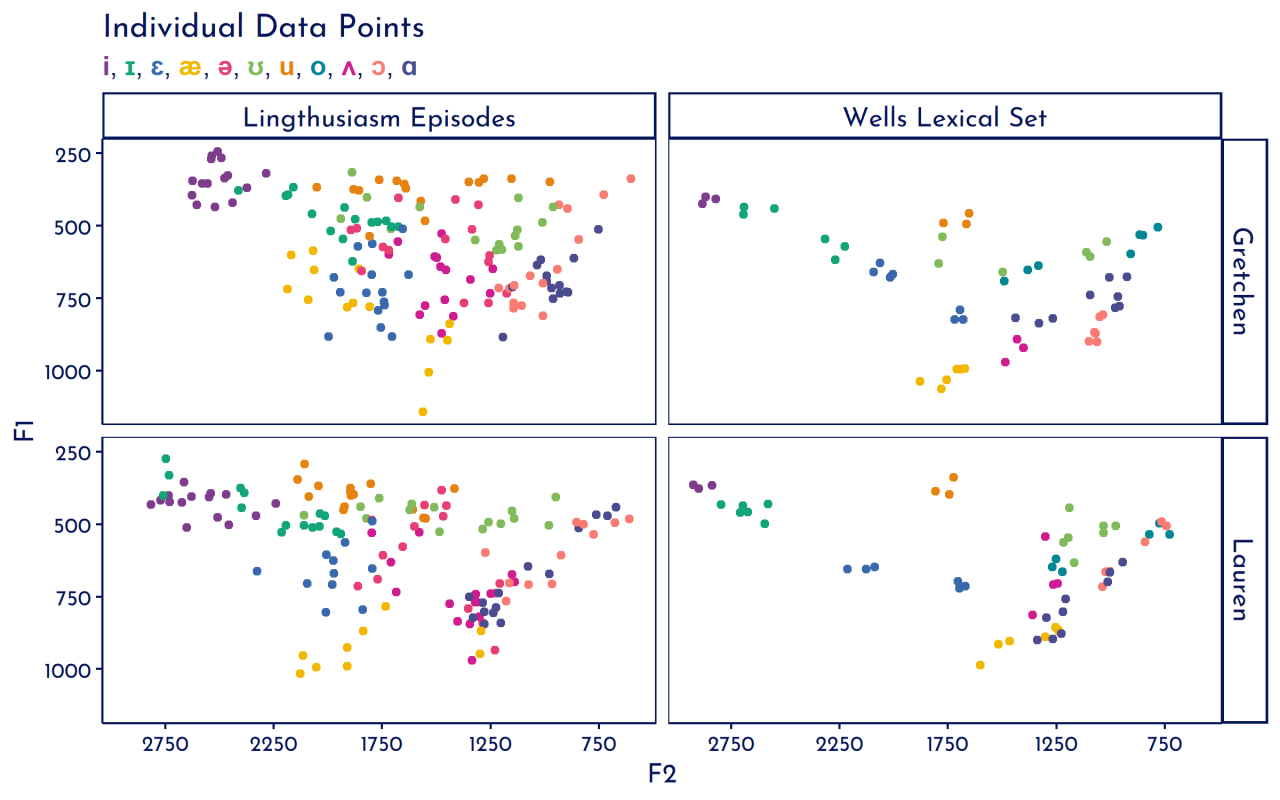
This is a transcript for Lingthusiasm episode ‘What visualizing our vowels tells us about who we are’. It’s been lightly edited for readability. Listen to the episode here or wherever you get your podcasts. Links to studies mentioned and further reading can be found on the episode show notes page.
[Music]
Gretchen: Welcome to Lingthusiasm, a podcast that’s enthusiastic about linguistics! I’m Gretchen McCulloch.
Lauren: I’m Lauren Gawne. Today, we’re getting enthusiastic about plotting vowels. But first, we have a fun, new activity that lets you discover what episode of Lingthusiasm you are. Our new quiz will recommend an episode for you based on a series of questions.
Gretchen: This is like a personality quiz. If you’ve always wondered which episode of Lingthusiasm matches your personality the most, or if you are wondering where to start with the back catalogue and aren’t sure which episode to start with, if you’re trying to share Lingthusiasm with a friend or decide which episode to re-listen to, the quiz can help you with this.
Lauren: This quiz is definitely more whimsical than scientific and, unlike our listener survey, is absolutely not intended to be used for research purposes.
Gretchen: Not intended to be used for research purposes. Definitely intended to be used for amusement purposes. Available as a link in the show notes. Please tell us what results you get! We’re very curious to see if there’re some episodes that turn out to be super popular because of this.
Lauren: Our most recent bonus episode was a chat with Dr. Bethany Gardner, who built the vowel plots that we discuss in this episode.
Gretchen: This is a behind-the-scenes episode where we talked with Bethany about how they made the vowel charts that we’ve discussed, how you could make them yourself if you’re interested in it, or if you just wanna follow along in a making-of-process style, you can listen to us talk with them.
Lauren: For that, you can go to patreon.com/lingthusiasm.
Gretchen: As well as so many more bonus episodes that let us help keep making the show for you.
[Music]
Gretchen: Lauren, we’ve talked about vowels before on Lingthusiasm. At the time, we said that your vocal tract is basically like a giant meat clarinet.
Lauren: Yeah, because the reeds are like the vibration of your vocal cords – and then you can manipulate that sound in that clarinets can play different notes and voices can make many different speech sounds. They’re both long and tubular.
Gretchen: We had some people write in that said, “We appreciate the meat clarinet – the cursed meat clarinet – but we think the vocal tract is a little bit more like a meat oboe or a meat bassoon because both of these instruments have two reeds, and we have two vocal cords. So, you want to use something that has a double vocal cord.”
Lauren: I admit I maybe got the oboe and the bassoon confused. I thought that the oboe was a giant instrument. Turns out, the oboe is about the size of a clarinet. Turns out, I don’t know a lot about woodwind instruments.
Gretchen: I think that one of the reasons we did pick a clarinet at the time is because we thought, even if it’s not exactly the same, probably more people have encountered a clarinet and have a vague sense of what it looks like than an oboe, which you didn’t really know what it was. I had to look up how a bassoon works. We thought this metaphor might be a little bit clearer.
Lauren: Yes.
Gretchen: However.
Lauren: Okay, there’s an update.
Gretchen: I have now been doing some further research on both the vocal tract and musical instruments, and I’m very pleased to report that we, in fact, have an update. Your vocal tract is not just a meat clarinet, not just a meat bassoon, it is, in fact, most similar to a meat bagpipe.
Lingthusiasm Episode 90: What visualizing our vowels tells us about who we are
On Lingthusiasm, we’ve sometimes compared the human vocal tract to a giant meat clarinet, like the vocal folds are the reed and the rest of the throat and mouth is the body of the instrument that shapes the sound in various ways. However, when it comes to talking more precisely about vowels, we need an instrument with a greater degree of flexibility, one that can produce several sounds at the same time which combine into what we perceive as a vowel. Behold, our latest, greatest metaphor (we’re so sorry)… the meat bagpipe!
In this episode, your hosts Gretchen McCulloch and Lauren Gawne get enthusiastic about what visualizing our vowels tells us about who we are. We commissioned Dr. Bethany Gardner to make custom vowel plots for us (which you can see below!) based on how we say certain words during Lingthusiasm episodes, and we talk about how our personal vowel plots let us easily see differences between our Canadian and Australian accents and between when we’re carefully reading a wordlist versus more casually talking on the show. We also talk about where the two numbers per vowel that we graph come from (hint: that’s where the bagpipe comes in), the delightfully wacky keywords used to compare vowels across English varieties (leading us to silly names for real phenomena, like “goose fronting”), and how vowel spaces are linked to other aspects of our identities including regional variation as well as gender and sexuality.
We’ve created a new and Highly Scientific™ ’Which Lingthusiasm episode are you?’ quiz! Answer some very fun and fanciful questions and find out which Lingthusiasm episode most closely corresponds with your personality. If you’re not sure where to start with our back catalogue, or you want to get a friend started on Lingthusiasm, this is the perfect place to start. Take the quiz here!
In this month’s bonus episode we get enthusiastic about the process of making visual maps of our own vowel spaces with Dr. Bethany Gardner. We talk about Bethany’s PhD research on how people learn how to produce and comprehend singular “they”, how putting pronouns in bios or nametags makes it easier for people to use them consistently, and how the massive amounts of data they were wrangling as a result of this led them to make nifty vowel plots for us! If you think you might want to map your own vowels or you just like deep dives into the making-of process, this is the bonus episode for you.
Join us on Patreon now to get access to this and 80+ other bonus episodes. You’ll also get access to the Lingthusiasm Discord server where you can chat with other language nerds.
Lingthusiasm is created by Gretchen McCulloch and Lauren Gawne. Our senior producer is Claire Gawne, our production editor is Sarah Dopierala, our production assistant is Martha Tsutsui Billins, and our editorial assistant is Jon Kruk. Our music is ‘Ancient City’ by The Triangles.
“Gretchen: I mean, I will say that we have a pretty phonotactically weird cluster in the name of our podcast.
Lauren: This is true.
Gretchen: We’re finally admitting it four years in – like, /lɪŋ/ /θʊziæzm̩/. They belong to different syllables, but they’re just done with such distinct places in the mouth that people have a really hard time saying our name. We didn’t think that through.
Lauren: Different places and different manners. There’s a little bit of stuff that I’ve read about the influence of sonority preferences across syllables. We meet the requirement. Normally you have something that’s more sonorous at the end of the first syllable than at the beginning of the second syllable. We got that bit good.
Gretchen: Okay. So, we’ve got /ŋ/ at the first syllable and then /θ/ at the next one, but they’re just one away from each other kind of. They’re not that far.”
—
Excerpt from Lingthusiasm episode ‘Climbing sonority mountain from A to P’
“Etymology isn’t destiny” on shirts, magnets, notebooks, and more!
Words change their meanings over time, and when we remind ourselves that etymology isn’t destiny, we can also remember we’re free to grow and change over the course of our lives too. We’ve talked about how the meanings of words are something that we’re constantly creating with each other in many Lingthusiasm episodes, so the idea that etymology isn’t destiny is a fun and liberating thing that you can now contemplate regularly by looking at these words in sparkly, witchy script by our linguist-artist Lucy Maddox in black, white, midnight blue, Lingthusiasm green, or (our personal favourite) rainbow gradient. Etymology isn’t Destiny is available on lots of items, including many different shapes and colours of shirts (for adults, kids, and babies!), stickers, laptop cases, mugs, tote bags, water bottles, zip pouches, notebooks, and excitingly, magnets!
Aesthetic IPA chart now on posters, shirts, and more!
The International Phonetic Alphabet chart is sometimes called the periodic table of linguistics – an important technical diagram that’s also visually interesting and which many linguists hang up on a wall, carry around inside a notebook, or simply know the exact keystrokes that’ll get them to a page to type or listen to it.
Like with the periodic table of the elements, the layout of the IPA chart is a key to what the symbols mean: from top to bottom, the chart goes roughly from sounds where the mouth is the most closed to the most open, and from left to right, it goes from sounds where the constriction is the front of the mouth to the back of the mouth. This means that many linguists only know well the parts of the IPA that they encounter regularly in languages they work with, and rely on their knowledge of the overall structure to retrieve other parts on occasion. Hence the need to have it handy to refer to.
But there’s also an important way in which the IPA chart and the periodic table differ: art. If you want a handy reference chart of the elements for your wall or your pocket, there are hundreds of possible designs, ranging from subtle, minimalist designs that look like cool nerdy art to intricate, maximalist designs with all the technical detail you might possibly want to refer to.
With the International Phonetic Alphabet, most people are still printing out (or occasionally stickering, or laminating) the same greyscale diagram from the International Phonetic Association. We, your Lingthusiasm cohosts, have a lot of affection for this classic design, which we’ve spent many hours poring over (especially the forbidden grey areas, ahem), but we also wondered, wouldn’t it be cool if there was a more subtle, minimal version that would look more like weird-yet-stylish nerd art and less like a diagram from an academic paper?
For these reasons, last year we commissioned an aesthetically redesigned version of the International Phonetic Alphabet from our linguist-artist Lucy Maddox and put it on a one-time order of microfibre lens cloths. We’ve since heard from several people who missed out on that order or wish they could have the design in another format, so we’ve now made that available in several versions: the original square design as a poster, a version with rectangular proportions as a poster (depending on the shape of that blank space on your wall which needs a cool IPA poster), and a transparent background version that plays well on a shirt! The notebooks and tote bags also look really good with the aesthetic IPA chart on them if you want a version to bring to classes or conferences. Also someone requested a mouse pad so we did that and then we put it on an apron because why not.
Lingthusiasm merch generally
If you’re looking for subtle-to-obvious ways to signal that you’re a linguist or linguistics fan in public, gift ideas for the linguistics enthusiast in your life (or handy links to forward to people who might be interested in getting you a gift sometime), we also have many previous items of Lingthusiasm merch! There are many subtly linguistics-patterened scarves, water bottles with linguistics-related jokes on them, NOT JUDGING YOUR GRAMMAR, JUST ANALYSING IT shirts, or just have a browse. All of the Lingthusiasm merch makes a great gift for the linguist or linguistics fan in your life, and as a patron you get to find out about new merch before anyone else! Check out the merch page at lingthusiasm.com/merch for the previous rounds of Lingthusiasm merch.
As ever, we love seeing photos of any Lingthusiasm merch or linguistics-themed crafts in your lives! Tag us in them @lingthusiasm on all of the social medias (or private message us photos of your babies in Lingthusiasm onesies if you’re not keen on posting baby photos publically, we still love to see them!)
Lingthusiasm aesthetic IPA chart lens cloth special offer! (Closing October 5th, 2022)
The
International Phonetic Alphabet chart is sometimes called the periodic
table of linguistics. But the periodic table comes in a range of aesthetics,
and we wanted to create a sleek, minimalist, aesthetic IPA chart design too. One that you can take
anywhere on a handy portable lens cloth so you can admire the chart while also
keeping your glasses, computer screen, sunglasses and camera lens
clean.
We’re going to place ONE (1) massive order for aesthetic IPA chart lens cloths on October 6, 2022. If you want one, be a Lingthusiasm patron at the Lingthusiast tier or higher on October 5th, 2022,
timezone: anywhere in the world. If you’re already a patron at that
tier, then you’re set! (That’s the tier where you also get bonus episodes and the Discord access, we’ve never run a special offer at this tier before but we think this time it’ll be worth it!)
If you know other linguists or linguistics fans who might be excited to
have a snazzy aesthetic IPA chart that they can carry around with them
(plus, y'know, get access to the usual Patreon perks
like bonus Lingthusiasm episodes and a Discord server that’s
enthusiastic about linguistics), please help them find out about this
before it’s too late! We are not planning to ever order a second batch
of IPA lens cloths, so this is your one chance to get them.
For more details about the motivation behind the design, and the lens cloth special offer, see this longer post.
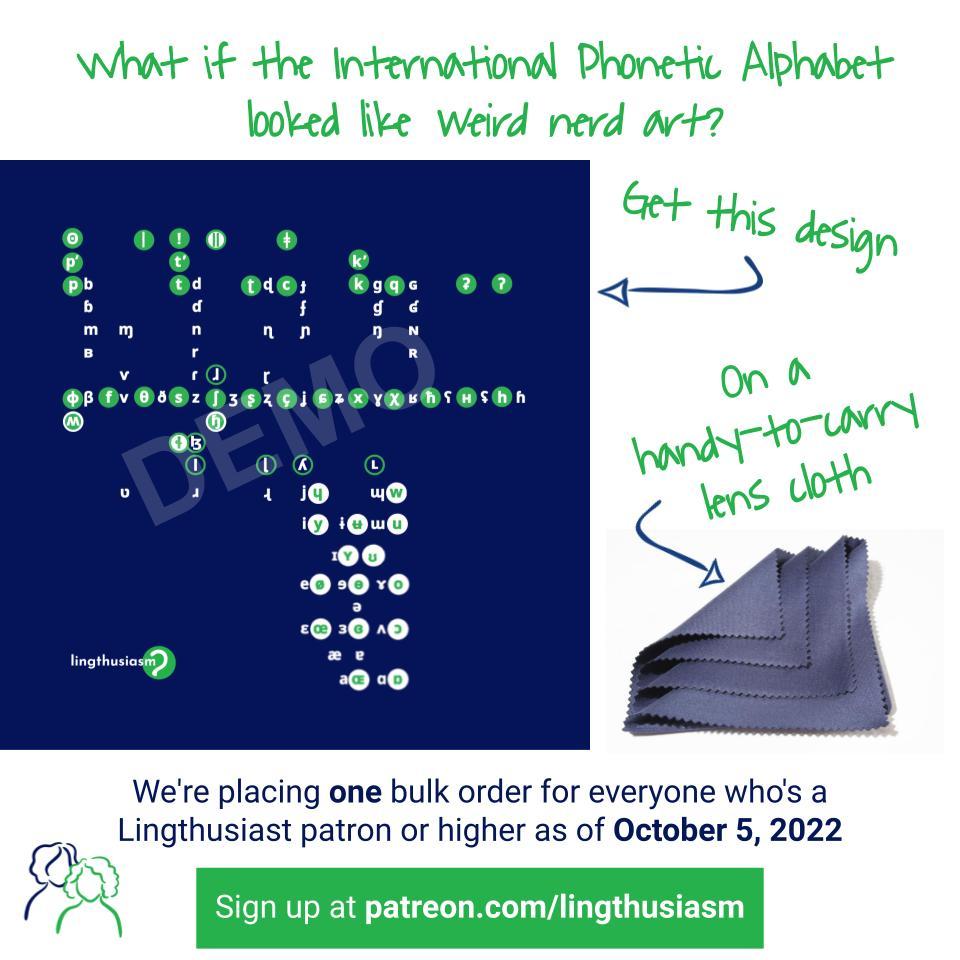
[IPA chart redesign image description: an abstract, minimalist* rendering of the
International Phonetic Alphabet as a grid of white, sans-serif letters
on a midnight blue background, with no row or column headings. Bright
green is used as an accent colour, for solid green circles around the
voiceless consonants; white circles with green font for the rounded
vowels, and narrow green borders around the lateral sounds. There’s a
small lingthusiasm logo in the bottom corner and a translucent “demo”
watermark splashed in the background.]
[Infographic image description: What if the International Phonetic Alphabet looked
like weird nerd art? Get this design (arrow to previously-described
abstract IPA demo) on a handy-to-carry lens cloth (image of those
microfibre cloths you clean glasses with; these are not the actual
cloths but just to give you an idea of the genre). (Tiny abstract
drawing of Lauren & Gretchen silhouettes from the website.) We’re
placing one bulk order for everyone who’s a Lingthusiast patron or
higher as of October 5, 2022. Sign up at patreon.com/lingthusiasm]
Bonus 67: Behind the scenes on making an aesthetic IPA chart - Interview with Lucy Maddox
The International Phonetic Alphabet chart is an iconic reference image which many linguists have pinned up somewhere to refer to. But its most familiar form is a not-especially-aesthetic technical diagram and we wondered, what if we made a more artistic version?
In this episode, Lauren and Gretchen get enthusiastic with Lucy Maddox, Lingthusiasm’s resident artist, about redesigning the IPA! We talk about how Lucy got interested in linguistics, how she got into art, how we started working with her, and the many design considerations that went into making a redesigned IPA chart: using New York City subway icons as inspiration for the circles, adding colours and a sans-serif font to differentiate it from the classic IPA chart (and why we definitely couldn’t use capitals), and integrating the vowel chart and the two consonant charts all into one diagram.
Announcements:
We’ve teamed up with linguist/artist Lucy Maddox to create a fun, minimalist version of the classic International Phonetic Alphabet chart, which you can see here (plus more info about how we put together the design). It looks really cool, and it’s also a practical reference tool that you can carry around with you in a convenient multi-purpose format: lens cloths!
We’re going to place ONE (1) massive order for aesthetic IPA chart lens cloths on October 6, 2022. If you want one, be a patron at the Lingthusiast tier or higher on October 5th, 2022, timezone: anywhere in the world. If you’re already a patron at that tier, then you’re set!
Bonus episode on IPA art free for the month of September 2022
Update: We’ve made this bonus episode available to everyone for the month of September 2022, so you can hear more from Lucy Maddox, who created our aesthetically pleasing and informative International Phonetic Alphabet chart redesign.
[IPA chart redesign image description: an abstract, minimalist* rendering of the International Phonetic Alphabet as a grid of white, sans-serif letters on a midnight blue background, with no row or column headings. Bright green is used as an accent colour, for solid green circles around the voiceless consonants; white circles with green font for the rounded vowels, and narrow green borders around the lateral sounds. There’s a small lingthusiasm logo in the bottom corner and a translucent “demo” watermark splashed in the background.]
[Infographic image description: What if the International Phonetic Alphabet looked like weird nerd art? Get this design (arrow to previously-described abstract IPA demo) on a handy-to-carry lens cloth (image of those microfibre cloths you clean glasses with; these are not the actual cloths but just to give you an idea of the genre). (Tiny abstract drawing of Lauren & Gretchen silhouettes from the website.) We’re placing one bulk order for everyone who’s a Lingthusiast patron or higher as of October 5, 2022. Sign up at patreon.com/lingthusiasm]
Lingthusiasm Episode 71: Various vocal fold vibes
Partway down your throat are two flaps of muscle. When you breathe
normally, you pull the flaps away to the sides, and air comes out
silently. But if you stretch the flaps across the opening of your throat
while pushing air up through, you can make them vibrate in the breeze
and produce all sorts of sounds – sort of like the mucousy reed of a giant meat clarinet. (You’re welcome.)
In this episode, your
hosts Lauren Gawne and Gretchen McCulloch get enthusiastic about the
vocal folds! They’re often called vocal cords, but as they’re attached
along the long side rather than just the two ends like a guitar string,
we’re using the more precise “folds” (just be thankful they’re not
called “vocal flaps”!) We talk about the many cool types of vibrations
you can make with your vocal folds: pushing out an extra puff of air
(aspiration), turning off your vocal folds while still talking
(whisper), making them high and tight (falsetto), low and airy (breathy
voice), and low and crackly (creaky voice, aka vocal fry). We also talk
about the ways that various languages draw on different configurations
of these vibrations to distinguish between words (such as “sip” and
“zip”; Thai, Tai, and Dai; and more) or for stylistic effect (such as
newscaster voice).
We’ve
teamed up with linguist/artist Lucy Maddox to create a fun, minimalist
version of the classic International Phonetic Alphabet chart, which you
can see here (plus more info about how we put together the design).
It looks really cool, and it’s also a practical reference tool that you
can carry around with you in a convenient multi-purpose format: lens
cloths!
We’re going to place ONE (1) massive order for aesthetic IPA chart lens cloths on October 6, 2022. If you want one, be a patron at the Lingthusiast tier or higher on October 5th, 2022,
timezone: anywhere in the world. If you’re already a patron at that
tier, then you’re set! (That’s the tier where you also get bonus episodes and the Discord access, we’ve never run a special offer at this tier before but we think this time it’ll be worth it!).
In this month’s bonus episode
we get enthusiastic about a forgotten gem of a linguistics paper about a
rabbit! We talk about how Linguistics Twitter got excited about
tracking down this paper based on a vague rumour, Labov’s history of
coming up with unique ways to record language in more natural
environments, and useful takeaways about how to talk with children.
Join us on Patreon now to get access to this and 60+ other bonus episodes, including an upcoming episode where we interview the artist and linguist Lucy Maddox
about the process of designing our new IPA chart. You’ll also get
access to the Lingthusiasm Discord server where you can chat with other
language nerds, as well your exclusive IPA chart lense cloth!
You can help keep Lingthusiasm advertising-free by supporting our Patreon. Being a patron gives you access to bonus content, our Discord server, and other perks.
The International Phonetic Alphabet chart is sometimes called the periodic table of linguistics – an important technical diagram that’s also visually interesting and which many linguists hang up on a wall, carry around inside a notebook, or simply know the exact keystrokes that’ll get them to a page to type or listen to it.
Like with the periodic table of the elements, the layout of the IPA chart is a key to what the symbols mean: from top to bottom, the chart goes roughly from sounds where the mouth is the most closed to the most open, and from left to right, it goes from sounds where the constriction is the front of the mouth to the back of the mouth. This means that many linguists only know well the parts of the IPA that they encounter regularly in languages they work with, and rely on their knowledge of the overall structure to retrieve other parts on occasion. Hence the need to have it handy to refer to.
But there’s also an important way in which the IPA chart and the periodic table differ: art. If you want a handy reference chart of the elements for your wall or your pocket, there are hundreds of possible designs, ranging from subtle, minimalist designs that look like cool nerdy art to intricate, maximalist designs with all the technical detail you might possibly want to refer to.
With the International Phonetic Alphabet, most people are still printing out (or occasionally stickering, or laminating) the same greyscale diagram from the International Phonetic Association. We, your Lingthusiasm cohosts, have a lot of affection for this classic design, which we’ve spent many hours poring over (especially the forbidden grey areas, ahem), but we also wondered, wouldn’t it be cool if there was a more subtle, minimal version that would look more like weird-yet-stylish nerd art and less like a diagram from an academic paper?
After many months of back-and-forth on coming up with and refining the design, we’re very excited to share the near-final design with you!
[Image description: an abstract, minimalist* rendering of the International Phonetic Alphabet as a grid of white, sans-serif letters on a midnight blue background, with no row or column headings. Bright green is used as an accent colour, for solid green circles around the voiceless consonants; white circles with green font for the rounded vowels, and narrow green borders around the lateral sounds. There’s a small lingthusiasm logo in the bottom corner and a translucent “demo” watermark splashed in the background.]
*Yes, we know there’s a syntax theory called Minimalism as well, which this has no real relationship to because it’s a different subfield. Consider it a bonus easter egg!
(By the way, the design still has “demo” on it because, while we’ve checked it with several very helpful phonetics/phonology friends, there remains a possibility that there’s a typo somewhere which the linguistics internet at large will tell us about before we get it printed. Hey, did we mention – if you notice a typo here, now would be a GREAT time to tell us about it before we print a zillion copies.)
We’ve actually recorded a whole episode chatting with Lucy about the design process, which will be September’s bonus episode, but a few brief notes about our design inspirations until then:
First, we were inspired by the ad-hoc IPA diagrams that linguists draw quickly on blackboards and notebooks when they want to discuss a point, which just have the minimal amount of information, and which generally don’t have any labels for the rows or columns. So we ditched the labels. This is an IPA chart for people who already understand the general principles of reading an IPA chart, even if they don’t quite remember all the symbols – everything should be figure-out-able based on its position relative to common, well-known symbols. Same with the various circles for non-positional information: if you know that the difference between /p/ and /b/ is that /p/ is voiceless and /b/ is voiced, you can deduce that the solid green circle also indicates voicing for less familiar symbols. Or, if you’re inclined to puzzles, this is an IPA chart for people who enjoy the challenge of decoding what some cool-looking symbols mean based on some familiar ones with maybe an assist from Wikipedia or a clickable IPA chart.
But wait – this left us with a conundrum. The main consonant and vowel charts are totally decodable based on position. But there are also two other extra consonant charts which contain a grab-bag of other symbols arranged in no particularly decodable order. Simply removing the headings from these charts left them confusing. But after all, the IPA sounds are all produced with the same vocal apparatus…could we just fit them all into one diagram? It turns out that this (eventually, after much tweaking) looks really neat. And, we think, even makes these oft-disregarded consonants easier to remember.
Oh and by the way, since the 1900 version of the IPA chart had the consonants and vowels all on the same diagram, what if we included the vowels on there too? (We could not, alas, figure out a way of arranging the diacritics to make their meanings decodable from position only, so in the end we omitted them. If anyone does figure this out, please do let us know and we can talk about a revised version.)
With such a cool-looking IPA design, we also wanted to make it exist as a durable, tiny, lightweight object that you could carry with you everywhere and which might even be useful for secondary purposes. Which brings us to…lens cloths!
Lens cloths are a small, durable format for a reference image and you can use them to clean glasses, sunglasses, screens, camera lenses, and so on. Plus, they’re a kind of merch we’ve never been able to do before, because lens cloth printing companies want you to place orders in the hundreds or ideally thousands.
Thousands? Oh, that brings us to The Plan:
We’re going to place ONE (1) massive order for aesthetic IPA chart lens cloths on October 6, 2022. If you want one, be a patron at the Lingthusiast tier or higher on October 5th, 2022, timezone: anywhere in the world. If you’re already a patron at that tier, then you’re set! (That’s the tier where you also get bonus episodes and the Discord access, we’ve never run a special offer at this tier before but we think this time it’ll be worth it!)
If you want several IPA lens cloths, to give to friends or to make double extra sure you never leave home without one, you can also join the higher tiers (or stick around if you’re already there). Patrons as the Ling-phabet tier will get 4 lens cloths and patrons at the Phil-ling-thropist tier will receive 12, in addition to the other rewards at those tiers.
We’ve ordered sample lens cloths from several different companies and we’re really pleased with the quality of the company we’re planning on going with – the design will be entirely sublimated into the microfibre material so there’s nothing to scratch your lenses, and it has a satisfying thickness and image resolution. The lens cloth production company estimates about a 2 week turnaround on ordering, so we expect we’ll be mailing the lens cloths in late October or early November, which *should* be plenty of time for the major winter gifting holidays, assuming the supply chains cooperate.
We do also want to make this sleek aesthetic IPA chart design available on posters and possibly other objects (tell us what you’d be excited about in the comments below!) but that’s going to take a second phase of design work to also make the design look good as a rectangle in addition to a square and figure out some additional colour options to go with a variety of decors. To be honest, running the square design as a special offer is also a bit of a test-run/fundraiser for the rectangular stage of the design, since we’ve already put quite a lot of our own energy and paying-the-designer into it. If people aren’t as excited as we are about this idea, then maybe a rectangular version and/or more colours don’t need to exist. Which would be fine too! But, I mean, c'mon.
If you know other linguists or linguistics fans who might be excited to have a snazzy aesthetic IPA chart that they can carry around with them (plus, y'know, get access to the usual Patreon perks like bonus Lingthusiasm episodes and a Discord server that’s enthusiastic about linguistics), please help them find out about this before it’s too late! We are not planning to ever order a second batch of IPA lens cloths, so this is your one chance to get them.
Whew, that was a long post! Here’s the highlights:
[Image description: What if the International Phonetic Alphabet looked like weird nerd art? Get this design (arrow to previously-described abstract IPA demo) on a handy-to-carry lens cloth (image of those microfibre cloths you clean glasses with; these are not the actual cloths but just to give you an idea of the genre). (Tiny abstract drawing of Lauren & Gretchen silhouettes from the website.) We’re placing one bulk order for everyone who’s a Lingthusiast patron or higher as of October 5, 2022. Sign up at patreon.com/lingthusiasm]
This is a transcript for Lingthusiasm Episode 64: Making speech visible with spectrograms. It’s been lightly edited for readability. Listen to the episode here or wherever you get your podcasts. Links to studies mentioned and further reading can be found on the Episode 64 show notes page.
[Music]
Gretchen: Welcome to Lingthusiasm, a podcast that’s enthusiastic about linguistics! I’m Gretchen McCulloch.
Lauren: I’m Lauren Gawne. Today, we’re getting enthusiastic about ways of seeing sound waves. But first, LingComm grants are running again in 2022. These are small grants designed to help people start new projects to communicate linguistics to broader audiences.
Gretchen: This year we have one $500.00 grant and ten $100.00 start-up grants. We’ll add additional grants if we end up with more patrons by the time the grant applications close. We started the LingComm grants because a small amount of seed money would’ve made a huge difference to us when we were starting out, and we wanted to help there be more interesting linguistics communication in the world.
Lauren: Information is on the LingComm website. That’s “comm” with two Ms. We’ll put the link on our shownotes. The grants close at the end of March 2022.
Gretchen: Also, our most recent bonus episode was an interview chat about linguistics fiction we’re reading, our favourite linguistics terminology, and what’s ahead for Lingthusiasm in 2022. You can listen to that and many, many more bonus episodes by becoming a patron at patreon.com/lingthusiasm.
[Music]
Gretchen: Learning about sounds in an intro linguistics class is kind of weird because we’re already generally really good at processing sounds. We’re doing it right now. One of the things that you end up having to figure out how to do is how to unlearn some of that automatic processing that you’ve been doing since you were a tiny kid and re-learn how to process it in a more awkward way so that you can actually look at what’s going on there and not this very sophisticated object that your brain has made it into, which is language.
Lauren: Framing it as a process of un-learning is a really nice way of putting it. I know some profs teach phonetics using sign language phonetics and hand shapes first because, for non-signers, there’s less for them to un-learn. But when it comes to learning speech sounds, if you’ve grown up with a spoken language, it really is hard to actually pay attention to what you’re so used to attending to.
Gretchen: It’s often hard to believe. Like, what do you mean these two things that I think of as the same T sound are actually different T sounds? They seem the same to me. I’m used to thinking of them as the same. It’s necessary for my understanding of this language that I’m very fluent in that I treat them the same way but trying to figure out and unpack what’s actually different about them is this long process that you encounter in introduction to linguistics.
This is a transcript for Lingthusiasm Episode 58: A Fun-Filled Fricative Field Trip. It’s been lightly edited for readability. Listen to the episode here or wherever you get your podcasts. Links to studies mentioned and further reading can be found on the Episode 58 show notes page.
[Music]
Gretchen: Welcome to Lingthusiasm, a podcast that’s enthusiastic about linguistics! I’m Gretchen McCulloch.
Lauren: I’m Lauren Gawne. Today, we’re getting enthusiastic about fricatives. But first, we have new merch. We now have kiki bouba merch available in the Lingthusiasm store.
Gretchen: This is from a classic psycholinguistics experiment where you show people two shapes, a spikey one and a rounded one, and you ask them which one is called “bouba” and which one is called “kiki.” You can now conduct this experiment with your friends and acquaintances using your scarf, mug, notebook, etc.
Lauren: You may recall bouba and kiki from our episode, “What words sound spikey across languages?” which was a chat that I had with psycholinguist Suzy Styles. If you haven’t listened to that yet, there is a treat awaiting you.
Gretchen: We’ve also expanded the range of items that you can get with our IPA esoteric symbols designs. Also, we have an exciting new merch range that we’re going to tell you about towards the end of this episode because it’ll make more sense then.
Lauren: Indeed.
Gretchen: So tantalising.
Lauren: If you have listened to our episode about kiki and bouba and all of our other main episodes and would like to listen to bonus episodes, our most recent Patreon episode was about speaking under the influence. There’s that and 52 other bonus episodes awaiting you.
Gretchen: You can see links to our merch both new and old from lingthusiasm.com/merch or any of our social media.
[Music]
Lauren: I have a list of words, Gretchen. Are you ready to figure out what they all have in common?
Gretchen: I am so ready.
Lauren: I can promise you it’s nothing semantic.
Gretchen: Okay, that’s a good start.
Lauren: You can try and start a story with these. “Fan,” “vote,” “thing,” “than,” “seep,” “shin,” “zhuzh,” and “hand.” “And” is not one of the words.
Gretchen: I mean, now that you’ve issued this challenge, I feel like I do need to construct a story with them. But I’m gonna play along and say I think what these have in common is that they all start with a particular type of sound.
Lauren: They do, indeed. They all are produced with some kind of friction in your mouth where you can feel it’s like turbulence in between two parts of your mouth. They’re all different parts.
A podcast that's enthusiastic about linguistics by Gretchen McCulloch and Lauren Gawne.
Weird and deep conversations about the hidden language patterns that you didn't realize you were already making.
New episodes (free!) the third Thursday of the month.