


| CARVIEW |
Posts tagged "accents"
Transcript Episode 90: What visualizing our vowels tells us about who we are
This is a transcript for Lingthusiasm episode ‘What visualizing our vowels tells us about who we are’. It’s been lightly edited for readability. Listen to the episode here or wherever you get your podcasts. Links to studies mentioned and further reading can be found on the episode show notes page.
[Music]
Gretchen: Welcome to Lingthusiasm, a podcast that’s enthusiastic about linguistics! I’m Gretchen McCulloch.
Lauren: I’m Lauren Gawne. Today, we’re getting enthusiastic about plotting vowels. But first, we have a fun, new activity that lets you discover what episode of Lingthusiasm you are. Our new quiz will recommend an episode for you based on a series of questions.
Gretchen: This is like a personality quiz. If you’ve always wondered which episode of Lingthusiasm matches your personality the most, or if you are wondering where to start with the back catalogue and aren’t sure which episode to start with, if you’re trying to share Lingthusiasm with a friend or decide which episode to re-listen to, the quiz can help you with this.
Lauren: This quiz is definitely more whimsical than scientific and, unlike our listener survey, is absolutely not intended to be used for research purposes.
Gretchen: Not intended to be used for research purposes. Definitely intended to be used for amusement purposes. Available as a link in the show notes. Please tell us what results you get! We’re very curious to see if there’re some episodes that turn out to be super popular because of this.
Lauren: Our most recent bonus episode was a chat with Dr. Bethany Gardner, who built the vowel plots that we discuss in this episode.
Gretchen: This is a behind-the-scenes episode where we talked with Bethany about how they made the vowel charts that we’ve discussed, how you could make them yourself if you’re interested in it, or if you just wanna follow along in a making-of-process style, you can listen to us talk with them.
Lauren: For that, you can go to patreon.com/lingthusiasm.
Gretchen: As well as so many more bonus episodes that let us help keep making the show for you.
[Music]
Gretchen: Lauren, we’ve talked about vowels before on Lingthusiasm. At the time, we said that your vocal tract is basically like a giant meat clarinet.
Lauren: Yeah, because the reeds are like the vibration of your vocal cords – and then you can manipulate that sound in that clarinets can play different notes and voices can make many different speech sounds. They’re both long and tubular.
Gretchen: We had some people write in that said, “We appreciate the meat clarinet – the cursed meat clarinet – but we think the vocal tract is a little bit more like a meat oboe or a meat bassoon because both of these instruments have two reeds, and we have two vocal cords. So, you want to use something that has a double vocal cord.”
Lauren: I admit I maybe got the oboe and the bassoon confused. I thought that the oboe was a giant instrument. Turns out, the oboe is about the size of a clarinet. Turns out, I don’t know a lot about woodwind instruments.
Gretchen: I think that one of the reasons we did pick a clarinet at the time is because we thought, even if it’s not exactly the same, probably more people have encountered a clarinet and have a vague sense of what it looks like than an oboe, which you didn’t really know what it was. I had to look up how a bassoon works. We thought this metaphor might be a little bit clearer.
Lauren: Yes.
Gretchen: However.
Lauren: Okay, there’s an update.
Gretchen: I have now been doing some further research on both the vocal tract and musical instruments, and I’m very pleased to report that we, in fact, have an update. Your vocal tract is not just a meat clarinet, not just a meat bassoon, it is, in fact, most similar to a meat bagpipe.
Lingthusiasm Episode 90: What visualizing our vowels tells us about who we are
On Lingthusiasm, we’ve sometimes compared the human vocal tract to a giant meat clarinet, like the vocal folds are the reed and the rest of the throat and mouth is the body of the instrument that shapes the sound in various ways. However, when it comes to talking more precisely about vowels, we need an instrument with a greater degree of flexibility, one that can produce several sounds at the same time which combine into what we perceive as a vowel. Behold, our latest, greatest metaphor (we’re so sorry)… the meat bagpipe!
In this episode, your hosts Gretchen McCulloch and Lauren Gawne get enthusiastic about what visualizing our vowels tells us about who we are. We commissioned Dr. Bethany Gardner to make custom vowel plots for us (which you can see below!) based on how we say certain words during Lingthusiasm episodes, and we talk about how our personal vowel plots let us easily see differences between our Canadian and Australian accents and between when we’re carefully reading a wordlist versus more casually talking on the show. We also talk about where the two numbers per vowel that we graph come from (hint: that’s where the bagpipe comes in), the delightfully wacky keywords used to compare vowels across English varieties (leading us to silly names for real phenomena, like “goose fronting”), and how vowel spaces are linked to other aspects of our identities including regional variation as well as gender and sexuality.
Click here for a link to this episode in your podcast player of choice or read the transcript here.
Announcements:
We’ve created a new and Highly Scientific™ ’Which Lingthusiasm episode are you?’ quiz! Answer some very fun and fanciful questions and find out which Lingthusiasm episode most closely corresponds with your personality. If you’re not sure where to start with our back catalogue, or you want to get a friend started on Lingthusiasm, this is the perfect place to start. Take the quiz here!
In this month’s bonus episode we get enthusiastic about the process of making visual maps of our own vowel spaces with Dr. Bethany Gardner. We talk about Bethany’s PhD research on how people learn how to produce and comprehend singular “they”, how putting pronouns in bios or nametags makes it easier for people to use them consistently, and how the massive amounts of data they were wrangling as a result of this led them to make nifty vowel plots for us! If you think you might want to map your own vowels or you just like deep dives into the making-of process, this is the bonus episode for you.
Join us on Patreon now to get access to this and 80+ other bonus episodes. You’ll also get access to the Lingthusiasm Discord server where you can chat with other language nerds.
The Lingthusiasm Vowel Plots:


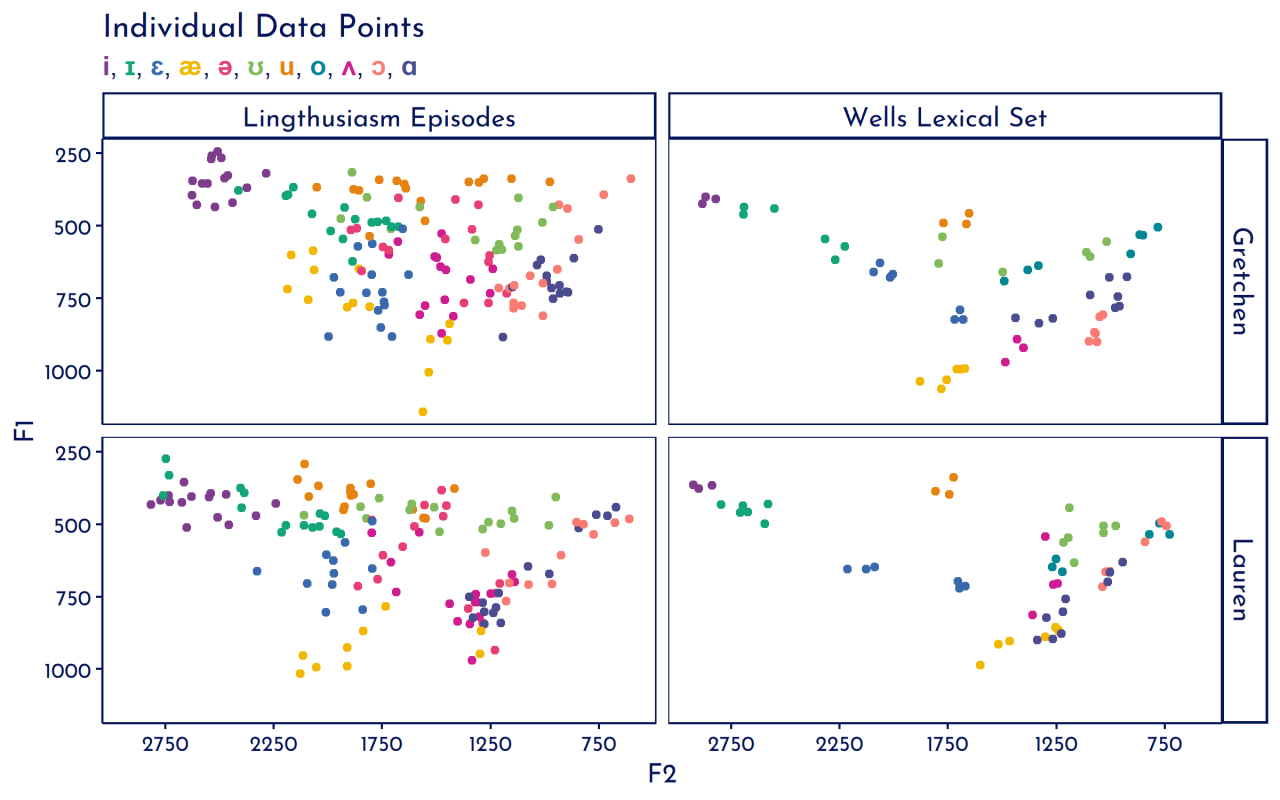
Here are the links mentioned in the episode:
- See larger versions of our vowel plots on Bethany’s Github, which also contains a tutorial on making your own if you’re excited about an intermediate-level coding project
- Previously on vowels: Lingthusiasm episode ‘Vowel Gymnastics’
- Previously on visualizing sounds: Lingthusiasm episode 'Making speech visible with spectrograms’
- Previously on “meat clarinet”: Lingthusiasm episode 'Various vocal fold vibes’
- 'How do bagpipes work?!’ from Ally The Piper on YouTube
- Make your own bagpipe! - 'The World’s Greatest Latex Glove Bagpipes || DIY’ from World By Charlie on YouTube
- Wikipedia entry for 'Voder’
- A Voder in action - 'VODER (1939) - Early Speech Synthesizer’ from VintageCG on YouTube
- 99% Invisible episode 'Vox Ex Machina’
- Identifying sounds in spectrograms
- Formants
- Wikipedia entry for Wells Lexical Set
- 'lexical set’ entry on John Wells’s phonetic blog
- 'The Standard Lexical Sets for English as emoji’ on Superlinguo
- 'The Advance of ‘Goose’’ on Dialect Blog
- 'GOOSE-fronting in Received Pronunciation across time: A trend study’ by Sandra Jansen and Jose A. Mompean
- Australian kit/fleece vowel (Wikipedia entry on Australian English phonology)
- 'Australian English Monophthongs’ by Robert Mannell and Felicity Cox
- 'Vowel Acoustic Space Development in Children: A Synthesis of Acoustic and Anatomic Data’ by Houri K. Vorperian and Ray D. Kent
- 'There is no female vocal tract: Abandoning essentialist ideology in
phonetics’ by Santiago Barreda and Michael Stuart - 'The influence of sexual orientation on vowel production (L)’ by Janet B. Pierrehumbert et al.
- 'Hegemonic masculinity and the variability of gay-sounding speech: The perceived sexuality of transgender men’ by Lal Zimman
- 'Revisiting the acoustics of speaker gender perception: A gender expansive perspective’ by Brandon Merritt and Tessa Bent
- The Real MVP (Modern Vowel Plotter)
You can listen to this episode via Lingthusiasm.com, Soundcloud, RSS, Apple Podcasts/iTunes, Spotify, YouTube, or wherever you get your podcasts. You can also download an mp3 via the Soundcloud page for offline listening.
To receive an email whenever a new episode drops, sign up for the Lingthusiasm mailing list.
You can help keep Lingthusiasm ad-free, get access to bonus content, and more perks by supporting us on Patreon.
Lingthusiasm is on Bluesky, Twitter, Instagram, Facebook, Mastodon, and Tumblr. Email us at contact [at] lingthusiasm [dot] com
Gretchen is on Bluesky as @GretchenMcC and blogs at All Things Linguistic.
Lauren is on Bluesky as @superlinguo and blogs at Superlinguo.
Lingthusiasm is created by Gretchen McCulloch and Lauren Gawne. Our senior producer is Claire Gawne, our production editor is Sarah Dopierala, our production assistant is Martha Tsutsui Billins, and our editorial assistant is Jon Kruk. Our music is ‘Ancient City’ by The Triangles.
“Lauren: It’s a really nice example of how migration creates these little accent time capsules. The R sound is something that’s very easy to lose from the ends of words. Across languages this happens. It’s a very easy target for something to get lost. It was far more common in England four centuries ago when a lot of people migrated. The areas that people migrated from in England and the British Isles and the United Kingdom, more generally, people migrated to what is now the United States and Canada. They had more of this R at the end of words as a feature. Then a couple of centuries later, when the colonists arrived in Australia from the United Kingdom, that feature was far less common there. You don’t find it in Australian or New Zealand accents, but you do find it in those North American accents more predominantly. Not always – but as a general feature. You have this really nice time capsule just because the migrants came a couple of centuries earlier to the US than they did to Australia.
Gretchen: It’s neat – I mean, there are, obviously, historical records of when all this migration was happening, but it’s comforting to know that if we didn’t have those historical records, we would be able to reconstruct them from the accents.
”—
Excerpt from Episode 55 of Lingthusiasm: R and R-like sounds - Rhoticity
Listen to the episode, read the full transcript, or check out more links about phonology
Transcript Episode 48: Who you are in high school, linguistically speaking - Interview with Shivonne Gates
This is a transcript for Lingthusiasm Episode 48: Who you are in high school, linguistically speaking - Interview with Shivonne Gates. It’s been lightly edited for readability. Listen to the episode here or wherever you get your podcasts. Links to studies mentioned and further reading can be found on the Episode 48 show notes page.
[Music]
Lauren: Welcome to Lingthusiasm, a podcast that’s enthusiastic about linguistics! I’m Lauren Gawne. Today, I’m joined by Shivonne Gates, and we’re getting enthusiastic about linguistic variation in the UK. But first, Crash Course Linguistics is out this month – the beginning of the 16-part introduction to linguistics through the Crash Course YouTube Channel. We’ll have a link to their channel in the show notes. We’ll also be doing weekly emails every time a new video is out through the Mutual Intelligibility newsletter. If you sign up to Mutual Intelligibility, you’ll receive a link to every new video as it comes out and some related linguistics resources.
[Music]
Lauren: Today, I’m joined by Shivonne Gates who is a Senior Researcher at NatCen Social Research. Shivonne has a background in linguistics as well as sociology and applied social research. Her linguistics research interests include language and ethnicity, sociolinguistics, and critical race theory. Welcome, Shivonne.
Shivonne: Hi, Lauren! Thanks for having me.
Lauren: It is absolutely a delight to have you here today. Can you tell us a bit about how you got into linguistics?
Shivonne: Sure. I actually got into linguistics when I was in sixth form, which is the last two years of high school in the UK. I did A level English language. As part of that, I did a mini research project.
Lauren: Cool!
Shivonne: Yeah, it was really cool. I did some narrative analysis of a couple of recordings of my cousin at different developmental stages. He was, I think, something like 5 and 9. I compared how his narrative structures had developed over time, essentially.
Lauren: Cool. Had you happened to just record him as a 5-year-old because he was cute, or were you thinking that you had plans to analyse his language?
Shivonne: Neither. His family just did lots of home videos, and something he liked to do for himself was just stand in front of the camera and record himself telling stories.
Lauren: Oh, how wonderful.
Bonus #25 - Adapting your language to other people - chat with Claire Gawne | Lingthusiasm on Patreon
When you talk to someone who speaks a different version of English than you do, do you keep talking the way you do otherwise or do you find yourself slightly edging towards the way they speak? What about if you travel and you’re surrounded by people with another accent or dialect?
This episode features a special behind the scenes chat with a member of the Lingthusiasm team, our audio producer Claire Gawne, who’s the person responsible for making sure that the show reaches your ears sounding crisp and with only the funny digressions left in! (Yes, she’s also Lauren’s sister and very kindly agreed to help fill in while Lauren is occupied with her tiny human.)
Claire is not a linguist by training, but she does have linguistic experience that’s highly relevant to this episode! She’s an Australian who’s been living in Edinburgh for the past few years, and of course Gretchen is a Canadian who recently got back from visiting Australia. In this episode, Gretchen and Claire get enthusiastic about how our ways of speaking change when we move around, some of their favourite words that we’ve noticed across different varieties, and more about linguistic accommodation.
We also want to hear your stories! Are you an accommodator? What have you picked up from another person? (Or noticed but not picked up?) Have you ever noticed someone accommodating towards you?
To listen to this episode and 24 more bonus episodes, support Lingthusiasm on Patreon!
Transcript Lingthusiasm Episode 17: Vowel Gymnastics
This is a transcript for Lingthusiasm Episode 17: Vowel Gymnastics. It’s been lightly edited for readability. Listen to the episode here or wherever you get your podcasts. Links to studies mentioned and further reading can be found on the Episode 17 shownotes page.
[Music]
Lauren: Welcome to Lingthusiasm, a podcast that’s enthusiastic about linguistics. I’m Lauren Gawne.
Gretchen: And I’m Gretchen McCulloch. And today we are all over the place with vowel gymnastics! But first! Our monthly Patreon episode this month is about conlangs, so you can listen to us talk about people who create languages and the process of creating languages, and support the show by going to patreon.com/lingthusiasm, and listen to that and all the previous bonus episodes there.
Lauren: We have, like, ten bonus recorded episodes now, and all of our bonus episodes from this point on are full-length episodes, so you get two full Lingthusiasm episodes for the price of one Patreon subscription, and if you can’t support the Patreon, as always you get the monthly free episode here on SoundCloud or wherever else you get your podcasts.
Gretchen: And thanks so much to everybody who’s doing that already.
[Music]
Gretchen: So. Vowels.
Lauren: Human voices are amazing. Like, the fact that we communicate by speech is this amazing process that’s basically that humans are giant meat tubes, and we make air go through those tubes to make sounds. But that’s disgusting, and that’s why we call it phonetics instead of meat tubes.
Gretchen: Meat tube science?
Lauren: The science of meat tubes and air! So, we kind of push air through, and then we have different parts of our vocal tract, so our – what we think of as voice box and our mouth, and all the things in our mouth, to kind of change –
Gretchen: And especially our tongue!
Lauren: – especially our tongue! – changes the way the air flows, and that changes the quality of the sound. And so all of this that we’re saying now is based on that outflow of air, but it’s how we stop and change and shape the air that makes different sounds!
Lingthusiasm Episode 17: Vowel Gymnastics
Say, “aaaaaahhhh…..” Now try going smoothly from one vowel to another, without pausing: “aaaaaaaeeeeeeeiiiiiii”. Feel how your tongue moves in relation to the back of the roof of your mouth as you move from one vowel to the next. When you say “ahhhh” like at the dentist, your tongue is low and far back and your mouth is all the way open. If you say “cheeeeese” like in a photo, your tongue is higher up and further forward, and your mouth is more closed: it’s a lot harder for the dentist to see your molars.
In this episode, your hosts Lauren Gawne and Gretchen McCulloch explain how the position of our tongue when we make vowels can be described in the shape of a trapezoid: it can go up and down, forward towards the teeth and backwards towards the throat, and there’s a bit more space for movement higher up towards the roof of your mouth.
Click here for a link to this episode in your podcast player of choice or read the transcript here
Announcements:
Vowels don’t just exist in a trapezoid, they move around inside it: sometimes they squish up against their neighbours, sometimes they expand into less-occupied corners of the trapezoid for more elbow room. These vowel gymnastics explain so many things: why is the first letter in the alphabet named “ay” in English, but “ah” in most other languages that use the Roman alphabet? Why is “e” in “coffee” pronounced one way and “cafe” another, when they’re clearly related? Why is English spelling so difficult? What’s the difference between a California accent and a Kiwi accent? It’s all about VOWEL SHIFTS.
This month’s Patreon bonus episode is about constructing languages for fun and learning.
Here are the links mentioned in this episode:
- Pink trombone (note: link makes sound!)
- Using lollypops to explore vowels
- Vowel space in the face (from Wuglife)
- IPA vowels with keywords
- pin/pen merger (Dialect blog)
- The Great Vowel Shift
- New Zealand vowel shift
- Californian vowel shift
- SNL skit with Californian vowels
- Best of Bret McKenzie - Flight of the Conchords
- Australian Indigenous Languages with three-vowel systems
- Number of vowels in a language (WALS map)
Some more vowels:
- All of the English vowels
- GIF of a tongue moving in the vowel space
- Bernie Sanders vowel trapezoid animated video
- Vowel jokes
- Vowel space tattoo
- Embroidered Wells lexical set
- Wells lexical set as emoji, in the vowel space
- Emoji IPA vowels
- Cardinal vowels cross-stitch
- Cardinal vowels original Daniel Jones recording
- Schwa cross-stitch
- Schwa cookie-cutter (3D print your own)
- Nasal vowels
You can listen to this episode via Lingthusiasm.com, Soundcloud, RSS, Apple Podcasts/iTunes, Spotify, YouTube, or wherever you get your podcasts. You can also download an mp3 via the Soundcloud page for offline listening.
To receive an email whenever a new episode drops, sign up for the Lingthusiasm mailing list.
You can help keep Lingthusiasm ad-free, get access to bonus content, and more perks by supporting us on Patreon.
Lingthusiasm is on Twitter, Instagram, Facebook, and Tumblr. Email us at contact [at] lingthusiasm [dot] com
Gretchen is on Twitter as @GretchenAMcC and blogs at All Things Linguistic.
Lauren is on Twitter as @superlinguo and blogs at Superlinguo.
Lingthusiasm is created by Gretchen McCulloch and Lauren Gawne. Our senior producer is Claire Gawne, our editorial producer is Emily Gref, our production assistant is Celine Yoon, and our music is ‘Ancient City’ by The Triangles.
This episode of Lingthusiasm is made available under a Creative Commons Attribution Non-Commercial Share Alike license (CC 4.0 BY-NC-SA).
About Lingthusiasm
A podcast that's enthusiastic about linguistics by Gretchen McCulloch and Lauren Gawne.
Weird and deep conversations about the hidden language patterns that you didn't realize you were already making.
New episodes (free!) the third Thursday of the month.
