| CARVIEW |
A suggestion about adding some instruction in “Before we begin” part
This is a very good and interesting interactive part of letting students take the first step in this class. In this step, learners can know your teaching concepts about the learning environment and detailed information about design. It would be helpful and easy for students to start on the right track. You can provide a hyperlink to slido.com for easier access. And maybe there can be another slide with some screenshots to illustrates the steps you expected students to follow in slido.com.
The order of slides
It might be better to place the “welcome” part in the beginning to have a general explanation about the topic in this class and let students know about your teaching goals so that they could know better about the meaning of your first discussion activity. If you worry that it would be a little weird to move from the discussion to the teaching section suddenly, there can be a transition slide after slide four (start a discussion).
The layout for slide 10
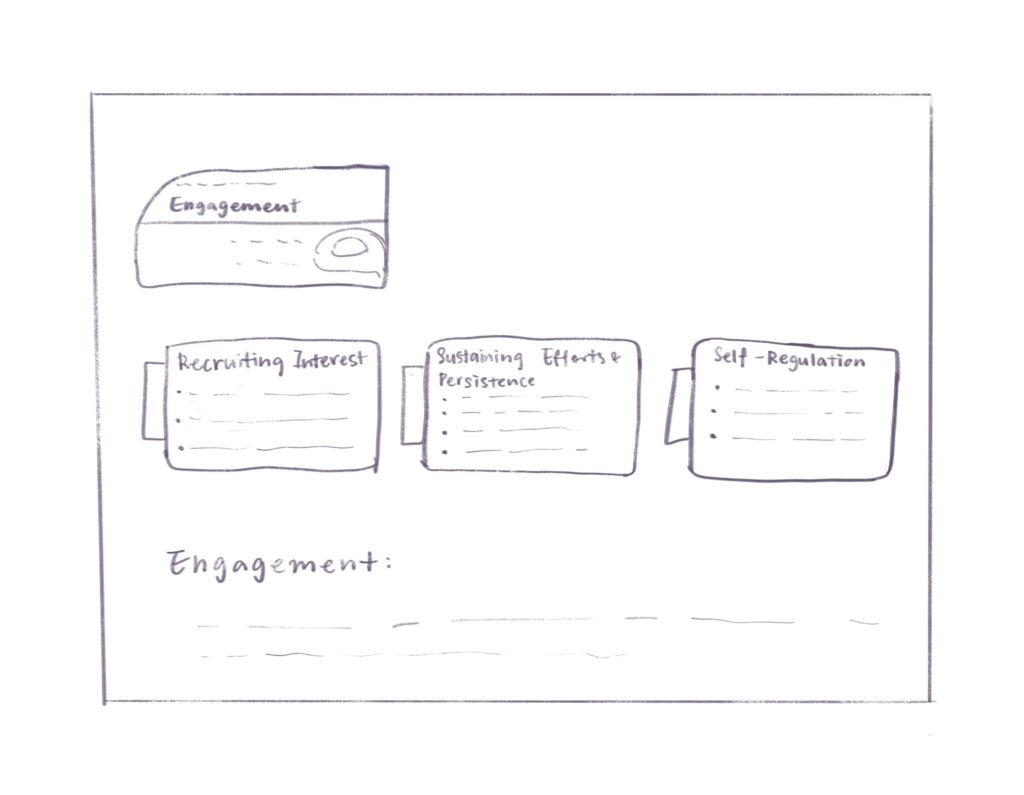
Nice image for an explanation of the universal design of learning! But there might be too much information in one slide with limited space. As an audience, I think it might be better to split the image into three parts and use one slide to show each part. Maybe it can be like this (you can take it as a reference).
The transition about Pop quiz
It is a fascinating in-class activity. However, I found there seems like a gap between the content you introduce in previous slides and this section. Students might be confused about the correlation between drawing trees with the topic they are learning. Therefore, before continuing, there can be an introduction part, like “Trying to understand ‘how to include indigenous knowledge in learning’ through practical experiences.”
Overall
I think Pod 5 has done a very good job in this Interactive Learning Resources, and many aspects remind me that we can improve our design. The knowledge about ‘inclusion in the classroom’ can be easily understood through the course materials and the resources that the instructor provided. And the class could be perfectly present to learners through over zoom. The designed activities throughout the whole class are very fun and can help students to have a better understanding of class materials. I just kind of worry that these activities might take much time for this workshop, and it might be a challenge for instructors about time management. Overall, this is an integral and excellent design with a clear structure!
]]>In what way are they likely to respond to the video on their own, e.g., make notes, do an activity, think about the topic (learner-generated)?
Before sharing the video, instructors would raise a question, and students are asked to find their answers from the video. The question would be how Londoners view K-pop, and what different views do they have? Learners are encouraged to write down the keywords about their impression that the video left them.
What activity could you suggest that they do, after they have watched the video (designed)? What type of knowledge or skill would that activity help develop? What medium or technology would students use to do the activity?
After watching the video, there would be a small brainstorming activity, which is the learner-learner interaction. Learners are encouraged to write down the keywords about their impression that the interview left them to answer the question.
Then, learners can share their words with their group members (the groups have been divided already). The group discussion is meant to be a process of learner-learner interaction. The instructor would draw a tree as an example on the blackboard. Each group would generate a word list and then share with the class how their trees would be like (each word is a leaf on the branch of the tree). They can also share the reason why they came up with the answers. Through this activity, learners can better understand the class topic from the perspective of public views.

How would students get feedback on the activity that you set? What medium or technology would they and/or you use for getting and giving feedback on their activity?
Students can get feedback right after they share their answers in class. It would be provided as verbal comments by instructors, which would be an interaction between instructors and learners as well.
How much work for you would that activity cause? Would the work be both manageable and worthwhile? Could the activity be scaled for larger numbers of students?
The biggest cost for this activity would be the time that spends on sharing answers. However, since the response would be made as a group unit, and the instructor would give the feedback immediately, it would not cost too much time for class with a scale less than 40. It would not be suitable for the class with students more than 40 because discussion and sharing could be a significant part of the class.
What is more, this kind of interaction in class can help students refresh their understanding of course materials by knowing others’ thoughts. Therefore, this activity should be manageable and worthwhile for small and medium-sized classes.
Reference
Madland, C. (2021). Assessing Interaction. University of Victoria. Educational Technology. Retrieved from https://edtechuvic.ca/edci335/assessing-interaction/
]]>
For our design, I think the barrier that students would meet is lack of engagement to the classes and chances to communicate with other students. Thus, well-planned activities may help students have a better understanding about the materials, study in a better pace, and help them with self-regulation through the course. Therefore, I think the design can be improved by adding more activities for students to participate.
First, the instructor can share some videos, articles or material-related links in the course website for students to get familiar with the topic that would be discussed in the class. Focus on the materials provided before and during the classes, students can optionally write a weekly journal to track their studying progress.
Second, there could be a mini-presentation part in the beginning of classes. In this activity, students can be the “little instructor”. There is no much limitation about the content of presentation. Students are required to do some research about the class topic, choose the date to present, and share them in the class. They can share their favorite Korean songs, or the Korean singer or band and so on. Also, other students are encouraged to ask questions about the information that the “little instructor” shared, which can help them to have further discussion and thinking about the materials.
For students who feel uncomfortable with making presentation in front of the class, there can be another way for them to share their opinion and communicate with others. They can post their thoughts and share information on the discussion board, and other students are welcomed to leave comments or raise questions below the posts.
Third, students need to complete the exercises after each class meeting. For students who have the confusion and questions about the exercises or course materials, there would be a regularly zoom meeting to resolve these questions. Learners can also post their questions on discussion board or email to the instructor to get the answers.

As the designer, I think it is necessary to make learners feel that they are engaging in class and get what they want to learn through different appraoches that are enjoyable to them.
Reference
Inclusive Learning Design. (n.d.). https://edtechuvic.ca/edci335/inclusive-learning-design/
Universal Design. (n.d.). https://edtechuvic.ca/edci335/universal-design/
]]>

What is direct instruction (DI)?
Direct instruction, also be known as DI, is one of the most familiar teaching approaches. Professor Siegfried Zig Engleman and his colleagues first developed direct instruction at the University of Illinois in 1964 (NIFDIINFO, 2017).
In the classes instructed by teachers who use this technique, students could receive knowledge by attending class, responding to teachers, and completing exercises about the class topics.
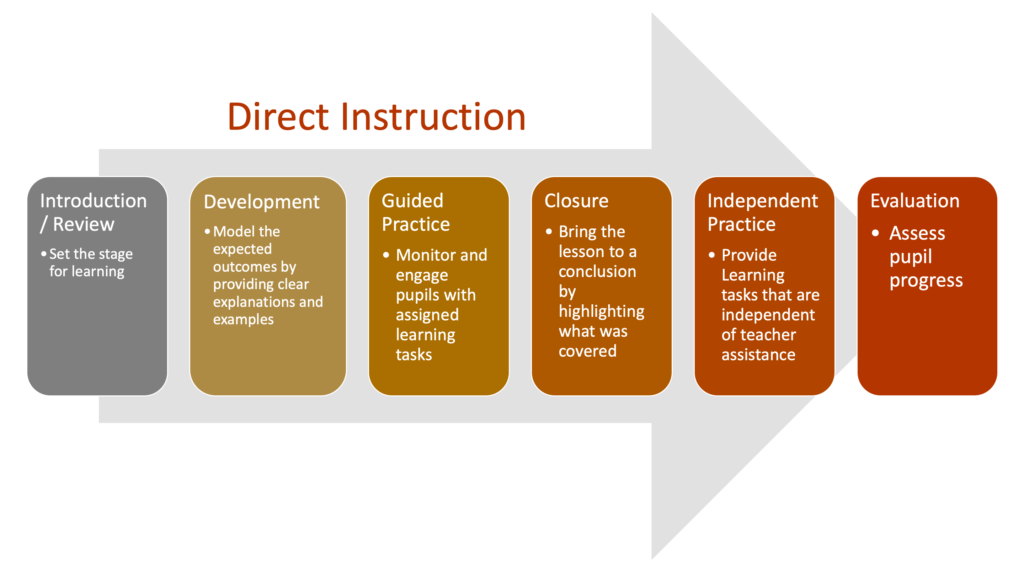
Several detailed features about the teaching methodology of direct instruction are listed below (NIFDIINFO, 2017):
- Students are required to respond to teachers immediately in class.
- After getting responses from students, instructors would correct the errors or confirm correct responses.
- Under most circumstances, students respond according to the model which is presented by teachers (in a scaffolded way).
- DI programs are designed based on step-by-step design (with increased complexity).
- Students are grouped according to their skill level rather than grade level. In other words, the time that students spend on finishing the program depends on how fast that they master the skills. Students who have difficulties in mastering skills can keep learning the same unit by repeating studying the materials.
- Several exercises are designed corresponding to different aspects of class materials.
- After class, all students are able to master knowledge in lessons through making responses in class and completing exercises.

Direct instruction and our design
Several features of direct instruction were valued and considered when designing the instruction program about our topic, which aims to introduce Korean popular culture.
Firstly, we found that exercises related to different aspects of materials can help students have an image about what they have not yet understand, and what they have already mastered.
In addition, we thought it is necessary to arrange the materials according to the degrees of difficulty. There should be a step-by-step process for students to accept materials from easy to difficult. In this way, students could gradually get their pace of studying and obtain new knowledge easier if they have already been familiar with the basic information related to new content.
However, it is not easy to get the best expected outcome only through the direct instruction approach.
In our design, the materials would be posted on the websites. Students are expected to master the knowledge by doing readings and watching videos as well as articles. Since the course would be carried out in a digital way, I think the online settings would restrict some advantages of direct instruction.
Though there are some designed exercises for students to check how they learned, it is hard for instructors to get immediate responses from students and interact with them face to face as usually done in direct instruction. Therefore, our pod decided to encourage and guide students to learn through other approaches.
Reference
NIFDIINFO. (2017, May 19) Intro To DI: What is Direct Instruction [Video]. YouTube. https://www.youtube.com/watch?v=TkjxO3PSzwk
]]>
Since my teachers and parents said that it is a good habit for learning to make good use of time in the morning, I assume that it is necessary to adjust my biological clock. Therefore, I tried many different methods. For example, I have tried to get up earlier and do some morning exercise to help me wake up, have espresso each day, or wash my face with cold water. Nevertheless, I found that these methods can just function temporarily for me.
After attending the university, I felt much relieved because the studying time become more flexible, and I can manage my time better. Gradually, I accept that I am a night person, and I always scheduled my studying task on nights and complete them productively. As a student, it is essential to know that learning when can be productively and focused during the day, then making a plan based on the individual learning habit.
This strategy to improve the efficiency of learning is about cognitivism (Ertmer & Newby, 2018). For cognitivism, learners should notice both the environmental cues and mental activities. Being ‘early bird’ might be a good strategy for some learners to get a better learning experience, but it might not has the same impact on others. Learners always need to determine the learning strategies which are the most suitable for them.

Reference
Ertmer, P. A., & Newby, T. (2018) Behaviourism, cognitivism, constructivism: Comparing critical features from an instructional design persepctive. In R. E. West, Foundations of Learning and Instructional Design Technology: The Past, Present, and Future of Learning and Instructional Design Technology. EdTechBooks. https://edtechbooks.org/lidtfoundations/behaviorism_cognitivism_constructivism
]]>Hi, I’m Lori. Nice to meet you!