


| CARVIEW |
The idea
Social scientists produce social network data. In order to share that data with other scientists, they must ensure that the identity of the actual people in the networks is protected. Simple pseudonymisation is typically not enough, because the neighbourhoods of individuals (nodes) in the network (i.e., what their friend group looks like) can be so unique as to leak information about their identity. After all, a lot of online social networking sites allow users to query details about other users’ connections on the social networking site.
Hence, some form of anonymisation is needed before social network data can be shared. This network anonymisation process typically consists of making subtle changes to the network to ensure that no individual has unique features. This particular criterion is called 2-anonymity, meaning that for each node, there exists at least one other node (and hence: person) with the same exact features.
In our work, we focus edge deletion: given a budget of a number of edge deletions, we try to remove those edges that maximise the number of nodes that are 2-anonymous w.r.t. features that characterise how many connections each node has (the number of friends of the person represented by the node), and how many incident triangles the node has (how many friend relationships there are between friends of the person). This particular measure strikes a good balance between other popular measures that are either very expensive to compute, or too trivial to be a real threat.
In our approach, we choose for simulated annealing; a metaheuristic that uses stochastic search to first focus on exploring the search space, and then gradually shifts its focus to exploiting promising areas. We call our approach SANA (Simulated Annealing for Network Anonymisation). Our findings indicate that SANA tends to achieve better anonymisation (up to 18$times$ more $2$-anonymous nodes) than other heuristic algorithms with similar running times. When looking at other quality measures, related to how well the algorithm preserves key network properties, we find that SANA performs comparably to the SotA.
The collaboration
A year and a half or so ago, two of my former colleagues from Leiden University, dr. Frank F. Takes and Rachel G. De Jong, and I decided to explore collaborations on the topic of social network anonymisation. After all, I had been working on uniquely identifying nodes in networks (LSM2023, LSB+2024), so it seemed only natural to me that I could apply the tricks that I used in that work to the opposite problem.
That turned out to be somewhat optimistic, but we decided to explore this topic further anyway, and I wrote a proposal for a BSc thesis project to explore network anonymisation, with Frank and Rachel as external advisors.
Denisa and four fellow students chose/were assigned to (it’s complicated) that project, and we spent 10 weeks exploring the topic from different angles. You can find posters that summarise their projects on this website (Ctrl+F for “Network anonymization for science”). Frank, Rachel, Denisa and I ended up turning Denisa’s project into a research paper, and submitted it to the Complex Networks conference.
Denisa’s poster
The paper was accepted, so Denisa will travel to Binghamton, New York, USA to present our work to the community during a poster presentation! Many thanks to all of my (former) students who gave feedback on her poster and her pitch!
Acknowledgements
We thank Denisa’s team mates, Andrei Ioniţă, Jakub Matyja, Mike J.J.S. Erkemeij, and Emke de Groot for their constructive feedback and discussions. We also thank the anonymous reviewers for their valuable comments that helped us improve the manuscript. Finally, we thank the TU Delft University Fund that, through their FAST programme has funded part of Denisa’s trip to the USA.

Expertise
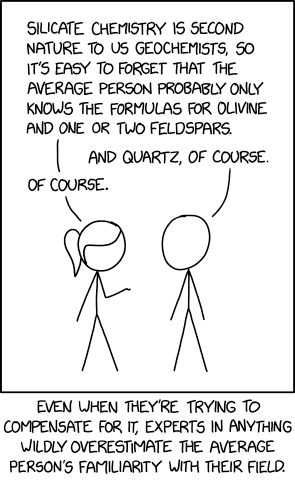
One thing I notice about my students’ writing, is that they include a lot of technical terms that they don’t explain. I find that one of the reasons for this is that the students assume that the reader is familiar with those technical terms, so they don’t need to explain. In part, this might be due to the students not realising how quickly they gain very specific expertise while working on a research project:
 |
|---|
| Source: xkcd 2501, copyright: Randall Munroe. |
It’s my job to help my students figure out who their audience is and how to adjust their communication to that audience. That’s what this post is about.
Who is my audience?
This is really the key question you should be asking whenever you are communicating. Whether it is a project report, a presentation, or even a meeting with your adviser.
Once upon a time I was an editor for Universum, an astronomy magazine for kids. My fellow editors and I were always looking for ways to improve our skills. This led to us taking a writing class with Jet Sebus, who specialises in teaching experts how to write for laypeople. Exactly what we needed.
She taught us to always ask (and answer!) the following questions:
- Who is my reader?
- What does my reader know/think/believe/want/do before reading my text?
- What should my reader know/think/believe/want/do after reading my text?
This generalises to other forms of communication (such as presentations and meetings), so I would suggest that you replace “reader” with “audience”.
Example: Robin
As an example of how to answer these questions, let’s consider Robin:
Robin is a 3rd-year Bachelor student at Delft University of Technology, majoring in Computer Science and Engineering. During their second year, Robin chose the Data track for their Variant Courses. During their third year, Robin did a minor on Offshore Wind Energy at the Faculty of Aerospace Engineering. Robin’s final project before getting their diploma is a 10-week research project. At the end of this project Robin has to present their findings in a report and a presentation.
All the students who I supervised for the Research Project (RP) struggled with deciding what to include and what to leave out in their reports and presentations. When that happens, I advise them to ask and answer the above questions. Let’s answer those questions together for Robin’s RP report.
Who is Robin’s reader?
This is a tricky one. After all: anyone might read Robin’s report and the presentations public events. Hence, Robin’s audience includes their supervisor, their external examiner, their fellow students, and maybe their friends and family. Quite a wide range. However, in academic educational settings, generally speaking, the expectation is that you write or present for your peers. That narrows it down.
In this case, Robin’s peers are fellow 3rd-year Bachelor students who did the same Computer Science program, but may not have chosen the same Variant Courses track, likely did not do the same minor, and definitely did not do the same research project as Robin.
What do Robin’s peers know/think/believe/want/do before reading Robin’s RP report?
Robin can reasonably assume that their peers have retained at least some knowledge from the courses that are in the main curriculum. Anything topic-specific that Robin had to learn during their project should be considered as unknown to their peers.
Without having specified a particular project, we cannot write specifics for the knowing/thinking/believing/wanting/doing part of the question. Furthermore, since Robin’s peers may not even have heard of the problem that Robin studied or the techniques they used, it is unlikely that Robin’s peers have any thoughts on that problem or those techniques at all. Hence, in answering this question it makes sense to stick to very high-level concepts that usually relate to the (potential) societal impact of Robin’s work. Familiarity with specific societal challenges will help motivate Robin’s work. Furthermore, we should consider which specific problems or techniques Robin’s audience should really know about and why. This helps Robin decide on what to include and exclude from their writing.
Below are some examples of statements that reflect what Robin’s peers might know/think/believe/want/do before reading Robin’s report, based on real student projects that I supervised over the last academic year. They are based on personal experience of Robin’s peers, on their general knowledge about the world, and on specific knowledge that they may have picked up in their classes:
- Probabilistic inference is computationally expensive.
- Personal privacy is important. Social science is important.
- Launching satellites is expensive.
- I want to get enough sleep, but I have way too many lectures that start at 8:45 am.
- I try to eat well, but planning a weekly menu that is nutritious and affordable takes way too long.
What should Robin’s peers know/think/believe/do after reading Robin’s RP report?
Generally speaking, we want academic texts to be standalone. Conceptually, this means that we want a member of the intended audience to be able to understand the main message of the text without having to read additional sources or appendices. Concretely, this means that a reader should be able to write a summary of the text. That summary should include answers to the “What, why, and how?” of the research.
It is Robin’s responsibility to include the information that the reader needs to be able to write that summary. Answering the question of what their reader should know after reading Robin’s report, combined with the answer to what they know before reading it, helps Robin to identify which knowledge gap they must fill.
Recall the example statements above, reflecting what Robin’s peers know/think/believe/want/do before reading their report. Below are companion statements for what they should know/think/believe/want/do after reading Robin’s report:
- Weighted model counting and knowledge compilation make probabilistic inference fast in practice.
- In order to study social phenomena, researchers need access to social network data. Sharing social network data for research can compromise the privacy of the people in those networks.
- There are several exact combinatorial solving methods that can compute the smallest number of satellites that we need for the task of monitoring the Earth for disasters.
- A clever implementation of a simulated annealing algorithm can come up with a lecture roster that better accommodates students’ preferences.
- By using integer linear programming techniques we can automate the task of coming up with varied and frugal weekly menus.
Having a list of what the audience knows and a list of what the audience should know after reading Robin’s report should help them answer the central question of this blog post: “Should I explain this?” If it is something that the audience can be expected to know: no. If it is something the audience cannot be expected to know, but is on the list of things they should know: yes. Finally, Robin may have to explain things that are not on the list of things the audience should know, but will help Robin bridge the knowledge gap for something that is on the list.
This also gives Robin a tool to test how well they did. Asking a fellow student to read a draft of their report and writing a 1/2-page summary gives Robin the opportunity to check if they filled the knowledge gap.
Knowing, thinking, believing, wanting, doing
Focus in the above was mostly on what the reader should know. However, the questions also specify “think/believe/want/do”.
As academics, we obviously don’t like being told what to think or believe or want. We do, however, write opinion pieces about where our research focus should be, what we should do to improve the quality of the research in our field, or about the ethics of (pursuing) certain research topics. Hence, you may find yourself in the position where you will need to convince others of your opinion. I believe that answering the above questions will help in that situation, also.
As for “doing”: academic writing contains implicit calls to action. When we build a new solver, we want people to see how great it is, and build on it or compare their own against it. When we curate a benchmark set, we want people to use it for their research. When we write a survey paper, we want people to read and cite it. These calls to action are often more explicit in and oral presentation. They may be spelled out on the slides, or said out loud. This is usually combined with an easy first step, like scanning a QR-code.
Hence, answers to the question of “what should my audience know/think/believe/want/do after listening to me?” may also include explicit calls to action, like:
- Use my tool to solve problem X.
- Use my benchmarks to validate your solver.
- Submit benchmarks to my competition.
- Read and cite my survey paper.
- Join the conversation on the future of research field Y.
What are your writing tips?
As I described above, I found answering these questions very helpful in streamlining my writing process. What is some good writing advice that you received and now pass on to others? Please share it with me?
]]>
About Sreevidya
Sreevidya obtained a Bachelor’s degree in Computer Engineering from the Vivekanand Education Society’s Institute Of Technology. After three years of working in the Finance industry as a Software Engineer, she came to TU Delft to pursue a Master’s in Computer Science. Her strong technical skills, interest in societal problems, and methodical work ethic make her an ideal student to tackle this project.
The Project: Anonymising Social Networks
Sreevidya will be continuing a line of research that I have recently explored with my colleagues from Leiden University (Dr. Frank W. Takes and Rachel G. de Jong), and one of my other students (Denisa Arsene), where we explored methods for the anonymisation of social networks.
Anonymising social networks is important for the Social Sciences. Once social scientists have obtained a social network through their research, they typically want to share that network with other scientists, so they can study that network also. However, they have the obligation to protect the privacy of the people in that network. Simple pseudonymisation is typically insufficient, since the neighbourhood structure of each node can reveal a lot of information. Some online social networks allow you to inspect other people’s connections, thus providing access to structural information about the neighbourhoods of those people in the shared social network.
Hence, to protect people’s privacy, researchers can alter the network structure, to minimise the number of nodes that have the same neighbourhood structure, hence ensuring some level of anonymity. However, these changes should be minimal, as they might affect interesting network properties, like centrality and connectivity.
The literature studies different attack models and different measures for data utility. These all come with bespoke algorithms that are implemented in different languages and evaluated with different protocols, making it difficult for a user to predict the trade-off of privacy vs data utility for different attack models, data utility measures, network alteration strategies, and properties of the input network.
Sreevidya will develop a prototype of a framework for users to explore these trade-offs in a user-friendly, declarative constraint programming paradigm. I am much looking forward to my collaboration with her, and with Dr. Demirović’s group!
]]>
About Roxana
After completing a Bachelor’s degree in Computer Engineering at Gheorghe Asachi Technical University (Romania), Roxana came to the Netherlands to study Computer Science at Delft University of Technology. While passionate for the abstract elements of mathematics and puzzle-solving, Roxana enjoys applying her analytical skills to solving more concrete problems, also, as witnessed by her software development internship at Amazon.
The project: Complex satellite constellation design
Over the coming 9 months, Roxana will be working on a very exciting collaboration with the European Space Agency’s (ESA) Advanced Concepts Team (ACT). In particular, she will be building on work done by Dr. Max Bannach, who will be an external supervisor for this project. I met Dr. Bannach in September, while attending his Dagstuhl seminar on Optimization and Automated Reasoning for Designing Future Space Missions, and I am thrilled that he agreed to be part of this project.
Dr. Bannach’s earlier work on modelling the communication reliability of satellite constellations forms the inspiration of this project, along with my earlier work on satellite constellation design for monitoring and network reliability optimisation. Roxana will explore how the insights from this earlier work can be applied to future-proof and resource-efficient satellite constellations that provide highly reliable long-distance communication networks for quantum communication as well as classical communication.
I am very excited about this project and am confident that Roxana will be able to report some interesting findings by the end of it!
]]>The TU Delft Honours Programme
At Delft University of Technology, our top BSc students can apply to the Honours programme. During the 2-year programme, an Honours student will spend 15 ECTS working with a faculty member to do an original piece of research, culminating in a report, a presentation, and ideally also a publication. For more information, see this website.
The project
In the coming two years, Gianmaria will be working on algorithms for optimal computer network monitoring system design. In doing so, he will build on my earlier work on this topic, as well as on work by my former colleagues from Université catholique de Louvain (e.g., [BSP2024]).
I trust that the combination of hard-core formal methods and some challenging programming tasks are well-suited for someone like Gianmaria, who enjoys picking apart complex puzzles, so he can understand every detail. The approach we are taking is related to the work that I will start shortly for my Veni project, so I am keen to see what we can achieve. I am excited to have Gianmaria on board and I am looking forward to a fruitful collaboration.
]]>
NWO Veni grants
NWO (Dutch Research Council) is one of the main suppliers of science funding in the Netherlands. Its role in funding fundamental research is especially important in the Dutch research funding landscape. The Veni grants are part of the NWO Talent Programme, and are awarded yearly to early-career researchers who have visionary research ideas, the CV to back them up, and the potential to become leaders in their research fields. This year, 15% of applications were awarded with a grant. Grant awardees receive a maximum of € 320 000.
Click here for more information about NWO, and here to read more about the Veni, Vidi, Vici NWO Talent Programme.
My proposal
My proposal is titled “Finding Variables that Matter”, and I’m sharing the public summaries in English and Dutch below. Once I actually have the money and have taken the first steps in executing the research, I will be able to share more details. Keep an eye on this blog for updates!
English summary
Real-world decision-making often relies on best guesses from domain experts. Even when a computer model is used to inform decisions, inputs are often based on expert opinion. We can gain more accurate estimates for these variables by gathering more data, which is expensive. Therefore, we want to know which parameters are most important in a problem, to allocate our resources wisely. Existing methods rely on expensive simulations, which might miss important variables. This project will conduct the first research into how to use independent supports to exploit the structure of problems to identify the variables that really matter in decision-making.
Dutch summary
We maken vaak beslissingen op basis van schattingen van experts. Zelfs wanneer we een computermodel gebruiken om te helpen met onze beslissingen, worden de inputwaardes afgeschat door experts. We kunnen nauwkeurigere schattingen maken door meer informatie te vergaren. Dit is typisch een duur process. Daarom willen we graag weten welke inputwaardes en beslissingen het belangrijkst zijn voor de uitkomst van een probleem, zodat we weten naar welke waardes we meer onderzoek moeten doen. Bestaande methodes gebruiken simulaties. Deze zijn duur, en kunnen belangrijke variabelen missen. In dit project gebruiken we de structuur van een probleem om belangrijke variabelen te identificeren.
Acknowledgements
Even though Veni grants are personal grants, I firmly believe that Siegfried’s assertion that no piece of research ever is the product of just one person also holds for grants. I received a tremendous amount of training, help, support, trust, and encouragement by a number of people, and I want to name a few of them explicitly.
First: dr. ir. Sicco Verwer and dr. Tina Nane. Sicco has been my academic mentor since I arrived at TU Delft just over a year ago, and has been invaluable for me. He’s been coaching me in how to approach this grant application, and pushing me to not let myself be paralised by my perfectionism. He’s been incredibly important for me in learning how to present my research, and helped me brainstorm and finetune my ideas. Tina’s support has also been incredibly important to me in this process. Not knowing me at all, she was nevertheless kind enough to listen to the vague ideas I had at the start of writing this proposal, and to help me sharpen them. It is through her that I get to expand my knowledge and experience, by tackling real-world problems. I look forward to working with her in the later phases of the project.
Next: dr. ir. Corine Meuleman and dr. Tom Breukel were my main coaches from TU Delft’s impact and innovation office. They helped me even when I was missing deadlines or showed up underprepared. I learned so much from them and they were so patient and kind in their support. I’m also grateful to my other trainers, including Bas Verbruggen and dr. Maria Sovago.
I also want to acknowledge my colleagues, prof. dr. Mathijs de Weerdt and dr. Sebastijan Dumančić in particular. Both Mathijs and Sebastijan were crucial in me staying sane, despite the stress of applying to this grant. Both made time for me to provide me with professional advice, and friendly support when putting all of it in perspective. They helped me figure out the story and the framing of my ideas, and patiently gave feedback on early drafts.
Many of my other colleagues helped me by letting me vent, asking how things were going, or giving me feedback on my proposal and presentation. Shoutout to dr. ir. Fabian Mies, dr. Gabriel de Albuquerque Gleizer, dr. Harm Griffioen, dr. ir. Irene Martínez, and dr. Marc Rovira Navarro in particular. I enjoyed my training sessions with them, value their feedback, and congratulate them on also seeing their Veni research proposals granted!
A somewhat hidden group of people I want to acknowledge are the those who run NWO, and the anonymous reviewers who kindly read and critiqued my proposal. I am also grateful to the committee who had to read all full proposals in the Science domain, interview all candidates, and finally make decisions on who gets the grant and who doesn’t.
Of course, I owe a great debt to my academic advisers from earlier years. This may be a personal grant, reflecting my research ideas, but I am the product of their expertise and mentoring. I particularly hear the voices of prof. dr. Kuldeep Meel, dr. Siegfried Nijssen, prof. dr. Holger Hoos and prof. dr. Fahiem Bacchus in my own writing and ideas.
Finally, my friends and family have been incredibly patient with me during this entire process. I know it isn’t healthy, but I couldn’t escape sometimes having a meeting while the others went to the beach, or leaving my loved-ones to do the dishes while I returned to my laptop to make a deadline. I hope they are proud of me.
Further reading
- NWO’s news release about this year’s recipients: 200 Researchers receive Veni grants
- TU Delft’s news release about Delft’s recipients: Record number Veni grants for leading TU Delft researchers
- The Faculty of Electrical Engineering, Mathematics and Computer Science’s coverage about the Veni grants received at our faculty: Six Veni grants for EEMCS researchers
Reminder: I’m hiring!. Please apply no later than 31 August 2025!
]]>Are you passionate about logic and reasoning, do you have a strong interest in statistics, and are you looking for a vibrant work environment with ample opportunities for networking and collaboration? Then I may have a vacancy for you.
I am looking to hire a PhD candidate who will join me at the Algorithmics section of the Software Technology department of Delft University of Technology, to work on algorithmic and statistical methods for sensitivity analysis and other forms of reasoning under uncertainty and combinatorial optimisation. The supervisory team for this position will consist of me, dr. ir. Fabian Mies (Assistant Professor of Statistics) and dr. ir. Sicco Verwer (Associate Professor of Algorithmics and Machine Learning).
For details on the position, required qualifications, and how to apply, please refer to TU Delft’s careers page. Please apply no later than 31 August 2025.
I am looking forward to reading your application!
]]>Over the last nine months, I had the pleasure of co-supervising Roy, together with my colleague dr. Neil Yorke-Smith at the Algorithmics group of TU Delft, and dr. Lotte Berghman and Eva van Rooijen from ORTEC.

ORTEC kindly hosted Roy in this student project on improving an existing simulated annealing-based solver for the Nurse Rostering Problem (NRP). NRPs are tricky combinatorial optimisation problems, both from a modelling perspective and a solving perspective. After all hard constraints have been satisfied, the challenge is to satisfy as many of the soft constraints as possible, in order to accommodate nurses’ preferences, and to ensure healthy work-life balances.
Existing methods rely on stochastic local search paradigms to refine feasible solutions to good feasible solutions. Roy first did a literature study of NRP solving techniques. He finally focused on ejection chains, which are techniques aimed at leaving local minima by breaking a feasible solution and then repairing it through a series of propagating moves (in this case: shift swaps). He designed and implemented several variants of ejection chains in an existing NRP solver, and did a thorough analysis of how they perform in terms of eventual solution quality.
I’ve gotten to know Roy as a humble and friendly guy with a good sense of humour, an intellectually honest thinker, and a researcher who presents his findings with flair. I wish him all the best with his next career steps.
]]>Andrei was kindly hosted by Picnic, under the supervision of Catalin Stefan Cernat. My colleague dr. Neil Yorke-Smith and I had the pleasure of co-supervising him on behalf of the Algorithmics group of TU Delft.
Andrei worked on Picnic’s meal planner service. His goal was to help consumers minimise costs by selecting a weekly menu in which dishes share ingredients, so consumers can buy in bulk. A secondary goal was to select recipes, ingredients and corresponding packing that minimises the waste that comes from unused ingredients.
To this end, Andrei did a thorough study of integer-linear programming (ILP) and genetic algorithm (GA) methods, and hybrid ILP-GA methods to see how fast they are and how well they achieve both optimisation criteria. He showcased his ability to come up with practical tools that are a good starting point for actual potential integration in real systems.
For me, this was a great opportunity to learn more about how Industry operates. Never before were my YouTube videos interrupted by commercials for a product that I was (however peripherally) involved in developing. I wish Andrei all the best for his next career steps!
]]>Make a mock-up
At the start of a research project, in the second week or so, I ask my students to do the following:
Grab a pen and paper. Sketch out the most important figure that you will create. Which figure will you use to communicate your main contribution/finding/take-home message to me?
The idea is that this will help them think about what things they can measure, and what things they should measure to answer their research questions. This should give some direction for them, because it allows them to work back from that final figure. They can, and likely should, also have other figures to communicate a more nuanced story.
This is actually where my advice originates. When I was trying to decide on the experimental design for this paper, prof. dr. Kuldeep Meel once told me to envision the final figures and do what was necessary to get them.
Stick to the rules
I also encourage them to annotate their mock-ups with the meaning of certain findings. In fact, there are a couple of rules:
- Use pen and paper. Don’t waste time with fancy plotting tools until you have concrete data to plot.
- Do not write any numbers. You don’t want people to mistake your mock-up for actual findings.
- Stay open-minded. The point of science is not to prove your point. It is to find the truth. Commit to what you will measure, not to your desired outcome.
Example
Here is an example of what I expect from this exercise. It is based on one my favourite visualisations of research findings, which I was introduced to by prof. dr. Siegfried Nijssen1:

In this plot, I am imagining a scatter plot, where each data point corresponds to a problem instance. The horizontal axis represents how much time the SotA (State of the Art) needs to solve that instance. The vertical axis represents how much time my method needs to solve that instance. I have annotated different areas in the plot with their interpretation. Any data point below the diagonal means that my method solved the corresponding instance faster than the SotA. Any data point above the diagonal means the opposite. Data points on the diagonal indicate instances for which both methods performed the same.
Now what?
I ask my students to make a sketch like the above at the start of their projects. Once they have decided on what their most important plot is going to be, they can start making a script that takes their raw data as input and returns a plot that looks like their sketch. Because they have already shown me what figure to expect, and what the meaning of the shape of the figure is, they can then quickly update me on their progress. They can even use it as a placeholder figure in their paper drafts or presentations.
Obviously, everybody’s research is different, and the plot above may not work for your research. My advice: sit down and think about:
- what you are researching
- what the most important research question is
- what you need to show to answer that question, and thus
- what you need to measure, so you have data to plot.
If you don’t know, read the literature to see how other scientists in your field use plots communicate their findings. Kick ass!
Inspiration
I am not the only one who does this! The following examples were kindly shared with me by Tom Stafford and Daniela Gawehns (posted here with their permission):
| Credit: Tom Stafford. | Credit: Daniela Gawehns. |
|---|---|
 |
 |
| Possible outcomes for an analysis of Community Notes contributors. | Interpreting potential findings. |
I really love the following slides by prof. dr. Thomas Gärtner. They immediately grabbed my attention at the start of his talk, and communicated to me what I should pay attention to and how to interpret the material that he was going to present during the rest of his talk (posted here with his permission):
 |
 |
Thanks for sharing!
Call for submissions
What is your favourite plot to communicate your main findings? Do you have any sketches that you are willing to share, so I can post them here to help others? Please get in touch!
This post is part of ASK, the Academic Survival Kit. Please click here for a list of all posts in this series.
Footnotes
-
Fun fact: when my former student Daniël once came across a picture of me presenting a poster at a conference, he immediately spotted a figure like this on my poster and went “I don’t know what this is about, but knowing you, I can congratulate you on these results.” That’s how much I like this kind of plot, and that’s how much he was trained to immediately recognise it as a consequence. ↩