


| CARVIEW |
One dimension higher, Alexander proved that every smoothly embedded 2-sphere in the 3-sphere bounds a ball on both sides. However the hypothesis of smoothness cannot be removed; in two three-page papers which appeared successively in the same volume of the Proceedings of the National Academy of Science, Alexander proved his theorem, and gave an example of a topological sphere that does not bound a ball on one side (a modified version bounds a ball on neither side). This counterexample is usually called the Alexander Horned Sphere; the `bad’ side is called a crumpled cube. For a picture of Alexander’s sphere, see this post (the `bad’ side is the outside in the figure). The horned sphere is wild; it has a Cantor set of bad points where the sphere does not have a collar; it can’t be smooth at these points.
Let’s denote the horned sphere by 


There is an obvious involution on
The paper is nine pages long, and the heart of the proof is only a couple of pages, and depends on an ingenious inductive construction. However, in Bing’s paper, this construction is indicated only by a series of four hand-drawn figures which in the first place do not obviously satisfy the property Bing claims for them, and in the second place do not obviously suggest how the sequence is to be continued. I spent several hours staring at Bing’s paper without growing any wiser, and decided it was easier to come up with my own construction than to try to puzzle out what Bing must have actually meant. So in the remainder of this blog post I will try to explain Bing’s idea, what his mysterious sequence of figures is supposed to accomplish, and say a few words about how to make this more precise and transparent.
1. The crumpled cube
First we give a precise description of the crumpled cube.
Start with the 3-ball 
Let 

We think of ![[0,1] \times D](https://s0.wp.com/latex.php?latex=%5B0%2C1%5D+%5Ctimes+D&bg=ffffff&fg=333333&s=0&c=20201002)
![[1/3,2/3] \times D](https://s0.wp.com/latex.php?latex=%5B1%2F3%2C2%2F3%5D+%5Ctimes+D&bg=ffffff&fg=333333&s=0&c=20201002)


![[1/3]\times D](https://s0.wp.com/latex.php?latex=%5B1%2F3%5D%5Ctimes+D&bg=ffffff&fg=333333&s=0&c=20201002)

![[2/3]\times D](https://s0.wp.com/latex.php?latex=%5B2%2F3%5D%5Ctimes+D&bg=ffffff&fg=333333&s=0&c=20201002)

If we replace 


Denote the middle third of 


And so on. Thus the crumpled cube 


2. The crumpled cube as a quotient
The next step is to give a description of 
In other words, we let 


The limit 
By abuse of notation we can think of 


To go from 

3. Double the picture
Now let’s double this picture.
We replace 


The solid cylinders 


In general, given any knot there is an operation which thickens the knot to a solid torus, and inserts two new knots in this solid torus, clasped as 


In order not to make the pictures too complicated, we draw the shadow of each solid torus in the 


If we proceed in this way, each core 

4. The magic isotopy
How do we show that 

- each
- if we define
then each component of
with
has diameter


If we could find such 



Each isotopy, roughly speaking, `slides’ the components of 

As an example, we indicate how to slide

5. Some notation
Let’s restrict the rules of the game. We use the notation 


We need a bit of notation to get started. 


This notation is ambiguous; it defines the image under radial projection relatively but not absolutely; it is well-defined up to the choice of a starting point. But this notation does let us compute the total angular length of the projection to the core of 

Now, suppose we have a component 


- the endpoint of
is at the endpoint of some segment corresponding to a letter of
- the endpoint of
In the first case we have a decomposition of 


In the second case we must first subdivide; this means replacing 


6. An inductive lemma
OK, we are nearly done. The initial torus 






The `best’ strings are those of the form 


In a cubeless string, the only `bad’ subwords are (disjoint) substrings of the form 
We imagine a binary rooted tree of cyclic strings, whose node is
It is clear that Bing’s claim is proved if we can show that there is an infinite tree of this form which is a union of finite trees 
To prove the existence of such a tree inductively, we start at a vertex with the label 
Lemma: Let 
Proof:Just choose any subdivision 

One often-lamented weakness of this otherwise excellent book is that Milnor does not really give much insight into the geometric “meaning” of the characteristic classes; for example, Stiefel-Whitney classes are introduced axiomatically, and then “constructed” by appealing to the axiomatic properties of Steenrod squares, applied to the Thom class. This makes it hard to get a geometric “feel” for these classes, especially in the important case of bundles over a manifold. So I thought it would be useful to give a “geometric” description of Stiefel-Whitney classes in this context (described via Poincaré duality as cycles in the manifold), which is at the same time elementary enough to give a feel, and at the same time is transparently related to the “geometric” definition of Steenrod squares, so that one can see how the two definitions compare.
Milnor’s treatment of Stiefel-Whitney classes is axiomatic. If 


, and
for
;
- the
are natural; i.e. if
and
, then if
denotes the pullback bundle over
is equal to the fiber of
) then
for each
;
- the
satisfy the Whitney Product Formula:
for bundles
over the same space
and where the product in taken in the ring
; and
- if
is the twisted
bundle over the circle
then
is nontrivial.
(For convenience, I’m going to suppress 
Uniqueness of classes satisfying these properties is established by a dimension count, after one shows that any natural characteristic class must be obtained by pulling back cohomology from a classifying map to a Grassmannian. Then Milnor shows existence via Thom’s formula involving Steenrod squares.
Explicitly, if 


where 

Well yes, exactly; clear enough if you are Thom or Milnor, but mysterious to the rest of us.
First of all, what are these Steenrod squares? They arise in a subtle way from the systematic failure of the commutativity of cup product on cohomology (with
Let me explain. Let 



by pulling back a tautological class 
If 





But by obstruction theory, the map 

and we can glue 


And so on by induction. In the end we obtain

which factors through the 


There is a ring isomorphism ![H^*(X\times \mathbb{R}P^\infty) = H^*(X)[t]](https://s0.wp.com/latex.php?latex=H%5E%2A%28X%5Ctimes+%5Cmathbb%7BR%7DP%5E%5Cinfty%29+%3D+H%5E%2A%28X%29%5Bt%5D&bg=ffffff&fg=333333&s=0&c=20201002)


for canonical classes 
This is a hell of a procedure to go through to get Stiefel-Whitney classes
Let’s let 


![[M]](https://s0.wp.com/latex.php?latex=%5BM%5D&bg=ffffff&fg=333333&s=0&c=20201002)




What is 




Okay, this identification is well-known: the top class is the
Since the section 





Now, 


And now proceed by induction. The two sections 



Notice once we get to 


Personally I find that this construction bears a nice “family resemblance” to one of the standard constructions of Steenrod squares, and removes some of the mystery from Thom’s theorem.
One nice application of this geometric interpretation of Stiefel-Whitney cycles is that it gives an elementary proof of a theorem of Halperin-Toledo (originally conjectured by Stiefel), that if 


Update 2/18/2016: Rob Kirby emailed me to point out the following nice “homework exercise”. Consider the real 1-dimensional bundle over the circle whose total space is a Mobius band. We can choose a section 


Another Update 2/18/2016: It is natural to wonder whether there is an analog of this construction for Chern classes, at least for complex vector bundles over closed smooth oriented manifolds
If 



![[C_n] \in H_{m-2n}(M;\mathbb{Z})](https://s0.wp.com/latex.php?latex=%5BC_n%5D+%5Cin+H_%7Bm-2n%7D%28M%3B%5Cmathbb%7BZ%7D%29&bg=ffffff&fg=333333&s=0&c=20201002)


But now there is a natural 
![\theta \in [0,2\pi]](https://s0.wp.com/latex.php?latex=%5Ctheta+%5Cin+%5B0%2C2%5Cpi%5D&bg=ffffff&fg=333333&s=0&c=20201002)





![[C_{n-1}] \in H_{m-2n+2}(M;\mathbb{Z})](https://s0.wp.com/latex.php?latex=%5BC_%7Bn-1%7D%5D+%5Cin+H_%7Bm-2n%2B2%7D%28M%3B%5Cmathbb%7BZ%7D%29&bg=ffffff&fg=333333&s=0&c=20201002)

At the next stage we get 




Question: What is the analog in this context of the Steenrod squares? It seems they should be replaced by cohomology operations in integral cohomology, defined now not for arbitrary spaces but for spaces with
 ) over the last few months, it’s been somewhat hard to concentrate on research. Fortunately the obligation of teaching sometimes exerts the right sort of psychological pressure to keep my mind on mathematics in short bursts. Concerning teaching I believe it was Bott who said (roughly): the trouble with teaching is that when you’ve done it you feel like you’ve accomplished something. But I think this is exactly wrong, and especially absurd coming from a gifted teacher like Bott.
This quarter I’m teaching an introductory graduate class on Kleinian groups. It’s something I could teach standing on my head, and during a couple of the classes I half suspected that I was. But every time I teach something, no matter how “elementary” or “familiar”, I find that I get something new out of it. This time around I have been thinking about the Schläfli formula for the variation of volume in a smooth family of hyperbolic polyhedra, and the way in which it relates to some other well-known and important volume formulae relating to hyperbolic manifolds and geometry, especially in 3 dimensions. It turns out that there are some elegant and easy ways to derive many otherwise quite complicated statements directly from Schläfli; probably this is well known to experts, but it wasn’t to me, and I think it might make an interesting blog post.
0. Volumes.
The subject of volumes is one where mathematics makes contact with daily life in many different ways. For instance, taking a shower today, I was confronted with this:

No doubt other readers with lush, voluminous hair like mine have had a similar experience.
In two dimensions volume is area. For a hyperbolic polyhedron 


The following diagram shows how to decompose an ideal triangle into four smaller triangles — one with angles 


A semi-ideal triangle with one regular vertex can be moved by an isometry so that the regular vertex is at the origin (in the unit disk model); thus one sees that such triangles are determined up to isometry by the angle at the regular vertex. Let’s use the notation 


So to determine 

The next diagram shows how to decompose two semi-ideal triangles with angles 


Thus

This gives a functional equation for 



for a hyperbolic triangle
1. The Schläfli formula.
The Schläfli formula is a variational formula that applies to the volumes of a 1-parameter family of geodesic polyhedra 



If we agree that the “0-dimensional volume” of a point is 1, then the angle defect formula follows by integration, using the fact that an infinitesimally small hyperbolic triangle looks nearly Euclidean (and therefore has area close to 0 and angle sum close to
There is a short and slick proof of this formula due to Milnor, contained in the first volume of his collected works; but I am not sure how much insight it really gives. Anyway, here is the argument.
Proof of Schläfli formula: First, since both sides are additive under decomposition into pieces, it suffices to prove the formula for a simplex. Second, since both sides are linear in first derivatives, it suffices to prove the formula for a set of variations which linearly span the space of deformations of a simplex. An 
We now choose simple coordinates; let’s concentrate on the case 



where the second equality is Stokes’ theorem.
If 



and similarly for 

2. Schläfli from Crofton via Hodgson.
When I recently corresponded with Martin Bridgeman, I opined that Milnor’s derivation did not seem to really “explain” the formula, and I wondered aloud whether there was a more insightful derivation. Martin helpfully pointed me to Craig Hodgson’s thesis (which I read a very long time ago) where there is a derivation using some version of the Crofton formula.
For those who don’t know, the Crofton formula is one of the most beautiful and useful in all of geometry. The simplest version expresses the length of a (rectifiable) finite plane curve
If 

3. Infinitesimal volume rigidity.
I would now like to explain some corollaries and easy derivations of the formula. The first is a weak version of Gromov Proportionality, a key step in modern proofs of the Mostow Rigidity Theorem.
Gromov Proportionality is the statement that in each dimension 

![\|[M]\|_1 = \text{vol}(M)/v_n](https://s0.wp.com/latex.php?latex=%5C%7C%5BM%5D%5C%7C_1+%3D+%5Ctext%7Bvol%7D%28M%29%2Fv_n&bg=ffffff&fg=333333&s=0&c=20201002)
where 


A weaker statement is the observation that if 

4. Neumann-Zagier formula.
The next application is a quick derivation of a famous theorem of Neumann-Zagier from this paper (with its famous math review by Jorgenson), for the leading order change in volume under hyperbolic Dehn filling of the cusp of a complete finite volume hyperbolic 3-manifold.
Let 


At the complete structure, the holonomy representation 



where we take the branch of the logarithm which is zero at the complete structure. Thurston showed (by an elementary computation) that for small deformations of the complete structure, the ratio 



then we obtain (by taking metric completion) the structure of a cone manifold on 
Where does Schläfli come in? Let’s let 



Thus the length of the core geodesic 

Using Schläfli and integrating immediately gives the following
Theorem (Neumann-Zagier): with notation as above there is an estimate

The error term comes from the fact that the volume is even in 

5. Bloch-Wigner dilogarithm.
One last application is to give an integral formula for the volume of an ideal simplex. An ideal simplex has 4 vertices, and by an isometry we can put these vertices (in the upper half-space model) at 


This function satisfies 

Five distinct points 

If you have a book of special functions handy, this will give a strong clue as to the identity of the function

This is not at all easy to derive directly from the definition. But it falls out effortlessly from Schläfli, by the following trick.
The simplex 





(this uses the easy calculation that the dihedral angles along the edges 


Integrate this expression from 

The two terms under the integral together sum to 
Fix a surface 
- it is a connected component of the
character variety
, the space of homomorphisms from
into
- it is topologically a cell, homeomorphic to
, and can be given explicit coordinates (analogous to Fenchel-Nielsen coordinates for hyperbolic structures) in such a way that a coordinate describes an explicit method to build such a structure from simple pieces by gluing; and
- it has the natural structure of a complex variety; explicitly it is a bundle over the Teichmuller space of
This last identification is quite remarkable and subtle, since 
Following Dumas, we explain these three incarnations in turn. Some references for this material are Goldman, Benoist, and Loftin.
1. Real projective structures
Let’s start with the definition of a real projective structure. This is an example of what is called a 


Associated to such a structure is a developing map 


It follows from a general theorem of Ehresmann-Thurston (valid for any
The first claim can be proved as follows. Think of a representation from 


The second claim can be seen by covering 




Note that the point stabilizers of
2. Convex structures
A real projective structure on a surface is convex if the developing map 
Example. Let 


Example. Not every real projective structure is convex. Here is the image under the developing map of another real projective torus; a fundamental domain is the immersed annulus between the green and red curves. Observe that the holonomy representation is not faithful (as it must be for a convex projective structure):

I love how a picture like this lets you “see” a surface immersed in 3-space in terms of the projective impression it leaves on your retina.
Notice that the core of the immersed annulus is not homotopic in the projective torus to a “geodesic” representative. On the other hand, every essential loop in a surface has a geodesic representative in any convex structure. On a nonconvex surface, some loops have geodesic representatives, and some don’t. A fundamental theorem of Choi says that there is always a canonical collection of disjoint simple geodesics which decompose the surface into convex pieces:
Theorem (Choi): Every real projective surface with negative Euler characteristic has a unique collection of disjoint simple closed geodesics whose complementary pieces are either annuli covered by an affine half-space, or the interior of a compact convex real projective manifold of negative Euler characteristic.
Building on this result, Choi-Goldman obtained a complete classification of real projective structures on a surface
Theorem (Choi-Goldman): The space of real projective structures on a surface of genus 

3. Hilbert metric
Although an arbitrary real projective surface does not carry a canonical metric, the convex ones do. Equivalently, a convex, compact domain
Let’s start with the simplest case, that of an interval in the projective line. For concreteness, think of this interval as the projectivization of the positive orthant in the plane, so that the endpoints have projective coordinates 



![[0,1]](https://s0.wp.com/latex.php?latex=%5B0%2C1%5D&bg=ffffff&fg=333333&s=0&c=20201002)


![[p,q]](https://s0.wp.com/latex.php?latex=%5Bp%2Cq%5D&bg=ffffff&fg=333333&s=0&c=20201002)

i.e. the logarithm of the cross-ratio of the four points.
If 



Because of this monotonicity, a (geodesic) triangle 


If 


4. Construction of examples
Now let’s explicitly construct some examples of convex projective structures on surfaces of positive genus. The simplest examples are simply the hyperbolic structures: the region enclosed by a quadric is stabilized by a conjugate of 
Some genuinely new examples can be obtained from this one by bending, much as one obtains quasifuchsian deformations of fuchsian groups. Let’s start with a hyperbolic structure on a surface 


A hyperbolic element of 

Geometrically, choose coordinates in which the quadric looks like a round circle in the plane, and the fixed points 

The figure below shows the “before” and “after” picture for a hyperbolic structure on a once-punctured torus bent along the edges of an ideal square fundamental domain (yes I know a once-punctured torus is not closed, and I am bending along proper geodesics rather than closed ones, but this is easier to draw and gives the essential idea).


Although it seems hard to believe, the existence of a divisible but non-symmetric convex bounded projective domain was (apparently) unknown until Kac-Vinberg constructed examples in 1967.
5. Goldman’s coordinates
Suppose that 


The centralizer of a cuff is 2-dimensional (as explained above), so there are an additional two parameters for each geodesic explaining how adjacent pants are glued along each cuff. Finally, Goldman showed that there are two additional real parameters describing the geometry of each pair of pants (once the cuff parameters have been prescribed). Thus, after choosing a pair of pants decomposition, one determines a system of
Notice that the dimension of the space of convex projective structures on a pair of pants is easily seen to be 8, since this is just the dimension of the character variety: a pair of pants has fundamental group which is free on two generators, so the space of representations has twice the dimension of
How to describe the parameters for a pair of pants geometrically? Thurston showed how to understand hyperbolic structures on surfaces with geodesic boundary by decomposing them into ideal triangles which can be “spun” around the boundary components (thus finessing the issue of where the ideal vertices should land). A similar construction makes sense for convex projective structures on surfaces with boundary. Goldman obtains his coordinates by understanding the way in which two projective triangles can be glued along their edges in pairs in such a way that the resulting (incomplete) structure on a pair of pants is convex. There does not seem to be a straightforward way to see that these conditions cut out a (topological) cell, fibering naturally over the space of cuff lengths.
6. Complex structure
Now let 


The existence and uniqueness of a (smooth) solution
Let’s consider the special case where 





The surface
The surface 


and it turns out that this cubic form is symmetric, and holomorphic with respect to the conformal structure associated to the metric on
As a sanity check, let’s verify that dimensions work out. Teichmuller space is a complex manifold of complex dimension

where 



Monge-Ampère equations arise in minimal surface theory, and one may think of this instance in a similar way. A convex real projective structure determines a holonomy representation of the fundamental group into
This construction is due (independently) to Loftin and Labourie.
]]>This theory was developed by Iain Aitchison around 2000; some record can be found on the web here. From memory, I believe Iain explained some of this to me when we were both in Xian in 2002, but I could easily be wrong. The idea of the construction of these complexes is illustrated in the following figure:

The Aitchison-Wildberger maps (Iain just calls these “Wildberger maps” after a conversation he had with Norman Wildberger of UNSW) as follows. These are a 1-parameter family of injective maps 


These maps satisfy 
- Each vertical line (i.e. each hyperbolic geodesic ending at the distinguished point at infinity) is taken to itself;
- If
is the foot of the (hyperbolic) perpendicular from
to
.
- The map takes geodesics/totally geodesic (hyper)planes to segments of geodesics/convex subsets of totally geodesic (hyper)planes.
These geometric properties are illustrated in the figure; three points on three vertical geodesics are shown, along with their images under a discrete set of values of the Aitchison-Wildberger map. The “outermost” points are the feet of the perpendiculars from the “middle” point to the “outermost” geodesics. Fact 3, that hyperbolic geodesics are taken to segments of hyperbolic geodesics (and similarly in higher dimensions), follows from facts 1 and 2.
Note that the Aitchison-Wilberger maps are invariant under conjugation by parabolic transformations keeping infinity and the distinguished horosphere fixed. A hyperbolic transformation fixing infinity of the form 


Now, suppose that 

The figure shows an example of a hyperbolic pentagon
- Each polygon
has normalizations (coming from the two sides) which differ by a reflection, the Aitchison-Wildberger maps commute.
- The universal cover
contains a subcomplex
. Adjacent polygons in this subcomplex are at heights determined by the horofunction; thus they fit together in the upper half space in such a way that the canonical points are exactly at heights
, so the Aitchison-Wildberger maps agree on their boundary segments.
In particular, there is a canonical metric deformation of the spine through pieces which are the images under Aitchison-Wilberger map; rescaling the metrics to have fixed diameter, the curvature increases monotonely to 0 and we obtain a piecewise-Euclidean spine in the limit.
We can also think of this as a deformation of the geometric structure on the underlying 3-manifold; the Aitchison-Wildberger map applies to the part of the 3-manifold “above” 
Another, more intrinsic way to see this deformation is to consider the canonical foliation 


https://www.youtube.com/watch?v=AGF5ROpjRAU
Live long and prosper!
]]>In any case, I am officially “retiring” this talk, so for the sake of variety, and while I am still at the point where everything is very coherent and organized in my mind, I will attempt to translate the talk into a blog post.
0. Idle curiosity
This project started with my daydreaming in the bath, some time last March. I let my mind wander, and started to think about some simple piecewise-linear dynamical systems defined on the unit interval, which arise naturally in the theory of Bernoulli convolutions. Some basic questions about these systems seemed easy, and others more subtle. As my mind drifted, I wondered about the complexification of these systems; now the basic questions seemed harder, but it occurred to me that I could write a computer program to investigate them.
With a bit of work (mostly debugging), I had a program running and generating pictures, full of some striking (and completely unexpected!) complexity and beauty. Without giving any more context, here are some samples of the output:


This last picture reminded me a bit of Hokusai’s The Great Wave off Kanagawa. Tereez posted it on her Facebook page, and Amie Wilkinson, in a fit of remarkable creativity, made a fabric print out of it, from which she made a pillow and a dress:

Anyway, out of fascination with the apparent structure and intricacy in these dynamical systems, I pursued them further, soon sharing some ideas and questions with Sarah Koch. Shortly after, Alden Walker came on board, and we have spent a very interesting and rewarding 9 months or so teasing out some of the apparent structure that our computer programs produced, proving some things, conjecturing others, and discovering connections to work of various other people that was done over a period stretching back several decades.
1. Pairs of similarities
We are concerned with dynamical systems which are at first glance of a very simple sort. These dynamical systems consist of semigroups of contracting similarities of the Euclidean plane. Or, identifying the Euclidean plane with the complex numbers, the elements of the semigroup are complex affine maps of the form 


for some 
In fact, I have described here not a single semigroup, but a family of semigroups 
2. Limit set
In the study of a dynamical system, one natural first step is to look for invariant sets; in our context, this means looking for a set 


In each case, since 


There are several ways to define 


Another description of 




so that 
A third definition involves infinite words. Suppose 





3. Schottky semigroups
Suppose that 
One way to certify that 


In fact, it turns out that
Short Hop Lemma. If 

This is easily proved by induction. Note that if 

We thus have a fundamental dichotomy: for each
At this point we are starting to ask more substantial questions, and it is proper to begin to discuss some of the history of the subject. The semigroups
Definition (Barnsley and Harrington, 1985) The “Mandelbrot set” 

Describing 

Here is a picture of

Every colored pixel is some 
If 



(Actually, it is worth remarking that
Note that the Schottky condition is open; thus
4. Roots
Up to this point we have introduced a family of dynamical systems parameterized by a single complex number
In a nutshell, for every parameter

This is surprisingly easy to see. We have already shown that points in 








But now what is

where the first is in 


Every coefficient of this power series is one of 


Proposition: 
The closure of the set of all such roots (including those of absolute value greater than 1) is obtained as the union of
This elementary but profound relationship between roots and complex (linear) dynamics has been discovered independently many times. It was discussed in the original paper of Barnsley-Harrington, and (in a very closely related context) in a paper of Odlyzko-Poonen. More recently, similar connections were made by Sam Derbyshire, Dan Christensen and John Baez, and in Bill Thurston’s last paper these and similar sets make an appearance because of their connections to core entropy of Galois conjugates of post-critically finite interval maps on the main “limb” of the (usual) Mandelbrot set.
5. Holes and Interior Points
In their paper, Barnsley-Harrington made many experimental observations, some of which they codified as conjectures or questions, and some which they were able to prove. One intriguing and apparent feature of the picture of 

Another observation they made, which is unexpected if one naively expects a very close analogy with the ordinary Mandelbrot set, is that Schottky space is (apparently) disconnected: on zooming in, one finds many (apparent) tiny holes in

The limit sets at this parameter look for all the world like a pair of oddly-shaped “gears”, whose teeth interlock so that the two gears are disjoint, but can’t be separated from each other by a rigid motion:

Floating near this “exotic hole” are smaller exotic holes; when we pick a point in one of these smaller holes, and zoom in on the limit set, we discover that the “teeth” on the gears themselves have smaller “teeth”, and now the teeth-on-teeth are interlocked. When we pick a point in yet a smaller hole, we discover the teeth-on-teeth have their own teeth, and these teeth-on-teeth-on-teeth are now interlocked . . . and so on, to the limits of numerical resolution.
The existence of at least one “exotic” hole was rigorously confirmed by Christoph Bandt in 2002, using techniques developed by Thierry Bousch (unpublished, but see his web page) in 1988. Bousch showed by a lovely argument that
But the apparent self-similar structure of
Landmark points are the analog of Misiurewicz points in the ordinary Mandelbrot set. At such a point 


This is a good strategy, but to realize it is not straightforward. The problem is that the kind of self-similarity Solomyak proves is too weak: the rescaled copies of
After some thought it becomes clear that the main obstacle to fleshing out this strategy, or gaining a finer understanding of
Conjecture (Bandt): Interior points are dense in
The need to exempt 
6. Two methods to construct interior points
Let me now give two somewhat complementary methods to certify that certain points
The first method is an argument using Hausdorff dimension. Suppose 

where 






The second method is the topological method of traps. How does a topologist prove that two sets intersect? The most usual way is to use homology (or more naively, separation properties). But if
Suppose 


In this figure, 


Now, suppose we are at some 





so 


OK, we have a criterion to prove that some point is in the interior of 

Suppose 

This is a satisfying answer, but it raises a new question: for which 


The yellow circle has radius 
From here the proof of Bandt’s conjecture is almost done. Suppose we are at some point 




7. Renormalization and infinitely many holes
We can use traps to certify exotic holes in
The self-similarity that Solomyak establishes is closely related to the phenomenon of renormalization in the theory of rational maps (and elsewhere). One of the nice things about traps is that they behave in a predictable way under renormalization. That is, at a landmark point 


One very pretty example (taken from our paper) is the following:

The tip of the “spiral” is 


This figure shows a loop of renormalizable trap balls, separating some exotic holes from the rest. The forward images of this loop certify the existence of infinitely many holes, limiting to
The point 
Conjecture: Algebraic points in 
Conjecture: Every non-real point in
8. Multimedia
It’s too late to hear me give a talk on this stuff, but I believe Alden and Sarah have some upcoming talks scheduled. Our preprint is available on the arXiv, and the program schottky with which we produced all the figures and numerical certificates is available from my github page. And in fact the very first talk I gave, back in August, was taped by the Graduate School of Mathematical Sciences at the University of Tokyo, who generously allowed me to post the footage on my youtube channel. So, in glorious technicolor, here it is:
]]>
 taut foliation on a 3-manifold (other than
  ) can be approximated by both positive and negative contact structures; it follows that
  admits a symplectic structure with pseudoconvex boundary, and one deduces nontriviality of various invariants associated to (Seiberg-Witten, Heegaard Floer Homology, etc.). This theorem was known for sufficiently smooth (at least ) foliations by Eliashberg-Thurston, as exposed in their confoliations monograph, and it is one of the cornerstones of
  -dimensional symplectic geometry; unfortunately (fortunately?) many natural constructions of foliations on 3-manifolds can be done only in the or world. So the theorem of Rachel and Will is a big deal.
If we denote the foliation by 


for some small 

The answer is actually well-known and quite easy to state, and is one of the applications of Sullivan’s theory of foliation cycles. One can also give a more hands-on topological proof which is special to codimension 1 foliations of 3-manifolds. Since the theory of taut foliations of 3-manifolds is a somewhat lost art, I thought it would be worthwhile to write a blog post giving the answer, and explaining the proofs.
To be a bit more precise, let me insist in what follows that
Theorem: Let ![[\beta] \in H^2(M;\mathbb{R})](https://s0.wp.com/latex.php?latex=%5B%5Cbeta%5D+%5Cin+H%5E2%28M%3B%5Cmathbb%7BR%7D%29&bg=ffffff&fg=333333&s=0&c=20201002)
>0](https://s0.wp.com/latex.php?latex=%5B%5Cbeta%5D%28%5Cmu%29%3E0&bg=ffffff&fg=333333&s=0&c=20201002)
This requires a bit of explanation. A transverse measure 



Such a measure ![[\mu]](https://s0.wp.com/latex.php?latex=%5B%5Cmu%5D&bg=ffffff&fg=333333&s=0&c=20201002)
Here is another interpretation of an invariant transverse measure. Any compact subsurface 


Thus one immediately sees one direction of the Theorem: if
The converse direction is also easy to see, modulo some functional analysis. A sketch of the idea is as follows. In the space 


![[\beta]](https://s0.wp.com/latex.php?latex=%5B%5Cbeta%5D&bg=ffffff&fg=333333&s=0&c=20201002)
![Z_{[\beta]}](https://s0.wp.com/latex.php?latex=Z_%7B%5B%5Cbeta%5D%7D&bg=ffffff&fg=333333&s=0&c=20201002)
Note that the theorem is very interesting even in the case that the foliation admits no invariant transverse measure. In some sense, this is the generic situation for a taut foliation of a 3-manifold; the existence of a nontrivial invariant transverse measure imposes strong (polynomial!) growth conditions on leaves in the support of the measure. In this case, every cohomology class is represented by a form positive on the leaves of the foliation.
It is worth pointing out an important application. A foliation is said to be geometrically taut if there exists a Riemannian metric for which all the leaves are minimal surfaces. A necessary and sufficient condition for this is the existence of a form
The proof above is short, but the appeal to Hahn-Banach and the analytic details in Sullivan’s paper is unsatisfying. Here is the sketch of a topological argument which gets to the point. First consider a special case: suppose some homologically trivial loop 


![[p,gp]](https://s0.wp.com/latex.php?latex=%5Bp%2Cgp%5D&bg=ffffff&fg=333333&s=0&c=20201002)
![[g,h]](https://s0.wp.com/latex.php?latex=%5Bg%2Ch%5D&bg=ffffff&fg=333333&s=0&c=20201002)
OK, back to 3-manifolds and cohomology classes. What about Taubes’ question: when can the Euler class 

where

On the other hand, if 

![e(S)[S] = \chi(S)](https://s0.wp.com/latex.php?latex=e%28S%29%5BS%5D+%3D+%5Cchi%28S%29&bg=ffffff&fg=333333&s=0&c=20201002)
![e(\mathcal{F})[\mu] = \chi(\mu)](https://s0.wp.com/latex.php?latex=e%28%5Cmathcal%7BF%7D%29%5B%5Cmu%5D+%3D+%5Cchi%28%5Cmu%29&bg=ffffff&fg=333333&s=0&c=20201002)
A theorem of Ghys says that for any Riemann surface lamination 
If there is a transverse measure 

Feels like old times . . .
 (some of) the old foliations gang together again – Renato Feres, me, Larry Conlon, and Rachel Roberts
]]>
 in the plane (all distinct), where each pair is distance at most apart, the pairs can be joined by a family of N disjoint paths, each of diameter at most
  (where depends only on , not on N, and goes to zero with ). This fact led (by a known technique) to an important application which had hitherto been known only in dimensions 3 and greater (where the construction is obvious by general position).
Sullivan goes on:
A heavily bearded long haired graduate student in the back of the room stood up and said he thought the algorithm of the proof didn’t work. He went shyly to the blackboard and drew two configurations of about seven points each and started applying to these the method of the end of the lecture. Little paths started emerging and getting in the way of other emerging paths which to avoid collision had to get longer and longer. The algorithm didn’t work at all for this quite involved diagrammatic reason.
The graduate student in question was Bill Thurston.
I had heard Dennis tell this story before on more than one occasion, but never payed quite enough attention to the precise mathematical claim the speaker was making, or exactly what Thurston’s counterexample could have been. I was also never sufficiently intrigued to wonder what the applications of this claim to dynamics might have been.
A few weeks ago, Marty McFly (name changed to protect the innocent) emailed me, saying that this question had occurred to him while preparing the proof of the Oxtoby-Ulam theorem (a generic measure preserving map of the square has a dense orbit) for presentation in class, and speculating that it might have been the question that Bill counterexampled in Sullivan’s anecdote. We had some back-and-forth on it, and then decided that it must have been a different question, because as far as we could tell, the claim about connecting nearby points by paths of small diameter is true.
Further clarification in email with Sullivan shows that this was indeed the question in the anecdote, and that Bill had not demonstrated a counterexample to the statement of the claim, but to show that the argument presented by the speaker was wrong. Apparently, a correct proof had been worked out not too long afterwards, Sullivan thought maybe by Bob Edwards, with the optimal constant.
So out of curiosity, I thought I would try to find out what the dynamical applications of this statement might be, and I thought it could be useful to present the statement of the application, and the (cute) proof of the claim that I worked out while corresponding with Marty.
We must go back in time to a 1972 Annals paper by Shub-Smale, entitled Beyond hyperbolicity. Suppose we have a compact smooth (i.e. 


The actual definition of a fine sequence of filtrations is a bit technical and unenlightening; its main properties are that it is manifestly stable under
Sheesh, apparently the Annals used to publish just about *anything*… ;^)
In fact, Shub-Smale do not even prove the equivalence of the existence of a fine sequence of filtrations and the no-explosions property in full generality, since there is a key point in their argument in which they need to assume that the dimension of M is (you guessed it) at least 3. So this is the mysterious “important application” that the unnamed Berkeley dynamics seminar speaker wanted to establish: the equivalence of the two conditions for diffeomorphisms of 2-manifolds.
Before I give the short proof of the missing proposition, I should say that with some detective work, I believe that a Lemma, implying the desired application, can be found in a paper of Nitecki-Shub from 1975. This is Lemma 13 in their paper, which depends on an earlier Lemma 9 in the same paper (they remark that the same result was proved independently by S. Blank, but they don’t say how, and there is no reference). The statement of the Lemma is the following:
Lemma (Nitecki-Shub): Let M be a manifold of dimension at least 2. Suppose we have pairs of points 

Notice that this is implied by, though weaker than, the claimed result in the dynamics seminar, though with a (presumably optimal) explicit constant
Anyway, after all this, I hope that I have motivated the proof of the following proposition:
Proposition: Let X and Y be finite disjoint subsets of the plane, and suppose there is a bijection f from X to Y such that the distance from x to f(x) is at most R for all x in X. Then there is a collection of disjoint embedded paths in the plane, each of diameter at most 42R, joining each x to f(x).
We first prove two Lemmas:
Lemma 1: With notation as above, we can partition X into three disjoint sets 


Proof of Lemma 1: We can tile the plane by regular hexagons, each of diameter 4R, and 3-color the hexagons so that hexagons with the same color are distance at least 2R apart (see figure). Let 

Tiling of the plane by hexagons of diameter 4R
Lemma 2: Suppose P is a collection of disjoint paths in the plane all with diameter at most D, and Q is a collection of disjoint paths in the plane all with diameter at most D’. Suppose endpoints of P and Q are disjoint. Then there is a collection Q’ of disjoint paths joining the same pairs of points as Q, so that P and Q’ are disjoint, and every path in Q’ has diameter at most D’+2D.
Proof of Lemma 2: Let N be the union of disjoint narrow disk neighborhoods of the paths in P. We can suppose that the endpoints of Q are not in N. There is a homeomorphism h of the plane, supported in N, taking each component of N to itself and shrinking everything except a tiny collar of the boundary down to an extremely small neighborhood of the center. The image of P under h is thus as close as we like to a discrete set of points, so we may perturb Q an arbitrarily small amount to be disjoint from 

Proof of Proposition: Apply Lemma 1 to obtain 


After all this, I am curious about the following questions:
- What was Bob Edwards’ proof (if it was Bob Edwards)? What is the optimal constant?
- Are there any applications of the stronger Proposition that are not implied by the Nitecki-Shub (-Blank) Lemma?
- Are fine sequences of filtrations (or explosions for that matter) important in dynamics these days?
- Who was the mystery speaker at the Berkeley seminar, what was their argument, and what was Bill’s counterexample???
Answers to any of these questions would be greatly appreciated!!
(Update November 10:) Bob Edwards emailed me a link to a different solution, appearing in the American Mathematical Monthly. It was posed as a problem by J. L. Bryant, and solved by Peter Ungar; an editorial note at the end suggests that the best constant is 
Theorem: Every compact subset of the Riemann sphere can be arbitrarily closely approximated (in the Hausdorff metric) by the Julia set of a rational map.
A rational map is just a ratio of (complex) polynomials. Every holomorphic map from the Riemann sphere to itself is of this form. The Julia set of a rational map is the closure of the set of repelling periodic points; it is both forward and backward invariant. The complement of the Julia set is called the Fatou set.
Kathryn Lindsey gave a nice constructive proof that any Jordan curve in the complex plane can be approximated arbitrarily well in the Hausdorff topology by Julia sets of polynomials. Her proof depends on an interpolation result by Curtiss. Kathryn is a postdoc at Chicago, and talked about her proof in our dynamics seminar a few weeks ago. It was a nice proof, and a nice talk, but I wondered if there was an elementary argument that one could see without doing any computation, and today I came up with the following.
The construction depends on the idea of an electromagnetic dipole. This is a pair of charged particles of equal but opposite charge; from far away, the two charges almost cancel, and the particle-pair is effectively neutral. The analog of a dipole for a rational map is a factor of the form 


If 


Now suppose we want to approximate the set 


It is interesting that although such rational functions are essentially trivial to write down, drawing their Julia sets is bound to be disappointing. This is because when the zero-pole pair of the dipole are very close, the dipole is numerically indistinguishable from the constant function 1 at the resolution of the pixels in a drawing.


Here are four examples, with 

When I mentioned this construction to Curt McMullen, he alerted me to another preprint by Oleg Ivrii, which gives another, quite different, construction of a polynomial with quasi-circle Julia set which approximates any given Jordan curve (apologies if there are alternate constructions by other people that I have not mentioned).
(Update November 4:) Oleg Ivrii gives yet another (even shorter!) construction of a Julia set approximating any closed set, in the comments below.
(Update November 13:) Merry Xmas!

Nothing stands still except in our memory.
– Phillipa Pearce, Tom’s Midnight Garden
In mathematics we are always putting new wine in old bottles. No mathematical object, no matter how simple or familiar, does not have some surprises in store. My office-mate in graduate school, Jason Horowitz, described the experience this way. He said learning to use a mathematical object was like learning to play a musical instrument (let’s say the piano). Over years of painstaking study, you familiarize yourself with the instrument, its strengths and capabilities; you hone your craft, your knowledge and sensitivity deepens. Then one day you discover a little button on the side, and you realize that there is a whole new row of green keys under the black and white ones.
In this blog post I would like to talk a bit about a beautiful new paper by Juliette Bavard which opens up a dramatic new range of applications of ideas from the classical theory of mapping class groups to 2-dimensional dynamics, geometric group theory, and other subjects.
1. Surfaces.
Surfaces and their symmetries are ubiquitous throughout geometry, and even more broadly throughout mathematics. In the first place, surfaces arise as Riemann surfaces, and can be found wherever one finds the complex numbers (which is to say, everywhere). Moreover, surfaces frequently arise in families, and the global study of these families is governed by mapping class groups. And for this reason, mapping class groups are among the most widely-studied objects in topology/dynamics/complex analysis/geometric group theory.
But: when surfaces arise in nature, one does not always know in advance the genus or the topology (think of Seifert surfaces for knots, or Heegaard surfaces for 3-manifolds); moreover, families (especially the kinds of families – think Lefschetz pencils – that arise in complex or symplectic geometry) are typically singular, and depend on choices (a meromorphic function on a complex surface, an integral symplectic form in the symplectic cone etc.). So for a proper appreciation of the role of surfaces in mathematics, one must often consider the totality of all possible surfaces at once; here I explicitly mean to emphasize the importance of considering surfaces of different topological types all at once.
Let’s say we are interested in (oriented) surfaces up to homeomorphism, and homotopy classes of maps between them. We should also be interested in localizing our objects of interest; hence we should also pay attention to surfaces with boundary and maps between them. Connected surfaces with boundary are classified (up to finite ambiguity) by Euler characteristic. Stabilizing the domain of a map (by adding handles which map homotopically trivially) decreases Euler characteristic, so the most interesting information is obtained by trying to minimize 

Christoph Bavard with some guy
2. Inverse limits and big mapping class groups.
A different route to understanding maps between surfaces of different topological types is to take inverse limits; this naturally leads to the study of homotopy classes of homeomorphisms between surfaces of infinite type; i.e. to the study of big mapping class groups. One natural way in which such things turn up is in the theory of 1-dimensional dynamics. Suppose X is a tree, and 


Geometrically,
If the “top” and “bottom” surfaces of the sutured manifold are homeomorphic, they can be glued up to give a closed (well, cusped) foliated manifold, in which the depth 0 leaves are Thurston norm minimizing. By Agol’s recent resolution of the virtual fibered conjecture, there is a finite cover of this manifold which fibers over the circle, and in which the class of the depth 0 leaves is in the boundary of a fibered face. Perturbing the depth 1 foliation to a nearby fibration gives a way of approximating the dynamics of the generalized pseudo-Anosov on a surface of infinite type by a sequence of (ordinary) pseudo-Anosovs on surfaces of finite type.
This is part of a general story: the theory of taut foliations of 3-manifolds is the study of mapping classes of surfaces of infinite type. The best results in the theory are concerned with developing a “pseudo-Anosov package” for a taut foliation which synthesizes the geometric, topological and dynamical avatars of the object in a way which generalizes Thurston’s classical picture for 3-manifolds fibering over the circle. For an introduction to this story, see my monograph Foliations and the geometry of 3-manifolds, especially the first chapter.
3. Artinization of automorphism groups of trees.
Another route to big mapping class groups, or subgroups of them, has a more algebraic flavor, as certain familiar groups from geometric group theory are seen to be close cousins of mapping class groups of infinite type.
The first main example is Thompson’s group V of “dyadic homeomorphisms of the Cantor set”. Here one thinks of the Cantor set C as being made up of smaller Cantor sets 

But Cantor sets sit comfortably in the plane; e.g. the middle third Cantor set. Shrinking or growing a sub(Cantor)set can be accomplished by a planar isotopy, as can a rotation of a subset (although one needs to choose a direction of rotation; this ambiguity is resolved by choosing both!) and a rearrangement (by a choice of braid lifting the given permutation). One thus obtains in an obvious way a subgroup 
Similar methods let one Artinize other groups of automorphisms of trees, for example the famous Grigorchuk groups of intermediate growth. One partial Artinization procedure lifts these groups to groups of homeomorphisms of the line – which are necessarily torsion-free – while still being of intermediate growth. Navas studied these groups and found a deep connection between growth rate and analytic quality of the group action. Navas’s groups (actually, any countable left-ordered group) embed in the mapping class group of the plane minus a Cantor set. Another way that self-similar groups give rise to mapping class groups of infinite type is by taking iterated monodromy groups of post-critically finite branched self-coverings of the (Riemann) sphere; this can also be viewed as an example of the inverse limit construction, of course, and realized in the language of taut foliations.
Apropos of nothing, here’s one of the authors of the modern theory of iterated monodromy groups with some guy:

4. Bavard, the next generation.
Let me now come to discuss Juliette Bavard‘s exciting new preprint (note that Juliette is the daughter of Christoph, mentioned earlier). A few years ago I wrote a blog post about the mapping class group of the plane minus a Cantor set. This is a very interesting group; like many mapping class groups, it is circularly orderable; this is a key step in my proof that a group of
Juliette’s preprint exceeded my wildest expectations, answering all three questions positively, and doing so in a way which connects up the geometry of this ray graph to the geometry of classical curve complexes. Significantly, it builds on a recent result, proved independently by three separate groups, that the curve and arc graphs associated to surfaces of finite type are uniformly hyperbolic (in the version of this result I understand best, the constant of hyperbolicity is 7). Experts that I know who discussed this result all agreed that it was beautiful and worth knowing, but perhaps that it lacked immediate “killer applications”. I would like to suggest that the adaptation of these arguments to mapping class groups of infinite type by Bavard (which is how hyperbolicity is established) is the killer application: uniform theorems for all surfaces of finite type translate into theorems for surfaces of infinite type (and their mapping class groups).
The action of the mapping class groups on this complex satisfies the necessary conditions to construct lots of interesting (nontrivial) quasimorphisms, and Juliette spells out some specific examples. This gives an enormous range of new quantitative tools with which to attack problems in 2-dimensional (group) dynamics, where the existence of proper invariant closed sets for an action gives rise to homomorphisms to mapping class groups. I think it would also be very interesting to try to construct other hyperbolic graphs on which such mapping class groups of infinite type act, with asymmetric metrics, by combining distances tuned to left-veering maps with subsurface projection; one might be able to use such methods to construct interesting new chiral invariants for area-preserving homeomorphisms of surfaces; see this post for the sort of thing I mean in the finite case.
]]>
Geoff Mess in 1996 at Kevin Scannell’s graduation (photo courtesy of Kevin Scannell)
Geoff published very few papers — maybe only one or two after finishing his PhD thesis; but one of his best and most important results is a key step in the proof of the Seifert Fibered Theorem in 3-manifold topology. Mess’s paper on this result was written but never published; it’s hard to get hold of the preprint, and harder still to digest it once you’ve got hold of it. So I thought it would be worthwhile to explain the statement of the Theorem, the state of knowledge at the time Mess wrote his paper, some of the details of Mess’s argument, and some subsequent developments (another account of the history of the Seifert Fibered Theorem by Jean-Philippe Préaux is available here).
Before stating the Seifert Fibered Theorem we must first discuss the Torus Theorem, and its place in the history of 3-manifold topology. A manifold is said to be closed if it is compact and without boundary. A closed 3-manifold is irreducible if every smoothly embedded 2-sphere bounds a 3-ball. Not all 3-manifolds are irreducible, but every closed, oriented 3-manifold admits a canonical expression as a connect sum of irreducible 3-manifolds and copies of 
Torus Theorem (Scott): Let M be a closed orientable irreducible 3-manifold, and suppose that there is a 
- either M contains a 2-sided embedded incompressible torus, which is contained in any neighborhood of the image of T; or
Thus if M is a closed oriented 3-manifold whose fundamental group is known to contain a free abelian group of rank at least 2, the Torus Theorem says either that the manifold is Haken (and therefore satisfies the Geometrization Conjecture by Thurston), or its fundamental group is of a very special form (it is worth remarking that a version of the Torus Theorem was proved earlier by Waldhausen under the substantially weaker hypothesis that M is known to be Haken).
At the time Scott proved his theorem, examples were certainly known of non-Haken 3-manifolds whose fundamental group contains an infinite cyclic normal subgroup, but these examples were all of a very special kind. A 3-manifold is a Seifert Fibered space if it can be foliated by circles. Epstein showed that such foliations are always of a special form: every circle has a solid torus neighborhood which is foliated as the mapping torus of a finite order rotation of a disk (note that the very brief Math Review of this paper linked above gives an incorrect statement of the main theorem, omitting the main hypothesis that the leaves are all compact — i.e. circles!). Thus the leaf space of a Seifert-fibered 3-manifold can be thought of in a natural way as a 2-dimensional orbifold, and it makes sense to think of the 3-manifold as a circle “bundle” (in the orbifold sense) over a 2-orbifold O. This orbifold is just an ordinary surface with finitely many special singular “orbifold points”, near which the orbifold looks like the quotient of a disk by a finite rotation; one keeps track of the kind of singularity as part of the data of the orbifold. O has a well-defined “orbifold” fundamental group, in which a small embedded loop around an orbifold point is a torsion element, of order equal to the order of the singularity. There is a reasonably well-behaved theory of bundles in the category of orbifolds, and at least in this context, there is an associated short exact sequence for
Seifert Fibered spaces admit homogeneous geometric structures, and thus satisfy the Geometrization Conjecture. In the case that the base orbifold O has infinite orbifold fundamental group, the orbifold can be uniformized (as the quotient of the Euclidean or hyperbolic plane by a discrete lattice) and M has a geometry which fibers over Euclidean or hyperbolic geometry. Thus the work of Scott highlighted the importance of the
Seifert Fibered Conjecture: Let M be closed, orientable and irreducible, and suppose that the fundamental group of M contains an infinite cyclic normal subgroup. Then M is Seifert Fibered.
whose resolution would complete the proof of the Geometrization Conjecture for irreducible 3-manifolds whose fundamental groups contain a free abelian group of rank 2. It is at this point that Mess’s work becomes relevant.
As near as I can tell, some version of Mess’ paper was written during 1987 and circulated in December 1987, and then a somewhat edited version was submitted to JAMS in December 1988. Although physical copies of various versions were circulated to several people, it is increasingly difficult to find a copy; I misplaced my own copy when I moved from Pasadena to Chicago. So I am indebted to Peter Scott for scanning and emailing me a copy which I am confident is very close to the final version, and to Derek Mess (Geoff’s brother) for giving me permission to post it here, for the benefit of the younger generation, and for posterity. Darryl McCullough was the referee, and he did an admirable job; Mess’ paper was written in a demanding style, with many new and unfamiliar ideas expressed sometimes in very terse language. Darryl has very kindly permitted me to attach his referee reports here, since they give some perspective on, and insight into the paper that is very valuable. Here are the links:
- Mess’ preprint (December 1987?) mess_Seifert_conjecture.pdf
- Darryl’s comments for the author comments.tex
- Darryl’s comments for the editor (Blaine Lawson) lawson.tex
- Darryl’s comments on follow-up work of Gabai and Casson(-Jungreis), and its relevance to Mess’ work news.em
(note that the latter two files are stored on my department’s local computer, since wordpress does not like the suffix .tex). By carefully comparing page numbers in the preprint and in Darryl’s comments it seems that this version of the paper is probably not the final submitted version, but differs from it only very slightly, and mainly towards the end. I seem to recall in the version that I used to have Mess referred to Candel’s work on uniformization of surface laminations (which may have existed in some preprint form in 1989 or 1990, although I don’t really know). If any reader has a later version of Mess’ paper (i.e. one that is compatible with Darryl’s comments), I would be very grateful if they would send me a copy, and let me know the date their version was written, if possible.
OK, let’s begin to discuss the content of Mess’ paper. We can assume by passing to a cover if necessary that M is a closed, oriented 3-manifold whose fundamental group contains a central Z subgroup. For simplicity, let’s in fact assume that the center is actually equal to Z; it is easy (modulo facts well-known at the time) to reduce to the case that the center has rank 1, but it is subtle to deal with the possibility that the center might be infinitely generated. In any case, the first main theorem Mess proves (corresponding to Theorem 1, page 2) is:
Theorem: Let M be closed, irreducible, orientable. Suppose that center is Z. Then the covering space 
This is proved by “bare hands”, so to speak. Let’s let 




Now, at this stage, 

Theorem: With ![J:\hat{M} \times S^1 \times [0,1] \to \hat{M}](https://s0.wp.com/latex.php?latex=J%3A%5Chat%7BM%7D+%5Ctimes+S%5E1+%5Ctimes+%5B0%2C1%5D+%5Cto+%5Chat%7BM%7D&bg=ffffff&fg=333333&s=0&c=20201002)
![S^1\times [0,1]](https://s0.wp.com/latex.php?latex=S%5E1%5Ctimes+%5B0%2C1%5D&bg=ffffff&fg=333333&s=0&c=20201002)
In words, J is a bounded homotopy from H to the Seifert structure. In particular, because J has fibers of bounded diameter, 


Building the round 1-handles is tricky, and requires quite an ingenious argument. Because we chose a separated net, every round 0-handle is close to some, but not too many, other round 0-handles. Any two round 0-handles which are close enough can be connected by some annulus (because their cores are isotopic), and we can least area representatives. Two such least area annuli cannot intersect on their boundaries (unless they agree), by the roundoff trick. Thus, any two of them will intersect transversely in finitely many essential circles. So we pick a starting 0-handle 


Now consider a component X of the boundary of the union of round 0- and 1-handles constructed so far. Note that X is partitioned into annuli 


This brings us to section 3 of Mess’ paper (page 11), entitled, On groups which are coarse quasi-isometric to planes. The group in question is G, i.e. 
Theorem: Suppose a finitely generated group G is quasi-isometric to a plane P with a complete Riemannian metric. If P is conformally equivalent to the hyperbolic plane, then G is quasi-isometric to the hyperbolic plane.
Note that P has bounded geometry (i.e. 2-sided curvature bounds, and injectivity radius bounded below). One subtlety, observed by Mess, is that the plane admits complete Riemannian metrics with bounded geometry, and in the conformal class of the hyperbolic plane, but for which 0 is the bottom of the spectrum of the Laplacian; a group quasi-isometric to such a space would be amenable, by a famous theorem of Brooks, whereas no group quasi-isometric to the hyperbolic plane can be amenable. Nevertheless, there is a short-cut to proving this theorem, by invoking Candel’s theorem, alluded to above. Candel proves that if L is a compact Riemann surface lamination all of whose leaves are conformally hyperbolic, then the leafwise uniformization map is continuous; in particular, since L is compact, the uniformization map is bilipschitz (and in particular is a quasi-isometry). Now, a Riemannian manifold with bounded geometry can be realized as a dense leaf in a lamination by taking its closure in pointed Gromov-Hausdorff space; if we do this to P, we obtain a lamination L. A priori a lamination can have leaves of different conformal type; see e.g. this post; but in this case P is uniformly quasi-isometric to G, and therefore (since G acts cocompactly on itself) the same must be true for every leaf of L. Now apply Candel’s theorem; qed. Mess’ argument is not especially hard to follow, but I believe that invoking Candel makes the situation clearer.
Finally we must deal with the case that P is quasi-isometric to the Euclidean plane. In this case, Theorem 10 (page 20) says (paraphrasing):
Theorem: Suppose 
The argument is a beautiful application of ideas from the theory of random walks, combined with a theorem of Varopoulos. It is a well-known fact that a simple random walk is recurrent (i.e. returns to a bounded region infinitely often) in Euclidean space of dimension 1 and 2, and transient otherwise. This is not hard to show: under random walk on Euclidean space, after n steps each coordinate function is distributed like a Gaussian with variance of order n; thus the probability that a given coordinate function will be bounded by a constant C after n steps is of order 

Mess’ paper thus reduces the Seifert Fibered Conjecture to the question of whether groups quasi-isometric to the hyperbolic plane are virtually isomorphic to Fuchsian groups — i.e. to (cocompact) lattices in the group of isometries of the hyperbolic plane. Much progress on this question had already been made by Tukia, and while Mess’ paper was still under consideration at JAMS (maybe in a sense it is still under consideration there?) this question was solved in the affirmative independently (and in quite different ways) by Casson-Jungreis, and Gabai (see the comments by Darryl linked to above).
Tastes change; fashions come and go even in mathematics. After Perelman proved the Geometrization Theorem, this story and the mathematical content of these papers faded somewhat into the background, to be quoted if necessary, but rarely read. Mess’ paper in particular — and especially its beautiful and original tone, style and ideas — is in danger of disappearing from our collective consciousness. Today when borrowing some books from the Crerar Library I noticed a Latin inscription: Non est mortuus qui scientiam vivificavit (translation: “He has not died who has given life to knowledge”). But knowledge can die too, and culture, and ideas. My life has been enriched by Geoff’s beautiful ideas, and I’m happy to do my bit to see that they, and maybe some of him, live on a little longer, enriching us all.
]]>Riemannian manifolds are not primitive mathematical objects, like numbers, or functions, or graphs. They represent a compromise between local Euclidean geometry and global smooth topology, and another sort of compromise between precognitive geometric intuition and precise mathematical formalism.
Don’t ask me precisely what I meant by that; rather observe the repeated use of the key word compromise. The study of Riemannian geometry is — at least to me — fraught with compromise, a compromise which begins with language and notation. On the one hand, one would like a language and a formalism which treats Riemannian manifolds on their own terms, without introducing superfluous extra structure, and in which the fundamental objects and their properties are highlighted; on the other hand, in order to actually compute or to use the all-important tools of vector calculus and analysis one must introduce coordinates, indices, and cryptic notation which trips up beginners and experts alike.
Actually, my complicated relationship began the first time I was introduced to vectors. It was 1986, I was at a training camp for Australian mathematics olympiad hopefuls, and Ben Robinson gave me a 2 minute introduction to the subject over lunch. I found the notation overwhelming, and there was no connection in my mind between the letters and subscripts on one side of the page and the squiggly arrows and parallelograms on the other side. By the time the subject came up again a few years later in high school, somehow the mystery had faded, and the vocabulary and meaning of vectors, inner products, determinants etc. was crystal clear. I think that the difference this time around was that I concentrated first on learning what vectors were, and only when I had gotten the point did I engage with the question of how to represent them or calculate with them. In a similar way, my introduction to div, grad and curl was equally painless, since we learned the subject in physics class (in the last couple of years of high school) in the context of classical electrodynamics. I might have been challenged to grasp the abstract idea of a “vector field” as it is introduced in some textbooks, but those little pictures of lines of force running from positive to negative charges made immediate and intuitive sense. In fact, the whole idea of describing a vector field as a partial differential operator such as 

A few years later, as an undergraduate at the University of Melbourne, I was attending Marty Ross’ reading group as we attempted to go through Cheeger and Ebin’s Comparison theorems in Riemannian geometry, and the confusion was back. Noel Hicks’ MathSciNet review calls this book a “tight, elegant, and delightful addition to the literature on global Riemannian geometry”, although he remarks that the “tightness of the exposition and a few misprints leave the reader with some challenging work”. Today I love this book, and recommend it to anyone; but at the time it was a terrible book to learn Riemannian geometry from for the first time (actually, since I was not a maths major, my confusion was amplified by many gaps in my intermediate education). Some aspects of the book I could appreciate — at least we were not drowning in indices, and the formulae were almost readable. But I was simply at a loss to understand the rules of the game — what sort of manipulations of formulae were allowed? how do you contract a vector field with a form? why am I allowed to choose coordinates at this point so that everything magically simplifies? how would anyone ever stumble on the formula for the Ricci curvature and see that it was invariant and had such nice properties? and so on.
And yet again, the duration of a couple of years made a world of difference. As a graduate student at Berkeley taking classes from Shoshichi Kobayashi and Sasha Givental, suddenly everything made sense (well, not everything, but at least the rudiments of Riemannian geometry). The difference again was that the notation and the calculations followed a discussion of what the objects were, and what information they contained and why you might want to use them or talk about them. And, crucially, this initial discussion was carried out first informally in words rather than by beginning with a formal definition or a formula.
So with this backstory in mind, I hope it might be useful to the graduate student out there who is struggling with the elements of the tensor calculus to go through a brief informal discussion of the meaning of some of the basic differential operators, which are the ingredients out of which much of the beauty of the subject can be synthesized.
Let’s get down to brass tacks. We start with a smooth manifold M and a vector field X. What is a vector field? For me I always think of it dynamically as a flow: the manifold is something like a fluid, and an object in M will be swept along by this flow and moved along the flowlines, or integral curves of the vector field. On a smooth manifold without a metric it doesn’t make sense to talk about whether the flow is moving “fast” or “slow”, but it does make sense to look at the places where it is stationary (the zeros of the vector field) and see whether the zeros are isolated or not, stable or unstable, or come in families. If f is a smooth function on M, the value of f varies along the integral curves of the vector field, and we can look at the rate at which the value changes; this is the derivative of f in the direction X, and denoted Xf. It is a smooth function on M; we can iterate this procedure and compute X(Xf), X(X(Xf)) and so on. The level sets of a smooth function f are (generically) smooth manifolds, and the whole idea of calculus is to approximate smooth things locally by linear things; thus generically through most points we can look at the level set of f through that point, and the tangent space to that level set. This is a hyperplane, and is spanned locally by the vector fields for which Xf is zero at the given point. More precisely, we can define a 1-form df just by setting df(X) = Xf; where df is nonzero, the kernel of df is the tangent space to the level set to f as described above.
Grad. Now we introduce a Riemannian metric, which is a smooth choice of inner product on the tangent space at each point. It does two things for us: first, it lets us talk about the speed of a flow generated by a vector field X (or equivalently, the size of the vectors); and second, it lets us measure the angle between two vectors at each point, in particular it lets us say what it means for vectors to be perpendicular. If f is a smooth function on a Riemannian manifold, we can do more than just construct the level sets of f; we can ask in which direction the value of f increases the fastest (and we can further ask how fast it increases in that direction). The answer to this question is the gradient; the gradient of f is a vector field which points always in the direction in which f increases the fastest, and with a magnitude proportional to the rate at which it increases there. In terms of the level sets of the function f, any vector field can be decomposed into a part which is tangent to the level sets (this is the part of the vector field whose flow keeps f unchanged) and a part which is perpendicular to it; the gradient is thus everywhere perpendicular to the level sets of f.
The inner product 


Sharp and flat are inverse operations. In words, a vector field and a 1-form are related by these operations if at each point they have the same magnitude, and the direction of the vector field is perpendicular to the kernel of the 1-form (i.e. the tangent space on which the 1-form vanishes). Using these isomorphisms, the gradient of a function f is just the vector field obtained by applying the sharp isomorphism to the 1-form df. In other words, it is the unique vector field such that for any other vector field X there is an identity

The zeros of the gradient are the critical points of f; for instance, the gradient vanishes at the minimum and the maximum of f.
Div. In Euclidean space of some dimension n, a collection of n linearly independent vectors form the edges of a parallelepiped. The volume of the parallelepiped is the determinant of the matrix whose columns are the given vectors. Actually there is a subtlety here — we need to choose an ordering of the vectors to take the determinant. A permutation might change the determinant by a factor of -1 if the sign of the permutation is odd. On an oriented Riemannian n-manifold if we have n vectors at a point, we can convert them to 1-forms and wedge them together — the result is an n-form. On an n-dimensional vector space, any two n-forms are proportional. Wedging together the 1-forms associated to a basis of perpendicular vectors of length 1 (an orthonormal collection) gives an n-form at each point which we call the volume form, and denote it 
sharp flat and wedging) and the volume form.
Now, there is an operator called Hodge star which acts on differential forms as follows. A k-form 

In other words, 


If X is a vector field, the flow generated by X carries along not just points, but tensor fields of all kinds. Covariant tensor fields are pushed forward by the flow, contravariant ones are pulled back. Thus a stationary observer at a point in M sees a one-parameter family of tensors of some fixed kind flowing through their point, and they may differentiate this family. The result is the Lie derivative of the tensor field, and is denote 
The Lie derivative of the volume form is an n-form; taking Hodge star gives a function, and this function is the divergence. Thus:

In terms of the operators we have described above, applying flat to a vector field X gives a 1-form 

Gradient and divergence are “almost” dual to each other under Hodge star, in the following sense. Let’s suppose we have some function f and some vector field X. We can take the gradient and form 

But

If M is closed, the integral of an exact form over M is zero, so we deduce that

so that -div is a formal adjoint to grad.
Laplacian. If f is a function, we can first apply the gradient and then the divergence to obtain another function; this composition (or rather its negative) is the Laplacian, and is denoted

Note that there are competing conventions here: it is common to denote the negative of this quantity (i.e. the composition div grad itself) as the Laplacian. But this convention is also common, and has the advantage that the Laplacian is a non-negative self-adjoint operator. The Laplacian governs the flow of heat in the manifold; if we imagine our manifold is filled with some collection of microscopic particles buzzing around randomly at great speed and carrying kinetic energy around, then the temperature is a measure of the amount of energy per unit of volume. If the temperature is constant, then although the particles can move from point to point, on average for each particle that moves out of a small box, there will be another particle that moves in from the outside; thus the ensemble of particles is in “thermal equilibrium”. However, if there is a local hot spot — i.e. a concentration of high energy particles — then these particles will have a tendency to spread out, in the sense that the average number of particles that leave the small hot box will exceed the number of particles that enter from neighboring cooler boxes. Thus, heat will tend to spread out by the vector field which is its negative gradient, and where this vector field diverges, the heat will dissipate and the temperature will cool. In other words, if f is the temperature, then the derivative of temperature over time satisfies the heat equation 

The erratic motion of the infinitesimal particles as they bump into each other and drift around is called Brownian motion, after the botanist Robert Brown, who is known to Australians for being the naturalist on the scientific voyage of the Investigator which sailed to Western Australia in 1801. Later, in 1827, he observed the jittery motion of minute particles ejected from pollen grains, and the phenomenon came to be named after him. Thus, a function on a Riemannian manifold is harmonic if its expected value stays constant under random Brownian motion, and the Laplacian describes the way that the expected value of the function changes under such motion.
Curl. After converting a vector field to a 1-form with the flat operator, one can apply the operator d to obtain a closed 2-form. On an arbitrary Riemannian manifold, this is more or less the end of the story, but on a 3-manifold, applying Hodge star to a 2-form gives back a 1-form, which can then be converted back to a vector field with the sharp operator. This composition is the curl of a vector field; i.e.

Notice that this satisfies the identities


Thus one of the functions of the curl operator is to give a necessary condition on a vector field to arise as the gradient of some function; such a function, if it exists, is called a potential for the vector field. Since a gradient flows from places where the function is small to where it is large, it does not recur or circulate; hence in a sense the curl measures the tendency of the vector field to circulate, or to form closed orbits. Actually there is a subtlety here which is that the curl will vanish precisely on vector fields which are locally the gradient of a smooth function. The topology of M — in particular its first homology group with real coefficients — parameterizes curl-free vector fields modulo those which are gradients of smooth functions.
As mentioned above, the curl measures the tendency of the vector field to spiral around an axis (locally); the direction of this axis of spiraling is the direction of the vector field 
On an arbitrary Riemannian n-manifold it is still possible to interpret the curl in terms of rotation or twisting. Using the sharp and flat isomorphisms, a 2-form
Strain. Actually, the curl, the divergence, and a third operator called the strain can all be put on a uniform footing, as follows. We continue to think of a vector field X as a flow on a smooth manifold M. Tensor fields are pushed or pulled around by X, and an observer at a fixed point sees a 1-parameter family of tensors (of a fixed kind) evolving over time. But we would like to be able to study the effect of X on an object which is carried about and distorted by the flow; for example, we might have a curve or a submanifold in M, and we might want to understand how the geometry of this submanifold is preserved or distorted as it is carried along by the flow. Calculus takes place in a fixed vector space, and the flow is moving our object along the flowlines. We need some way to bring the object back along the flowline to a fixed reference frame so that we can understand how it is being transformed by the flow. On a Riemannian manifold there is a canonical way to move tensor fields along flowlines: we move them by parallel transport. There is a unique connection on the manifold called the Levi-Civita connection
So on a Riemannian manifold, we can flow objects away by a vector field X, and then parallel transport them back along the flowlines with the Levi-Civita connection. Now “the same” tensor experiences the effect of the vector field X while staying in “the same” vector space, so that we can compute the derivative to determine the infinitesimal effect of the flow. This derivative is the operator denoted 

On a Riemannian manifold, the space of endomorphisms of the tangent space at each point is a module for the Lie algebra of the orthogonal group, and it makes sense to decompose an endomorphism into components which correspond to the irreducible factors. Said more prosaically, an endomorphism is expressed (in terms of an orthonormal basis) as a matrix, and we can decompose this matrix into an antisymmetric and a symmetric part. Further, the symmetric part can be decomposed into its trace (a diagonal matrix, up to scale) and a trace-free part.
In this language,
- the divergence of X is the negative of the trace of
- the curl of X is the skew-symmetric part of
- the strain of X is the trace-free symmetric part of
The strain measures the infinitesimal failure of flow by X to be conformal. Under a conformal transformation, lengths might change but angles are preserved. The strain measures the extent to which some directions are pushed and pulled by the flow of X more than others; in general relativity, this is expressed by talking about the tidal force of the gravitational field. An extreme example of tidal forces is the spaghettification experienced (briefly) by an observer falling in to a black hole. In the theory of quasiconformal analysis, a Beltrami field prescribes the strain of a smooth mapping between domains.
and so on. This is a far from exhaustive survey of some of the key players in Riemannian geometry, and yet strangely I am temporarily exhausted. It is hard work to unpack the telegraphic beauty of Levi-Civita’s calculus into a collection of stories. And this is the undeniable advantage of the notational formalism — its concision. A geometric formula can (and often does) contain an enormous amount of information — much of it explicit, but some of it implicit, and depending on the reader to be familiar with a host of conventions, simplifications, abbreviations, and even ad hoc identifications which might depend on context. Maybe the trick is to learn to read more slowly. Or if you have a couple of years to spare, you can always do what I did, and go away and come back later when the material is ready for you. For the curious, I have a few notes on my webpage, including notes from a class on Riemannian geometry I taught in Spring 2013, and notes from a class on minimal surfaces that I’m teaching right now (much of this blog post is adapted from the introduction to the latter). Bear in mind that these notes are not very polished in places, and the minimal surface notes are very rudimentary and only cover a couple of topics as of this writing.
]]>I have tried to include at least one problem in each homework assignment which builds a connection between classical geometry and some other part of mathematics, frequently elementary number theory. For last week’s assignment I thought I would include a problem on the well-known connection between Pythagorean triples and the modular group, perhaps touching on the Euclidean algorithm, continued fractions, etc. But I have introduced the hyperbolic plane in my class mainly in the hyperboloid model, in order to stress an analogy with spherical geometry, and in order to make it easy to derive the identities for hyperbolic triangles (i.e. hyperbolic laws of sines and cosines) from linear algebra, so it made sense to try to set up the problem in the language of the orthogonal group 
First, let’s recall the definition of the hyperboloid model of the hyperbolic plane. In 


Another model is the upper half-space model of the hyperbolic plane. In this model, we define H to be the subspace of complex numbers with positive imaginary part, and let 


This action is not faithful; the subgroup 


The subgroup 


and all torsion elements in 
The group 


It is a theorem of Borel that the only way to get an arithmetic lattice in 
OK, now — how to reproduce this picture in the hyperboloid model? The most natural guess is to look at 


Now consider the condition that the entries of the matrix be integers. Let’s abstract the discussion slightly. Suppose V is a real vector space of dimension n, with a symmetric nondegenerate quadratic form Q. Let L be a lattice in V; this is a slightly different use of the word “lattice” than above (at least in flavor) — it means a discrete cocompact additive subgroup, isomorphic as a group to 


In 


Let’s find another matrix. An integral vector w on the hyperbolic H is a triple of integers x,y,z so that 


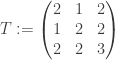
Actually, it is pretty easy to see that no other integral vector on H is closer to 


So, this group is certainly not 
Here’s a picture of the tiling of the hyperbolic plane whose symmetry group is

The center is the projection of 
(Update May 20, 2014): As galoisrepresentations points out, the fact that the field generated by traces of squares of elements is a commensurability invariant is a theorem of Alan Reid.
]]>This impression was dramatically shaken by Agol’s proof of the virtual Haken conjecture and virtual fibration conjectures in 3-manifold topology by an argument which depends for one of its key ingredients on the theory of non-positively curved cube complexes — a subject in geometric and combinatorial group theory which, while inspired by key examples in low-dimensions (especially surfaces in the hands of Scott, and graphs in the hands of Stallings), is definitely a high-dimensional theory with no obvious relations to manifolds at all. Even so, the transfer of information in this case is still from the “broad” world of group theory to the “special” world of 3-manifolds. It shows that 3-manifold topology is even richer than hitherto suspected, but it does not contradict the idea that the beautiful edifice of 3-manifold topology is an exceptional corner in the vast unstructured world of geometry.
I have just posted a paper to the arXiv, coauthored with Henry Wilton, and building on prior work I did with Alden Walker, that aims to challenge this idea. Let me quote the first couple of paragraphs of the introduction:
Geometric group theory was born in low-dimensional topology, in the collective visions of Klein, Poincaré and Dehn. Stallings used key ideas from 3-manifold topology (Dehn’s lemma, the sphere theorem) to prove theorems about free groups, and as a model for how to think about groups geometrically in general. The pillars of modern geometric group theory — (relatively) hyperbolic groups and hyperbolic Dehn filling, NPC cube complexes and their relations to LERF, the theory of JSJ splittings of groups and the structure of limit groups — all have their origins in the geometric and topological theory of 2- and 3-manifolds.
Despite these substantial and deep connections, the role of 3-manifolds in the larger world of group theory has been mainly to serve as a source of examples — of specific groups, and of rich and important phenomena and structure. Surfaces (especially Riemann surfaces) arise naturally throughout all of mathematics (and throughout science more generally), and are as ubiquitous as the complex numbers. But the conventional view is surely that 3-manifolds per se do not spontaneously arise in other areas of geometry (or mathematics more broadly) amongst the generic objects of study. We challenge this conventional view: 3-manifolds are everywhere.
The generic objects that we discuss in the paper are random groups, in the sense of Gromov. In fact, there are two models of random groups that one usually encounters in geometric group theory. First, fix a finite number k (at least 2) of generators 



Suppose we are interested in some property of a group; for instance, that it should be infinite, or torsion-free, or abelian, or whatever. For each fixed n, we get a probability law on groups, and we can ask what the probability is that our random group (with relators of length n) has the desired property. Then one takes n to infinity and looks at the way in which the probability behaves; usually we are interested in properties for which the probability goes to 1 as n goes to infinity. We say then that a random group has the desired property with overwhelming probability.
Gromov showed that there is a natural phase transition in the behavior of random groups; at any fixed density D bigger than 1/2, a random group is either trivial or isomorphic to 
So in one sense, we know what the “generic” objects look like amongst finitely generated groups. But in another sense, the answer is unsatisfying — these groups are unfamiliar, and not obviously related to the sorts of groups that we understand well, like free groups, surface groups, matrix groups, and so on. So it becomes important to try to understand the structure of subgroups of random groups; do they contain subgroups that are familiar, which we can use as key structural elements to understand the big group? and is this subgroup structure rich enough that we can hope to find similar structure in all hyperbolic groups?
In order to make progress, we must first be clear about what sorts of subgroups we are looking for. We are interested in our groups not only as algebraic objects, but as geometric objects (with respect to some choice of word metric), and it is important to look for subgroups whose intrinsic and extrinsic geometry are uniformly comparable, so that the geometry of the subgroup (which we understand) tells us something about the geometry of the ambient group (which we want to understand). Since the random group G is hyperbolic, this means looking for subgroups H which are quasiconvex. Such groups are themselves necessarily hyperbolic, and the boundary of a quasiconvex subgroup H embeds in the boundary of G. Since the boundary of G is (topologically) 1-dimensional, the same is true of H, so we are led to the natural question: what hyperbolic groups have 1-dimensional boundary?
The answer to this question is essentially known, by work of Kapovich-Kleiner. First of all, a hyperbolic group with disconnected boundary splits over a finite group, by Stallings theorem on ends. Second of all, a hyperbolic group with connected boundary with local cut points is either virtually a surface group or splits over a cyclic group, by Bowditch. So we are led to essentially four cases:
- a Cantor set; in this case, H is (virtually) free. All nonelementary hyperbolic groups contain free subgroups, by Klein’s ping-pong argument; so random groups certainly contain such subgroups;
- a circle; in this case, H is (virtually) a surface group. It is a famous open problem of Gromov whether all one-ended hyperbolic groups contain surface subgroups. A positive answer is known in a few cases: Kahn-Markovic showed that closed hyperbolic 3-manifold groups contain surface subgroups (a key ingredient in Agol’s theorem). About a year ago, Alden Walker and I showed that random groups contain surface subgroups, and these subgroups are quasiconvex;
- a Sierpinski carpet; in this case, conjecturally H is (virtually) the fundamental group of a compact hyperbolic 3-manifold with totally geodesic boundary. This conjecture more-or-less reduces (by a doubling argument) to the Cannon conjecture — that a hyperbolic group has boundary homeomorphic to the 2-sphere if and only if it is virtually the fundamental group of a closed hyperbolic 3-manifold; or
- a Menger sponge; this is the boundary of the random group itself!
In view of this classification, François Dahmani asked me (after hearing the proof of my theorem with Alden) whether random groups could contain subgroups isomorphic to the fundamental group of a compact hyperbolic 3-manifold with totally geodesic boundary. This is precisely the main theorem that Henry and I prove in the paper; explicitly:
3-Manifolds Everywhere Theorem: A random group, either in the few relators model or in the density model at any density less than 1/2, contains many quasiconvex subgroups isomorphic to the fundamental group of a compact hyperbolic 3-manifold with totally geodesic boundary.
The proof is direct — we basically show that one can directly construct a map from such a 3-manifold group into a random group (given by a random presentation) in such a way that it is very likely to be quasiconvex and injective. The argument borrows very heavily from many parts of my earlier paper with Alden, although the construction step is much more complicated.
It is possible to say something in general terms about the combinatorial construction. Our random presentation can be realized in geometric terms by building a 2-dimensional complex K, whose 1-skeleton X is a wedge of k circles (one for each generator), to which we attach
Gluing up L to produce the “spine” Z so that M(Z) is homotopic to a 3-manifold is thus the bulk of the work. The spine Z will be a 4-valent graph, and the circle L will map to Z with degree 3 (i.e. every edge of Z has 3 preimages). At each vertex of Z, 6 edges in L run over the vertex in all possible ways from one incident edge of Z to another. The figure below shows three local models; the correct local model is the third one:

The key to the construction is to glue up collections of segments in L in triples, leaving a gap of three unglued segments of some fixed length

This idea of first performing a random matching which is “almost” right, which can then be adjusted at the cost of perturbing the distribution of an almost equidistributed “sea” of predictable pieces of bounded size, so that the rest of the matching decouples into a massive number of matching problems of uniformly bounded size that can be solved once and for all — is one that has come up in several places recently, including in the papers of Kahn-Markovic and my paper with Alden mentioned above, but also in Peter Keevash’s construction of General Steiner Systems and Designs (a paper I learned of from Gil Kalai’s blog). This is an idea with remarkable power and potential, beyond the already impressive (but well-known) power of “random constructions”. And it shows that highly constrained and beautiful combinatorial and geometric objects — designs as well as 3-manifolds — can be built out of generic pieces.
So the purpose of this blog post is to advertise that I wrote a little piece of software called kleinian which uses the GLUT tools to visualize Kleinian groups (or, more accurately, interesting hyperbolic polyhedra invariant under such groups). The software can be downloaded from my github repository at
https://github.com/dannycalegari/kleinian
and then compiled from the command line with “make”. It should work out of the box on OS X; Alden Walker tells me he has successfully gotten it to compile on (Ubuntu) Linux, which required tinkering with the makefile a bit, and installing freeglut3-dev. There is a manual on the github page with a detailed description of file formats and so on.
One nice feature of the program is that the user just has to give semigroup generators for their (semi)-group, and a finite list of (hyperbolic) triangle orbits; the program then computes the Cayley graph out to some (user-specified) depth, applies the resulting set of transformations to the triangles, and renders the result. The code is available, and is licensed under the GPL, and I actively encourage anyone who wants to fork it and develop it into a more powerful tool to do so.
A few examples of output are:

universal cover of a genus 3 handlebody

universal cover of the fiber of the fibration of the figure 8 knot complement

space with Sierpinski carpet limit set invariant by super-ideal simplex reflection group
I wrote this program mainly just to produce some nice figures for a recent talk I gave at U Chicago to first-year graduate students; the talk itself can be downloaded from my webpage here. If you download this program, and enjoy using it, I would be very grateful to get feedback, or just to hear about your experience.
]]> ; thus one talks about fibered or nonfibered Kähler groups.
If X is a connected CW complex, by successively attaching cells of dimension 3 and higher to X we may obtain a CW complex Y for which the inclusion of X into Y induces an isomorphism on fundamental groups, while the universal cover of Y is contractible (i.e. Y is a 




A surjective map f from a space X to a space S with connected fibers is surjective on fundamental groups. This basically follows from the long exact sequence in homotopy groups for a fibration; more prosaically, first note that 1-manifolds in S can be lifted locally to 1-manifolds in X, then distinct lifts of endpoints of small segments can be connected in their fibers in X. A surjection 


So in a nutshell: the purpose of this blog post is to explain how the existence of isotropic subspaces in 1-dimensional cohomology of Kähler manifolds imposes very strong geometric constraints. This is true for “ordinary” cohomology on compact manifolds, and also for more exotic (i.e. 
1. Fibered Kähler groups
For a compact Kähler manifold Hodge theory gives

(recall that the notation 
![[\alpha]\cup[\beta] = 0 \in H^2(M)](https://s0.wp.com/latex.php?latex=%5B%5Calpha%5D%5Ccup%5B%5Cbeta%5D+%3D+0+%5Cin+H%5E2%28M%29&bg=ffffff&fg=333333&s=0&c=20201002)
This has the following classical application:
Theorem (Castelnuovo-de Franchis): Let M be a compact Kähler manifold, and let V be a subspace of the space of holomorphic 1-forms on M which is isotropic with respect to the pairing (on cohomology; but equivalently, on forms). Suppose that the dimension of V is at least 2. Then there exists a surjective holomorphic map f with connected fibers from M to a compact Riemann surface C of genus g such that V is pulled back by f from C.
Proof: Let 


A priori a holomorphic map to a Riemann surface defined on an open set U does not extend to M; the simplest example to think of is the holomorphic function

where x and y are the two coordinate functions. This map is well defined away from the origin, where it is indeterminate. On the other hand, as we approach the origin radially along a (complex) line, the ratio 


Now, the map 


Now suppose M is a compact Kähler manifold, and let V be a subspace of 


From this we easily deduce the following theorem of Siu-Beauville, proved originally by hard analytic methods (i.e. the theory of harmonic maps):
Corollary (Siu, Beauville): Let M be a compact Kähler manifold, and let 
Proof: A surjective map with connected fibers is surjective on fundamental groups. Conversely, a surjective map on fundamental groups pulls back 
Definition: A Kähler group is fibered if it surjects onto the fundamental group of a compact Riemann surface of genus at least 2; equivalently, if some (equivalently: every) compact Kähler manifold with that fundamental group holomorphically fibers over a compact Riemann surface of genus at least 2 with connected fibers.
Note that the condition of being fibered implies 
2. L2 cohomology
Perhaps the fundamental method in geometric group theory is to study a group via its cocompact isometric action on some (typically noncompact) space. If G is the fundamental group of a manifold M, then G acts as a deck group on the universal cover of M. The aim of geometric group theory is to perceive algebraic properties of the group G in the “global” geometry of this universal cover.
The most important tool for the study of differential forms on compact Riemannian manifolds is Hodge theory. To use this tool on noncompact manifolds one must impose additional (global) restrictions on the forms that one studies. Thus Hodge theory on noncompact manifolds is related directly not to ordinary cohomology, but to more refined, quantitative versions, of which one of the most important is
If M is a smooth Riemannian manifold (not assumed to be compact), the pointwise inner product on forms gives rise to a global inner product which is well-defined on compactly supported forms. We say that a smooth form

Now, the 



In general, the image of d is not a closed subspace (in the

The advantage of working with reduced cohomology is that there is an 


Let’s impose some reasonable global conditions on our manifold M. We say that a (complete) Riemannian manifold has bounded geometry if it satisfies the following two conditions:
- The curvature and its derivatives satisfy uniform 2-sided bounds:
for each k; and
- The injectivity radius satisfies a uniform lower bound:
everywhere.
Bounded geometry is the natural condition to impose to ensure that the manifold is “precompact” in Gromov-Hausdorff space; i.e. that for any sequence of points 

Theorem (L2 Hodge theorem): Let M be a complete Riemannian manifold with bounded geometry. Then every cohomology class in 


One subtlety is that it is no longer true that

(since a priori the forms 
On a Kähler manifold the identity 


and an 


Example: A harmonic form which is not 


3. Kähler hyperbolicity
Gromov showed that under certain geometric conditions, the reduced 

Definition: A compact Kähler manifold M is Kähler hyperbolic if the pullback 


Suppose M is Kähler hyperbolic, and let

Since 

![[L,\Delta]=0](https://s0.wp.com/latex.php?latex=%5BL%2C%5CDelta%5D%3D0&bg=ffffff&fg=333333&s=0&c=20201002)

But if V is a real vector space of dimension 2n, and 
Theorem (Gromov): If M is compact and Kähler hyperbolic, the reduced
Example: If M is any compact manifold with 


4. Calibrations
The previous section shows that 
So let’s suppose M is a compact Kähler manifold, that 


or in other words, most of the level sets 
On a Kähler manifold, the symplectic form
- it is closed; and
- it satisfies a pointwise estimate
for all real 2k-planes A, with equality if and only if A is a complex subspace.
It follows that if S is a holomorphic submanifold of complex dimension k, and S’ is a real 2k dimensional submanifold obtained from S by a compactly supported variation so that S and S’ are in the same (relative) homology class, there is an inequality

In other words, holomorphic submanifolds of Kähler manifolds are absolute volume minimizers in their homology classes (amongst compactly supported variations). From this one deduces the following:
Lemma: Let M be a Kähler manifold with bounded geometry. Then for each k there is a constant C so that if S is a complete holomorphic submanifold of complex dimension k, there is an estimate

Proof: It suffices to show that for some fixed 
But actually, the estimate follows just from the fact that S is a minimal surface. If S is a complete minimal surface of real dimension N in a Euclidean space, passing through the origin (say), then the Monotonicity Formula says that for any 

This can be proved directly by using the vanishing of the mean curvature, but there is a softer proof that 

![[0,T]](https://s0.wp.com/latex.php?latex=%5B0%2CT%5D&bg=ffffff&fg=333333&s=0&c=20201002)


It follows from this estimate that some of the fibers of 

In summary, the deck group
Now, it turns out that for a compact manifold M, the 1-dimensional 

Theorem (Gromov): Let G be a Kähler group with 
5. Ends
To apply Gromov’s theorem (and its generalizations) it is important to have some interesting examples of groups with 



taken with respect to the directed system of complements of compact subsets. If each
Now, let G be a finitely generated group. For each finite generating set we can build a Cayley graph C, which has one vertex for each element of G, and one edge for each pair of elements which differ by (right) multiplication by a generator. The graph C is locally finite and connected, and we define the space of ends of G, denoted 

The theory of ends of groups is completely understood, thanks to the work of Stallings:
Theorem (Stallings, ends of groups): Let G be a finitely generated group. Then 
if and only if G is finite;
if and only if G is virtually equal to
; and
if and only if G splits as a nontrivial amalgam or HNN extension
or
where B is finite, and G is not virtually cyclic.
Actually, the only hard part of this theorem is the third bullet; the rest is elementary, and was known to Freudenthal. The third case is equivalent to the existence of a nontrivial action of G on a tree T (which is not a line) with finite edge stabilizers. It follows that groups with infinitely many ends are non-amenable.
Now, let M be a compact Riemannian manifold, and suppose that the fundamental group G has infinitely many ends. This implies that the universal cover 


![[df]](https://s0.wp.com/latex.php?latex=%5Bdf%5D&bg=ffffff&fg=333333&s=0&c=20201002)

Now, on 

for all functions f of compact support (which are dense in
Theorem (Brooks): with notation as above, one has 
One can think of the size of 



So in conclusion, if G is a group with infinitely many ends, then reduced and ordinary
Corollary (Gromov): A Kähler group is either finite, or has 1 end.
Proof: A group with two ends is virtually equal to 
6. Ends and extensions
The arguments of Gromov can be generalized considerably. It should be remarked from the outset that at very few points in the proof of Gromov’s theorem did we use the fact that the manifold
The following is proved by Arapura-Bressler-Ramachandran:
Theorem (Arapura-Bressler-Ramachandran): Let M be a complete Kähler manifold with bounded geometry, and suppose that 


Here the subscript “ex” means the harmonic
Lemma (cup product): Let M be a complete Kähler manifold with bounded geometry, and let 

Proof: The first remark to make is that on a complete Kähler manifold with bounded geometry, any harmonic 
Now let 



Finally, if we let 

Now, the imaginary part of this is harmonic and 
It follows that the space 


At this point the following fact is extremely handy:
Proposition: Let M be a connected complex manifold (not assumed to be compact!) and 


This Proposition is Lemma 2.2 in a paper of Napier-Ramachandran, where they seem to suggest that the fact is standard, but give an elementary proof. Since the argument is local, one can write 


Anyway, once this proposition is proved, it follows that the components of the level sets of this function agree with the leaves of
Corollary: Let G be a Kähler group, and suppose there is an exact sequence

where 

Proof: Let M be a compact Kähler manifold with fundamental group G, and let N be the cover with fundamental group K. Then H acts on N cocompactly, and it follows that 



Example (Arapura): The pure braid group 

(Updated November 26: added references)
]]>Based on this brief interaction, Volodya asked me to give a talk on the subject in the Geometric Langlands seminar. On the face of it, this was a ridiculous request, in a department that contains Kevin Corlette and Madhav Nori, both of whom are world experts on the subject of fundamental groups of Kähler manifolds. But I agreed to the request, on the basis that I (at least!) would get a lot out of preparing for the talk, even if nobody else did.
Anyway, I ended up giving two talks for a total of about 5 hours in the seminar in successive weeks, and in the course of preparing for these talks I learned a lot about fundamental groups of Kähler manifolds. Most of the standard accounts of this material are aimed at people whose background is quite far from mine; so I thought it would be useful to describe, in a leisurely fashion, and in terms that I find more comfortable, some elements of this theory over the course of a few blog posts, starting with this one.
This post is a gentle introduction to the (mostly local) geometry of Kähler manifolds themselves. Everything I say here is completely standard, and can be found in all the standard references (e.g. Griffiths and Harris; another very nice reference is Lectures on Kähler geometry by Moroianu). The main reason to go through this material so explicitly is to make transparent what parts of the theory still hold, and what need to be modified, when one considers the geometry of noncompact Kähler manifolds, especially those arising as (infinite) covering spaces of compact ones; but this point will need to wait to a subsequent post to be validated. The definition of a Kähler manifold has two parts: a linear algebra condition, and an integrability condition. We discuss these in turn.
1. Linear algebra
A Euclidean structure on V is just a positive definite symmetric inner product. After a change of basis, we can identify V with 
A complex structure on V is just a linear endomorphism J which squares to -1. Since V is real, the eigenvalues of J are i and -i, each occurring with multiplicity equal to half the dimension of V (so the dimension of V had better be even). The endomorphism J extends by linearity to a complex-linear endomorphism of the complexification 


which we write as v = v’ + v”, where v’ is in V’ and v” in V”. The map from V to V’ taking v to v’ takes the operator J to multiplication by i, and identifies V with the complex vector space V’. Thus the group of (real) linear transformations of V preserving J is isomorphic to the complex linear group 
A symplectic structure on V is a non-degenerate antisymmetric inner product. This means a bilinear map 




Thus the group of linear transformations of V preserving a symplectic form is isomorphic to the symplectic group 
Thus, a real vector space V of even dimension can admit a Euclidean structure, a complex structure, and a symplectic structure. These three structures are said to be compatible if they satisfy

for any two vectors v and w. Note that any two of these conditions implies the third. At the level of Lie groups, compatibility can be expressed in terms of the intersection of the stabilizers of the three structures:
,
, and

Thus any two of the three structures (Euclidean, complex, symplectic) are compatible if the intersections of their stabilizers are isomorphic to a copy of the unitary group. The unitary group is the group of complex linear automorphisms of a complex vector space preserving a Hermitian form. This arises in the following way: a symmetric definite inner product on V induces a symmetric complex bilinear pairing on 

The restriction of H defines a Hermitian pairing on V’; identifying V’ with V gives a complex valued (real!) linear pairing on V whose real part is the given inner product, and whose imaginary part is the given symplectic form.
2. Integrability, and Kähler manifolds
Now let M be a real 2n-dimensional manifold. A Riemannian metric on M is a smoothly varying choice of positive definite inner product on the tangent spaces to M at each point. An almost complex structure is a smoothly varying choice of complex structure on the tangent spaces to M at each point. An almost symplectic structure is a smoothly varying choice of symplectic structure on the tangent spaces to M at each point. Expressed in terms of tensors, the Riemannian metric is a symmetric 2-form g, the almost complex structure is a section J of 
The field of endomorphisms J determines a splitting of the complexification of T M into T’M and T”M pointwise. An almost complex structure is integrable if the bundle T’M is integrable; i.e. if the Lie bracket of two sections of this bundle is also a section of this bundle. Such a structure gives M the structure of a complex manifold, and is equivalent to the existence of an atlas of charts modeled on 
Definition: A real 2n-manifold is Kähler if it admits a Riemannian metric, a complex structure, and a symplectic structure which are compatible at every point.
Every smooth manifold admits a Riemannian metric, and a manifold admits an almost complex structure if and only if it admits an almost symplectic structure (and either condition can be expressed in terms of properties of the characteristic classes of the tangent bundle). But the condition of integrability is much more subtle (at least for closed manifolds; any almost symplectic structure on an open manifold is homotopic to an integrable one).
Definition: A finitely presented group G is a Kähler group if it is equal to the fundamental group of a closed (i.e. compact without boundary) Kähler manifold.
Note that since the Kähler condition is preserved under taking covers and products, the class of Kähler groups is closed under passing to finite index subgroups, and taking (finite) products.
On any complex manifold we can choose coordinates locally

are sections of T’M. The dual 1-forms 


A Hermitian metric H determines such an h by 


which is nondegenerate pointwise (i.e. 

Now, on a Riemannian manifold, one may always locally choose geodesic normal coordinates, centered at any given point, and in which the metric tensor g osculates the Euclidean metric (in these coordinates) to first order; i.e.

where O(2) denotes terms vanishing to at least 2nd order at the center. One way to find such coordinates is to take Euclidean coordinates on the tangent space at the center point, and push them forward by the exponential map. For a Hermitian metric on a complex manifold, one can choose holomorphic local coordinates with this property if and only if the metric is Kähler; that is,
Proposition: A Hemitian metric h on a complex manifold M is Kähler if and only if there are local holomorphic coordinates at any point for which

One direction of this proposition is easy: for such a choice of coordinates, the form
3. Dolbeault Cohomology
On any almost complex manifold M, the decomposition of the complexified tangent space into T’ and T” gives rise to a decomposition of its dual space, and we can decompose the space of complex-valued n-forms 


If the almost complex structure is integrable, we can choose holomorphic coordinates 

Thus (by differentiating in the usual way) we see that 





So, for example, on a Kähler manifold, the symplectic form 


Since 


Dolbeault Theorem: for any complex manifold M, there is an isomorphism 
In particular, 
From the Dolbeault Lemma one can also deduce the following:
Local 

If 
4. Hodge theory
A Riemannian metric on a manifold induces inner products on the fibers of all natural bundles over the manifold, including the cotangent bundle and its tensor and exterior powers. On a Riemannian manifold of dimension n there is a Hodge star 

and we get an inner product on forms by 
The Hodge star operator satisfies the identity 



A form 

where the summands are orthogonal. One deduces that there is an isomorphism 
Again on a compact manifold, it turns out that

One proves this by integration by parts, since the difference between the two sides differs by the integral of an exact form. Thus, a form is harmonic if and only if it is closed and coclosed (i.e. in the kernel of
On a complex manifold we extend Hodge star to complex-valued forms so that 


and Laplace operators

On a Kähler manifold, a surprisingly difficult local calculation gives the crucial identity

and therefore the (p,q) components of a harmonic p+q form are themselves harmonic!
Explicitly, we have a Hodge decomposition for (p,q)-forms using 

where 


One immediate miracle is the fact that on a Kähler manifold, holomorphic forms are harmonic. Explicitly, a (p,q)-form 


proved as before by integrating by parts. But for a (p,0) form, the operator 

One reason to be impressed by this miracle is that the condition of being harmonic depends very delicately on the choice of a Riemannian metric, whereas the condition of being holomorphic depends only on the complex structure. Usually, the harmonic forms are only as regular as the metric; a Kähler metric is typically only smooth (one sees this by starting with one Kähler form and perturbing it by adding something of the form
Example: Let S be a closed Riemann surface of genus at least 2. There is a natural complex structure on S, and any Riemannian metric can be averaged under J to define a Hermitian metric, whose associated 2-form is automatically closed because S is 2-dimensional (as a real manifold). So S is Kähler. Let ![[\alpha] \wedge [\beta]](https://s0.wp.com/latex.php?latex=%5B%5Calpha%5D+%5Cwedge+%5B%5Cbeta%5D&bg=ffffff&fg=333333&s=0&c=20201002)


There are further symmetries of the various operators under consideration. Complex conjugation commutes with 



The last fact follows because the symplectic form
Example: finitely generated free groups are not Kähler, since they all have finite index subgroups with 

5. Hard Lefschetz Theorem
One consequence of Hodge theory is so special it deserves to be singled out. Define an operator 





Then with these definitions one has the Kähler identities:
![[L,\delta] = d^c, \quad [\Lambda,d] = -\delta^c, \quad [L,d] = 0, \quad [\Lambda,\delta]=0](https://s0.wp.com/latex.php?latex=%5BL%2C%5Cdelta%5D+%3D+d%5Ec%2C+%5Cquad+%5B%5CLambda%2Cd%5D+%3D+-%5Cdelta%5Ec%2C+%5Cquad+%5BL%2Cd%5D+%3D+0%2C+%5Cquad+%5B%5CLambda%2C%5Cdelta%5D%3D0&bg=ffffff&fg=333333&s=0&c=20201002)
From this one can deduce another miracle: ![[L,\Delta]=[\Lambda,\Delta]=0](https://s0.wp.com/latex.php?latex=%5BL%2C%5CDelta%5D%3D%5B%5CLambda%2C%5CDelta%5D%3D0&bg=ffffff&fg=333333&s=0&c=20201002)


The commutator ![h:=[L,\Lambda]](https://s0.wp.com/latex.php?latex=h%3A%3D%5BL%2C%5CLambda%5D&bg=ffffff&fg=333333&s=0&c=20201002)

![[h,L] = -2L](https://s0.wp.com/latex.php?latex=%5Bh%2CL%5D+%3D+-2L&bg=ffffff&fg=333333&s=0&c=20201002)
![[h,\Lambda] = 2\Lambda](https://s0.wp.com/latex.php?latex=%5Bh%2C%5CLambda%5D+%3D+2%5CLambda&bg=ffffff&fg=333333&s=0&c=20201002)


Hard Lefschetz Theorem: The map 



Ordinary Poincare duality on a closed oriented 2n-manifold says that the pairing

is nondegenerate. Combining this with the Hard Lefschetz Theorem we deduce the Corollary:
Corollary: For all 


is nondegenerate.
The special case 

Example: if 

6. Holonomy
On any Riemannian manifold there is a unique connection 
The Kähler condition for a Riemannian metric on a complex manifold is equivalent to equality for the Levi-Civita connection and the Chern connection on the tangent bundle. This is equivalent to the condition that the tensors J and 
The coincidence of the Levi-Civita and Chern connections simplify the expression for the curvature of many natural bundles on a Kähler manifold. The most important example is the following. Let K be the canonical bundle on M (i.e.\/ the holomorphic line bundle whose holomorphic local sections are holomorphic n-forms where n is the dimension of M). Let 


Some further remarks are in order:
- The Kähler condition already implies that
lemma says that it can be expressed locally in the form
(expressed in local coordinates), then
.
- Since the canonical bundle (as a holomorphic bundle, but ignoring its Hermitian metric) only depends on the complex structure, the form
represents the first Chern class
. Conversely, it is a famous theorem of Yau that on a Kähler manifold, for every 2-form
there is a unique Kähler metric for which
. As a corollary, M admits a Ricci-flat Kähler metric if and only if
.
- A Kähler metric is Ricci-flat if and only if the holonomy is a subgroup of
. Such a manifold is the product (locally) of a flat manifold and compact pieces of complex dimension
and with irreducible holonomy exactly equal to
. These irreducible factors are called Calabi-Yau manifolds. A Calabi-Yau has a compact universal cover, and therefore its fundamental group is finite.
7. Weitzenböck formulae
Suppose 



for some 

The integral of the first term is non-negative, and strictly positive unless 
Depending on the context, the operators
Definition: a real (1,1)-form 


A line bundle is positive if and only if its first Chern class is positive (this can be proved by adjusting the curvature of the bundle by adjusting the metric, using the global form of the
Example: The Kähler form of a Kähler manifold is positive. The Ricci form of a Kähler manifold with positive Ricci curvature (in the usual sense) is positive. The canonical bundle of a Kähler manifold has curvature 
Kodaira applied a Weitzenböck formula 
Proposition (Kodaira): Let L be a positive holomorphic line bundle on a compact Kähler manifold M. Then there is a positive integer 



From this one deduces the famous
Theorem (Kodaira embedding): If L is positive, then 
Proof: For any holomorphic bundle E, the holomorphic Euler characteristic

can be computed from the Atiyah-Singer index theorem by the formula

where Td is the Todd class, and ch is the Chern character, both formal power series in the Chern classes of the tangent bundle and of E respectively. All we need to know about the Todd class is that it starts with 1 in dimension 0. For a line bundle L we have

Since L is positive, 


(Appealing to the Atiyah-Singer index theorem is a cheap way to get nonvanishing of 

8. Lefschetz hyperplane theorem
If M is a (complex) n dimensional smooth projective variety in 


In fact this statement about homology has a refinement at the level of homotopy, which can be proved by Morse theory, as observed by Bott.
Theorem (Lefschetz hyperplane): Let M be a complex n dimensional smooth projective variety, and let V be its intersection with a generic hyperplane. Then 


Bott showed how to build a Morse function on 

In particular, it follows that any group which can arise as the fundamental group of a smooth projective variety, can arise as the fundamental group of a smooth projective variety of complex dimension at most 2.
9. Examples of Kähler manifolds
Example (


Example (nonsingular projective varieties): the Fubini-Study metric defines compatible complex and symplectic structures on every complex subspace of the tangent space at each point of
Example (bounded domains and their quotients): A bounded domain U in 


Example (Riemann surfaces): Riemann surfaces are Kähler manifolds, and so are their products. Atiyah–Kodaira found examples of nontrivial algebraic surface bundles over surfaces, which can be obtained as branched covers of products over certain sections.
Example (


Example (Voisin): Voisin found examples, in every complex dimension 
(Updated November 21: added several references)
]]>
Remember that a conformal map is one which infinitesimally takes round spheres to round spheres. That is, it is angle preserving, at least infinitesimally. In particular, it is smooth. So let’s think about a conformal map 
It is a classical fact, proved by Meusnier in 1785, that an umbilical surface in Euclidean space is locally a piece of a plane or sphere. One way to see this is as follows. Let G denote the Gauss map, so that the condition of being umbilical at a point says exactly that dG is a multiple of the identity at that point (note: we are using here in the usual way the canonical identification between the tangent space to the surface and the tangent space to the round sphere at the image of the Gauss map at each point to think of dG as a map from the tangent space to itself). So if a surface is totally umbilical, there is some function f so that dG is equal to f times the identity at each point. Let’s denote by X a local chart on the surface giving rise to local coordinates u and v. So the definition of f says in this notation that 


Since u and v are local coordinates, their tangent vectors 


Once we know that a conformal map takes subsets of planes and round spheres to subsets of planes and round spheres, we can intersect these planes and spheres with perpendicular planes and spheres to see that it takes straight segments and arcs of round circles to straight segments and arcs of round circles. From this it is easy to deduce Liouville’s theorem.
By the way, I strongly suspect that the connection between totally umbilical surfaces and conformal maps is classical and well-known, and for all I know this was how Liouville thought of his theorem in the first place.
]]>
The story starts with the following classical theorem, usually called the Jordan curve theorem, or Jordan-Schoenflies theorem:
Theorem (Jordan-Schoenflies): Let P be a simple closed curve in the plane. Then its complement has a unique bounded component, whose closure is homeomorphic to the disk in such a way that P becomes the boundary of the disk.
In order to make the relationship between the two complementary components more symmetric, one could express this theorem by saying that a simple closed curve P in the 2-sphere separates the 2-sphere into two components X and Y, each of which has closure homeomorphic to a disk with P as the boundary.
Based on this simple but powerful fact in dimension 2, Schoenflies asked: is it true for every n that every n-sphere P in the (n+1)-sphere splits the (n+1)-sphere into two standard (n+1)-balls?
For n=2 (i.e. 2-spheres in the 3-sphere) Alexander showed in 1924 that the answer is no: there is an embedding of the 2-sphere in the 3-sphere for which a complementary region is not homeomorphic to a ball (in fact, it it not even simply-connected). This counterexample is the well-known Alexander’s horned sphere, illustrated in the figure below:

For the example indicated in the figure, the “outside” region is not homeomorphic to a ball, and in fact its fundamental group is infinite. Interestingly enough, Alexander duality implies that the complementary regions have the homology of a ball, and the fundamental group, though infinite, is therefore perfect (i.e. every element can be expressed as a product of commutators).
Alexander’s sphere has a Cantor set of “wild” points where the sphere is not locally flat; i.e. where there is no neighborhood U in which the 2-sphere sits in the 3-sphere locally like a flat plane in 3-space. So Schoenflies question was modified to ask about locally flat n-spheres in the (n+1)-sphere. Perhaps surprisingly, the answer to this modified question turns out to be yes:
Theorem (M. Brown 1960): Every locally flat n-sphere in the (n+1)-sphere bounds a standard (n+1)-ball.
Brown’s argument depends on a certain remarkably simple infinite construction, introduced by Barry Mazur, and called the Mazur swindle. Morally, the argument is as follows. If some locally flat sphere were not standard, it would exhibit the (n+1)-sphere S as the connect sum of two manifolds X and Y, neither of which were themselves (n+1)-spheres; i.e. X#Y=S. But then we can form an infinite connect sum X#Y#X#Y#X#Y# . . . which is still homeomorphic to S. On the other hand, since Y#X=S we can bracket this infinite sum as X#(Y#X#Y#X# . . .)=X#S=X, so X=S contrary to hypothesis.
Because of the infinite nature of this construction, the resulting manifolds are only shown to be topologically standard, and not smoothly standard, even if P is smooth. So it is natural to wonder whether every smooth n-sphere in the (n+1)-sphere bounds a smooth (n+1)-ball. This is a question where the dimension is very important. For n=2, this is a classical theorem of Alexander:
Theorem (Alexander 1924): Every smooth 2-sphere in the 3-sphere bounds a smoothly standard 3-ball.
This is proved by a kind of Morse theory argument. We let P be the 2-sphere in question, and we look at its intersection with a foliation of the 3-sphere (minus the north/south poles, and assume by general position that all but finitely many planes are transverse to P, and at the exceptional level sets we have a standard Morse critical point – a local minimum, a local maximum, or a saddle. At a non-critical level, the intersection of the plane with P is a compact smooth 1-manifold, and hence a collection of circles. By the Jordan-Schoenflies theorem, some innermost circle bounds a disk, and one can cut along this disk to produce two simpler spheres which, by induction, bound balls. Thinking about how these balls are glued together along the disk we cut along proves the theorem. The base step of the induction involves looking at pieces with two critical points, which are analyzed directly. qed
In high enough dimensions too, the question is known to have a positive answer:
Theorem (S. Smale 1960): For n at least 4, every smooth n-sphere in the (n+1)-sphere bounds a smoothly standard (n+1)-ball.
This follows (at least for n>4) from Smale’s h-cobordism Theorem, which says that if W is a smooth cobordism between two simply-connected manifolds U and V which are both deformation retracts of W, then W is a smooth product UxI, and therefore U and V are diffeomorphic. A smooth n-sphere in the (n+1)-sphere is cobordant to a tiny standard sphere around a point, and therefore the region between them is a smooth product, and when capped off with a tiny ball around a point, is a smooth ball.
The last remaining case is n=3; this is the
Schoenflies Conjecture: Every smooth 3-sphere P in the 4-sphere bounds a smoothly standard 4-ball.
As a technical point: of course, we want P to bound a smoothly standard 4-ball on both sides. But it turns out that if one side is smoothly standard, the other side is too, since (for example), we could shrink one side down (by a smooth isotopy) to a very small, round ball in a small coordinate patch where a Riemannian metric looks almost flat, and recognize its complement as a standard smooth ball once it is small enough.
OK, let’s get started! It is natural to try to reproduce Alexander’s argument one dimension lower, and consider the intersections of P with a foliation of the 4-sphere minus the north/south poles by 3-spheres of constant “latitude”. We can put P into general position, so that the height function defining these level sets is Morse, and put the critical points on distinct levels in increasing index; a technical improvement due to Kearton-Lickorish says that we can arrange for all handles to be horizontal (ie contained in a level sphere), and for all collars (between handles) to be vertical.
By Alexander duality, P divides the 4-sphere into two submanifolds X and Y (Marty had the clever mnemonic that one should think of these as the Xterior and Ynterior), each with the homology of a 4-ball (actually, by Brown, we even know that they are homeomorphic to 4-balls, but perhaps not diffeomorphic). As we build up P by a handle decomposition, we can also imagine that we are building up X and Y at the same time. The effect on X and Y of attaching a handle to P depends on which “side” of P the handle is added (in its level 3-sphere); one has the
Rising Water Principle: adding a 3-dimensional i-handle to P on the Y side has no effect on Y, but adds a 4-dimensional i-handle to X (and vice-versa).
This is perhaps a bit counter-intuitive, unless one thinks of a “4-d printer”, building up X and Y as we go. During the collar regions between critical levels, the printer adds layer after layer to the “top” of X and the “top” of Y, building them higher, but not changing their diffeomorphism type. Adding an i-handle to the Y side has the effect of putting a “cap” on the top of some subset of Y; above this level, the printer lays down material on Y only above the part in the complement of this “cap”. From this point of view it is clear that the topology of Y is not changing – we are just adding a product collar on the top of some subset of the top face. But on the X side we are adding a new “bridge” running over the i-handle, which is unsupported on lower levels.

This is illustrated schematically (and one dimension lower) in the figure above. The Xterior is in red, and the Ynterior in blue. At some level, a (2-dimensional) 1-handle is added on the Ynterior side (the green square in the second figure). Above this level, the effect on the Xterior is to add a (3-dimensional) 1-handle, while the effect on the Ynterior is nothing.
There are also two kinds of “duality” to think about: the core of an “ascending” i handle in P can be “turned upside down” to be the cocore of a “descending” 3-i handle in P. But an i handle in P corresponds to an i handle in X or Y (depending on whether it is on the Y or the X side), so when it is turned upside-down in corresponds to a descending 4-i handle in X or Y.
Marty gave a nice example to illustrate these ideas. Suppose P can be built in such a way that all the (3-dimensional) 0 and 1 handles are attached on the X side. If we turn this picture upside down, a 0 handle on the X side becomes a 3 handle on the Y side, and a 1 handle on the X side becomes a 2 handle on the Y. side. So turning the picture upside down, Y is built without any (4-dimensional) 2 or 3 handles; i.e. it is made just from 0 and 1 handles. But this means Y is diffeomorphic to a thickened neighborhood of a graph, and since it is homeomorphic to a 4-ball (by Brown’s theorem), it is diffeomorphic to a thickened neighborhood of a tree, and hence is standard.
One of the first observations to make is that if we cut P along a surface H above all the 0 and 1 handles, and below all the 2 and 3 handles, then the two sides of H in P are actually handlebodies, and H is a Heegaard surface. Every Heegaard splitting of the 3-sphere is standard (by an old theorem of Haken), so this is quite reassuring. The genus of H is called the genus of the embedding. An embedding P is said to be a Heegaard embedding if every (nonsingular) level set is a Heegaard surface (not just the ones between the 1 and the 2 handles). A recent preprint of Agol-Freedman shows that every embedding can be isotoped to a Heegaard embedding, possibly at the cost of raising the genus dramatically.
It is natural to try to get some insight into the Schoenflies conjecture by restricting attention to a specific (low) genus. Marty Scharlemann famously proved the conjecture for genus at most 2; his paper appeared in the journal Topology in 1984. Something that Marty emphasized is the (a priori unexpected) fact that (hard) 3-manifold topology can be used to get insight in the Schoenflies conjecture, at least in the low genus case. For example, suppose P is a smooth 3-sphere in the 4-sphere and (with increasing height function) all 0 and 1 handles are attached on the X side. It follow that X can be built using only 2 and 3 handles. Turning the handle decomposition of X upside down, we see that X can be built using only 1 and 2 handles. If there is only one 1 handle and canceling 2 handle, then after attaching the 1 handle X is a circle times 3-ball, with boundary a circle times 2-sphere, and then the result of attaching a 2-handle is to do 0-framed surgery on a knot in the boundary circle times 2-sphere in such a way as to obtain the 3-sphere. Turning the handle decomposition of this 3-sphere upside down, we can say conversely that a circle times 2-sphere is obtained by 0 frame surgery a knot K (the co-core of the 2 handle in X) in the 3-sphere. Now, the famous Property R conjecture, proved in 1987 by Gabai, says that if 0-framed surgery on a knot K in the 3-sphere gives rise to a circle times 2-sphere, then K was the unknot. This shows that X is standard, and therefore Y too, and therefore P.
In general, knowing that X is built only from 1 and 2 handles is not known to be sufficient to show that X is standard. In the particular context of this example, one can get around this by studying the handle decomposition of Y: if we turn the original Morse function upside down, all 2 and 3 handles of P are attached on the Y side, so Y is built only from 0 and 1 handles. Any 4-manifold built from 0 and 1 handles is a smooth thickening of a graph; if it is contractible, the graph is a tree, and the 4-manifold (i.e. Y) is the smooth 4-ball. So in this particular case, we find a shortcut to the proof, bypassing the need for property R in this case.
But the idea of using 3-manifold topology to tackle Schoenflies is too good to pass up, and in fact, a certain purely 3-dimensional generalization of Property R would imply the Schoenflies conjecture. We explain how.
We have a smooth 3-sphere P in the 4-sphere, and to show it is standard it suffices to show that the two sides X and Y are standard 4-balls. In fact, just showing that one of them is standard implies that the other is, and that P is standard. Suppose that we somehow have some completely different smooth 3-sphere P’ in the 4-sphere, with sides X’ and Y’, and suppose we know that X and X’ are diffeomorphic (but a priori we don’t know anything about the relationship of Y and Y’). If we could show that X’ was standard, then of course X would be standard, and therefore also Y, and P. How might we find such a 3-sphere P’? Remember, the handles attached on the X side do not affect the topology of X. So if we build up P’ with the same abstract handle decomposition as P, attaching the handles on the Y side in the “same” way, but the handles on the X side in a possibly different way, we will construct X’ and Y’ for which we know that X and X’ are diffeomorphic, without immediately knowing anything about Y and Y’.
This new 3-sphere P’, with the same exterior as P, is called a reimbedding. Marty showed that for a genus 2 splitting, reimbedding can always make one side (say Y’) a handlebody. Just as above, a handlebody is always standard, so Y’ is standard, and therefore so is X’, and therefore X, and therefore Y, and therefore P.
It is worth remarking that reimbedding circumvents one natural drawback in a naive approach on the Schoenflies conjecture. Suppose one wanted to show directly that any smooth 3-sphere P was standard, by performing some canonical sequence of simplifying moves on P, ultimately obtaining a standard round 3-sphere. For instance, one could hope to find a flow which gradually straightened out the kinks, making P flatter and flatter until it could be recognized. The existence of such a flow would prove more than just Schoenflies: it would prove not just that the space of smooth (oriented) embeddings of the 3-sphere in the 4-sphere is path-connected (which is another reformulation of Schoenflies) but that its homotopy type was that of SO(4), the space of embeddings of round 3-spheres in the round 4-sphere. By contrast, reimbedding just jumps magically from one point in the space of embeddings to another, and if the Schoenflies conjecture were true, one would know that the two points were joined by a path, but without having to choose an explicit path from one to the other.
Let’s return to Schoenflies. Our original morse function has handles in increasing order, so we can always arrange to find some level 3-sphere with the 0 and 1 handles below, and the 2 and 3 handles above. This 3-sphere splits X into two sides, which are both 4-dimensional handlebodies. Suppose one further knew that the intersection of X with this level 3-sphere was itself a 3-dimensional handlebody. Then X could be represented as a Heegaard union. This implies (by a direct argument) that X admits a handle decomposition with only 1 and 2 handles. Is such an X a smooth 4-ball? By looking at the boundary of X in the dual handle decomposition, we see this is equivalent to a 3-dimensional question:
Generalized Property R Conjecture: if surgery on an n-component link L in the 3-sphere gives a connect sum of n circle times 2-spheres, can L be transformed into the unlink by handle slides?
It is known that this conjecture would imply Schoenflies for embeddings P with a single minimum or maximum (this follows from a recent result of Agol-Freedman; for details see their preprint) . Unfortunately, it seems likely that this conjecture is false: Gompf produced an example of a genus 4 splitting of the 3-sphere in the 4-sphere which gives the fundamental group of X the following presentation of the trivial group:


Generalized Property R would imply that this presentation could be reduced to the trivial presentation of the trivial group by a sequence of Andrews-Curtis moves; i.e. Nielsen transformations and conjugation of relators. The Andrews-Curtis Conjecture says that every balanced presentation of the trivial group can be reduced to a trivial presentation (with the same number of generators and relations) by Andrews-Curtis moves, but this conjecture is widely believed to be false, and the presentation above is widely considered to be a premier candidate counterexample.
One can try to weaken this Generalized Property R conjecture by allowing extra kinds of moves, for instance stabilization, corresponding to adding canceling 1-2 handle pairs or canceling 2-3 handle pairs at the level of X. Are these Weak Generalized Property R Conjectures true or false? Let’s find out!
(Update 10/18/13: made a couple of corrections due to Marty Scharlemann)
]]>I remember seeing my first cube some time in early 1980; my Dad brought one home from work. He said I could have a play with it if I was careful not to scramble it (of course, I scrambled it). After a couple of hours of frustration trying to restore the initial state, I gave up and went to bed. In the morning the cube had been solved – I remember being pretty impressed with Dad for this (later he admitted that he had just taken the pieces out of their sockets). Within a year, Rubik’s cube fever had taken over – my Mum bought me a little book explaining how to solve the cube, and I memorized a small list of moves. I remember taking part in an “under 10” cube-solving competition; in the heat of the moment, I panicked and got stuck with only two layers done (since there were only two competitors, I came second anyway, and won a prize: a vinyl single of the Barron Knights performing “Mr. Rubik”). The solution in the book was a procedure for completing the cube layer by layer, by judiciously applying in order some sequence of operations, each of which had a precise effect on only a small number of cubelets, leaving the others untouched. In retrospect I find it a bit surprising – in view of how much effort I put into memorizing sequences, reproducing patterns (from the book), and trying to improve my speed – that I never had the curiosity to wonder how someone had come up with this list of “magic” operations in the first place. At the time it seemed a baffling mystery, and I wouldn’t have known where to get started to come up with such moves on my own. So the appearance of my kids playing with a cube 33 years later is the perfect opportunity for me to go back and work out a solution from first principles.
The one useful item I remember from that book was the notation for the cube operations; if we orient the cube in a particular way, and label the faces as up, down, front, back, left, right (in the obvious way), then an anticlockwise twist of one of these faces is denoted by a lower case letter u,d,f,b,l,r and a clockwise twist by the corresponding upper case letter U,D,F,B,L,R. Thus a sequence of moves – and its effect on a cube (in solved initial state) is illustrated in the following figure:

There is nothing special about the sequence RuRLdBBFRulBDD; the idea is just to observe how scrambled the cube can become with the application of a very small number of moves.
The first step of the solution is to “build a layer” – i.e. to get all the cubelets with some given color into the correct position and orientation. This can be done quite easily – first get the “edge cubelets” (those which have two free faces) into place, then the “vertex cubelets”. I think this really is something that can be achieved just by a bit of mucking about, and if you have never played with a cube before, I encourage you to get one, play around with it, and try to build a layer, just to see how easy it is (if a physical cube is hard to come by, you can always play around with the .eps code that generated these figures; see the end of the post). In fact, exactly the same techniques will let you put any four edge cubelets and any four vertex cubelets together in a face, in any orientation, providing you don’t care about the effect on the rest of the cube. This latter observation may not seem particularly useful at this stage, but in fact it is the key to a complete solution; for the sake of notation, let’s refer to this step as setting up a face.
Now, having built the first layer, the next step is to build the second layer. There are four edge cubelets that need to be positioned in the second layer; if the first layer is intact, these cubelets are either in the second layer but in the wrong position or orientation, or they are in the third layer. So it suffices to work out how to swap a cubelet from the second layer with one in the third layer – without disturbing the rest of the first or second layers, of course. Well, as an intermediate step, suppose we can swap a cubelet from the second layer with one in the third layer, putting no restrictions on what the effect is on the first or second layer. That’s easy – it’s just the operation of setting up a face. So we can find some sequence of moves that does what we want – call it s – and then survey the result. After performing s, the two edge cubelets that we want to interchange are both in the third layer, and everything else in the third layer was there before performing s. So let’s just twist the third layer (by some power of the “U” move) and replace the cubelet from the second layer with the cubelet from the third layer we want to replace it with. Now here’s the trick: follow that by performing S – the inverse of the operation s. The net result is the operation sUS – a conjugate of U. What is its effect? Well, the operation U itself just permutes the eight cubelets in the top layer (nine including the center, which is fixed of course). So any conjugate of U will also permute just eight cubelets. Which eight? Well, the eight which are in the third layer after performing s – i.e. 7 cubelets from the initial third layer, and the cubelet from the second layer we want to swap. Thus sUS has the effect of swapping one cubelet between the second and third layer, while leaving the remainder of the second and first layers intact, which is exactly what we want. Some experimentation gives a short recipe for an operation of the form s; the result is illustrated in the next figure:

The third layer can be solved by a similar principle. Consider a setting up a face operation s which takes the cubelets in the third layer and scrambles them in a precise way – e.g. by interchanging two edge or vertex cubelets, or changing the orientation of one edge or vertex cubelet. This has some (unpredictable) effect on the first two layers, mucking them up somehow. But the commutator of s and U – i.e. the operation sUSu – will unscramble the first two layers, putting them back as they were, since the support of U is the third layer, and therefore U commutes with any permutation of the first two layers. The effect on the third layer is relatively easy to predict; in the cases described above, it will cyclically permute three edge or vertex cubelets, or change the orientation of two edge or vertex cubelets respectively. These four moves, used in concert, can unscramble the third layer; here’s an explicit example (in this example, one of the moves on edge cubelets affects the vertex cubelets, so the edge cubelets should be put into the correct location and orientation first, and then the vertex cubelets):

There is no claim that these operations are “optimal”; they’re the first thing I came up with when I worked this out last night. Note that these operations do not allow you to set the third face up in an arbitrary way while keeping the first two faces fixed; this is because the allowable operations of the Rubik’s cube do not generate the full group of permutations of the oriented cubelets (even conditioned on taking vertex cubelets to vertex cubelets and edge cubelets to edge cubelets). I leave it as an exercise in finite group theory to show that the operations described above allow one to unscramble the cube from any configuration in which it can be unscrambled by legal moves.
That’s it! That’s the whole solution. Similar ideas make it easy to solve variations on the cube (e.g. 4x4x4, cubelets with pictures on the faces, tetrahedra, etc.). And it was quite gratifying to see Anna and Lisa so excited to discover the solved cube this morning (and to know that I hadn’t cheated!)
If you want to play with the .eps code that generated these figures, I’ve attached it at the end (yes, I know it’s a hack):
%!PS-Adobe-2.0 EPSF-2.0

%%BoundingBox: 0 0 300 300

gsave

100 100 scale

1 100 div setlinewidth

1 setlinejoin

1.5 1.5 translate

/Helvetica findfont

0.1 scalefont

setfont

/square{6 dict begin

/c exch def

/k exch def

/j exch def

/i exch def

/xc i 2 mul 2 sub j 3 div add def

/yc k 3 div def

c 0 eq {

0 0 0.7 setrgbcolor

} {

c 1 eq {

0.8 0 0 setrgbcolor

} {

c 2 eq {

1 1 0 setrgbcolor

} {

c 3 eq {

0.9 0.9 0.9 setrgbcolor

} {

c 4 eq {

1 0.6 0.2 setrgbcolor

} {

0 0.5 0 setrgbcolor

} ifelse

} ifelse

} ifelse

} ifelse

} ifelse

i 0 eq {

% i=0

newpath

0 0.28867513459481 j mul add -1 0.166666666666 j mul add 0.33333333333333 k mul add moveto

0.28867513459481 0.28867513459481 j mul add -0.8333333333333 0.166666666666 j mul add 0.33333333333333 k mul add lineto

0.28867513459481 0.28867513459481 j mul add -0.5 0.166666666666 j mul add 0.33333333333333 k mul add lineto

0 0.28867513459481 j mul add -0.66666666666 0.166666666666 j mul add 0.33333333333333 k mul add lineto

closepath

fill

stroke

} {

i 1 eq {

% i=1

newpath

0 0.28867513459481 j mul add 0.28867513459481 k mul sub 0 0.166666666666 j mul add 0.166666666666 k mul add moveto

0.28867513459481 0.28867513459481 j mul add 0.28867513459481 k mul sub 0.166666666666 0.166666666666 j mul add 0.166666666666 k mul add lineto

0 0.28867513459481 j mul add 0.28867513459481 k mul sub 0.3333333333 0.166666666666 j mul add 0.166666666666 k mul add lineto

-0.28867513459481 0.28867513459481 j mul add 0.28867513459481 k mul sub 0.166666666666 0.166666666666 j mul add 0.166666666666 k mul add lineto

closepath

fill

stroke

} {

i 2 eq {

% i=2

newpath

-0.86602540378444 0.28867513459481 j mul add -0.5 0.166666666666 j mul sub 0.33333333333 k mul add moveto

-0.86602540378444 0.28867513459481 add 0.28867513459481 j mul add -0.5 0.166666666666 sub 0.166666666666 j mul sub 0.33333333333333 k mul add lineto

-0.86602540378444 0.28867513459481 add 0.28867513459481 j mul add -0.5 0.166666666666 add 0.166666666666 j mul sub 0.33333333333333 k mul add lineto

-0.86602540378444 0.28867513459481 j mul add -0.5 0.333333333333 add 0.166666666666 j mul sub 0.33333333333333 k mul add lineto

closepath

fill

stroke

} {

i 3 eq {

% i=3

gsave

1 1 translate

0.4 0.4 scale

newpath

-0.86602540378444 0.28867513459481 j mul add 0.5 0.16666666666666 j mul add 0.333333333333 k mul sub moveto

-0.86602540378444 0.28867513459481 add 0.28867513459481 j mul add 0.5 0.16666666666666 add 0.16666666666666 j mul add 0.333333333333 k mul sub lineto

-0.86602540378444 0.28867513459481 add 0.28867513459481 j mul add 0.5 0.16666666666666 sub 0.16666666666666 j mul add 0.333333333333 k mul sub lineto

-0.86602540378444 0.28867513459481 j mul add 0.5 0.33333333333333 sub 0.16666666666666 j mul add 0.333333333333 k mul sub lineto

closepath

fill

stroke

grestore

} {

i 4 eq {

% i=4

gsave

1 1 translate

0.4 0.4 scale

newpath

-0.86602540378444 0.28867513459481 j mul add 0.28867513459481 k mul add -0.5 0.16666666666666 j mul add 0.16666666666666 k mul sub moveto

-0.86602540378444 0.28867513459481 add 0.28867513459481 j mul add 0.28867513459481 k mul add -0.5 0.16666666666666 add 0.16666666666666 j mul add 0.16666666666666 k mul sub lineto

-0.86602540378444 0.28867513459481 2 mul add 0.28867513459481 j mul add 0.28867513459481 k mul add -0.5 0.16666666666666 j mul add 0.16666666666666 k mul sub lineto

-0.86602540378444 0.28867513459481 add 0.28867513459481 j mul add 0.28867513459481 k mul add -0.5 0.16666666666666 sub 0.16666666666666 j mul add 0.16666666666666 k mul sub lineto

closepath

fill

stroke

grestore

} {

% i=5

gsave

1 1 translate

0.4 0.4 scale

newpath

0 0.28867513459481 j mul add 0 0.16666666666666 j mul sub 0.333333333333 k mul add moveto

0 0.28867513459481 add 0.28867513459481 j mul add 0 0.16666666666666 sub 0.16666666666666 j mul sub 0.333333333333 k mul add lineto

0 0.28867513459481 add 0.28867513459481 j mul add 0 0.16666666666666 add 0.16666666666666 j mul sub 0.333333333333 k mul add lineto

0 0.28867513459481 j mul add 0 0.33333333333333 add 0.16666666666666 j mul sub 0.333333333333 k mul add lineto

closepath

fill

stroke

grestore

} ifelse

} ifelse

} ifelse

} ifelse

} ifelse

end} def

/display{5 dict begin

/V exch def % vector of 54 colors

0 1 5{

/i exch def

0 1 2{

/j exch def

0 1 2{

/k exch def

/n i 9 mul j 3 mul add k add def

i j k V n get square

} for

} for

} for

gsave

0 0 0 setrgbcolor

0 1 1{

gsave

0 1 2{

gsave

0 1 3{

newpath

0 0 moveto

0 -1 lineto

stroke

0.28867513459481 0.166666666666 translate

} for

grestore

gsave

0 1 2{

-0.28867513459481 0.166666666666 translate

newpath

0 0 moveto

0 -1 lineto

stroke

} for

grestore

120 rotate

} for

grestore

1 1 translate

0.4 0.4 scale

180 rotate

} for

grestore

end} def

/U{2 dict begin

/V exch def

/i V 2 get def

V 2 V 53 get put

V 53 V 33 get put

V 33 V 20 get put

V 20 i put

/i V 5 get def

V 5 V 50 get put

V 50 V 30 get put

V 30 V 23 get put

V 23 i put

/i V 8 get def

V 8 V 47 get put

V 47 V 27 get put

V 27 V 26 get put

V 26 i put

/i V 9 get def

V 9 V 15 get put

V 15 V 17 get put

V 17 V 11 get put

V 11 i put

/i V 12 get def

V 12 V 16 get put

V 16 V 14 get put

V 14 V 10 get put

V 10 i put

V

end} def

/F{2 dict begin

/V exch def

/i V 9 get def

V 9 V 27 get put

V 27 V 36 get put

V 36 V 0 get put

V 0 i put

/i V 10 get def

V 10 V 28 get put

V 28 V 37 get put

V 37 V 1 get put

V 1 i put

/i V 11 get def

V 11 V 29 get put

V 29 V 38 get put

V 38 V 2 get put

V 2 i put

/i V 26 get def

V 26 V 20 get put

V 20 V 18 get put

V 18 V 24 get put

V 24 i put

/i V 23 get def

V 23 V 19 get put

V 19 V 21 get put

V 21 V 25 get put

V 25 i put

V

end} def

/R{2 dict begin

/V exch def

/i V 9 get def

V 9 V 24 get put

V 24 V 44 get put

V 44 V 53 get put

V 53 i put

/i V 12 get def

V 12 V 25 get put

V 25 V 41 get put

V 41 V 52 get put

V 52 i put

/i V 15 get def

V 15 V 26 get put

V 26 V 38 get put

V 38 V 51 get put

V 51 i put

/i V 2 get def

V 2 V 0 get put

V 0 V 6 get put

V 6 V 8 get put

V 8 i put

/i V 5 get def

V 5 V 1 get put

V 1 V 3 get put

V 3 V 7 get put

V 7 i put

V

end} def

/D{2 dict begin

/V exch def

/i V 0 get def

V 0 V 18 get put

V 18 V 35 get put

V 35 V 51 get put

V 51 i put

/i V 3 get def

V 3 V 21 get put

V 21 V 32 get put

V 32 V 48 get put

V 48 i put

/i V 6 get def

V 6 V 24 get put

V 24 V 29 get put

V 29 V 45 get put

V 45 i put

/i V 37 get def

V 37 V 39 get put

V 39 V 43 get put

V 43 V 41 get put

V 41 i put

/i V 36 get def

V 36 V 42 get put

V 42 V 44 get put

V 44 V 38 get put

V 38 i put

V

end} def

/B{2 dict begin

/V exch def

/i V 6 get def

V 6 V 42 get put

V 42 V 33 get put

V 33 V 15 get put

V 15 i put

/i V 7 get def

V 7 V 43 get put

V 43 V 34 get put

V 34 V 16 get put

V 16 i put

/i V 8 get def

V 8 V 44 get put

V 44 V 35 get put

V 35 V 17 get put

V 17 i put

/i V 45 get def

V 45 V 47 get put

V 47 V 53 get put

V 53 V 51 get put

V 51 i put

/i V 46 get def

V 46 V 50 get put

V 50 V 52 get put

V 52 V 48 get put

V 48 i put

V

end} def

/L{2 dict begin

/V exch def

/i V 11 get def

V 11 V 47 get put

V 47 V 42 get put

V 42 V 18 get put

V 18 i put

/i V 14 get def

V 14 V 46 get put

V 46 V 39 get put

V 39 V 19 get put

V 19 i put

/i V 17 get def

V 17 V 45 get put

V 45 V 36 get put

V 36 V 20 get put

V 20 i put

/i V 27 get def

V 27 V 33 get put

V 33 V 35 get put

V 35 V 29 get put

V 29 i put

/i V 28 get def

V 28 V 30 get put

V 30 V 34 get put

V 34 V 32 get put

V 32 i put

V

end} def

/V [0 0 0 0 0 0 0 0 0 1 1 1 1 1 1 1 1 1 2 2 2 2 2 2 2 2 2 3 3 3 3 3 3 3 3 3 4 4 4 4 4 4 4 4 4 5 5 5 5 5 5 5 5 5] def

V R U U U R L D D D B B F R U U U L L L B D D display

0 setgray

newpath

-0.65 -1.2 moveto

( R u R L d B B F R u l B D D ) show

stroke

grestore

%eof