How To Make Real Money as A Novelist

By John Gilstrap

Spoiler: It ain’t quick and it ain’t easy.

“Okay Boomer.”

There, we’ve all said it together so now that’s out of the way. I wrote my first published novel when “Lion King” and “The Santa Clause” were the top two new releases of the year, and O.J. Simpson’s criminal trial for murdering his wife dominated the news cycle. Query letters were sent via U.S. mail (don’t forget the self-addressed stamped envelope), and manuscripts, God help us, had to be printed then mailed via Fed-Ex at about $25 a pop. Submission and rejection were expensive. On the positive side, the expense was also a barrier to entry. When there’s expense, I think writers are more careful about their editing in particular and storytelling in general.

Thirty books later, a few of which were bestsellers and fewer of which bombed, I think I’ve got insight worth sharing about how to survive as a working novelist and end up with a decent reliable income. NOTE: Mileage may differ for other writers.

Write a good story that is accessible to a wide audience.

I write thrillers about families in jeopardy. They are emotional roller coasters that are simultaneously heartwarming and violent. I intentionally appeal to as broad an audience as I can.

You write what you write — romance, sci-fi, fantasy, young adult, children’s, whatever. Then there’s romantasy, a genre I didn’t even know existed until I did a joint signing with Jennifer Armentrout and saw that her line was about fifteen times longer than mine. The idea is to embrace the largest possible audience to sell the largest number of books. Even before we get into talking about publicity and marketing, if you’ve written a cross-genre sci-fi vampire romance set on Planet Xanthar where all the characters are ugly, you’ve got to understand that the odds of success are stacked against you.

Sell your work to and through a traditional publisher.

(See Okay Boomer, above). Yes, there are gatekeepers (yay for them!), yes, there’s rejection, delayed gratification and all the blah-blah and yada-yada about self-promotion is true. And yes, you have to have an agent to gain entry to the gatekeepers.

But your stuff is good, right? You shouldn’t be afraid of no stinkin’ gatekeeper. Once you’re through the gate and you’ve become a critical element of the traditional publishing machine, you’ll have access to retail outlets and film agents and foreign agents and subrights opportunities that can pay handsomely. All of these are negotiated by others on your behalf so that you can get on with the business of writing the next book.

NOTE: All the rumors you hear from “experts” who say that the traditional system is closed to new writers are lies. The entire industry thrives on new writers.

ALSO NOTE: The entry gate is also the exit gate. Once you get a contract, the pressure remains to keep producing good stories that are accessible to wide audiences.

To get ahead of the comments I imagine will come, I acknowledge the royalties paid by traditional publishers to their authors is considerably less that that which is paid through online publishers, but you’ve got to consider that trad publishers pay advances and then bear the burden of all production and marketing costs. By my math, 15% of 25,000 sales is better than 70% of 250 sales.

Don’t stop writing.

Whether you make $1,000 from your first book or $100,000, you can’t stop writing if you want to make this writing gig a career. One book per year, minimum — or even more than that if you’ve chosen certain genres. This is a business of numbers and name recognition. By definition, nobody knows who you are when your first book drops, but if readers like the story, a solid percentage of them will buy your next book, too, and then tell their friends about it. The people who first learn about you on your fifth book (or fifteenth) may be inspired to go back and buy your previous works.

So, folks, this brings us to the true secret of how to make a living as a novelist. Never forget that . . .

The backlist sells the front list.

Of my 30 novels, 16 are part of my Jonathan Grave thriller series, with #17 on its way in February, 2026. Every time a new book is released (look for Scorched Earth, dropping on February 24), there’s a big spike in sales for the first book in the series, and smaller spikes in all the books that follow. The backlist lives forever and produces income forever, but for best results, that income pump needs to be primed annually with a new release. Otherwise, the sales curves flatten.

Do the math. Every book is an evergreen revenue generator, and those revenues add up over time. Now, 30 years into this game, I have reliable income from my current book, previous years’ books, foreign versions of all of the above, ongoing renewing movie options, and miscellaneous sources like speaking fees and the occasional short story. All of this in addition to the Social Security payments I’ll start accepting in a couple of years.

As promised, the route to real money is neither quick nor easy. But it is very real.

Final note: If you read this post on the the day it was published, I will be in Las Vegas, hanging out with 65,000 of my closest friends at the SHOT Show. Check my Facebook page for updates.

Pre-order your copy today!

Tagline, You’re It! Summing Up Your Story In Two Sentences

By PJ Parrish

You tell a lot about a book from its back cover.

I love reading the backcopy of books. It can be a powerful selling tool, summing up in just a couple paragraphs the soul of a story, giving us a glimpse of the plot and characters, without giving away the guts. When backcopy is good, it’s an art. And when it’s bad…well, I guess we can blame that on some poor editor somewhere. (I’ve had my share). Or maybe the problem runs deeper than that. We’ll get back to that…

Years ago, I did a long detailed post about how to write backcopy. Click here, if interested. But what I’d like to talk about today is what is known as the tagline. In usually one to three sentences, a good tagline — like a newspaper headline — tells you in a glance what the book is, at its true heart. And like a well-rendered headline, a book tagline makes you stop for a second or two and maybe get seduced.

I ran across a good example of this recently when I finally cracked open a novel I had gotten for Christmas. It’s set in France, so the giver was sure I would enjoy it. So was I because the tagline was pretty good:

In love we find out who we want to be.
In war we find out who we are.

I won’t be coy. The book is Kristin Hannah’s The Nightingale. Now I know this is a hugely popular, even beloved, book. But dang, I just couldn’t get into it, and I gave it about 150 pages. Well written but just not my cup of tea. À chacun son goût.

But as I said, it got me thinking about what makes for good taglines. If you are self-publishing, you need to know about this because it really can make or break a sale for a casually browsing reader. If you don’t believe me, go haunt a (real) bookstore and watch browsers. They pick up a book, drawn maybe by spiffy cover art and then, almost always, they turn it over and read the back.

Movies are really good at taglines, probably because in the good old days, the movie poster was like a carnival barker trying to lure you inside. Here’s maybe my all time favorites:

In space, no one can hear you scream.

Alien, of course. But I like the tagline for the sequel Alien vs Pedator as well:

Whoever wins, we lose.

And then there’s the classic:

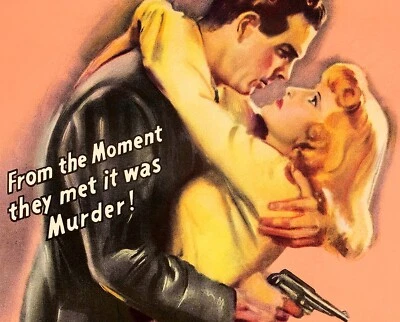
"DOUBLE INDEMNITY" (1944) one sheet - 27"x41" great Billy Wilder movie poster! - Picture 2 of 6

Billy Wilder’s Double Indemnity is a work of noir genius. Every line of dialogue is as sharp as the tagline itself. This should be assigned viewing for every writer.

And just because I watched the movie again the other night:

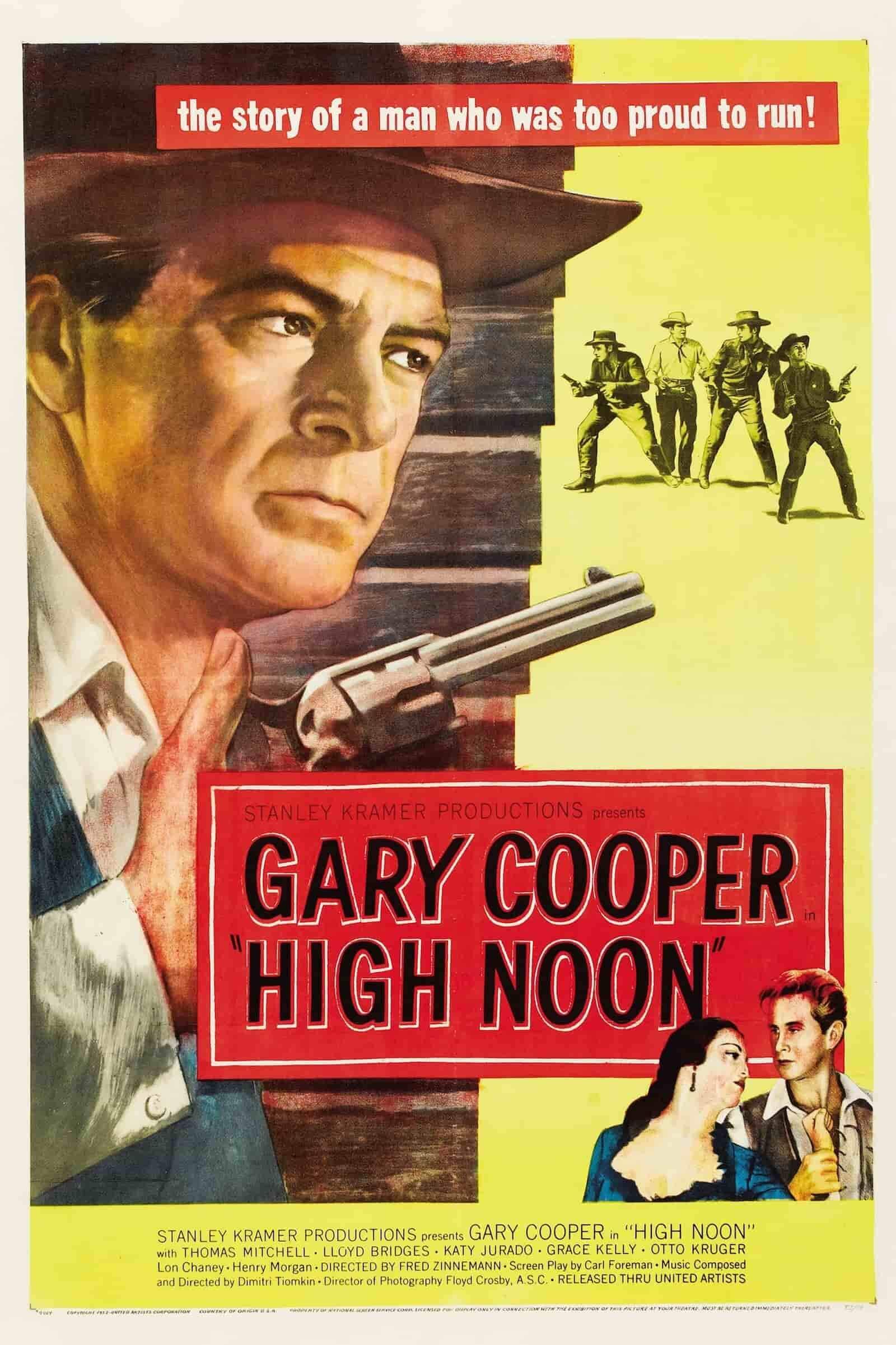
best movie taglines example high noon

Okay, intermission! Time out for a short quiz. See if you can tell which movies match these poster taglines. Answers at the end.

  1. You don’t get to 500 million friends without making a few enemies
  2. When he pours, he reigns
  3. Mankind was born on Earth. It was never meant to die here.
  4. The first casualty of war is innocence.
  5. On every street in every city in this country, there’s a nobody who dreams of being a somebody.
  6. He was the perfect weapon until he became the target.
  7. If you only see one movie this year … You need to get out more.
  8. A man went looking for America, and he couldn’t find it anywhere.
  9. Don’t get mad. Get everything.
  10. She brought a small town to its feet and a corporation to its knees.

I’ve been lucky to have some great editors over my career who shepherded my books through the backcopy and tagline process. For An Unquiet Grave: Not Every Soul Rests In Peace. And one of my faves from my Thomas & Mercer editor for She’s Not There:

A past she can’t remember.
A killer she can’t recongize.
And they’re both catching up with her.

Just for fun I pulled some books off my shelf in search of good taglines. Some taglines are only one juicy line. Some are puns. Others can stretch on into mini-plot summaries. But all tease and tantylize:

  • Yesterday was for youthful indiscretions. Today is for consequences. — Sue Grafton’s Y Is For Yesterday.
  • A tough detective follows a lead back to a 1960s Borcht Belt resort to crack an unsolved crime — or was it a crime at all? — Reed Farrel Coleman’s Redemption Street.
  • From a helicopter high above the empty California desert, a man is sent free-falling into the night…in Chicago, a woman learns that an elite team of ex-army investigators is being hunted down one by one…and on the streets of Portland, Jack Reacher — soldier, cop, hero — is pulled out of his wandering life by a code that few other people could understand. — Lee Child’s Bad Luck and Trouble.

Okay, that last one is not a true tagline, just a good summary. But I really like the tagline for the first Reacher movie: If he’s coming for you, you probably deserve it.

The best taglines distill the core emotional, thematic, or high-stakes essence of your story down into a punchy, memorable phrase. It serves as the HEADLINE above the rest of the backcopy, wherein you can go into more plot and character details. It also hints at the tone of your book — humor, noir, romantic.

Do you really need a tagline? Well, not if you’re famous. A scan of my bookshelf showed me that the bestsellers rarely have them because the big name is lure enough. Sometimes, the space is given over to a blurb from a fellow writer. And if you’re lucky, you’ve hit upon a fabulous title that needs no other help. A few from my bookshelf: The Girl With The Dragon Tattoo. Something Wicked This Way Comes. To Kill A Mockingbird. Midnight In the Garden Of Good And Evil. And David Sedaris’s Me Talk Pretty One Day because I am still doing my Duolingo French every day.

So, what about it? Can you write a great tagline for your book? Can you boil it down to its purest self and pour it out in one or two pithy lines? It’s hard. It’s an art even.

And at risk of depressing you, let me add a final thought. If you — or your poor overworked editor — can’t come up with a good tagline, well, maybe you’re not really sure, in your heart of hearts, what your story is really about. But that’s a post for another day.

ANSWERS

  1. The Social Network
  2. Cocktail
  3. Interstellar
  4. Platoon
  5. Taxi Driver
  6. Bourne Identity
  7. Naked Gun
  8. Easy Rider
  9. The First Wives Club
  10. Erin Brockovich


Creative Quirk or Signature?

When I first strolled through my new house with the realtor, I noticed a lot of unfinished work. For example, the previous owner painted the barn to match the house but left the tip of the peak untouched. Support posts on the covered porch were all painted, except the top of one. It baffled me. Why wouldn’t she paint those spots? Higher areas, she’d painted.

I could tell she’s creative. Painted butterflies, hummingbirds, and flowers dotted the landscape.

Did I buy the house from an emerging artist?

The support beam in the new addition (living room) has pallet wood wrapped around two sides, with the third side only painted. Gorgeous wood frames the back mudroom ceiling except for one tiny missing piece. The underside of an outside railing has new paint, one bare space, then continues to the barn loft. Four solar motion detectors line the back fence, with one blacked out with tape.

After I moved in, the closer I examined small details, the more my curiosity piqued. What’s going on here? The previous owner clearly has a fondness for 3s (as do I). Or maybe, she knows the importance of the number 3.

The number 3 often appears in nature and fundamental structures:

  • Atoms: protons, neutrons, electrons
  • Dimensions: length, width, height
  • Cycles: birth, life, death
  • Time: past, present, future
  • Essential survival needs: air, water, food
  • Geometric strength: The triangle is the simplest and most stable shape — it’s represented in everything from molecular structure to human-made architecture
  • Monocots: many flowering plants (monocots) have flower parts in multiples of three
  • Tree structure: roots, trunk, canopy
  • Primary colors of light: red, blue, yellow
  • States of matter: solid, liquid, gas
  • Layers of skin: epidermis, dermis, hypodermis
  • Types of muscle: skeletal, cardiac, smooth
  • Germ layers during development: ectoderm, mesoderm, endoderm
  • Circulations: Systemic, Pulmonary, Portal
  • Trinity: Earth, sun, moon… body, mind, spirit
  • Genetic code: DNA instructions are read in triplets (codons) to build proteins
  • Sensory Perception: Human color vision is trichromatic, based on three types of cones in the eyes sensitive to red, green, and blue light
  • Survival “Rule of 3”: Humans can typically survive 3 minutes without air, 3 hours without shelter in harsh environments, and 3 days without water
  • Geographic regions: land, sea, air
  • Insects: adult insects are characterized by a 3-part body: head, thorax, abdomen.
  • Dietary groups: herbivores, carnivores, omnivores

The number 3 represents universal patterns of stability and completeness.

Did the emerging artist find comfort in the power of 3? The mystery haunted me as I surveyed my new property.

Then one morning, I was admiring the sunrise from the back mudroom, when I noticed she’d painted only three sides of a window frame. The floor she tiled, except for one square in the corner by the water heater.

A ha! It’s an intentional act. Her creative signature, if you will.

Kind of a pain for the new buyer (me) to touch up all these spots but I also respect her creativeness — she left her signature on every improvement she made. And helped create the quirkiness I love about the property.

To her credit, she also left the supplies to finish every project. Maybe I’ll leave one or two minuscule signatures in a corner that’s not visible to others, as an homage to her creative spirit. Not the living room beam — that blank side drives me crazy. What she probably never considered was that buyers deduct money from their offer for unfinished projects. It’s automatic. The more a buyer must do, the less they want to spend.

The same could be said for readers.

If a reader runs into too many writing tics, they’ll either:

  • Never read that author again
  • Deduct stars for the annoyance
  • Give the author one last chance; they better deliver in the next book

Writing tics could be seen as a creative signature of sorts, I suppose, but not in a good way. Readers don’t want to be yanked from the story. They want immersion. They want you to sweep them away, to transport them into the scene and hold them captive. Writing tics do the opposite.

Even in my new home, some might look at the unfinished spots in a negative way. Not me. Though I’ll complete most of the projects for continuity, I love the quirkiness of the understated ones. With the mystery of why she did it solved, I appreciate her creative spirit.

The same cannot be said for writing tics. If you made no other writing resolutions this year, add this: Tighten your prose, TKZers!

Three Unforgettable Scenes and No Weak Ones

by James Scott Bell
@jamesscottbell

I believe it was the writer-director John Huston who once said a great movie has three unforgettable scenes, and no weak ones. Makes sense to me. Maybe that’s the difference between a good book and a great book, a fine read and an unforgettable one. Let’s think about it.

Huston wrote and directed many great films (let’s not talk about Annie. Why Ray Stark tapped Huston to direct his first and last musical, I’ll never know). One of my favorites is The Treasure of the Sierra Madre (1948) starring Humphrey Bogart, Tim Holt and John’s dad Walter Huston (who took home the Best Supporting Actor Oscar). It’s a stark, noirish drama set in Mexico. The first unforgettable scene (for me) is a brutal fight in a bar, when Bogart and Holt confront the man who owes them money. It’s brilliantly choreographed, and done without musical score.

And then there’s a scene that is with us today, whenever anybody utters the line, “Batches? We don’t need no steenking batches!”

I also love the scene where Walter Huston dances around calling out Bogart and Holt. “You’re dumber than the dumbest jackass! Look at each other, will ya? Did you ever see anything like yourself for bein’ dumb specimens? You’re so dumb, you don’t even see the riches you’re treadin’ on with your own feet. Yeah, don’t expect to find nuggets of molten gold. It’s rich but not that rich. And here ain’t the place to dig. It comes from someplace further up. Up there, up there’s where we’ve got to go. Up there!”

Let’s talk thrillers. Let’s talk The Silence of the Lambs.

There’s the  first time Clarice meets Lecter. When I saw the movie I felt  a distinct chill throughout my body as Clarice first approaches Lecter’s cell in the bowels of the prison.  We watch from her POV and she first lays eyes on him.

He’s just standing there, looking like Anthony Hopkins, in a position that’s hard to describe. It’s almost like he’s at attention, but with the slightest smile that is full of mystery and menace. It just radiated off the screen. And then begins the cat-and-mouse game that is almost ten minutes of pure tension, primarily through dialogue (as in the book as well).

Quieter movies or books need those unforgettable scenes, too. To Kill a Mockingbird  has several to choose from. There’s the cross-examination of Mayella Ewell (the movie version is enhanced by the knockout performance by Collin Wilcox as Mayella). At the end there’s the revelation of Boo Radley (brilliantly portrayed by a young Robert Duvall).

And then there’s the scene at the jail where Atticus faces a lynch mob, and the scene takes a most unexpected turn. See for yourselves:

It’s no undiscovered writing tip to say that we ought to strive for unforgettable scenes. Some writers don’t think about it. They just go from scene to scene doing the best they can with them. I prefer to be more intentional.

One of the things I used to do (before Scrivener came on the scene) was take a pack of 3×5 cards to a local coffee establishment and start brainstorming “killer scene” ideas for my upcoming project. I didn’t pre-judge. I just wrote and looked at the cards later. I remember writing cards for my first Ty Buchanan legal thriller, Try Dying. I had this “vision” of Ty getting on a conference table and tap dancing. Wait, what? But it fit in the book as Ty, whose fiance was killed on page one, is in the conference room of a big-time lawyer trying to intimidate him:

I grabbed my notes and stuffed them in my briefcase. With a quick step on the chair I jumped onto the conference table. As Walbert’s eyes opened wider, I did a little three-step tap dance.

“What are you doing?” he howled.

“Gene Kelly,” I said.

“Get off that table!”

“This is what it’s going to be like, Barton. You looking up at me from now on.”

His face changed colors. Cheeks rosy like the dawn. I don’t know why I did it, except that I never liked bullies. On the schoolyard or in a plush conference room.

Gerry Spence, the greatest trial lawyer of his day, was once asked on 60 Minutes what he’d have done if he were a cowboy in the old West, facing a guy with a knife. “I’d leave him bloody on the floor,” Spence said, “which is the way I try cases.”

I jumped off the table and said, “See you in court, Barton. I’m going to leave you bloody on the floor.”

Let your imagination run wild, without judgment. That’s how you get the gold. That’s what Walter Huston would say. He’d point to your head. “Up there’s where you’ve go to go. Up there!”

How about you? What scenes do you remember from books or movies that were unforgettable?

Rewiring

We shook things up at Casa Wortham this week. We’ve lived here for about seven years in what we call the new house, and felt the kitchen needed a change not long after the Bride’s oven sparked, gagged, and filled the house with the heady aroma of burned chemicals.

But this isn’t about major appliances. Remember when you first moved into your place and beheld empty drawers in the kitchen?

One question always comes up. Where does the silverware go? (In Texas, daily eating utensils are silverware, even though the real silver ((plate)) is in a wooden case stuffed back in a cabinet or under a bed and only comes out on Thanksgiving or when someone dies).

Then there are wooden spoons, cup towels, oversize forks and spoons, tongs, measuring cups and spoons, vegetable peelers, graters, garlic presses, thermometers, kitchen scales, bottle openers, corn cob holders.

They need a home in the shallow drawers.

What’s the proper dispersal method?

And while we’re at it, there’s the (ominous music) junk drawer. Where will that one be, because we know for certain that a drawer will devolve into one of these chaotic black holes that scientists with pocket protectors in their shirts discuss in hushed tones.

I’m sure you have one of these sacred disorganized repositories of migratory odds and ends nestled in a bed of bread ties, old rubber bands, thick blue rubber bands off celery stalks, nuts, bolts, mysterious batters that might or might not be dead (but you can’t throw them out until you know), and mysterious keys you’ve never seen before in your life. Wait. How the hell did my razor get in there? Was someone shaving carrots?

On moving day in the new house, we unloaded boxes marked KITCHEN into random drawers that were probably open and waiting, and have lived with those spur of the moment decisions since.

But there have been problems. The silverware drawer is between the oven and stove. That’s our serving area when we don’t have sit-down meals, which is 95% of the time. And there are usually a lot of people in line.

If someone is filling a plate, they’re in the way of spoons, forks, and knives, which we usually forget. Then we go back and excuse ourselves to open the drawer, or cut in line, which can be deadly with sons-in-law and hungry teens.

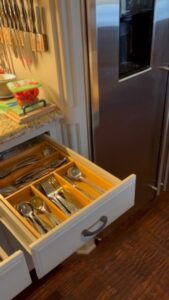
On Wednesday of this week, the Bride came home with a couple of classy bamboo dividers to help separate some of the more aggressive utensils. I was between writing projects, and the next thing I knew, we’d emptied all the drawers onto the countertops and forced significant changes in implement and gadget placement.

Now it all makes sense, to a small degree, but here’s the problem. We keep returning to the wrong places for wooden spoons, measuring cups, and the scissors which reside in the junk drawer. We’re on a learning curve, and I sent our daughters and sons-in-law a thirty-second video preparing them the new organization.

They were aghast.

The Redhead, mother of two, sent an eye-rolling emoji, and Taz, the youngest and mother of three kids, was verbally displeased. But then again, she even hates it when the Bride replaces accent pillows with new, fresh additions.

But I explained. “Change is good. Remembering where everything is in their new locations is exercise for the brain.”

With that, I needed proof to counter verbal attacks when the all come over Sunday night for out weekly get together.

An exhausting thirty second search on medical databases provided this agreement. “Positive change and new experiences are excellent for the brain, promoting neuroplasticity (the brain’s ability to form new connections), boosting cognitive function, improving mood (via dopamine, that’s why it’s called dope, according to my dad) and building mental resilience, even though the brain’s amygdala might initially perceive change as a threat. Varying routines, learning new skills, exploring new places, and engaging in diverse activities build cognitive reserve, helping you adapt and maintain long-term brain health.” 

Now I have to make this relevant to my writing blog post.

With that in mind, I looked up “neuroplasticity and amygdala” before diving into another search to find that it’s beneficial for authors to change genres, or write short stories, or nonfiction articles or books. In other words, shake it up.

While reading those confusing medical evaluations and articles for another fifteen minutes, I learned that changing genres or writing styles introduces new narrative tools, breaks writer’s block (which I don’t believe in), fosters artistic growth, and offers fresh perspectives, though it requires extra time.

Switching genres challenges an individual to think differently, find new solutions, and prevents creative stagnation, leading to broader skills and more diverse ideas that can even enrich their primary genre. 

But wait! Getting out of your writing lane is commonly considered a bad idea in literary circles. One article I read explored and supported Stephen Kings change from his traditional horror novels to write an alternate history with 11/22/63, or Cormac McCarthy’s shift to his post-apocalyptic The Road. I’ve been told only bestselling authors should take those chances.

Some say we should stick to our writing lanes and do what our fans come to expect.

Fine, wait a while after you write something different before submitting it, but there’s nothing wrong with taking a break from your WIP and writing a science fiction or post-apocalyptic short story if only for personal satisfaction.

This mental exercise is a great way to get out of a rut.

When you do that, find a different place to write for a day or two. Such a change just might inspire something different. Many authors write in one location, and edit in another.

You don’t have to sell those new works today, or tomorrow. You can put them in a figurative junk drawer (see the unplanned connection here? I love the subconscious author.) and dust it off sometime in the future when you need it.

I did that way back in 2012, when my first novel was published and my editors wanted the next book. I’d written a three-thousand-word short story in 1986 that sat in my file all that time, but when I needed an idea, I re-read that old experiment and found the foundation of the second novel in my Red River series, Burrows, which was truly a horror story.

Or maybe you’ve read a non-fiction article in a magazine and thought, “I know that much.” Give it a try.

For several years I wrote “hook and bullet” stories for several outdoor magazines. More than one took awards from the Outdoor Writers of America and the Texas Outdoor Writers Association. I’m proud of those stories and the framed acknowledgments from my peers.

One was an informative history of the longbow, and with liberal applications of scotch, the article was quirky and funny.

I’d exercised my creativity and different writing skills, because I like to try different things.

Like moving the silverware drawer.

In Science Explores News, an article about Dr. Nathan Spreng, a neuroscientist at Cornell University, explored how the brain changes as we learn. Much of the article concentrates on new physical tasks, such as hitting a baseball, but a deeper idea comes from pianists who can play complicated musical scores without thinking about where their fingers go. Their minds can wander, and that opens up even more neural pathways.

So if we get out of our writing lane and try something different, can authors open new creative paths to follow?

Some doctors think it does.

Try a short story, or an article, or start a new chapter in a different kind of novel just to see if that old excitement is there, or if a different way of thinking helps your writing. No one has to see it but you.


What a Difference a Word Makes

By Elaine Viets

When I taught English as a second language, one of my favorite students was a young man I’ll call Sam. Sam was 18, from South Korea. Smart and hard-working, Sam was brushing up on his English that summer before he went to college in the US. Sam had applied to several universities, many of them distinctly second-rate.

“Why didn’t you apply to any Ivy League schools?” I asked.

“Oh,” he said. “I couldn’t get in. I spent my senior year in high school screwing.”

“What??” Sam didn’t talk like that. “What do you mean?”

“I didn’t work hard and I got bad grades.”

“That means you spent your senior year screwing AROUND,” I  said, and gave him a quick course in American idioms.

I hope my students learned from me, but I definitely learned from them. English is a complex, expressive and extremely difficult language, fraught with pitfalls.  Consider the South American banker who told me, “My wife and I fled our country naked.”

“Naked?” I asked. “You weren’t wearing clothes?”

“Of course we were,” he said. “But we couldn’t take anything with us.”

Turned out he was using an idiom from his country. “Right. In the US, we’d say, ‘You left with nothing but the clothes on your backs.’”

In the words of Bill Bryson, “Any language where the unassuming word fly signifies an annoying insect, a means of travel and a critical part of a gentleman’s apparel is clearly asking to be mangled.” (If you haven’t read Bryson’s Mother Tongue, you’re missing a linguistic treat.)

Teaching articles, those pesky three words, “a,” “an” and “the,” is another misery. Try explaining that these two sentences mean basically the same thing:

There is little traffic at 4 a.m.

There is a little traffic at 4 a.m.

And don’t forget regionalisms (why is a carbonated drink “pop” in parts of the country and “soda” in others?), and accents.

A Japanese businessman said he was worried about going to South Carolina. He told me, “I can’t understand what the people there are saying.”

“That’s OK,” I told him. “None of us can.”

But before you get too smug, native speakers, tell me which of these ten words is misspelled:

mahagony

embarassed

sherriff

fourty-four

supercede

graffitti

rhythum

syrep

abdomenal

concensus


Answer: They all are.

Now in paperback: Sex and Death on the Beach, my new Florida beach mystery, is now in paperback. Check out it out here. https://tinyurl.com/3ut3chuu


What’s In A Format?

What’s In A Format?
Terry Odell

Happy New Year. It’s hard to believe we’re already two weeks into 2026. And that’s all I’m going to say about that.

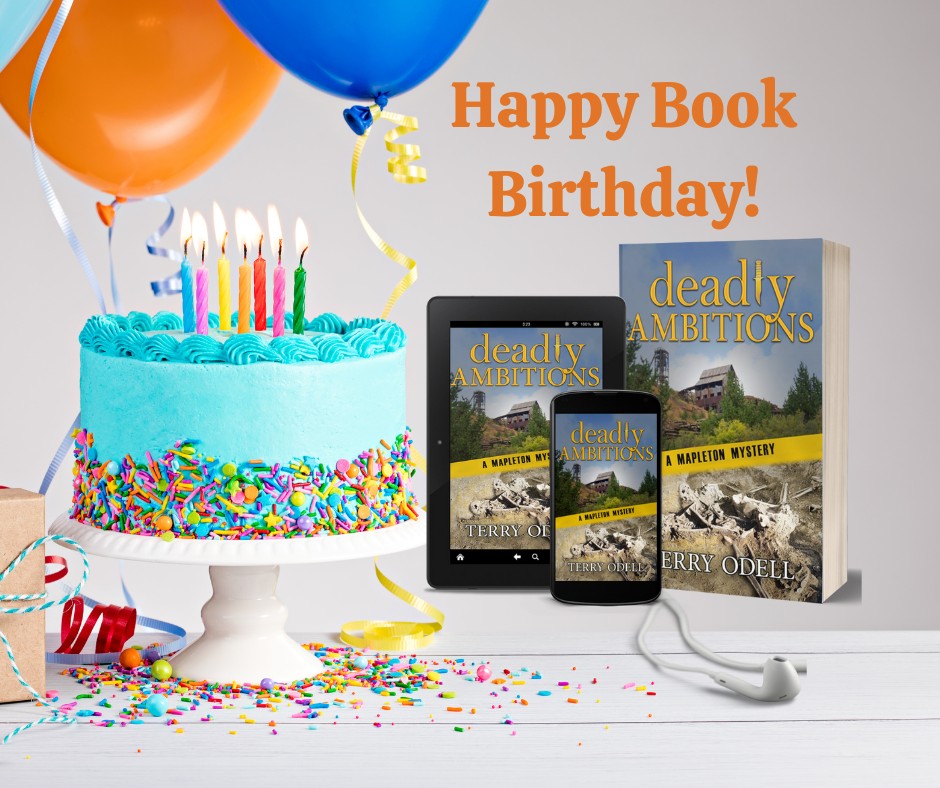
birthday cake and balloons next to 3 formats of Deadly Ambitions by Terry OdellI hope you don’t mind if I indulge in a little BSP. It’s release day for Deadly Ambitions. Happy Book Birthday!
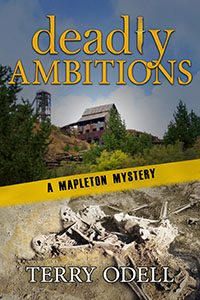
What’s it about?

Here’s the description:

Mapleton Police Chief Gordon Hepler is juggling a bitter town council candidate who refuses to accept election results and a new council member determined to cut his department’s funding, funding he needs to finance refresher training modules for his officers. Grant money is slow in coming.

Meanwhile, Angie’s diner remodel continues to suffer setback after setback. During the process, she uncovers an old journal. Her search for the girl who wrote it, along with the mysterious “Johnny” help keep her mind off the construction. Are the delays normal? Or are they personal?

When Angie’s in danger, Gordon must balance following the letter of the law with caring for his wife. Could there be a connection to the remodel? Or the journal? Or something else?

Does the threat to Angie come from history or from much closer to home?

I had a lot of fun—along with the sweat and frustration—writing the book. Fun because it was another in my Mapleton Mystery series, and I always enjoy spending time with the familiar characters.

Frustration because it’s always a challenge to keep things moving forward when I’m tempted to spend time chasing plot threads that entertain me, but aren’t needed for the story. In writing/researching Deadly Ambitions, I learned a lot about Colorado history along with Angie and Gordon.

Also, I wrote about health issues that (I hope) will sneak a little education into my readers, should they not already know about them. (No spoilers here.) And, I confess to taking some small pleasure in putting my own spin on some of the chaos of the ‘outside world.’ Justice might be hard to come by there, but in a book, I get to make sure it’s meted out.

Advance readers have given wonderful and positive feedback.

  • “Her crisp writing paints a visual picture of the town and its workings, incorporating real world situations that readers can relate to.”
  • “Odell does a skillful job of weaving in and out of the subplots to bring the reader to a satisfying, and somewhat surprising, resolution. A great read!”
  • “Before you start reading, set aside some time because you will not want to put this book down. This Mapleton mystery grabs you from the start and just keeps getting better.”
  • “A great addition to the series.  This one is tough to put down and you have more than one mystery to solve.  Will the diner ever get completed?  How can it possibly be involved with the death of the ex-mayor?  Or is it?  Who is behind all of the mysteries?”
  • “Deadly Ambitions drops the reader right into a small town cozy mystery complete with well-drawn characters, unexpected plot twists, and unidentified bones found in an abandoned mine. Personalities clash between Police Chief Hepler and local politicians, well balanced with a sweet love story as Angie’s bakery runs into construction delay after delay.”

Okay, and on with what the subject of the post says I’m supposed to be talking about.

Deadly Ambitions is available in three formats: ebook, trade paperback, and audio, which brings me to a pet peeve. I’ve seen far too many social media posts talking about Real Books.

They’re adamant in saying if it’s not printed on paper, it’s not real.

I say hogwash.

I spent months writing 85,000 words in the creation of Deadly Ambitions. Actually, a lot more of that before edits kicked in.

Then, when it was as good as I could get it, I published it as an ebook. After that, I adjusted formatting, changed front and back matter, and published those same 85,000 words in trade paperback format.

And, I hired the narrator who’s done all my Mapleton mysteries, and he read those same 85,000 words and created an audiobook.

Which one is real, I ask you?

Is my book club member who confesses to dyslexia not getting the same story when she listens to the audiobook? What about the person who has trouble holding a print book, or the one with vision problems who prefers a digital format she can manipulate to suit her eyes?

What do you think, TKZers? Does format matter? (And if you want a copy in the format of your choice, you can find them here)


New! Find me at Substack with Writings and Wanderings

Deadly Ambitions
Peace in Mapleton doesn’t last. Police Chief Gordon Hepler is already juggling a bitter ex-mayoral candidate who refuses to accept election results and a new council member determined to cut police department’s funding.
Meanwhile, Angie’s long-delayed diner remodel uncovers an old journal, sparking her curiosity about the girl who wrote it. But as she digs for answers, is she uncovering more than she bargained for?
Now, Gordon must untangle political maneuvering, personal grudges, and hidden agendas before danger closes in on the people he loves most.
Deadly Ambitions delivers small-town intrigue, political tension, and page-turning suspense rooted in both history and today’s ambitions.


Terry Odell is an award-winning author of Mystery and Romantic Suspense, although she prefers to think of them all as “Mysteries with Relationships.”

New Year’s Thoughts from Fifteen Authors

by Debbie Burke

The New Year is a time when many writers ponder what we want to accomplish.

I thought it might be fun to see what well-known authors, past and present, think about the New Year. Here’s a collection of advice, musings, and cautions:

1. “Cheer up! Don’t give way. A new heart for a New Year, always!” – Charles Dickens (1812-1870), English novelist

2. “We went nowhere without figs and never without notebooks; these serve as a relish if I have bread, and if not, for bread itself. They turn every day into a New Year which I make ‘happy and blessed’ with good thoughts and the generosity of my spirit.” – Seneca, who lived at the cusp of BC and AD.

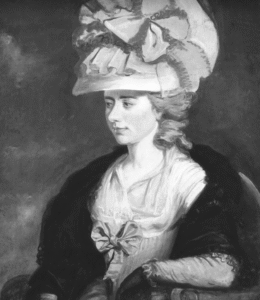
Frances Burney

3. “I opened the new year with what composure I could acquire…and I made anew the best resolutions I was equal to forming, that I would do what I could to curb all spirit of repining, and to content myself calmly—unresistingly, at least, with my destiny.” – Frances Burney AKA Fanny Burney (1752-1840), English novelist and playwright

4. “‘A merry Christmas, and a glad new year,’
Strangers and friends from friends and strangers hear,
The well-known phrase awakes to thoughts of glee;
But, ah! it wakes far different thoughts in me.
[…] I, on the horizon traced by memory’s powers,
Saw the long record of my wasted hours.” – Amelia Alderson Opie (1769-1853), English novelist and abolitionist

5. “Ring out the old, ring in the new,
Ring, happy bells, across the snow:
The year is going, let him go;
Ring out the false, ring in the true.” – Alfred Tennyson (1809-1892), English poet

6. “New Year’s Day: now is the accepted time to make your regular annual good resolutions. Next week you can begin paving hell with them as usual . . . New Year’s is a harmless annual institution, of no particular use to anybody save as a scapegoat for promiscuous drunks, and friendly calls, and humbug resolutions. Yesterday, everybody smoked his last cigar, took his last drink and swore his last oath. Today, we are a pious and exemplary community. Thirty days from now, we shall have cast our reformation to the winds and gone to cutting our ancient shortcomings considerably shorter than ever.”– Mark Twain (1835-1910), American author and humorist

7. “For last year’s words belong to last year’s language. And next year’s words await another voice. And to make an end is to make a beginning.” – T.S. Eliot (1888-1965), American poet

8. “Drop the last year into the silent limbo of the past. Let it go, for it was imperfect, and thank God that it can go.” – Brooks Atkinson (1894-1984), American theatre critic

9. “Youth is when you’re allowed to stay up late on New Year’s Eve. Middle age is when you’re forced to.” – Bill Vaughan (1915-1977), American author and columnist

10. “I made no resolutions for the New Year. The habit of making plans, of criticizing, sanctioning and molding my life, is too much of a daily event for me.” Anaïs Nin (1903-1977), French-American author

11. “The object of a New Year is not that we should have a new year. It is that we should have a new soul and a new nose; new feet, a new backbone, new ears, and new eyes. Unless a particular man made New Year resolutions, he would make no resolutions. Unless a man starts afresh about things, he will certainly do nothing effective.” – G.K. Chesterton (1874-1936), English author

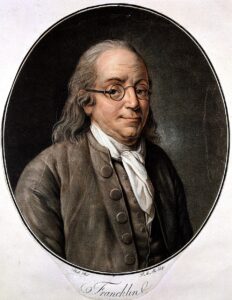
Benjamin Franklin
Photo credit: Wellcome CC BY-SA 4.0

12. “Be always at war with your vices, at peace with your neighbors, and let each new year find you a better man.” – Benjamin Franklin (1706-1790), American author and a founding father of the U.S.

13. “I have always loved New Year’s Eve and New Year’s Day. Even though our sense of time is arbitrary and human, it still means something. I love the feeling I always get on New Year’s Eve that I am lucky — that the universe has been generous to me, to have let me stick around for another year, and to now erase the slate and give me another chance. Tomorrow I will be gifted with a brand new year — with no mistakes in it yet, and no heartbreaks yet, and no failures yet. I get to try again. Amazing. You will be gifted with this huge blessing, too. A clean and empty book awaits us all. Maybe we will be able to write things differently this time. Maybe a bit better. Maybe we will be wiser this time. At least we get to try. We have all been given a fresh chance. Let’s close the old book, and open a new one.” – Elizabeth Gilbert (1969-), American author

Woody Guthrie Statue
Photo credit: Cosmos Mariner, CC SA-BY 4.0

14. Woody Guthrie (1912-1967), American songwriter, offers his list of resolutions:

  • Work more and better
  • Work by a schedule
  • Wash teeth if any
  • Shave
  • Take bath
  • Eat good—fruit—vegetables—milk
  • Drink very scant if any
  • Write a song a day
  • Wear clean clothes—look good
  • Shine shoes
  • Change socks
  • Change bed cloths often
  • Read lots good books
  • Listen to radio a lot
  • Learn people better
  • Keep rancho clean
  • Dont get lonesome
  • Stay glad
  • Keep hoping machine running
  • Dream good
  • Bank all extra money
  • Save dough
  • Have company but dont waste time
  • Send Mary and kids money
  • Play and sing good
  • Dance better
  • Help win war—beat fascism
  • Love mama
  • Love papa
  • Love Pete
  • Love everybody
  • Make up your mind
  • Wake up and fight

15. And last from Susan Sontag (1933-2004), American author:

“I want to make a New Year’s prayer, not a resolution. I’m praying for courage.”

~~~

TKZers: Which of these quotes resonated with you? Why?

Do you disagree with any of them? Why?

Did you make writing resolutions or set goals? Want to share them?

~~~

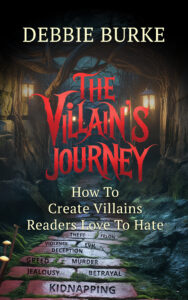
Is 2026 the year you want to learn to write fascinating villains and antagonists? Please check out Debbie Burke’s bestselling craft guide, The Villain’s Journey-How to Create Villains Readers Love to Hate.
Amazon

Barnes & Noble

Apple

Kobo

Interested in taking a villain workshop from Debbie? Please visit debbieburkewriter.com to learn about upcoming zoom and in person classes.

NATIONAL CLEAN OFF YOUR DESK DAY

“Cleanliness is indeed next to godliness.” —John Wesley

* * *

Yes, that’s right. Today is National Clean Off Your Desk Day. Oh, great. I just finished putting away the holiday decorations and was working on tax info to turn over to our accountant, and now they tell me I have to clean off my desk. I don’t have time for this.

But I’m a good team player, and my desk definitely needs some reorganization, so I went to the National Clean Off Your Desk Day site to get some inspiration and advice on exactly how to proceed. Here’s what they say:

This day is an opportunity to begin your new year with a clean and organized workspace. Whether your desk is in a private or shared office, cubicle, home or a make-shift desk on the counter, having your workspace uncluttered and organized will help you work more efficiently. A clean workspace improves productivity and inspires us, too. It often gives us a sense of serenity. (My emphasis)

They go on to outline a step-by-step process:

  • Remove everything from your desk. Yes, everything.
  • Clean the surface. As you replace items, clean them with the appropriate cleaning supply. Usually, a damp cloth is sufficient, but other electrical items need specific care.
  • Get out the shredder and the garbage can. Shred, file, scan documents, business cards, recipes, photos as needed.
  • Place all documents and photos in the appropriate locations.
  • Shred and toss outdated documents, non-working pens, junk mail.

That’s good advice, and I was just getting ready to start on Step One when something occurred to me. Maybe there’s another way to look at this.

* * *

“Cleanliness is the scourge of art.” —Craig Brown

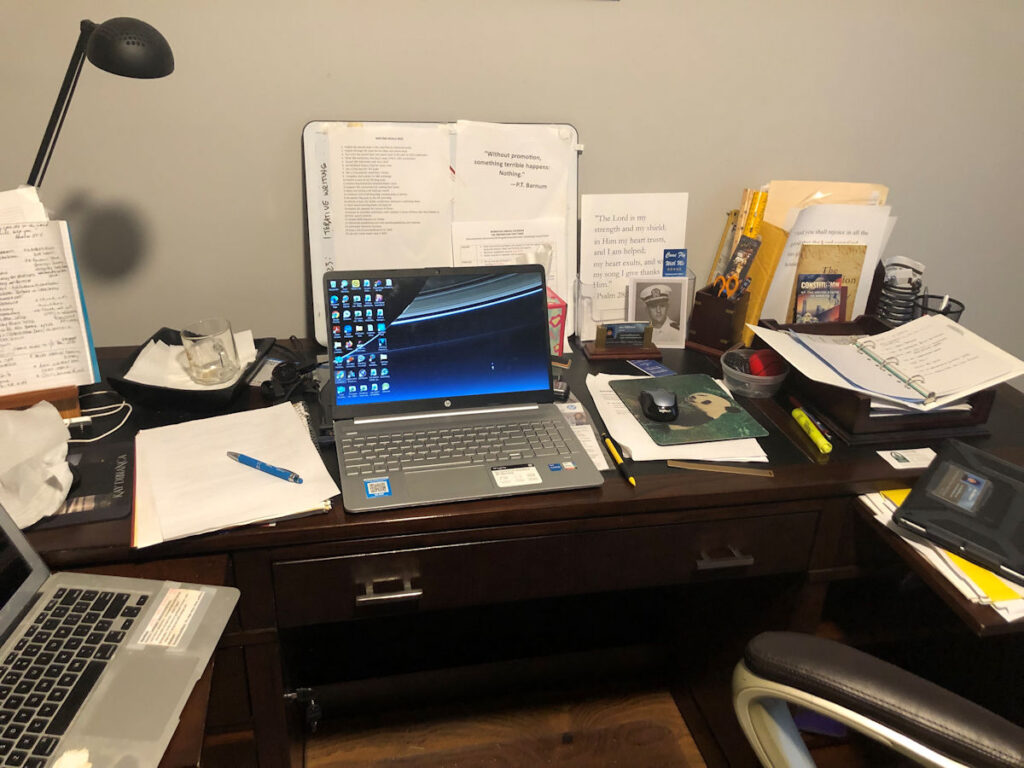
I don’t know if Craig Brown is correct, but since I place myself on the messier side of humanity, I want to believe it. Is it possible that creative people are messier than others?

I found evidence in an article on sciencedaily.com entitled “Tidy desk or messy desk? Each has its benefits.”

Working at a clean and prim desk may promote healthy eating, generosity, and conventionality, according to new research. But, the research also shows that a messy desk may confer its own benefits, promoting creative thinking and stimulating new ideas.

Well, that’s a relief. Maybe I can ignore the chaos for a while longer.

In an experiment overseen by psychological researcher Dr. Kathleen Vohs, 48 participants were asked to come up with novel uses for a ping pong ball. Half the participants worked in a messy room and half in a neat room. The result?

Overall, participants in the messy room generated the same number of ideas for new uses as their clean-room counterparts. But their ideas were rated as more interesting and creative when evaluated by impartial judges.

“Being in a messy room led to something that firms, industries, and societies want more of: Creativity,” says Vohs.

And we all know creativity is the lifeblood of good fiction.

So my desk isn’t messy. It’s simply a manifestation of my creativity. I like that.

Now where did I put that stapler?

* * *

So TKZers: What does your desk look like? Does a messy desk inhibit your work? Or does it inspire you?

* * *


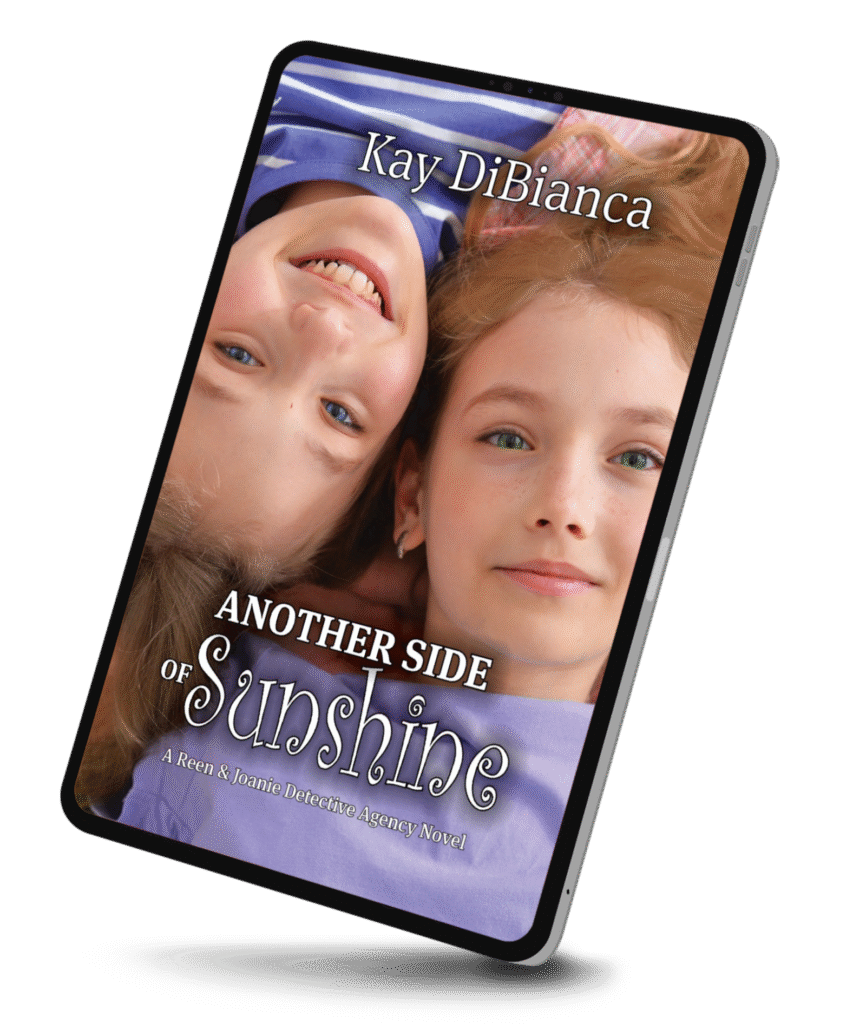
My ten-year-old protagonist and aspiring novelist, Reen, understands the signs of creativity. When her 9-year-old cousin points out a smudge on Reen’s shirt, she replies, “No problem. Authors are supposed to be sloppy. That’s because we’re creatives.”

I like the way she thinks.

Click the image to go to the universal book link.