


| CARVIEW |
Hale Ao o Ka Moamoa
A research lab at Georgia Tech reimagining computing for sustainability, with applications in conservation, healthcare, interactivity and education. Learn about the name
Josiah Hester
Associate Professor of Interactive Computing and Computer Science
College of Computing
Georgia Institute of Technology
Lab News
Press Highlights: Popular Science, Scientific American, Bulletin of the Atomic Scientists, Independent, The Wall Street Journal, CNET, Communications of the ACM, BBC Newsday, Smithsonian, Guinness Book of World Records, Seeker, ACM Tech News, Mongabay, Crain’s Business.

(11/2024) TerraCell won 1st in the 2024 Prototypes for Humanity competition in the Energy category!
(10/2024) Leading the bioelectronics effort for a $35 million ARPA-H effort fighting diabetes.
(10/2024) We presented Kaona, a Hawaiian Futurism tabletop RPG game at CHI Play!
(07/2024) A successful season complete of manoomin sensor check-ins with Wisconsin tribes.
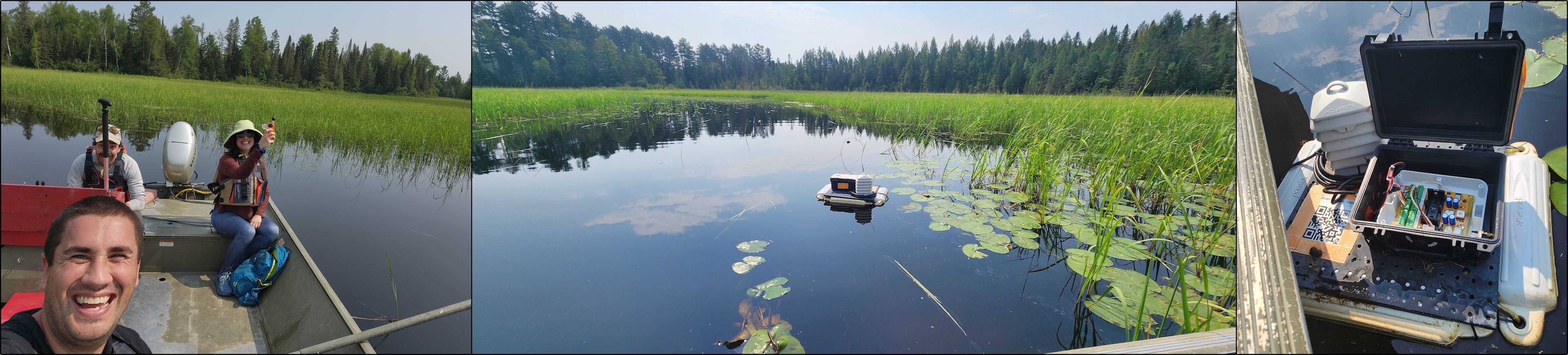
(05/2024) Our work on manoomin conservation discussed in the NYTimes and Mongabay!
(05/2024) Our JMIR article on equity and wearables featured in Crain’s Business, and on CBS News!
(03/2024) We led a Communications of the ACM review paper on intermittent computing!
(01/2024) Dirt powered computing paper published in IMWUT and in the press. (12/2023) We had the honor of hosting Georgia Tech’s President Angel Cabrera in our lab!
 –>
–>
(10/2023) NSF Grant ($2 million) on carbon nutrition labels for IoT devices with Cornell and Harvard. (09/2023) Our lab is part of a $45 million ARPA-H effort to cut cancer deaths in half! Led by Rice University, with MD Anderson Cancer Center, CMU, Northwestern, and others on the project.
(09/2023) John presented our award winning paper on Interaction Harvesting at ACM UbiComp!
(07/2023) Tingyu presented on challenges for transient devices at HotCarbon.
(06/2023) Panelist for a plenary panel on equitable evaluation at ACM RESPECT.
(06/2023) Rishabh presented our work on Batteryless flying things at DroNet.
(05/2023) Keynote for the staff of the National Academies (NASEM) DEI Speaker Series.
(05/2023) Stefany presented our EquityWare work, on inclusive design of wearables at ACM CHI.
(03/2023) Protean named a SIGMOBILE Research Highlight, printed in GetMobile Magazine.
(11/2022) We won Best Position Paper Award at ENSsys for approaches to circularity in computing!
(11/2022) Protean is presented at ACM SenSys 2022, the first major result from my NSF CAREER award! (10/2022) I was awarded a VMware Early Career Faculty Award! (09/2022) Prof. Hester gave a Keynote Address at Tapia Conference! (09/2022) After five amazing years at Northwestern, the lab has moved to Georgia Tech! (08/2022) NSF has funded our $5 million Coastlines and People regional Hub on sustainability! Focusing on Manoomin (wild rice) as a lynchpin of the ecosystem and indigenous led conservation! (05/2022) Prof. Hester wrote on sustainable computing for United Nations DESA in the SDG blog. (04/2022) ACM Tech News covers our work on battery-free MakeCode. (02/2022) Prof. Hester won his NSF CAREER Award on Intermittent Computing. (02/2022) National Science Foundation News covers our FaceBit project!. (02/2022) Prof. Hester named a Sloan Fellow in Computer Science! (01/2022) Quoted in the Washington Post about FaceBit and the future of excercise. (01/2022) Live interview with Sylvia Perez on Good Day Chicago (FOX32) about FaceBit! (01/2022) FaceBit, our smart face mask, covered by Scientific American, TechCrunch, and Gizmodo! (10/2021) Prof. Hester named Outstanding Young Alumni by Clemson University Engineering! (09/2021) Named to the Brilliant 10 by Popular Science for powering electronics without batteries!
Lab Director Biography
Josiah Hester holds the Allchin Chair and is Associate Professor of Interactive Computing and Computer Science at Georgia Tech. Josiah was previously at Northwestern as an Assistant Professor. He works in intermittent computing and battery-free embedded computing systems. He applies his work to health wearables, interactive devices, and large-scale sensing for sustainability and conservation, supported by multiple grants from the NSF, NIH, and DARPA. He was named a Sloan Fellow in Computer Science and won his NSF CAREER in 2022. He was named one of Popular Science’s Brilliant Ten, won the American Indian Science and Engineering Society Most Promising Scientist/Engineer Award, and the 3M Non-tenured Faculty Award in 2021. His work has received six Best Paper type Awards and seven Best Presentation type Awards, and featured in the Wall Street Journal, Scientific American, BBC, Popular Science, Communications of the ACM, and the Guinness Book of World Records, among many others.
Research Overview
We hold the vision that the untethered computing devices—wearables, implantables, energy harvesting sensors—hold significant promise for revolutionizing global scale applications across healthcare, environmental stewardship, infrastructure management, and space exploration.
Our research is concerned with the underlying computer systems principles, human factors, and behavioral issues that arise by bringing this vision to reality. We explore and develop radically new hardware designs, software techniques, tools, and programming abstractions so that developers can easily design, debug, and deploy intricate energy aware applications that work in spite of frequent power failures, constrained resources, and unpredictable conditions.
Research Approach: We build fully integrated, end-to-end computer systems to demonstrate the efficacy of the underlying scientific advancement we are concerned with. We run physical experiments to validate our hypothesis on hard benchmarks. We run user studies in the wild to test our sensing technologies, gathering quantitative and qualitative results that inform future work and guard against failures.
Recent Publications
Video Info Fast Company’s 2024 Innovation by Design Honorable Mention (2x)
Prospective Students
Our lab is always looking for highly motivated, extremely curious students, with interesting and diverse backgrounds. After reading some of our papers, and looking at some of our projects, where do you see yourself?
- Do you have serious hardware hacking skills? Are you a software guru?
- Maybe you are interested in handling the massive amounts of lossy data these systems gather in an elegant way?
- Perchance you think that all of this falls apart unless we study the human factors, and the sociological impact of trillions of always on devices interacting with us?
- Or maybe you just really like to build things and see those things have an impact.
If you are any of these people, we might be interested in working with you as a graduate, or undergraduate student.
Before you contact us, It is highly recommended you read this advice , and this advice. Make sure to apply to Georgia Tech’s College of Computing, and we can talk about working together. If you are already at Georgia Tech as an undergraduate or graduate student, email Prof Hester to schedule a time to talk in his office.
Prof Hester (a Native Hawaiian) is especially interested in engaging Native and Indigenous students and researchers in Computer Science and Engineering. Please reach out.
Fill out this form if you are interested in working with us.
Projects

NSF CAREER: Enabling Dynamic, Adaptive, and Reliable Battery-free Embedded Computing
Adaptive, Architecture, hardware, languages, and tools, for energy harvesting, intermittently powered computing devices.

Sustainable Cyberinfrastructure
Building sensor networks and edge computing cyberinfrastructure for environmental justice and civic action with Indigenous communities.

Carbon Nutrition Labels for IoT
Make carbon and sustainability a first-order design parameter for future edge computing devices that range from tiny, energy-harvesting IoT devices to higher performance consumer electronics.

Soil Powered Computing
Harnessing energy from soil to compute and sense at scale.

Sustainable Robotics
Reinventing robotics platforms with sustainable metrics in mind.

Cancer Fighting Implants
We develop implantable electronics that sense the tumour micro-environment and trigger living call based therapy to treat ovarian cancer.

Circadian Computing
We develop wearable devices that can sense circadian phase and activity, then deliver interventions (via implantable) to entrain new circadian rythyms.

Mobile Health
We explore wearable computational methods to reduce the effect of structural, societal, monetary, or mental barriers to receiving healthcare treatment.

Beyond CMOS Computing
Architecture, languages, and tools, for spintronic computing devices.

Interactive, Programmable Battery-free Devices
Battery-free, interactive devices for a sustainable IoT.

Smart Personal Protective Equipment
Batteryless devices for smart personal protection

Computing for Social Good
Building sustainable technology for environmental, human, and wildlife wellbeing.
Funding
Our lab is generously funded by the National Science Foundation under multiple awards:
- Collaborative Research: DESC: Type 2: Delphi: Life-time aware design frameworks for sustainable edge devices (CCF-2324861)
- SCC-IRG Track 1: Strengthening Resilience of Ojibwe Nations Across Generations (STRONG) (CNS-2233912)
- Focused CoPe: Strengthening Resilience of Manoomin, the Sentinel Species of the Great Lakes, with Data-Science Supported Seventh Generation Stewardship (RISE-2209226),
- Collaborative Research: HCC: Small: Toolkits for Creating Interaction-powered Energy-aware Computing Systems (IIS-2228983),
- CAREER: Enabling Dynamic, Adaptive, and Reliable Battery-free Embedded Computing (CNS-2145584),
- CPS: Medium: Batteryless Sensors Enabling Smart Green Infrastructure (CNS-2038853),
- RAPID: Low-cost, Batteryless Smart Personal Protective Equipment (PPE) Tackling the COVID-19 Pandemic (CNS-2032408),
- CRII: CSR: Systems and Tooling Enabling Adaptive Intermittent Computing (CNS-1850496),
- EAGER: SaTC: Early-Stage Interdisciplinary Collaboration: Privacy Enhancing Framework to Advance Behavior Models (CNS-1915847),
- NSF-BSF: CCSS: Resistance Tomography with 2D Sensor Membranes (ECCS-1912694),
- Collaborative Research: SWIFT: LARGE: Dynamics and Security Aware Predictive Spectrum Sharing with Active and Passive Users (EECS-2030251),
- SCC-CIVIC-PG Track B: Strengthening Resilience of Ojibwe Nations across Generations (STRONG): Sovereignty, Food, Water, and Cultural (in)Security (CNS-2044053),
- Collaborative Research: BPC-DP: Culturally Relevant Physical Computing for Sustainability Programs for Native Hawaiian Students (CNS-2137784),
- NSF-BSF: CNS Core: Small: Reliable and Zero-Power Timekeepers for Intermittently Powered Computing Devices via Stochastic Magnetic Tunnel Junctions (CNS-2106562),
- Collaborative Research: CNS Medium: Systems Foundations for Battery-free Body Area Intelligence and Sensing (CNS-2107400)
We are also funded by the Advanced Research Projects Agency for Health (ARPA-H) National Institutes of Health, the Defense Advanced Research Projects Agency (DARPA), the Army Research Office (ARO), the Alfred P. Sloan Foundation, VMware, and 3M.


