


| CARVIEW |
I learned a lot about PLN from this class, and also learned how to operate and build web pages to write blogs. This is the first time that I have recorded learning content in my blog every week. This class is a challenge and a help for me. This is a brand new experience for me.
In my opinion, the network is really a good thing. It seems that we can do anything by using the network, especially for the study of professional knowledge.The Internet has its own advantages, with the help of it to implement inquiry learning is really the best, as long as your mind can think of you can immediately start learning, more important is that you can immediately find the resources to learn. Full and fast is the most obvious advantage of the network, learning on the network can quickly expand the scope of knowledge, broaden the train of thought, and quickly understand some of the latest knowledge, but also can provide good support for the development of our divergent thinking, more profoundly, it can cultivate our creativity.Chinese people have a deep-rooted idea of the mean, which develops our dialectical thinking to a certain level. When we judge the positive side of a thing, it is easy for us to think of analyzing some of its negative side, so our understanding of things is difficult to go to extremes. When using the Internet learning is really “cool”, but the network resources of hypertext, hypermedia organization inadvertently knowledge for infinite links, so it’s easy to let us lost in the network, so at the time of web-based learning without a clear learning objectives to restrain may cause we use some time to learn the knowledge of now don’t need. In addition, there is no strict examination and approval system for the information on the Internet. Many people express it casually, even extreme, and there is no lack of a lot of information garbage. Therefore, we need to have a clear mind to screen and distinguish.
How to make more of the network’s contribution to learning?
I think in the use of the Internet can not be addicted to the network, an important principle is when we have some learning goals when the implementation of the network learning, and in the process of learning also often set some goals for themselves, not to delay. The knowledge on the network is rich but not well organized, which in some cases reduces the efficiency of learning, book knowledge is different, logical, clear, systematic, helpful to the establishment of the knowledge system. Therefore, three steps can be taken when using the Internet to carry out thematic learning. First, we can find some knowledge that we are interested in through the Internet, and do some preliminary investigation and understanding on the Internet. Then find some relevant books to carry out a systematic study, in the process of learning down some controversial points; And finally, we’ll go back to the web and see what you think.
In this closing blog, I hope PLN can be understood by more people and widely used in daily life.
]]>Before the Internet era, we usually used a series of paper materials to prove “I am me”, but after entering the Internet, the way of identification has changed from a paper certificate to an electronic certificate. In the information age, we use a virtual identity to carry out various social activities on the Internet, but all of this is always inseparable from real personal information. For the sum of these personal information on the Internet, we can call it a “digital identity” ,
“Digital identity” represents not only a personal identity, but also all identity certificates related to the person. The pain points of personal digital identities on the Internet
As digital identities gradually become people’s identity marks on the Internet, the authenticity, use security, and confirmation of digital identities have gradually become the focus of attention. On the Internet, more and more companies can easily obtain users’ personal information, and it is more and more common for personal information to be stolen, which brings a lot of trouble to users’ lives.
In other words, in the era of mobile internet, although there are digital identities, there is no best way to protect user identities until the emergence of blockchain.
The pain points of personal digital identities on the Internet
As digital identities gradually become people’s identity marks on the Internet, the authenticity, use security, and confirmation of digital identities have gradually become the focus of attention. On the Internet, more and more companies can easily obtain users’ personal information, and it is more and more common for personal information to be stolen, which brings a lot of trouble to users’ lives.
In other words, in the era of mobile internet, although there are digital identities, there is no best way to protect user identities until the emergence of blockchain.
At present, people’s demand for privacy protection is increasing, and the application of “digital identity” is no longer satisfied with a representative of an identity, but is equivalent to a value application of “digital assets”, which can self-control privacy rights. With the accelerated development of the information age and the “Internet +” era, the commercial value of personal information has been different from the past.
We can even think that personal information is an individual’s “information assets”, that is, a user’s “digital identity” not only represents a personal identity, but should be regarded as a personal asset.
For example, like UfileChain integrity archives public platform, people can build a complete and confidential personal information system, including personal education information, professional behavior, social identity, qualification certificates, personal assets, credit status, etc. This information is stored on the chain to form personal information records that cannot be tampered with. These personal information records will accompany users for life and form valuable personal digital identity information assets. When the data demander needs to obtain the user’s “digital identity”, they need to provide usage fees, and they also need to ensure that they cannot sell the user’s personal information at will.
Therefore, for the value application of “digital identity”, the most important thing is to make an individual’s “digital identity” a “digital asset”.
If you are building an application (or wallet, service, platform, network), you need users. These users may be mainstream consumers, developers, organizations, and/or DAOs. No matter what type of users you serve, the goal is the same: let other people interact with your product and realize value from it. This means you want to:
Eliminate friction in registration, certification and participation
Provide the richest experience possible, so that users hardly need extra work
Focus on your core value-added, instead of building new or redundant infrastructure internally
Build with a simple, elegant user model that can grow over time
The solution to these goals depends on how you manage users. How do they authenticate (login)? Can they communicate with each other (chat/comment)? Can you provide a lasting and personalized experience across time, devices, and login? Can you easily integrate with users’ other products and platforms? In traditional web applications, this is usually divided into identity recognition (related to account creation, KYC, etc.), identity authentication (login, fraud prevention), and authorization (permissions, sharing). This orderly approach will change with more flexible decentralized models. Identity is related to everything related to management, protection, service, and interaction with user groups.
As the product grows, the need to manage the user base will change rapidly.
Today, your biggest “identity” pain point may be filling in basic public profile information in your application so that users can identify each other. Next month, it may store user history and application state data, such as past or in-progress transactions (such as shopping carts). The next quarter may be basic KYC, and next year may be anti-witch attacks. Each product requirement has different “identity” problems, and these problems may be solved with different potential solutions.
Profiles: Should I implement 0auth or an IPFS hash mapped to the key? But what if the user rotates the key or uses multiple keys?
Data storage: Should I store data in Textile ThreadsDB? But how do I allow users to manage access control without adding more key types and resistance?
KYC/Proof of human: Should I use a service like Passbase or Democracy Earth’s technology? How to map this proof to existing users?
Anti-Sybil: Should I use services like BrightID or Idena? So how do I map their graphs to my user library?
Implementing these solutions independently obviously has its own challenges, but your biggest pain point will come from not using the right identity infrastructure from the beginning to connect them in a way that will stand the test of the future. A powerful and flexible identity infrastructure can make each new requirement naturally extend to the previous requirement, rather than new and isolated requirements that need to be solved individually, which will eventually kill itself.
Identity is an infrastructure that enables you to effectively link any functions related to the user
A good identification infrastructure should make it simple and easy to meet your evolving user-related needs. If you have ever used Okta or Rippling, you will understand that this is what they are trying to do for the business. Their goal is to provide a single system of record for users and accounts, but they do this in a clear, limited, and controllable corporate environment. In a more open and undefined environment (such as Web3), a good identity infrastructure needs to work in a permissionless and unlimited environment in a predictable way.
This means that your identity infrastructure must have enough customization capabilities to meet your own needs, but it must also be flexible enough to work well with many other existing solutions. It should be extensible and interoperable across many different networks, accounts/keys, and use cases. It can be used not only for the tools and services you are using, but also for other tools and services that your users are using, and other tools and services that you may need in the future. This will not only make identity management easier, but will also allow each solution to create composite value on top of the others. For example, KYC verification can use existing user profile information, while anti-witch attack tools can use existing KYC (and any other) verification methods.
Perhaps most importantly, the identification system should operate without relying on a single organization, platform or model. The identity infrastructure should be an open and shared agreement, and the identity itself should be user-managed and self-sovereign.
Problems without proper identity infrastructure products
 Single key pair identification
In today’s crypto world, the default user “identity” is often a public blockchain account key. This is reasonable and why this is the case: Blockchain keys already need to manage assets, so they are widely owned by users, and there are now many great wallets and SDKs to manage them. In fact, the keys and the KMS solution (wallet) that manages these keys is an excellent way to verify to applications and perform on-chain transactions, but for any product that wants to expand to meaningful and durable use , A single key pair cannot be the user identity infrastructure.
The problem of using a single key pair as an identity:
Infringement of privacy: there is no separate or private activity, because all transactions with the same “identity” must use the same public key.
Create vulnerability: When the key is used to sign and/or encrypt data, when the key is lost or changed/rotated, all user data and history related to your product will be lost.
Create a silo: Information can only be accessed through a specific key, and there is no opportunity to achieve interoperability and composability between the wallet and the network. This runs counter to the vision of Web3.
Increased complexity: Adding distributed databases and other user technologies to the stack is very difficult because they operate using different encrypted identities and access control systems.
Give up network effects: You must start your own user network, configuration files, and data from scratch, instead of using existing data to easily log in users and skip the cold start.
Key pairs and wallets are a core part of the Web3 experience, but they should be perfected (and integrated into) a good identity infrastructure.
]]>– Why is it important?
– Why is it dismissed?
The concept of media literacy is authentic and exotic. According to scholar Rubin’s analysis, there are three main levels, namely, ability model, knowledge model and understanding model. As far as the ability model is concerned, it refers to the ability of citizens to acquire, analyze, evaluate and transmit various forms of information, focusing on the cognitive process of information. The knowledge model view believes that media literacy is a knowledge system about how the media functions to society, and its focus is on how to transmit information. The view of understanding mode claims that the so-called media literacy is to understand that media information is forced by cultural, economic, political, and technological forces in the process of manufacturing, production, and transmission, focusing on the ability to judge and understand information. In 1992, the American Media Literacy Research Center defined media literacy as follows: Media literacy refers to the ability of people to choose, question, understand, evaluate, create and create information when they face various information in different media. Production capacity and ability to react speculatively.
In a nutshell, the so-called media literacy refers to the ability to use mass communication resources correctly and constructively, to be able to make full use of media resources to improve oneself and participate in social progress. It mainly includes the public’s motivation for using media resources, the methods and attitudes of using media resources, the effectiveness of using media resources, and the ability to criticize the media. First, understand basic media knowledge and how to use media;
Second, learn to judge the meaning and value of media information;
Third, learn the knowledge and skills of creating and disseminating information;
Fourth, understand how to use mass media to develop yourself. “Media literacy includes not only the ability to accept media products, but also the ability to look at the content of the media with an independent and critical eye and the ability to use the media constructively; media literacy is not only the need to use the media, but also the quality of a modern society’s citizens. Some scholars also pointed out that “media literacy refers to the literacy of people to correctly judge and evaluate the meaning and function of media information, and to effectively create and disseminate information. “
The concept of “Second Media Age” was first proposed by American media culture scholar Mark Post. He believes that “in film, radio, and television, the few producers transmit information to a large number of consumers, and there are strict restrictions on the broadcast mode. However, with the early intervention of the information superhighway, satellite technology and television, The combination of computers and telephones, an alternative model will most likely lead to the emergence of a system that integrates producers, sellers, and consumers. The second era of mass media is leaping into the field of vision.” The essential feature is two-way communication and decentralization. Taking the Internet as an example, the opening of Internet “blogs” and “podcasts” provides a platform for the public to release information. Every citizen is an audience or a preacher, and every individual member of modern society is a media citizen. In recent years, all kinds of fake news, funny text, and spoof pictures have become more and more intense on the Internet. Many experts and scholars have put forward new requirements for regulating online behavior. The government has issued relevant laws and policies. However, the improvement of the internal media literacy of the public is the key.
Why should you aim for varied views but the factual consensus in your PLN?
The abundant information resources and convenient ways of dissemination on the Internet have created extremely favorable conditions for online learning. However, many information on the Internet is not as high-quality as people hope, and it is not easy to find information that suits the needs of learners. More importantly, obtaining information is not the main purpose of learning. How to convert information into knowledge so that learners can digest, understand and make it meaningful is the real purpose of learning. The difference between information and knowledge reminds us that the focus of online learning should be on learners’ cognition, understanding and transformation of information. This process requires learners to think, analyze and judge. E-learning is not simply about moving information online or downloading it to a file package. More importantly, it must turn information into knowledge and become a wealth of learners.
Knowledge can create behavior, and reliable information is its prerequisite, but only meaningful and correct judgments can awaken its vitality. From this perspective, it is essential to transform information into truly useful knowledge and to improve learners’ ability to process information. In contrast to our online teaching, many teachers and students believe that “owning the Internet means possessing knowledge”. Teachers often turn students’ minds into containers for filling information. The questions designed are often filled-in, and students can find answers without thinking. , The research carried out is also simple, the teacher’s question is low, and the student’s answer is poor. Some teachers and students have reached a level of superstition about the Internet, believing that the Internet is the only source of information, so that whenever there is a need for information, they will search on the Internet, and all research studies will be conducted on the computer. Online teaching is repeating the mistakes of exam-oriented education. If teachers just put students’ works on the Internet at will, the result will be a website that is quickly outdated and of little use. If teachers clearly realize that setting up a website is not the most important thing in itself, but the more important meaning is that students can use the information displayed on the Internet to carry out collaborative research, and students’ learning will be improved because of the website.
In order to prevent students from becoming slaves of network information, it is necessary to transform the function of education, liberate education from the shackles of a single knowledge imparting, and transform knowledge into wisdom through education, so that civilization can accumulate human personality. In order to enable students to learn “online learning”, they must cultivate their cognitive and judgment abilities, so that students can use computers to store conclusions, and use their brains to observe, think, and store problems.
Open dialogues about media literacy and factual information can create conflict, why does this happen?
One is the diversification of the information field. In the new media era, information channels are diverse and complex, and different fields are gradually formed due to differences in content producers and audiences. For example, the distinction between elites and grassroots, professional and non-professional, official and public information fields, thus forming a “tribal survival.”
The second is the four modernizations in communication. Fragmented information reception brings shallow information production and entertainment information expression, and finally forms an emotional public opinion ecology.
The third is the polarization of online public opinion groups. In the “post-truth” era, fake news and rumors prevail. People’s desire to express emotions, express opinions, and stand in line based on certain events is greater than the pursuit of truth. In the black-and-white public opinion field, the event flipped or even flipped to become the “new normal”. Opinions precede facts, sensibility replaces reason, emotions are excessive and facts are scarce.
How to improve our media literacy in the new media era?
First, we must improve the ability to acquire media information. The first is to read efficiently while avoiding information overload; the second is to look at the source of the information first, to see if the news information has a clear publishing agency and author, and to read more professional media reports and professional official account content; the third is to have the awareness of information cross-confirmation. For example, to conduct mutual verification of an event by reading information from different media channels, and searching to see if there has been a rumor refutation. Second, we must improve media information analysis capabilities. The first is to judge whether the media information conforms to the facts and whether it conflicts with common sense; the second is to see whether the causality and relevance of the event are logical; the third is to look at the author’s position and intentions and opinions, some articles do not rule out opinions first or public relations behavior; fourth, pay attention to the author Source reliability of data, evidence and materials used.
The third is to improve media evaluation capabilities. Ability to question and criticize the content of information. Ask a few more whys and avoid information control.
The last point is to continuously improve media communication capabilities. The first is not to easily adopt and spread the news of unknown origin; the second is not to forward the suspicious news that cannot be verified; the third is not to disclose the private information of the parties involved in the incident, and the use of “human flesh” is cautious; the fourth is to verify and remind suspected false information.
What is the benefit of having a PLN that values media literacy?
The purpose and significance of media literacy are mainly: 1. In terms of cognition, help citizens improve their ability to understand the nature and form of information carried and broadcast by the media, be familiar with the methods of seeking information, and have the ability to evaluate, explain, discriminate, and choose 2. The ability to organize and aggregate information; 2. In terms of affection, help citizens recognize the value and power of media information, and judge its appropriateness, which is legal and ethical; 3. In terms of skills, help citizens have and improve the use of media tools The basic abilities of the company include the use of computers, media systems and networks for information retrieval, processing and dissemination; 4. In terms of creating an environment, help citizens continue to attach importance to the scientific use of media, actively participate in the creation of a suitable and healthy media ecological environment and atmosphere, and promote The reform and development of the cultural media industry and journalism will promote the mass media to improve the quality and social benefits, and promote the media with good social benefits to continuously obtain better economic benefits and have more stamina for development.
Due to the rapid development of China’s mass media, it has even become the fourth pillar industry of the national economy. From the perspective of development communication, the media will play a huge role in the transition from traditional society to modern society. Not only does it directly provide the public with various types of economic information and other public resources, it can also help eliminate the gap between the rich and the poor, eliminate the public “knowledge gap” problem, and build a community form in the information age where the public takes the media as the core. In addition, it can also solve a wide range of sociological issues such as children’s education, women’s issues, and cultural product production.
]]>Second, the concept and characteristics of social media The concept of social media first appeared in the American scholar Anthony? Mayfield (Antony Mayfield) (2007) in an e-book called “What is Social Media”. It refers to websites and technology platforms that allow people to write, share, evaluate, discuss, and communicate with each other. In short, social media is a combination of social media and social networks. It is an “interactive” media. As a new form of media, social media has specific forms such as domestic Weibo, WeChat, QQ and Renren.com, and foreign ones such as facebook, twitter, Flickr, YouTube and MySpace.
Compared with traditional media, social media has three characteristics: 1. Social people are social animals and cannot live alone, so their social ability often determines their social recognition. Traditional media “dissemination” pays more attention to information content, but ignores the “relationship” behind the dissemination. The emergence of social media has re-established mass communication channels on the interpersonal communication network. With the innate advantages of social networks in terms of “location”, “real-time”, “identity” and “interactivity”, social media changed the role of people in the network and led to corresponding changes in social relations. Human beings have more and more realistic attributes in virtual space, and human real world and virtual space are gradually converging. User Generated Content (UGC) social media has self-media attributes. It is different from the top-down discourse power structure of traditional media. Instead, it is adjusted from the original “Knowledge, Trust, and Action” mode of dissemination and understanding to the “As a result, the information pyramid of the dissemination subject and the power subject has changed: the establishment of relationships and trust should be better than the transmission of information and the popularization of knowledge. Social media aggregates users due to their relationships and interests, and can easily form a “tribalized” and “circularized” information community and action community. Even the “silent majority” in the real world has an affiliation in social networks. Sense and voice. Social media content is created by the masses, users generate content, and consumers are producers. Chad is managed by the BBC Global News Department? Sambrook’s words are: “The audience is on the stage.”
Social media has long become an indispensable tool in people’s lives. Schools have also realized the need to teach new technologies and popularize new communication methods. Foreign universities have taken the lead in opening new teaching courses with social media applications as the content. Syracuse University in the United States has opened two courses: “You Must Know Social Media” and “Syracuse University Social Media Theory and Practice”. Among them, “You Must Know Social Media” emphasizes practical business applications and how to measure return on investment. The homework of the course includes 20 Twitter messages posted every week, which are tracked by class-specific tags, using influence analysis tools such as Klout to analyze the spread and effectiveness of the information. Professor Ward, who offered the course, believes that students must master the necessary digital and social skills to reflect their competitiveness in job competition. Subsequently, other top universities also followed up. New York University, Columbia University and the University of Washington have launched a large number of undergraduate courses on social networking, marketing and learning; Columbia Business School and Harvard Business School have launched social media marketing courses; New England College has even launched a comprehensive social media MBA.
Social media, an auxiliary tool for classroom teaching, was regarded as a scourge by teachers and the functional departments of the school after it entered the classroom of colleges and universities. It was chased and intercepted by various parties, and even “man-machine separation”, but the effect was very low, and it was still difficult to conceal the physical presence and psychological absence of students Embarrassment. “If you can’t beat them, then join them.” So some teachers began to seek the advantages of social media in communication, cooperation and coordination, to reform teaching models and methods, and to seek the optimization of educational opportunities and educational productivity.
There are four typical applications of social media in the classroom: (①WeChat classroom. In the WeChat classroom created by the School of Economics of the Central University of Finance and Economics, instructors use their mobile phones to send voices while using the computer’s web version of WeChat to supplement pictures and texts. At this time , Students can listen to the class online anywhere they can use WeChat. 2 Sharing and commenting on class notes online. GradeGuru and Notehall are two online note-distribution platforms where students can search for notes from a class in the school or similar subjects in other schools. On the one hand, it satisfies the needs of students with learning difficulties to obtain high-quality study notes resources, and on the other hand, through paid rewards and the attention of others, it encourages note sharing and strives for excellence. ③Classroom creative presentation and reporting. Prezi is a kind of mainly through zooming action and A presentation software for quick actions to make ideas more vivid and interesting. It breaks the traditional single-line sequence of Powerpoint, and uses a systematic and structural integration method to demonstrate. It is a way of presentation that suddenly pulls from one object to another. Objects, with rotation and other actions, will have more visual impact. ④Classroom interaction. For example, teachers and students can share files in the QQ group.
The online education platform breaks the barriers of learning time and space, enabling both teaching parties to realize synchronous or asynchronous information transmission in the case of “physical absence”. A “typical” user of an online education platform is often a learning individual in the presence of one person. In the virtual situation of “absence of the body”, learners will have a sense of loneliness with no friends and a sense of alienation from the cold computer screen, which will lead to problems such as inefficient learning, loss of users, and even the decline of the platform. In fact, the core of online education should be the combination or unification of teaching and learning, and online education should place more emphasis on learners’ interactive communication, active participation and cooperative learning. It involves the entire learning chain of students, including lectures, exercises, Q&A, knowledge feedback and so on. American sociologist Randall? Collins believes that mutual attention and emotional connection can form a kind of “instant shared reality”, and the unity of the group and the identity symbols between group members will also be formed. The core of social media is “socialization”, that is, user participation and interaction, which allows learners to conduct virtual “co-presence” interactive sharing activities in the real context of “physical absence”.
Social media has reshaped the way of teacher-student communication. Effective education and teaching activities are always based on teacher-student communication. As Jaspers said: “The so-called education is nothing more than the spiritual and physical communication activities between human and human subjects, whether it is the teaching of knowledge, the regulation of behavior, or the shaping of character, it is realized in the interaction between teachers and students.” Social media has social attributes, which not only facilitates the communication between teachers and students, but also expands the time and space of teacher-student communication and forms new social network relationships. Can teachers and students be in communication? Facing the embarrassment of face-to-face and the restriction of status level, communicate and “focus” with each other as friends to establish a long-term interactive relationship. In this new interactive relationship, teachers should act as opinion leaders, speak positively, and actively think about with students The exchange of knowledge and knowledge guides students to establish correct interpersonal relationships in virtual social networks, obtain effective information, realize self-expression and form comprehensive cognition.Social media has reshaped the way of communication between home and school. Many teachers communicate with parents about students through social platforms. Schools can also provide parents with some warning suggestions on how to use social media to communicate. Parents use WeChat, qq, Facebook Wait for social media to make friends with your children and help them avoid bad information. 5. Expand the way of education management. Social media stationed in education not only provides new ideas for education and teaching activities, but also provides new ideas for education management. The typical application is university official microblog. In a notice issued by the National Internet Information Power Office on September 10, 2014, it was stated: Actively encourage education departments at or above the county level to open official accounts for government affairs, grasp the laws and characteristics of mobile Internet, and meet the diverse and multi-level information needs of Internet users. As of January 2016, statistics from the Ministry of Education show that among the 75 directly affiliated colleges and universities, 73 have opened official Weibo, and all have opened official WeChat. The emergence and application of university official microblogs plays an important role in shaping the image, strengthening communication, promoting teaching, providing services, and increasing resources.
]]>
– Explore the video provided and reflect on the themes and questions below reflecting on how you would curate your social media with a critical public audience.
With the development of Internet technology, the role of social media in emergencies can be divided into two categories. One is that social media is used to disseminate information and receive feedback from the public to improve the ability of the public to communicate with the government, and the other is social networking. The media is used as a tool for crisis management: on the one hand, different types of social media users have different motivations in emergencies, which may bring negative effects; on the other hand, strengthen the role of social media in crisis management It can promote risk reduction and effectively respond to emergencies. To a large extent, the media will be the most reliable information platform. As the media between the government and the public, it will become a key factor in determining success or failure in the response and management of emergencies. The Australian crisis management expert Robert Heath summed up the role that the media can play in social risks as follows: 1. Provide information to guide the public to act in different crisis situations; 2. Enhancing the public’s crisis awareness; 3. To warn the public when a crisis occurs; 4. Provide information for crisis managers, pay attention to the emotions of stakeholders, and understand and analyze larger crises; 5. Provide information about what to do, where to go, who to contact, and what measures to take to control and resolve the crisis.
– How do notable individuals use social media?
American reality TV star and mobile app entrepreneur Kim Kardashian talked about mobile technology trends at the Code/Mobile conference and how she shaped her career based on this.
In terms of social media, Kardashian is indeed very capital-she currently has 24.8 million followers on Twitter, and the number of followers on Instagram is as high as 20 million. Here are some suggestions Kardashian gave:
Social media can shape your career
“I think my profession is highly dependent on social media, and many of my opportunities are obtained through mobile space.”
Use Twitter as your own customized version of Google
“Twitter has actually become a Google tailored for me-I will go directly to Twitter and ask, ‘Does anyone know where there is good food in this city?’ The effect is absolutely great.”
Instagram is the best social network
“It feels more intimate and more textured than mere words.”
Use BlackBerry Bold to send messages
“This is my favorite, I like it so much, I will never abandon it.”
Don’t be too funny, don’t send more than 3 pictures in one place.
– What are the benefits of being in the public eye and having a PLN?
First of all, it is convenient. There is no geographical restriction or time limit. Individuals can master the complete initiative, allowing people to arrange work, study and entertainment in accordance with personal habits, thereby reducing Passive resistance psychology improves learning efficiency; online learning, all resources or courseware are online, shared globally, and geographical restrictions are eliminated, and these resources can be used repeatedly, if you don’t understand it again. Learn it again, you can learn in the way you are used to, instead of traditional learning, you can only follow the teacher’s thinking. Secondly, through online learning, you can get in touch with the best resources and the best experts in the world. In traditional learning, if you want to hear the best lessons, it is either very expensive or very far away, etc., and online learning is okay. Communicate with teachers very well, breaking the traditional education of students who dare not face-to-face communication with teachers. Through online learning, students can not only download teachers’ excellent handouts, homework, or other related materials, but also to teachers thousands of miles away. Consultation and exchanges have stimulated the enthusiasm of learning very well.
– Building community with online tools provided by the employer can be limiting, what are the perceived restrictions and benefits?
The advantage of online application software is that there is no need to install it, and users can use the software and data at will as long as they have permission and network connection. Many SaaS service companies are now beginning to provide offline services. The disadvantage is that you may receive restrictions when searching for information, including regional restrictions, content restrictions, and so on.
– Delivering information in a connected society requires verifiable resources, how to build a PLN to rely on?
Computer Internet online learning is the main realization method of online learning. Most learners are willing to accept and use learning methods. People mainly use the following channels to conduct computer Internet online learning: First, the Internet media function. Internet media, also known as “network media”, is a kind of digitization of information dissemination in the form of text, audio, graphics, images and videos with the help of the Internet as an information dissemination platform, using computers, TV sets, and mobile phones as terminals. , The media of multimedia. At present, the development of the Internet has emerged the development trend of video, such as multimedia video online learning, two or more individuals or groups in different places, through the computer client and other multimedia devices, transmit audio, video, and document data to each other to achieve Immediately and interactively communicate to complete the learning objectives. Internet media function, which is the basis of other functions.
Second, browse the text resources of web pages. Computer Internet online learning can make full use of the huge learning resource library of the Internet. Learners can directly log in to the website, browse text documents, and read text; they can go to professional forums to exchange and learn with other learning; they can also conduct online question and answer, such as Baidu Know, Sina love to ask; they can also directly use search engines to search and question related topics Such as Google, Baidu, etc., learners through browsing, sharing learning resources, to achieve the purpose of learning.
Third, the Internet learning platform and learning system. It is different from an online school. It is not an education and teaching institution. It is a comprehensive teaching service support platform that includes online teaching, teaching guidance, online self-study, online teacher-student exchanges, online homework, online testing and quality assessment and other services. system. The Internet learning platform and learning system can provide students with real-time and non-real-time teaching and guidance services, and can record the learning progress and situation of each learner for teachers and administrators.With flexible course management, learners and teachers can choose courses for learning freely and independently anytime, anywhere. The development and popularization of the Internet has promoted the development of Internet learning platforms and learning systems, and many online learning platforms and systems have emerged, such as education platforms or systems established by QQ, Sina UC and I Speak, China Education Online, Z + Z intelligent education platform and so on.
Fourth, online school. Online school is a form of distance education that uses the Internet as a carrier and uses modern information technology including computer systems, multimedia technology, and radio and electronic system integration technology to simulate the real environment and educational process of traditional schools to carry out educational activities. Online school is a kind of education and teaching institution. It simulates traditional classroom teaching and teaches courses to people. It breaks through the restriction that teaching must be in a certain area in the past, and provides a lot of convenience for both learners and teachers.
Fifth, the mail function. Online learners use the Internet to access email clients, send and receive emails, exchange and share learning resources with teachers, experts, and others, or evaluate, feedback and re-feedback the teaching. The mail function is a relatively simple computer Internet online learning channel, generally used as an auxiliary and supplementary means for other learning methods.
– How do those, who are veteran storytellers, minimize risk in sharing misinformation?
Everyone’s actual situation is different. Experience sharers just share their own experiences, useful learning that suits them, and don’t blindly follow those who are not suitable.
]]>– what are the benefits of a diverse and inclusive PLN in social media sharing that understands where you are coming from with messaging that impacts the community?

In order to increase your presence on social media, you need to work hard to create high-quality content, usually the quality of the content is more important than the quantity. Find ways to provide value or new insights to your customers so that they are more willing to choose you over your competitors. Because of the short content of social media, it is possible to directly produce short information about what you see and hear without going through deep thinking in the brain. At the same time, information can be released in real time through web pages, clients, mobile phone text messages, mobile clients, instant messaging tools, emails, etc. Therefore, social media takes a very short time from information production to release, and it can even be said to be instant broadcast. For the audience, the need for instant information exceeds the need for in-depth information mining. They pay more attention to continuous and rolling reports of news, and emphasize the speed of information update. Due to the limited capacity of social media information publishing systems (such as Weibo), information publishers can pay more attention to the selection and processing of information, making it easier for the audience to find important information in this short 140 words, and summary news is increasing. The more refined it is, the more it emphasizes the value of news. The concise and concise nature of social media information enables people to judge whether the information is valuable and worth reading in a short period of time without spending a lot of time, so that more information can be obtained in a shorter period of time.
With the emergence of social media such as Twitter and Facebook, interpersonal communication has found a point of integration with mass communication. Its unique “node-broadcast” mode of communication has opened up a brand-new mode of communication. Internet users are accustomed to record and share opinions and publish new things in the form of “short messages”. The cultivation and formation of this habit of use will in turn have an impact on the way information is expressed, especially from one-way linear communication mode to Change of node interaction mode. This concept is bound to have a further impact on future news. For example, the current generation of “SMS news” and “communication news” shows that the audience is adapting and creating new news production and distribution methods.
The communication effect of social media can be examined from two dimensions: microscopically, the effect of targeted communication is significant, information is transmitted based on the identity of real friends, and the audience’s feedback is timely. The rise of community groups has increased the stickiness within this group. Within the group, a piece of information will spread very quickly. At the same time, interpersonal communication on social media is more inclined to form “weak link” interpersonal relationships. The American sociologist Grano 9-9 Witt put forward the hypothesis of “the strength of weak ties”. He believes that weak ties tend to connect people with high heterogeneity to the actors themselves, acting as a “relationship bridge” to communicate with different groups, and it is easy to transmit non-repetitive information between different groups and expand the transmission of information. Scope, can achieve a better spread effect. On the macro level, social networks are a new platform for information dissemination, and the way in which a large number of ordinary users participate in information dissemination is changing the form of media and public opinion. Nowadays, the implantation of mobile media has made it more convenient for the audience to contact social media, which has invisibly increased the stickiness of social media audiences and made the dissemination of information faster.
Compared with traditional media, the interactive, personalized, immediacy, and intelligent characteristics of social media have determined that audiences are more and more favored by it, thereby increasing the public’s dependence on it.Social networks are not only changing the global Internet market, but also changing the lifestyles of consumers. According to data, in China, more than 45% of people have the habit of reading BLOG every day, while 33% of people insist on updating their blogs. In the past six years, the time spent online by Chinese netizens has doubled, and both network-based applications and the function of obtaining information have shown a diversified state.The data of the new-generation market monitoring agency shows: “From the perspective of the average contact time of consumers of various media, the weekly contact time of other media except the Internet is slowly decreasing, and the average contact time of TV has dropped the most. For example, The weekly contact time for newspapers dropped from 5.9 hours to 4.8 hours; broadcasting dropped from 10 hours to 8.4 hours; TV dropped from 25.3 hours to 22.8 hours; and the time consumers spent on the Internet increased from 10.2 hours to 16.4 hours.”
]]>
Currently, the learning networks I use are WordPress, Mattermost, Tophat, Teams, Websign, Eviews and so on.
First of all, cultivate students’ autonomous learning ability.Through online learning, teachers and students are in a state of separation. The learning process is completely through students’ independent learning, consciously constraining personal behavior, self-designed learning process, only for the purpose of learning, the learning process is active thinking, strong interest, and exciting The process of learning under the state of inspiration, through this way of learning in an invisible state will stimulate the students’ self-restraint ability and self-management ability. Secondly, PLN can develop the personality of students.Distance learning can flexibly control time without any restrictions, as long as it has basic internet conditions. The learning process is from individual behavior (beginner stage) to group behavior (discussion stage) to individual behavior (self-test). Compared with the traditional learning process-group behavior (teacher teaching stage) to individual behavior (homework test), the individual role is highlighted. This process is not a simple change in form, but to create conditions for personalized quality education. Highlighting individuality means personal innovation, and the resulting flexibility of thinking and novelty of thinking expression cannot be achieved by traditional teaching methods. Traditional teaching methods make the thinking activities of middle school students be constrained on the construction of knowledge by the teacher, and what they achieve is seeking common ground. Faced with the structure of organic connections in online courses, what students realize is to seek differences in thinking. This is undoubtedly in line with the requirements of today’s society for talents. Finally, PLN can also improve students’ writing spirit.The various interactions of online courses enable students to break through geographical and time constraints, and participate in the exchanges between students and students, and between students and teachers in an equal manner, avoiding the phenomenon of introverted students being ashamed to open their mouths and enhancing collaboration The flexibility of learning. The expansion of the communication area allows students to learn from the strengths of others on a larger scale. The variability of interaction methods stimulates the interest of participation, so that the learning process is always carried out in an excited mood.
In My PLN, I learning from a variety of voices.And I also participate in a silo of information sharing.Information Sharing refers to different terminals (clients) through the network (including local area network, Internet) to jointly manage and share the data information of the server (database).Information Sharing refers to the exchange and sharing of information and information products between information systems at different levels and different departments. It is to share information, a resource that has become more and more important in the Internet era, with other people for better Reasonably achieve the purpose of resource allocation, saving social costs and creating more wealth. It is an important means to improve the utilization of information resources and avoid repeated waste in information collection, storage and management. The basis is the standardization and standardization of information, which is guaranteed in the form of laws or decrees.The efficiency of information sharing depends on the technological development of the information system and the improvement of transmission technology, and must be implemented strictly under the conditions of information security and confidentiality. Of course, the degree of information sharing in different countries is different. At present, it seems that the degree of information sharing in Western countries is much greater, which is an invisible indicator of why they are so developed. The lack of information sharing has greatly hindered the cooperation between various departments and industries, whether it is work cooperation or scientific research data needs.I think no matter what is dedicated, there should be inclusiveness, and information sharing is a win-win way.
I have always supported inclusion and PLN. After reading readings and videos, I think we should continue to be tolerant and make better use of personal learning networks.
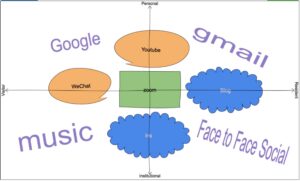
]]>
● What digital platforms are students currently using to develop their professional network?
Digital collaboration platform refers to the digital space and tools that support local and global collaboration. Digital collaboration platform is a powerful tool for teaching, learning and educational practice. These tools can support the learning experience, help students develop digital and career-related skills, and support professional development.
In recent years, digital collaboration platforms have become increasingly popular in the education field, and the global new crown pneumonia epidemic has accelerated the use of digital collaboration platforms. In India, educators and the government are using digital collaboration tools, such as social networking platforms, online course platforms, mobile applications, and wireless communication technologies such as radio and television, to communicate with students and support learning during the new crown pneumonia epidemic. Educational countermeasures issued by UNESCO during the epidemic also pointed out dozens of distance learning solutions and mentioned collaborative spaces many times. The five major technology drivers used by the school are: digital collaboration platforms, online privacy and security tools, analytics and adaptive technologies, cloud infrastructure, and mobile devices. The “2020 Basic Education Innovation Driving Force Report (Technology)” identifies digital collaboration platforms and online privacy and security tools as key technologies for schools to overcome obstacles and adapt to educational development trends during the new crown epidemic and in the future, and conduct in-depth analysis.
● What can you (as a student) consider to expand your professional learning network?
Countries with digital courses can now provide distance learning for children and young people who have Internet connections and use mobile phones, tablets, laptops, or desktop computers at home. This tool has been used in Kosovo, East Timor and Ukraine. These tools can achieve cross-temporal collaboration and facilitate access to a wider range of data and resources, thereby providing a wider range of learning opportunities. They can be used to cultivate connections between people, break through the limitations of physical space, and eliminate the sense of isolation caused by distance.
The digital collaboration platform supports synchronous and asynchronous group work, which can minimize or change the complex challenges behind collaboration. Through the digital collaboration platform, educators and students can fundamentally improve the way they create collaboratively, from the occasional parallel personal work to simultaneous collaboration and continuous feedback. For example, the Meriden Public School in Connecticut, USA, uses a web application to support elementary school students’ individual learning and group work.
These online tools also support global collaboration, enabling students to collaborate with people in the class or other regions. Digital collaboration platforms can also cultivate students’ sense of ownership of their work and digital skills development. Digital collaboration platforms also provide great opportunities for educators to establish connections with each other and with partners in the industry and the community.
● In your network, how can you create a digital identity/reputation?
Take the character identity management system as an example. By performing identity verification between peers and certified notaries, personas are assigned trust. Individuals obtain a professionally certified digital identity to meet your customer (KYC) requirements. Before getting digital services, more and more KYC-compliant identities are needed. Digital citizens can now engage in any form of activity-investment, banking, social media-by signing a verified digital identity, which is centrally managed. This encrypted identity does not have a single point, it can be the target of theft or failure.
● Consider what a local employer would do if you applied for a job with them – can they search the content, is it of benefit to the career path, does it hinder the opportunity of employment?
In the digital age, digital platforms for the labor market are increasingly helping job seekers (from informal workers to highly skilled professionals) to find suitable jobs. These platforms can gather a large amount of data and have three advantages: first, it reduces the difficulty for job seekers to understand recruitment information and requirements; second, it reduces recruitment costs; and third, they self-market to the broader market for individual job seekers Provide a platform. Looking to the future, digital employment platforms can improve their data aggregation and analysis capabilities and reduce labor market inefficiencies, including designing more relevant evaluation standards for specific positions, training job applicants based on market conditions and needs, and assisting through qualification certificates and employer evaluations Individual job seekers plan career development. For digital employment platforms, companies and schools must work closely together to ensure that the training of labor can respond to the changing needs of the market. At the same time, digital employment platforms must serve both companies and job seekers. In order to support the continued growth and transformation of digital employment platforms in emerging markets, local governments and the private sector (including companies and investors) must also actively play a key catalytic role.
The following advantages are democratized in information: Open digital employment platforms provide a level playing field, especially for those who do not have professional contacts or cannot access relevant information sources. In order to attract and retain the best talents, companies will try their best to manage and maintain their reputation as a good employer (increased mobility and transparency in the labor market). In this way, the digital employment platform narrows the information gap in the job market and helps improve the efficiency of the labor market and the wages of workers. Job search costs are low: Compared with offline platforms, digital platforms greatly reduce the time and money that job seekers and employers spend searching for jobs. Digital platforms accelerate the speed of communication, screening, evaluation and matching. This technology allows both parties to search for a wider range of job opportunities or candidates in a shorter time, thereby increasing the probability of achieving a better match. In addition, such platforms can help protect the self-esteem of job seekers. For example, in Morocco, job seekers wait in line at the job center on a regular basis, sometimes a whole day, which is their first step in finding a job. Digital platforms allow job seekers to conduct most of the search and query process privately and online. In some areas where women are prejudiced against women actively seeking jobs, online platforms can increase women’s labor force participation.
]]> – What is a digital identity?
Digital identity is a concept in cyberspace. It refers to a set of data describing a person or thing (sometimes referred to as a subject or entity), or the sum of all information about a person available on the Internet. It is an online identity adopted by individuals, organizations or electronic devices in the network, or network identity. These individuals, organizations or electronic devices may have more than one digital identity through different online communities. These digital identities are composed of some characteristics or digital attributes. -A digital identity may also be associated with other digital identities, such as e-mail, Weibo, etc. Although these identity-related attributes can help determine a person’s identity to a certain extent, these attributes can be changed, hidden, or even discarded.
– How do personal versus professional approaches to digital identity affect social media use?
Technologies such as digitization and cloud have matured, but still have potential to be tapped; at the same time, the importance and influence of technologies such as blockchain, cognition and digital reality are also growing rapidly. It can be seen that digital transformation is a necessary process for future organizational innovation, and is extensively reconstructing people’s work and life.
Whether it is the Internet era or the blockchain era, one of their characteristics is “digital.” The basis of digital activities is the digital identity of users. Only by ensuring the authenticity and validity of the user’s digital identity can the information and data associated with a series of activities and transactions be authentic and effective. Therefore, the development of a digital identity system is inevitable, and blockchain technology provides a relatively credible solution to a certain extent by virtue of its decentralization, multi-party consensus, hard to tamper with, openness and transparency, and traceability.
– How do digital identities converge in networked publics?
Due to the theft or loss of identity certificates, more than 7,000 homeless people in Austin, the capital of Texas, are unable to receive social services such as medical care, housing and potential employment each year. To solve these problems, the city uses blockchain technology to create unique digital identifiers for homeless people, enabling them to rebuild credible records about housing, health, and employment records to help them get back on track. IDHub, a domestic blockchain digital identity startup company, has realized the link between blockchain and the pan-Internet, government affairs, justice, and notarization through the core entry of blockchain digital identity. In 2017, Foshan Chancheng, Guangdong, cooperated with IDHub to establish an IMI digital identity system, which kicked off the “Zhixin Chancheng” plan, providing a trusted identity data authentication interface for local governments and more than 1.3 million residents in the jurisdiction, realizing administrative approval, medical and health care , Public welfare, charity, pension assistance and other public services online application processing; as of the first quarter of 2019, the project will complete more than 250 public government affairs.
– what are the impacts and/or benefits? – Can a digital wallet provide trust in networked publics?
An individual’s digital identity is formed by an individual through participating in network activities. From a social perspective, a digital identity can become the second business card for people to communicate with each other. From a broader perspective, a person’s digital identity also contains his personal data and personal information. As a product of the era of big data, online digital identities are diverse, false, super-domain, and variability.
Diversity, in the era of big data, people can construct different digital identities according to their own needs and surrounding environment. These digital identities will change due to factors such as specific areas and application purposes. Due to the virtual nature of online communication, people can almost have any identity they want on the Internet, and even have multiple identities at the same time without conflict with each other.
Falseness. The construction of digital identity is greatly affected by subjective factors. The identity attributes provided by users can be real, one-sided, historical, anonymous, tampered or even forged. Digital identities on the Internet are false and may also mess up online identities.
Hyperterritoriality, due to the characteristics of the network, allows network users to communicate acrossthousands of miles away even if they are separated by thousands of miles. Therefore, network identity also has the characteristics of transcending regions and regions.
Variability. The online digital identity of network users will change according to their different work, life, study, status and other factors. The uploaded text, picture and video will vary greatly according to the passage of time.
I think that a digital wallet can provide trust among the online public, because electronic payment is a convenient and fast payment method that is very popular in the current society.
What does it mean to network using social media?
Social media refers to websites and technologies that allow people to write, share, evaluate, discuss, and communicate with each other.
Social media is a tool and platform that people use to share opinions, insights, experiences and opinions with each other. At this stage, they mainly include social networking sites, Weibo, WeChat, blogs, forums, podcasts, and so on. Social media has flourished on the fertile soil of the Internet and has exploded with dizzying energy. The information it disseminates has become an important content for people to browse the Internet. It has not only created one hot topic after another in people’s social life, but also Attract traditional media to follow up.
The so-called social media should be a process in which a large number of netizens contribute spontaneously, extract and create news and information, and then spread it. There are two points that need to be emphasized. One is a large number of people and the other is spontaneous communication. If any of these two factors are lacking, it will not constitute the category of social media. The emergence of social media relies on the development of WEB 2.0. If the Internet does not give netizens more initiative, social media will lose its mass base and technical support and lose its foundation. If there are not so many interactive modes supported by technology, so many interactive products, the needs of netizens can only be suppressed and cannot be released. If you do not realize that netizens have a strong desire for interaction and self-expression, it will not give birth to so many dazzling technologies. The development of social media is based on the mass base and technical support.

How are we motivated to participate in networked publics?
We should actively participate in networked publics.The supply of a large number of professionals and the development of computer network technology provide a platform for the public to participate in the public management affairs of the national government, including various government websites, online forums, online communities, personal blogs, and the emerging communication method Weibo. The establishment of these network platforms not only enhances the communication between people, but also promotes the dialogue and information exchange between the public and the government. When a variety of major, unexpected and abnormal events occur at home and abroad, a government decision needs to solicit public opinions, or the government releases important policy decisions to the public, the news media will report on these contents through various channels. The public will use various online platforms to quickly express their ideas and opinions. The government will use the online platform to collect the wishes of the public, and superimpose and amplify the consistent content of their wishes to form a representative public will. Finally, the government will analyze and demonstrate these wishes, and come up with reasonable solutions and policies for feedback to the public. This is the basic process of online public participation. In the entire process of online public participation, the most important thing is to ensure judicial fairness in order to protect the rights and freedom of the public and realize the benign interaction between the government and the public.
What are the risks & rewards of public communications?
First of all, the reward is to protect the public’s right to participate and speak. In today’s society, the development of computer network technology provides technical support for more people to participate in the decision-making of government departments. This enables more people to know world affairs without leaving their homes and participate in the management of government public affairs. Regardless of whether they make rational suggestions or critical suggestions, the Internet will provide the public with a platform for fast and smooth communication. It not only protects the public’s right to participate and speak in government decision-making, but also makes the process of public participation more free, convenient and safe. Because of this, the way of online public participation is supported by the public and accepted by the public.
Then, the negative impact of online public participation can be divided into constructive participation and critical participation. Constructive participation refers to the public’s more rational suggestions for some decision-making goals or plans of the national government; critical participation refers to the public’s critical implementation of some national government departments’ decisions or drafts that damage all or part of the interests of the people. Speech. As we all know, in addition to the characteristics of immediacy and interaction, Internet communication also has the characteristics of globalization and community. Once a certain kind of information on the Internet attracts people’s attention, it will be quickly known to most people through the Internet, and will cause widespread discussion. Therefore, online public participation is a “double-edged sword.” When the public uses this method of participation reasonably, it will have a huge effect on the public management of the national government; when it is used by some people with improper purposes, it will not only mislead the people’s thoughts and opinions, but also The government’s public management caused a bad influence. Therefore, in the public management of our government, it is necessary to make proper use of online public participation and actively play the good side of its role.
]]>